




Abstract
Globally, patient satisfaction with outpatient department (OPD) health services is a crucial part of evaluating the quality of healthcare. This study was aimed at estimating the pooled proportion of patient satisfaction and determining the associated factors with OPD health services at public hospitals in Ethiopia. The Preferred Reporting Items for Systematic Review and Meta-Analysis (PRISMA) guidelines were followed in the article selection and searching. We searched the following sources of data for identification of primary studies: PubMed, MEDLINE, Google Scholar, Web of Science, SCOPUS, and repositories. STATA version 17 software was used to analyze statistical data using the random effects model. Forest plots were used to display the pooled results. The estimated pooled proportion of patient satisfaction with outpatient department health services was found to be 61.95% (95% CI: 53.00-70.90, I² 98.61%). Being informed on the prevention of recurrence of illness during consultation, the availability of all the prescribed drugs in the hospital pharmacy, and privacy respected by healthcare providers during consultation were statistically significant factors associated with OPD health services. Nearly 60% of patients were satisfied with the health services provided at the outpatient department (OPD) of public hospitals. Different factors, such as being informed on the prevention of recurrence of illness during consultation, availability of ordered drugs in the health facility, and healthcare providers respecting the privacy of patients, were affecting patient satisfaction. Healthcare managers and providers should work on these factors to ensure high patient satisfaction with OPD health services.
Introduction
Patient satisfaction (PS) is the value and response of patients to the care they received. It is a crucial component of healthcare services strategies; in most countries, patient satisfaction is a fundamental criterion used in quality assurance and accreditation procedures.1,2 PS is also a key indicator of the level of success of the providers in meeting patient expectations and values. 3 Understanding how patients feel about healthcare and the treatment they have received is crucial to improving the health service quality. 4 The outpatient department (OPD) serves as the primary site for the majority of healthcare service delivery. As a result, patients/clients face various problems and challenges during their visits, such as overcrowding, delays in consultations, and a lack of proper guidance, which ultimately leads clients/patients to dissatisfaction. This dissatisfaction can negatively impact patient outcomes and may deter individuals from seeking care in the future. Addressing these issues is crucial for improving the overall patient experience and ensuring that healthcare services are both effective and accessible. 5
According to recent research findings, PS is linked to the effectiveness and length of care, as well as the empathy shown to patients by healthcare providers and communication with the healthcare provider. 6 The most pertinent factors in the assessment of healthcare services from the viewpoints of patients were found to be patient-rated satisfaction and health-related experiences, as well as measurements of the patients’ characteristics. 7
Patient satisfaction differs from country to country and even among nations with comparable healthcare infrastructure. Factors such as cultural attitudes toward health, access to information, and the level of personal interaction with healthcare providers can significantly influence these variations. Understating these differences is crucial for healthcare policymakers aiming to improve patient experiences globally. The majority of previous studies have been conducted in the developed countries, with little evidence from developing countries, including Ethiopia. Cultural differences and the characteristics of the health system may affect how people prefer and value health care. 8
Globally, different studies were conducted to assess patient satisfaction with OPD health services in the public hospitals; the levels of client satisfaction with health care varied. A study conducted in Nigeria shows that 78.5% of the study participants were satisfied with OPD health service, 9 68.9% in Bangladesh, 10 and 89.1% in rural India. 11 A study conducted in the OPD of different hospitals that are found in Ethiopia shows different patient satisfaction results ranging from 18.0% in Addis Ababa to 89.3% in Hawassa.12-18 The previous studies conducted in Ethiopia’s public hospitals show variation among health services given and low patient satisfaction, which reflects the gap between patient experiences and the expected services. 19
Different factors, including sociodemographic characteristics, behavioral traits, and cultural influences, may affect the level of patient satisfaction. 20 Patient age, educational background, gender, and residence were determinants of OPD satisfaction. 21 Lack of necessary resources, such as drugs; poor communication; long waiting times; unclean health facility environments; not being informed on the prevention of recurrence of illness during consultation; and invasion of privacy were causes of patients’ dissatisfaction with the health services they received. 22
In Ethiopia, there are many primary studies that were conducted in the different parts of regions with inconsistent results regarding outpatient satisfaction and its associated factors. However, the national level of patient satisfaction with OPD health services remains unknown in Ethiopia. Therefore, this systematic review and meta-analysis was conducted to assess the national level of OPD satisfaction status and its associated factors at public hospitals in Ethiopia. The results will assist policymakers in being aware of the magnitude of OPD health services, as well as the factors that influence satisfaction, thus establishing a foundation for enhanced OPD health service quality in hospitals.
Methods
Search Strategy
We searched through a number of electronic databases, including Google Scholar, PubMed, Med-Line, Web of Science, and Scopus, to find studies that describe the level of patient satisfaction and associated factors with OPD health services that have been published in Ethiopia across time. The articles were downloaded, screened, and cited using EndNote 21 reference management software for Windows. Additional literature was retrieved by extending our search to cross-references. Unpublished papers were retrieved from the internet database repositories of Ethiopian universities.
This systematic review and meta-analysis used the population, exposure, comparator, outcome, and study design (PECOS) strategy to organize, formulate, and answer its research questions. 23 Population means patients, caregivers, or parents of children seen at the outpatient department; exposure means factors related to outpatient satisfaction; comparator means the reference group mentioned in the included studies; and outcome means the level of patient satisfaction with OPD health services.
A search for relevant material/literature was conducted from December 10 to December 24, 2024. To search the articles, we used the combination of key search terms as follows: (((patient satisfaction [Title/Abstract]) OR (satisfaction [Title/Abstract]) OR ((outpatient department [Title/Abstract]) OR (outpatient health services [Title/Abstract]) AND (((associated factors [Title/Abstract]) OR (determinants [Title/Abstract]) OR (predictors [Title/Abstract])) AND (Ethiopia).
Study Design
A systematic review and meta-analysis was used to determine the pooled proportion of patient satisfaction and identify the associated factors with OPD health services at public hospitals in Ethiopia. All primary studies that investigated the level of patient satisfaction and the associated factors with OPD health services at public hospitals in Ethiopia were included in this systematic review and meta-analysis.
Protocol Registration and Reporting
The study protocol was registered in the Prospective Register of Systematic Reviews (PROSPERO) database at the University of York Center for Reviews and Dissemination under registration number CRD42024613331. A trial registration number was used to check whether or not a systematic review and meta-analysis had been conducted on this title. The result of this review is reported based on the Preferred Reporting Items for Systematic Review and Meta-analysis (PRISMA) 2020 Checklist, which guided the reporting of this review’s findings.24,25
Eligibility Criteria
Eligible studies included both unpolished and unpublished reports in English that described the degree of satisfaction with OPD health services among patients seen there, irrespective of the research years. All research, regardless of methodological measurements, that reported the degree of satisfaction in the setting of Ethiopian public hospital departments was considered. The included studies evaluated the factors linked to patient satisfaction with treatments provided by the outpatient department.
However, we excluded studies that were methodologically erroneous, not conducted in the context of outpatient departments, case studies, editorial letters, unclear studies, studies without full text access, reviews, and studies conducted outside of Ethiopia. Studies that reported outpatient satisfaction with specific segments of services like nursing, laboratory, and pharmacy services were also excluded. Evaluation of eligibility criteria for all retrieved studies was carried out by 2 authors (MRT and GGB) independently, and any inconsistencies and disagreements were resolved by thorough discussion and consensus.
Quality Assessment and Data Extraction
Two authors (MRT and GGB) conducted a full-text review of the included articles independently using a quality appraisal tool. The quality appraisal tool adapted from the Joanna Briggs Institute (JBI) critical appraisal checklist for the cross-sectional studies consists of 8-item checklists. 26 The third author (BFO) facilitated and arranged discussions to resolve any disagreements and differences. To assess the agreement among the 3 reviewers, actual agreement and beyond-chance agreement (unweighted Kappa) were employed. There was 0.88, or almost perfect, agreement among the reviewers. 27
We also assessed the methodological quality of included studies using a modified version of the Newcastle-Ottawa Scale (NOS) for cross-sectional studies, which includes key criteria like sample size, sample representativeness, response rates, controlling confounders, outcome determination, and appropriateness of the statistical tests. 28
Data extraction was conducted by 2 authors (MRT and GGB) independently using a pre-piloted data extraction format developed in an Excel spreadsheet in Microsoft for Windows. Duplicate articles were removed using EndNote version 21. Initial screening was based on titles and abstracts, followed by a full-text review. Studies were included or excluded based on the predefined criteria. For the first outcome, data on the author’s name, publication year, region, study design, sample size, outcome measuring instrument, and proportion of patient satisfaction with OPD health services were extracted. For the second outcome, data were extracted into 2 × 2 tables, and log ORs were calculated. Corresponding authors of primary studies were contacted via email if additional data was required.
Data Processing and Analysis
The extracted data were exported to STATA version 17 software, and a meta-analysis was computed. To assess the study heterogeneity, a forest plot with the inverse-variance (I²) statistic was used, with I² values of 0%, 25%, 50%, and 75% indicating no, low, medium, and high heterogeneity, respectively.29,30 The DerSimonian and Laird random-effects model was applied to estimate the pooled level of patient satisfaction with OPD health services by generating the pooled 95% confidence interval.31,32
Subgroup analysis and meta-regression were conducted to explore variations across regions and study settings. Publication bias was examined using funnel plots and Egger’s tests, with a P-value of <.05 considered significant levels.33,34 A leave-one-out sensitivity analysis was conducted to assess which individual studies had the most significant influence on the heterogeneity observed between the studies. 35 For the secondary outcome, common factors associated with patient satisfaction with OPD health services using a random-effects model to estimate pooled odds ratios. The results were presented through forest plots with corresponding prevalence and 95% confidence intervals.
Results
Search and Study Selection
After systematic review and manual searches in the electronic databases including Google Scholar, PubMed, Med-Line, Web of Science, Scopus, and online repositories of Ethiopian universities, we initially found a total of 918 studies. We removed 396 articles due to duplicates or irrelevance, and 233 articles were excluded after title and abstract screening. Following evaluation of the remaining 289 papers’ full texts for eligibility, 273 of them were declared ineligible due to not satisfying the inclusion criteria. Finally, 16 studies were included (Figure 1).

PRSIMA flow diagram for the study selection.
In this study, a total of 16 studies fulfilling the eligibility criteria were included. The included articles were published between 2011 21 and 2023. 36 Five studies were conducted in the Amhara region,4,21,37,38 three in the Oromia region,39,40,41 four in SNNPR,17,42-44 two in Tigray,36,45 and two in Addis Ababa.16,46 Out of 16 articles 15 of them were cross-sectional studies (Table 1). The total sample size of all the studies selected for review was 6580.
Characteristics of the Included Studies Assessing Patient Satisfaction and Associated Factors With Outpatient Department Health Services at Public Hospitals in Ethiopia, 2024.

Patient Satisfaction With OPD Health Services
We used the random effects model to look at the pooled effect size of patient satisfaction with OPD health services because there was a significant heterogeneity across studies when computing the fixed effects model (P = .001). As a result, 61.95% (95% CI: 53.00-70.90, I2 98.61%) was estimated as the pooled national level of patient satisfaction with OPD health services (Figure 2).

Forest plot showing the overall prevalence of patient satisfaction with OPD health services in public hospitals in Ethiopia, 2024.
Subgroup Analysis
To investigate regional disparities in OPD health services practice, we conducted a subgroup analysis based on the administrative regions of Ethiopia where the primary studies were conducted. The findings revealed a significant range in prevalence, from a low of 27.80% (95% CI: 22.59-33.01) in the study from the Oromia region to a high of 89.3% (95% CI: 87.34-91.26) in the random effects pooled meta-analysis for the Addis Ababa region (Figure 3).

Forest plot showing the subgroup analysis with OPD health services in public hospitals in Ethiopia, 2024.
Sensitivity
A leave-one-out meta-analysis was conducted to assess the effect of individual studies on the pooled prevalence of patient satisfaction. In this analysis, the combined prevalence estimate was recalculated after each study was sequentially excluded. The findings consistently showed that the total prevalence was not significantly affected by the removal of any 1 study (Figure 4).

Leave-one-out sensitivity analysis.
Assessment of Publication Bias
To evaluate the potential impact of publication bias, both visual and statistical methods were employed. A funnel plot was constructed to visually inspect the distribution of studies. The symmetrical shape of the funnel plot indicated no apparent evidence of publication bias. Furthermore, Egger’s regression test was conducted to formally assess for small study effects. The non-significant P-value corroborated the findings from the funnel plot, suggesting that publication bias was unlikely to have influenced the results (Figure 5).

Funnel plot for graphical diagnostics of small-study effects.
Factors Associated With Patient Satisfaction With Outpatient Department Health Services
In this systematic review and meta-analysis; informed on the prevention of recurrence of illness during consultation, availability of ordered drug in the health facility, healthcare providers respected the privacy of the patients, and cleanliness of the consultation room were significantly associated with patient satisfaction with OPD health services public hospitals in Ethiopia.
Informed on the Prevention of Recurrence of Illness During Consultation
The pooled effect of 3 studies showed that patients who were informed on the prevention of recurrence of illness during consultation were around 2 times more satisfied (OR: 2.12; 95 CI% 1.68, 2.56) than those who were not informed with low heterogeneity between the included studies (I2 = 17.85%, P = .00) and presence of publication bias (P = .00; Figure 6).

Forest plot showing association between informed on the prevention of recurrence of illness during consultation and patient satisfaction among patients with OPD health services in public hospitals in Ethiopia, 2025.
Availability of Ordered Drug in the Health Facility
Compared to patients who did not get all the prescribe drugs in the hospital pharmacy, those patients who have got all the prescribed drug in the hospital pharmacy were 4.04 (OR = 4.04; 95 CI%: 3.46, 4.62) more likely to satisfied with low heterogeneity between the included studies (I2 = 0.00%, P = .00) and presence of publication bias (P = .00; Figure 7).

Forest plot showing association between availability of drugs and patient satisfaction among patients with OPD health services in public hospitals in Ethiopia, 2025.
Privacy Respected by Healthcare Providers During Consultation
The pooled estimate using the random effect model showed that those patients who were their privacy respected by healthcare providers during consultation were 6.58 times more likely satisfied than their counterparts (OR = 6.58, 95% CI: 3.32, 9.83). However, included studies were heterogeneous (I2 = 98.56%) and there is publication bias (P = .00; Figure 8).

Forest plot showing association between patient’s privacy respected and patient satisfaction among patients with OPD health services in public hospitals in Ethiopia, 2025.
Cleanliness of the Consultation Room
Compared patients those who did not treated at the clean of consultation room, those who treated at the clean consultation room were, 2.20 times more satisfied (OR = 2.20, 95% CI: 1.68, 2.71). Significant variation between studies was found using the heterogeneity test (P = .00). Significant publication bias was found using the Egger’s test (P = .00; Figure 9).
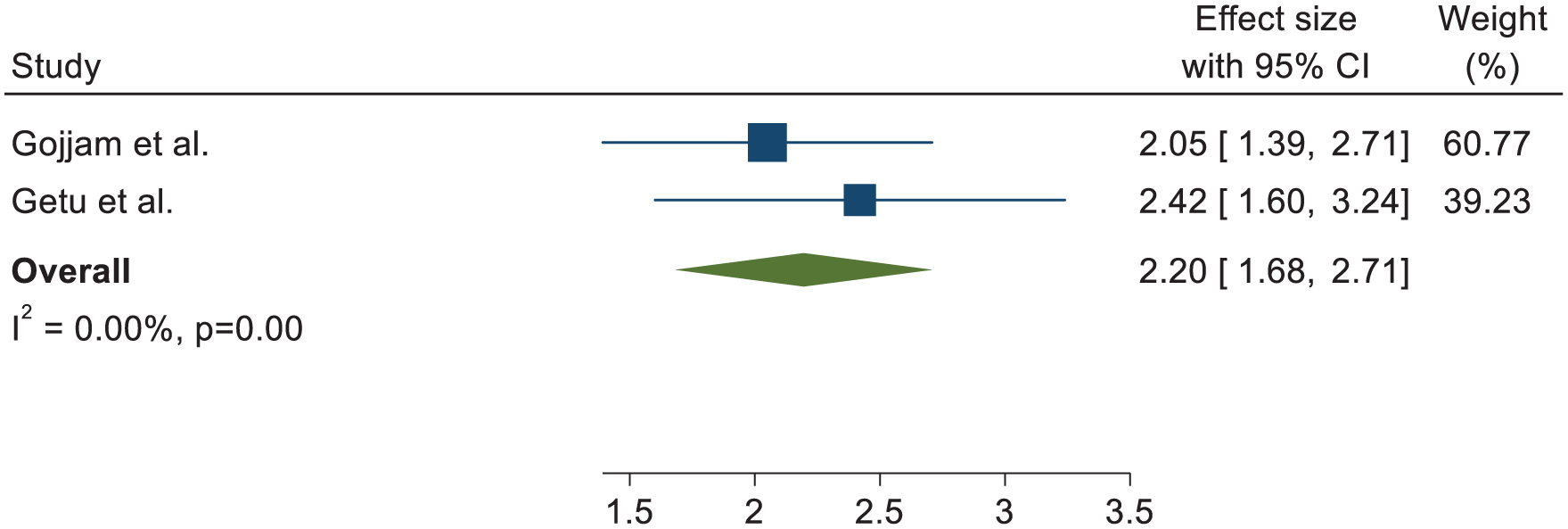
Forest plot showing association between cleanliness of the consultation room and patient satisfaction among patients with OPD health services in public hospitals in Ethiopia, 2025.
Discussion
Patient satisfaction is one of the important measures of how well providers are meeting the needs and expectations of their patients/clients. Currently, the majority of countries have accreditation and quality assurance procedures that are based on the regular patient/client satisfaction evaluation. Satisfaction significantly influences a person’s decision to seek medical advice, follow through on treatment, and maintain a good rapport with healthcare professionals.3,47 The purpose of this systematic review and meta-analysis was to assess the pooled patient satisfaction with outpatient department health services and associated factors to generate national evidence on the outpatient department health services of public hospitals in Ethiopia.
In this study, after reviewing studies including 6580 participants, the pooled prevalence of patient satisfaction was 61.95% with a 95% confidence interval of 53.00% to 70.90%. This result is lower than other studies conducted in China, 48 and Saud Arabia, 49 which found that patient satisfaction rates were, 89.75% and 78% to 96%, respectively. The difference might be due to different socioeconomic status and different national policy on the healthcare delivery system. However, this findings is higher than study conducted in hospitals of Iran, 50 which was found that 14.1% were examined percentage of patient satisfaction. This discrepancy could be due to difference in the cultural, and socio-economic backgrounds. But, the current result, is in line with a systematic review and meta-analysis that assessed patient satisfaction with the general healthcare system in Ethiopia, estimating the over-all pooled effect size of patient satisfaction accounting for 63.7%. 51 This recurring findings might be due to healthcare professionals and concerned bodies are still failing to address patients’ basic issues.
Our findings indicate that patients who were well-informed on the prevention of recurrence of illness during consultation, patients who did get all the prescribed drugs in the hospital pharmacy, healthcare providers respect the privacy of the patients, patients who were treated in the clean consultation room were more satisfied with health services provided at OPD, which is consistent with the results of studies.4,38,40,41,43,44,46 Factors influencing patient satisfaction, including communication, respect, and privacy, are mainly behavioral and do not necessitate financial resources. Emphasizing these aspects, which healthcare professionals can control, could enhance the health sector and lead to tangible improvements in service delivery.
Moreover, different variables not statistically significant, the educational status, gender, age, paying for treatment, time, clean environment outside the health facility, clean environment outside the facility, availability and cleanness of the toilet were also found to be associated with degree level of patient satisfaction with OPD health services. Focusing on these factors also could improve the healthcare delivery service.
Strengths and Limitations of the Study
This is a systematic review and meta-analysis offering pooled proportion national studies to generate evidence at the national level about Ethiopian public hospitals outpatient satisfaction rates. The meta-analysis included a large sample size, enhancing the statistical power and generalizability of the findings. However, it was not done without limitations. The included studies varied in terms of sample size, and methodology, which may have introduced heterogeneity into the meta-analysis. Few studies have compared patient satisfaction with outpatient department (OPD) healthcare delivery. This review of primary studies conducted in certain regions of Ethiopia presents a challenge in generalizing the findings, suggesting that other regions may be underrepresented.
Conclusions and Recommendations
Nearly 60% of patients were satisfied with the health services provided at the outpatient department (OPD) of public hospitals. The meta-analysis indicates that patient satisfaction with OPD health services was associated with being informed on the prevention of recurrence of illness during consultation, availability of ordered drugs in the health facility, healthcare providers respecting the privacy of the patients, and cleanliness of the consultation room. Healthcare managers and providers should be emphatic about identified factors to ensure high patient satisfaction and the provision of high-quality OPD health services in public hospitals in Ethiopia.
Supplemental Material
sj-docx-1-inq-10.1177_00469580251371387 – Supplemental material for Patient Satisfaction With Outpatient Department Health Service and Associated Factors at Public Hospitals in Ethiopia
Supplemental material, sj-docx-1-inq-10.1177_00469580251371387 for Patient Satisfaction With Outpatient Department Health Service and Associated Factors at Public Hospitals in Ethiopia by Meseret Robi Tura, Nimona Amena, Wubet Tazeb Wondie, Belete Feyera Olkaba, Lemma Mideksa Egu, Bulti Tadesse, Ebisa Zerihun, Gonfa Moti Geda, Solomon Seyife Alemu, Gemechu Gelan Bekele and Belay Tafa Regassa in INQUIRY: The Journal of Health Care Organization, Provision, and Financing
Footnotes
Acknowledgements
We authors would like to thank all the authors of primary studies included in this research.
Lists of Abbreviations
CI: Confidence Interval; JBI: Joanna Briggs Institute; NOS: Newcastle-Ottawa Scale; OR: Odds Ratio; PRISMA: Preferred Reporting Items for Systematic Review and Meta-analysis; PROSPERO: Prospective Register of Systematic Reviews SNNP; Southern Nations, Nationalities, and Peoples.

Ethical Considerations
This section is not applicable as this study is systematic review and meta-analysis.
Consent to Participate
This section is not applicable as this study is systematic review and meta-analysis.
Consent for Publication
Not applicable.
Author’s Contributions
MRT, NA, WTW, BFO, LME, GGB, and BT involved in the conceptualization, the methodology, selection of articles, data extraction, and statistical analysis. MRT, EZ, GMG, SSA and BTR contributed significantly to the conceptualization, formal analysis and preparation of the text for this systematic review as well as to the critical assessment, substantive feedback, and intellectual content of the study. The original manuscript draft preparation was read and approved by all authors. All authors reviewed and approved the final manuscript.
Funding
The authors received no financial support for the research, authorship, and/or publication of this article.
Declaration of Conflicting Interests
The authors declared no potential conflicts of interest with respect to the research, authorship, and/or publication of this article.
Data Availability Statement
The data included in the systematic review and meta-analysis are available in the main manuscript.
References
Supplementary Material
Please find the following supplemental material available below.
For Open Access articles published under a Creative Commons License, all supplemental material carries the same license as the article it is associated with.
For non-Open Access articles published, all supplemental material carries a non-exclusive license, and permission requests for re-use of supplemental material or any part of supplemental material shall be sent directly to the copyright owner as specified in the copyright notice associated with the article.
