




Abstract
Postgraduate programs (PGPs) in pharmacy practice have gained significant importance in recent years, reflecting the evolving roles and expanding responsibilities of pharmacists globally. Understanding the factors that influence the decision to pursue such programs is essential for workforce development and educational planning. This study aimed to assess the motivations and barriers influencing pharmacy interns in Saudi Arabia to pursue PGPs in pharmacy practice. This cross-sectional study was conducted from December 2019 to March 2020 and utilized a validated questionnaire distributed electronically to pharmacy interns (sixth-year pharmacy students) across 3 major pharmacy schools in Saudi Arabia. Data were analyzed using descriptive statistics, chi-square, and Fisher’s exact tests, with a significance level set at a P-value of less than .05. Of the 247 pharmacy interns invited, 157 (62%) completed the survey. Most respondents were female (82.8%) and had an average of 3 clinical and 2 nonclinical advanced pharmacy practice experiences. Approximately 20% intended to pursue PGPs immediately after graduation, while 60% would consider them later. Preferred career paths included hospital pharmacy (31.85%) and regulatory bodies (24.84%). The decision to pursue PGPs in pharmacy practice was influenced by PGP orientation during school, either positively or negatively. The primary motivator cited was the need for further training for future positions, whereas high competition was the most significant barrier. These findings offer valuable insight into pharmacy interns’ perspectives on PGPs, highlighting key motivators and barriers. This understanding can inform future educational strategies and stakeholder efforts aimed at supporting pharmacy interns’ career planning and addressing workforce development needs in pharmacy practice.
Keywords
Highlights
Around 19% of pharmacy interns intended to pursue postgraduate programs (PGPs) immediately after graduation, with approximately 80% planning to pursue PGPs in pharmacy practice.
Around 76% of pharmacy interns believed that information about PGPs in pharmacy practice should be introduced before the internship year.
Main motivators for pharmacy interns intended to pursue PGPs in pharmacy practice included the need for further training, adapting to new roles in pharmacy, and career advancement.
Key barriers for pharmacy interns intended to pursue PGPs in pharmacy practice included competitive enrollment, the desire for work experience, and the beleif that a job cab be attained without a PGP.
Introduction
Given the notable global evolution in the roles of pharmacists over recent decades, postgraduate programs (PGPs) in pharmacy practice have emerged as an essential trajectory for pharmacy professionals seeking to collaborate with healthcare professionals to improve medication use and patient clinical outcomes. 1 In 2006, both the American College of Clinical Pharmacy and the American Society of Health-System Pharmacists presented a forward-looking vision for the pharmacy profession. 2 This vision encompassed a mandate for all fresh graduates to undertake postgraduate residency training to engage in patient care directly by 2020. 2 Similarly, the Saudi Society of Clinical Pharmacy endorsed the provision of PGP pathways for pharmacists to practice as clinical pharmacists in Saudi Arabia (SA) through postgraduate residency programs or a master of clinical pharmacy programs. 3
As part of the Saudi Vision 2030, the Health Sector Program highlights the importance of expanding the workforce size and enhancing the healthcare capabilities across all major fields and subspecialties. 4 Despite the surge in the number of pharmacy schools and the unprecedented rise in pharmacy graduates over the past decade in SA,5-8 the availability of trained clinical pharmacists from PGP in pharmacy practice fails to meet national demands, especially in rural cities.5,7,9 There is a growing demand for pharmacists with advanced postgraduate degrees in pharmacy practice to fulfill the strategic goals outlined in Saudi Vision 2030 effectively.
A recent study conducted in 2023 examined pharmacy interns’ future career interests, has noted that 80% of the pharmacy interns in SA showed their intentions to pursue postgraduate education, including academic degrees such as master’s or doctorate (PhD), as well as postgraduate training such as residency. Moreover, nearly 28% of them were interested in pursuing a clinical pharmacy career. 10 However, several factors hinder their pursuit of PGPs in pharmacy practice. A study by Hammond et al assessed the motivating factors and barriers to postgraduate training among third-year pharmacy students in the United States. 11 They revealed that gaining knowledge and experience was the students’ primary incentive, while student debt (referring to both existing educational loans and anticipated debt during residency) was the top barrier. Similarly, McCarthy and Weber compared the responses of residents and fellows in 2011 with those of pharmacy students surveyed in 1993 and identified comparable motivators and barriers, including financial concerns, job availability, and family obligations. 12 These findings are consistent with other studies that examined factors influencing pharmacy students’ pursuit of PGPs.13-15 It is crucial to acknowledge that, while some similarities may exist, differences in healthcare systems and educational contexts between countries can result in varying motivational factors. To date, a comprehensive assessment of these factors has not been conducted in SA.
In SA, pursuing a clinical pharmacy career typically follows 2 main pathways, as endorsed by the Saudi Society of Clinical Pharmacy. These include completing a pharmacy practice residency training or enrolling in a master’s degree program in clinical pharmacy.3,5,9 Both pathways qualify pharmacists to practice as clinical pharmacists. Enrolled students in the master’s program are typically engaged in a series of didactic courses, research projects, and practical training, with an anticipated completion period of 2 to 3 years, depending on the program’s structure and the providing institution. Meanwhile, the pharmacy practice residency program is overseen and endorsed by the Saudi Commission for Health Specialties, the regulatory body responsible for licensing and accrediting residency programs across different healthcare disciplines. The Postgraduate Year One (PGY-1) residency program in Saudi Arabia is a 24-month training program that encompasses a wide range of pharmacy settings, including both operational and clinical rotations. In contrast, the PGY-1 program in the United States typically spans 12 months and primarily focuses on clinical training. Further specialization can be pursued through a Postgraduate Year Two (PGY-2) program, which consists of an additional 12 months of focused training in a specific area of practice. This structure is comparable to the PGY-2 programs offered in the United States. 16
Understanding the students’ perspective regarding their inclination toward pursuing a PGP in pharmacy practice holds potential for stakeholders in pharmacy education and training to adapt strategies and measures that can attract more graduates to PGP in pharmacy practice. Thus, this study aimed to evaluate the motivational factors and barriers influencing pharmacy interns’ decision to pursue a PGP in pharmacy practice.
Materials and Methods
Study Design and Setting
This cross-sectional questionnaire study was conducted in 3 major pharmacy schools in SA. It included pharmacy interns (ie, sixth-year pharmacy students) from December 2019 to March 2020.
Questionnaire Development and Distribution
The questionnaire used in the study was developed by adopting 2 previously validated questionnaires investigating factors influencing pharmacy students’ decisions to pursue PGPs and assessing motivating factors and challenges for pursuing postgraduate studies.11,15 Some items of the questionnaires were combined to create a more comprehensive tool that covers all relevant aspects in a single instrument, ensuring better coherence and minimizing respondent burden. Subsequently, a pilot study was performed by disseminating the questionnaire to 5 pharmacy faculty members and 15 pharmacy students to assess face and content validity. The questionnaire was then modified and updated based on the relevant feedback and comments provided by the participants. The questionnaire consisted of 16 questions, organized into 4 domains, as outlined in Supplemental Appendix I. These domains comprise: (1) participant demographics (3 questions), (2) pharmacy interns’ perspectives toward their future career choices (6 questions), (3) promotion and orientation of PGPs (5 questions), and (4) the motivational factors and barriers that pharmacy interns perceived as important (2 questions). The 2 questions related to motivational factors and barriers each included multiple statements. The motivational (M) factors statements were grouped into 3 themes: professional goals (M1-M5), role modeling (M6-M9), and personal factors (M7-M14). Similarly, the barriers (B)-related statements were grouped into 3 themes: institutional barriers (B1-B5), personal barriers (B6-B9), and dispositional barriers (B10-B15). Some statements related to motivating and barrier factors were adopted from previously validated questionnaires.11,15 We carefully reviewed and modified these items to ensure cultural and contextual relevance to the Saudi setting. The pharmacy interns then assessed the motivational factors and barriers using a 5-point Likert scale, with 1 representing strong disagreement and 5 representing strong agreement (Supplemental Appendix II). The participants were asked to rank their level of agreement or disagreement with each motivational factor and barrier. The responses were then categorized into “agreement” for those who responded with a 4 or 5 and “disagreement” for those who responded with a 1 or 2. The questionnaire was administered to the study participants through self-administration and an online survey system. The self-administered version was distributed in person by one of the authors during a scheduled visit, followed by another visit to obtain additional responses. The online version was sent via email to students who did not have the chance to complete the self-administered questionnaire, including the survey link, with a reminder sent 2 weeks later to encourage participation. Informed consent was obtained from all study participants upon filling out the study questionnaire. Before starting the questionnaire, participants were presented with a consent statement and asked to indicate their agreement. Only those who selected “Yes” were able to proceed with the questionnaire, while those who selected “No” were exited from the survey. Therefore, explicit consent was obtained before participation. All participants were informed that their participation was completely voluntary and no financial incentives would be provided.
Ethical Considerations
This study was reviewed and approved by the Institutional Review Board.
Statistical Analysis
According to The Future of the Saudi Health Workforce report, issued by the Saudi Commission for Health Specialties, 17 the total number of students enrolled in pharmacy colleges in 2018 was 14 004. Additionally, 796 pharmacists were enrolled in postgraduate programs. For the expected prevalence of 10% pursuing postgraduate education, the required sample size is/was 139 for the margin of error or absolute precision of ±5% in estimating the prevalence with 95% confidence. With this sample size, the anticipated 95% CI is/was (−10%, 30%). This sample size is calculated using the Scalex SP calculator. 18 Descriptive statistics (frequency and percentages) were used to present the data. Chi-square and Fisher’s exact test were used as appropriate based on the type of data and group size to compare the data, and a P-value of less than .05 was considered significant. Data were analyzed using STATA 14 (StataCorp LP, College Station, Texas, USA).
Results
Among the 247 pharmacy interns invited to participate in the survey, 157 completed the full study questionnaire and were analyzed, resulting in an overall response rate of 63.6%. Partial responses were not included in the analysis.
Participants’ Demographics
The participants were predominantly female (82.8%). A higher proportion of female participants, compared to males, intended to pursue PGPs (63.1% vs 40.7%, P = .012). Most respondents were between 22 and 24 years old, and no difference was noted between the age groups of interns who intended to pursue PGPs, those who did not, or those who were still undecided (P = .141). The number of advanced pharmacy practice experiences (APPEs) completed was similar, with an average of 3.1 ± 1.6 clinical and 3.2 ± 1.2 non-clinical APPEs. The demographic characteristics of the participants are presented in Table 1.
Demographic Characteristics and Future Career Intentions of Pharmacy Interns.
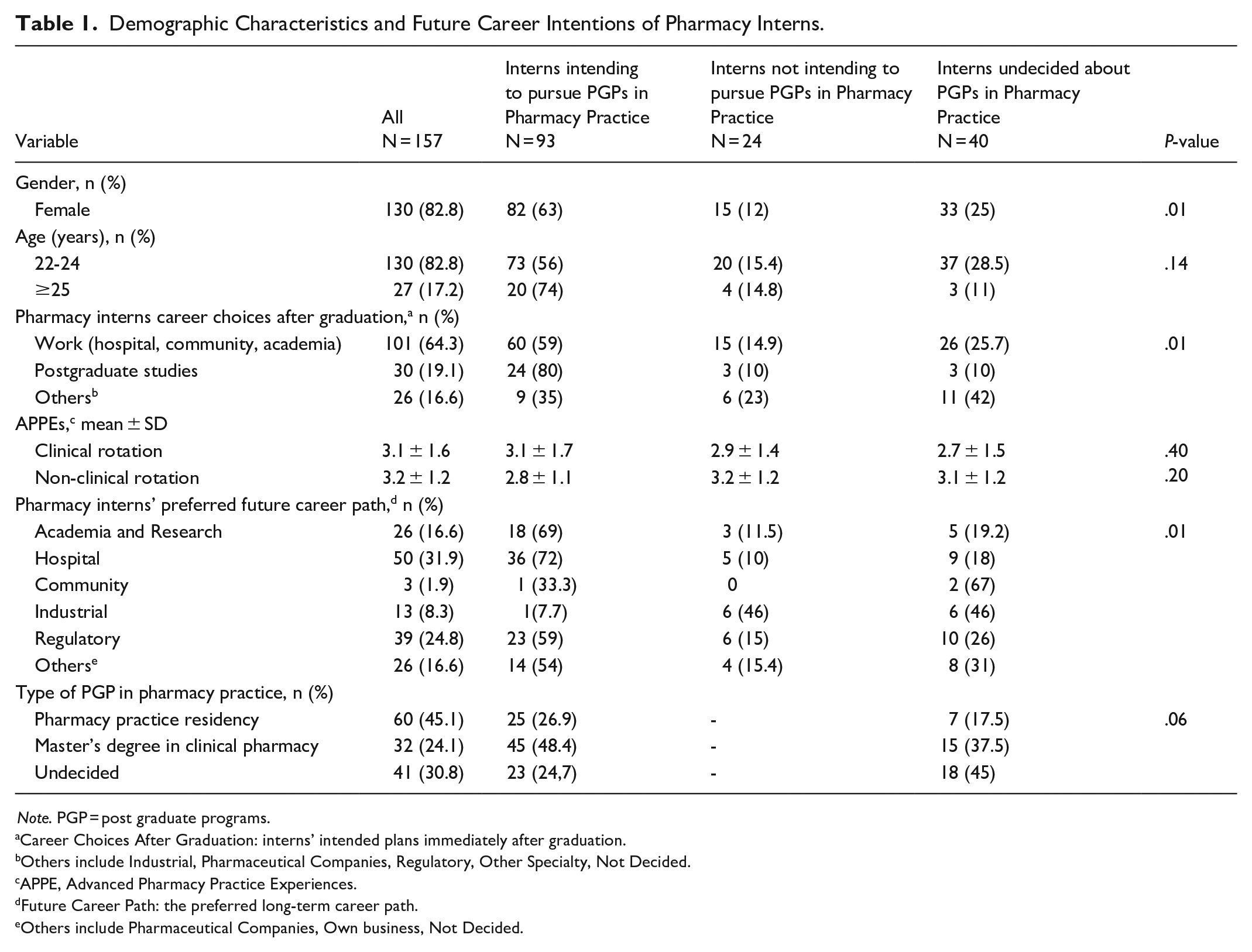
Note. PGP = post graduate programs.
Career Choices After Graduation: interns’ intended plans immediately after graduation.
Others include Industrial, Pharmaceutical Companies, Regulatory, Other Specialty, Not Decided.
APPE, Advanced Pharmacy Practice Experiences.
Future Career Path: the preferred long-term career path.
Others include Pharmaceutical Companies, Own business, Not Decided.
PGPs Planning Findings
Only 19.1% of the respondents expressed their intention to pursue postgraduate studies. Among those who expressed willingness to pursue PGP in pharmacy practice, a high proportion favored a pharmacy practice residency over a master’s degree in clinical pharmacy (45.1% vs 24.1%, respectively). Nevertheless, 30.8% of respondents had not yet decided regarding which program to follow. In terms of a 5 year career path, most interns chose hospital pharmacy (31.9%) as the preferred option, followed by regulatory organizations (24.8%). Of those who considered hospital settings the preferred career path, 72% intended to pursue PGPs, 10% did not plan to pursue PGPs, and 18% were undecided. Similarly, among those who preferred regulatory organizations, 59% intended to pursue PGPs, 15% did not, and 26% were undecided (Table 1).
The top factors influencing the pharmacy interns’ preferences were high salaries, flexible working schedules, work experience, and employment opportunities with a high potential for socialization. Additionally, factors such as influence from parents, family, or friends (31.9%), interest in health sciences (31.2%), direct patient interaction (26.8%), and the possibility of owning a business (22.3%) were frequently cited. In contrast, prestige (7%) and other reasons (6.37%) were less commonly identified as significant factors in shaping career choices (Table 2).
Factors Influencing Pharmacy Interns’ Career Choices.

Any work experience that may affect the student’s career choice.
Parents, family, and friends influence students mainly through their opinions and cultural views regarding career stability, work/life balance, and social status.
Additionally, the study findings revealed that 45.2% of the interns began considering their future trajectory beyond graduation during their internship year, and 24.8% first learned about PGPs in pharmacy practice (Table 3). Nevertheless, a significant majority of 76.4% believed that pharmacy schools should incorporate information about PGPs in pharmacy practice prior to the commencement of the internship year. Preferred timing for introducing PGPs varied, with the first academic year (17.8%), third year (17.8%), and internship year (19.1%) being the most frequently selected. Various orientation approaches were reported throughout the curriculum, including formal and informal instruction by faculty members (38.9% each), involvement of residency preceptors in clerkship teaching (36.9%), postgraduate program showcases (35.7%), and student-mentor programs (26.8%). Among all respondents, 44.6% confirmed their intention to pursue PGPs in pharmacy practice, while 17.2% lost interest and 8.3% gained interest after orientation. Additionally, 8.3% did not initially plan to pursue a PGP in pharmacy practice but later developed an interest, and 22.9% were still undecided about their future plan (Table 3).
Pharmacy Interns’ Perceptions and Considerations of Promotion/Orientation of Postgraduate Programs (PGPs) in Pharmacy Practice.

Note. PGP = post graduate programs.
Pre-professional year: Common First Year, Preparatory Year, or Foundation Year.
Motivators and Barriers for Pursuing PGPs
The top 3 motivational factors influencing the decision to pursue PGPs in pharmacy practice were “I believe that further training is required to obtain the position I desire in the future,” “I believe further training is needed due to new and challenging roles that pharmacists may have in the future,” and “I believe that completing the postgraduate program in pharmacy practice will help me to enhance my career options, incentives, and rewards” (78.9%, 77.1%, and 75.2% respectively). On the other hand, “The enrollment in the postgraduate program in pharmacy practice is highly competitive,” “I desire to gain work experience first,” and “I believe I can get a job without completing the postgraduate program in pharmacy practice” were the 3 key barriers to such a decision (73.9%, 69.4%, and 69.4% respectively). Additional motivational factors and barriers were presented in Table 4.
Agreement With Motivational Factors/ Barriers to Pursue Postgraduate Programs (PGPs) in Pharmacy Practice.

Discussion
This cross-sectional study explored pharmacy interns’ motivations and barriers to pursuing postgraduate programs (PGPs) in pharmacy practice. While many interns indicated a preference for entering the workforce immediately after graduation (64.3%), their career decisions were shaped by factors such as financial incentives, flexibility, and perceived professional development. The desire for further training to attain future career goals emerged as a key motivator, whereas the competitiveness of PGPs was a common barrier.
Our study findings demonstrated that pharmacy interns are more inclined to enroll in PGP if perceived as essential for their desired position. The desire for career advancement, personal fulfillment, and following role models were also identified as key motivators among those intending to pursue PGPs (Table 4: M4, M5, M9, M11). Owing to the demanding nature of PGPs, PGP pursuers are more equipped to deal with any challenges their future career may hold. 19 In turn, this pursuit may open the door to a wider array of career options and higher incentives, thereby making PGPs more appealing. 19 Hence, necessitating the completion of a relevant PGP for pharmacy positions in accordance with the Saudi vision may motivate students to pursue appropriate programs that align with their intended careers. On the other hand, significant barriers hinder pharmacy interns from pursuing such programs. The pharmacy interns reported limited awareness of the long-term benefits of PGPs or expressed hesitation toward roles requiring further training. Others simply felt they had reached a point of academic fatigue, contributing to their reluctance. These barriers underscore the need for timely information and proper orientation (Table 4: B9, B11, B13). Additionally, perceptions of intense competition for PGP enrollment, a preference for gaining work experience before pursuing further education, and a lack of awareness regarding available PGP options might further hinder pharmacy interns’ willingness to pursue PGPs.
These findings are consistent with previous research on the factors influencing career selection among pharmacy interns in SA. This includes the study by Thabit et al, which similarly underscores the importance of financial incentives in influencing students’ decisions in SA. 10 Similar motivators and barriers have been reported from other countries, suggesting some consistency across different settings. For instance, Hammond et al 11 found that in the United States, gaining knowledge and experience, career advancement, and personal fulfillment were key motivators for pursuing postgraduate training, while student debt, academic fatigue, and intense competition were significant barriers. Furthermore, Dupuis et al reported that Canadian students’ decisions to pursue hospital pharmacy residencies were primarily influenced by perceived long-term benefits, such as gains in knowledge, experience, and self-confidence. 15 Additionally, a study from the United Kingdom found that postgraduate studies boost graduates’ confidence by improving their understanding of the specialty and its application in practice. 19 Al Hamarneh et al also emphasized professional identity and workplace culture influence career paths. 20
While the pharmacy profession offers various career opportunities, hospital pharmacy and regulatory organizations were the 2 most preferred career paths, with near-equal representation among respondents. Such a decision may be attributed to the hands-on experience involved in such positions relative to other areas of pharmacy practice. 20 Moreover, the direct positive impact of pharmacists on patient outcomes is extremely rewarding and makes this career path desirable for many. 20 In our study, most of the pharmacy interns who intended to pursue a career in hospital pharmacy had also intended to pursue PGPs.
Our study highlighted that early exposure to PGP options, particularly during the internship year, when most pharmacy interns reported learning about or considering their career paths (24.8%, Table 3), plays a pivotal role in shaping pharmacy interns’ motivation to pursue PGPs. This finding aligns with those of Hammond et al, 11 who similarly identified the importance of early career planning in shaping the motivation to pursue PGPs in the United States. Although most of the pharmacy interns in our study preferred PGPs to be introduced in their internship year, their limited knowledge regarding the training requirements and options and the stress associated with that year could potentially impede their chances of acceptance. Lack of appropriate orientation regarding PGP options during pharmacy school may substantially influence the number of pharmacy interns inclined to pursue PGPs. Therefore, introducing the concept of PGPs and their requirements at an early stage may motivate pharmacy interns to consider enrolling in such programs. This is aligned with the findings of a study conducted in the United States by Hammond et al. 11 The findings of this study demonstrated a positive correlation between the timing of students’ exposure to PGP opportunities and their willingness to enroll in such programs. 11 Students who were introduced to PGP options at an earlier stage were more inclined to consider enrolling in these programs.
The results of the present study should be considered in the context of certain limitations. First, the questionnaire was distributed to pharmacy interns from 3 large universities located in the Central Region of Saudi Arabia, which may limit the generalizability of the findings to pharmacy interns in other regions. However, it is important to note that colleges of pharmacy in the Central Region represent more than 30% of all pharmacy colleges in Saudi Arabia, which may enhance the representativeness of the sample to some extent. Nevertheless, these universities are located in the most densely populated city in SA, which also has the largest pharmacy schools, accommodating many students. Moreover, our study assessed students’ perceptions at a specific point in time, specifically during their internship years. Pharmacy interns’ decisions and preferences may evolve after graduation as a result of additional experiences and exposure to new job opportunities. Hence, future studies should assess the long-term reliability of these factors. Despite these limitations, to our knowledge, this study is the first to assess the motivational factors and barriers that Saudi pharmacy students encounter when pursuing PGPs in pharmacy practice.
Multiple strategies can be implemented to motivate students to pursue PGPs, hence enhancing their preparedness for future responsibilities. For instance, the timing of introducing PGPs to pharmacy students is suggested to be throughout the early years of pharmacy school education. 10 Participating in summer training, workshops, and shadowing experiences can be highly beneficial for students to determine their preferred career path and equip them with the necessary skills and knowledge at the early stages of their professional journey. 10 These activities will consequently boost candidates’ confidence in being accepted to such programs.
Moreover, pharmacy interns may refrain from applying to PGPs in pharmacy practice because of limited seats and the competitive nature of these programs. Given the annual growth in pharmacist density in SA. 21 it may be justified to expand the capacity of these programs to accommodate the increasing number of graduates. 3 In addition, launching programs across all provinces in SA could potentially increase the likelihood of acceptance for all individuals interested in participating across the entire region. 3 Effectively training the distinguished, enthusiastic students will be a worthwhile investment for future preceptors to better meet the growing number of positions and programs.
Conclusions
Evaluating these motivational factors and barriers is essential for aligning pharmacy education with the evolving pharmacy workforce. These findings offer valuable insight into pharmacy interns’ perspectives on PGPs. It is vital to maintain the key aspects that have an impact on it, including but not limited to competitive salaries and rewards, flexible schedules, fruitful experiences, and strong social connections. As financial costs may be a detrimental factor to such programs’ enrollment, providing scholarships for distinguished students may be a viable solution. Future nationwide studies should re-evaluate existing incentives and the outcomes of our study, utilizing a more representative sample in order to encourage pharmacy interns to pursue PGPs in pharmacy practice and reduce their attrition from the workforce.
Supplemental Material
sj-docx-1-inq-10.1177_00469580251361346 – Supplemental material for Motivators and Barriers for Pursuing Postgraduate Programs in Pharmacy Practice Among Pharmacy Interns in Saudi Arabia
Supplemental material, sj-docx-1-inq-10.1177_00469580251361346 for Motivators and Barriers for Pursuing Postgraduate Programs in Pharmacy Practice Among Pharmacy Interns in Saudi Arabia by Abdullah M. Alhammad, Majidah Aljohani, Bana Almadi, Yazeed Ghawaa, Mansour Almuqbil, Ghazwa B. Korayem, Hisham A. Badreldin, Ohoud Aljuhani, Nora A. Kalagi, Yahya M. K. Tawfik, Mohammad H. Aljawadi, Yousif A. Asiri and Wael Mansy in INQUIRY: The Journal of Health Care Organization, Provision, and Financing
Supplemental Material
sj-docx-2-inq-10.1177_00469580251361346 – Supplemental material for Motivators and Barriers for Pursuing Postgraduate Programs in Pharmacy Practice Among Pharmacy Interns in Saudi Arabia
Supplemental material, sj-docx-2-inq-10.1177_00469580251361346 for Motivators and Barriers for Pursuing Postgraduate Programs in Pharmacy Practice Among Pharmacy Interns in Saudi Arabia by Abdullah M. Alhammad, Majidah Aljohani, Bana Almadi, Yazeed Ghawaa, Mansour Almuqbil, Ghazwa B. Korayem, Hisham A. Badreldin, Ohoud Aljuhani, Nora A. Kalagi, Yahya M. K. Tawfik, Mohammad H. Aljawadi, Yousif A. Asiri and Wael Mansy in INQUIRY: The Journal of Health Care Organization, Provision, and Financing
Footnotes
Acknowledgements
The authors thank the Ongoing Research Funding program (ORF-2025-919), King Saud University, Riyadh, Saudi Arabia, for supporting the publication of this article.
ORCID iDs

Ethical Considerations
The study was approved by the Institutional Review Board of King Saud University (Reference Number: E-19-4186) on September 29, 2019.
Consent to Participate
All study participants gave written, informed consent to participate and for their de-identified data to be used in the publication. All methods were performed in accordance with the relevant guidelines and regulations
Author Contributions
A. Alhammad, M. Aljohani, and Y. Ghawaa contributed to the conceptualization, methodology, data curation, and investigation of the study. M. Aljohani carried out the investigation and collected the data; A. Alhammad, M. Aljohani, and M. Almuqbil were responsible for the formal analysis, statistical analysis, and interpretation of data. The original draft of the manuscript was prepared by A.M. Alhammad, M. Aljohani, and B. Almadi, Y. Ghawaa, M. Almuqbil, G.B. Korayem, H. Badreldin, O. Aljuhani, N. Kalagi, Y. Tawfik, M. Aljawadi, and Y. Asiri critically reviewed the manuscript for important intellectual content. All authors contributed to the review and editing of the manuscript, validated the findings, approved the final version of the manuscript, and agreed on the choice of journal for submission; and are accountable for all aspects of the research.
Funding
The author(s) received no financial support for the research, authorship, and/or publication of this article.
Declaration of Conflicting Interests
The author(s) declared no potential conflicts of interest with respect to the research, authorship, and/or publication of this article.
Data Availability Statement
The dataset supporting the conclusions of this article is available at the request of the corresponding author.
Supplemental Material
Supplemental material for this article is available online.
References
Supplementary Material
Please find the following supplemental material available below.
For Open Access articles published under a Creative Commons License, all supplemental material carries the same license as the article it is associated with.
For non-Open Access articles published, all supplemental material carries a non-exclusive license, and permission requests for re-use of supplemental material or any part of supplemental material shall be sent directly to the copyright owner as specified in the copyright notice associated with the article.
