



Abstract
Although critical to enacting change, effectively communicating clinical and public health research results remains a challenge. In a webinar that occurred on December 7, 2023, a group of clinical and public health researchers and communications specialists convened to share their experiences using plain language materials to communicate research results. Herein, they provide practical guidance and case examples of lay summaries, infographics, data dashboards, and zines, along with challenges and potential solutions. Discussion illuminated the critical importance of partnering with communities who represent the intended beneficiaries of the research to plan, create, and disseminate materials. Accordingly, researchers should plan early, prepare, and dedicate resources for results dissemination. Researchers can use this guidance to develop plain language research dissemination materials, help connect with their audiences to inform and influence their understanding, and empower action to ultimately improve health and well-being.
Keywords
Introduction
Effectively communicating health-related research is essential for findings to inform policy and practice, to enact meaningful changes, and ultimately to improve health and well-being. Health researchers are increasingly encouraged or even required to communicate their findings to broader audiences,1,2 Although there is existing general guidance for science communication 3 and return of research results to study participants,2,4,5 specific, practical strategies, and successful case examples in community-level research remain limited. As patients and caregivers, 6 policy and decision makers,7,8 and other members of the public 9 increasingly access health research directly 10 and through social media outlets,6,11,12 and misinformation and disinformation threaten trust in public health, 13 guidance for effective health research communication has never been more critical.
Using plain language may be especially helpful for communicating health research. Plain language underpins effective communication by presenting materials—visually and written—in clear and digestible ways for readers. Plain language is intended for readers to easily find what they need, understand what they find, and use the information. 14 Guidance and resources exist for using plain language in government and other documents,15,16 but less is known about how to use plain language in health research communication. Here, we provide practical guidance and case examples of plain language materials that have been used by clinical and public health researchers to disseminate results.
Methods
This perspective article was written by a group of clinical and public health researchers and communication specialists to provide practical guidance, as well as specific examples, challenges, and potential solutions for health researchers interested in using plain language materials to communicate research results. The group was assembled as part of the National Institutes of Health (NIH)-funded Helping to End Addiction Long-term (HEAL) Initiative (https://heal.nih.gov) Connections program. HEAL Connections launched in 2022 to support HEAL researchers in meaningfully sharing results with communities and stakeholders, and to create pathways to further build and sustain community partnerships. A planning committee, consisting of HEAL Connections leadership, HEAL Connections staff, and NIH officials, selected topics and identified speakers for a webinar entitled “Communicating Your Research with Plain Language Materials,” that occurred on December 7, 2023. The webinar consisted of three 15-min presentations followed by a moderated discussion. The speakers were: a communications specialist from a large academic research institute, a pediatrician and health researcher, a media designer with expertise in human-centered design, a medical social scientist, and a front-line service provider and public health researcher. Following the live webinar, the manuscript was conceptualized, drafted, and revised by the authors using topics, content, and structure from the webinar. The manuscript draft was circulated to continue discussion and synthesize General Guidance, Cross-Cutting Challenges and Potential Solutions sections. Additional references were added to provide details, context, supportive evidence, and additional resources for the final manuscript.
Results
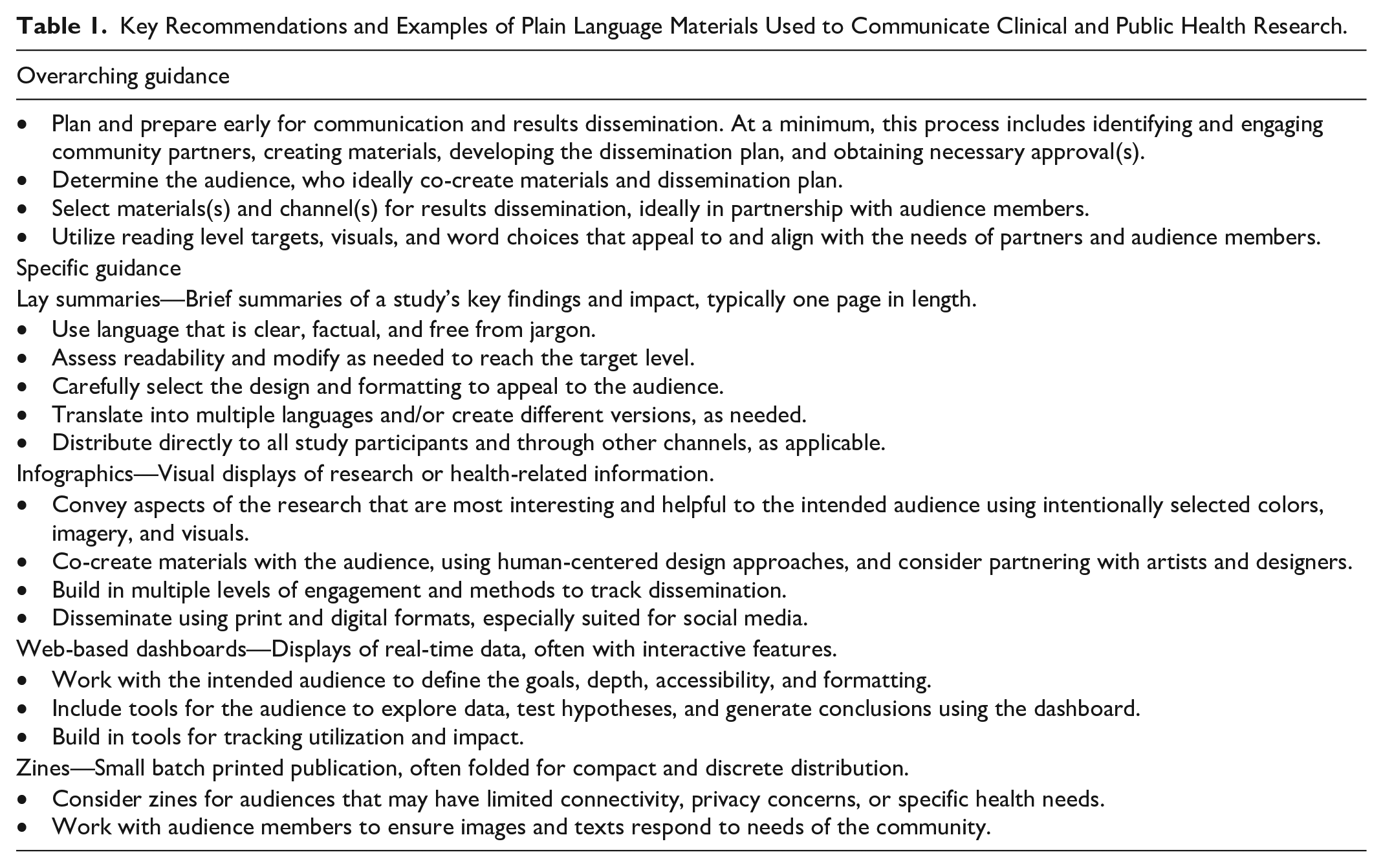
Practical guidance for developing and disseminating health research results using plain language materials is summarized in Table 1.
Key Recommendations and Examples of Plain Language Materials Used to Communicate Clinical and Public Health Research.
Part 1. General Guidance
Plan and Prepare Early for Communication and Results Dissemination
Results dissemination is often an afterthought in research. Best practices require early and thoughtful planning and preparation for results dissemination. Plans should include, at a minimum, time for: (1) identifying and engaging community partners, who can provide critical input on the development of materials and dissemination plan; (2) creating the materials, which depends on the specific type and number of versions; (3) developing the plan for disseminating and tracking or measuring the impact of the materials; and (4) obtaining institutional regulatory approval, which is usually required prior to distributing materials to study participants. Researchers should consider convening a dissemination team from project conceptualization, in parallel to planning the research project itself. 18
Determine the Dissemination Audience
A critical step in research dissemination is identifying the people or groups of people to whom the research should be disseminated. This piece is important because the materials and dissemination plan should ideally be co-created with representatives of the intended audience. Representatives can help identify the best channels, or specific approach (eg, distributing through printed news or social media, hosting a meeting or conference) for sharing materials.19,20 To begin, all potential audiences who could stand to benefit from the research should be identified and, ideally, engaged to ensure no group is missing.
Select Material (s) and Channel(s) to Meet the Needs of the Intended Audience
The material(s) will depend on the audience and how they are expected to receive the materials. For example, an audience of policy makers may be most comfortable with a lay summary formatted like an executive summary, while a multilingual community may find infographics more universally approachable. The material(s) must be compatible with the dissemination channel; for example, a lay summary is well suited for print or e-mail distribution, while infographics may garner greater attention on social media. When an audience is varied, multiple different materials may be necessary. In addition to written and visual materials, research teams should consider audiovisual options such as videos, animated shorts, and podcast episodes. These less traditional materials may require different channels, such as a new web page. The intended timing and frequency of communicating results can also dictate the material(s) and channel. For example, web-based data dashboards can rapidly communicate evolving data in times of urgency, like during a pandemic.
Identify an Appropriate Target Reading Level
The specific reading level target depends on the intended audience, but generally should be below an 8th grade reading level. Discipline- and science-specific jargon, abbreviations, long sentences (in excess of 20 words), and unnecessarily complex wording should be avoided whenever possible. 21 A plain language definition and pronunciation guide should be considered if the use of complex medical terms is unavoidable.4,22 Community partners and other members of the target audience can provide valuable feedback on language, imagery, and accessibility of materials.
Be Intentional With Word Choices
Specific word choice matters when appealing to partners and audience members. For example, the Community Vitality Collaborative (CVC) specifically uses “collaborative” instead of “advisory” because advisory capacity suggests making a recommendation, whereas collaborative suggests 2 or more parties working together toward a shared goal. 23 Community partners can identify specific relevant wording that is both clear and inclusive.
Part 2. Examples of Plain Language Materials
Lay Summary
A lay summary is a plain language summary, typically 1 page or less in length, of study findings intended for study participants, stakeholders, and the public. Lay summaries can help disseminate research findings to a broader audience, with a goal of inspiring greater trust, and potentially enhancing recruitment and retention in clinical research. 24 In many countries, research sponsors are required to provide summary results of clinical trials in a format that is understandable and accessible to the general population. 2
The content of a lay summary should include key findings (eg, results of the primary study endpoint, adverse events) and the significance of the results. 25 The lay summary should include the study completion date and disclosure that results are from 1 study and that other studies may have different results. It may include links to the study website, contact information, and related publications. 25
A lay summary should be written in clear, short sentences, avoiding jargon and acronyms as much as possible. Language should be fair, balanced, factual, and non-promotional.2,25 Readability should be assessed using, for example, Flesch Reading Ease and Flesch-Kincaid Grade Level scores.26,27
Although lay summaries are typically text-based, it is important to minimize long paragraphs and use white space and bold headings to break up text. Bulleted lists and formats such as questions and answers can help draw attention to key points. 2 Embedded graphics, including models and diagrams, can be especially helpful in highlighting essential takeaways; however, graphics must be selected carefully, and be inclusive and not off-putting or propagating harmful stereotypes.
Traditionally, a lay summary is mailed to study participants after a study has ended and results are published. However, lay summaries can also be disseminated through a variety of approaches (eg, sent via email, posted on a website, distributed at a health fair). Investigators should consider translating into different languages and multiple versions for different audiences (eg, teenage study participants, caregivers). Ideally, specific plans for disseminating the lay summary are developed in partnership with participants and community representatives.
For examples of lay summaries, the Pediatric Trials Network “Results-At-A-Glance” are publicly available at https://pediatrictrials.org/results_at_a_glance/. 17
Informational Graphics or “Infographic.”
An informational graphic, or “infographic,” is a knowledge translation strategy that uses visual aids to convey information, often about data. Infographics are well-suited to sharing general health and public health information, as well as research results. 28 Infographics are relatively easy to create and disseminate, both physically and digitally, and can be tailored to the needs of the intended audience. They can be especially appealing to visual learners, reach audiences with varying levels of English literacy, and may be more approachable than text-heavy materials. Infographics can include links to access more information (eg, short hyperlinks and QR codes), which can simultaneously track dissemination and allow for information to be updated in real time.
The Community Integrated Research for Care and Language Equity (CIRCLE) Collaborative, creates infographics after research studies using human-centered design (HCD) to obtain feedback on the infographic prior to use, and subsequently share infographics with community partners. The HCD approach involves incorporating collaborator feedback and expertise throughout the entire research process to shape the final product effectively.29,30 Collaborators also bring knowledge of their information ecosystem and are often part of the same groups that will help disseminate the final infographics. An HCD approach includes visual activities, rapid cycle analyses, and group brainstorming to co-create dissemination materials with the intended audiences. 31 A specific example of HCD activity to elicit feedback on infographics is using “Rose, Thorn, Bud,” where community partners review the rough draft of an infographic and brainstorm strengths (roses), limitations (thorns), and opportunities for improvement (buds).
An infographic’s content should be intentionally selected to serve its purpose, which, in most research cases, is to communicate results back to study participants and surrounding communities. Content should include what is most interesting and helpful to community members. For example, communicating that study results led to creation of new community resources may be more interesting than communicating the study’s contribution to gaps in academic literature. Foundations and methods information should be brief, with priority given to results and outcomes.
When considering the infographic design, color selection should be intentional and accessible for those with visual differences. Imagery and visuals should be emphasized over text, though illustrative quotes can be used if not overwhelming. Features, such as arrows, can guide the audience through the infographic in the intended order. Infographics may require translation into multiple languages. Specific guidance exists for multilingual research 32 and accessible digital content. 33
Infographics can be disseminated through analog and digital channels. When formatting for social media, it may be necessary to design smaller, more focused infographics. This creates opportunities for multiple levels of engagement, that is, what impact can be achieved with 1 s of attention, 3 s, 1 min, or more. For example, multiple Instagram panels can be created, where each panel represents a different part of the study and the panels are presented in a narrative, with the most critical information in the first or second panels.
Partnerships with artists and designers can increase the impact and broaden the dissemination audience of infographics, as well as other types of dissemination materials. For example, the CIRCLE Collaborative includes an artist and immersive media expert who works with researchers to develop materials including short videos, infographics, websites, and even a card game, a novel strategy not often used in research.
For examples of infographics and social media panels, CIRCLE Collaborative provides visual slide decks for results of recent studies at https://www.ragavancircle.com/infographics.
Web-Based Dashboards
A data dashboard is a web-based, interactive platform that may leverage text and visual elements to display data and communicate findings. In public health, data dashboards have been used for surveillance, policymaking, disease monitoring, and evaluation.34,35 Dashboards enable real-time and continuous data dissemination of data and tracking changes over time. Unique dashboards is the audience’s ability to explore data, test hypotheses, and generate data-based conclusions on their own. Dashboards can also track metadata and utilization metrics (eg, number of page views, time on views) to assess engagement and impact.
The Toxicological and Ethnographic Drug Surveillance Testing in Rhode Island (testRI) project leveraged a web-based dashboard (https://preventoverdoseri.org/local-drug-supply/) to present near-real-time toxicological data on the local drug supply to inform overdose prevention efforts at the individual, community, and state levels. The testRI project used community and stakeholder feedback, as well as an iterative process to modify a study-specific page on the state’s existing overdose data dashboard in collaboration with the Rhode Island Department of Health. 36 Based on this guidance, they produced monthly/bi-monthly recaps, highlighting new substances that emerged as needed, and distributed information through social media.
Based on the testRI experience and evaluation of the dashboard over time, the study team recommends designing a dashboard with the audience in mind. Research teams considering disseminating data to lay audiences through a dashboard should work with a community or patient advisory board and/or departments of health from the outset to determine the goals, depth of data available, accessibility, and any needed framing. Standardized communication assessment tools, such as the CDC Clear Communication Index, can help guide accessible dashboard development, and ensure the intended audiences understand how to navigate the tool and use the presented information. 37 Working alongside community advisors and other stakeholders should be an iterative process; data should be presented in ways that are appropriately open and responsive to feedback.
Engaging the community/target audience in an iterative process is especially important for dashboards. Condensing detailed and complex data can be extremely challenging, especially if targeting an 8th grade reading level or below. The target audience’s desired level of detail is essential to selecting which data are shown in the dashboard, how they are displayed, and how many interactive elements are made available. Not all communities may find a dashboard accessible, depending on factors such as literacy, device access, and internet access.
Self-Published Booklets (Zines)
A “zine” is an independent publication that often includes images, text, and artwork, and is produced in small batches. Zines have a long history in social and political activism.38 -40 Zines can be produced in booklet form, pamphlet-type publications, or made from a single piece of paper that can be folded into small booklets (approximately 8 pages) and reproduced via photocopy in small batches or digitally.
Zines are a low-budget approach to disseminating research to diverse communities. The folded zine is concise, compact, easily distributable, and can be discrete enough to be shared alongside other resources (eg, packaged within safer use kits). Some audiences may find zines to be especially appealing because they do not require a device, internet, or cellular data.
When considering arts-based dissemination, it is important to elicit feedback from the community as the history and culture of zines (eg, anti-establishment and outside of mainstream media) may not be concordant with all audiences, types of research, and communication styles. 38
Based on community feedback about needing to reach diverse communities of people who use drugs, including people with more limited connectivity, the testRI project developed a series of zines to share qualitative, and toxicology results. Examples of the zine were presented to the study’s community advisory board for feedback and workshopping, to ensure images used and text included were responsive to community needs. For examples, testRI zines are available free for download at https://medium.com/pphc/zines/home. Additional specific guidance on creating and folding a zine can be found at https://www.42ndstreet.org.uk/support/read/how-to-make-your-own-zine/.
Part 3. Cross-Cutting Challenges and Potential Solutions
Community Partnerships
Effectively communicating health research remains a challenge, despite these successful examples. An overarching framework that can help with communication and research dissemination is community-partnered or community-based participatory research (CBPR), which orients research around relationships between researchers and the community.23,41 Building a relationship with community members improves the researchers’ ability to anticipate and resolve problems, build committed, sustained partnerships, and communicate in an authentic, effective, and transparent way. CBPR focuses on the continuum of research, which includes communicating results of research. Involving community members throughout the research process offers several opportunities to improve the quality, reach, and ultimate impact of all plain language materials described herein. Importantly, researchers should adequately compensate community partners who co-created dissemination materials, and ensure there is training and support for community partners.
Mistrust and Misinformation/Disinformation
Effectively communicating research results is increasingly challenged by growing mistrust in public health and science, in part fueled by misinformation and disinformation. 9 Many communities have longstanding distrust in researchers and research institutions due to historical traumas and ongoing extractive practices, in which academics conduct research on—rather than with—a community without authentic engagement or sustainable change. 42 The coronavirus (COVID-19) pandemic illuminated the deep distrust among specific communities, 42 although 1 study showed that use of local researchers for COVID-19 information was associated with positive vaccine intention. 43 Ultimately, researchers and research institutions must shift the paradigm from asking communities to trust them to earning trust through multilevel community-partnered approaches. 42
CBPR emerged as a strategy to address distrust and to foster connections and build ground for continued community-driven inquiry, ultimately in support of improved health equity.23,41 The partnerships that support CBPR are long-standing, rather than short-term and project-based, and ideally allow community members to collaborate on research questions and participate actively in research design, data collection, data analysis, and ultimately dissemination. To build effective, durable partnerships and benefit from CBPR, researchers need to communicate clearly and transparently. Plain language can also be used to effectively answer people’s questions about research, which is proposed as a key tactic to combat misinformation. 44
Funding
Another major barrier to research communication is historically limited funding for these efforts, 45 although programs like NIH HEAL Connections and dissemination grants from the Patient-Centered Outcomes Research Institute offer promise. 46 When faced with budgetary constraints, researchers and team members can consider which specific dissemination materials they may be able to create themselves. Several user-friendly programs exist for creating infographics, such as Canva (http://www.canva.com). 47 Self-directed learning using this program has allowed project coordinators in the CIRCLE collaborative to create an infographic after each study has been completed. Other tools, such as pre-existing templates, and artificial intelligence (AI)/machine learning tools can be helpful for individuals creating infographics and other communication tools for the first time. Additional cross-cutting challenges and potential solutions are shown in Table 2.
Cross-Cutting Challenges Faced by Health Researchers When Using Plain Language Materials to Communicate Research, and Potential Solutions.

Abbreviations: HEAL = Helping to End Addiction Long-term; PCORI = Patient-Centered Outcomes Research Institute.
Discussion
This perspective article provides practical guidance and examples, drawn from experiences of clinical and public health researchers and communication specialists, using plain language materials to communicate results. Lay summaries are the most widely used plain language material, and guidance aligns with existing recommendations.2,4,25 For infographics, existing published recommendations refer primarily to transmitting a public health message or medical information.48,49 Although many of these recommendations likely apply to research infographics, research adds complexities that need to be considered (eg, study design, population, intervention). This complexity makes partnership and ideally, co-creation, of an infographic with the target audience especially critical. Guidance for using web-based dashboards and zines to communicate health research remains very limited. Thus, this editorial adds practical and useful information to help inspire researchers to use plain language materials to communicate their research. It also describes the process, and challenges and potential solutions, that researchers can use for planning.
This article has important limitations. This guidance is not a comprehensive nor systematic review of this topic or evidence hierarchy, but as a practical guide. Throughout this editorial, the importance of partnering with community/target audience is highlighted, but this document was written by researchers and communication specialists. Further, this article does not specifically address the rapidly growing field of artificial intelligence (AI) in communication. In fact, there are multiple existing AI tools to create lay summaries. 50 While using AI for research communications is a growing area of interest, content generated via AI tools requires careful review for accuracy, bias, and unanticipated harms, such as propagating mistrust. Guidance such as this article could be used alongside AI tools to create plain language materials, or to review, edit, and improve materials created with AI. This guidance will need to be re-evaluated if the use of AI tools becomes increasingly commonplace in research communication.
Conclusion
Multiple plain language materials (eg, lay summaries, infographics, dashboards, booklets, zines) can be used to enable and enrich communication between researchers and communities/target audiences. Health researchers can use this guidance and suggested solutions to help overcome challenges and amplify the impact of their results, empowering action and meaningful changes that ultimately improve health and well-being.
Footnotes
Acknowledgements
The authors wish to acknowledge Lindsay E. Singler, MPH, from the Duke Clinical Research Institute, for providing outstanding leadership and input on the manuscript and for moderating the webinar.
Author Contributions
RLR, HPW, and CPH conceptualized the manuscript. RLR, HPW, MIR, ABC, JV, SR, JA, EM, MSK, ECM, and CPH collected and curated information for the manuscript. HPW and SR conducted project administration. RLR, HPW, and SR wrote the original draft. RLR, HPW, MIR, ABC, JV, SR, JA, EM, MSK, ECM, and CPH reviewed and edited the final manuscript.
Funding
The author(s) disclosed receipt of the following financial support for the research, authorship, and/or publication of this article: HEAL Connections is funded by the National Institutes of Health (NIH) HEAL Initiative under OTA numbers: 1OT20D034479, and 1OT2OD034481.
Declaration of Conflicting Interests
The author(s) declared the following potential conflicts of interest with respect to the research, authorship, and/or publication of this article: The contents of this publication are solely the responsibility of the authors, and do not necessarily represent the official views of the NIH. RLR receives salary support from the National Institutes of Health (NIH) including award K23AR084424 and the Patient Centered Outcomes Research Institute. RLR discloses a financial relationship with Biogen. HPW: Nothing to report. MR: Dr. Ragavan receives salary support from the National Institutes of Health (K23HD104925; R21HD109627; R01NR021484). ABC: Funding for testRI was provided by the Foundation for Opioid Response Efforts. MK: None. ECM: None. JV: Nothing to report. JA is a consultant on grants from the National Institutes of Health (R21HD109627; R01NR021484). EM: Nothing to report. SR: Nothing to report. CPH receives salary support for research from the NIH (R01HD106588; K24HL173596; RL1HD107784; OT2OD034481; PL1HD105462; R33HL147833; U01MD018294), the non-for-profit Burroughs Wellcome Fund and from sponsors for drug development in adults and children ( ).
).