




Abstract
This paper aims to establish an intelligent delivery system integrated with track logistics and explores its impact on the clinical transportation of goods. The study analyzed hospital delivery items before and after the implementation of an intelligent delivery system combined with automated track logistics in 2023. Delivery conditions prior to the system’s activation served as the control group, while those post-implementation formed the observation group. This research assesses the effects on transportation efficiency, resource allocation, transport safety, and satisfaction among medical staff. The average delivery time of goods significantly decreased following the adoption of the intelligent delivery system combined with automated track logistics (P < .01). The total number of adverse delivery-related events was reduced from 25 to 4 (P < .01). Departmental medical staff reported substantial increases in scores for delivery efficiency, error incidence, and overall satisfaction with the delivery process (P < .01). The integration of the intelligent delivery system with automated track logistics significantly enhances the efficiency of clinical goods transportation, optimizes resource allocation, ensures the safe transport of items, and improves the patient experience and clinical staff satisfaction with delivery operations. Regular system maintenance and adjustments, supported by professional technical personnel, are essential to fully leverage the system's advantages.
Keywords
The findings of this study indicate:
The organic integration of intelligent systems with rail logistics can optimize the resource allocation of hospital delivery systems and medical-related items, thereby promoting the efficient operation of clinical item transportation and enhancing the safety of delivered goods. This advancement facilitates medical practices and reduces the time required for patient treatment. Furthermore, as the comprehensive implementation and popularization of intelligent systems progresses, new demands and challenges arise regarding the professional skills of technical personnel to ensure the effective operation of these intelligent systems.
To meet the evolving standards of medical care and the demands for high-quality services in hospitals, the efficient, safe, and timely delivery of goods has become crucial for the orderly execution of clinical operations. Within the healthcare setting, there is a frequent need to transport various clinical items, including medications, reagents, instruments, specimens, and documentation, to meet the treatment and care requirements of patients. However, traditional methods of hospital goods transportation often suffer from low efficiency, high costs, and recurring issues such as safety hazards, errors, and delays. These problems significantly compromise both the efficiency of goods delivery and the quality of service in hospitals.1,2 In response to these challenges, intelligent delivery systems and automated track logistics technology have emerged. An intelligent delivery system is an advanced, information-driven transportation framework based on technologies such as the Internet of Things (IoT), cloud computing, and artificial intelligence. 3 It incorporates state-of-the-art technologies, including robotics, automated navigation systems, and IoT, to automate the delivery and management of goods.4,5 Conversely, automated track logistics employ rail systems and intelligent control technologies to facilitate efficient transportation and automated processing of items. The organic integration of these technologies offers a novel solution for the delivery of clinical goods. This paper establishes a delivery system that integrates intelligent delivery systems with track logistics and explores the impact of this combined system on the transportation of clinical items.
Materials and Methods
Study Subjects
This research is observational studies and adheres to the guidelines established by EQUATOR.In the tertiary hospital in Sichuan Province, China,the items transported between October 2022 and March 2023,prior to the implementation of the intelligent delivery system combined with automated track logistics, were designated as the control group. Conversely, items transported from April to September 2023, following the system’s implementation, were deemed the observation group.
Research Methods
Control group
The semi-automated track logistics delivery method was employed, operating as follows: "When a clinical department requires item transportation, the requesting department contacts the delivery dispatch center via telephone. A dispatcher manually dispatches a logistics cart, which travels along the track to the requesting department to collect the items. The cart then transports the items to the designated department, where personnel receive the logistics cart, thus completing the delivery. After delivery, the dispatcher is manually contacted to retrieve the logistics cart."
Experimental group
This group involves the establishment of a hospital-based intelligent delivery system combined with automated track logistics for transporting clinical items.
Construction of the intelligent delivery system combined with automated track logistics
This system consists of 4 main components, all working in concert to create a comprehensive clinical goods delivery system that covers the entirety of the hospital.
(1) Intelligent Transport Vehicles: These are the operational elements of the system, utilizing automated navigation and sensor technology for self-driving, obstacle avoidance, and precise positioning. The fleet includes electric vehicles, automated guided vehicles (AGVs), and robots.
(2) Smart Terminal Devices: These devices are used by healthcare personnel and patients to issue, track, and provide feedback on transport tasks. Smart calling devices are strategically located throughout the hospital within the intelligent delivery system.
(3) Intelligent Control Center: Serving as the core management hub, this center uses cloud computing and artificial intelligence to manage task scheduling, perform data analysis, and issue risk warnings.
(4) Comprehensive Intelligent Track Logistics System: Each clinical department is equipped with intelligent calling systems interconnected by concealed logistics tracks.
Clinical application of the hospital intelligent delivery system combined with automated track logistics
The clinical item delivery process using the intelligent delivery system operates as follows: 1) Clinical departments activate the smart calling system at the designated point; 2) The intelligent delivery center system schedules the logistics box based on demand; 3) The logistics box travels via the track to the task location; 4) Clinical staff open the logistics box to place or retrieve items and subsequently lock it; 5) They select the target location on the smart calling system interface and send the request; 6) The logistics box is delivered to the target department via the track and automatically returns to the scheduling center when there are no pending tasks.”
Observation Indicators and Research Tools
We evaluated the average time of 2000 item deliveries, the occurrence of negative delivery events, and changes in healthcare personnel satisfaction before and after the implementation of the intelligent delivery system combined with automated track logistics.An investigation into the satisfaction levels of healthcare personnel regarding item transportation at 57 delivery points across the hospital was conducted. Healthcare workers rated their satisfaction on a scale from 0 to 100, with higher scores indicating greater satisfaction.
Statistical Methods
Data analysis was conducted using SPSS version 23.0. Categorical data were presented as frequency counts and compared using the chi-squared test. Continuous data were expressed as mean ± standard deviation and analyzed using Paired Samples T-Test. A P-value of <.05 was considered statistically significant.
Results
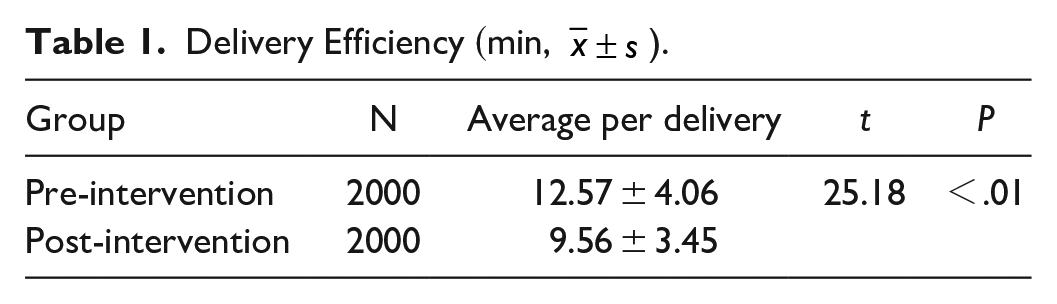
The average delivery time for 2000 item deliveries significantly decreased following the implementation of the intelligent delivery system combined with automated track logistics. This change was statistically significant, as evidenced by the data presented in Table 1 (P < .01).
Delivery Efficiency (min,
The total number of negative delivery events for the 2000 item delivery tasks decreased significantly from 26 occurrences to just 4 following the implementation of the intelligent delivery system combined with automated track logistics. This improvement is statistically significant (P < .01), as detailed in Table 2.
Negative Delivery Events [counts].

Following the implementation of the intelligent delivery system combined with automated track logistics, there was a notable increase in overall satisfaction with the item delivery process. These improvements were statistically significant (P < .01), as outlined in Table 3.
Healthcare Personnel Satisfaction (scores,

Discussion
The intelligent delivery system, in conjunction with automated track logistics, markedly reduces delivery times, increases the efficiency of clinical item transportation, optimizes resource allocation, and accelerates the turnover of clinical supplies. This system also significantly cuts both time and labor costs. Previously, the delivery of clinical items relied on semi-automated, manual systems, which faced limitations such as mechanical scheduling processes, high dependency on human labor, and susceptibility to unforeseen circumstances. 6 The introduction of the intelligent delivery system has revolutionized the scheduling of delivery tasks, optimizing delivery routes and task assignments to efficiently meet the needs of medical item transportation. 7 With the support of the automated track logistics system, smart transport vehicles autonomously navigate predetermined routes and schedules, transporting pharmaceuticals and medical equipment from 1 department to another. This advancement minimizes manual transfer times, mitigates delays caused by various factors, and enhances the accuracy and timeliness of deliveries. 8 The integration of smart delivery technology with a hospital-wide automated logistics framework results in swifter, more precise delivery of items, maximizing time efficiency and human resource savings while correspondingly reducing operational costs, thus providing hospitals with a more efficient, convenient, and rapid delivery solution.
Furthermore, the intelligent delivery system combined with automated track logistics ensures the integrity and accuracy of item deliveries, increasing overall satisfaction among clinical staff. Traditional manual scheduling methods are prone to interference from human factors and unexpected events, potentially leading to item damage, loss, or even accidental harm. 7 In contrast, the intelligent system, supported by automated control and monitoring, optimizes delivery routes, shortens delivery times, and reduces risks associated with human scheduling. This effectively minimizes transportation disruptions and decreases the occurrence of negative events such as item damage, misdelivery, and loss. 9 The efficiency and safety of deliveries are thus further ensured, enhancing experiences for both patients and medical personnel while continuously improving clinical work efficiency and staff satisfaction. However, following the implementation of the intelligent delivery system and automated track logistics, instances of dissatisfaction among healthcare personnel regarding nighttime delivery conditions have been reported. These issues are likely influenced by factors such as system adjustments and maintenance needs, highlighting the necessity for regular system tuning and upkeep with ongoing technical support from professionals to ensure effective operations during nighttime deliveries.
Conclusion
With the ongoing advancement of intelligent technologies and progress in medical logistics, intelligent delivery systems and automated track logistics will continue to play a pivotal role. Future research should explore the application of these technologies within medical logistics further, aiming to optimize system design and operational processes. Such enhancements could significantly improve delivery efficiency, reduce costs, and boost the overall operational efficacy of healthcare institutions. While the integration of intelligent delivery systems with automated track logistics offers substantial benefits for clinical delivery tasks, there are limitations to consider, including technological constraints and the need for long-term professional maintenance. To maximize the efficiency and quality of intelligent delivery systems, it is crucial to strengthen technological research and application innovation. Continually optimizing both hardware and software configurations and monitoring the efficacy of these systems in clinical applications are essential steps toward realizing their full potential.Additionally, owing to the limitations imposed by the venue and time constraints of this study, the sample size was not meticulously calculated. Nevertheless, the research sample was sourced from the entire observation center, resulting in a sufficiently substantial sample size, which may lead to an excessive number of samples and a considerable expenditure of human and material resources.
Footnotes
Acknowledgements
I extend my sincere gratitude for the funding support from the Sichuan Provincial Hospital Association Medical Management Branch.
Author Contributions
Yi Li and Ping He conducted the research design and project implementation; Xue-Lian Peng performed the data analysis; Min Peng was responsible for data collection.
Data Sharing Statement
Technical appendix, statistical code, and dataset available from the corresponding author on reasonable request.Participants gave informed consent for data sharing.
Declaration of Conflicting Interests
The author(s) declared no potential conflicts of interest with respect to the research, authorship, and/or publication of this article.
Funding
The author(s) disclosed receipt of the following financial support for the research, authorship, and/or publication of this article: 2022 Project Grant SCYW010 from the Sichuan Provincial Hospital Association Medical Management Branch.
Ethical/Consent Statement
Our study did not require an ethical board approval because it does not pertain to human or subjects.
