




Abstract
The aim of this study is to investigate the relationship between the perceived value of outdoor activities and exercise persistence among elderly Chinese individuals. Specifically, the study aims to explore whether motivation for active social adaptation mediates this relationship. Three hundred twenty-five subjects were randomly chosen and invited to complete 3 questionnaires about the perceived value of outdoor activity, the motivation for active social adaptation, and the adherence to physical exercise. The results showed that older people’s perception of the value of outdoor activity (function, landscape, and cost) has a statistically significant effect on their adherence to exercise. The mediating role of motivation for active social adaptation was also statistically significant, and the mediating role of active environmental adaptation motivation affected the perceived functional value, perceived landscape value of outdoor activities on adherence to exercise. Hence, it is concluded that older Chinese adults’ perception of the value of outdoor activities promotes their adherence to exercise and reinforces it based on active social adaptation motivation.
Keywords
The studies that have been conducted on the factors influencing physical activity adherence in older adults are basically based on psychological and sociological theories; and have evolved from purely psychological characteristics (e.g., motivation) influencing exercise adherence to the mediating moderating role of variables such as exercise programs, self-efficacy, and social support. Other studies have explored the factors affecting physical activity adherence in older adults from the perspective of sports programs.
This study provides a new research perspective on the study of factors influencing physical activity adherence in older adults, and the findings enrich the study of physical activity adherence in older adults.
This study found that older adults’ perceived value of outdoor activities not only promotes adherence to exercise behavior, but also strengthens adherence through active social adaptation motivation. The results of this study not only enriched the research content of physical activity adherence among older adults, but also provided suggestions for the development of outdoor sports, as well as for the aging planning of various types of sports programs.
Introduction
According to The People’s Daily, the number of people involved in outdoor sports in China exceeded 400 million by the end of 2021 and the total scale is expected to exceed 3 trillion Yuan in 2025. 1 Due to the value functions of outdoor sports, such as improving communication and adapting to society, there are increasing many older adults favoring to participate in outdoor sporting activities. 2 According to the 14th Five-Year Plan for Healthy Aging (2022) more than 20% of China’s total population will be aged 60 and above by 2025, representing a moderately aging society. 3 In response to this aging population, the General Administration of Sport of China has issued the “Notice of the General Administration of Sports of China on Further Improving Sports Work for the Elderly,” in which of encouraging elderly’s awareness of that “I am the first responsible for my own health,” and improving the active health ability for the elderly, as well as promoting their healthy lifestyle. Furthermore, the Notice also requires each industrial plan of Chinese outdoor sports authorities to help older adults to be conscious of “being the first person responsible for their health,” promote a healthy lifestyle, and actively improve their capacity for health. Meanwhile, to attract more older adults to participate in outdoor sports consistently and persistently, the plans should meet the needs of China’s aging society and take account of older adults’ motivation and demand for outdoor sports programs, venues, services, and products. 4
It can be seen from the literature that the current research on older adults’ adherence to exercise is mainly focused on the theoretical perspectives of psychology and sociology, such as the health belief theory, theory of planned behavior, social cognitive theory, and behavioral ecology theory, however, those are not particularly relevant to older adults’ perceived value of exercise.5 -8 Today, the popular outdoor sporting activities, such as frisbee movement and cycling, are not appropriate and suitable for Chinese older people, because of their limited physical condition; it is also difficult for them to choose a sports program which will offer the best value. Zeithaml first defined the theory of perceived value from “Gain and Loss” in 1988, meaning that people will evaluate the utility of a product or service after weighing its perceived benefit against the cost of acquiring it. 9 In this context, this study considers how older adults’ perceived value of participating in sports affects their adherence to exercise, as well as if the motivation of social adaptation may contribute to relationship between the perceived value and older adults’ adherence to exercise. Therefore, this study is based on the use of the value perception theory to explore older adults’ adherence to outdoor exercise. First, our hypothesis 1 is that: older adults’ perceived value of outdoor activities has a significant effect on their adherence to exercise. We then will look at the effect of motivation to adhere to outdoor exercise due to social adaptation will be analyzed in this study as a reference for the development of outdoor sports in China.
Factor Effects on Adherence to Exercise
Adherence to exercise is the behavioral tendency of individuals to show persistence, continuity, and effort during physical exercise. 10 It is generally accepted that adherence to exercise is influenced by 3 kinds of factors, namely, past and present personal factors, past and present environmental factors, and the self-factor of physical activity. 11 Research of the effect of individuals’ personal factors on their adherence to exercise has mainly included demographic characteristics, biomedical conditions, past and present behavior, personal activity history, personal psychological characteristics, and states related to physical activity. 12
Previous research, however, has also shown that individuals’ psychological characteristics and conditions when participating in physical activity are closely related to their adherence to exercise. For example, one study found that older people’s motivation to participate in sport is one of the psychological factors related to exercise adherence, which it could be divided into 6 components, namely, acquiring a sense of achievement, social interaction, spending time, improving health, experiencing nature, and learning from life. As result of their studies, the variance explained by the motivational factor of social interaction was 14.50%. Zhou et al 13 and Zhou et al 14 explained that the stronger people’s intrinsic motivation is, the longer they could keep exercising.
On the other hand, research also found that a robust external motivation for exercise may inhibit older adults’ content motivation, which is not conducive to the long-term adherence to exercise. 12 Internal motivation refers to participants’ initial satisfaction when joining the activity. External motivation is related to participation in activities due to external pressures or rewards. 15 Zeng, 16 Li and Jiang, 17 explored the difference between internal and external motivation, and they found that stimulating individuals’ internal motivation is beneficial for them to actively take part in physical exercise.
Motivation has, however, either a direct or indirect effect, which may affect other variables. For example, Wang and Liu 18 found that the outdoor exercise atmosphere (interpersonal connection, natural connection, and access to information) played a partially mediating role in predicting older people’ motivation (self-breakthrough, ability, independent choice, and personal investment) to adhere to exercise. Another study found that self-efficacy and planning exercise mediate the relationship between the intention to exercise and exercise behavior, 19 in which the formation of exercise plans and the realization of the mediating effect are regulated by self-efficacy. Furthermore, research suggested that physical health beliefs and social support influence older adults’ adherence to exercise, and that their active and independent participation in physical activity is effectively promoted by developing their perception and belief of physical health, as well as providing adequate social support. 20
Following that, it seems to be more targeted using older adults’ motivation as variables to analyze its influence on exercise adherence due to the particular logical remodeling effects of psychological factors on the process of exercise adherence. The acquisition of these psychological characteristics can better reflect their correlation and interaction with behavior. These acquired psychological traits can be achieved due to the perceived value of participating in a program. Older participants’ perception of the value of a sports program is not only a conceptual understanding and recognition of knowledge, but also an evaluation of the perceived value of sports practice. This perception of value must be related to a specific program in order to reflect the impact of different sport on sustained participation because different programs contain different environmental factors and the individual characteristics of older participants.
The scope of this research has been extended from psychology to sociology as it has developed over time. More and more studies have emphasized environmental factors, such as group and team support, and yielded a plentiful and substantial harvest. Some of the representative results can be summarized as follows: Bruner and Spink 21 and Leng 22 demonstrated that enhancing the cohesion of team building improves adherence to exercise, reduces exercise risk in older adults, and enhances group members’ satisfaction. Meanwhile, Spink and Carron 23 found that social cohesion was an important factor in differentiating exercise adherents from dropouts, and task cohesion was a predictor of adherence to exercise. Furthermore, research suggested that physical health beliefs and social support influence older adults’ adherence to exercise, and that their active and independent participation in physical activity is effectively promoted by developing their perception and belief of physical health, as well as providing adequate social support. 20
In China, Liao et al 24 demonstrated that interpersonal interactions in different exercise groups had a positively influence on individuals’ adherence to exercise, while Wu and Yin 25 pointed out that leadership behavior aimed to improve adherence to exercise, providing guidance and developing team building can all directly promote members’ adherence to exercise. Furthermore, in their study, Qiao et al 26 noted that enriching group exercise activities to enhance the quality of friendship and motivate autonomy is an effective way to improve frail older adults’ adherence to exercise.
In summary, studies of the effect of environmental factors on older adults’ adherence to exercise emphasize social influence and the role of group and team behavior. These environmental influences have a critical effect on older adults’ participation in exercise in terms of whether they are active or passive participants. Active participation means that older adults respond to “Active Aging.” They are motivated to adapt to society by choosing an appropriate social activity to achieve harmony and balance with the outside world. The continuous process from “maladjusted” to “well-adjusted” is the dynamic expression of the elderly’s active social adaptation. Older people’s participation in socially motivated sports should also include the further recognition and practice of the project’s perceived value. In other words, older adults’ motivation to adapt socially by actively participating in sports contributes to their adherence to exercise, or the perceived value of the sports program affects their adherence to exercise due to being motivated to adapt socially.
Therefore, research hypothesis 2 is that: older adults’ perceived value of outdoor activities has a significant and positive effect on their motivation to actively adapt socially, and research hypothesis 3 is that: older adults’ motivation to actively adapt socially has a significant and positive effect on their adherence to exercise.
Building the Testing Model
The results from studies on the influence of psychological factors on older adults’ adherence to exercise are rich, such as Zhu and Li claimed that sporting commitment has a direct effect on persistence of exercise, while satisfaction of sport experience and social support have indirect effects on it in elderly. 27 In summary, the psychological factors that affect older adults’ adherence to exercise are complex and diverse, so that elderly’s perceived value of outdoor activities and the motivation of active social adaptation were selected to investigate their effect on the elderly’s adherence to exercise in this study.
In combination with the above, research hypothesis 4 is proposed that: older adults’ motivation for active social adaptation plays a mediating role in their perceived value of outdoor activities, which affects their adherence to exercise. The corresponding conceptual model for this research hypothesis is shown in Figure 1.

The corresponding conceptual model for this research hypothesis.
Methods
Characteristics of Sample
All the data for this study was collected using the “Questionnaire Star” survey platform from April to May 2022. After sorting and eliminating invalid questionnaires from the total of 368 collected, 325 valid questionnaires remained, representing 88.32% validity. Following Bentler and Chou’s 28 suggestion that the sample size should be more than 10 times the observed variables, 325 of sample size in this study met the research requirements. For sample characteristics, see Table 1.
Sample Characteristic Table.

Questionnaire and Validity Testing
This study is based on relevant research results to test the research hypothesis quantitatively by constructing a measurement questionnaire about the perceived value of outdoor activities, motivation of active social adaptation, and adherence to exercise (see Figure 1). The questionnaire contained 4 main parts: Part 1 consisted of demographic characteristics, participation in outdoor activities, and screening items. “Have you participated in at least 2 outdoor activities in the last month?” was used as a screening question, and those who did not meet this criterion were deemed to be invalid. The second part of the questionnaire, which was designed to measure the perceived value of outdoor activities of the elderly, included 3 dimensions: function, landscape, and cost. The third part involved the motivation for active social adaptation and included 2 dimensions: active interpersonal and environmental adaptation. The last part was 1-dimensional to measure the elderly’s adherence to exercise. Their perceived value of outdoor activities, motivation for active social adaptation, and adherence to exercise were all measured using a Likert scale. Although the questionnaire was designed based on existing studies, the measurement of the subjects may still have been a little different. Hence, a pre-study was conducted before the formal distribution of the questionnaires. The data from 52 questionnaires was analyzed and the reliability and validity of the central part of the questionnaire were tested using SPSS 25.0. Although the Cronbach’s α value was greater than 0.7, the factor loading of the landscape value question 4 (Landscape Folklore Features) was 0.447, and the cost value question 3 (Physical Exertion) was 0.435 was below the minimum standard of 0.5 based on an exploratory factor analysis (EFA). Therefore, these 2 questions were deleted.
Measure of perceived value
The perceived value was measured from the main dimensions of Functional Value, Landscape Value, and Cost Value. Prior researchers found that participation in physical activities would improve the physical and mental quality of life of Chinese urban residents, especially older people.29,30 First, 4 questions were used to measure the perceived functional value: Strength and Fitness function (FV1), Mood-pleasing function (FV2), Social interaction function (FV3), and the program is fun (FV4).
As for the landscape value, several researchers have confirmed that the landscape experience and facilities could affect the perceived value.31,32 Therefore, 4 items were used to measure this in the questionnaire: Physical Geography (LV1), Road Sanitation Environment (LV2), Road Safety and Security (LV3), and Landscape Folklore Features (delete item) (LV4). Zhu et al 33 found that physical exercise plays a significant role in older adults’ anti-depression as they consider joining social sports organizations or look for suitable sports companions when choosing a form of sport. One of the next 3 related questions included in the cost value was deleted: Participation Cost (CV1), Time Consumed (CV2), and Physical Exertion (deleted item) (CV3).
Motivation of Active Social Adaptation Scale
Various researchers have confirmed the reliability and validity of the active social adaptation scale among older people.34 -37 This study contained 2 main parts in this context. Three sample items of active interpersonal adaptation motivation included: Preferring to socialize with friends (AIAM1), being Proactive in meeting new friends (AIAM2), and getting along harmoniously with people who have different opinions (AIAM3). One of the five sample items of active environmental adaptation motivation was deleted: Proactive participation in group organization activities (AEAM1), Like to learn new things and new knowledge (AEAM2), Can adapt quickly to any situation (AEAM3), Can have a good time, even under challenging environmental conditions (AEAM4), and Like to try different activities in different environments (deleted item) (AEAM5).
Adherence to exercise
The factors that influence adherence to exercise were rich. As mentioned above, older adults are likely to consider the time, place, and companions when choosing to continue to participate in a sport.11,38 Hence, 3 items were used to collect data on adherence to exercise: Will participate again if have the chance (EA1), Choose the correct route to experience (EA2), and Organize friends to participate (EA3).
Validity and reliability
The validity and reliability of the 325 valid samples in this study were tested using SPSS25.0 and AMOS25.0. Since the questionnaire content and items were tested by small samples, all 325 samples were used to test the validity and reliability of the questionnaire using a Confirmatory Factor Analysis.
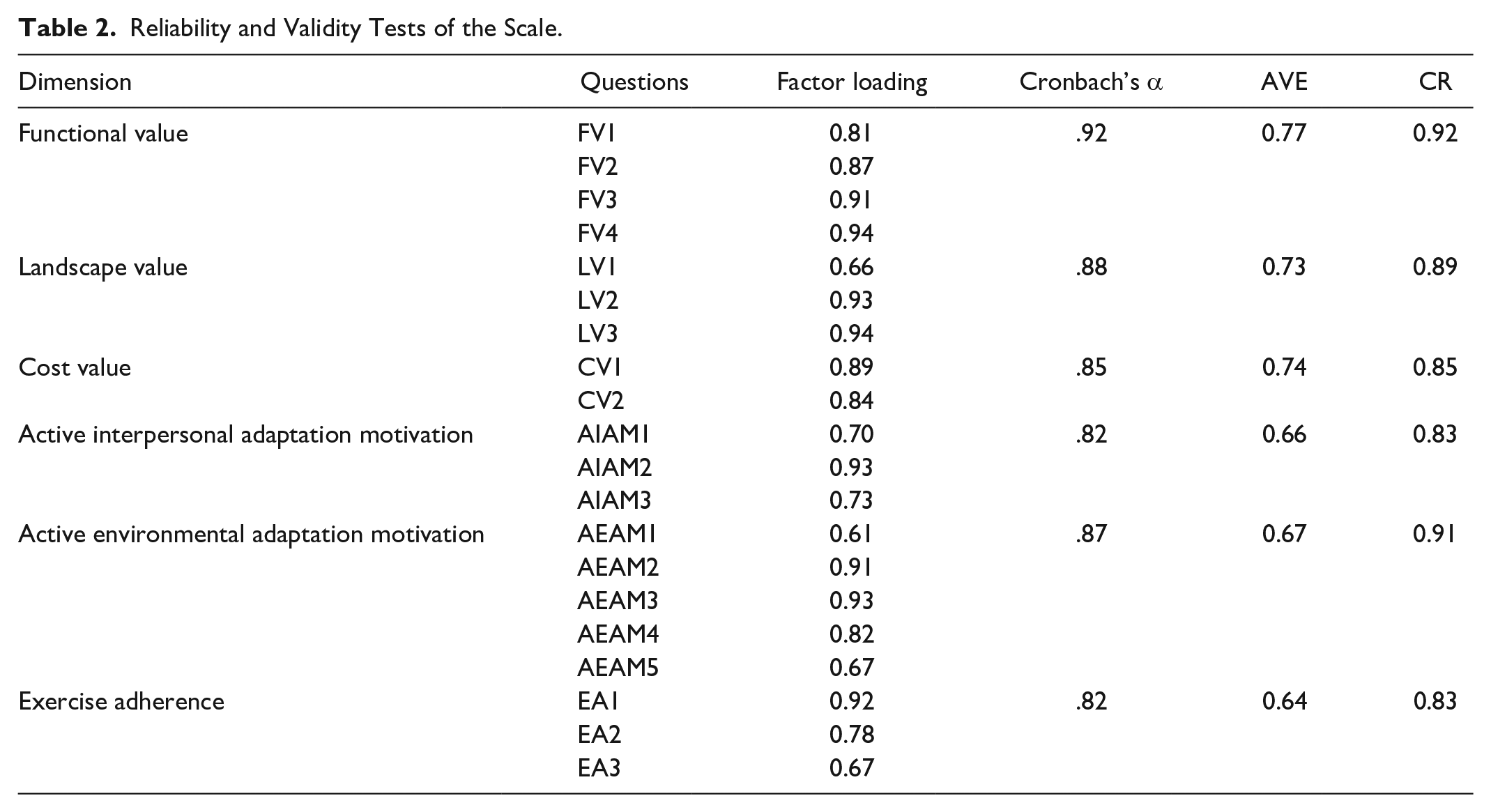
The results of measuring the factor loading of the indicators and the average variance extracted (AVE) showed that (see Table 2) the factor loadings were all greater than 0.6, and the AVE values were all greater than 0.5. In addition, the correlation coefficients between each variable and other quantities were less than the AVE value of that variable, which indicated good discriminant validity and met the statistical requirements of the measurement of validity. 39 Furthermore, the results of the reliability analysis of the questionnaire showed that the internal consistency coefficients of Cronbach’s α of the perceived value of outdoor activities, motivation of active social adaptation, and adherence to exercise variables were above 0.80, which met the statistical requirements of reliability.
Reliability and Validity Tests of the Scale.
Analytical Techniques
All the analyses were conducted using SPSS 25.0 and AMOS 25.0, in which the data was checked for missing values first, and then the descriptive statistics were computed. The reliability was checked by Cronbach’s alpha and the validity was assessed using a confirmatory factor analysis. Bivariate correlations were calculated to see the association among the variables. Furthermore, a mediation model was developed in AMOS graphics to see the mediating effect of the motivation of active social adaptation between outdoor value perception and adherence to exercise.
Results
Common Method Bias Testing
To avoid possible errors caused during the measurement of the variables, the standard method bias was mainly reduced by program control and statistical control. 40 The program was mainly controlled by a web-based survey: Questionnaire Star. This method is able to separate the subjects and reduce the effect of shared space. The test duration varies from person to person, which reduces the effect of common timing. With regard to statistical control, Harman’s 1-factor test was used to observe the exploratory factor analysis without rotation. According to a domestic application, the variance explained by a single factor is generally considered to be no more than 40%. Six factors with eigenvalues greater than 1 were extracted for the data analysis in this study. The maximum factor variance explained 26.15%, indicating that the data common method bias was within an acceptable range.
Correlation Testing
Firstly, the selection of variables was screened by a correlation analysis. The results showed that the correlation between the 2 variables of the perceived value of outdoor activities (Functional Value, Landscape Value, and Cost Value) and older adults’ adherence to exercise was statistically significant. The correlation between these 2 variables and the social adaptation motivation (Active Interpersonal Adaptation Motivation and Active Environmental Adaptation Motivation) was also statistically significant (see Table 3).
Correlation Coefficients Between Variables (n = 325).

indicates P < .001.
Measurement Model
Structural equations were adopted for modeling and observations to construct an explanatory model of the relationship between the measured variables. Further to clarify the effects of the perceived value of outdoor activities on adherence to exercise, a parallel multiple mediation model was used to examine the effects of active social adaptation motivation (active interpersonal adaptation motivation and active environmental adaptation motivation) on the relationship between the older adults’ perceived value of outdoor activities and their adherence to exercise.
After constructing a fitting analysis of the structural equations, the fit indices of the simulations were CMIN/DF = 2.60, RMSEA = 0.05, NF1 = 0.92, CF1 = 0.95, IFL = 0.95, TLI = 0.93, which showed a good fit of the measurement model. The path coefficients of the measurement model in Table 4 indicate that the effect of older people’s perceived value of outdoor exercise (function, landscape, cost) on their adherence to exercise reached a statistical significance, thereby confirming research hypothesis 1.
Results of Structural Equation Modeling (n = 325).

Abbreviations: FV = functional value; LV = landscape value; CV = cost value; AIAM = active interpersonal adaptation motivation; AEAM = active environmental adaptation motivation; EA = adherence to exercise.
indicates P < .001.
In the pathway of the modeling, the statistical results show that apart from the relationship between perceived cost value and motivation of active interpersonal adaptation (β = 0.10, P = 0.29, >.05), and the relationship between perceived cost value and adherence to exercise (β = 0.30, P = .06, >.05) to be not statistically significant, all pathways of the relationships reached statistical significance, thereby confirming research hypotheses 2 and 3.
Mediating Effects Testing
In order to test the validity of the hypothesis model, we observed the total model’s mediated effect firstly. The results showed that the mediation effect size of the overall model was 0.19. Among them, the effect of perceived value of outdoor activities on exercise adherence was 0.11, while the mediation effect of positive social adjustment was 0.08, both of which reached statistical significance.
Finally, the method of Mackinnon 41 was used to verify the mediating role of active social adaptation motivation (interpersonal and environmental adaptation motivation), and the Bootstrap in the Amos 25.0 program was also applied to test the mediating effects by estimating the confidence intervals for an indirect effect. Repeated random sampling was used to draw 200 samples out of the total of 325, and 95% confidence intervals were constructed and tested in combination with P-values (intervals excluding 0 and probability P-values less than .05 indicate a significant mediating effect). According to the analytical results (see Table 5), apart from the mediating effect of the path “perceived cost value-active interpersonal adaptation motivation-adherence to exercise” to be not statistically significant, the mediation effects of the other 5 measurement models were all valid, thereby confirming research hypothesis 4. this means that Older adults’ active social adaptation motivation mediates the relationship between the perceived value of outdoor activities and their adherence to exercise.
Results of Structural Equation Model Mediation Analysis (n = 325).

Abbreviations: FV = functional value; LV = landscape value; CV = cost value; AIAM = active interpersonal adaptation motivation; AEAM = active environmental adaptation motivation; EA = adherence to exercise.
Discussion
This study was based on the use of the value perception theory to examine the effect of older adults’ perceived value of outdoor activities on their adherence to exercise, motivated by active social adaptation. The focus was on older adults’ perception of outdoor activities’ functional, landscape, and cost values and how these 3 values affected their adherence to physical activity. At the same time, the motivational explanatory mechanisms related to older adults’ perception of outdoor activities were tested by including factors in the model that could explain their motivation to participate in exercise in order to adapt socially and environmentally. It was found from a questionnaire survey, data collection, and statistical analysis of multiple measurement models that older Chinese adults not only perceived the value of outdoor activities, but also their motivation to actively adapt socially strengthened their adherence to outdoor exercise.
Effect of Perceived Value of Outdoor Exercise on Exercise Adherence in Elderly
Compared to previous studies on the physical adherence to exercise, this study is mainly based on emphasizing the effect of older adults’ perceived value of the function, landscape, and cost of outdoor activities on their adherence to exercise, with a focus on the explanatory effect of the role of motivation to actively adapt to society.
The research selection has highlighted new perspectives of the role of social motivation from that of previous researchers, some of whom used sports atmosphere as a mediating variable to examine the explanatory effect of the role of exercise motivation on participation in and adherence to exercise. 18 Meanwhile, others used exercise self-efficacy as a mediating variable to examine the explanatory mechanism of the role of intention to exercise or team leadership on adherence behavior.25,42 Above all, the addition of a different research perspective is an essential theoretical innovation for exploring the effect of adherence to exercise on older adults.
It was found in this study that older adults’ adherence to exercise was greatly affected by their perceived value of outdoor activities. This may be explained by the fact that, when older adults participate in outdoor activities, they are more concerned with value judgments regarding the concept, knowledge, awareness, and skills of outdoor sports. Although outdoor sports have been developed for a relatively short period in China, there is an increasing number of participants, and relatively abundant channels for popularizing and training the concept, knowledge, awareness, and skills of outdoor sports.
Older participants are usually concerned with learning these relevant concepts, knowledge, and cases to avoid accidents in outdoor activities. For instance, there are studies to enhance the dissemination of basic knowledge and safety techniques for outdoor sports, as well as identifying and controlling risk, by constructing corresponding knowledge theories to provide readers with a large amount of information for their effective use. 43 Researchers also focus on interpreting professional knowledge, causes of accidents, risk awareness, and safety prevention techniques in outdoor sports, which provide a good source of information for participants in outdoor physical exercise. 44 These literary sources of information consider the safety, physical fitness, and cost factors of older adults’ participation in outdoor activities, and enrich the concepts, knowledge, awareness, and skills related to outdoor activity programs for older adults. As a result, they are a good foundation of the perceived value of participating in outdoor activities for older adults, who can subsequently behave in a way that promotes their continued participation in outdoor activities.
Mediating Mechanism of Active Social Adaptation Motivation
The mediating mechanism constructed in this study to explain the active social adaptation motivation of older adults mainly observed the fit validity of the 6 measurement models. Active social adaptation motivation includes active interpersonal and environmental adaptation motivation, and the perceived value of outdoor activities includes function, landscape, and cost. Therefore, 3 mediating measurement models were examined in this study: how active interpersonal adaptation motivation affects the perceived value of the function, landscape, and cost of outdoor activities on adherence to exercise, and how active environmental adaptation motivation affects the 3 mediated measurement models of function, landscape, and perceived cost-value on adherence to exercise. The results of the sample data analysis revealed that 5 of the 6 measurement models were statistically significant, but the measurement model of active interpersonal adaptive motivation on the effect of perceived cost-value on exercise persistence was not statistically significant.
The findings showed that older adults’ perceived cost-value is unlikely to influence their active interpersonal adaptive motivation for outdoor physical activity. However, it has a significant effect on their adherence to exercise. A possible explanation for this finding is that older adults’ perceived value of the cost of participating in outdoor physical activity is often not considered with their interpersonal adaptive motivation. The reason is that outdoor physical activity provides a platform for an interpersonal environment and is, therefore, less likely to generate interpersonal-related cost payoffs. Particularly for older adults, the cost of outdoor activity is usually expressed in terms of environmental need; in other words, the value of outdoor sports programs is described as meeting older adults’ needs when they are considering the activity environment. According to the fitting data model in this study, the perceived value of the outdoor activity landscape significantly affects the motivation for active interpersonal adaptation. This suggests that the environmental value of the outdoor activity program is essential for older adults to actively participate or adapt socially. Alternatively, it means that “where to go and who to go with” are both critical questions for older adults to participate in outdoor sports. This reflects that the elderly’s active social adaptation process is cost-neutral, but their need for the environment cannot be ignored. In addition, the perceived cost of outdoor activities is weakly correlated with active interpersonal adaptation motivation. This reflects that, when older adults participate in outdoor activities, the more detailed and precise their perception of the cost, the more likely they are to be influenced by other variables. There is a need to grasp interpersonal communication between different occasions and groups and control the breadth and depth of interpersonal communication. This causes the perceived cost value of outdoor activities to be less likely to promote active interpersonal adaptation motivation.
However, it was found from the data-fitting model in this study that the perceived cost-value can affect older adults’ motivation to adapt to the environment. Possible explanations for this are that older adults are not only constrained by their physical state and time costs, but also by financial costs, and that the greater the perceived cost-value is, the more cautious they are in choosing their outdoor activity environment. This reflects the value and significance of “cost” to older adults when they retire.
In conclusion, active interpersonal adaptation motivation has a significant and positive effect on older adults’ adherence to outdoor exercise, especially the mediating effect of active environmental adaptation motivation on adherence to exercise has a statistically significant explanation. This implies that the effect of the motivation to adapt to an active environment on adherence to exercise reflects the increasing diversity of older adults’ social ties in the context of “Active Aging.” Scenarios of older adults’ environmental adaptation are no longer limited to the community and family, but also reflected in diverse social adaptation paths, so that the active socialization of the motivation to adapt to the environment can influence adherence to exercise. On the other hand, active interpersonal adaptation motivation reflects the elderly’s desire to actively participate in the interpersonal communication activities of different organizations to achieve active social adaptation. The outdoor activities of the elderly tend to be collective and organized due to their current development status and organizational forms of outdoor sports, which can satisfy the elderly’s motivation for interpersonal adaptation. Therefore, their active interpersonal adaptation motivation can naturally promote the elderly’s adherence to exercise in outdoor activities.
Limitations and Suggestions
An explanatory mechanism model was constructed in this study to examine the relationship between older adults’ perceived value of outdoor activities and their adherence to physical activity. However, the study was limited by the sample size and characteristics because it was based on a cross-sectional design survey. For example, it was limited to the scope and size of the questionnaire survey, and the study population was mainly focused on retirees in the community. It is suggested that, if subsequent studies expand the survey scope, increase the survey test variables, or refine the test questions, it will have significant reference value to enhance the explanatory power of the study. At the same time, it is believed that further observation of the mechanism of action of factors related to activity costs when researching older adults’ adherence to exercise based on outdoor activity is also significant for deepening the related theoretical base. In particular, older adults’ perceived cost-value of outdoor activity programs influences their interpretation of the mechanisms of action of elements such as selection, input, and adaptation to the environment. For example, it is believed that outdoor sports programs that consider an appropriate cost reduction for older adults, especially economic cost, have positive implications for their active and persistent participation in outdoor activity programs. In addition, the results of the study not only provide different sports scenarios to enhance the elderly’s interpersonal communication, but also theoretical explanations for outdoor sports participation in “Active Aging” services for the elderly.
In addition, the choice of physical exercise for the elderly should follow the guidance of the public health management department, such as during the COVID-19 pandemic, the elderly should be more reasonable to adjust the place of physical exercise, and choose the physical exercise activities suitable for home,45 -48 in order to better maintain their own health.
Conclusion
These findings suggest that older adults’ adherence to outdoor activity is influenced by their perception of the value of the activity. Specifically, when older adults perceive outdoor activities to have a high value, they are more likely to adhere to these activities.
Furthermore, this study found that the effect of perceived value on adherence to outdoor activity can be further enhanced by the motivation for active social adaptation. This means that when older adults are motivated to actively adapt to social situations while participating in outdoor activities, they are more likely to persist with these activities.
Interestingly, the study also found that the motivation for active interpersonal adaptation did not have a mediational effect on the relationship between perceived cost value of outdoor activities and exercise persistence in older adults. However, the study did confirm that both active interpersonal adaptation motivation and active environmental adaptation motivation have mediational effects on the relationship between perceived functional value of outdoor activities and exercise persistence in older adults, as well as on the relationship between perceived landscape value of outdoor activities and exercise persistence in older adults.
Overall, these findings highlight the importance of perceived value and active social adaptation motivation in promoting adherence to outdoor activities among older adults. They also suggest that different types of motivation may have different effects on the relationship between perceived value and exercise persistence in this population.
Footnotes
Acknowledgements
We would like to thank all the participants who helped us complete this study.
Data Availability Statement
We consent the data deposit in a public repository that meets appropriate standards of archiving, citation, and supplement information files under alongside of our manuscript; we can provide an explanation and details of any restrictions on access if data are not freely available, and acceptable justifications for restricting access may include legal and ethical concerns.
Can be obtained from corresponding author upon reasonable request.
Declaration of Conflicting Interests
The author(s) declared no potential conflicts of interest with respect to the research, authorship, and/or publication of this article.
Funding
The author(s) received no financial support for the research, authorship, and/or publication of this article.
Ethics Approval and Consent to Participate
Not applicable.
Consent for Publication
Not applicable.
