




Abstract
Regular physical exercise lowers the risk of all-cause mortality and various chronic diseases. New technologies, such as smartphones and social media, have been used successfully as health promotion tools in college populations. The purpose of this study was to conduct a systematic review of studies examining the effectiveness of interventions that used modern technologies, as with social media or text messaging, to promote physical activity or reducing sedentary behavior in college students. The systematic review was conducted on the PubMed and SCOPUS databases, considering studies published from 2012 to 2022. For a total of 19 articles selected, an evidence table was drawn up, and the quality of the studies was assessed using the PRISMA checklist. The interventions differed enormously in design, from the strategies implemented to the types of outcome considered. Fifteen of the 19 studies demonstrated an improvement in participants’ physical activity levels, 3 studies found no such improvement, and 1 reported a worsening of baseline activity levels. Interventions to improve college students’ physical activity levels through the use of social media and/or text messaging tend to be effective. However, many factors can influence the effectiveness of such interventions. For example, a gender-related difference emerged in student participation, and the interventions proved more effective if they were accompanied by the creation of social groups.
Keywords
A sedentary lifestyle was found to be common among highly educated young people such as university students, in a critical period of life, building their own lifestyle choices
The present study collects evidences about the efficacy of intervention studies regarding physical activity promotion in college students through the use of new technologies.
The use of mHealth and similar technologies is a successful type of intervention in increasing physical activity among university students.
Introduction
Physical inactivity is an increasing global health problem causing more than 10 000 deaths in Europe 1 and approximately 5 million deaths around the world every year. 2
Low levels of physical activity are common in the general population, including young people. 3 A sedentary lifestyle was found to be common among highly educated young people such as university students. 4 Indeed, a study on Italian university students 5 reported that 25.8% never do any type of physical activity and 4.9% do sport just once per month. These results agree with a cross-sectional survey involving university students from 23 countries, which demonstrated that the overall prevalence of physical inactivity is substantially higher in women (45.8%) than in men (33%), 6 indicating that a significant part of university students do not reach the minimum levels of physical activity recommended by the WHO. This subset of the population is in a critical period of life, taking the first steps toward independence and building their own lifestyle choices as adults. Moving to a new city and a new house, changing habits, and meeting new people can all affect their ability to maintain a healthy lifestyle during this transition period. Consequently the specific life of college and university can induce an increase in sedentary behaviors and a decrease in active behaviors. 7
The habits adopted during high school years also influence adult lifestyles. In fact, weight gain or sedentary behavior in young adulthood have been linked to problems during university life, such as a reluctance to increase physical activity. 8
Using mass communication technologies for health-related applications (i.e., mobile Health (mHealth)) is an area of fervent development. An American study 9 reported that 94% of young adults possess a smartphone. The near ubiquity of this device shows how it could be used in planning health promotion interventions that easily reach almost all of the population with minimal problems and at a relatively low cost. In terms of physical activity, mHealth behavioral interventions were implemented through text messages or social media groups. 10
The aim of this systematic review is gathering evidences about the effectiveness of new technologies, as with social media or text messaging, in promoting physical activity or reducing sedentary behavior among college students.
Methods
Search Strategy
A comprehensive and systematic literature search was conducted in the PubMed and Scopus databases to identify randomized-experimental and quasi-experimental studies investigating the efficacy of interventions using text messaging or social media for the promotion of physical activity in university students. Using Boolean operators, the search process involved a search string obtained by combining the terms:
“social media” OR “text messag* OR “cell phone messag*” OR “mobile phone messag*” OR “SMS messag*” OR “MMS messag*” OR “physical activ*” OR “gym” OR “physical exerc*” OR “sedentar* OR “physical inactiv*” OR “fitness” OR “walking” OR “exercise” OR “universit* OR “colleg*” OR “facult*.”
The search strings are reported in Appendix 1.
The records retrieved from the databases were imported into Endnote and duplicates were removed. Search hits were checked by reading the article titles and abstracts. If the results of a study were published more than once, just the most complete article was considered in the analysis. The authors also checked the reference lists of the papers included in the review for any articles that were not already considered.
In conducting this systematic review, the authors conformed to the Preferred Reporting Items for Systematic Reviews and Meta-Analysis (PRISMA) statement.
The following data was extracted from each study: the number of the articles; author, year, and journal of publication; the efficacy of the intervention; the study aim; the study design; the methods of recruitment; the sample characteristics; the intervention applied; the measures of the outcomes; the results; and the conclusions.
Eligibility Criteria
The studies included in the review had to meet the following inclusion criteria:
The population studied was university students.
Multi-component interventions were used with only partial physical activity.
A clearly defined measure of efficacy in terms of physical activity level variation (both subjective by means of questionnaires or objective by means of pedometers, accelerometers, or other equivalent methods).
Published in English.
Published between January 2012 and July 2022.
The studies excluded for the purposes of this review had:
No measure of physical activity.
No intervention to promote physical activity among university students.
Data Synthesis
Authors in each study choose the measures to evaluate physical activity, determine the timing to assess intervention efficacy, and select digital platforms for delivering effective physical activity promotion messages to participants. As a result of this heterogeneity and lack of standardization, it was not feasible to employ a quantitative approach to summarize data and accurately represent the diverse intervention strategies. Therefore, the extracted data were not utilized for quantitative synthesis via meta-analysis. Instead, a qualitative summarizing approach was adopted to assess the effectiveness of each intervention independently and in relation to others included in the studies.
Methodological Assessment
Two authors judged the methodological quality of the studies. RCT studies were evaluated by the CONSORT checklist. There are 25 items on this checklist that focus on reporting how randomized trials was designed, analyzed, and interpreted. 11 Alternatively, the quasi-experimental studies or non-experimental studies were evaluated with the TREND Statement Checklist (22 items). 12 The scoring system conforms to a “yes,” “no,” or “not applicable” design.
The studies included in the review were categorized into 3 groups to determine the quality score: 0.8 to 1 (high quality), 0.5 to 0.8 (intermediate level), and <0.5 (low level). The quality score was calculated by dividing the number of positive items by the total study score, where the total study score is the sum of the checklist items that were applicable for each study.
Appendix 2 outlines the methodological quality of the studies.
Figure 1 shows the flow chart of the article selection process.
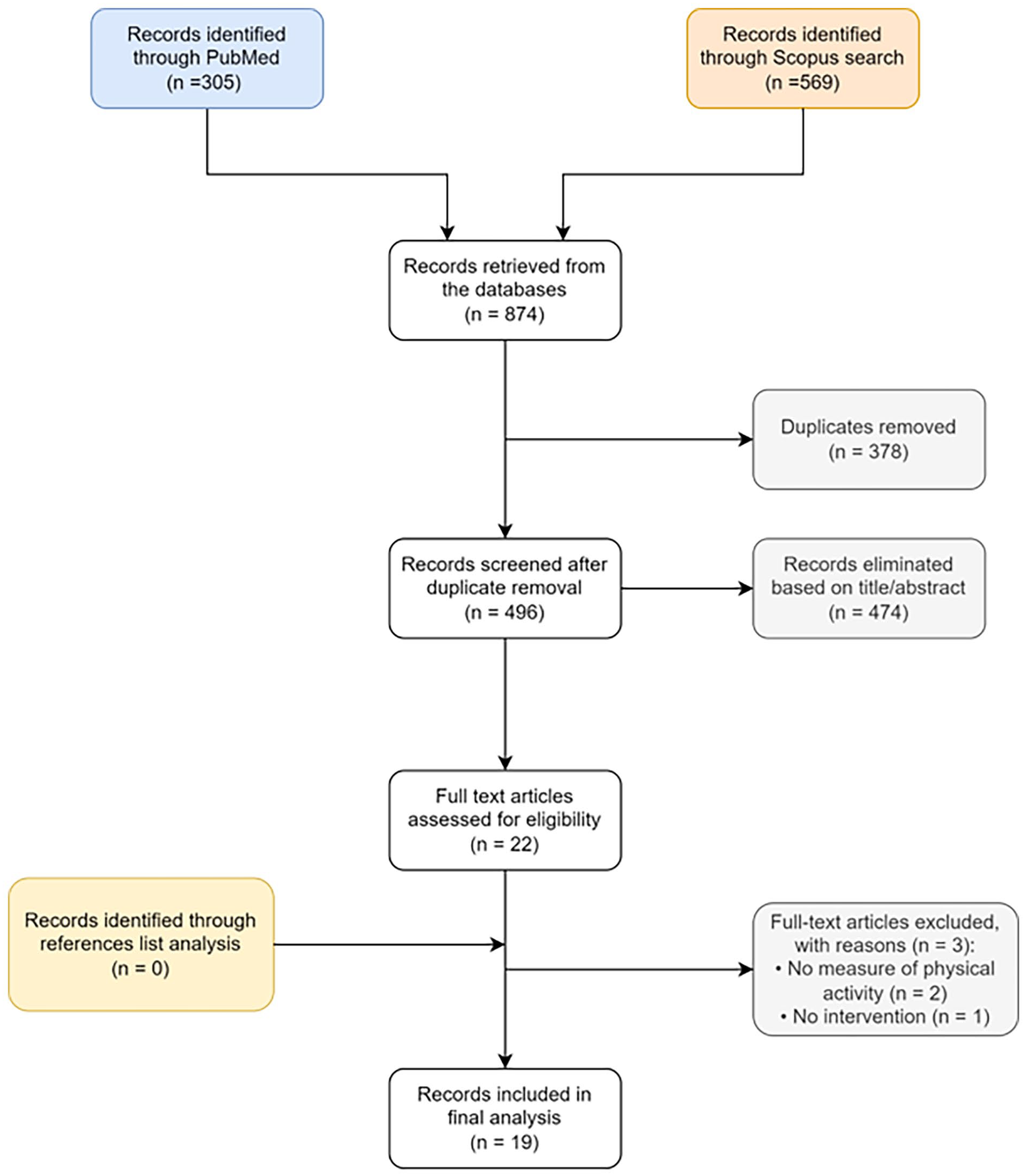
Flowchart on the selection of studies.
Results
Included Studies
The study selection process led to the identification of a total of 19 studies (Table 1) that met the inclusion criteria. One article 13 was discarded after the selection phase because it lacked measures of post-intervention physical activity due to an attrition rate of 91%, making it impossible to conduct a post-intervention evaluation.
Overview of Studies Reviewed.

Note. Intervention, results, and conclusions.
Populations
The 19 studies examined include samples for a total of 2579 university students. They were conducted in various parts of the world, including Canada (3), Serbia (2), Australia (1), Malaysia (1), South Korea (1), Saudi Arabia (1), UK (1), and China (1).
Many studies enrolled more females than males, and 4 (Cavallo et al, 14 Rote et al, 15 Nam and Cha, 16 and Alshahrani et al 17 ) recruited only women. The starting level of physical activity was used as a selection criterion at the beginning of 4 studies (Cavallo et al, 14 Rote et al, 15 Pope et al, 18 and Pope and Gao 19 ), not aiming to intervene on the general student population, but instead specifically targeting inactive students.
Interventions
The types and characteristics of the interventions in the 19 selected studies are very different (see Table 1), both for the presence of a control group, as well as for the technology type and combinations of strategies used. The most common intervention type combines an educational component (e.g., lectures, leaflets) and reinforcement through instant messages. Six studies (Nam and Cha, 16 Lua et al, 20 Sandrick et al, 21 Castro et al, 22 , Dillon et al, 23 and Hardan-Khalil et al 24 ) adopted this kind of intervention, 3 (Nam and Cha, 16 Lua et al, 20 and Dillon et al 23 ) of which with a passive control that did not receive any intervention (this makes it impossible to separate the educational component from the messages), while 2 (Sandrick et al 21 and Hardan-Khalil et al 24 ) had a control group that received the educational portion of the intervention but not the messages and 1 (Castro et al 22 ) did not have a control group (i.e., a “before and after” study).
Four studies (Castro et al, 22 Dillon et al, 23 Cotten and Prapavessis, 25 and Figueroa et al 26 ) only used messaging, but with varying characteristics of the control group. Two studies (Castro et al 22 and Figueroa et al 26 ) had no control at all (micro-randomized type and “before and after”), 1 article (Dillon et al 23 ) had a control that received no intervention, while the comparison group of the last study (Cotten and Prapavessis 25 ) received messages containing generic topics about health, but not specifically about physical activity.
Two interventions (Mandic et al 27 and Wang et al 28 ) only used social media (Facebook in 1 case, and WeChat in the other), both with passive controls. Two studies (Rote et al 15 and Pope et al 18 ) combined the use of social media (Facebook in both cases) with devices for monitoring physical activity (smartwatch or pedometer), and in both cases the control received the Facebook media intervention but not the devices.
The other 5 studies have a unique intervention design:
One study (Gilbert et al 29 ) combined the educational component with the use of social media (Facebook) and messages on mobile phones. The intervention group was compared with the control group which received just the educational intervention.
Another study (Cavallo et al 14 ) combined social media (Facebook) together with an educational program. The control group only received the educational program.
In a 3-arm study (Mandic et al 27 ): a group used a social strategy (Facebook), in another group the social media strategy was accompanied by an individual motivational interview and the last group received no intervention.
One study (Pope and Gao 19 ) combined a physical activity monitoring app with a social media intervention (Facebook). Control group participants received only social media interventions.
Finally, 1 study (Zhang et al 30 ) provided students with free access to a variety of physical activities offered by the institution, promoted using a social media versus a motivational strategy.
Outcome Measures
Throughout the 19 studies, the outcomes of our interest, as well as the methods for measuring them, were very varied.
Physical activity was the only outcome measure in twelve (Cavallo et al, 14 Nam and Cha, 16 Alshahrani et al, 17 Pope et al, 18 Pope and Gao, 19 Lua et al, 20 Sandrick et al, 21 Hardan-Khalil et al, 24 Mandic et al 27 , Wang et al, 28 Gilbert et al 29 , and Todorovic et al 31 ) of the 19 studies. In 2 articles (Rote et al 15 and Figueroa et al 26 ), participants’ daily steps were measured, which could also be considered as a form of physical activity measurement. An independent measure of sedentary behavior was used in 1 study (Castro et al 22 ), while 4 studies (Dillon et al, 23 Cotten and Prapavessis, 25 Zhang et al, 30 and Keahey et al 32 ) combined the measurement of sedentary behavior with physical activity.
The most common method of measuring physical activity or sedentary behavior was self-reporting through questionnaires. This method was used in 14 studies (Cavallo et al, 14 Nam and Cha, 16 Alshahrani et al, 17 Lua et al, 20 Sandrick et al, 21 Castro et al, 22 Dillon et al, 23 Hardan-Khalil et al, 24 Cotten and Prapavessis, 25 Figueroa et al, 26 Wang et al, 28 Gilbert et al, 29 Todorovic et al, 31 and Keahey et al 32 ), that is, nearly three-quarters of all studies reviewed. The most frequently used questionnaire is the International Physical Activity Questionnaire (IPAQ), often in its short form (IPAQ Short Form or IPAQ-S).
Two studies (Pope et al 18 and Castro et al 22 ) combined questionnaires with objective measures, using devices such as activ-Pal, pedometers, smartwatches, and even pedometer embedded in the students’ smartphones (Figueroa et al 26 ), while 3 (Rote et al, 15 Pope et al, 18 and Pope and Gao 19 ) just used these objective measures (without associating them with a self-reported measure).
In 14 (Cavallo et al, 14 Rote et al, 15 Nam and Cha, 16 Alshahrani et al, 17 Pope et al, 18 Lua et al, 20 Sandrick et al, 21 Castro et al, 22 Hardan-Khalil et al, 24 Figueroa et al 26 , Wang et al, 28 Gilbert et al, 29 Zhang et al, 30 and Todorovic et al 31 ) out of the 19 studies (approximately 74%), outcomes were measured exclusively at baseline and at the end of the intervention. Three studies (Pope et al, 18 Pope and Gao, 19 and Cotten and Prapavessis 25 ) added other interim measurements taken at regular intervals during the course of the intervention period, allowing assessment of the changes over time. Three other studies (Dillon et al, 23 Mandic et al 27 , and Keahey et al 32 ) also included a follow-up measurement, allowing an assessment of the degree of persistence of behavioral changes. Two cases (Dillon et al 23 and Keahey et al 32 ) used a very short follow-up (2 weeks after the intervention finished) while only 1 study (Mandic et al 27 ) presented a longer-term assessment (1 year after the end of the intervention).
Study Designs
More than half of the studies (11 out of 19) were randomized controlled trials (RCTs), while the others were non-RCTs (8 out of 19).
Some studies did not implement interventions focused only on physical activity promotion, but instead were multi-component interventions. Five studies (Lua et al, 20 Sandrick et al, 21 Hardan-Khalil et al, 24 Cotten and Prapavessis 25 , and Wang et al 28 ) included interventions to change eating behavior in order to promote healthier eating patterns. One study (Nam and Cha 16 ) evaluated the component of the physical activity intervention as part of a series of strategies aimed at reducing the symptoms of Premenstrual Syndrome in students. Lastly, 1 study (Sandrick et al 21 ) allowed participants to choose a behavioral style to follow (dealing with physical activity, diet, stress, and sleep), and then an intervention was designed to promote the health style chosen.
Effectiveness
Thirteen articles (Rote et al, 15 Nam and Cha, 16 Alshahrani et al, 17 Pope et al, 18 Pope and Gao, 19 Lua et al, 20 Sandrick et al, 21 Castro et al, 22 Dillon et al, 23 Figueroa et al, 26 Mandic et al, 27 Wang et al, 28 and Zhang et al 30 ) showed an improvement in physical activity in the group that underwent the intervention. Three studies (Hardan-Khalil et al, 24 Cotten and Prapavessis 25 , and Gilbert et al 29 ) did not show any improvement, while in 1 case (Keahey et al 32 ), a post-intervention worsening of physical activity was observed.
Finally, 2 studies (Cavallo et al 14 and Pope et al 18 ) did not find a significant association with increased physical activity when comparing the experimental and control groups on the application of the single versus the multi-component intervention strategy. The lack of significance should not be interpreted as a failure of the intervention, but rather as the absence of an advantage in the multi-component context compared with its single-strategy control.
Quality Assessment
Regarding RCT studies, the quality scores ranged from the highest value of 0.92 for (Sandrick et al 21 ) and the lowest of 0.67 for (Rote et al 15 ). More than 70% of the articles had a quality score of 0.8 or higher.
Analyzing the non-RCT studies, their scores ranged from a maximum of 0.93 for (Castro et al 22 ) and a minimum of 0.67 for (Todorovic et al 31 ). More than 60% of the articles had a quality score of 0.8 or higher.
Discussion
A total of 13 (Rote et al, 15 Nam and Cha, 16 Alshahrani et al, 17 Pope et al, 18 Pope and Gao, 19 Lua et al, 20 Sandrick et al, 21 Castro et al, 22 Dillon et al, 23 Figueroa et al, 26 Mandic et al, 27 Wang et al, 28 and Zhang et al 30 ) out of 19 intervention studies included in the present systematic review found an improvement in physical activity level, suggesting that intervention studies promoting physical activity in college students through the use of social media and/or text messaging could be effective.
Types of Interventions
Only 8 of the included interventions were based on a theoretical framework of behavior change (mentioned in the results section). According to Castro, 22 scientific studies often rely on “common sense” to define the research design, instead of using pre-existing evidence or conducting a thorough analysis of the determinants relevant to the study. In most cases, the protocol includes both an initial education and training component, which teaches participants the necessary skills and knowledge to motivate them to physical activity, and a reinforcement component. For example, attention and involvement of the subject were supported by messaging used as a reminder (Lua et al, 20 Sandrick et al, 21 Castro et al, 22 Dillon et al, 23 Hardan-Khalil et al, 24 Cotten and Prapavessis, 25 Figueroa et al, 26 and Keahey et al 32 ), or alternatively through the use of social media platforms (Cavallo et al, 14 Rote et al, 15 Nam and Cha, 16 Alshahrani et al, 17 Pope et al, 18 Pope and Gao, 19 Mandic et al, 27 Wang et al, 28 Gilbert et al 29 , Zhang et al, 30 and Todorovic et al 31 ). Several new studies are needed to assess how different components contribute to the overall efficacy of the protocol.
Technologies Adopted and Their Implications
Smartphones were used in most interventions, since they are now almost ubiquitous among college students. 33 A literature review supports the use of instant messaging over other methods of communication. An American study 34 revealed that, among respondents aged 18 to 23, text messaging was the preferred method of communication, over voice calls, email, or even face-to-face interactions. Among the studies carrying out interventions through social media, only a few used specialized platforms, such as INSHAPE in Cavallo et al 14 and a plugin for WeChat in Wang et al 28 , while the rest used Facebook. However, study results were published between 2012 and 2022, and it is important to note how young people’s perceptions of social media have changed. Using platforms which are the most popular and trendy in the specific historical period of the intervention is always important to cater to user preferences, which will of course change over time. Well-designed interventions may fail if they are implemented on platforms that are not liked or highly used by the target population. Based on the 2018 PewResearch’s survey 35 on 743 U.S. teens, Facebook is no longer the social media of choice in this demographic. According to the survey, YouTube was the most preferred online platform, selected by 85% of respondents, followed by Instagram with 72%, Snapchat with 69%, and Facebook with 51%. This means that 1 in 2 individuals could potentially be excluded from a youth health promotion intervention using this platform.
Generalizability of Results
Some notable factors and design choices may have influenced study results. First of all, timing of the intervention (Dillon et al 23 ), since the cyclical nature of health behaviors in college students can lead to bias in the measurements. For instance, Pope and Gao 19 acknowledged that because assessment sessions often coincide with holiday breaks (such as Christmas and Thanksgiving) or with examination periods, participants’ physical activity-related behavior may not reflect their usual behavior. Moreover, inferring long term treatment effectiveness is difficult, since most studies are short-term and lack post-intervention evaluations. One study (Keahey et al 32 ), conducted over the course of 1 semester, found that physical activity actually decreased post-intervention. It is possible to explain this decline in physical activity levels by the increased workload associated with the academic semester and by the inability of the intervention to provide coping strategies that should make it possible for the students to remain physically active. According to Castro 22 89% of respondents reported being sedentary during the examination period, based on the interviews conducted among study participants.
Communication contents is another factor which greatly varies among different studies. According to a study 36 of 1460 adults conducted in Australia in 2019, messages containing specific and achievable goals may be more effective in reducing sedentary behavior. The process of customizing messages to a population or individual may result in increased costs in the planning phase, but adds to the intervention’s effectiveness. Participants in a Danish study 37 of 2030 smokers between the ages of 15 and 25 were randomized between receiving personalized or non-personalized messages in the context of an online program for quitting smoking. Patients who received personalized messages were more likely to give up smoking for a long time.
The high proportion of female participants also reinforces the well-known difficulties in recruiting and engaging men in interventions that aim to promote healthy lifestyles. Achieving important population-level outcomes requires strategies that increase recruitment of male subjects in health promotion studies. In line with our results, a previous systematic review, 38 which analyzed 10 studies looking at interventions to promote healthy behavior, found 83.3% women in the studies on average. 39 Another study 40 was actually performed in order to evaluate possible methods to increase the recruitment of men in a physical activity promotion studies. They found that (consistent with the pre-existing literature) men are much less likely to respond to unisex communication campaigns, 41 instead the production of content geared toward males increases their involvement. There was a much greater likelihood for study participants to interact with advertisements containing concise and clear captions, especially below 35 words and images representing masculine traits, such as strength and leadership. Several studies came to the same conclusion: representing typically masculine ideals may be an effective way to boost male recruitment in health promotion programs. The difficulty in recruiting male subjects is a theme known in the context of health behavior studies, in fact males have increased risk for some chronic noncommunicable diseases that can be prevented. 42 A systematic literature review of 57 studies conducted in 2015 43 examined clustering patterns between health risk behaviors (such as alcohol abuse, smoking, and inactivity) and sociodemographic characteristics, finding that males were more frequently associated with those clusters. According to another systematic review published in 2014, 44 being male is associated with reduced “help-seeking behaviors,” highlighting their tendency to delay and avoid seeking medical care. As a result, disease diagnosis is delayed, mortality is higher, leading to a higher burden on the healthcare system. Special care should be taken when designing future studies, in order to increase the proportion of men as study subjects.
Finally, a geographical contextualization of each intervention is necessary in order to fully understand its generalizability and applicability outside the research environment. Thankfully, although technological and financial constraints may limit the effectiveness of mHealth, there is a growing body of literature that reassures of the potential of these interventions even in developing countries and in marginalized communities.45 -47 Of the studies included in the review, 3 took place in low- or middle-income countries (Lua et al, 20 Mandic et al, 27 and Todorovic et al 31 ) and all concluded in favor of the effectiveness of the intervention employed. In these studies, the inclusion criteria selected students who actively used digital platforms, but it should be noted that, unlike in developed countries, smartphone ownership is higher among adults in emerging economies. On the other hand, a limited number of studies conducted in developing countries on the topic of mHealth are of high quality.
Standardizing Outcome Measures
Physical activity outcome measures were very heterogeneous among the included studies, nevertheless they can essentially be divided into 2 macrocategories: direct and self-reported measures. The choice between these 2 measurement methods depends on the available evidence and the logistical and practical requirements of the specific intervention. 187 studies were analyzed in a Canadian systematic review 48 published in 2008, which found that the measurement method chosen can significantly influence the observed levels of physical activity.
Furthermore, problems in direct measurement standardization still exist. Thanks to technological advancements, we now have easy access to devices that are increasingly miniaturized and require no cumbersome wiring, making them less intrusive in the lives of participants. A Harvard Medical School article 49 published in 2014 describes the use of accelerometers (Actigraph GT3X model) in a long-term longitudinal study involving approximately 18 000 sedentary women over 62 years old. A number of challenges were encountered during the development of this project, including:
Logistical difficulties associated with retrieving and delivering devices. Approximately 2.1% of participants who received accelerometers did not return them, resulting in a substantial expense given the number of participants and cost (approximately $200-250 per person).
Data management, cleaning, and analysis difficulties. This long-term data collection results in a large amount of data (estimated in the article at 20 terabytes).
Another study 50 published in Medicine & Science in Sports & Exercise (2015) outlines the heterogeneity of physical activity measures. The study focuses on the importance of assessing the total volume of physical activity (TAC/d, Total Activity Counts per day), which is a standardized measure to summarizes the frequency, intensity, and duration of activity sessions. The widespread use of this measure would lead to greater comparability among different studies. To produce solid evidence, it is essential to use direct measurements, particularly in the analysis of behavioral sedentary and low-intensity physical activity, which are much more difficult to quantify than moderate- or high-intensity physical activity. The evidence on the health benefits of these types of physical activity is significantly less established than on moderate- or vigorous-intensity physical activity. Furthermore, the amount of data provided by these technologies, when combined with algorithms based on Machine Learning and artificial intelligence, may provide new insight into the effects of certain physical activity characteristics (such as intensity, frequency, duration, and volume) on health outcomes in the future.
Feasibility and Accessibility of Studies
The feasibility and/or acceptability of the interventions was considered in many studies. One study included in the current review (Castro et al 22 ), mentioned that the intervention protocol was “feasible and acceptable.” In fact, a questionnaire was administered at the end of the study to measure exactly this. Feedback from the students was substantially positive, while the only possible negative factor was the number of days the subjects were expected to wear the monitoring devices per week. Participants in Keahey et al’s 32 article who received messages liked the intervention (only 5.6% disliked the intervention).
Although many studies, including some in this review, have emphasized that the implemented interventions are low-cost (Wang 2021 28 and Keahey et al 32 ), cost-effectiveness related to different components of these interventions specific to different target populations has not yet been validated scientifically. It is crucial that this information be collected in order to plan the appropriate intervention for the right group of people, how to implement it, and in what context.
Synergistic Interventions with Environmental Changes
Based on the current holistic concept of health, which draws upon the socio-ecological theory, 51 the adoption of any health behavior, including an active lifestyle, is not solely influenced by individual factors, but also by environmental factors.
Several studies have been published with the aim of showing possible environmental intervention strategies in university students. One 52 attempted to translate the knowledge derived from studies that have successfully reduced sedentary lifestyles in pre-university students and office workers by introducing “sit-stand” desks, that is, that are capable of changing from a sitting height to a standing height with relative ease. Another study 53 conducted in Germany in 2019 combined the implementation of these “sit-stand” desks with “decisional cues,” placing posters and pictures in common university study areas. The study indicates that these reminders can promote the reduction of sedentary behavior and increase active behavior in its place. This shows how interventions that act on reducing environmental barriers can be highly effective.
One study (Castro et al 22 ) evidenced that the increase in physical activity was associated with an improvement in physical activity levels exclusively during weekends, because students are often away from the campus and in a different context. Again, this shows how the environment can influence adherence to the intervention and thus effectiveness.
To date, there are no studies in the literature combining individual-targeted strategies with environmental modification in university students. There is a need for more research on how these two components interact with each other, since the two can have a synergistic effect when combined.
Limitations
Heterogeneity of the interventions used and outcome measures meant that a meta-analysis was not possible. Many studies have been described as multi-component interventions that, in many cases, did not involve a control group necessary to evaluate the contribution of each component separately, limiting the understanding of the effectiveness of individual strategies and the impact of their interaction (Cavallo et al 14 , Nam and Cha, 16 Pope et al, 18 Pope and Gao 19 , Lua et al 20 , Sandrick et al, 21 Hardan-Khalil et al, 24 Cotton and Prapavessis, 25 Figueroa et al 26 , Mandic et al 27 , and Wang et al 28 ). Moreover, there was an observable tendency for these interventions to include mainly female individuals, and 4 studies actually recruited only female subjects. A further consideration is that in some research, inclusion criteria were based on the level of physical activity at baseline, which limited access to participants that were more active. The goal in these cases was to avoid bias created by a ceiling effect that prevents some subjects from increasing their physical activity levels due to their already high baseline levels.
Conclusion
The systematic review of literature revealed that new technologies, such as text messaging and social media, can effectively been used to improve physical activity habits among university students. The study highlighted the persistence of some key limitations to the existing body of evidence and just as many opportunities to enhance and improve the applicability of these interventions. First, the lack of standardization of the theoretical framework and study design, which reduces the possibility of replicating and adapting interventions in other settings. Second, the need for greater equity in scientific research on the topic, particularly with respect to gender and geographic setting. Finally, the opportunity to better tailor interventions to students through an analysis of their needs and habits and, in addition, by combining direct health promotion with environmental changes. In conclusion, it is important for researchers to act to shape health promotion interventions, basing their designs on past models and data to increase the likelihood that interventions will be effective when implemented.
Footnotes
Appendix 1
Acknowledgements
None to declare.
Author Contributions
Conceptualization, A.B.; methodology, A.B.; data curation, R.L.B., F.M., A.M., C.Z., and G.L.; writing—original draft preparation, R.L.B., A.M., C.Z., and A.B.; supervision, G.L. All authors have read and agreed to the published version of the manuscript.
Declaration of Conflicting Interests
The author(s) declared no potential conflicts of interest with respect to the research, authorship, and/or publication of this article.
Funding
The author(s) received no financial support for the research, authorship, and/or publication of this article.
Ethical Approval
This study is a systematic review and it does not require any ethical compliance.
