




Abstract
Health promotion and education are collaborative efforts involving patients, healthcare providers, and society, crucial for preventing and managing disease outbreaks. However, in Saudi Arabia, the actual or perceived endeavors of physicians and nurses in health education and promotion are not widely understood, which holds significant implications for those working in the field. This study aimed to evaluate the level of awareness and attitude toward health education and promotion among physicians and nurses in primary healthcare centers in Najran, Saudi Arabia. A descriptive cross-sectional study design was employed, and 187 participants were incorporated into the analysis. Questionnaires were distributed to physicians and nurses at the primary health care centers. Participants completed a face-to-face survey questionnaire about their awareness and attitude toward health education and promotion. One of the authors was physically present at the primary health care centers to assist the participants with answering the questionnaire questions. Saudis and physicians had higher awareness than non-Saudis and nurses, respectively. Work experience and institutional factors did not significantly influence awareness. A positive correlation between awareness and attitude was observed. However, perceived shortcomings in current approaches were identified, including a lack of skills and training, poor communication, and inadequate leadership support. Despite these challenges, healthcare professionals held positive attitudes toward health education, recognizing its importance in behavior change, reducing disparities, and influencing community policies. The study highlights the need for targeted interventions, including research on effective models, training programs, and improved communication and leadership support, to address identified gaps and optimize health education implementation.
Health promotion and education are collaborative efforts involving patients, healthcare providers, and society, crucial for preventing and managing disease outbreaks. However, in Saudi Arabia, the actual or perceived endeavors of physicians and nurses in health education and promotion are not widely understood, which holds significant implications for those working in the field.
The study revealed that health professionals in Saudi Arabia exhibit positive attitudes toward health education and promotion. However, the research also highlights several areas that could benefit from improvement or further attention. First, a significant proportion of respondents face challenges in presenting health education activities and feel that they lack the skills to provide effective health education. This suggests a need for increased training and support for health professionals in health education. Second, more than half of the respondents are unfamiliar with existing health education policies and procedures. This indicates that the distribution of health education policies and procedures among health professionals needs to be improved. Third, most respondents perceive a lack of health promotion leadership within their facilities. This suggests a need to strengthen leadership and support for health education in healthcare facilities.
The findings of this study indicated that healthcare workers in Saudi Arabia are committed to health education, despite the challenges they may face. The study reported that health professionals perceive health education as an integral component of their practice and recognize its potential to bring about positive changes.
Introduction
It is essential to assess current health promotion practices in health systems. Effective disease outbreak prevention and control requires recognizing health promotion as a collaborative process involving patients, health professionals, and society.
The term “awareness” describes a healthcare provider’s knowledge and understanding of patient-centered care, patient safety, and patient education. Within the scope of health education and promotion, attitude refers to an individual’s evaluative stance or predisposition toward a particular health-related behavior, concept, or message.
Health promotion and education are collaborative endeavors involving patients, healthcare providers, and society, crucial for preventing and managing disease outbreaks.
One of the most essential requirements for preventing and managing chronic disease is effective health promotion.1,2
In Saudi Arabia, effective health promotion is considered a key element in managing and preventing the onset of chronic diseases. The Saudi Ministry of Health (MOH) reports that 75% of Saudis do not attend regular checkups, 60% are overweight or obese, 60% do not exercise enough, and 18% of Saudis smoke. By 2030, the prevalence of health risk factors will increase the number of chronically ill Saudis from the current 5 to 10 million. 3
The most effective way to spread knowledge and motivate people to live a healthy lifestyle is through health education and awareness. In particular, the strategy of patient education has the potential to increase patient satisfaction cost-effectively and effectively, which leads to an improvement in the overall health of the population. 4
Individuals, communities, healthcare professionals, healthcare delivery organizations, and governments all play a role in health promotion. 5
To promote positive health outcomes and overall effective healthcare, healthcare professionals are recognized as contributing critically to health education in both acute and community settings.6,7 Importantly, the multiple educational moments provided by this setting make hospitalization an “opportunity” to promote lifestyle changes. Moreover, research has shown that most patients in the hospital are thinking about or desire to make at least some lifestyle changes. 8
Nurses’ and physicians’ role can be successful if they provide advisory services according to current guidelines and ensure that their proposals are supported by solid data.
More specifically, patient education is the process by which people learn health-related behaviors (knowledge, skills, attitudes, and values) and integrate those behaviors into their daily lives. 9
Nurses play an important role in health promotion by improving patients’ adherence to long-term medications and enhancing their quality of life, as well as encouraging patients and their families to take part in decision-making about problems related to their health. 10 Nurses are in a key position to positively impact patients’ lives through education, which can change their lives in the long term. 11
It is crucial to recognize the importance of health education in the work of healthcare professionals and establish clear standards that guide the overall organization of hospitals and primary healthcare centers, facilitating and supporting health promotion activities. 12
Primary healthcare centers (PHCs) play a critical role in providing basic health services to the population of Saudi Arabia. They are the first point of contact for people seeking medical help and provide a wide range of services, including preventive and curative care, maternal and child health services, family planning, and chronic disease management. 13
Patients seeking healthcare should first contact their local (PHCs). To provide quality healthcare to patients, the physicians and nurses working in PHCs play a critical role. The attitudes and awareness of healthcare professionals toward their patients have a direct impact on the standard of healthcare they provide. The attitudes and awareness of physicians and nurses working in PHCs toward their patients must therefore be assessed.
A Saudi Arabia study found that primary healthcare professionals have positive attitudes toward patient-centered care and high awareness levels.14,15 However, a study from Iran revealed low awareness and negative attitudes toward patient education among these professionals. 16
Many factors can influence the awareness and attitudes of physicians and nurses working in primary care settings toward their patients. One of these factors is the quality of education and training that healthcare workers receive. According to a Saudi study, physicians and nurses who had received training in patient-centered care had higher awareness and more positive attitudes than those who had not. 14 Similarly, a Jordanian study found that physicians and nurses who had received training in patient-centered care had more positive attitudes than those who had not. 17 According to another Saudi study, physicians and nurses who had participated in patient safety training had more positive attitudes toward their patients. 15
The other factor that can influence the awareness and attitudes of health professionals is leadership style and organizational culture. In a Saudi Arabia study, the organizational culture and leadership style of primary healthcare centers were found to have a significant impact on physicians’ and nurses’ awareness and attitudes toward patient-centered care and patient safety. 15 Consequently, healthcare facilities should promote a positive organizational culture and leadership style that emphasizes patient-centered care, patient safety, and patient education.
According to a Saudi study, physicians and nurses who had a strong awareness of patient-centered care demonstrated more favorable attitudes toward their patients. 14 This correlation is supported by a study conducted in Jordan, which revealed that physicians and nurses with positive attitudes toward patient-centered care also exhibited a greater understanding of its principles. 17
Researchers in Saudi Arabia examined nurses’ perspectives on health promotion and found that a lack of common language and cultural understanding is a major barrier to providing quality care in the region. 18 Furthermore, studies conducted in Saudi Arabia have revealed inadequate patient health education, with only 8% of healthcare centers having trained health educators, highlighting a shortage of qualified professionals in this field. Physicians, who often struggle to allocate sufficient time to each patient, also face challenges in providing adequate attention to health education, thereby impacting patient satisfaction. While it has been suggested that healthcare facilities should increase health promotion initiatives to enhance staff professional development and deliver appropriate care, there are instances where a receptive attitude toward prevention activities is evident. 5
It is essential to acknowledge that promoting health is an appropriate role for professionals like nurses. 19 However, in Saudi Arabia, the actual or perceived endeavors of physicians and nurses in health education and promotion are not widely understood, which holds significant implications for those working in the field. Clarifying and enhancing the understanding of physicians and nurses’ role in health promotion is crucial for advancing healthcare practice in the country. Thus, the study aimed to evaluate the level of awareness and attitude toward health education and promotion among physicians and nurses in primary healthcare centers in Najran, Saudi Arabia. The proposed question is “What attitudes and level of awareness do primary care physicians and nurses have toward health education and promotion?”
Methods
Research Design
A cross-sectional descriptive study was employed that relies on quantitative methods.
Population and Sampling
The focus of this research was the community of physicians and nurses working in primary healthcare centers in Najran, Saud Arabia. This community comprises of medical and nursing teams that specialize in providing healthcare to patients in this area.
The population settings are at 8 primary healthcare centers in Najran, Saudi Arabia; 5 out of these 8 centers operate 24 h a day while the remaining 3 operate for 16 h per day.
A convenience sampling technique was used. The sample size was determined using Raosoft® software, considering the total number of physicians and nurses with a 5% margin of error and 95% confidence interval. As a result, we set our sample estimate at 208 participants.
Inclusion Criteria
The target population of this study is all physicians and nurses working in primary care settings in Najran, Saud Arabia for evaluating their awareness and attitudes toward health education and promotion activities.
Exclusion Criteria
All administrators working in primary healthcare centers who do not directly provide healthcare services to patients, as well as other healthcare professionals other than nurses and physicians.
Study Tool
The self-administrated questionnaire was adapted to assess the awareness and attitude of health education and promotion.20,21 The questionnaire is divided into 3 parts:
The first part contains 5 demographic questions about the participants: gender, nationality, type of work, work experience, and name of healthcare center.
The second part includes 12 questions related to physicians’ and nurses’ awareness of health education and promotion interventions. For example, “Are health education an essential part of physicians’ and nurses’ practice.” Responses were recorded on a 5-point Likert scale ranging from “Strongly Agree” to “Strongly Disagree.”
The third part focuses on physicians’ and nurses’ attitudes toward health education and its promotion with 7 questions. For example, “The doctor or nurse is content with the existing approaches to health promotion.” Responses were also recorded on a 5-point Likert scale ranging from “Strongly Agree” to “Strongly Disagree.”
The pilot study included 17 physicians and nurses from primary care centers in Najran, Saudi Arabia. The location and community are made up of medical and nursing samples that fit the study’s population definition. The primary goal of the pilot study was to collect additional feedback on the time it took to complete the questionnaire, the clarity of the questions, and the logical arrangement. The pilot study provides valuable data and evidence for its validity and reliability. Table 1 shows the questionnaire’s validity, with a Cronbach’s alpha value of .60 to .80.
Validity of the Questionnaire.

Ethical Considerations
A certificate of completion of good clinical practice was obtained after passing the Good Clinical Practice (GCP) course for conducting studies and research. A certificate was also obtained from the National Committee for Bioethics (NCBE), and full ethical approval was obtained from the Research and Studies Department of the Directorate of Health Affairs in Najran, Saudi Arabia, before collecting respondent data for all 8 primary healthcare centers. “IRB registration number KACST, KSA: H-11-N-081” and “IRB log Number 2023-08 E”, in addition to written consent obtained by informed physicians and nursing staff before completion of the questioner.
Data Collection
Questionnaires were distributed to physicians and nurses (face-to-face). One of the authors was physically present at the primary health care centers to assist the participants with answering the questionnaire questions. The study was carried out in 2023 during the months of June and August. During the study, 208 questionnaires were collected. However, 21 questionnaires were eliminated from the analysis for reasons such as being completed by hospital staff rather than doctors or nurses (26%), incomplete responses (70%), and inappropriate responses (4%). As a result, data from 187 participants were included in the analysis.
Statistical Analysis
This study employed statistical data analysis to investigate the awareness and attitudes of physicians and nurses toward health education and promotion. Data were analyzed using IBM SPSS Statistics 29 (IBM Corp., 2022). Descriptive statistics were used to summarize and interpret the data. This includes measures of central tendency (meaning) and measures of dispersion (standard deviation). The Pearson correlation coefficient was used to examine the relationship between independent variables (demographics) and dependent variables (awareness and attitude). The Pearson correlation coefficient measures the linear relationship between these variables, providing insight into whether the relationship is positive or negative. This analysis helps determine the extent of the impact of demographics on awareness and attitude, as well as estimate the strength and direction of this influence.
Results
Demographic Data of the Study Participants
Table 2 summarizes the demographic profile of the study participants.
Demographics Characteristic Among Participants.

The sample consisted mainly of female participants, who accounted for 58% (n = 108) of the total. Most respondents 95% (n = 178) were of Saudi nationality, while the remaining 5% (n = 9) represented other nationalities. In terms of professional status, 65% (n = 121) of participants were nurses and 35% (n = 66) were physicians. On average, participants had 10 years of professional experience, with a standard deviation of 5 years. Participants were relatively evenly distributed across primary healthcare centers, with each center representing approximately 25% of the total sample.
Awareness of Health Education and Promotion
Table 3 shows the descriptive analysis of the awareness items, demonstrated that the majority of participants expressed agreement or strong agreement with the statements. For instance, item 1, which assessed the perception of health education as an essential part of participants’ health practice, received an average value of 4 (SD = 1.1). 90% (n = 168) of respondents agreed or strongly agreed with this statement.
Awareness of Health Education and Promotion.
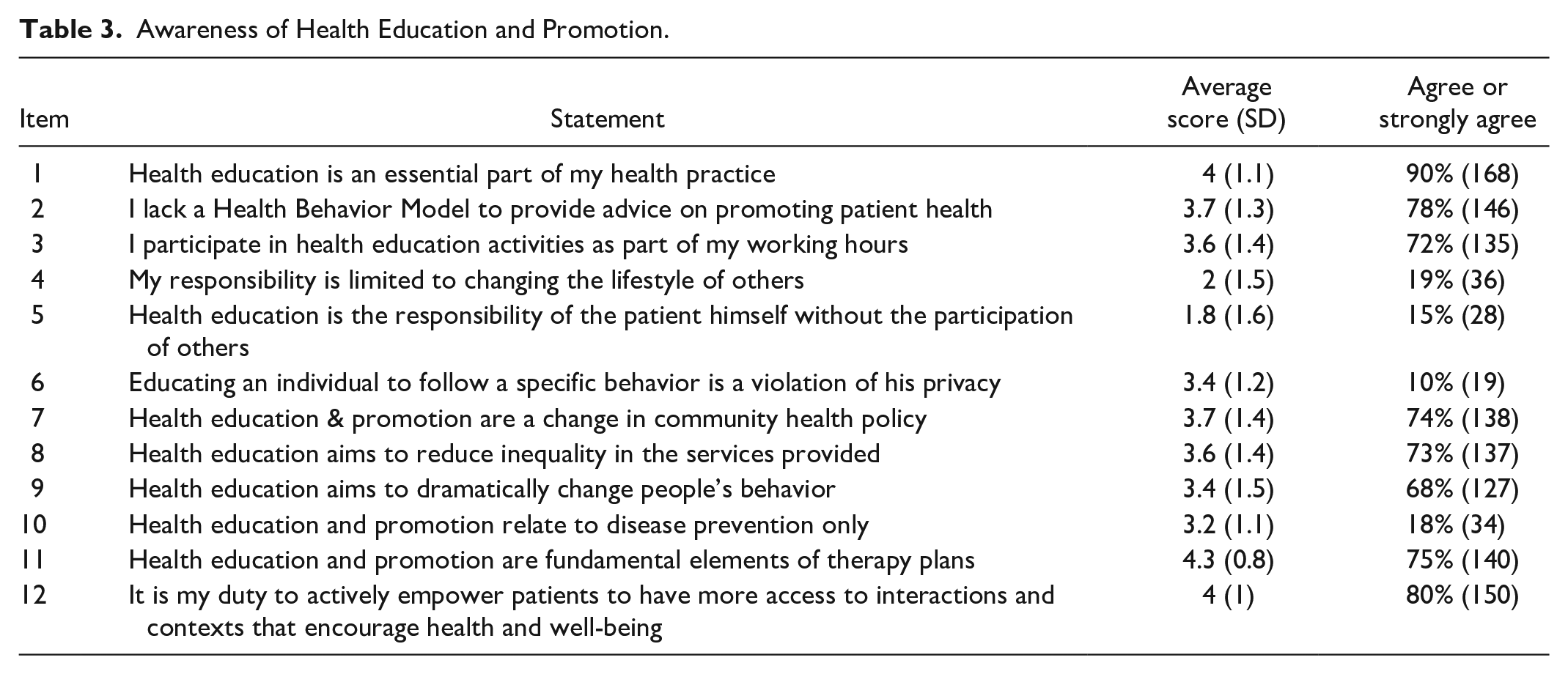
Item 2, which assessed the availability of a health behavior model for providing advice on promoting patients’ health, had an average value of 3.7 (SD = 1.3). Approximately 78% (n = 146) of respondents agreed with this statement, indicating that a significant portion of participants felt they lacked an effective health promotion model.
Item 3, which explored the participation of respondents in health education activities during their working hours, received an average score of 3.6 (SD = 1.4). About 72% (n = 135) of participants agreed with this statement, suggesting that most of them incorporate health education into their work routine.
Items 4 and 5, which were related to the responsibility for health education, received lower scores and agreement rates.
Item 6, which assessed the perception of health education as an invasion of patient privacy, had the lowest level of agreement at 10% (n = 19). This shows that most respondents did not view health education as an invasion of privacy.
Items 7 through 9, which examined the overall goals and impact of health education, received an average score ranging from 3.4 to 3.7 and agreement rates ranging from 68% to 74% (n = 127-138).
For item 10, which stated that health promotion relates only to disease prevention, agreement was low at 18% (n = 34). Item 11, which stated that health education and promotion are fundamental elements of treatment plans, received the highest average score of 4.3 (SD = 0.8) and an agreement level of 75% (n = 140).
Finally, item 12, which stated that it is my duty to actively empower patients with greater access to interactions and contexts that encourage health and well-being, had a high average score of 4 (SD = 1) and an agreement level of 80% (n = 150).
Attitudes Toward Health Education and Promotion
Table 4 shows the descriptive analysis of attitudes toward health education and promotion.
Item 13, which states that “patients respond positively to the advice given to them,” received an average score of 4.2 (SD = 1), indicating a relatively high level of agreement. Approximately 83% (n = 155) of the respondents agreed or strongly agreed with this statement.
Item 14, “I face challenges in presenting promotional and educational activities,” had an average score of 3.7 (SD = 1.3), suggesting a moderate level of agreement. Around 65% (n = 122) of the participants agreed with this statement.
Item 15, “I do not have adequate skills to provide adequate and effective educational activities,” obtained an average score of 3.6 (SD = 1.4), indicating a moderate level of agreement. Approximately 62% (n = 116) of the respondents consented to this statement.
Item 16, “I need training courses on health promotion strategies,” received an average score of 4 (SD = 1.1), indicating a relatively high level of agreement. Approximately 78% (n = 146) of the participants consented to this statement.
Item 17, “I am not familiar with the health education policies and procedures applied in health facilities,” had an average score of 3.5 (SD = 1.5), suggesting a moderate level of agreement. Approximately 58% (n = 108) of the respondents concurred with this statement.
Item 18, “I am completely satisfied with the current approach to health promotion,” received an average score of 3.2 (SD = 1.6), indicating a lower level of agreement. Only around 45% (n = 84) of the participants concurred with this statement.
Finally, Item 19, “There is a lack of effective leadership for health promotion within health facilities,” had a high mean score of 3.9 (SD = 1.2) and an agreement level of 74% (n = 138).
Attitudes Toward Health Education and Promotion.

Correlation Analysis
There was no significant difference in awareness or attitude toward health promotion and education between male and female participants. This suggests that gender does not significantly influence these aspects.
Saudi participants had a higher awareness of health promotion and education than non-Saudi participants, which was reflected in an average score of 3.85 compared to 3.68 (P < .05). However, nationality had no significant effect on attitudes toward health education and promotion.
Physicians exhibited a higher level of awareness of health education and promotion than nurses, with mean scores of 3.91 and 3.72, respectively (P < .05). Despite this difference in awareness levels, there was no significant difference in attitudes toward health promotion and education between these 2 professional groups.
Work experience did not show a significant correlation with either awareness or attitudes toward health promotion and education. This implies that these factors are not significantly influenced by the length of professional experience. Last, there were no significant variances in awareness or attitudes toward health education and promotion across the different primary healthcare centers.
Correlation analysis of the awareness and attitude items (Table 5) showed that there was a significant positive correlation between the total awareness and attitude scores (r = .79), indicating that higher awareness was associated with more positive attitudes toward health education and promotion.
Correlation Between Awareness and Attitude in the Study Population.
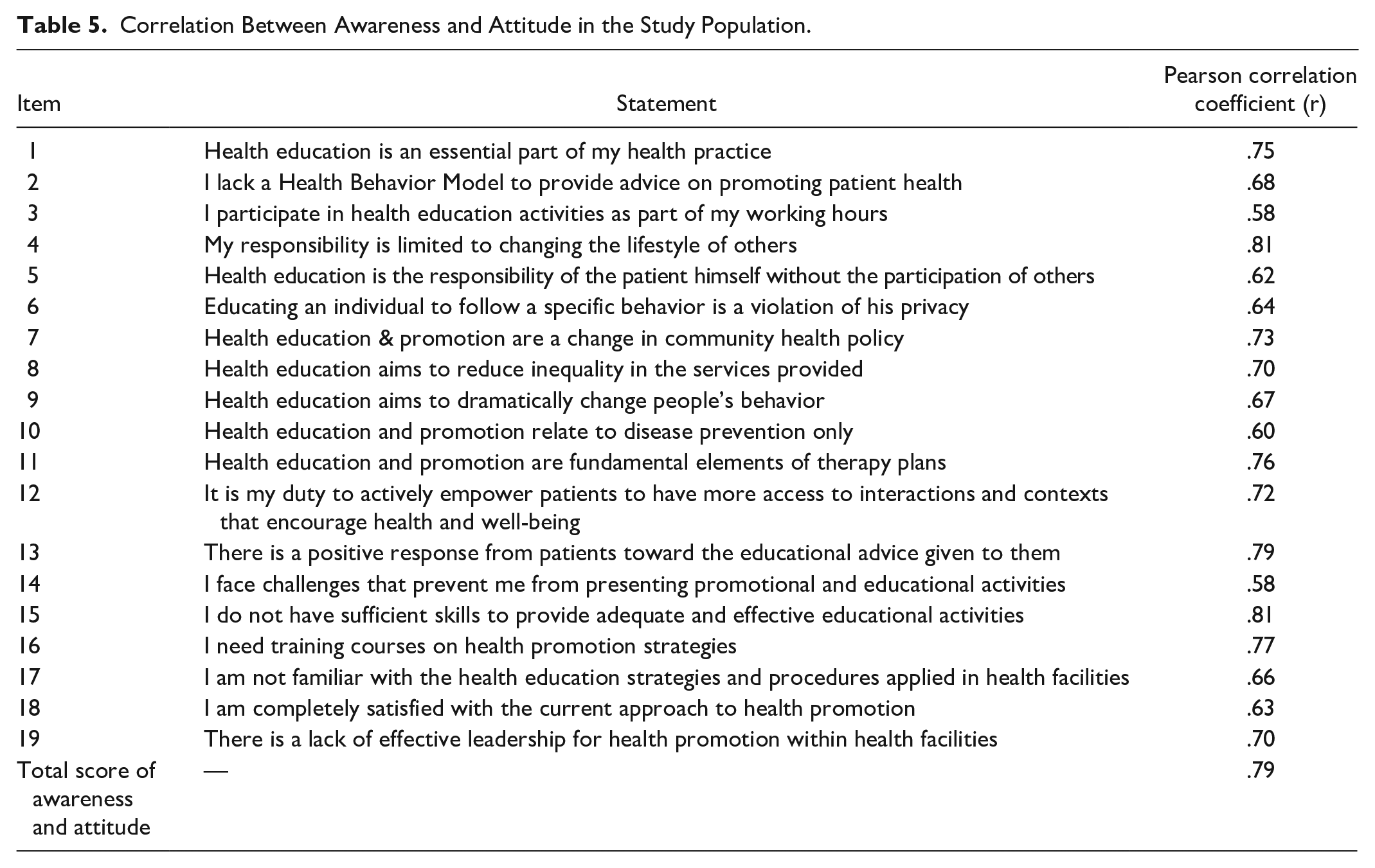
Item 1, “Health education is an essential part of my health practice,” had a Pearson correlation coefficient of .75, indicating a strong positive correlation between awareness and attitude for this item.
Item 2, “I lack a behavioral health model to provide advice on promoting patient health,” had a correlation coefficient of .68, indicating a moderate to strong positive correlation.
Item 3, “I participate in health education activities as part of my work schedule,” had a correlation coefficient of .58, indicating a moderate positive correlation. Item 4, “My responsibility is limited to changing the lifestyle of others,” had the highest correlation coefficient at .81, indicating a very strong positive correlation. Items 5 through 19 had correlation coefficients ranging from 0.62 to 0.81, indicating varying degrees of positive correlation between awareness and attitude for these items.
These results suggest that physicians’ and nurses’ attitudes toward health education and promotion were positively influenced by their extent of awareness of these practices.
Discussion
Significance of Demographic Characteristics on Awareness and Attitude
This study assessed the awareness and attitudes of healthcare professionals in Najran, Saudi Arabia, regarding health education and promotion. The results indicated that, on average, healthcare professionals in this region have a relatively high level of awareness, with an average score of 3.79 out of 5. However, it is important to note that there were variations in awareness and attitudes based on demographic characteristics.
Saudi participants had a higher awareness of health education and promotion than non-Saudi. This may be because health education and promotion initiatives are more widely available and accessible in Saudi Arabia. Additionally, Saudi healthcare professionals may be more familiar with the cultural context of health education and promotion in Saudi Arabia, which may make them more likely to be aware of and supportive of these initiatives. 5
The outcomes of the study revealed that physicians exhibited a higher level of awareness of health education and promotion compared to nurses. This difference could be attributed to several factors. First, physicians typically receive more extensive training during their medical education, which may contribute to their heightened awareness in this area. Second, physicians are more likely to be directly involved in health education and promotion activities as part of their clinical practice. They often have more opportunities to interact with patients, provide counseling, and deliver health education messages. This hands-on experience and regular engagement with patients may contribute to their increased awareness and understanding of health education and promotion principles. 22 Work experience showed no significant correlation between awareness or attitude toward health education and promotion. This suggests that these factors are not significantly affected by the length of work experience. 23
There were no significant differences in awareness or attitudes toward health education and promotion among the different primary healthcare centers. This suggests that institutional factors at the individual health center level do not significantly influence these aspects.
The findings of this study indicated that healthcare practitioners in Saudi Arabia possess a favorable awareness and attitude toward health education and promotion. This is an encouraging finding, as health education and promotion play an important role in improving the health of the people.
Impact of Awareness of Health Promotion and Education
The study findings reported a significant positive correlation between awareness and attitudes toward health education and promotion among healthcare professionals in Saudi Arabia. This implies that healthcare professionals who possess a higher level of awareness regarding health education and promotion activities are more likely to exhibit positive attitudes toward them. This correlation suggests that increasing awareness of health education and promotion could be a promising approach to fostering more favorable attitudes among healthcare professionals.
The correlation analysis also revealed that some items were more strongly correlated with awareness of health education and promotion than others. For example, the item “My responsibility is limited to changing the lifestyle of others” had the highest correlation coefficient, suggesting that health professionals who are more aware of health education and promotion are also more likely to concur with the statement that they are not solely responsible for changing patients’ lifestyles. This finding is consistent with the outcomes of the descriptive analysis, which showed that respondents did not feel solely responsible for changing patients’ lifestyles.5,24 Awareness of health education and promotion is an important factor shaping health professionals’ attitudes toward these practices.
Impact of Attitudes Toward Health Promotion and Education
The study revealed that health professionals in Saudi Arabia exhibit positive attitudes toward health education and promotion. However, the research also highlights several areas that could benefit from improvement or further attention. First, a significant proportion of respondents face challenges in presenting health education activities and feel that they lack the skills to provide effective health education. This suggests a need for increased training and support for health professionals in health education. Second, more than half of the respondents are unfamiliar with existing health education policies and procedures. This indicates that the distribution of health education policies and procedures among health professionals needs to be improved. Third, most respondents perceive a lack of health promotion leadership within their facilities. This suggests a need to strengthen leadership and support for health education in healthcare facilities.
The findings of this study indicated that healthcare workers in Saudi Arabia are committed to health education, despite the challenges they may face. The study reported that health professionals perceive health education as an integral component of their practice and recognize its potential to bring about positive changes.
The consistency of the current study’s findings with previous research on health education and promotion among healthcare workers in Saudi Arabia provides further support for the conclusions drawn. The mentioned studies5,15 provided additional insights into the attitudes and issues encountered by healthcare professionals in the country. One study highlighted the positive attitude of health professionals toward health education and promotion in Saudi Arabia while acknowledging the obstacles they encounter, such as limited time and resources. 25 This aligns with the current study’s findings, which suggest a commitment to health education and promotion among healthcare professionals despite the challenges they face. Another study emphasized the need for additional training on health education and promotion among health workers in Saudi Arabia. 26 This finding reinforces the current study’s recommendation for targeted interventions and educational programs to enhance healthcare professionals’ knowledge and skills in health education and promotion.
Future Research Directions
The study results suggest several potential future research directions in health education and promotion among healthcare professionals in Saudi Arabia. These include:
Research and evaluation of effective health promotion models in primary care: Further investigation can focus on identifying and evaluating different models or approaches to health promotion that can be effectively implemented in primary care settings. This research can provide insights into the most successful strategies for promoting health and preventing diseases among patients.
Developing and implementing training programs: Research can be conducted to develop and implement comprehensive training programs that enhance healthcare providers’ skills and knowledge in health education and promotion. These programs can address the specific needs and challenges identified in the current study, providing healthcare professionals with the tools to effectively engage in health education and promotion activities.
Investigating challenges in executing health education activities: Future research can delve deeper into the specific difficulties confronted by healthcare professionals when implementing health education activities. This can involve exploring barriers, such as time constraints, resource limitations, and organizational factors. Understanding these challenges can inform the development of targeted interventions and strategies to overcome them.
Examining the impact of health education and promotion activities on patient outcomes: It would be valuable to conduct studies that assess the impact of health education and promotion activities on patient outcomes. This research can explore the effectiveness of different interventions, identify best practices, and provide evidence to support the integration of health education and promotion into routine clinical care.
Strength and Limitations of the Study
The study evaluated awareness and attitudes towards health education and promotion using validated instruments. It also explored the influence of demographic factors like nationality and professional role on these attitudes. This multidimensional analysis provides a comprehensive understanding of healthcare professionals’ perspectives. The study’s findings are valuable in the field and establish connections with previous research in Saudi Arabia, contributing to the understanding of health education and promotion. This study contributed to a better understanding of physicians’ and nurses’ awareness and attitudes toward health education and promotion in primary care settings in Saudi Arabia, though it still has some limitations.
The present study refers only to healthcare professionals in one region of Saudi Arabia. The results will not be generalizable to other regions or countries because of differences in healthcare infrastructure, cultural norms, or other socioeconomic aspects. The study also uses participant self-report, which may be influenced by social desirability or poor recall. Another limitation is that the current study only considered healthcare professionals employed in primary care facilities. However, this does not consider the fact that medical professionals in other settings, such as hospitals and private clinics, may have a different awareness and attitude toward health promotion and education.
Conclusion
The study found a positive correlation between awareness and attitude towards health education and promotion, suggesting that higher levels of awareness lead to more positive attitudes towards these practices. This highlights the need for increased healthcare providers’ engagement in these activities. The findings suggest future research directions in health education and promotion among healthcare professionals in Saudi Arabia. These include:
Researching effective health promotion models in primary care settings to gain insights into successful strategies.
Developing comprehensive training programs for healthcare providers in health education and promotion.
Investigating the challenges faced by healthcare professionals in implementing health education activities.
Examining the impact of health education and promotion on patient outcomes to identify best practices.
The study highlights the need for targeted interventions to improve health education integration in primary health centers. It also highlights the importance of fostering interdisciplinary collaborations and knowledge exchange to address COVID-19 prevention challenges. This can be achieved through research networks, conferences, and promoting collaborative projects, thereby enhancing awareness and attitudes towards health education among healthcare professionals.
Supplemental Material
sj-docx-1-inq-10.1177_00469580241248127 – Supplemental material for Awareness and Attitudes toward Health Education and Promotion among Physicians and Nurses: Implications for Primary Health Care
Supplemental material, sj-docx-1-inq-10.1177_00469580241248127 for Awareness and Attitudes toward Health Education and Promotion among Physicians and Nurses: Implications for Primary Health Care by Nawal A. Alissa and Mohammed Alwargash in INQUIRY: The Journal of Health Care Organization, Provision, and Financing
Footnotes
Declaration of Conflicting Interests
The author(s) declared no potential conflicts of interest with respect to the research, authorship, and/or publication of this article.
Funding
The author(s) received no financial support for the research, authorship, and/or publication of this article.

Supplemental Material
Supplemental material for this article is available online.
References
Supplementary Material
Please find the following supplemental material available below.
For Open Access articles published under a Creative Commons License, all supplemental material carries the same license as the article it is associated with.
For non-Open Access articles published, all supplemental material carries a non-exclusive license, and permission requests for re-use of supplemental material or any part of supplemental material shall be sent directly to the copyright owner as specified in the copyright notice associated with the article.
