




Abstract
Existing literature generally suggests that rising labor costs lead to the substitution of capital for labor, prompting firms to save on labor costs through technological upgrades. However, as a typical human capital-intensive industry, the pharmaceutical sector finds it challenging to replace labor with capital through the introduction of advanced equipment. Therefore, compared to other industries, the pharmaceutical sector faces greater adverse impacts. Research on how pharmaceutical R&D behavior is influenced by labor costs is scarce. This paper analyzes the triple effects of rising labor costs on corporate innovation from the perspectives of human capital, physical capital, and financial capital. Based on empirical research using data from Chinese listed companies, we found that an increase in labor costs promotes innovation output in the pharmaceutical sector, but this effect is more pronounced in other sectors. Financing constraints play a negative role on corporate innovation in the pharmaceutical sector, while it is not significant in the other sectors. Factor substitution play a positive effect on corporate innovation in the other sectors, which is invalid in the pharmaceutical sector. This research contributes to a deeper understanding of the unique mechanisms by which labor costs impact innovation activities in the pharmaceutical industry.
Introduction
The accelerating economic globalization has promoted numerous emerging economies to achieve rapid economic growth through cost advantages and factors including the labor force. However, economic development among emerging economies inevitably comes with the challenge of rising labor cost. Thus, the original labor-intensive industries may suffer from the lack of economic growth and may consequently step into the “middle-income trap” if they fail to increase posts with a boomed remuneration. The relationship between rising labor costs and corporate innovation remains a contentious topic. Most research believe that, labor costs rising would promote enterprises to substitute labor with capital or technology.1 -6 One perspective, based on traditional induced investment theory, posits that when labor costs rise relative to capital costs, it induces firms to innovate in labor-saving technology to maintain ongoing operations and competitive advantage.7,8 Another viewpoint, based on efficiency wage theory, argues that wages and efficiency are strongly positively correlated, meaning that higher wages paid by firms can enhance workers’ overall quality and motivate them to improve productivity, thereby increasing the level of corporate innovation.9,10 Numerous empirical studies have confirmed the substitution relationship between wage levels and technological innovation.11 -17 However, many studies also argued that rising labor costs are detrimental to corporate technological innovation.18,19 Higher labor wages might also diminish a firm’s profitability, reducing internal capital available for R&D investment.20 -24 Acemoglu 12 posited that the relationship between labor costs and innovation varies across industries, periods, and different countries’ institutional settings. Therefore, how rising labor costs affect corporate innovation still requires further exploration.
Existing literature primarily examines the impact of labor costs increases on corporate innovation from a general perspective, often overlooking heterogeneity between innovation types. Innovation in enterprises can be categorized into process and product innovations. 25 Product innovations are embodied in the outputs of an organization, its goods or services. Process innovations are innovations in the way an organization conducts its business, such as in techniques of producing or marketing goods or services. 26 The factors influencing process innovation and product innovation differ significantly. Product innovation is primarily driven by internal factors within a firm, while process innovation is more often motivated by external technological changes. 25 Pharmaceutical companies focus on the product innovation no process innovation.27,28 Pharmaceutical product innovation is distinguished by its extensive and costly R&D cycle, where pharmaceutical FEI/research constitute a period of up to 5 years and the entire R&D process often lasts between 10 and 12 years. 29 The pharmaceutical industry has unique characteristics that distinguish it from other industries.27,30 Due to these particularities, it is necessary to closely examine the relationship between labor costs and innovation in the pharmaceutical industry. Moreover, the mechanisms of labor costs affecting innovation in the pharmaceutical industry has been rarely investigated. This study also tries to shed light on these subjects that have been inadequately explored.
This study aims to reveal the particular influence of labor costs rising on innovation on the pharmaceutical sector from 3 mechanisms: financing constraint, employ incentives, and factor substitution. It will providing a theoretical foundation for a deeper understanding the different impact of rising labor costs between corporate product and process innovation. The results indicate that, compared to other industries, the rise in labor costs has a more pronounced inhibitory effect on innovation within pharmaceutical companies. There are 2 reasons for these results. First, product innovation in pharmaceutical firms requires significant capital investment, and rising costs can lead to financing constraints. Second, in companies where product innovation is paramount, increasing labor costs do not lead to a significant substitution of capital for labor, making the factor substitution effect less apparent. These findings reveal the unique impact mechanism of labor costs on product innovation.
Research Hypotheses
Product innovation primarily relies on the input of human capital, physical capital, and financial capital.31,32 Therefore, this study aims to examine how rising labor costs affect technological innovation in pharmaceutical companies from these 3 dimensions. From the financial capital perspective, innovation requires substantial financial investment, so rising labor costs may affect corporate innovation through financing constraints. 33 From the human capital perspective, efficiency wage theory suggests that overpay wages help enhance employee effort levels. In the human capital-intensive pharmaceutical industry, high wage will contribute to improved efficiency in product innovation. 9 From the physical capital perspective, rising labor costs will lead to the substitution of machinery for labor inputs, thereby enhancing innovation efficiency. Therefore, the following hypotheses will investigate the impact of rising labor costs on pharmaceutical corporate innovation from three aspects: financing constraints, employee incentives, and factor substitution. Figure 1 shows the transmission mechanisms of labor costs affecting technological innovation.

Mechanism of labor costs influence on technological innovation.
Financing Constraint
The pharmaceutical industry is characterized by one of the highest research and development (R&D) intensity among all industry sectors, the long period and low success rate of product (drug) development.27,30 Rising labor costs increase operational costs and diminish financial performance, 34 leading to tighter financing constraints and thus limiting innovation activities. From an internal financing perspective, increased labor costs reduce profits and internal cash flow, causing internal financing difficulties.35,36 From an external financing perspective, innovation activities are inherently high-risk and uncertain, with substantial funding needs. High levels of debt financing can consume profits and contract company cash flow, posing financial risks. Creditors, having limited understanding of a firm’s investment projects and being at an informational disadvantage, face further information asymmetry, especially since innovation and R&D projects are internal information resources with a focus on confidentiality management, leading to adverse selection and moral hazard. 37 Therefore, firms implementing technological innovation face higher financial pressure than their competitors. 38 Wang et al 39 examined the impact of bank financing on technological innovation in BRICS countries, finding a positive correlation between bank financing and technological innovation. Based on the above analysis, the second hypothesis is proposed:
Employee Incentives
Efficiency wage theory explains from the employee’s perspective how wage levels incentivize workers. The theory posits that firms are willing to pay wages higher than market-clearing levels to motivate employees to enhance productivity and innovation levels. 34 Bena 1 argued that increased wage levels have an innovation incentive effect, with corporate innovation capabilities growing in tandem with employee compensation. The shirking model suggests that wage increases can improve employee work efficiency to some extent, thus benefiting corporate innovation levels.40 -42 Kong et al 10 also believed that paying higher relative wages encourages ordinary employees to improve both the quantity and quality of patents in terms of innovation outcomes. Furthermore, paying higher wage levels motivates employees to work harder, raising their opportunity cost of quitting, leading to a reduction in negative behaviors such as laziness and shirking, thereby improving labor productivity.40,43,44 Based on the above analysis, the first research hypothesis is proposed as follow:
Factor Substitution
Hicks 34 observed that an increase in the relative price of a factor of production induces firms to reduce their reliance on this factor, substituting it with others to achieve optimal output, albeit within a certain scope of effect. Antonelli and Quatraro 45 further argued that under conditions of labor scarcity, leading to rising wages, firms, in pursuit of profit maximization and enhanced product competitiveness, typically increase investments in advanced technological equipment or boost R&D funding to improve production efficiency. However, this mechanism may not hold for industries like pharmaceuticals. Unlike traditional manufacturing, the pharmaceutical sector is talent-intensive. 46 Production equipment is not as critical to the pharmaceutical industry as human expertise. Therefore, improvements in production equipment cannot substitute for labor to facilitate technological advancement. Based on these considerations, this paper proposes the following hypothesis:
Research Design
Data
The empirical research data is sourced from the Wind database, the Patent Retrieval and Analysis System of the China National Intellectual Property Administration, and the China City Statistical Yearbook. The sample scope includes panel data of all A-share pharmaceutical companies listed in China from 2012 to 2021. To ensure robust results, the following processing steps were applied to the original data. First, according to usual practice, listed companies that have ever received special treatment are excluded. The name of a stock receiving special treatment or delisting a risk warning is prefixed with ST or *ST. Second, missing values for key indicators, including total R&D expenditures, labor costs, and the number of patent applications, were eliminated. Third, to control the impact of outliers, the observation was winsorized at 1st and 99th percentiles. Forth, to eliminate the impact of price factors, monetary indicators were deflated using the Consumer Price Index (CPI). After these processes, a total of 1634 valid observations were obtained.
Variables



The selection of control variables adheres to two principles. First, control variables should not be affected by the independent variable of rising labor costs to avoid collinearity and biased estimations. Second, control variables should be as exogenous as possible to prevent endogeneity issues. This study controls following corporate-level factors: total assets, current ratio, fixed asset ratio, and asset-liability ratio. Meanwhile, considering the significant clustering effect of technological innovation, where more developed regions exhibit a more pronounced clustering effect, leading to more frequent innovative activities and richer innovation outcomes in companies, we also control city-level factors, including GDP per capita, number of employees and market competition intensity (Herfindahl-Hirschman Index, HHI) (Table 1).
Definitions and Descriptive Statistics of Variables.

Regression Model
Negative binomial model
Given that the dependent variable, the number of patent applications, is count data, the Negative Binomial Model is used for regression analysis. For listed company i in period t, let the number of patent applications be denoted as

Herein,

In this model,

The first-order condition for maximizing equation (6) is as follow:

The descriptive statistics of the variables reveal significant differences in the means and variances of the total number of patents, invention patents, and non-invention patents. This suggests that the dependent variable exhibits “over dispersion.” A common approach to address this issue is to include an additional term in the logarithmic expression of the conditional expectation function:

In equation (8), the random variable

It can be demonstrated that in the Negative Binomial Regression Model, the conditional expectation remains
Mechanism test
Following the stepwise regression method outlined by Baron and Kenny, 51 this study tests the mediation effects of financing constraints, employee incentives, and factor substitution on the impact of rising labor costs on corporate innovation. In the first step, the regression of labor costs on corporate innovation is examined by following model:

Herein, i represents the company; t represents the year; dependent variable in the left is corporate innovation; the log-transformed labor costs is used as core explain variable.
In the second step, the regression of labor costs on the mediating variables is examined by the coefficient

In equation (11), mediating variables denote financing constraints, employee incentives, and factor substitution.
In the third step, the regression of both labor costs and mediating variables on corporate innovation is conducted to obtain the coefficient

The results of the three-step regression analysis reveal the total effect as
Empirical Results
Baseline Regression Results
The fixed-effects negative binomial regression model was employed to analyze the impact of labor costs on corporate technological innovation. Initially, in column 1 of Table 2, the estimation was conducted without including any control variables. Subsequently, column 2 and 3 progressively included control variables at the firm and regional levels. In column 4, we added the interaction item of industry dummy variable and labor costs to examine whether there are differences between the pharmaceutical industry and other industries. The coefficient of interaction item is significantly negative. It means that the coefficient of pharmaceutical industry is significantly less than that of other industries. In columns 5 and 6, invention patents were used as the dependent variable, when non-invention patents were the dependent variable in columns 7 and 8. All estimation results indicate that the coefficient for labor costs is significantly positive passing the 1% significance level test. Furthermore, the coefficient of interaction item is negative, passing 5% and 10% significance level test respectively. This suggests that rising labor costs make less impacts on innovation in pharmaceutical industry comparing to other industries.
Baseline Regression Results (Negative Binomial Model).
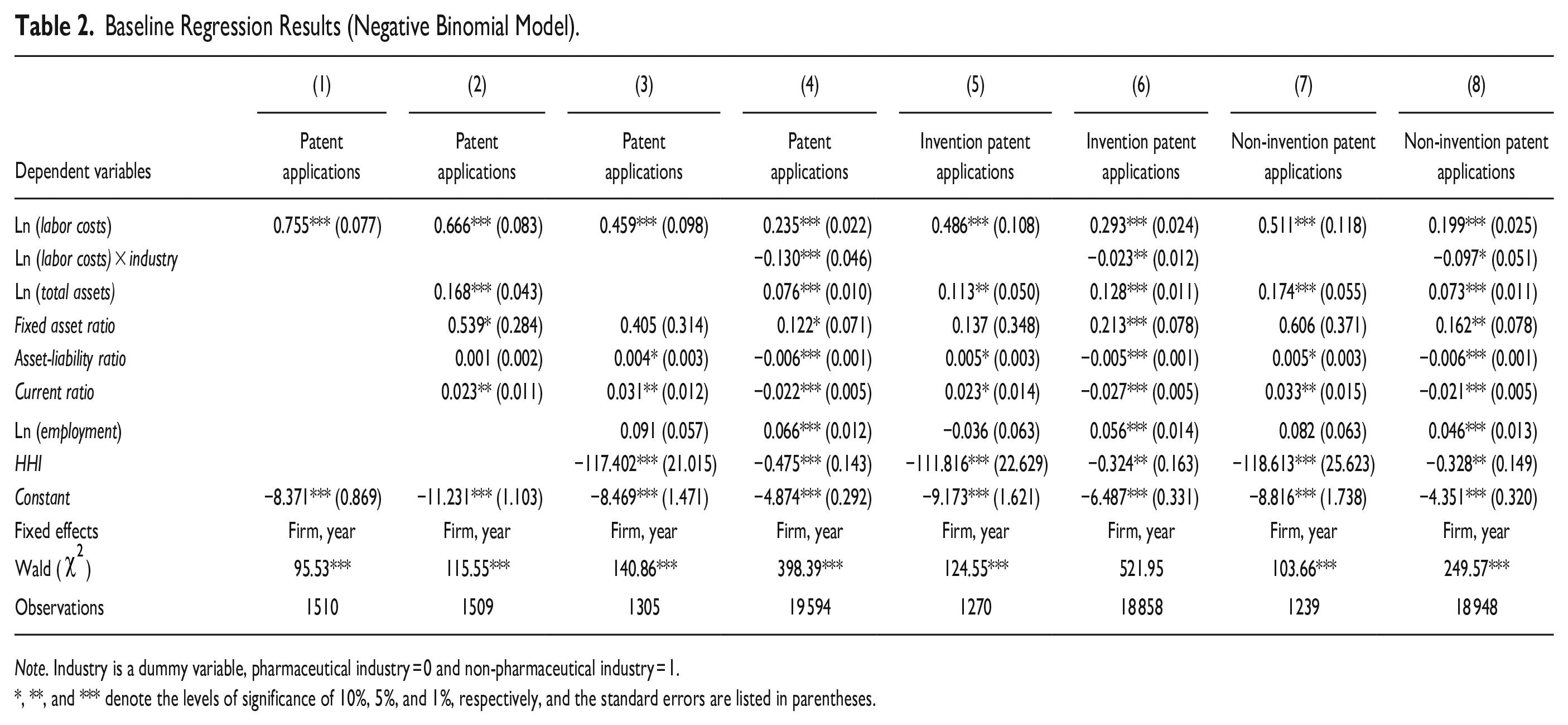
Note. Industry is a dummy variable, pharmaceutical industry = 0 and non-pharmaceutical industry = 1.
, **, and *** denote the levels of significance of 10%, 5%, and 1%, respectively, and the standard errors are listed in parentheses.
The empirical study presented in Table 2 also finds that the coefficient for total assets of a company is positive and significantly enhances corporate innovation at the 1% level. This is attributed to 2 advantages of large-market-scale companies compared to small and medium-sized enterprises. Firstly, larger companies have greater advantages in innovation human resources, product innovation, and production technology innovation, resulting in higher-quality innovation outcomes. 52 Secondly, larger companies have more substantial start-up capital and are better equipped to bear the risks of failure, making them more likely to implement innovative practices. Therefore, under the backdrop of rising labor costs, the larger the company, the greater its effect on promoting innovation. The positive coefficient of the current ratio indicates that pharmaceutical companies with more ample cash flow have higher levels of innovation. This is mainly because innovation, as a high-input and high-risk activity, requires substantial cash flow support. The Herfindahl-Hirschman Index (HHI) reflects the degree of competition in the industry; as mentioned earlier, monopolistic markets greatly hinder the motivation for corporate technological innovation, thus leading to a negative correlation between the HHI index and corporate innovation. Additionally, the parameter estimation results in Table 2 indicate that the coefficients for variables such as fixed asset ratio, asset-liability ratio, and employment are either not significant or not robust.
Endogeneity Test
To ensure the robustness of empirical results and address potential endogeneity issues due to mutual causality or omitted variables, this study adopts the instrumental variable method for causal identification. Drawing on the approach by Lin et al, 53 the per capita GDP of prefecture-level cities is used as an instrumental variable to identify and test for endogeneity. The rationale is as follows: per capita GDP reflects the economic level of a region to some extent, and there is a positive correlation between a region’s economic level and employee wage levels. That is, in more economically developed areas, wage levels tend to be higher, thereby showing a positive correlation between regional per capita GDP and labor cost levels. Considering that the wage levels is more closely related to economic development level in last year, the lagged regional per capita GDP is employed a instrumental variables. A two-stage approach by Hilbe 54 is used to address endogeneity. The endogeneity test results of pharmaceutical industry are shown in column 1 Table 3. The Kleibergen-Paap statistic is 65.002, strongly rejecting the null hypothesis of a weak instrumental variable. The coefficient of independent variable labor costs is 0.382, passing significant test at 5% level. Column 2 list the endogeneity test results of other industries. The Kleibergen-Paap statistic is 614.372, indicating the instrumental variable is strong related to independent variable. The coefficient of logarithm of labor costs is 0.684, passing significant test at 1% level. In column 3, we added the interaction item of industry dummy variable and labor costs. The Kleibergen-Paap test also reject the null hypothesis. The coefficient of interaction item is −0.150, passing significant test at 10% level. These results are consistent with baseline regression.
Endogeneity Test of Two Stage Estimation.
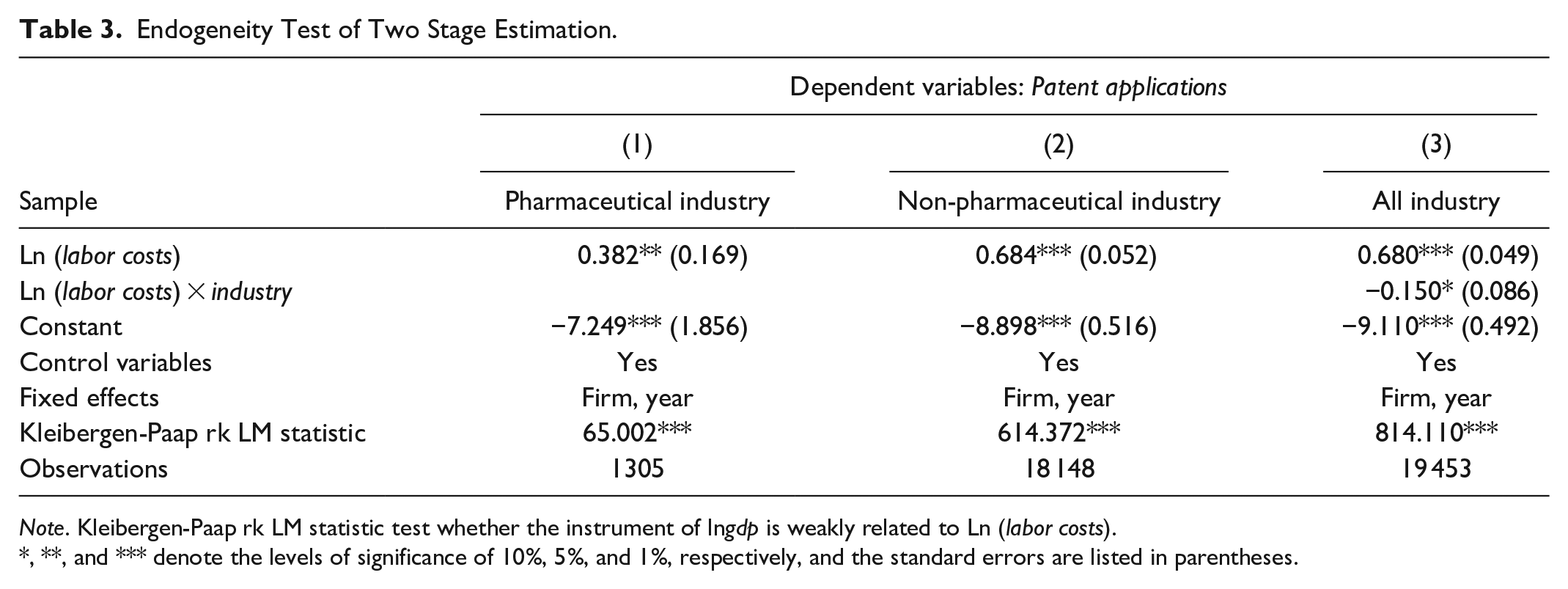
Note. Kleibergen-Paap rk LM statistic test whether the instrument of lngdp is weakly related to Ln (labor costs).
, **, and *** denote the levels of significance of 10%, 5%, and 1%, respectively, and the standard errors are listed in parentheses.
Robustness Test
To further examine the reliability of the research findings, we also used the OLS method to re-estimate the regression model. This study converts the total number of patents, invention patents, and non-invention patents into continuous variables after logarithmic transformation. To ensure the log-transformed values are greater than 0, the original data is incremented by 1 before taking the logarithm, which is then used as the dependent variable. A panel fixed-effects model is employed for analytical examination, progressively incorporating control variables at both the firm and industry levels.
The empirical results presented in Table 4 indicate that the coefficient of the interest variable is significantly positive in all 3 regression equations. A 1% increase in labor costs leads to a 0.460% increase in the total number of patents, a 0.464% increase in invention patents, and a 0.242% increase in non-invention patents. These findings are largely consistent with the baseline regression results from earlier sections, demonstrating that the empirical research outcomes remain robust across different estimation methods.
Robustness Check (OLS Model).

, **, and *** denote the levels of significance of 10%, 5%, and 1%, respectively, and the standard errors are listed in parentheses.
Mechanism Test
The theoretical analysis earlier demonstrated that the rise in labor costs may impacts technological innovation through 3 mechanisms: financing constraints, employee incentives, and factor substitution. The following employs a stepwise regression method to test the multiple mediation effects: (1) examining the total effect of labor costs on corporate innovation; (2) assessing the impact of labor costs on financing constraints, employee incentives, and competition impetus; (3) testing with all mediating variables and labor costs simultaneously included in the regression equation. The first step has been done in the baseline regression, confirming a significant positive impact of rising labor costs on corporate innovation. Table 5 presents the results for the second and third steps.
Stepwise Regression for Mechanism Test.

, **, and *** denote the levels of significance of 10%, 5%, and 1%, respectively, and the standard errors are listed in parentheses.
Columns 1 to 3 in Table 5 report the second-step regression results of the mediation effect for pharmaceutical industry. Firstly, a 1% increase in labor costs raises the financing constraint index by 0.027, indicating that rising labor costs intensify financing constraints for pharmaceutical companies. Secondly, an increase in labor costs shows a significant positive correlation with employee incentives, with a 1% rise in labor costs leading to a 0.735% increase in labor productivity, significant at the 1% level. Thirdly, rising labor costs will not significantly affect factor substitution. Column 4 in Table 3 present the third-step mediation effect test. The coefficient for financing constraints is −0.861, passing significant test at the 1% level, indicating a negative impact on corporate innovation. The coefficient for labor productivity is positive, passing significant test at the 5% level. Meanwhile, the mediating variable of factor substitution is non-significant. These results indicate that, rising labor costs have not impact on innovation from factor substitution mechanism in the pharmaceutical industry, which is consistent with theoretical hypothesis.
Columns 5 to 7 in Table 5 report the second-step regression results of the mediation effect for pharmaceutical industry. All mediating variables, including financing constraint, employee incentives and factor substitution, have positive impacts on innovation patent applications. Column 8 in Table 5 present the third-step mediation effect test. Financing constraint has not significant impact on patent applications in the other industries. The coefficient of labor productivity and substitution are positive, passing significant test at the 1% and 10% level, respectively. These results indicate that, rising labor costs have not impact on innovation from financial constraint mechanism in the other industries different from the pharmaceutical industry.
Conclusion
Current literature generally posits that rising labor costs promote technological advancement, as exemplified by the factor substitution theory represented by Hicks. 34 This theory suggests that an increase in the relative price of one factor induces businesses to reduce investment in that factor and increase investment in others to optimize output. However, the pharmaceutical industry, distinct from traditional industries, is characterized by its intensive human resource focus. Its primary direction of technological progress lies in product innovation rather than process innovation. Therefore, this study proposed theoretical hypotheses that the impact of rising labor costs on innovation in the pharmaceutical sector follows unique patterns, distinct from the traditional substitution of technology for labor. Furthermore, rising labor costs mainly impact to innovation through mechanisms of financing constraint and employ incentives, but the factor substitution.
Based on theoretical analysis, this study uses data from all A-share listed companies from 2012 to 2021 to examine the impact of rising labor costs on corporate innovation and its specific mechanisms. The results indicate that, overall, increasing labor costs boost the innovation level of Chinese pharmaceutical companies. However, the positive impacts in the pharmaceutical industry is significant less than that of other industries. Moreover, mechanism tests reveal that, in the pharmaceutical industry, employee incentive effects play a significant role in positively promoting corporate innovation, while financing constraints exert a negative effect; however, the impact of factor substitution is not significant. In the other industry, both employee incentive and factor substitution effects play a significant role in positively promoting corporate innovation, while financing constraints is not significant. The empirical results demonstrate that the mechanism and results by which rising labor costs affect innovation in the pharmaceutical industry are differs from that in other industries. This is primarily because the pharmaceutical industry is focused on product innovation.
The article holds significant theoretical and practical implications. Firstly, it focuses on the impact of rising labor costs on innovation levels in the pharmaceutical industry. Unlike traditional factor substitution theory and given the emphasis on product innovation in this sector, the impact of rising labor costs on innovation exhibits unique mechanistic effects. The paper proposes 3 distinct mechanisms through which rising labor costs affect innovation in pharmaceutical companies, considering the perspectives of human capital, physical capital, and financial capital. This new research perspective helps to reveal the heterogeneous impact of rising labor costs on innovation across different sectors. Secondly, the empirical findings show that, overall, increasing labor costs are beneficial for enhancing the innovation level of pharmaceutical companies, but the extent of the influence is less than that of other industries. The primary reason for the positive impact on pharmaceutical innovation is the employee incentive, when financing constraints make a significantly negative effect. Meanwhile, the factor substitution has not play “anti-driving” effect. These results uncover the unique effects of rising labor costs on innovation in pharmaceutical companies, further deepening and expanding the theory of corporate innovation.
This study acknowledges certain limitations. First, the number of patent applications is used as a proxy indicator for innovation. However, this metric may not distinguish between product innovation and process innovation. Future research will need to seek additional empirical evidence to explore the heterogeneity of the impact of rising labor costs on product innovation versus process innovation. Second, while the theoretical framework presented in this paper has broad applicability and could be relevant to other countries beyond China, the empirical analysis is grounded in data from the Chinese listed companies. Consequently, the empirical findings mainly reflect the dynamics within Chinese context. In future research, empirical analyses should be undertaken to investigate disparities or uniformities across various countries.
Footnotes
Declaration of Conflicting Interests
The author(s) declared no potential conflicts of interest with respect to the research, authorship, and/or publication of this article.
Funding
The author(s) received no financial support for the research, authorship, and/or publication of this article.
