




Abstract
This article aims to estimate the Value per Statistical Life (VSL) and Value per Statistical Life Year (VSLY) at the sub-national level, which can be used to calculate the economic impact of health and environmental problems. We estimate the value of life for Mexico and its 32 states, grouped into 5 regions for 2021. We used the OECD’s guidelines on “Mortality Risk Valuation in Environment, Health and Transport Policies,” which applies the measure of Willingness to Pay (WTP) and Cost-Benefit Analysis (CBA). Mexico’s overall VSL of $2 000 000 USD in 2021 showcases the value placed on human life. The variation in VSL across the 32 states, with Chiapas having the lowest VSL of $400 000 USD and Mexico City boasting the highest VSL of $3 300 000 USD highlights the different levels of regional development and people’s willingness to pay to reduce the risk of mortality. Our estimates of VSL and VSLY have the potential to contribute to the evaluation of public policies in the fields of health and the environment. Monetizing human life through these estimates can offer valuable insights to policymakers at both the national and sub-national levels. By quantifying the economic value placed on human life, this paper helps decision-makers prioritize investments, assess the cost-effectiveness of interventions, and allocate resources to maximize societal well-being.
Keywords
Value per Statistical Life (VSL) does not measure the value of life but, instead, reflects people’s willingness to pay for slight reductions in mortality risk by sacrificing other goods and services. 1 This concept helps us understand how people perceive and prioritize potential threats in their environment. By studying VSL, researchers can delve deeper into understanding what individuals are willing to trade or sacrifice to minimize the risk of mortality within a specific timeframe. Policymakers can make informed choices about public health and safety measures.
Estimating VSL is crucial for quantifying the monetary costs and benefits of intervention policies. It allows us to understand the economic impact of addressing health, environmental, and traffic accident issues. This study aims to compute the VSL and VSLY (Value per Statistical Life Year) at the sub-national level in Mexico for the year 2021. Providing estimates for all 32 states, grouped into 5 regions, this study enables the evaluation of public policies at the local level. This is particularly valuable in the realm of health, considering the challenges posed by atmospheric pollution.
By typifying the cost-benefit analysis (CBA) and willingness to pay (WTP) implemented by the Organization for Economic Cooperation and Development (OECD), this study sheds light on different conceptions and interpretations of assigning a value to human life in Mexico. On a practical level, our findings are the first estimates of VSL at the sub-national level in Mexico, providing specific values for each of the 32 states, grouped into 5 regions. This enables intra-regional comparisons and offers valuable insights into the regional disparities in the value of life. These results confirm that regions with greater development have a higher VSL due to risk adversity and higher GDP per capita. The evaluation of local public policies using CBA and monetizing impacts becomes possible with these results. This allows policymakers to make more informed decisions and establish a legal framework that aligns with the magnitude of the problem at hand.
Introduction
As a member of the OECD, introducing VSL metrics in Mexico can help policymakers make more informed decisions when evaluating the costs and benefits of policies related to health, safety, and environmental regulations. By understanding the economic value that individuals place on reducing risks to life, society can prioritize interventions that maximize societal welfare and promote public health and safety. Likewise, VSL across regions of a country may vary due to uneven economic growth. 2 From a philosophical perspective, the concept of value in human life is a complex and debatable topic.3,4 While it is true that death and its consequences cannot be undone or compensated for, humans have found ways to assign value to life by reducing the risks associated with it. One way in which life can be monetized is through the choices individuals make to mitigate the risk of harm or death.
People often make decisions based on their perception of safety and are willing to pay a higher price for goods or services they consider safer compared to riskier alternatives. Whether it is selecting a safer mode of transportation like an airplane, investing in protective gear such as a motorcycle helmet, choosing high-quality car tires, paying a road toll for better-maintained roads, or opting for food items that meet certain safety standards, individuals implicitly evaluate the reduction of risk before each event.5,6 By assigning value to safety and taking actions to minimize risks, individuals recognize the importance of life and their desire to protect it. While it may not be a direct monetary value, the choices people make reflect their implicit evaluation of risk reduction and the value they place on their own well-being and longevity.7 -9
The challenge of explicitly determining the implicit valuation of the risk of death is an empirical inquiry, particularly in countries with an absence of referential values for basic CBA. Monetizing this value is essential for conducting cost-benefit analyses and making informed policy decisions. However, the estimation of the value of human life is indeed a complex and multifaceted process, influenced by numerous variables. This complexity often leads to controversies and debates within the field. Various factors contribute to the controversy surrounding the estimation of the value of human life such as different approaches that can yield varying results. Also, societal and cultural perspectives play a role in shaping our perception of the value of life. Some argue that every life is priceless and cannot be reduced to a monetary value, while others believe that assigning a value is necessary for policy evaluations and resource allocation.
Furthermore, the value of life estimation can be influenced by factors such as age, health status, occupation, income level, and individual preferences. These variables introduce further complexity and subjectivity into the calculation process. Balancing these factors and arriving at a consensus is a challenging task. Despite these challenges, researchers and policymakers continue to strive for more accurate and comprehensive estimations of the value of human life. This is evident from the upward real Gross Domestic Product (GDP) growth trends, continuous improvement of living standards, and the average citizen’s purchasing power. 10 Thus, public and private healthcare funding has expanded because of socioeconomic progress. Most countries have strengthened their ability to invest in national networks of hospitals and primary care units to achieve the goal of universal health coverage, which is apparent from the impressive medical and health expenditures.11,12
In the realm of economic evaluation, VSL is used to measure negative externalities and serves as a trade-off between risk and monetary compensation, which allows for monetizing the value of preventing deaths. This approach assesses the economic costs associated with different risks and evaluate the potential benefits of interventions.13 -16 For instance, measuring the impact of anthropogenic pollution and economic activities helps understand negative externalities in the environment; thus, knowing the value of life is essential in quantifying the problems generated in areas such as public health, labor, and social development.17,18 In labor markets, the VSL represents the wage premium that workers require to accept jobs with higher levels of risk, considering the trade-off between the risk of death and the additional salary they need to feel adequately compensated. By recognizing and quantifying these values, we can better inform decision-making processes, design effective policies, and allocate resources to mitigate the negative impacts of pollution and economic activities. These concepts contribute to a better understanding of the challenges society faces.19 -22
Conceptual Framework
In economics, there are 2 important approaches to estimating the value of life: Quality-Adjusted Life Year (QALY) and Willingness to Pay (WTP). Each approach offers a unique perspective on valuing human life, providing valuable insights for decision-making. QALY considers both the quantity and quality of life gained when a person’s life is saved; it measures the additional time a person gains and adjusts it based on the quality of life experienced during that time. Likewise, the WTP estimates the value placed on extending a person’s life and seeks to understand how much someone is willing to pay for an extension of their life expectancy. This approach captures the economic value people assign to their own lives. Both QALY and WTP have their merits and can be used in different contexts depending on the specific objectives and considerations of the analysis.23 -26 Similarly, Disability-Adjusted Life Year (DALY) is used by the World Health Organization (WHO) to measure the years gained in life expectancy adjusted for disability. However, it essentially has the same perspective.27 -30
WTP is widely used by governments and specialized agencies such as the Environmental Protection Agency (EPA), WHO, and OECD. It is a valuable tool in economic evaluation and plays a crucial role in determining the net benefit of environmental policies and investment projects through CBA. With the WTP approach, we can assign an economic value to the prevention of risks and the improvement of public health. VSL helps quantify the benefits of interventions and enables decision-makers to compare them with the associated costs.31 -33 However, it should not be understood as the value of life but as a similar value obtained from what a person would be willing to pay.34 -36 For example, if a person is willing to pay $300 to reduce his probability of dying from 2 in 10 000 people to 1 in 10 000 people. The VSL is equal to $300 divided by (1/10 000), which is $3 000 000.
Differences between QALY and WTP showcase the distinct perspectives inherent in these 2 approaches, offering different tools to assess the value of life and benefits associated with policy decisions. 23 Regarding measurements, WTP is quantified in monetary units while QALY is in time; thus, it makes easier to compare the value of life between different countries using the VSL derived from WTP and a common currency for cross-country analyses. 37 In terms of their assumptions, QALY presumes an extension of the quality-adjusted lifespan, incorporating the notion of quality of life during that time, while WTP leaves the decision of how much extension someone desires entirely to the individual. WTP captures the individual’s valuation of additional life years and the associated risk reductions. 30 As per aggregation, individuals are summed up if a year of life has the same value for everyone in the QALY approach; whereas in the WTP approach, individuals are added together if a monetary unit (such as USD) has the same value for everyone.
Neither of the measures is accurate, but QALY might be much better than WTP when comparing rich and poor countries, given that the perspective on the value of money by the individuals involved is different. 30 Perhaps, if VSL were $10 000 000 in the US and $1 000 000 in Mexico, it would imply that 1 USD for a Mexican has the same social value as 10 USD for an American. The issue of setting the money value of human life is highly controversial and there is no single clear-cut agreement on this issue.
Table 1 shows a summary of VSL estimates (range: $210 880-$2 600 000) for Mexico found in the current literature. In addition to different methodologies, the wide range of VSL in Mexico may be associated to the use of various income elasticities, the source of information considered and the temporality of the data. By the means of a meta-analytic approach, Masterman & Viscusi found that the VSL’s income elasticity varies between 0.55 for wealthy countries and 1 for low-income countries. 35 Some authors use data from face-to-face interviews and official sources on the perceived and real risk of death from accidents at work, finding that the observed and recorded real mortality risks by workers are consistent.38 -40 Having a homogeneous monetization of the economic impacts caused by environmental problems and/or fatal accidents is not enough; the problem is more challenging when we try to estimate the impact at the sub-national level, since VSL information is not available.
VSL Estimates for Mexico (in USD).

Note: The income elasticity was adjusted to 2010 USD and taking values of 0.8. These authors suggest a value of $5.4 million ($2 000) 34 for the US. This value has been adjusted by benefit transfer to $1.65 million for Mexico (2010 USD). VSL’s income elasticity in the range of 1.00 to 2.00 was determined to use the value with elasticity of 1.5 and a ratio greater than 100.
Materials and Methods

Our main variables of our model are VSL is the value per statistical life measured in USD; WTP is the willingness to pay in USD; and risk reduction typically is (1/10 0000). Figure 1 provides a simplified illustration of these calculations, assuming that both the risk reduction and the VSL are constant throughout the population.

Example calculation of mortality risk reduction benefit.
To infer values across countries, we selected estimates of the degree of change in the VSL associated with a change in income (income elasticity of VSL). These calculations were performed for the year 2021 using equation (2) 47 and assuming a unit income elasticity. The extrapolation of these estimates across countries with significantly different income levels is highly dependent on the elasticity estimate, as demonstrated in Table 1. To create the table for Mexico up to 2021, we started with the OECD VSL estimate of $9 million and projected it to resemble Mexico’s GDP of $9590, utilizing the corresponding OECD GDP per capita estimate of $42 457 and various elasticities. We have chosen $9,590 as the target income level because it is the threshold used by the World Bank (WB) to differentiate between low- and middle-income countries.

The WB has defined as low-income economies those with 2015 GDP per capita of $677 or less. By the same criteria, a lower middle-income country has a GDP per capita between $2314 and $5813 and an upper middle-income economy produces a GDP per capita between $9794 and $48 179. Finally, a high-income country has a GDP per capita of $48 179 or more. These values are expressed in US dollars based on market-exchange rates, using the Atlas method. Analogously, the OECD’s 2021 GDP per capita was valued as $42 457 falling within the range of a high-income country and the same metric for Mexico positions it as an upper middle-income economy. Viscusi computed mortality costs as a result of the COVID epidemic for 2020 to 2022, which includes VSL and number of deaths in a cross section of countries, including values for Mexico. 53 Although it is statistically valid to extrapolate the values obtained for high-income countries, it should be noted that it is necessary to directly investigate the WTP of the population of middle- and low-income countries with the objective of validating the extrapolated data using different elasticities (Table 2).47,54,55
Effect of Income Elasticity. a

Estimates are for illustration only. Results rounded to 2 significant digits.
Inferred from an OECD VSL of $9 million. GDP per capita of $42 457 (2021 dollars).
An income elasticity of 1.0 means the ratio is constant, for example, the starting point (U.S. VSL = $9 million) yields a WTP estimate of $900 for a 1 in 10 000 risk change, which is also 9.4% of OECD GDP per capita.
In million USD.
Adjustments for Age and Life Expectancy
Differences between VSL and VSLY (VSL Year) are worth discussing. In the VSL approach, the average value represents the overall population, whereas the VSLY approach considers different values based on an individual’s age. For a middle-aged person, both approaches would yield the same value. However, for older individuals, the VSL would be lower, while for younger individuals, it would be higher. This difference accounts for the varying life expectancy and potential years of life remaining for different age groups. To ensure accuracy, creating a table that recalculates the probability of survival each year, specifically for different age groups within the population, is a recommended approach. This allows for a more nuanced understanding of the value of statistical life based on age strata.
In Figure 2, the VSL of $1 500 000 is equivalent to individual WTP of $150 for a 1 in 10 000 risk change. Note that the increase in life expectancy is approximately equal to the risk reduction multiplied by current life expectancy. For average-age adults, it is 0.0041 years [41 years × (1/10 000)] and the value is $150 per person ($36,586 × 0.0041 years). If the policy only affects younger people, with a life expectancy of 56 years, the increase in life expectancy is 0.0056 years [56 years × (1/10 000)] and the value is $205 per person ($36,586 × 0.0056 years). If the policy only affects older people, with a life expectancy of 6 years, the increase in life expectancy is 0.0006 years [6 years × (1/10 000)] and the value is $22 ($36,586 × 0.0006 years). It follows from the above that if people have different WTPs, which may vary by age, then they may have different value of life. Therefore, public policies to reduce mortality caused by exposure to pollution, for example, may have different effects depending on the population segment targeted. Estimating the value of life is a complex issue given the paucity of information, especially at early ages or even before birth. How to determine the WTP that parents may have on their children before they are born. Many countries lack of this kind of studies, particularly in those ranked as low- and middle-income.

Example of VSLY calculation versus VSL.
Results
Based on equations (1) and (2), we present the results of the VSL for Mexico calculated with the profit transfer method for different income elasticities (see Table 1). Five values were estimated for the year 2021, using an income elasticity of 0 to 2, with intervals of 0.50. Of these, the VSL of $2 000 000 was selected for use in subsequent VSL calculations at the sub-national level. Given that the national versus sub-national economic reality is similar, it was determined to use the value with elasticity of 1 and a ratio greater than 100. The Table 3 exemplified effect of income elasticity in the state of Aguascalientes.
Effect of Income Elasticity in the State of Aguascalientes.
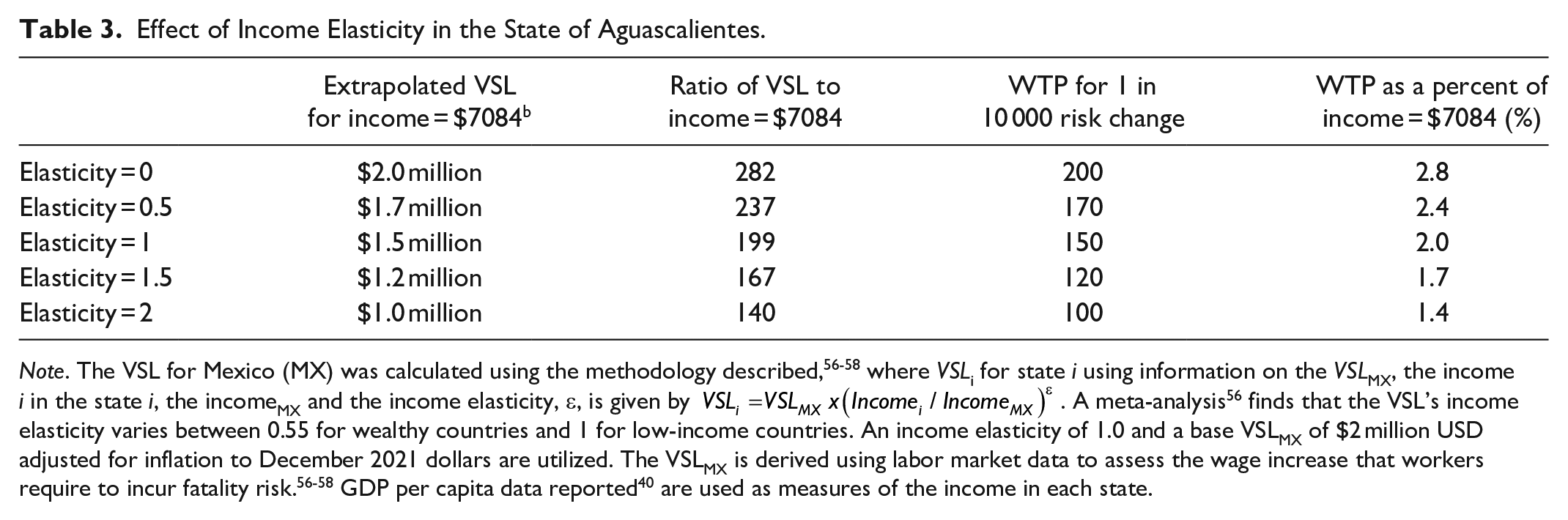
Note. The VSL for Mexico (MX) was calculated using the methodology described,56
-58 where VSLi for state i using information on the VSLMX, the income
i
in the state i, the incomeMX and the income elasticity, ε, is given by
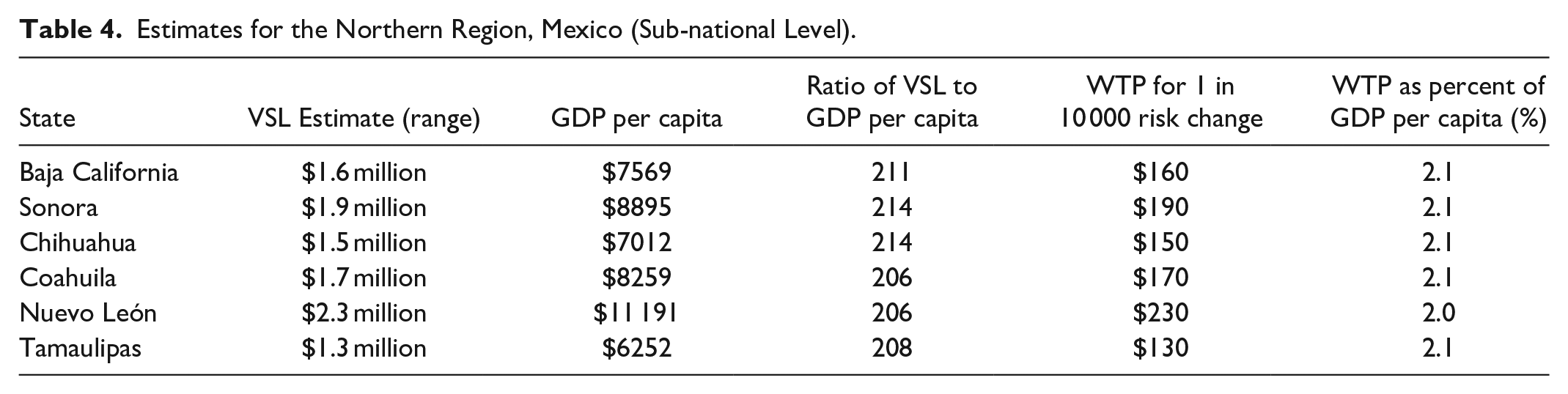
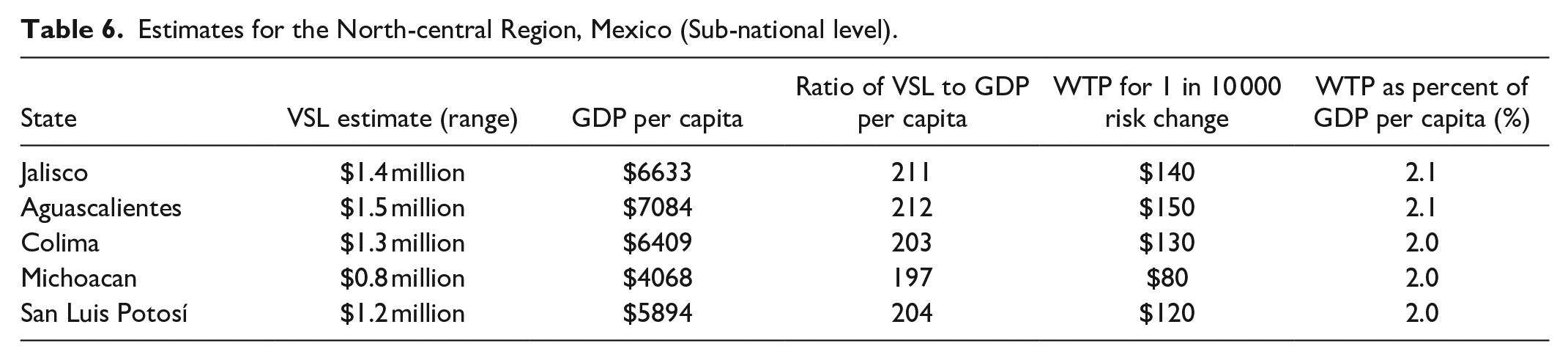
Following the methodology described above and using a VSL of $2 000 000, values were calculated at the subnational level. Tables 4 to 8 depict VSL calculations for Mexico’s thirty-two provincial states, which were divided by regions, 40 an exercise that provides new statistical data for the country. Economic development in Mexico is uneven across states; northern states produce more sophisticated products and manufactures whereas southern states present less economic opportunities. Poverty rates are high (more than 50% of the population) in Chiapas, Guerrero, Oaxaca and Puebla but low (less than 20% of the population) in Baja California, Nuevo Leon, Chihuahua, and Coahuila. VSL may be vary in Mexico due to different levels of economic development across regions, as evidenced in other countries. 56
Estimates for the Northern Region, Mexico (Sub-national Level).
Estimates for the Northwestern Region, Mexico (Sub-national Level).

Estimates for the North-central Region, Mexico (Sub-national level).
Estimates for the Central Region, Mexico (Sub-national Level).

Estimates for the Southern Region, Mexico (Sub-national Level).

Regardless of the methodology followed to calculate the value of life, be it through the VSL or any other approach, it is crucial to consider the wide range of impacts caused by diseases, productivity losses, and other adverse effects. Once these values are estimated, it becomes evident that the number of potential impacts predicted by the models is significantly multiplied. In our specific case, we conducted a comprehensive analysis to calculate VSL in Mexico for 2021. Our calculations yielded some intriguing results. The minimum estimated value of a statistical life was determined to be $500 000, representing the lower end of the spectrum. On the other hand, the maximum estimated value reached an impressive $4 200 000, illustrating the upper bounds of the potential impact. However, it is important to highlight that the mean value, which provides a more representative average, was calculated to be $1 000 000. This value serves as a reference point, reflecting the average estimation of the value of a statistical life for the population under consideration. These calculations not only provide insight into the monetary worth attributed to an individual’s life but also emphasize the broader implications of these values. Understanding the potential impacts that could have been avoided by considering these estimates helps us grasp the significance of valuing life in such a manner.
Discussion
This paper is novel because pioneers VSL estimations for Mexico at the sub-national level (states) highlighting uneven degrees of economic development across different regions. Determining the value associated with a decrease in mortality is a process that draws heavily from a country’s economic performance. In recent years, there has been a significant surge in interest regarding preference techniques and surveys that aim to gauge individuals’ perceptions of the risk of death and the monetary value they assign to it. These approaches have proven to be valuable tools in estimating the value of preventable deaths, often represented by the Value of Statistical Life (VSL). Through extensive assessments and studies conducted worldwide, a wide range of values for the VSL has been identified, with estimates varying between $0.6 million and $9 million for different countries. 36 These findings highlight the inherent variability in the value individuals place on preventing deaths.
One crucial aspect revealed by the literature is that the VSL is heavily influenced by the characteristics of the risk of death. Factors such as the age at which death occurs and the time interval between exposure to the risk and the actual occurrence of death, commonly known as latency, play significant roles in determining the value assigned to preventable deaths. These characteristics contribute to the nuanced understanding of the VSL and emphasize the need to consider various factors when estimating it. By exploring these dimensions and considering the multifaceted nature of the risk of death, researchers and policymakers gain valuable insights into the complex relationship between mortality reduction and economic considerations. These insights can guide decision-making processes to prioritize interventions and allocate resources effectively, ultimately leading to improved public health outcomes.57 -59
In the process of estimating VSL for Mexico, it is important to consider various factors, including the usage of the OECD values as a parameter. This choice is made to account for the significant disparity in per capita income observed between Mexico and the United States, as the VSL can vary depending on the economic context of a country. While estimating the VSL in Europe, a sample of 27 countries with different levels of development is typically considered. This approach allows for a value that is more closely aligned with the reality of Mexico, as it considers countries with similar socioeconomic conditions. To illustrate the disparity in VSL values, we can examine the case of the United States. In the United States, a VSL of $7.4 million (2006) was used to justify the implementation of the Clean Air Act from 1990 to 2020. 9 This value, although appropriate for the US, is remarkably high when compared to the context of Mexico. Hence, it becomes crucial for future research to focus on developing a local VSL that accurately reflects the socioeconomic conditions and realities specific to Mexico. By conducting further research to establish a localized VSL, policymakers and researchers can ensure that the estimates align more closely with the Mexican context. This localized approach will provide more accurate and relevant data to guide decision-making processes, allowing for the effective allocation of resources and the implementation of policies that prioritize public health and well-being.
The issue of statistically insignificant results not being made public is a matter that warrants attention. When such results are not disclosed, it can potentially introduce a selection bias and subsequently lead to an overestimation of VSL. This bias occurs because only statistically significant findings tend to be published, while non-significant results may remain hidden. The potential impact of this effect is a subject of debate among researchers. Some argue that the influence of publication bias could be substantial, suggesting that it may significantly distort the estimation of the VSL. They emphasize the importance of considering the possibility that non-significant results exist but are not widely disseminated, leading to an inflated perception of the VSL. 60 On the other hand, there are those who contend that publication bias is not a significant concern when good data and careful econometric techniques are employed. They argue that thorough analysis, appropriate methodology, and transparent reporting can mitigate the potential bias introduced by non-publication of insignificant results.
To address these concerns and enhance the accuracy of VSL estimations, it is crucial for researchers to adopt rigorous practices in data collection, analysis, and reporting. This includes ensuring transparency in the publication process, encouraging the dissemination of both statistically significant and insignificant findings, and promoting open dialog within the scientific community. By fostering an environment that values comprehensive reporting and encourages the publication of all results, researchers can mitigate the risk of selection bias and improve the overall quality and reliability of VSL estimates. This approach contributes to a more robust understanding of the true value of statistical life and facilitates evidence-based decision-making.61,62
In the context of those who utilize the VSL for policy purposes, public choice theory provides predictions that are more straightforward. It acknowledges that individuals involved in lawmaking also act based on their incentives. A commonly held assumption is that bureaucracies strive to maximize their budgets to enhance their power and influence. It is believed that bureaucracies are motivated to maximize the estimated value of the benefits of proposed projects. In relation to contingent valuation, which has faced criticism, it is worth noting that various branches of the federal government continue to fund contingent valuation research with the hope that it will support their preferred policies, subject to CBA. 63
When assuming budget-maximizing behavior, agencies that utilize VSL to estimate the benefits of their projects, regulations, or programs will aim to use the highest value for the VSL. As an example, the Environmental Protection Agency (EPA) is conducting a CBA on a new pollution control program aimed at improving air quality. In this scenario, if the policy can be attributed to avoiding premature deaths, a larger VSL will result in increased estimated benefits for the policy. 64 This, in turn, increases the likelihood of the policy passing a cost-benefit test. It is worth noting that there is evidence of inconsistency in the VSL measures used by different US government agencies. While most VSL estimates are obtained by academic researchers and published in scientific papers, the VSL used to inform public policies can be influenced by political pressure. This highlights the potential for variations and challenges in the application of VSL within policy-making processes. 65
Study Limitations and Future Directions
In addition to the moral objection against monetizing a human life, there are differences of opinion as to whether this value is uniform for the entire population. For example, it is often thought that the elderly, since their risk value is lower than that of the younger population, should have a lower value. Attempts to apply this criterion in some countries have met with resistance.65 -68 It can be used in different contexts related to labor and environmental risk problems, which helps to have a reference value for case studies where CBA is required. This study calculated the VSL at the sub-national level in Mexico for the year 2021, which is of great relevance given that it presents the first estimates of the value of life in 32 states, grouped into 5 regions.
One limitation of this study is related to the extrapolation of the WTP data; since there are not specific studies determining the amount individuals in Mexico are willing to pay to reduce their probability of death. This may cause uncertainties in the estimates and becomes more significant at the sub-national level. While the country-level results align with many other studies, it is challenging to compare the estimates at the local level since they are the first of their kind. Another limitation to consider is the potential bias in individuals’ behavior across different contexts. People’s preferences and decision-making can vary, which may introduce some bias into the results. Additionally, the estimation of VSL at the sub-national level relies on GDP data, which could contain accounting errors. These errors might result in deviations in the VSL estimate. Therefore, it is advisable to consider ranges of values instead of relying solely on a single value.
There are several important directions to consider for future research. First and foremost, it is highly recommended that specific studies be conducted to determine the WTP in various cities across Mexico, particularly those with high population density or strong economic growth. By focusing on different urban areas, we can gain a better understanding of regional differences in how individuals value risk reduction and their preferences for reducing the probability of death. These localized studies will provide valuable insights that can enhance the accuracy and applicability of future estimations. Furthermore, it is crucial to conduct more direct research on the value individuals place on risk reduction in different contexts. For example, investigating how much individuals value reducing the risk of death in home fires, automobile accidents, cardiovascular diseases caused by living in polluted areas, or deaths resulting from floods, among other significant scenarios.
By exploring these specific contexts, we can gain a deeper understanding of the varying degrees of importance individuals assign to different types of risks. This knowledge will enable policymakers to make more informed decisions when designing interventions and allocating resources to address specific risks and improve public safety. By undertaking these future research endeavors, we can refine our understanding of individuals’ values and preferences related to risk reduction in diverse settings, paving the way for more effective policies and interventions that prioritize the well-being and safety of the population.
Conclusions
This work has successfully obtained VSL estimates to monetize the risks and fatalities associated with various investment projects, both public and private, as well as economic activities such as transportation and industry. By utilizing the stated preference method and the benefit transfer technique, the statistical value of life has been estimated for both Mexico as a whole and its individual states for the year 2021. For the country, these findings reveal a range of VSL values. The minimum estimated VSL is $500 000, the mean is $1 000 000, and the maximum reaches $4 200 000. These values represent the monetary worth individuals place on reducing the risk of death and reflect the importance society assigns to preserving human life.
At the sub-national level, the average VSL varies across different states within Mexico. The estimated average VSL ranges from $400 000 to $3 300 000. Among the states, Mexico City, Nuevo Leon, and Sonora rank highest in terms of VSL values, indicating a higher valuation of risk reduction and safety. Conversely, Chiapas, Oaxaca, and Guerrero have the lowest VSL values, suggesting a relatively lower monetary value placed on mitigating risks and ensuring safety in these regions. These findings shed light on the regional disparities in the perceived value of life and risk reduction within Mexico. They provide valuable insights for policymakers and stakeholders involved in decision-making processes related to investment projects, resource allocation, and risk management strategies. By understanding these variations, targeted interventions and policies can be developed to address the specific needs and priorities of different states, ultimately working toward enhancing the overall well-being and safety of the population.
Footnotes
Authors Contributions
L.A.B-P: conceptualization and study design, writing-review and editing, supervision, methodology, project administration; R.A.R-A: review of literature and drafting, methodology, data curation, software, investigation; J.J.D-C: writing-review and editing, validation, data curation, investigation; B.G-P: review and editing, validation, supervision, investigation.
Availability of Data and Materials
The database generated and analyzed during the current study is available from the corresponding author on request.
Declaration of Conflicting Interests
The author(s) declared no potential conflicts of interest with respect to the research, authorship, and/or publication of this article.
Funding
The authors did not receive financial support for the research and authorship of this article. Partial support for publication was received from the General Coordination for the Promotion of Scientific Research and Innovation of the State of Sinaloa (CONFIE).
Consent for Publication
All participants completed a consent form stating that they were well-informed about the content of the questionnaires and agreed upon the publication of anonymized data.
Presence of Declarations,and Ethics and Consent statements
Our study did not require ethics committee approval because we did not manipulate living organisms in a laboratory or interact with people in a free and/or controlled environment.
