




Abstract
Relaxation-related workplace interventions can be counterstrategies for stress due to office work and should be evaluated for success after implementation. This study reports on the evaluation and comparison of 3 relaxation techniques introduced as an intervention for health promotion. A Germany-wide multicenter evaluation of a 3-month relaxation intervention (30 min, once a week) including autogenic training, progressive muscle relaxation (PMR) or Tai Chi was conducted at 14 locations as an intervention study. Anonymous questionnaires (n = 244) were used to collect self-reports of perceived stress after the courses. Status before the courses (pre) and after completion (post) were reported at the end of the intervention. All 3 relaxation techniques were able to improve the subjective perception of stress (SPS) score. Autogenic training was reported to improve all singular items with large effects, whereas only 2 items showed change for Tai Chi and none for PMR. Singular items were also influenced by the location of the courses. All 3 methods were able to improve stress-related outcomes in terms of stress perception and individual aspects of stress management. For this specific intervention autogenic training yielded the largest and wide-ranging effects. Tai Chi was also effective, but additional effect due to an associated increase in physical activity were not found. For a workplace intervention PMR could not be recommended based on this study. The literature on workplace interventions is surprisingly scarce, and future studies should focus on the selection of appropriate participants while avoiding potential bias.
Keywords
Stress can have a detrimental effect on quality of life, well-being and work performance.
Three relaxation techniques were evaluated for a relaxation-related workplace intervention and their effectiveness and feasibility are discussed.
Relaxation-related workplace intervention can improve perceived stress and the choice of relaxation method should depend on the desired outcome and related influencing factors.
Introduction and Objectives
Introduction
Workplace-related interventions regarding mindfulness, stress management, workload and time management targeting subjective perceptions of stress have been reported in the literature to have positive effects.1,2 Organizing these interventions during working hours could reduce the conflict between work and family, care work and leisure time. Typical interventions regarding mindfulness and relaxation interventions include autogenic training, progressive muscle relaxation (PMR) or Tai Chi. 3
The aim of this study was to evaluate a relaxation-related intervention during working hours in an insurance company.
Background
Stress plays an important role in the well-being and quality of life of individuals. Focusing on occupational settings, stress can be either work-related or non-work-related but affect work performance and perceptions. 4 Work-related stress, such as excessive workloads, professional and administrative demands or resource constraints 5 can significantly affect work performance and job satisfaction. 6
Increasing job demands especially in digital work contribute to increasing work-related stress,7,8 but can also have positive effects. 8 In addition, work-family conflict due to remote work can increase stress. 9
Thus, it seems feasible to address employees’ stress with workplace related interventions. Most interventions reported in the literature include among others autogenic training, progressive muscle relaxation (PMR) or Tai Chi. 3
Autogenic training involves autosuggestion to achieve a relaxed state. 3 Through a form of self-hypnosis that causes the body’s vegetative functions (eg, blood circulation, pulse rate, breathing) to go into a state of rest, a relaxed state is achieved through mental concentration. Participants assume a comfortable position, for example, lying on a cushioned floor and listen to instructions for self-suggestions. Physical and mental relaxation usually occurs during the course. 10 Workplace related interventions including autogenic training, can reduce perceived stress and contribute to well-being.11 -13
PMR was developed in the 1920s by Edmund Jacobson. 14 He discovered that there is an interaction between muscle tension and mental well-being. The basic idea is to minimize stress and tension and their associated physiological symptoms by reducing muscle tension. The exercises can be done in a sitting or lying position. Tension in the muscle groups is started with inhalation. The tension should be held about 5 to 10 s and released. PMR in workplace interventions has been reported to reduce stress and burnout.12,15,16
In the 13th century, the 13 basic postures (the foundation of Tai Chi) were developed by the Wu-dang monk Chang SanFeng. 17 Conscious relaxation of muscle groups to achieve maximum softness is one of the main goals of Tai Chi, and it is also used to develop self-awareness and self-control. Tai Chi is reported to reduce oxidative stress, 18 stress as indicated by heart rate variability, 19 and work-related stress. 20
All 3 relaxation techniques have been reported to positively modulate stress in general and in the workplace. Furthermore, these effects have been reported in many different countries, as well as in different professions, such as health care workers, 20 teachers, 12 or police officers. 11 Thus, workplace interventions with relaxation techniques represent an internationally relevant concept that is widely used.
Purpose
In 2016, a workplace intervention targeting stress was introduced at an insurance institution in Germany. Its employees work in 14 locations throughout Germany and approximately 82% of the employees perform office work. In the present study, employees who participated in a 3-month program of autogenic training, PMR or Tai Chi were asked about their perception of stress. The survey was administrated after the courses with an adaptation of the German translation of the Perceived Stress Scale with 10 items (PSS-10) by Cohen et al. 26 Participants were asked to indicate their current status (post) and to provide additional information about their status before the course (pre). This design was intended to test the following 2 hypotheses:
(1) Evaluation: The introduction of a 3-month workplace intervention regarding stress has a positive effect on participants’ stress perception, and
(2) Comparison: All 3 relaxation techniques achieve a comparable stress reduction.
Since previous studies have mostly investigated and compared relaxation-related interventions with controls or other types of interventions16,21,22 or only groups treated with multiple techniques,21 -23 this study aimed to specifically investigate the effects and differences between 3 of the most commonly used relaxation techniques. In particular, stress and stress reduction are often studied in health care workers2,6,15,16,20 with unique workplace demands. In this study, insurance employees with typical office desk jobs were examined.
In summary, the contribution of this study’s contribution includes the specific comparison of 3 relaxation-related interventions and provides insights into health promotion programs situated in office work environments.
Methods
Study Design
This was a Germany-wide program at an insurance institution to implement and evaluate stress-related health promotion measures at 14 locations. The program was initiated and implemented by the management, safety and health team at the insurance institution. It was part of a health initiative at the institution that consisted of 2 offerings for courses during working hours. The first offer was for a workplace active rest program reported here 24 and the second is reported in this study as an as an intervention study without a control group. For this purpose, a pre- and post-status was surveyed at the end of the courses for the subjective perception of stress (for a description of the questionnaire, see the section on surveys), see Figure 1.
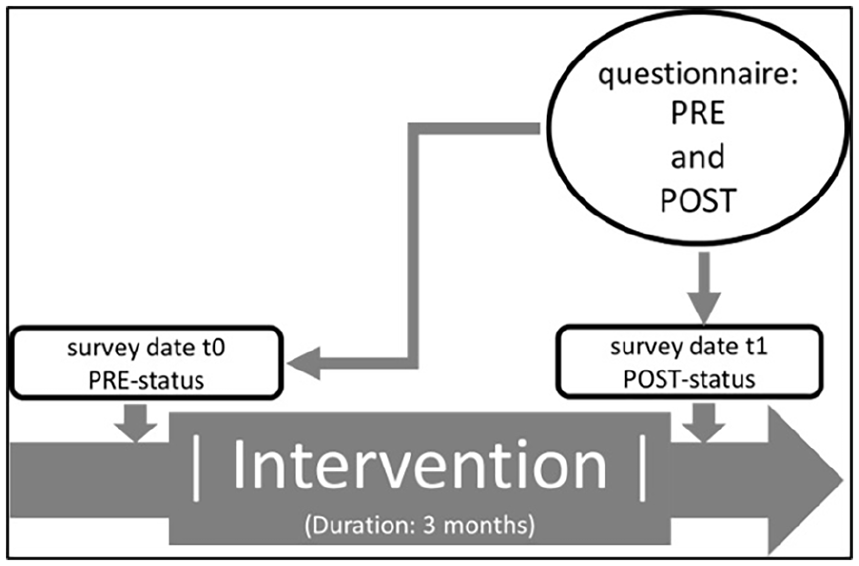
Timeline of intervention and survey.
Participants
Between 2016 and 2018 all 1751 employees working at the insurance institution were contacted, informed about the intervention and had the opportunity to attend the courses. The survey was distributed at the courses so that only participants could complete the questionnaires and was voluntary and anonymous. Of the participants, 244 questionnaires were returned. There was no control group without intervention. Since there was no record of course attendance, no response rate could be determined.
Intervention
The relaxation-related courses were offered to all employees during working hours weekly at all 14 locations for a period of 3 months with a maximum of 12 participants per group. These half-hour sessions were either autogenic training, progressive muscle relaxation (PMR) or Tai Chi. Participants had to choose and could not attend more than 1. Autogenic training was offered in 6 locations, PMR in 4 and Tai Chi in 4. All courses were held on the institution premises und conducted in person by trainers. These trainers were trained in sports science according to the criteria of the statutory health insurance. 25 The goal of all interventions was subjective stress reduction. The courses included trainer-led exercises depending on the technique, for example, guided imagery in autogenic training, guided tension and relaxation of muscle groups in PMR or guided postures and exercises in Tai Chi.
To increase accessibility and compliance, courses could be attended without registration and attendance verification. Adherence to the relaxation technique was generally ensured by the trainer-led course design. It was not recorded whether participants performed the relaxation techniques outside of the courses.
For neither course participation nor return of questionnaire an incentive was offered. Participants could attend during working hours as paid time. They were not actively recruited, as part of the announcement of the stress-related health promotion measures at the institution employees were recommended to participate but this was not enforced or checked for attendance.
Survey
The Surveys were primarily used and communicated as an internal evaluation of the workplace active rest program. A scientific evaluation was planned and carried out later, although participants were informed during the survey that this could follow. The questionnaire items were adapted from the Perceived Stress Scale with 10 items (PSS-10) by Cohen et al 26 and the German translation by Büssing. 27 The items were presented as about the previous month, see the following sample items:
In the last month I have had the feeling that I cannot influence important things in my life very often
In the last month I have very often been annoyed about not being able to influence important things.
The questionnaire is included in the Supplemental Material in English translation (Suppl. Material questionnaire).
A 7-point scale was chosen for sensitivity to change. The response alternatives were: 1 = does not apply at all, 2 = does mostly not apply, 3 = applies little, 4 = applies somewhat, 5 = applies a little, 6 = does mostly apply, 7 = Does almost completely apply.
All 10 items were recorded. A subscale “subjective perception of stress” (SPS) as sum score was computed from re-coded items 1 to 6. Here, an increase in stress would result in a decrease in score, so that higher scores indicate less stress. This was chosen to report a reduction in stress as an “increase” of workplace safety as specific evaluation and improvement of stress related workplace stress and strain is legally required in Germany.
All course participants from 2016 to 2018 were given a paper-pencil survey during working hours at their respective sites. The survey was voluntary and anonymous, so participants of the interventions could choose not to participate in the survey. As the working language is German, a German version of the questionnaire was used.
At the end of the 3-month intervention, participants received a questionnaire from their trainer with the opportunity to ask questions. Upon completion, the questionnaires were first placed in an envelope to ensure anonymity and then placed in an urn.
Statistical Evaluation
Since the evaluation was initially planned as an internal evaluation, no statistical approach beyond descriptive analysis was planned. Accordingly, sample size estimation was not conducted. For a post hoc power analysis with n = 244, α < .05 and dz = 0.2 for small effects, a power of 1-β = 0.93 was determined (G*Power v. 3.1.9.7, Düsseldorf, Germany28,29).
Cronbach’s alpha was calculated to test for internal consistency for all items and for SPS.
For retrospective analysis, repeated measures analysis of covariance (ANCOVA) was selected, controlling for age, gender. Gender/sex and age-dependent influences and effects on stress perception and response have been extensively reported in the literature.9,10 Effect sizes (η²) were determined with η² ≥ 0.01 for small effects, η² ≥ 0.06 for medium effects and η² ≥ 0.14 for large effects. Data analysis was performed using SPSS Statistics for Windows, version 27.0 (IBM Corp. Armonk, NY). Significance levels were considered significant at P < .05. The graphical representation of the results was done using Microsoft Excel for Microsoft 365 MSO (Microsoft Corporation, Redmond, WA).
Results
Out of the 244 Persons Returning the Questionnaire, 157 (64.5 %) Were Female.
Regarding the age distribution, participants were asked to indicate their age category, and the following was collected: 22 participants were under 20 years old (9%), 43 participants were 21 to 30 years old (17.6%), 44 participants were 31 to 40 years old (18%), 69 participants were 41 to 50 years old (28.3%), 66 participants were 51 to 60 years old (27.1%) and no one between 61 and 70 years participated.
Sixty participants rated themselves as having normal weight (24.6%), 67 as under normal weight (27.4%) and 116 as over normal weight (47.5%). In comparison to others of their age and gender, 66 participants (27%) assessed themselves as the same, 79 (32,4%) as worse and 95 (38.9%) as better.
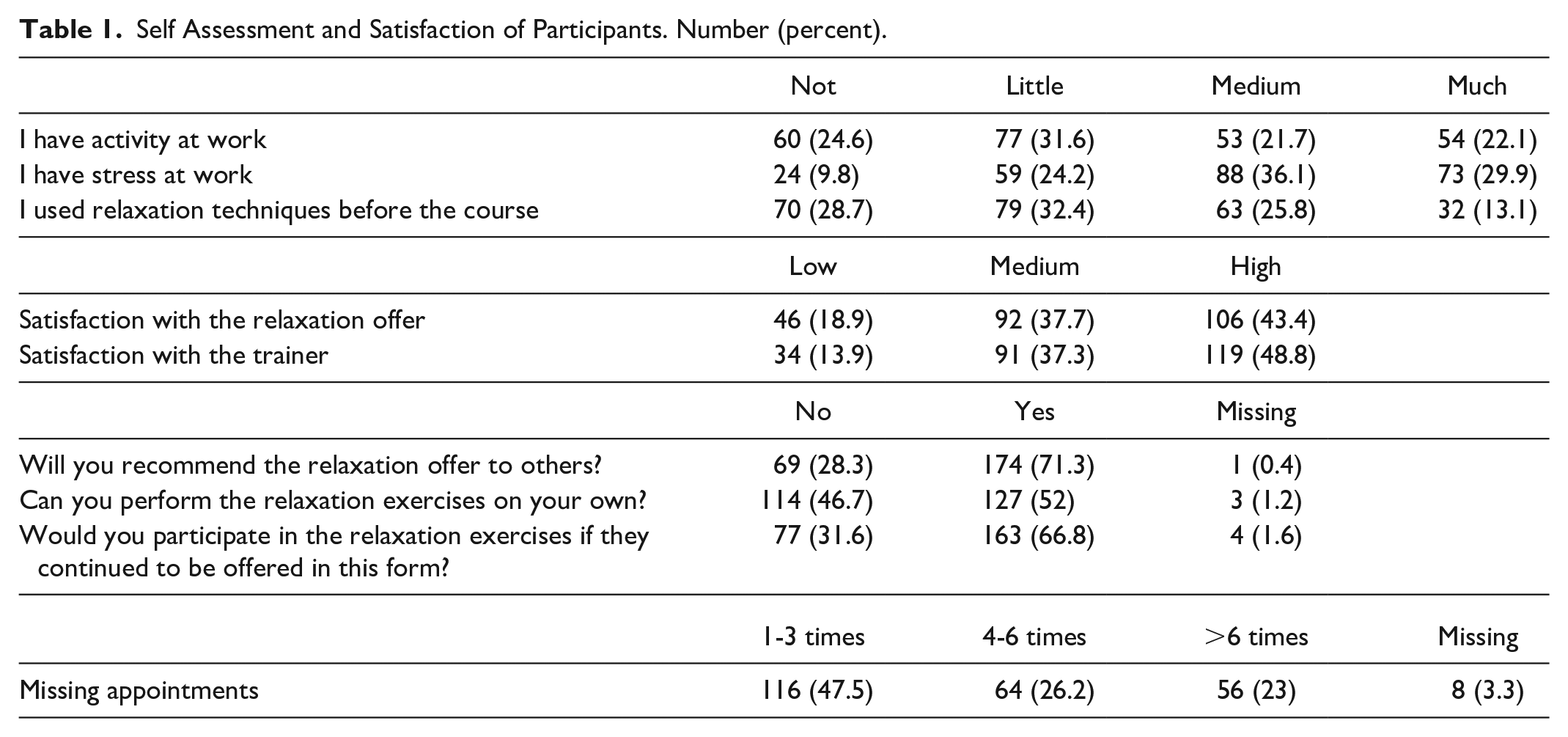
Of all participants only approximately 10% reported no stress at work, while nearly two-thirds reported medium or high stress (see Table 1). Nearly 29% had never used relaxation techniques before. Satisfaction with the courses and trainers was given with at least 80% of participants indicating medium or high satisfaction and only 28% not recommending the course to others. Two-thirds would have participate again. About half of the participants reported that they could do the exercises on their own.
Self Assessment and Satisfaction of Participants. Number (percent).
Of the returned questionnaires, 129 persons (52%) had participated in autogenic training, 42 PMR (17%) and 73 Tai Chi (31%).
Cronbach’s alpha was α = .741 for all items and α = .735 for SPS, indicating an acceptable internal consistency. 30
Effects of Autogenic Training, PMR and Tai Chi for Change Between Pre and Post and for Location
For autogenic training, a significant change was observed for all items and the score for SPS, with mostly medium and large effect sizes for all subjects (Table 2). For the sum score a considerable large effect size was recorded. For 9 out of 10 items and the score for SPS no differences between locations could be observed. Only for item 8 a location effect was found.
Autogenic Training: ANCOVA of Pre and Post for Subjects and by Location, Controlled for Age and Gender.

P ≤ .05. **P ≤ .01. ***P ≤ .001. Bold entries indicate significant p values.
Regarding PMR only the score for SPS showed significant differences between pre and post with medium effects while there were no location-dependent differences for all items and the total score (Table 3).
Progressive Muscle Relaxation (PMR): ANCOVA of Pre and Post for Subjects and by Location, Controlled for Age and Gender.

P ≤ .05. Bold entries indicate significant p values.
For Tai Chi the score for SPS was significantly different with a large effect size but also displayed location dependent effects (Table 4). In addition, significant changes were observed for items 1 and 5, while item 5 also showed location-dependent effects.
Tai Chi: ANCOVA of Pre and Post for Subjects and by Location, Controlled for Age and Gender.

P ≤ .05. ***P ≤ .001. Bold entries indicate significant p values.
Comparison of All 3 Relaxation Techniques
Regarding the score for SPS, all 3 techniques, autogenic training PMR and Tai Chi, resulted in increased scores after the intervention (Figure 2). The pre score of PMR was slightly higher than that of autogenic training and Tai Chi.

Change in overall sum score between pre and post for (A) autogenic training, (B) PMR and (C) Tai Chi.
When comparing effect sizes, autogenic training was the most effective for stress reduction (Figure 3). Large effects were observed for autogenic training and Tai Chi, whereas PMR had moderate effects.

Effect sizes (η²) for change between pre and post for (A) autogenic training, (B) PMR and (C) Tai Chi.
Discussion
This study showed the positive effects of autogenic training, PMR and Tai Chi in a 3-month weekly workplace course during working hours on the subjective perception of stress. Autogenic training and Tai Chi achieved large effects greater than PMR with medium effects. Singular items were also influenced by location of courses.
Evaluation for Stress Reduction
Interestingly, the majority of participants reported medium or high stress at work and most had used some relaxation techniques before. This underlines the pervasiveness of work-related stress and the general motivation to address it. Satisfaction with the courses was generally high and two-thirds would have continued the intervention. In terms of evaluation the workplace intervention could be reported as successful in the opinion of the participants. However, only half of the participants reported being able to perform the exercises on their own after completing the program. This limits the possibility of long-term effects from continuing the relaxation techniques after the course and incorporating them into ongoing routines. In general, stress management interventions can have long-term effects on anxiety and reactivity to social conflicts. 31 It is recommended that employee engagement be included in the intervention development and implementation process. 2 A systematic review found that person interventions for burnout tended to have short-term effects, whereas the combination of person- and organization-directed interventions achieved longer lasting effects. 32 In the current study, because the survey was administered only at the last course appointment, the longevity of the reported effects could not be examined.
Regarding the evaluation of the relaxation techniques, all 3 are feasible for stress reduction and promotion of well-being.3,33 In this study, all 3 techniques achieved a significant stress reduction as indicated by an increase in the SPS score. However, for Tai Chi, location effects also influenced the score. Regarding the positive effects on the 10 items, autogenic training achieved significant changes for all items, while for Tai Chi only 2 items displayed change and for PMR none of the items. Autogenic training also achieved the largest effect size in change of score for SPS with a large effect.
Comparison of Relaxation Techniques
In this study autogenic training would be superior to PMR and Tai Chi. It achieved the greatest effects for all items and the score for SPS. However, for other indications, it does not always seem to be superior. For headache, 2 systematic reviews found no clear superiority.34,35 Similar results were found in systematic reviews on pain 36 and stress and anxiety. 37 It was concluded that the quality of controlled studies was not sufficient to reliably assess the effectiveness of autogenic training. In a systematic review on rheumatoid arthritis, autogenic training led to reduction in pain, whereas no effects were found for Tai Chi and PMR. 38 A direct comparison between autogenic training and PMR in remitted depressed patients 39 reported unchanged cortisol levels in patients with improvement in affective symptoms after 4 weeks of mindfulness-based focused autogenic training, whereas patients with no improvement after autogenic training and PMR reported cortisol increases. Workplace interventions including autogenic training were associated a reduction in perceived stress and an increase in well-being.11 -13 Other studies reported reductions in sick days 40 or anxiety. 41 A 16 weeks autogenic training intervention for in emergency room personnel resulted in a reduction in stress, quality of life and work motivation. 42 In ballet dancers autogenic training improved some subscales, for example, peaking under pressure, but was significantly inferior to a broad coping skills condition that included autogenic training, but also imagery and self-talk, regarding coping, confidence, and coachability. 23 Thus, autogenic training seems to be effective especially in the conditions of the workplace. One could hypothesize that interventions in the workplace could have side effects due to the implementation at work. The possibility of attending stress-related courses during working hours could be seen as an expression of gratitude and appreciation by employers toward their employees. Attending the course could have led to a slowing down of the schedule with corresponding relaxation. However, in our study, the conditions of participation were identical for all 3 interventions, so differences between relaxation techniques would be due to different reasons. In addition, there are studies that report positive effects on stress of combining each of autogenic training, PMR and Tai Chi with other relaxation techniques, for example, mindfulness. 43 However, participants in the current study had to choose between the courses and could not combine them.
PMR is applied in multiple settings for relaxation. In cancer patients, it has been reported to reduce anxiety and pain and improve quality of life. 44 In college students, it was associated with lower scores on risk of burnout. 15 In a systematic review of burnout among teachers, PMR was reported to reduce stress. 12 PMR has also been reported to reduce stress in automobile assembly line workers, 45 female workers 46 or white-collar employees. 47 In this study, it was less successful in reducing stress than autogenic training or Tai Chi. This could be explained by the rather short duration of the courses and the fact that PMR requires a learning process to perform the muscle relaxation maneuvers. While autogenic training can be easily reproduced in a short time and without specific requirements for the surroundings due to being only in the individuals’ mind, PMR has some requirements for posture and muscle movements. However, a systematic review of stress management techniques on persons with addictive behavior 48 found evidence of stress reduction for PMR but not for autogenic training. Thus, it seems to depend on the context and surroundings whether PMR is feasible as a relaxation measure.
Tai Chi does not only target stress, but also provides moderate physical activity and muscle training. 49 Studies report potential effects on stress reduction for healthcare professionals, 20 office workers 49 and multiple jobs. 50 In a systematic review, Tai Chi was associated with reduction of stress, anxiety and depressive symptoms. 51 An abstract by Bikuličienė et al. reported reduced anxiety in participants of Tai Chi compared to PMR on the overall rating of the Hamilton Anxiety Rating Scale. 52 In the current study, stress reduction was achieved with large effects. However, effects on physical activity and muscle training were not investigated in the current study. Physical activity as a workplace intervention had positive effects in the same setting as a 12-week course. 24 Perhaps, Tai Chi could be a sufficient combination of relaxation and physical activity intervention at the workplace. Future studies should specifically evaluate such effects of Tai Chi as a workplace intervention.
Theoretical Framework
The evaluation was initially planned as in-house evaluation rather than a scientific study, so no theoretical framework was established beforehand. However, this project could be embedded in the theoretical framework for reviewing stress management interventions and health promotion programs published by Tetrick and Winslow 53 based on the Job Demands-Resources (JD-R) Model by Bakker and Demerouti. 54 Here, demands are categorized as job demands and personal demands, while resources are derived from job, personal or nonwork fields. Demands can contribute to strain and burnout, and resources can increase work engagement. The sum of strain and burnout, and work engagement results in the employee wellbeing. According to the stages of prevention this intervention was open to all employees (primary prevention) with the goal of preventing decreases in wellbeing due to perceived stress. The primary target was personal recourses with the orovision of techniques to increase psychological capital. 53 As this was a company-driven intervention, it was not optimized according to the recommendations for reviewing stress management interventions and health promotion programs. 53 Thus, only 1 domain was addressed and only at the individual level. Future studies should also address the targeting of different recources simultaneously, for example, resources in job and the individual. However, the current study only could identify immediate effects and if there was a long-term increase in personal resources could not be investigated.
Limitations
To increase accessibility and compliance, courses could be attended without registration and attendance verification. Therefore, attendance rates could not be recorded. Self-reported attendance rates showed that half of all participants attended at least 9 out of 12 appointments, while less than a quarter missed more than half of the appointments. For analysis, participants were assigned by “intention to treat.” The reported attendance rate is a limitation as the reported effects cannot be clearly attributed to the intervention. However, it also represents the realistic situation in a workplace environment especially when interventions were delivered during working hours. If a higher attendance rate would have resulted in an increase in stress reduction could be investigated in future studies with a “as treated” analysis.
Although course characteristics and objectives were consistent across all courses at all locations, location-dependent effects were observed for autogenic training in 2 items and for Tai Chi in items and SPS. They could have been due to different reasons, both intervention-dependent and intervention-independent. Course-dependent effects could be caused by different styles or ways of teaching of the involved trainers. However, all coaches fulfilled the same requirements regarding the qualification in sports science according to the criteria of the statutory health insurance. 25 Course-independent factors could include specific location factors, such as accessibility in terms of space, embedding in the work routine, and even overall stress and workplace satisfaction. Workplace and job satisfaction can have affect stress processing and management. 55 For autogenic training and Tai Chi, 3 items related to self-confidence, influence on important things and optimism showed location effects. These could be influenced by current job satisfaction and interaction with employers and colleagues. For Tai Chi, the sub-scale SPS was found to be influenced by location. The specific confounders contributing could not be investigated because the courses could only be offered in different locations due to organizational reasons. This is a limitation and due to the origin of this intervention as an in-house measure. Future studies should include courses offered at the same locations or even in a cross-over design.
Since the evaluation was originally planned as in-house evaluation and not as a scientific study, a variety of limitations is due to that approach. Accordingly, no statistical approach beyond descriptive analysis was not planned in advance and sample size estimation was not performed. The Post hoc power analysis reported sufficient power with the given sample even for small effects. However, post hoc power analysis is considered flawed and misleading by some authors. 56
In addition, multiple bias must be considered. This study was conducted in a retrospective design with self-assessment of participants for pre and post after the completion of the courses. In a previous study at the same institution regarding a workplace active rest program comparing prospective and retrospective evaluation, retrospective assessment reported more positive effects. 24 Retrospective evaluation seems to be more associated with outcome satisfaction. 57 Furthermore, the overall experience with the procedure may influence retrospective analysis. 58 In addition, recall bias is always possible 59 and higher cognitive abilities are required in retrospective surveys. 60 However, healthy participants should be able to reliably recall up to 3 months. 61
As only self-reported outcomes were collected in 1 questionnaire, a common methodological bias could not be excluded. Additional questionnaires for example, for different outcomes related to stress would have been beneficial. Due to the nature of a primary internal evaluation of the health program, this was not conducted.
Response bias should also be considered. Social desirability could have consolidated the believe course participation should have resulted in stress reduction and resulted in consecutive responses. Additionally, response bias depends on gender or age, 62 but also on character traits. 63 However, stress also seems to contribute to the response behavior. 63 Thus, in this study, it is possible that participants who responded to the questionnaire were less stressed than non-participants. However, the stress levels reported by the participants were rather high, with response scales in the lowest third.
Non-response bias was also possible and not controlled for. This was due to anonymity and lack of course attendance records. Due to the lack of a control group, the response rate and response bias could not be quantified. With voluntary participation in both the courses and the survey, there was pre-selected group was present. It can be assumed that people who participated in the health courses had a generally positive attitude toward stress interventions. Interestingly, relaxation programs can be attributed to positive attitudes toward such interventions. 64 At the same time the attitude shapes the adherence and response to relaxation interventions. 65 Future studies should carefully select participants and survey methods to avoid these biases.
Paper questionnaires were distributed by the trainer at the last appointment of courses. Each participant received only 1 copy and completed it immediately. After completion, the questionnaires were first placed in an envelope and then thrown into an urn. This procedure made duplications or fraud highly unlikely. However, because the questionnaires were anonymous, they could not be checked for duplicates. All participants completed the questionnaires on the last date of their course and therefore at the same time in relation to the completion of the course. Thus, early versus late response bias should not be relevant in this setting.
Implications for Future Research and Workplace Interventions
The current study reports as an evaluation that all 3 relaxation techniques investigated are feasible to reduce stress in a short-term setting of a 12-week intervention in office workers. Future research should focus on identifying and identifying and characterizing the effects of the interventions, possible longevity, clear attribution to the intervention, and overlap with other interventions. Settings with a recorded response rate should be favored for bias assessment. For planning of a future workplace intervention, the implementation of these courses resulted in a medium to high satisfaction with participants. Comments praised the delivery during working hours in office buildings. Considering the reported limitations, site-dependent effects should be taken into account.
Regarding the comparison of autogenic training, PMR and Tai Chi, based on the current study autogenic training should be preferred as an intervention as it had the largest effects on stress reduction in items and subscale. However, the discussion revealed that it seems to depend on the participant/patient clientele and the setting if and how efficient a relaxation-dependent intervention is.
Conclusion
In summary, all 3 methods were able to improve stress-related outcomes in terms of stress perception and individual aspects of stress management. For this specific intervention, autogenic training produced the largest and most widespread effects. Tai Chi was also effective but additional effect due to an associated increase of physical activity were not observed. For a workplace intervention, PMR could not be recommended based on this study.
Future research should focus on further characterization of the achieved effects in terms of longevity, clear attribution to the intervention and overlap with other interventions, for example, for physical activity.
Supplemental Material
sj-docx-1-inq-10.1177_00469580241242793 – Supplemental material for Evaluation and Comparison of Relaxation-Related Workplace Interventions Among Office Workers at an Insurance Institution: An Intervention Study
Supplemental material, sj-docx-1-inq-10.1177_00469580241242793 for Evaluation and Comparison of Relaxation-Related Workplace Interventions Among Office Workers at an Insurance Institution: An Intervention Study by Heidi Lehmann, Nelly Otte, Thomas Kraus, André Esser and Julia Krabbe in INQUIRY: The Journal of Health Care Organization, Provision, and Financing
Footnotes
Acknowledgements
N/A
Author Contributions
Conceptualization, HL; Data curation, HL, AE; Formal analysis, HL, AE; Investigation, HL; Methodology, HL, AE, TK; Resources, HL, TK; Supervision, TK; Visualization, HL, NO, JK; Writing—original draft, HL; Writing—review & editing, HL, NO, TK, AE, JK.
Consent to Participate
Participation was voluntary. Participants received the in the questionnaire included information with the option to inquiry further and could decide to answer the questionnaire or not.
Declaration of Conflicting Interests
The author(s) declared the following potential conflicts of interest with respect to the research, authorship, and/or publication of this article: Heidi Lehmann is the head of the Management Safety and Health Team at the Social Accident Insurance Institution for the Energy, Textile, Electrical and Media products sectors (BG ETEM). Nelly Otte, Thomas Kraus, André Esser and Julia Krabbe have done other research funded by BG ETEM with unrestricted grants.
Funding
The author(s) received no financial support for the research, authorship, and/or publication of this article.
Ethics Approval
The study was conducted in accordance with the Declaration of Helsinki and approved by the Ethics Committee of the Medical Faculty, RWTH Aachen University (EK 22-437).

Supplemental Material
Supplemental material for this article is available online.
References
Supplementary Material
Please find the following supplemental material available below.
For Open Access articles published under a Creative Commons License, all supplemental material carries the same license as the article it is associated with.
For non-Open Access articles published, all supplemental material carries a non-exclusive license, and permission requests for re-use of supplemental material or any part of supplemental material shall be sent directly to the copyright owner as specified in the copyright notice associated with the article.
