




Abstract
Emergency call-takers and dispatchers’ (ECDs) work makes them vulnerable to occupational burnout and health problems. The aim of this research was to apply a Person-Oriented approach in order to examine the relationships between burnout risk factors (having children), personal resources (being married), and health consequences (overweight and obesity) among men working in these positions. The burnout syndrome was assessed among 228 Polish ECDs using The Link Burnout Questionnaire and the method of latent profile analysis (LPA). All ECDs were characterized by high levels of occupational burnout exhibited in 3 out of its 4 dimensions. The LPA allowed us to differentiate 4 patterns of burnout, taking into account socio-demographic variables, the length of employment as ECD and body weight. The need to balance the demands of professional work with having children and marital roles played an important role in predicting the level of professional burnout. There was a relationship between the dimensions of occupational burnout and age, being married, and having children. Being married was associated with a greater intensity of emotional exhaustion, and the level of exhaustion was higher if the employee had children in their care. Health consequences in the form of overweight and obesity can be associated with levels of emotional exhaustion and professional effectiveness. The application of the Person-Oriented approach presents hidden correlations between burnout predictors and health consequences.
Keywords
Improper stress management can lead to the development of signs of occupational burnout syndrome. As a result, the employee’s risk of serious health consequences increases, both in the area of somatic and mental health. The emergency call takers and dispatchers profession is at high risk of stress and occupational burnout.
The use of a Person-Centered approach to the study of burnout makes it possible to detect relationships that are invisible in a Variable-Centered approach. Important information is provided by the simultaneous analysis of burnout predictors, its symptoms, and its health consequences.
An individualized approach to the issue of preventing burnout and its health consequences allows for a better selection of the assistance offered. Being married and having children have a positive impact on spouses’ health. At the same time, being in a marital relationship and having children can be stressful. It is advisable to adapt the organization of the workplace and the training offer to the length of employment of employees, their marital status, and the number of children. Psychoeducation is needed about dietary patterns and the relationship between overweight and obesity and workplace demands.
Introduction
Burnout is defined as an occupational phenomenon linked to chronic workplace stress that has not been successfully managed. It is considered to be a factor that can influence workers’ health status or cause them to seek medical help. Depending on the model used to explain the mechanisms of burnout, the phenomenon is described as a syndrome of 2, 3, or 4 groups of symptoms1 -3 Researchers have identified a number of burnout predictors, including those from work environment as well as socio-demographic and personal factors, however, many of them do not have a direct effect, and the relationships linking predictors to burnout are not straightforward. The phenomenon is examined with the application of 2 methodological approaches. The most widely used approach, called the Variable-Oriented approach, involves analyzing the relationship between particular variables and burnout indicators, taking into account each group of symptoms separately.4,5 Such an analysis includes only cases consistent with the accepted criteria for diagnosing burnout in each dimension separately. For this purpose, cut-off points were determined for each group of symptoms across the entire employee population. Differentiation of the study group is made in the dimension: no burnout—low burnout, medium or high burnout. The researcher is guided by the assumption that the distribution of results in the examined group is the same as in the entire population of employees. The data that do not conform to the typical burnout pattern, such as those indicating incomplete forms of burnout or a burnout picture characterized by varying severity of each symptom group, including those below the cut-off points for syndrome diagnosis, are omitted. An alternative approach, called the Person-Oriented approach, allows the researcher to analyze individualized forms of burnout characterized by different severity of each dimension. 4 It makes it possible to diagnose burnout without its full symptoms following the high score obtained by the researcher in only 1 or more burnout dimensions. This approach allows for isolating the so-called latent profiles of burnout within a single professional group, as well as for testing hypotheses about the chronology of the incidence of particular groups of symptoms and the trajectory of their changes over time. It also makes it possible to identify typical (pattern-conforming) and atypical forms of burnout specific to a given professional group.5 -7
Predictors of Burnout. Worker’s Gender
The main burnout predictors include the employee’s gender, age and the length of employment, workload expressed in terms of weekly working hours and on-call working arrangements, as well as the presence of work-home and home-work conflicts.1,2,8 The differentiation of burnout risk by employees’ gender has been analyzed for many years. Research results are inconclusive, and the relationship between burnout and gender is generally not clear.1,9 Initially, it was assumed that women were more prone to burnout because of their dual workload (work at home and work at work) and performing monotonous and low-skill activities at work. It was also because they could not plan their breaks at work and were frequently interrupted by unexpected events.10,11 Men are believed to be at higher risk of burnout due to high levels of occupational stress related to the quantitative demands of work and lack of sufficient control over professional responsibilities. 9 A meta-analysis of the study results revealed that gender differentiates burnout symptoms: men are less likely than women to report symptoms of physical and emotional exhaustion from work, but more likely to report symptoms of depersonalization in work relationships.2,12,13 Men’s depersonalization of other people in professional relationships may be a manifestation of their burnout, which could be related to suppression of emotional tension. 14 Due to changes in social expectations regarding the fulfilment of duties determined by cultural roles and moving away from the traditional division of labor between a man and a woman, the risk of burnout is linked to the increased complexity of the roles performed by employees of both sexes at home and at work. 12 However, there are still research findings supporting the thesis of the importance of gender differences in the etiology of burnout due to the presence of work-home conflict. 15 The quality of evidence for work-home conflicts is rather low. 16 Attention is paid to the importance of organizational and personal resources, taking into account differences in expectations between men and women. The impact of occupational burnout can be mediated by the support received by men at work, whereas by women at home. Changes in the nature of work and family structures, may contribute, in different degrees, to the risk of burnout in men and women. Therefore, it can be concluded that gender indirectly affects the burnout risk through other variables. 14 In addition, a study conducted among workers of various occupations reported intergroup variations in burnout symptoms and a similarity in burnout profiles between men and women in different occupational groups. 17
Age and Length of Employment
Findings from the last 5 years indicate that age is negatively correlated with burnout or that the relationship is bimodal with elevated burnout rates in both younger and older workers.12,18 A study of a large sample of Canadian workers reported that age was negatively and linearly correlated with some groups of burnout symptoms and strongly moderated by gender. For men, the overall level of burnout and the severity of its components tended to decrease with age. 17 It was observed that older age may be one of the factors that protect an employee from burnout due to higher levels of perceived professional skills, social support and sense of control.19,20 Perhaps the differences in these findings can be explained by specific features of different work environments. Age is directly related to the length of employment. It is thought that workers with less work experience may experience higher levels of stress and, consequently, burn out more quickly. In a study of a large group of teachers of both sexes, 21 those who worked in their profession longer reported lower levels of burnout compared to their younger colleagues. Similarly, in a group of male physicians, the levels of emotional exhaustion and depersonalization were inversely correlated with age and the length of employment. 11
After turning 50, Polish men are characterized by lower professional activity compared to men in other EU countries. 22 Reduced professional mobility may raise the risk of burnout in older people. For some jobs, occupational stress accumulating over many working years as well as burnout symptoms account for a significant number of sick leaves. 23 This may contribute to a high employee turnover rate as people change their jobs to less stressful ones. 24 In Poland, since 2012 the number of hours employees spend on sick leave has increased by 24%, whereas the number of hours spent on sick leave due to mental health issues has increased by 97%. 24 Work responsibilities left behind by absent employees become an additional burden for those who are still professionally active.
Working Hours, Duties Per Month
Overwork (too much work in the time available), time pressure as well as an excessive number of working hours and lack of time for sleep are commonly cited as predictors of occupational burnout. 2 About 30% of Poles work more than 40 h a week and fear losing their jobs within the next 6 months. This problem is exacerbated by a growing recession. American health care workers who worked about 60 or more hours per week reported a doubled rate of occupational burnout associated with sleep deprivation. 25 Rotating on-call work and lack of a sufficient amount of sleep are negatively associated with workers’ physical health. 26 In the case of organizing working time in the form of on-call work, the results of studies clearly indicate the importance of a proper work-home and home-work balance in order to prevent occupational burnout and deterioration of employees’ health. 27 The importance of an employee having time to develop non-work interests and social relationships is emphasized. This is particularly important in the case of occupations characterized by a constant shortage of staff and the need to work overtime. It is also true for professions exposing the employee to contact with the suffering of other people.
Marital Status and the Number of Children at Home
Among demographic factors, responsibilities connected with caring for a large number of children of different ages have been identified as an important predictor of burnout. 28 Such a situation occurred in a study of male doctors, where the need to care for more children exacerbated work-home conflicts. 12 Could the risk of burnout for men working in emotionally taxing occupations co-occur with the burden of family life, as it does for women? 29 Far fewer men than women report helping with household duties and caring for their own children. 30 In a study of a professional group of working women, the role of marital and parental status in predicting burnout was not confirmed. 13 The aforementioned complexity of roles performed by married employees of both sexes, who are involved in their family lives was actually responsible for their levels of stress and occupational burnout. 31
Health Consequences of Occupational Burnout—Obesity
Obesity and occupational burnout share common psychophysiological relationships related to stress mechanisms. It is known that chronic occupational stress often leads to a metabolic syndrome and, as a consequence, to abdominal obesity. 32 Both obesity and metabolic deregulation disrupt the functioning of the autonomic nervous system, increasing the sensitivity of physiological stress mechanisms and, secondarily, raising stress levels. Body mass index (BMI) is normally used as an obesity indicator. In this regard, the WHO describes a person as emaciated when their BMI is lower than 16.9, overweight when BMI is equal to or higher than 25.0 and obese when the BMI is equal to or higher than 30 BMI. 33 Typical causes of obesity include: long work shifts and prolonged working hours, feelings of work insecurity, and perception of high psychological job demand.34,35 Some interrelationships between high BMI and burnout can be observed. BMI moderates the relationship between the components of occupational burnout: the level of emotional exhaustion and professional efficacy. 34 The results of a study conducted in a group of male managers clearly indicated high levels of occupational burnout as a variable responsible for high BMI. 36 At the same time, it was identified that in a group of men suffering from burnout and with high BMI the risk of hypercholesterolemia was significantly increased. 37 It was reported that higher levels of occupational burnout co-occurred with an increase in so-called emotional eating, which can lead to obesity, as employees suffering from burnout tend to eat uncontrollably. 38
Emergency Call-Operators’ and Dispatchers’ Work Characteristics
The profession of an emergency call-taker and dispatcher (ECD) is one of the most stressful jobs. 39 It requires from ECSs to quickly assess incoming information, the content of which is unpredictable, notify appropriate emergency services, give medical instructions to callers, provide them with both emotional and instrumental support, and organize help in an external environment over which they have little control. 40 ECDs are exposed to secondary or vicarious traumatic experiences and compassion fatigue. 41 An epidemiological study in the USA identified, that regardless of ECDs’ gender and length of service, a quarter of responders reported high levels of work stress. 40 Although the contact of ECDs with traumatic stressors is made by phone, it is as stressful as direct contact. 42 Conversations with a traumatized person may trigger in ECDs symptoms of peritraumatic stress, secondary traumatic stress (STS), PTSD and other anxiety disorders, as well as depressive symptoms. 43 It is not uncommon for callers to use verbal aggression or use obscene words, as well as emotional or verbal violence toward ECDs because of the anger and fear they experience, which also increases the stress of the operator’s work. 37 This very important problem occurs in all health care professions. It is one of the predictors of burnout and serious health problems. 44 The high and increasing rates of depression and anxiety, as well as associated with them development of post-traumatic stress and suicidal ideation were clearly outlined as current and systemic issues witch call-takers face, with rates estimated as being twice as high as those of other health professionals. 45 The organization of working time in the form of 12-h shifts, work in front of computer monitors and lack of physical activity contribute to the overweight and obesity of public-safety answering points staff.26,41,46 Overweight problems are very common in the occupational groups of emergency services workers such as firefighters, ECDs, and police officers.38,41 This professional group is diagnosed with diseases such as obesity, frequent headaches, back pain and sleep disorders. 37 Shift work, especially night duties, does not encourage physical activity, which could protect ECDs from health problems. 46 Accumulating stress and burnout symptoms account for a high rate of sick leave days among ECDs.
The Emergency Notification System in Poland is formed by 17 public safety points (PSAPs), in which work is organized in the form of a shift system equivalent to 12 h a day. A person working in PSAP should have at least secondary education, speak at least one foreign language at an communicative level, and have completed operator training ending with an exam.
Person-Oriented Approach in Studying Occupational Burnout
The Person-Oriented approach employs various methods of statistical data analysis, including cluster analysis, logistic regression, and latent profile analysis (LPA). LPA method aims to identify exclusive classes called latent profiles using the distribution of responses to different continuous variables. 47 Unlike the cluster analysis method, LPA accurately determines the ideal number of classes with the appropriate number of cases. 7 In the study of unobserved latent profiles (classes) of occupational burnout, numerous dependent and independent variables are analyzed.5,7,48 The term “latent class” is used when analyzing categorical indicators, and “latent profile” when analyzing continuous indicators. In our study, we examined both categorical and continuous variables.
Our study was aimed to employ a Person-Oriented approach to determine the cause-burnout-health consequence relationship. We hypothesized that the causes of burnout among male ECD professionals include those related to job demands: working time organization, balancing caregiving and professional roles as well as demographic variables. The job demands were operationalized in terms of the number of working hours per week and the number of shifts per month, whereas balancing caregiving and professional roles were operationalized in terms of 2 variables: marital status and the number of children under respondents’ care. The demographic variables included age and the length of employment as ECD. Health consequences included changes in eating habits which might lead to overweight, and were operationalized in terms of body mass index (BMI). The study controlled the effect of variables such as education level, learned profession and actively cultivated hobbies. Our study aimed to answer the following research hypotheses:
(1) The application of a Person-Oriented approach provides information about unobserved latent profiles of burnout in male call-takers and dispatchers.
(2) Burnout profiles allow for highlighting the differences in working time organization, balancing caregiving and professional roles, age, and the length of employment.
(3) Burnout profiles allow us to predict the risk of overweight and obesity.
Our article presents the results of a study that was part of a larger research plan concerning the group of Polish ECDs. The whole research plan was used to verify many research hypotheses, related to stress predictors, personal resources, and health consequences. In Poland, there have been no previous studies investigating burnout syndrome, its associated factors, and its health consequences for this occupational group. Although public-safety answering point (PSAP) workers are often the first responders to most critical life events, their work still receives insufficient attention in research. The data present in the world literature are incomplete, and ECDs are a particularly understudied emergency service population.26,45 There are not enough studies providing information that would help match health prevention actions to the requirements of this professional group. All the more so if they relate to work performed under the overload conditions associated with the first phase of the COVID-19 pandemic. For this reason, our study seems particularly important.
Materials and Methods
Design of the Study
A cross-sectional study was conducted from January to May 2020 among emergency call operators working in all PSAPs in Poland. The sets of the 800 anonymous research tools were sent to all ECDs’ workplaces in Poland, along with information about the study and informed consent forms.
Sampling
In 2019 to 2020, the entire ECD population in Poland amounted to 1101 full-time positions. 49 The power of the sample size was determined using http://sampsize.sourceforge.net/iface/. 50 The prevalence of men among ECDs in Poland is 40%. The power of the analysis reached 0.95, which presented that the estimated sample size was 277. The data came from 14 PAPs in Poland, and then 238 sets completed by male ECDs were obtained. Two hundred twenty-eight sets of questionnaires were completed correctly. The sample was smaller than calculated. The inclusion criteria for the study was: work as ECD and voluntarily agreeing to participate. We did not include any ECDs who were working in administrative positions.
Instruments
To assess the occupational burnout syndrome, the Polish version of The Link Burnout Questionnaire was used. 51 This questionnaire is intended for studying burnout in people working in care-related professions, and for this reason, we used it in our research. The LBQ is a 24-item questionnaire with a 6-point Likert-type scale (1-never, 2-rarely, 3-once (or more) a month, 4-about once a week, 5-several times a week, 6-every day) to evaluate the frequency of the variable. The tool provides results for the 4 dimensions of burnout: PE—refers to psychophysical resources of ECDs: a state of exhaustion, fatigue or activity and energy, RD—refers to the quality of interpersonal relationships in a workplace: interpersonal distance or commitment to relationships with callers and co-workers, PI—concerns the assessment of one’s professional competence: sense of ineffectiveness and lack of work results or sense of effectiveness in achieving professional goals and DI—concerns expectations related to the employee’s motivation to work as ECD. The confrontation of ECDs’ sense of mission to provide help with the reality can lead to lack of enthusiasm and job satisfaction. The questionnaire provides 5 indicators: the higher the score on each of the 4 subscales (ranging between 6 and 36 points), the greater the intensity of each group of burnout symptoms. The burnout syndrome cumulative index (LBQINDEX)—the sum of the scores obtained in the questionnaire is an indicator of the intensity of burnout syndrome.
Sociodemographic data were obtained using the questionnaire which included: respondents’ age, education, length of employment as an ECD, weekly number of working hours, number of shifts per month, marital status, number of children and an actively cultivated hobby. Respondents’ education, and actively cultivated hobby were control variables not included in further analyses.
Data Analysis
The LPA method was used to identify profiles of individuals sharing similar patterns of variables and compare them with other profiles. The criterion used to identify classes was based on mean values of the 4 dimensions of burnout as well as on age, length of employment as ECD, number of working hours per week, number of shifts per month, BMI index, marital status and number of children living at home.
The model fit was estimated employing the following indices: the Akaike Information criterion, the sample size adjusted Bayesian Information Criterion and the bootstrapped Lo-Mendell-Rubin test. 52 The low AIC and BIC values and higher latent class probabilities [range] and class prevalence [range] values are the indicators of better fit models. The BLRT(P) value compares a model with a given number of classes to a model which is one class lower. A significant P-value (P < .05) indicates that a model with a given number of classes is a better fit than a model which is one class lower. The entropy index assesses how accurately a model classifies people into unobserved latent profile classes (the higher value within the range: 0-1, the higher accuracy is indicated). The analysis presented above was performed both for unconstrained models (parameters of the model can take any values, not imposed by the researcher in advance) and for constrained models (each variable affects class membership to the same extent).
The chi-squared test was used to compare qualitative variables among groups. In case of low values in contingency tables, Fisher’s exact test was used instead. Kruskal-Wallis test (with Dunn post-hoc test) was used to compare quantitative variables between more than 2 groups. U Mann-Whitney test was used to compare quantitative variables between 2 groups and r-Pearson’s coefficient was used to test the correlation between quantitative variables. The significance level for all statistical tests was set at .05. The statistical software R 4.1.3 53 with tidyLPA package was used for computations. 54
Ethical Considerations
The study protocol was approved by the Bioethics Commission at Jagiellonian University Medical College (decision No. 1072.6120.23.2017; date: October 24, 2019) and was carried out in accordance with the recommendations of the APA Ethics Code. Participants were informed about the study procedure and provided their written consent.
Results
Characteristics of the Study Group by the Variables Used in the Analysis
The average age of surveyed men was 34.45 ± 8.59 years. The age ranged from 20 to 64, where 42% (n = 95) of the men fell into the age range 31 years and below, 38% (n = 87) fell into the range of 32 to 41 years, and 20% (n = 46) to the range above 42 years. As far as respondents’ education is concerned, 65.8% (n = 150) of ECDs had bachelor’s and master’s degrees and 34.2% (n = 78) had secondary education.
Table 1 presents data characterizing the study group in terms of the variables included in the analysis. In terms of the number of hours per week 50.8% (n = 116) of ECDs worked between 30 and 40 hours per week, while 46.2% (n = 106) worked between 42 and 60 h per week. Only 3% (n = 6) of ECDs worked between 7 and 20 h per week. In terms of the number of shifts per month 50.4% (n = 115) of the respondents worked 14 shifts per month, 35% (n = 80) between 15 and 20 shifts, 14.6% (n = 33) of ECDs worked 13 shifts or fewer. Respondents’ length of employment as ECD ranged from 3 days to 12 years with 34.1% (n = 78) having work experience of 5 to 8 years, 31% (n = 71) between 2 and 5 years, 26.1% (n = 59) less than 2 years and 8.8% (n = 20) from 8 to 12 years. The majority of men lived in domestic partnership 66.6% (n = 152) and were childless 69.3% (n = 158). Among men with children 29% (n = 66) of ECDs had 1 or 2 children at home, whereas only 2.1% (n = 5) had 3 children or more. Burnout levels were high in all 3 dimensions: PE-7 stanine, RD-8 stanine, DI-8 stanine, PI-9 stanine. Regarding the BMI value, 0.2% (n = 1) of men was underweight, 36.3% (n = 83) had normal weight, 46.2% (n = 105) were overweight and 17.3% (n = 39) were obese. The following correlations were observed between the study variables: ECDs’ age positively correlated with their BMI (r = .20; P = .01) and PE burnout dimension (r = .20; P = .01). The number of shifts per month positively correlated with BMI (r = .13; P = .05) and LBQINDEX (r = .15; P = .05). The Cronbach’s α reliability coefficient in our study was .63 for PI subscale, .69 for RD, .85 for PE, .86 for DI, and .58 for the entire questionnaire.
Characteristics of the Variables Applied in the Study. N = 228.

Note. M = mean ± SD (standard deviation); PE = psychophysical exhaustion; RD = relation deterioration; PI = professional inefficacy; DI = disappointment; BMI = body mass index.
Unobserved Classes of Burnout
In the analysis, a number of nested LPA models were tested to select the best fit to the data (hypothesis one). Step by step, starting with a model with one class, the nested LPA models were tested by adding one class at a time both for both unconstrained and constrained models.
The unconstrained models were selected for further analysis due to better fit indicators. The constrained models generated a smaller class size, below the assumed value of 5% of observations. These models assume identical effects of the analyzed variables, taking into account class membership, suggesting that all variables measure the same. However, in fact, the variables differ from each other (see Table 2). The best fit was obtained by the unconstrained model with 4 classes, ranging in size from 24 to 161 observations (Table 3). In our study, the smallest class in the unconstrained models contains 8% of the observations for the entire group, which is an acceptable value.
Comparing Model Fit for Different Classes Profiles in Studied Models.
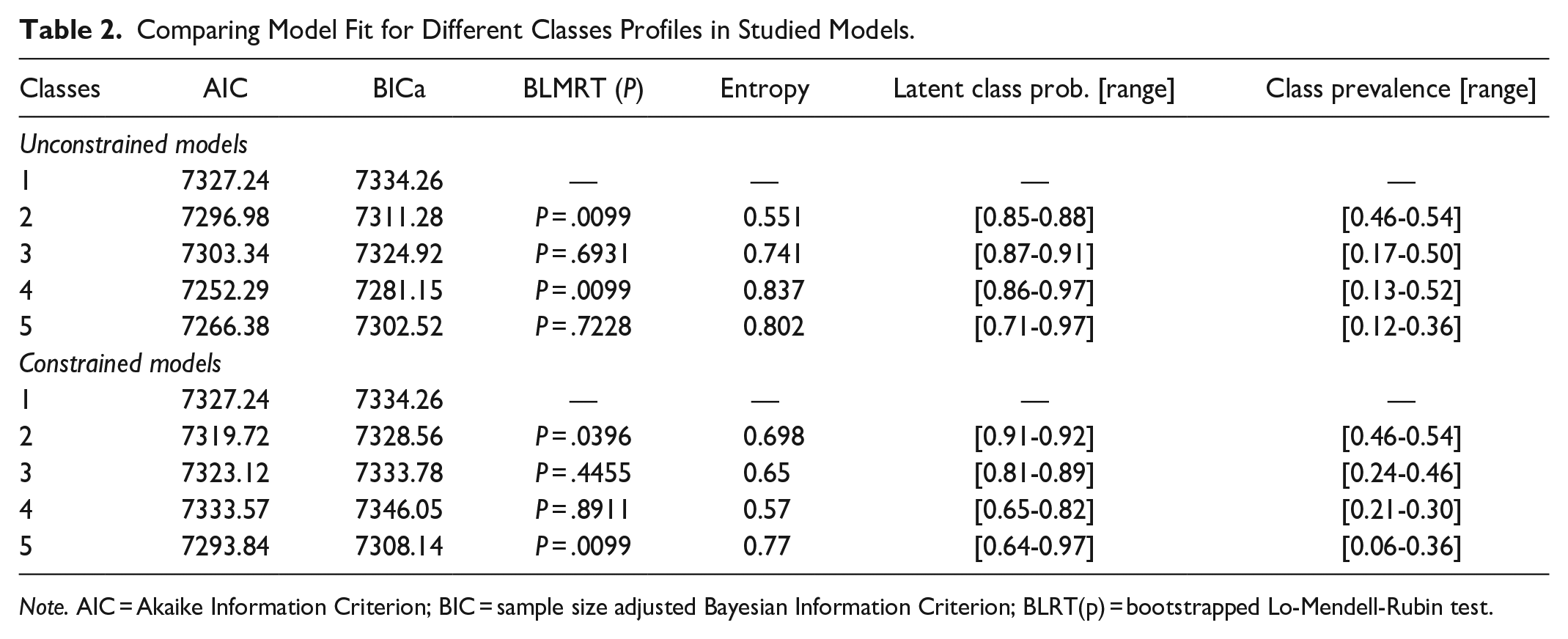
Note. AIC = Akaike Information Criterion; BIC = sample size adjusted Bayesian Information Criterion; BLRT(p) = bootstrapped Lo-Mendell-Rubin test.
Mean Scores of Variables in Unobserved Classes and Significance Differences Between Variables by Classes. N = 228.

Note. M = mean; SD = standard deviation; Me = median; Q = quartiles; PE = psychophysical exhaustion; RD = relation deterioration; PI = professional inefficacy; DI = disappointment; BMI = body mass index. Kruskal-Wallis test + post-hoc analysis (Dunn-Bonferroni test) for quantitative variables, Chi-squared or Fisher’s exact test for qualitative variables.
Statistically significant (P < .05).
Moving on to the discussion of the extracted burnout profiles, it should be noted that the entire group of men surveyed declared high scores in 3 dimensions of burnout (RD, PI, DI), while their scores in PE dimension were average. Table 3 presents the characteristics of the classes identified taking into account the variables used in the study and the significance of differences between the variables in each class. It can be observed that each class was characterized by a different profile of burnout dimensions. No class with extremely high or extremely low scores in all dimensions of burnout was recognized. There were significant differences between classes regarding 8 of the 11 variables used. The starting point for further analysis is the difference in the length of employment of the ECDs surveyed. Class 3 consisted of men with the shortest length of employment (the median of 8 months), with 59% (n = 19) of the respondents aged between 25 and 31 years, 46% (n = 15) living in a civil partnership, most of whom had no children 71.88% (n = 25). The respondents in this class scored relatively average (compared to the other respondents) in 2 burnout dimensions (RD and DI) and higher than average in the PE and PI dimensions. As for physical health, the BMI of the class in question was in the overweight category. This class was named: men with short length of employment, at risk of exhaustion, disillusionment and overweight. Class 1 comprised ECDs with the median of the length of employment reaching 3.5 years. They were young adults—80% (n = 24) of whom were aged between 25 and 35, 50% (n = 11) of them lived as married couples (in total 80% (n = 24)) as married and partnered couples) and mostly without children 73.33% (n = 22). The men in this class obtained the highest rates of burnout in all 4 dimensions among all the ECDs surveyed. Their average BMI was within the normal range. Although the number of working hours per week did not significantly differ between particular classes, men in class 1 worked the highest number of hours per week as compared to the others (on average more than 43 h, range: 36-80). This class was named: young men starting their career and family life, with symptoms of full-blown burnout. Class 2 was formed by men whose median of the length of employment in the ECD profession was 4 years. This was the most diverse group in terms of age and marital status. Most of the men in this group were between 25-35 years old, and 35% (n = 42) of them were over 35. Married men 41% (n = 48) and those living alone 31% (n = 37) made up a significant percentage of this class. It was the second biggest class in terms of the number of children in the family, 29% (n = 35) of ECDs had 1 or more children. This was the class of men with the lowest burnout rates in all 3 dimensions (PE, RD, DI) of all the respondents. In the PI dimension their score was similar to that of class 1, and higher by 1 point than those of the other 2 classes. The class in question had the highest BMI, which fell into the overweight category. It had the highest number of obese men (50% (n = 59). ECDs from the discussed class reported the lowest average number of working hours per week. This class was called: at risk of incomplete burnout and obesity. Class 4 comprised men with a median of the length of employment of 5 years. In this class 38% (n = 18) of the men in this class were between the ages of 31% and 35%, 45% (n = 23) over 36, including 11% (n = 6) aged 50 and over. The class was dominated by married men 49% (n = 23). This class had the highest number of men with children at home 38% (n = 18) had 1 child or more. The men in this class reported relatively the lowest rates of burnout in 2 dimensions (RD, PI) of all the respondents. The scores in the PE and DI dimensions were 1 point higher than in the lowest-performing class 2. The median of BMI was in the overweight category. This class was named: persistent, at risk of exhaustion and overweight.
As for the relationships between burnout symptoms and socio-demographic variables (hypothesis 2), it was observed that the highest intensity of PE (at a high level) occurred in the class of young men starting their professional and family careers, with the length of employment of 3.5 years, mostly living in formal and informal relationships and without children. The men in this group reported signs of full-blown burnout, with indices of all dimensions falling within the high range (scores of the RD and PI dimensions were extremely high—10 stanine). The respondents with short period of employment, quickly disillusioned and overweight, were slightly less affected with PE issues (7th stanine), but their scores in the other dimensions of burnout were lower than in the previously mentioned class. The men who were employed in the profession for 4 years, at risk of incomplete burnout and obesity, from the group with high rates of married and partner couples scored as high in the PI dimension (10th stanine) as young men starting their careers, simultaneously, having the lowest scores in the other 3 dimensions of all the ECDs surveyed (PE—7th stanine, RD 7th stanine, DI—8th stanine). The PE, RD, PI and DI scores obtained by men with the longest time of employment were the most balanced and relatively lower in the whole ECDs group surveyed (PE 7th stanine, RD 7th stanine, PI 8th stanine, and DI 8th stanine).
There were significant differences between particular classes as far as ECDs’ marital status was concerned. The largest number of married men was found in the class of young men starting their career and family life, with symptoms of full-blown burnout, whereas the lowest number of married men was found in the class with a short period of employment, quickly disillusioned with work and overweight. The largest proportion of men living alone was in the class at risk of incomplete burnout and obesity. The highest percentage of childless men was found in the class of young men starting their career and family life, with symptoms of full-blown burnout, and the lowest percentage in the class of persistent men, at risk of exhaustion and overweight. Men with children reported a significantly higher rate of PE compared to other ECDs (U = 7671.0; P = .001). No similar relationships were observed for the other dimensions of burnout.
Negative consequences related to respondents’ occupation in the form of the risk of overweight and obesity (hypothesis 3) as well as their connections with occupational burnout were observed in the class that had relatively the lowest burnout rates among all the respondents, with the exception of the PI dimension (class 2). However, since the problem of professional inefficacy (PI) was also pointed out by males from the class with low BMI, the aforementioned relationships may be coincidental or more complex. It was confirmed by an analysis of correlations between BMI and burnout dimensions, which presented no significant relationships between the variables. A distinguishing feature of the men in Class 2 was the highest percentage of those living alone and aged between 40 and 45. Are single and middle-aged men really more likely to be obese? A comparison of intergroup average scores seemed to contradict these speculations. Married men declared significantly higher BMI values than men living alone (U = 4315.0; P = .01). Also, the men who had children declared higher BMI values (U = 7248.5; P = .01). BMI had a positive linear correlation with ECDs’ age (r = .20; P = .01), which may explain the results obtained by men in Class 2. It is also worth noting that BMI in the whole study group correlated negatively with actively cultivated hobbies (r = .15; P = .02).
Discussion
The primary purpose of the study was to test the efficacy of the Person-Oriented approach in researching occupational burnout. The study presented that the simultaneous consideration of several variables related to occupational burnout, possible predictors and negative health consequences, makes it possible to differentiate the patterns describing the aforementioned relationships.
Firstly, it is important to note that the prevalence of men with high levels of burnout and the risk of some burnout-related problems was widespread among the ECDs surveyed. High levels of burnout were related to the dimensions of the loss of commitment to relations with callers and co-workers, a sense of professional inefficacy and disillusionment with work. Explanation may be offered by the fact that the study was conducted during the SARS-CoV-2 pandemic, which, in the case of PSAP work, was associated with, among other things, high employees’ absenteeism due to isolation and quarantine and frequent shutdowns of the centers because of the need to disinfect operators’ workplaces. This resulted in the need to take over the duties of disinfected centers by other centers and posed a risk of work overload for their employees. 49
Identification of Latent Burnout Profiles
According to the assumptions of the first hypothesis, it was possible to distinguish burnout classes characterized by different profiles, although not all variables were able to differentiate the study group. The study identified classes with varying profiles of burnout symptoms. Differentiation of profiles by the severity of particular symptoms was recently observed in a longitudinal study of Finnish white-collar workers. 55 In this study, 3 developmental profiles of burnout were distinguished that differed in the type of relationship between variables (rectilinear or u-shaped). In our study, we observed rectilinear relationships between some dimensions of burnout and age, length of service and having children. The assumption about the role of work-time organization characteristics such as the number of working hours per week and the number of on-call shifts per week as differentiating factors in ECDs’ burnout profiles was not confirmed. It should be noted that the high level of burnout characterizing the entire study group referred to men working on average 42 h per week on an ECD position and having 14, on average, 12-h on-call shifts per month. An important role may be played by the fact that the number of calls received (which is a stress factor for an employee) varied depending on several factors: whether the on-call shift was during the day or at night (most calls are made between 10 am and 8 pm), the start times of the night shift, which vary among PSAPs in Poland, and the number of calls, which also varies depending on the day of the week (Fridays and Saturdays have the most calls). However, these variables were not included in the study.
The Variables Predict the Differences Between the Profiles
As mentioned in the introduction, the results of the meta-analysis indicate a negative correlation of age and the length of employment with occupational burnout. 12 According to the assumptions of the second hypothesis, in the study conducted, the shortest period of employment at ECD position coincided with symptoms of psycho-physical exhaustion, deterioration of social relationships and disillusionment with work. In turn, the longest period of employment co-occurred with relatively less severe symptoms of burnout observed in the study group, including the lowest severity of symptoms of deterioration of social relationships and loss of professional efficacy. The average period of employment ranging from 3.5 to 4 years coincided with both the highest severity of burnout symptoms in the dimensions of exhaustion, deterioration of social relationships and disillusionment with one’s job, and the lowest severity of the aforementioned variables in the group of surveyed ECDs. In Poland, the average period of employment as an ECD is 3 - 4 years, indicating the high turnover rate in this profession. The difference between these particular classes with extreme values of burnout was the highest number of single men in the class with lower severity of symptoms compared to the low number of single men in the class with higher severity. This may indicate an indirect influence of the period of employment on burnout through marital status, which would explain the contrasting results obtained in the studies by different authors.18,19
Modern models of occupational burnout explain its causes by a sequence of stages over time. The first stage is imbalance between work demands and individual resources, the second stage is an emotional response of exhaustion and anxiety, and the third stage involves changes in attitudes and behavior (defensive coping methods). 2 As a result, psychological tension (emotional response to exhaustion and anxiety) increases, the level of which is regulated by defensive coping methods activated by employees. They can take the form of distancing in ECD employees’ relationships with callers. The signs of such relationships could be seen in the results of our study. Higher levels of psychophysical exhaustion co-occurred with higher scores of deterioration of social relationships, but to different degrees in each class. In the class of young men starting their career and family life, with symptoms of full-blown burnout, the deterioration of social relationships far outweighed the other symptoms of burnout and was accompanied by the highest level of psychophysical exhaustion observed among the subjects. In the class with an equally high level of exhaustion (men with short period of employment, at risk of being exhausted, disillusioned and overweight), there was no such strong deterioration of social relationships while there was a similarly high level of disillusionment with work. In the other classes, the level of deterioration of social relationships was lower as compared to the level of exhaustion. What seems really noteworthy is the high level of the sense of professional inefficacy, the highest in both the class of men starting their career and family life, with symptoms of full-blown burnout and in the class at risk of incomplete burnout and obesity.
Elevated levels of exhaustion and disillusionment among men with the shortest period of employment may have a number of explanations. One of them can be the theory of personal resources deficit, which is aimed at providing protection against the “reality shock” that occurs after starting work. 56 It is also believed that employees at the beginning of their careers may experience a mismatch between their professional expectations and reality, feel unfamiliar at their new workplace and have unrealistic expectations of their work. At the same time, they may lack effective strategies for coping with chronic stress, which is the main cause of burnout. In conclusion, it can be stated that in our study group the length of employment was a variable that significantly differentiated respondents in terms of burnout symptoms. The findings presented both a negative linear relationship between seniority and burnout and, in the case of average working time, the influence of other variables on the relationship in question. It should be remembered that the length of employment of 3 to 4 years is a critical moment - many ECDs in Poland decide to leave their jobs after 3 years of service. Highlighting of the aforementioned relationships was made possible by using the Person-Oriented approach.
As for the variable: balancing caregiving, marital and professional roles (ECDs’ marital status and, the number of children) played an important role in class differentiation. The class of young men with symptoms of full-blown burnout and an extremely high deterioration of social relationships was characterized by the highest prevalence of ECDs living in partnerships. Meanwhile, unmarried men seem to be more prone to burnout syndrome compared with those who are married. 57 High levels of exhaustion accompanied by slightly lower levels of deterioration of social relationships were observed in the second most numerous class of men living in partnerships. Probably, the results obtained were additionally influenced by the occurrence of the first phase of the COVID-19 pandemic, during which the study was conducted. Caring for loved ones has become an additional burden for ECDs. The occupational demands of ECDs and healthcare professionals have increased due to the COVID-19 pandemic, while the possibilities of regenerating psychophysical strength have decreased. Due to the illness of one’s own or family members and the quarantine, the number of staff has additionally decreased. 58 Considering the entire group of ECDs, men with children reported the highest intensity of symptoms of emotional exhaustion. This is in line with the research results of male doctors, where the need to care for more children exacerbated work-home conflicts. 12
The Latent Profiles of Burnout Predict the Risk of Overweight and Obesity
Relationships linking burnout profiles to the employees’ health disorders have been confirmed in most scientific studies. Research reports indicate that emotional exhaustion can lead to both appetite loss and overweight due to changes in eating habits and so-called “emotional eating.” In our study, according to the assumptions of the third hypothesis, it could be clearly observed that the highest prevalence of overweight and obesity indicators coincided in a group of men with longer period of employment with relatively low psychophysiological exhaustion, deterioration of social relationships and disappointment but, with a high index of professional inefficacy. Overweight was also diagnosed in the group of men with the shortest length of employment, with varying degrees of burnout in all dimensions, predominating psychophysical exhaustion and, as in the previous group, a sense of professional inefficacy. Finally, overweight was observed in the class formed by men with the longest period of employment and relatively low burnout rates with the exception of psychophysical exhaustion and disappointment with work. A recurring incidence of high BMI has been observed in men with emotional exhaustion and a sense of professional inefficacy. Such individuals feel unable to face problems at work, are unable to see results of their work and may experience a sense of professional failure. The mediating effect of high BMI on exhaustion and professional inefficacy is also known from studies by other authors. 34 These studies confirmed the links between chronic occupational stress (the underlying cause of burnout) and abdominal obesity. 36 It is known that the ECDs’ occupational group is exposed to obesity as an occupational disease due to sedentary work and low physical activity 39 In our study, overweight occurred in both very emotionally exhausted and less emotionally exhausted men. This seems understandable; chronic psychophysical exhaustion means loss of energy resources. Weight loss in exhausted men may be explained by hypocortisolism, which is typical of increased job stress and burnout and results in restricted food intake. 59 In the study conducted, higher BMI levels occurred in ECDs living in married couples with children, and rose linearly with the respondents’ age. In conclusion, it can be said that higher BMI was associated with a number of variables: older age (longer period of employment), being married and having children to raise, as well as psycho-physical exhaustion and professional inefficacy. The obtained results indicate directions for organizational activities to prevent burnout in the group of ECDs.
Regarding the need to balance the demands of professional work with caring and marital roles, long working hours and shift work can make it difficult to fulfill a caring role. Men with children in their care should receive organizational support, that facilitate the care of children. During the COVID-19 pandemic, the threat to the health of a family member additionally burdened married ECDs, weakening the protective effect of marriage on occupational burnout. Although being married is a man’s personal resource, it was associated with higher emotional exhaustion in the study group. This presents how non-professional factors can affect an employee’s health and work. This fact should be brought to the attention of those managing the work. 60
Regarding seniority, for employees with a short length of employment, activities that increase the level of psychological capital (PsychCap), which consists of high levels of self-efficacy, hope, optimism and resilience, are particularly important. 61 Some help can be provided by introducing mentoring in the workplace - an interpersonal relationship in which an employee with more experience supports a less experienced colleague. 62 The role of PsychCap in preventing burnout has been reported, for example, in studies conducted among employees who treat their work as a vocation, which frequently exposes them to work-home conflict. 63 The level of an employee’s sense of professional efficacy can be increased by both organizational activities carried out within the institution and individualized activities of the employee. An organizational resource may involve providing employees with feedback, emotional and instrumental support, ensuring professional autonomy, and creating a positive organizational atmosphere. 64 It also means introducing the idea of empowerment into the supervisor-subordinate relationship and strengthening the level of self-efficacy in employees by eliminating conditions that account for their powerlessness.65,66 It is important to focus on employees’ positive qualities, rights and abilities and to delegate to them more power and autonomy of action. Using proactive coping strategies to anticipate the timing of a stressor and to minimize its impact has been proven to be a successful way to prevent emotional exhaustion. 67 For people struggling with a sense of disappointment with their work, activities that increase their ability to transform work generally called job crafting, can be particularly helpful. Job crafting increases the sense of meaningfulness and significance of the work done. 68 A set of various stress-reducing interventions has also been developed for the ECDs’ group, with the intention of its further evaluation. 39
Regarding health consequences, our study confirmed the complex relationship between burnout symptoms, age and length of employment, and overweight and obesity. In our study, more than half of ECDs were overweight or obese. In a sample of 911 telecommunicators in the USA, 83% of them were either overweight or obese. 46 This phenomenon has been known for many years. 69 Obesity is explained by sedentary work and limited physical activity. 39 It is associated with older age and longer period of employment. A similar relationship was observed in the study of 911 telecommunicators. 46 Obese employees are more emotionally exhausted, and additional perceptions of high psychological job demand co-occur with obesity. 70 The phenomenon of a vicious circle appears. The employer should provide incentives for ECDs to participate in exercise and healthy eating programs. It also includes stress management training, training in emotional intelligence, and psychoeducation on the issue of emotional eating and emotional labor. 71 Currently, these preventive actions are only a personal preference of the employee.
Conclusion
Many scientific studies have already proven that there are no typical burnout patterns for all employees, and the form of burnout can vary among various individuals. 8 We found a number of hidden correlations between burnout predictors, symptom groups and health consequences among ECDs. This would not be possible in the classic Variable-Oriented approach, just because it excludes from the analysis results that do not coincide with pre-established burnout patterns. A high levels of burnout syndrome and the risk of some burnout-related health problems was widespread among the ECDs surveyed. Most ECDs were overweight or obese, but among the most psycho-physically exhausted men, there were the fewest overweight ones. In our study, we observed rectilinear relationships between some dimensions of burnout and age, length of service and having children. The shortest period of employment at the ECD position coincided with high symptoms of burnout. Living in a domestic partnership (cohabitant and married) and having children co-occurred with the highest intensity of emotional exhaustion and a higher BMI index. Probably, caring for loved ones during the first phase of COVID-19 became an additional emotional burden for ECDs.
The Limitations
The conducted research had its strengths and certain limitations. It was the first ECD study in Poland and one of the few in the world. Additionally, it was conducted in exceptional conditions of the first phase of the COVID-19 pandemic. A large sample size in almost all PSAPs, close to the expected value, may provide the right statistical power for analysis. The first limitation is the lack of random selection of people to the sample. Questionnaires were sent to all Polish ECDs, but not all agreed to participate in the study. The cross-sectional research model did not allow for the search for causal relationships between the variables. It is important to assess the stability of the differentiated profiles, which requires further longitudinal studies. An important issue is a clinic diagnosis of burnout. The LBQ questionnaire provides data about the severity of symptoms, but does not allow for a clinical diagnosis. In some countries, the Maslach Burnout Inventory questionnaire has cut-off points allowing for making a clinical diagnosis. 55 Our study group did not include employees on sick leave, whose participation is often omitted in studies. The way participants were recruited may have partially biased the results, as well as the use of self-report questionnaires (rather than objective behavioral indicators). An alternative is to use more objective indicators, such as psycho-physiological indicators or supervisors’ ratings. The study did not take into account important information on the organization of working time, especially important during the pandemic period. It included working overtime in order to replace those in quarantine and taking a significant number of calls while on duty due to the temporary shutdown of other PSAPs.
Supplemental Material
sj-doc-1-inq-10.1177_00469580241229642 – Supplemental material for Having Children and Being Married Are Predictors of Burnout and Obesity Among Working Men: Effects of Latent Profile Analysis
Supplemental material, sj-doc-1-inq-10.1177_00469580241229642 for Having Children and Being Married Are Predictors of Burnout and Obesity Among Working Men: Effects of Latent Profile Analysis by Maciej Załuski and Marta Makara-Studzińska in INQUIRY: The Journal of Health Care Organization, Provision, and Financing
Supplemental Material
sj-docx-2-inq-10.1177_00469580241229642 – Supplemental material for Having Children and Being Married Are Predictors of Burnout and Obesity Among Working Men: Effects of Latent Profile Analysis
Supplemental material, sj-docx-2-inq-10.1177_00469580241229642 for Having Children and Being Married Are Predictors of Burnout and Obesity Among Working Men: Effects of Latent Profile Analysis by Maciej Załuski and Marta Makara-Studzińska in INQUIRY: The Journal of Health Care Organization, Provision, and Financing
Footnotes
Acknowledgments and Credits
None
Declaration of Conflicting Interests
The author(s) declared no potential conflicts of interest with respect to the research, authorship, and/or publication of this article.
Funding
The author(s) received no financial support for the research, authorship, and/or publication of this article.
Wring Assistance
None

Supplemental Material
Supplemental material for this article is available online.
References
Supplementary Material
Please find the following supplemental material available below.
For Open Access articles published under a Creative Commons License, all supplemental material carries the same license as the article it is associated with.
For non-Open Access articles published, all supplemental material carries a non-exclusive license, and permission requests for re-use of supplemental material or any part of supplemental material shall be sent directly to the copyright owner as specified in the copyright notice associated with the article.
