




Abstract
Many studies have reported that Cognitive reserve is a critical mechanism affecting cognitive statuses, such as dementia. The purposes of this study were to identify the knowledge structure and the research trend on cognitive reserve by conducting keyword analysis on research papers ranging from the earliest to the most recent studies done on the topic and to suggest directions for future research. The Web of Science (WOS) database was used to search for articles on cognitive reserve in aging from 2001 to 2020. NetMiner version 4 (cyram, KOREA), a social network analysis program, was used for keyword network analysis. Data analysis showed keywords that could be categorized as cognitive reserve related keywords (cognitive reserve related concepts, cognitive reserve related factor, cognitive reserve diagnosis and measurement, cognitive reserve outcomes) and cognitive reserve research keywords (research subject/disease, research method, intervention, research field). Through trend analysis, we found that various keywords appeared, indicating that the research has gradually developed conceptually and methodically. Based on these findings, future CR studies require the development of multimodal interface-based tools by applying modern digital technology that can be used to more accurately diagnose and monitor CR; remotely, in real time. In addition, to improve CR, it is suggested that the development of cognitive stimulation interventions utilizing VR which fuses AI based interaction technology with the subjects. Finally, CR could develop further through a cooperation of multidisciplinary professionals such as psychology, medicine and nursing.
What do we already know about this topic?
Cognitive reserve, a concept based on the brain plasticity, is an implicit mechanism that delays or minimizes clinical manifestations of brain changes or pathologies in regards to aging.
How does your research contribute to the field?
This research contributed to identify the knowledge structure and the research trend on cognitive reserve by conducting keyword analysis on research papers ranging from the earliest to the most recent studies done on the topic and to suggest directions for future research.
What are your research’s implications toward theory, practice, or policy?
Various potentials in CR research were also identified as we proposed new topics for the future such as the development of cognitive stimulation interventions utilizing VR, gleaning insights from the research trends by period.
Introduction
The concept of reserve, the mind’s resilience against brain damage, was developed in the context of the clinical symptoms of Alzheimer’s disease (AD) not always corresponding to the degree of brain damage. 1 Later studies have reported that the pathological severity of AD or aging is not identical to their symptoms,2,3 and Stern 4 proposed that these discrepancies could be explained by the element of reserve. There are 2 models constituting the reserve: brain reserve, a passive concept represented as the size of the brain or the number of neurons; cognitive reserve (CR), an active frame effectively coping with neuropathological changes employing the pre-damage cognitive function or the process of compensation.4,5
CR, a concept based on the brain plasticity, is an implicit mechanism that delays or minimizes clinical manifestations of brain changes or pathologies in regards to aging.4,5 Individual differences of CR is inherited in part but can affect by lifelong cognitive activities such as education,6 -8 IQ,9,10 leisure activities,6,11 occupation,6,12 -14 and bilingualism.15 -19
Since the introduction of the concept in 1989, there has been a constant stream of research on CR from 2000s ranging from the measurement of CR to the studies on correlation and related factors, primarily concerning the elderly with senile/degenerative diseases including dementia, for example, AD, and Parkinson’s disease.13,19 -24 Many studies have reported that CR is a critical mechanism affecting cognitive status such as dementia. CR has recently been reported to reduce the risk of dementia and increase the ability to cope with brain damage by expanding the range of experience and learning through cognitive training and cognitive rehabilitation programs.5,19,25,26 For this reason, the World Health Organization (WHO) 27 guidelines included cognitive training as a preventive intervention to reduce the risk of cognitive dysfunction and dementia in the elderly and people with Mild Cognitive Impairment (MCI). Since then, various studies on cognitive aging spectrums (ie, normal cognition, MCI, and AD) and neurocognitive disorders such as schizophrenia have seen a rapid increase in number.21,26,28,29
A diverse set of systematic review studies have been conducted upon the accumulation of a rich volume of research on CR. According to the systematic reviews30,31 investigating the correlation between CR and education in dementia patients, a low level of education was found to increase the risk of dementia while a high level of education was reported to have protective effects delaying the symptoms in case the patient was already affected. Similarly, in systematic reviews on CR and Parkinson’s disease, 32 a high level of education positively correlated with increased MMSE, overall cognitive function, attention, executive function, visuospatial function, and memory. The rate of cognitive decline was observed to decrease in these groups. The strategies to operationalize CR reported in another systematic review 33 noted that the primary factors defining CR suggested education, occupation, and leisure or cognitively stimulating activities supplied CR and provided protective effects in regards to the risk of dementia. A high level of education was seen to also decrease the risk of post-surgical cognitive impairment in a review. 34 A study that reviewed functional magnetic resonance imaging (fMRI) research 18 systematically compared the implicit neural mechanisms based on CR with the effects of aging. The body of systematic reviews, however, was primarily an overview of CR related specific diseases or a group of individuals and none concerned the entire knowledge structure and research trend on CR in aging.
Literature review methods can be categorized into thematic analysis, semantic analysis, and network analysis based on classification criteria. 35 Analyzing the networks extracted from the related topics is what network analysis entails. 36 Literature review utilizing network analysis includes keyword network analysis, text network analysis, etc. Text network analysis is useful to look into micro topics out of extensive amount of text materials and big data, using computer software for social network analysis. The most important advantage of text network analysis is that it enables the researcher to discover what is primarily, actually, and implicitly discussed in the text. 37 Unlike this, keyword network analysis is performed on the keywords presented by authors, which are core components of knowledge, 38 representing the central topics that allow for visualizing and analyzing scientific knowledge 39 and discovering changing keywords through which research trends and knowledge structure can be identified. 40
The objective of this study is to identify the knowledge structure and the research trend on CR by conducting keyword analysis on research papers ranging from the earliest to the most recent studies done on the topic and to suggest directions for future research.
Methods
Data Collection
The Web of Science (WOS) database was used to search for the literature on CR in aging for the last 20 years from January 2001 to April 2020. The WOS is an academic database offering bibliographies, abstracts, and references for literature published in more than 18 000 academic journals worldwide such as SCIE, SSCE, A & HCI. The advantage of the WOS is that it provides an automatically extracted keywords of the papers.
A total of 1225 studies were identified by using search terms including TOPIC: “cognitive reserve” AND TOPIC: (aging OR aged) (Figure 1). Two researchers and a research assistant independently screened out papers not meeting the topical categories or missing keywords based on the titles, abstracts, and keywords, leaving 679 papers for the final selection. The WOS was then used to extract the publication years and the keywords from the bibliographies and references of the 679 papers, which were downloaded as excel files.

Published papers for cognitive reserve in aging.
Data Standardizing
Data refining
The types of keywords given by researchers show a great variation and the keywords themselves are not standardized, which calls for a data refining process to achieve consistency. 41 For the current study, different terms of the same meaning were merged into a single term by the 2 researchers, for example, cognitive reserve capacity → cognitive reserve. The refining process was carried out based on the Medical Subject Headings [MeSH] in accordance with the journal keyword-related contribution regulations most widely used. In case the keyword did not show up on the MeSH terms, 2 standardization processes were implemented: a formal standardization process to correct spaces and stopwords and a semantic standardization process to handle singular/plural, synonyms, and auxiliaries, reflecting the authors’ intentions as much as possible. Some words not found in the MeSH terms went through consultations with nursing/medicine/psychology/radiology professors and were unified based on the terms commonly used in papers, however, as the purpose of the study was to refine the terms for network analysis, they were not necessarily converted into the MeSH terms.
Preprocessing of data for network analysis
As network analysis takes the relationship between the paper and the keywords as an object for analysis, an appropriate form of data coding is required to use a network analysis program. The publication years and the keywords were coded into linked list files for this study.
Data Analysis and Mapping
Keyword network analysis used NetMiner Program version 4 (Cyram Inc., South Korea), a software program that automatically performs network visualization. The details are as follows. 42
Core keywords selection
(1) 97 keywords were selected as the core keywords which appeared more than 5 times, marking the frequency of occurrence of 11.25% out of the entire 862 keywords refined from the initial search results. This was to exclude the keywords from a small number of papers.
Keyword classification
(1) Papers with the same keyword were organized into a single file and then reviewed by the 2 researchers independently for the first round of classification.
(2) The second round of classification was performed, discussing with the third researcher.
(3) To verify the validity of keyword classification, the third round was executed by consulting nursing/medicine/psychology/radiology experts and the final meetings with the researchers.
The terms of final selection and analysis results underwent consultations with professors of brain science/clinical examination/dementia/gerontological nursing while the data analyses were reviewed by the experts from the NetMiner developer.
Keyword network generation
(1) The 2-mode data with the rows of papers and the columns of keywords was transformed into 1-mode data with keywords only.
Link filtering
(1) The networks with a low frequency of co-occurrence was excluded from analysis in order to clarify the structural features of the network, filtering out co-occurrences of less than 2. Ninety-seven core keywords were reduced to 95 in the process.
Identifying the entire structural features
(1) In order to identify the knowledge structure, the network structure was constructed based on the analysis of the co-occurring words. Each keyword was recognized as a node and network structures were constructed on CR in aging consisting of the links of each keyword. The statistical features of network analysis such as link, degree centrality, and betweenness centrality were checked and data mapping was performed using 2D visualization. The size of the nodes was adjusted to the frequency of keyword appearance in submissions and the edges to the co-occurrence frequency of the keywords.
Cohesion analysis for clarifying sub-structures
(1) A cohesion analysis was conducted in order to clarify the sub-structures within the entire network structure.
Research trends by period
(1) Separate networks were generated to identify the research trends of CR in aging by period, segmenting the entire period into the first 10, the next 5, and the final 5 years of timeframe.
(2) The trends were identified by comparing the changes in the top 30 keywords (changes in keywords and category ratios) for each period.
Ethical Considerations
We received approval to conduct this study from the S University institutional review board (IRB Review Exemption Approval Number: 2-1040781-A-N-012020028HR). The data were collected from published articles in the WOC, and the study therefore posed no harm and risk to the participants. In addition, the collected secondary data were used solely for the purposes of this study.
Results
A total of 3699 keywords were extracted out of 679 papers, leaving 862 final keywords for selection through the data standardization process. The keywords with a frequency of 11.25% (or more than 5 times of appearance) were categorized as in Table 1 below. Studies on CR in aging presented keywords categorized into CR related keywords (CR related concepts, CR related factors, CR mechanisms, CR measurement tests, CR outcomes) and CR research keywords (research subjects/diseases, research methods, interventions, research fields/disciplinaries).
Classification or Frequency of the Keyword.

Keyword Network Knowledge Mapping and Cohesion Analysis
(1) Structural features of the keyword networks
Using the nodes of 97 core keywords, a structural analysis was conducted on the networks of the final 95 keywords constructed by the links between each node (link reduction 2 applied). The entire keyword network properties on CR research in aging revealed 460 links. The entire network structure is shown in Figure 2.
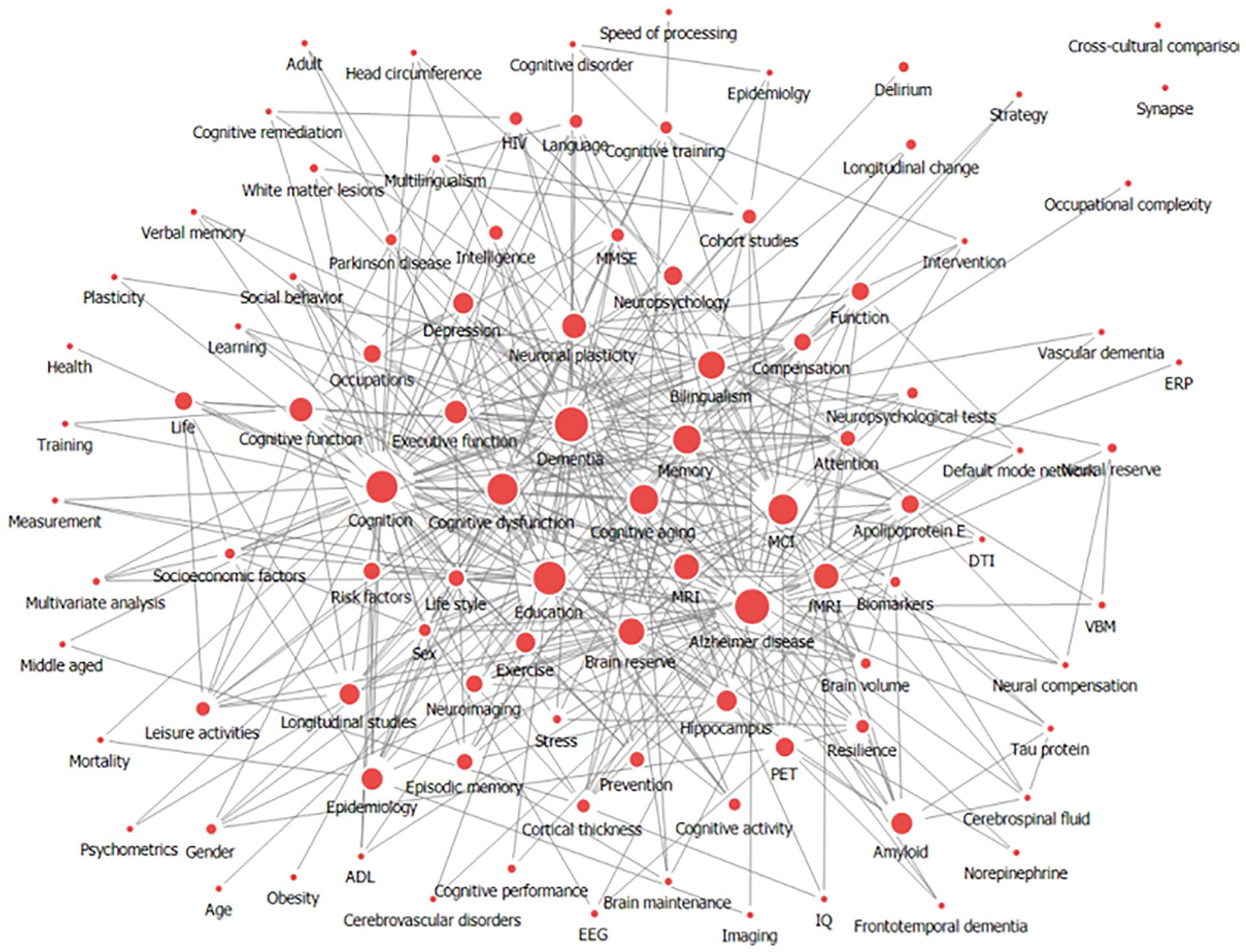
Overall keyword network structure for Cognitive reserve in Aging node size: the frequency of keyword appearance edge length: Frequency of co-appearance of keywords.
Keywords with a high degree centrality indicate that they are studied along with a large number of other keywords. Keywords with a high betweenness centrality refer to a high connectivity of sub-domains of research. The list in order of high degree is presented in Table 2 below. The keywords with a high degree centrality, that is, the degree of connection within the network, were “Alzheimer’s disease,” “Dementia,” “Cognition,” “Education,” and “MCI,” etc. The ones with a high betweenness centrality, that is, the degree of mediation level between groups, were in the order of “Cognition,” “Alzheimer’s Disease,” “Dementia,” “Education,” “Cognitive dysfunction,” “MCI,” and “Cognitive aging.”
Degree Centrality, Betweenness Centrality.

(2) Cohesion analysis
The cohesion analysis performed to clarify the knowledge structure of CR in aging showed a total of 4 groups. The topics and the primary keywords of each group are shown in Figure 3.

Structure of subgroup keyword for cognitive reserve in aging.
The primary keywords of Group 1 were “Cognitive dysfunction, Dementia, Cognitive function, Depression” with “Epidemiology” being the keyword of research areas. Group 2 revealed “Cognitive aging, Cognitive training, Intelligence” as their primary keywords and “Intervention” for the research related keyword. Group 3 had “Education, Cognition, Neuronal plasticity, Brain reserve, Lifestyle” and “Longitudinal change” for research methods. Group 4, lastly, showed “AD, MCI, Memory, Bilingualism, Amyloid, Hippocampus, Apolipoprotein E” and “Strategy” as the research related keyword.
Research Trends
Separate networks were generated to identify the research trends of CR in aging by period, segmenting the entire period (2001-2020) into 3 parts: the first 10, the next 5, and the final 5 years of timeframe. The results are shown in Table 3.
Comparison for research trend in cognitive reserve in aging.

The change in the trends of the network for each period was analyzed by observing the changes in category ratios of the top 30 keywords which appeared in more than 2 articles in each period.
A diverse set of keywords appeared over time (85 during 2001-2010, 207 during 2011-2015 and 387 during 2016-2020), indicating a conceptual and methodological development in research. The subject groups have expanded from the preexisting dementia groups to depression and HIV groups and the number of longitudinal cohort studies has increased. More diverse cognitive functions were examined and various factors such as genes, amyloids, and cortical thickness were found to be associated with CR. The factors affecting CR have been extensively examined along with a trend where research on leisure activities, sports, and language is carried out as a way of supplying CR.
Discussion
This study identified the keyword distribution using keyword network analysis in the literature of CR in aging and structuralized the keyword networks to examine the features and the research trends by period.
Core Keywords
The keyword frequency analysis showed “CR related keywords” (CR related concepts, CR related factors, CR mechanisms, CR measurement tests, CR outcomes) and “CR research keywords” (study subjects/diseases, research methods, intervention, research areas/disciplines). Of these keywords, the measurement variables of CR were categorized into 2: Judgments based on morphological alterations or mutation using imaging techniques and assessments on the degree of function or response. This is explicated by Stern’s research4,5 on “Reserve,” where brain reserve and CR take different conceptual understandings, the former represented by the brain size or the number of brain cells in a passive model and the latter depicted as an active model that incorporates coping mechanisms in a compensation process. It is therefore understood that for brain reserve, the degree of function or response can be measured by neuroimaging techniques with a focus on the hardware aspects of the brain, being the brain capacity. For CR, it is measured by the neurological pathways, the degree of connection, and efficiency. 43 The area of measurement is particularly limited to hippocampus, corresponding to the results that the brain experiences both atrophy and development enabled by the CR mechanism of brain plasticity and that these phenomena are prevalently observed in hippocampus. 44
Similarities were found in the keywords of high degree centrality (AD, Dementia, Cognition, Education, MCI) indicating the level of association between the concepts and in the keywords of high betweenness centrality (Cognition, AD, Dementia, Education, Cognitive dysfunction, MCI, Cognitive aging), the level of mediation between the concepts. This is interpreted that the keywords high of both statistical elements are identical as the ones connecting groups—high in betweenness centrality—are shown to have a high overall connectivity to other keywords. The results suggest that research on CR in aging has been restricted to the domain of particular diseases such as AD, Dementia, and MCI.
Cohesion Analysis
The cohesion analysis returned the results of 4 groups (Figure 3). Group 1 found that the studies were conducted on exercise and learning with a variety of target groups including dementia, delirium, obesity, and depression related to cognitive function and dysfunction. This result speaks to the findings that physical activity has been associated with better cognitive functions and prevention of dementia.45,46 Group 2 showed that research has been done on the CR related factors (ie, intelligence, IQ, occupational complexity) and preventive interventions (ie, cognitive training) against cognitive aging. These results agree to the findings from a systematic review that computerized cognitive trainings need to be implemented to prevent cognitive aging caused by HIV and improve cognitive function. 47 Group 3 presented the studies done on the groups of PD, HIV, and cerebrovascular disorder, focusing on cognition, brain reserve, and neural plasticity—higher and similar concepts of CR—where education, lifestyle, and occupation appeared to be relevant factors. The method of a longitudinal study was frequently used for these studies. It is similar to what a systematic review study 32 on CR in PD revealed that a high level of education correlated with MMSE and an overall high cognitive functioning. Group 4 found the studies conducted with AD and MCI groups, identifying memory, bilingualism, amyloid, and apolipoprotein E as related factors. This is constant with the findings that bilingualism was observed to delay the development of dementia such as AD by approximately 4 to 5 years, utilizing CR compared to monolingual patients. 48
Future Research
The research trends in CR in aging by period have observed to have a diverse set of keywords and a conceptual and methodological development. Previously, cognitive training was provided mainly through programs using paper or computers, whereas recently, access and usability have been greatly improved by adopting applications (apps).26,28,29 However, the diagnosis areas of CR still remain ambiguous, calling for conceptual clarity based on which diagnosis and assessment methods need to be established.
The findings point to the future directions that CR studies in aging require the development of multimodal interface-based tools enabling more accurate diagnosis and real time remote monitoring of CR empowered by the modern digital technology. As a way of improving CR, we also propose to develop intervention schemes to stimulate cognitive functions utilizing virtual reality (VR) that integrates participant interactions with artificial intelligence (AI) technologies. These intervention studies need to be carried out on a large scale, enabling long-term tracking for more than a few years, tailored to individuals based on long-term plans in accordance with the individual CR characteristics resulting in longitudinal changes. Such interventions need to be implemented, aiming to supply CR, not only for the elderly and the ones experiencing cognitive decline, but for young individuals with normal cognitive function. Finally, CR has room for further development in cooperation of various multidisciplinary professionals such as psychology, medicine, and nursing.
Limitation
The limitations of the study lie in that first, the quality assessment procedure is missing. However, 2 researchers independently reviewed and screened the papers and keywords according to the criteria, consulting NetMiner experts for methodology and nursing/medicine/psychology/radiology professors for the results which underwent repetitive modifications and improvements.
Second, papers published before the concept of CR emerged were not included because arbitrary judgments could lead to misinterpretation of the author’s intentions and could jeopardize objectivity if intervened by the researcher.
Third, the CR evaluation tools had the same content but different terms at times. For instance, the assessment scales for ADL and neuropathology were assumed to have been described in many different ways, thus having a low frequency of being featured.
Finally, although the core keywords were recently trending in research, they did not necessarily show up in the results if the frequency of occurrence and co-occurrence were low, for example, chronic sleep deprivation causing cognitive decline increasing the rate of AD. 49 However, if the related research increases both in quantity and quality, they will be included in the trend analysis in the future.
Conclusion
In this study, we found that knowledge structure on cognitive reserve is classified as core keywords of CR related keywords (CR related concepts, CR related factors, CR mechanisms, CR measurement tests, CR outcomes) and CR research keywords (research subjects/diseases, research methods, interventions, research fields/disciplinaries). Various potentials in CR research were also identified as we proposed new topics for the future such as AI or VR, gleaning insights from the research trends by period.
Footnotes
Declaration of Conflicting Interests
The author(s) declared no potential conflicts of interest with respect to the research, authorship, and/or publication of this article.
Funding
The author(s) disclosed receipt of the following financial support for the research, authorship, and/or publication of this article: This research was supported by Basic Science Research Program through the National Research Foundation of Korea (NRF) funded by the Ministry of Education (2018R1D1A1B07045245).
Ethical Statement
We received approval to conduct this study from the S University institutional review board (IRB Review Exemption Approval Number:2-1040781-A-N-012020028HR). The data were collected from published articles in the WOC, and the study therefore posed no harm and risk to the participants. In addition, the collected secondary data were used solely for the purposes of this study.
Consent
Because purposes of this study were to identify the knowledge structure and the research trend on cognitive reserve by conducting keyword analysis on research papers on CR (secondary data), consent was unnecessary.
