




Abstract
This nationwide, large-scale, cross-sectional study has hypothesized that there might be differences in workers’ satisfaction with work environment depending on demographic, socio-economic, and work characteristics in the context of a mismatch between actual and preferred working hours. The current study is a secondary data analysis of the Fifth Korean Working Conditions Survey. A total of 29 694 subjects (n = 29 694) were finally included in the current study. Female gender (β = −.372, OR 0.689 [95% CI 0.646-0.736]), age of ≥60 years old (β = .226, OR 1.253 [95% CI 1.089-1.441]), graduation from middle school (β = −.320, OR 0.726 [95% CI 0.616-0.856]), college (β = .492, OR 1.636 [95% CI 1.371-1.952]), or university (β = .826, OR 2.283 [95% CI 1.918-2.718]), fixed period of work (β = −.105, OR 0.901 [95% CI 0.823-0.986]), full-time employment (β = −.105, OR 0.900 [95% CI 0.813-0.996]), the engagement in public sector (β = .544, OR 1.722 [95% CI 1.532-1.935]), private-public partnership organization (β = .605, OR 1.832 [95% CI 1.342-2.500]) or NPO or NGO (β = .780, OR 2.182 [95% CI 1.522-3.127]), regular side job (β = −.929, OR 0.395 [95% CI 0.289-0.539]), or temporary side job (β = −.330, OR 0.719 [95% CI 0.533-0.970]), membership of multiple teams (β = −.501, OR 0.606 [95% CI 0.552-0.666]), labor union (β = .143, OR 1.154 [95% CI 1.047-1.273]), and better health status (β = .977, OR 2.657 [95% CI 1.175-6.007]) were predictors of satisfaction with work environment in the context of a mismatch between actual and desired working hours. Based on the current results, it can be concluded that female gender, age of ≥60 years old, graduation from middle school, college, or university, fixed period of work, full-time employment, the engagement in public sector, private-public partnership organization or NPO or NGO, regular side job or temporary side job, membership of multiple teams, labor union, and better health status were predictors of satisfaction with work environment.
There is a relationship of a mismatch between actual and desired working hours with psychological well-being of workers.
The current results will contribute to identifying employees who are vulnerable to dissatisfaction with work environment based on their demographic, socio-economic, and work characteristics.
Future researchers are also warranted to explore gender differences in the well-being of workers in the context of a mismatch between actual and desired working hours.
Introduction
Recently, the workforce has become diverse, followed by heterogeneous changes in workers’ expectation from their employers or other factors they may depend.1-3 A good job is no longer defined based on income or career opportunities; its current definitions are made based on work flexibility and the opportunity to balance between work and personal life.4-6 Moreover, the transition of obligation to form such work environment from an individual worker to an organizational responsibility has become notable. 7
Factors affecting occupational health should be thoroughly examined to protect workers from occupational diseases and accidents and to eliminate any risk factors that may threaten their health. This is essential for not only ensuring the quality of work and work environments but also achieving a sustainable social development. 8 Of such factors, working hours deserve special attention in that a growing body of evidence suggests that long working hours have adverse impacts on workers’ health and wellbeing. 9 It is well known that the working hours in Korea are nearly the third longest worldwide, which is supported by the 2020 Organization for Economic Cooperation and Development (OECD) report showing that the annual working hours were measured as 1908 hour in Korea, 1767 hour in the US, 1644 hour in Canada, 1598 hour in Japan, 1559 hour in Italy, 1424 hour in Sweden, and 1332 hour in Germany. 10
Over several decades, the mean length of the working hours in a week has been gradually decreased. This is closely associated with a decreased amount of labor as well as an increased output per working hours with the introduction of automatization. Although economists have expected that the mean length of weekly working hours would be decreased, there has been no decline in it despite the increased productivity; it has started to rise again. 11
An appropriate work-life balance (WLB) in workers from industrialized countries has been of increasing interest within the scope of socio-economic and political researches. 12 Moreover, it has also intrigued those who have studied the quality of life of workers. 13 It deserves special attention in that it is closely associated with improvements in firm performance, job-related attitudes, retention, recruitment, and productivity.4,13-15 But there are empirical evidence and theoretical framework supporting that workers are restricted in their choice of working hours and the type of work although they tend to match themselves to jobs based on the length of working hours and the amount of salary.4,16 To date, the length of weekly working hours has been decreased in many countries, and a balance between actual working hours and workers’ preferences has been considered important.17,18 Nevertheless, the deviation of actual working hours from desired ones is commonly seen among workers from many countries, and prolonged working hours cause workers to spend more time in taking household responsibilities.19,20 A mismatch between actual and desired working hours is one of the employment characteristics that are wholly dependent on the economic cycle. There was a variability in the impact of crisis on the employment market across countries, which is closely associated with discrepancies in initial economic conditions together with the role of government policy in recovering from the economic recession. 21 It should be considered serious because it has negative impacts on employment, job mobility, relations with colleagues, productivity, health status, and satisfaction with job and life.4,22-25 It is quantitatively defined as a discrepancy between the hours individuals work and how many hours they would like to work, also termed as work hours mismatch; it is of transitory nature as workers tend to simply change jobs for the purposes of seeking a new job that is more in line with their preferences.11,26 In more detail, over- and under-employment are referred to as longer and shorter actual working hours than preferred ones, respectively, both of which are closely associated with a length of working hours. But they do not reflect qualitative aspects of a worker’s labor, such as discrepancies in his or her actual and preferred expertise. A previous study explored the relationship of a mismatch between actual and preferred working hours with a worker’s satisfaction with work environment, thus showing that it affects his or her satisfaction with work environment. 27 Moreover, previous studies have explored a relationship of a mismatch between actual and desired working hours with psychological well-being of workers using diverse control variables across countries. These studies have shown that both over-employment and under-employment are associated with psychological well-being of workers, while mentioning that the former has more impact as compared with the latter.21,28
Given the above background, this study has hypothesized that there might be differences in workers’ satisfaction with work environment depending on demographic, socio-economic and work characteristics in the context of a mismatch between actual and preferred working hours. The current nationwide, large-scale, cross-sectional study was conducted to test the above hypothesis.
Materials and Methods
Nature of the Study
A cross-sectional study is an observational one that is characterized by concurrent determination of exposure and outcome for each subject. It is often described as taking a “snapshot” of a group of individuals. It is the most appropriate for screening hypotheses because they require a relatively shorter time commitment and fewer resources to conduct. 29 The Korean Working Conditions Survey (KWCS) is a benchmark of the European Working Condition Survey (EWCS) and the Labor Force Survey (LFS) of the United Kingdom; it was designed to assess the overall work environment, such as the pattern of work, the type of work employment, occupation, industry, exposure to risk factors, and the stability of employment. 30 The KWCS is a cross-sectional study that is regularly administered by the Korea Occupational Safety and Health Agency (KOSHA).31-35
Study Setting
The current study is a secondary data analysis of the Fifth KWCS. The Fifth KWCS was performed by the KOSHA at 17 cities and metropolitan areas in Korea between July and November of 2017. A total of 50 205 workers were included in the Fifth KWCS whose target populations include workers aged 15 years or older who were residing in Korea based on the 2010 Population and Housing Census, thus encompassing employees, business owners and self-employed. 36
The current study included Korean men or women aged between 20 and 65 years old and full- or part-time paid workers who had worked for >1 h for the past week. In the current study, however, Korean men or women aged less than 20 years old and workers in agriculture and fishery considering that the Labor Standards Act (LSA) does not apply to some occupations, such as surveillance workers, agriculture and fishery workers, transportation workers, or health care workers and employees of small-sized workplace with <5 workers were excluded. 35 A total of 29 694 subjects (n = 29 694) were finally included in the current study. Moreover, the subjects’ data was collected by well-trained agents through a face-to-face interview in the Fifth KWCS. 35
Ethics Statement
Ethical review and approval were waived for this study because personally identifiable information was not used and there is no possibility of human rights violations. Informed consent was obtained from all subjects for a questionnaire survey whose responses were analyzed in the current study.
Research Questions
Research questions (RQs) for the current study include the following:
Study Variables
The Fifth KWCS questionnaires are available at the official website of the Occupational Safety and Health Research Institute in Korea (https://www.kosha.or.kr/eoshri/resources/KWCSDownload.do). The subjects were asked to respond to a question “What do you generally think about your work environment?” (Q69) as “Never satisfied,” “Unsatisfied,” “Satisfied,” or “Very satisfied.” Both “Never satisfied” and “Unsatisfied” were considered “Unsatisfactory.” Moreover, both “Satisfied” and “Very satisfied” were considered “Satisfactory.”
Based on 2 questions “How many hours do you work in a week?” (Q22) and “How many hours do you wish to work for salary in a week if you are free to choose working hours?” (Q23), the current study assessed a mismatch between actual and preferred working hours. Thus, it was defined as over-employment (actual working hours > preferred working hours), under-employment (actual working hours < preferred working hours), and adequate employment (actual working hours = preferred working hours), as previously described. 27
The current study explored demographic and socio-economic variables; these include gender, age, level of education, number of family members, number of working days in a week, working hours in a day, commute time between home and work, mean monthly income, fixed period of work, type of employment, place of work, type of work, side job, visit to the client, member of the team, labor union, and overall health status.
Statistical Analysis of the Data
All data was expressed as mean ± SD (SD: standard deviation) or the number of the subjects with percentage, where appropriate. Statistical analysis was done using the SPSS ver. 18.0 for windows (SPSS Inc., Chicago, IL). Differences in demographic and socio-economic characteristics of the subjects between under-employment, adequate employment and over-employment were analyzed using the χ 2 -test. Moreover, differences in work characteristics of the subjects between under-employment, adequate employment and over-employment were also analyzed using the χ 2 -test or analysis of variance (ANOVA). Furthermore, a multivariate logistic regression analysis was also performed to identify factors determining satisfaction with work environment, for which the odds ratio (OR) and 95% confidence interval (CIs) were calculated. A P-value of <.05 was considered statistically significant, if applicable, for which P-values were adjusted for multiple comparisons using Bonferroni’s correction method.
Results
Demographic and Socio-Economic Characteristics of the Subjects
The study population (n = 29 694) comprises 15 445 men (52.0%) and 14 249 women (48.0%). By the age group, the subjects aged between 40 and 49 years old were the most prevalent (26.0%, 7716/29 694). By the level of education, high school graduates were the most prevalent (34.6%, 10 258/29 694).
The Subjects’ Responses About a Mismatch Between Actual and Preferred Working Hours
Of the total subjects, 22.5% (6692/29 694), 67.5% (20 049/29 694), and 9.9% (2953/29 694) were divided into the over-employment group, the adequate employment group and the under-employment group, respectively, as shown in the study flow chart (Figure 1).
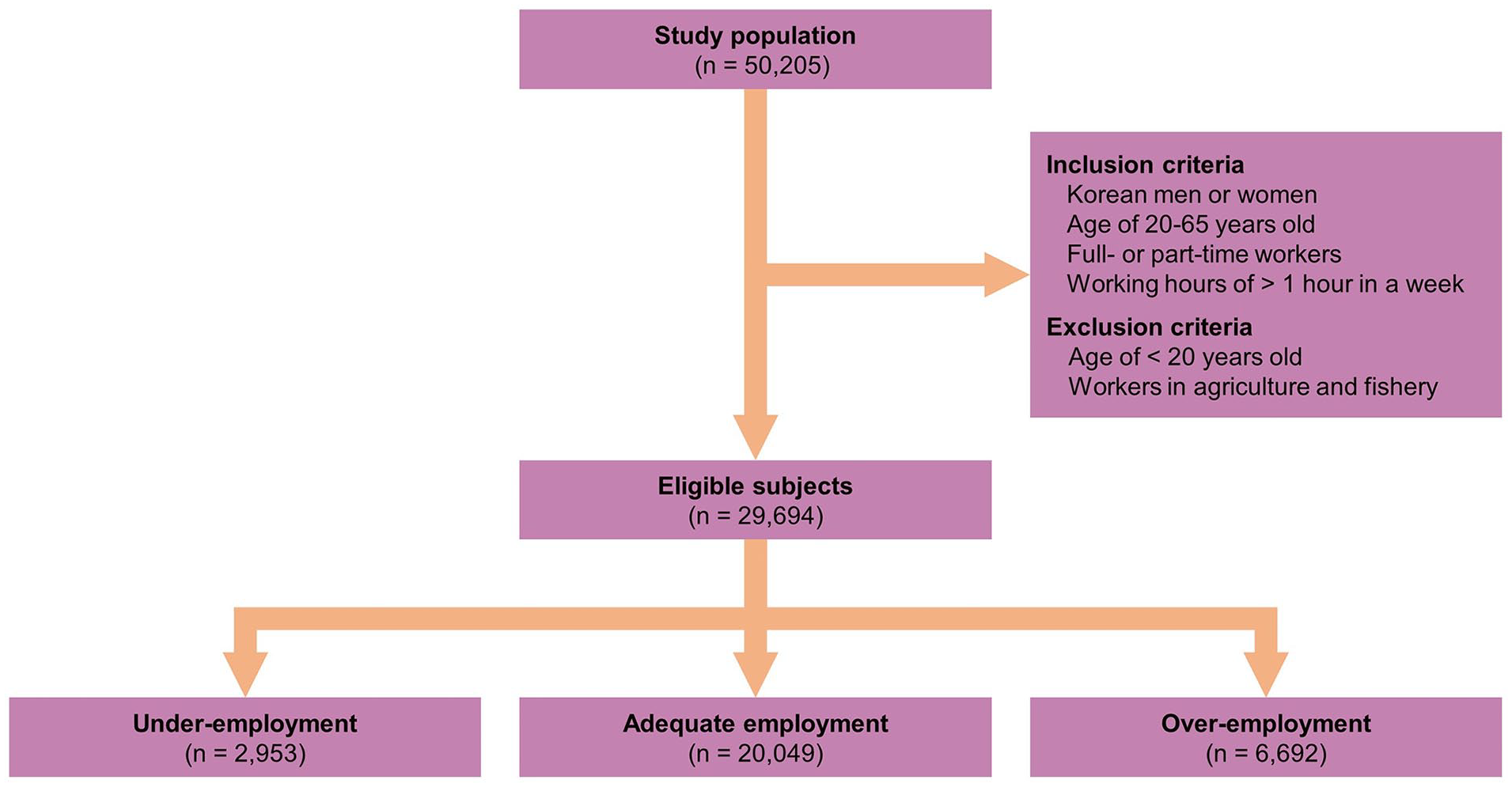
Disposition of the study subjects.
Demographic and socio-economic characteristics of the subjects are represented in Table 1. There were significant differences in the gender, age distribution, level of education, mean number of family members, the number of working days in a week, mean working hours in a day, commute time between home and work, mean monthly income, fixed period of work, type of employment, place of work, type of current work, side job, visit to the client, member of the team, labor union, and overall health status between the 3 groups (P < .05).
Demographic, Socio-Economic, and Work Characteristics of the Subjects by a Mismatch Between Actual and Preferred Working Hours (n = 29 694).

Note. Values are mean ± standard deviation with the range or the number of the subjects with percentage, where appropriate.
NPO = non-profit organization; NGO = non-government organization.
Statistical significance at P < .05.
a-cDifferent letters indicate statistical significance.
The Subjects’ Responses About the Degree of Satisfaction With Work Environment
The proportion of the subjects who responded that they were satisfied with work environment was 69.29% (4637/6692) in the over-employment group, 80.16% (16 232/20 249) in the adequate employment group, and 68.10% (2011/2953) in the under-employment group (Figure 2).

Satisfaction with work environment depending on a mismatch between actual and desired working hours.
Factors Determining the Degree of Satisfaction With Work Environment
As shown in Table 2, a logistic regression analysis showed that significant predictors of satisfaction with work environment include “women” (β = −.372, OR 0.689 [95% CI 0.646-0.736]) (P < .001), “age of ≥60 years old” (β = .226, OR 1.253 [95% CI 1.089-1.441]) (P = .002), “middle school graduates” (β = −.320, OR 0.726 [95% CI 0.616-0.856]) (P < .001), “college graduates” (β = .492, OR 1.636 [95% CI 1.371-1.952]) (P < .001), “≥university graduates” (β = .826, OR 2.283 [95% CI 1.918-2.718]) (P < .001), “fixed period of work” (β = −.105, OR 0.901 [95% CI 0.823-0.986]) (P = .023), “full-time employment” (β = −.105, OR 0.900 [95% CI 0.813-0.996]) (P = .042), “public sector” (β = .544, OR 1.722 [95% CI 1.532-1.935]) (P = .023), “private-public partnership organization” (β = .605, OR 1.832 [95% CI 1.342-2.500]) (P = .042), “NPO or NGO” (β = .780, OR 2.182 [95% CI 1.522-3.127]) (P < .001), “regular side job” (β = −.929, OR 0.395 [95% CI 0.289-0.539]) (P = .000), “temporary side job” (β = −.330, OR 0.719 [95% CI 0.533-0.970]) (P = .031), “a member of multiple teams” (β = −.501, OR 0.606 [95% CI 0.552-0.666]) (P < .001), “presence of labor union” (β = .143, OR 1.154 [95% CI 1.047-1.273]) (P = .004), and “better overall health status” (β = .977, OR 2.657 [95% CI 1.175-6.007]) (P = .019).
Factors Determining Satisfaction With Work Environment.

OR = odds ratio; CI = confidence interval; NPO = non-profit organization; NGO = non-government organization.
Statistical significance at P < .05.
Statistical significance at P < .01.
Statistical significance at P < .001.
Discussion
To date, the relationship of a mismatch between actual and desired working hours with satisfaction with work environment has been described in the literature.4,37-39 Previous studies on this subject have shown not only that negative effects of working hours are lower in countries with a lower level of welfare but also that work autonomy is the only key factor in those with a higher level of welfare.4,40-43 Only when there is a difference between actual and desired working hours, however, the length of working hours is more associated with satisfaction with work environment as compared with work characteristics.4,37,44 In this regard, studies have also examined effects of the length of working hours on satisfaction with work environment considering multiple factors, such as job complexity and control over working hours. Some studies have reported a conflict between high performance practices and WLB policies.45,46 There are also reports that a mismatch between actual and working hours rather than the length of working hours is closely associated with satisfaction with work environment.4,45,47-49
Previous studies have shown that an individual’s satisfaction with work environment is closely associated with turnover intention, job selection, or social affinity.50-52 Satisfaction with work environment is referred to as an individual’s general attitudes toward his or her work; it can be defined as a worker’s pleasant emotional state at work. 53 An individual with a higher degree of satisfaction with work environment is expected to perform a task both more actively and more efficiently, which leads to increased performance of an organization. 54 Form this context, the current study explored diverse factors that may affect satisfaction with work environment, as described earlier. Considering these factors, efforts should be made to raise the degree of an individual’s satisfaction with work environment from organizational perspectives. It is known that a worker’s sense of schedule control is increased with the level of education, family income, and occupational prestige. It is presumed, however, that gender might be the most essential factor that is involved in the relationship between a mismatch between actual and desired working hours and well-being. 55 Moreover, working non-preferred hours, longer hours in particular, is more detrimental for job satisfaction and organizational commitment in women as compared with men. 55 Presumably, this might be closely associated with a difference in work-life conflict (WLC) between women and men. Women take more family and household responsibilities as compared with men. Therefore, women have less latitude or control over when they can work. 55 It has also been argued that a mismatch between actual and desired working hours may serve as a measure of WLC. 56 This leads to the speculation that greater mental health effects of a low degree of schedule control might arise from a higher level of WLC in women. 21 Furthermore, there is a variability in working involuntary short or long hours depending on job characteristics, such as job demands, job autonomy, job complexity, social support, or other diverse individual and household characteristics.21,28 Working involuntary long hours is more commonly seen in men, highly-skilled workers and those with high occupational prestige. 57 By contrast, less educated individuals and women are more likely to work involuntary short hours. 58 Previous studies have also shown that having children, especially young children, is typically associated with high chances of experiencing a mismatch between actual and desired working hours.21,59
The current study found that 13.80% and 8.80% of the respondents were dissatisfied and satisfied with work environment, respectively, in the under-employment group. This can be explained by a previous study showing that having a job would be beneficial for life satisfaction irrespective of job attributes, such as a mismatch between actual and desired working hours in the work environment where the level of concerns for unemployment is relatively higher. 56 Moreover, the current results also showed that the proportion of the subjects who responded that they were satisfied with work environment was the highest in the adequate employment group although the number of the subjects in the adequate employment group as compared with the over-employment group and the under-employment group. This can be explained by a previous study conducted by Nam and Kim. 60 According to these authors, because long working hours have been a widespread aspect of workplace culture before the implementation of the LSA, a worker’s experience of adequate employment has a significant correlation with a high level of job satisfaction.35,60
An individual’s satisfaction or dissatisfaction with work environment has been reported to affect his or her health outcomes; an individual with a higher degree of satisfaction with work environment is less vulnerable to health problems.61,62 This is in agreement with the current results showing that there was a significant correlation between satisfaction with work environment and better overall health status (β = .977, OR 2.657 [95% CI 1.175-6.007]) (P = .019). It has been shown that poor job quality is closely associated with retirement intentions and early cessation of participation in labor force, which might partly be due to work-related ill-health.63-65 It is thought that job quality influences health because of an exposure to work stress. Once continuously or repeatedly exposed to even minor work-related stress, workers are vulnerable to cumulative negative consequences over time. This may cause physiological dysregulation, thus eventually resulting in health problems. Moreover, it is also known that workers’ exposure to environmental hazards, their dissatisfaction with salary and psychosocial factors forming the quality of work have a correlation with stress-related physical and mental health problems. 66
The current study explored the RQ1: Are there any differences in demographic, socio-economic, and work characteristics depending on the type of employment? There were significant differences in the gender, age distribution, level of education, mean number of family members, the number of working days in a week, mean working hours in a day, commute time between home and work, mean monthly income, fixed period of work, type of employment, place of work, type of current work, side job, visit to the client, member of the team, labor union, and overall health status between the 3 groups (P < .05). These results suggest that a specific type of employees might be vulnerable to dissatisfaction with work environment in the context of a mismatch between actual and desired working hours.
The current study explored the RQ2: Which demographic, socio-economic and work characteristics serve as predictors of satisfaction with work environment in the context of a mismatch between actual and preferred working hours? Female gender (β = −.372, OR 0.689 [95% CI 0.646-0.736]), age of ≥60 years old (β = .226, OR 1.253 [95% CI 1.089-1.441]), graduation from middle school (β = −.320, OR 0.726 [95% CI 0.616-0.856]), college (β = .492, OR 1.636 [95% CI 1.371-1.952]), or university (β = .826, OR 2.283 [95% CI 1.918-2.718]), fixed period of work (β = −.105, OR 0.901 [95% CI 0.823-0.986]), full-time employment (β = −.105, OR 0.900 [95% CI 0.813-0.996]), the engagement in public sector (β = .544, OR 1.722 [95% CI 1.532-1.935]), private-public partnership organization (β = .605, OR 1.832 [95% CI 1.342-2.500]) or NPO or NGO (β = .780, OR 2.182 [95% CI 1.522-3.127]), regular side job (β = −.929, OR 0.395 [95% CI 0.289-0.539]), or temporary side job (β = −.330, OR 0.719 [95% CI 0.533-0.970]), membership of multiple teams (β = −.501, OR 0.606 [95% CI 0.552-0.666]), labor union (β = .143, OR 1.154 [95% CI 1.047-1.273]), and better health status (β = .977, OR 2.657 [95% CI 1.175-6.007]) were predictors of satisfaction with work environment. These results suggest that organizations and policy-makers should consider predictors of satisfaction with work environment in the context of a mismatch between actual and desired working hours.
A mismatch between actual and desired working hours has been a matter of interest among academic researchers from in other countries.9,67,68 Hanglberer performed an analysis of job satisfaction in 31 European countries, thus suggesting that negative effects of working hours are lower in countries with lower welfare levels. This author also noted that work autonomy is only relevant in countries with higher welfare status. 69 Clark 70 noted the importance of job characteristics in 19 OECD countries, thus suggesting that working hours are important only when there is a mismatch between actual and desired ones. Valcour 71 used the data collected from US call center agents to assess the impacts of working hours, job complexity and control over work time on WLB satisfaction, thus indicating that working hours have a negative impact on satisfaction with work-family balance. In the UK, White et al 72 analyzed the impacts of working hours on WLB, suggesting that there is a conflict between high performance practices and WLB policies. But Gash et al 73 evaluated those of changes from full-time to part-time work on satisfaction for women in the UK or Germany, thus reporting a positive impact of shorter working hours on life satisfaction. Wooden et al 9 used an Australian panel survey and showed that a mismatch between actual and desired working hours rather than the amount of working hours itself was an essential factor.
Limitations of the current study are as follows: First, the current study failed to stratify the subjects according to cut-off values of working hours in a week. Second, the current study failed to quantify values, such as the number of family members, that of working days in a week, working hours in a day, commute time between home and work and monthly income, in identifying factors that are associated with satisfaction with work environment. Third, the number of the subjects of the adequate employment group (n = 20 049) was significantly greater than that of those of the under-employment group (n = 2953) or the over-employment group (n = 6692) in the current study. Therefore, the possibility of comparison bias could not be completely ruled out. A great discrepancy in the number of the subjects between the 3 groups can be explained based on the legislation enforced by the Korean government. Korea is known to belong to one of the countries long working hours, and the Korean government has tried to lower the longest working hours by legislation. It legislated the LSA, applying to employees in a workplace with ≥5 workers, according to which the standard work hours are set at 40 h/week and the maximum work hours based on an employee’s consent are set at 52 h/week. 35
Nevertheless, the current results are of significance in that this is the first report about factors associated with satisfaction with work environment in the context of a mismatch between actual and desired working hours based on data from the Fifth KWCS; they are in line with previous literatures about the possible relationship between satisfaction with work environment and the occupational health.39,74 The current results will contribute to identifying employees who are vulnerable to dissatisfaction with work environment based on their demographic, socio-economic and work characteristics. But this deserves further large-scale, well-designed studies with valid outcome variables.
Conclusions
Based on the current results, it can be concluded that female gender, age of ≥60 years old, graduation from middle school, college or university, fixed period of work, full-time employment, the engagement in public sector, private-public partnership organization or NPO or NGO, regular side job or temporary side job, membership of multiple teams, labor union and better health status were predictors of satisfaction with work environment. These results suggest that organizations and policy-makers should consider predictors of satisfaction with work environment in the context of a mismatch between actual and desired working hours because such predictors may differ depending on the type of employment.
Finding an appropriate WLB is a challenge for all employees. This has been of increasing interest in the context of socio-economic and political researches. From an organizational perspective, the use of WLB practices is closely associated with increased performance of an organization and employees’ job-related attitudes, retention, recruitment and productivity.13,75 A mismatch between actual and desired working hours may arise from over-employment, where the former exceeds the latter, and under-employment, where the former falls short of the latter. It may impair employees’ performance and well-being. 76 Employees’ well-being deserves special attention. Indeed, it would be valuable to implement resource-intensive policies that promote employees’ well-being. 77 From this context, the current results are of significance in that they recommend that organizations and policy-makers consider predictors of satisfaction with work environment in the context of a mismatch between actual and desired working hours. Due to the cross-sectional nature of the current study, however, the causality between employees’ dissatisfaction with work environment and a mismatch between actual and desired working hours could not be established. This deserves further studies.
Footnotes
Acknowledgements

Declaration of Conflicting Interests
The author declared no potential conflicts of interest with respect to the research, authorship, and/or publication of this article.
Funding
The author received no financial support for the research, authorship, and/or publication of this article.
Ethics Statement
Ethical review and approval were waived for this study because personally identifiable information was not used and there is no possibility of human rights violations. Informed consent was obtained from all subjects for a questionnaire survey whose responses were analyzed in the current study.