




Abstract
The study is to examine the effect of progressive muscle relaxation exercise on anxiety of nursing students during their initial clinical experience. A quasi-experimental, pre-post study was carried out in the Arab American University. A convenience sample consists of 90 first-year nursing students were chosen. A progressive muscle relaxation exercise for five days per week was conducted on one group of nursing students. Students’ anxiety was measured by S-anxiety scale (STAI Form Y-1) at pre and post the intervention. The severity of anxiety reduction was greater post the exercise (t (89) = 30.783, P = .001).
Nursing students frequently suffer high levels of anxiety throughout clinical courses and are subjected to a variety of stressors during the initial clinical practicum. To reduce anxiety, it is endorsed that stress reduction techniques based on this method be performed in nursing schools for nursing students earlier than their initial clinical training. Given the findings of this study, it is recommended that relaxation training be taught and performed as nursing principles during the first semester of theory and practice. Nursing schools can promote progressive muscle relaxation through nursing training courses in relaxation knowledge and techniques, including this type, for instructors and students to employ, and minimize anxiety in clinical settings.What do We Already Know About This Topic?
How does your research contribute to the field?
What are your research’s implications toward theory, practice, or policy?
Introduction
Nursing education is accomplished by utilizing knowledge and skills in clinical settings. 1 Clinical practice, an central aspect of nursing education, permits nursing students to acquire and develop their psychomotor abilities. 2 One of the main features shaping clinical education quality is students' exposure to and preparation for enrolling in the clinical training setting. 3 According to several research, the clinical aspect of nursing education is the most demanding.4,5 Students in clinical training have significant levels of anxiety.6-9
Previous study described that nursing students in Indonesia faced stress and anxiety through clinical care. 5 A Malaysian study revealed that clinical assignments were the leading source of anxiety among nursing students. 10 Also, a study conducted in Saudi Arabia found that 50% of the pharmacy students experienced anxiety and stress during their undergraduate education. 11 According to study, extreme levels of anxiety can have adverse effect on learning and clinical accomplishment of medical students. 8 This stress and anxiety might be ascribed to challenges in clinical practice as well as a scarcity of professional work experience. 12
It is generally acknowledged that exposing nursing students to long-term and unmanageable stress has a negative impact on the development of their professional identity as well as their health, and it can also be considered to have an impact on patient outcomes.13,14
Faculty and students must work together to create practical techniques to help nursing students avoid, minimize, or resolve psychological harm. 8 Relaxation techniques can help students cope with academic stress. 15 According to some studies, the PMR exercise should be used across all of nursing courses to encourage greater satisfaction and positive outlooks. 16
According to the researchers' experiences in nursing clinical training, nursing students experience anxiety in their initial clinical training and their behaviors and performances alter. 17 This alteration may have a detrimental impact on their training, advancement in patient care, and quality performance. The performance of a progressive muscle relaxation program, with which students are confronted in their first clinical learning setting, assists in the resolution of these issues and contributes to their professional development.18,19
Given the significance of reducing nursing students’ anxiety throughout their initial clinical training, strategies such as progressive muscle relaxation exercise (PMR) may be beneficial in resolving this issue. However, according to the literature, no investigations have been done in Palestine upon this benefits of relaxation exercise on stress reduction in student nurses in their initial clinical training. As a result, the current study is to examine the effect of progressive muscle relaxation exercise on anxiety of nursing students during their initial clinical experience.
Methods
Design and Sample
The study was a pre and post, quasi-experimental design. The study was accomplished in 2019 in Arab American University. Ninety students were agreed to participate in the study. First-year nursing students, being in the area of practice as fixed on the first clinical training day, and agreeing to take part in the study were the inclusion criteria. A history of psychological illnesses, use of sedatives, being subjected to stressful circumstances in the prior three months, and missing more than two session meetings were all exclusion criteria. The flow diagram of the study seen in Figure 1. Flow diagram of the study.
Procedure
One group of students obtained Jacobson’s PMR exercise. These exercises were demonstrated in the nursing faculty for five following days each week. Firstly, the researchers approached the coordinator of the pediatric nursing course and told him to act a mediator in contacting the students. The coordinator’s task was limited to tackling students and notifying them about the purpose of the study, as well as encouraging them to participate in the study. Also, in collaboration with administrator of the nursing department, an announcement about the study was posted on the electronic contact links and students' board. Then, the coordinator called the researcher to present information about the study to students who agree to participate in it. The researcher explained the purpose, duration, and content of the study, as well as what participants were expected to do. The researcher assigned the students who agreed to participate to ten groups randomly. Date and time of the intervention were communicated to each group. The participants were asked to complete the demographic data form and the STAI questionnaire two weeks before ingoing the clinical setting.
The intervention was taken place in the nursing lab room. Notice cards were hung on the room’s door, noise was reduced to the greatest extent potential, and the area was dim lighting.
Jacobson’s PMR
Progressive Muscle Relaxation (PMR) exercise.

Instrument
First part: composed of demographic data of the nursing students which included age and gender.
Second part: composed of State-trait anxiety inventory (STAI): The S-anxiety scale (STAI Form Y-1) created by Spielberger was used in this study. 23 The questionnaire consists 20 items that assessed the students' beliefs at the moment they responded toward each item. Ten items accompanied the anxiety-present [3, 4, 6, 7, 9, 12, 13, 14, 17, 18], while the items accompanied the anxiety-absent were [1, 2, 5, 8, 10, 11, 15, 16, 19, 20]. On a 4-point Likert scale, participants' feelings were rated (1- not at all, 2- somewhat, 3-moderately, and 4-very much so). The anxiety-free items were rated from 4 to 1. The anxiety-present items were given a score of 1 to 4, with higher scores reflecting a great level of anxiety. 23 The overall score for the STAI Form Y-1 varied from 20 (low anxiety) to 80 (high anxiety). The reliability of the questionnaire was .86 and .95. 23
Ethical Consideration
After getting formal approval from Arab American University, all students who agreed to participate in the study signed informed consent. The purpose of the study was explained to the students. Furthermore, the participants were notified about the potential adverse effects of PMR, as increased levels of physiological activation, and fear of relaxing. They were told to call the researcher if any negative consequences happened. They can leave the study at any moment. Furthermore, confidentiality was respected.
Results
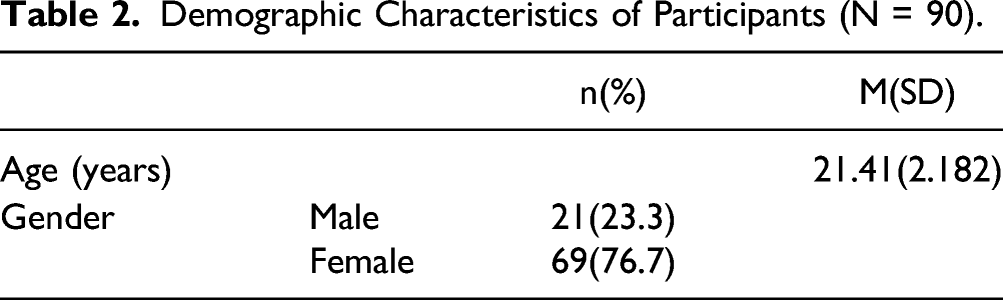
Sample Description
Demographic Characteristics of Participants (N = 90).
Comparison Between Anxiety Before and After PMR (N = 90).

P. value significant at the .05 level.
Discussion
During clinical experience, students may be required to utilize items that they are unfamiliar with or have not seen before. Students experience anxiety as a result of a lack of knowledge and the necessity to communicate with patients, which is essential for the majority of nursing skills. 24 Mild anxiety promotes learning, but excessive anxiety inhibits it, resulting in poor performance. 24
The anxiety level was examined before and after the progressive muscle relaxation program in the current study. According to the findings, nursing students felt less anxiety after the exercise training. The current study revealed that PMR is effective in decreasing score of anxiety among nursing students.
In a study in which İnangil et al. assessed nursing students’ anxiety prior to their first clinical experience, they found that the mean SAI score was 41.64±10.23, and the mean score of TAI was 32.07±8.05. 17 In a similar study conducted by Açıksöz et al. assessed nursing students’ anxiety prior the clinical experience, they found that the mean scores of SAI was (38.6 ± 7.64), and the mean score of TAI was (47.6 ± 6.27). 25 Also, Arabacı et al. found that the mean score of SAI was (41.05 ± 10.69), and TAI mean was (48.05 ± 5.00). 18
Zargarzadeh et al. demonstrated that relaxation exercises had a positive effect on reducing students' test anxiety. 26 Also, Ahmadnejad and colleagues investigated the effects of relaxation techniques on decreasing anxiety among students in a clinical experience and realized it to be helpful. 27 Heidari et al. revealed that teaching muscular relaxation techniques and gradually releasing tension, combined with biofeedback, significantly reduces students’ anxiety. 28 According to Korkut et al., students who used muscular relaxation therapy were less anxious than those who did not. 29 Gangadharan and Madani reported that nursing students experienced a significant decrease in their state anxiety post PMR exercise. 30 Another study carried out by Patel reported that (40.0%) of the nurses had mild stress, (53.3%) had moderate stress, and (6.7%) had severe stress in pre-test, while (73.3%) of them reported mild stress and (26.7%) reported no stress in the posttest. The study stated that Muscle Relaxation technique can help nurses to reduce their stress levels. 31 The current study is supported by Maharjan and Baby’s findings of the effect of muscular relaxation therapy for academic and clinical stress. For ten consecutive days, progressive muscle relaxation was demonstrated. The study found that muscle relaxation technique was beneficial in lowering stress in nursing students. 32
Also, Dehghan-Nayery et al. indicated that PMR reduces stress and improves quality of life (QOL) among schoolgirls. 33 As a result, practicing PMR appears to be essential for students, particularly nursing students, because, according to one study, test anxiety reduces information processing speed. 26 The key idea behind PMR is to educate people how to deliberately suppress their tension and, as a result, decrease their level of anxiety. This strategy’s key benefits in anxiety reduction and management include independence of practice, cost-effectiveness, and convenience. Nursing is stressful for nursing students, and the quantity of academic information they must study, and intense clinical setting, contribute to their anxiety. Individuals' perceptions of their capacity to adapt with daily stressors may change, and PMR exercise technique can be used to lower students' anxiety.
This study has some limitations that may have influenced the study’s results. This study relied on self-reported questionnaires, which may increase the possibility of reporting bias due to personal interpretations of questionnaire items. Also, only age and gender from socio-demographic data were used and this was limiting factors. Furthermore, one methodological limitation of this study was that no control group.
Conclusion
The current study confirmed that PMR has an effect in decreasing clinical experience anxiety. As a consequence, it was recommended that prior to the initiation of clinical practice, nursing students be given relaxation techniques such as this approach to lessen anxiety.
Footnotes
Acknowledgments
The authors would like to express their thanks to the nurses who participated in the study
Declaration of Conflicting Interests
The author(s) declared no potential conflicts of interest with respect to the research, authorship, and/or publication of this article.
Funding
The author(s) received no financial support for the research, authorship, and/or publication of this article.
