




Abstract
The current condition of ensuring WHO-recommended newborn and young child feeding practice is becoming a challenge in many developing nations, particularly in places where family food security is threatened. Because many households in underdeveloped nations frequently face acute food shortage due to poverty, optimal child nutrition is jeopardized. The purpose of this study was to analyze the child feeding behaviors of mothers with children aged 0-24 months and to investigate their household food insecurity in a coastal region of Bangladesh, Suborno Char (one of Noakhali District’s coastal neighbourhoods) was studied from October 2019 to April 2020. In this study, a cross-sectional survey with multistage sampling technique was employed, and Suborno Char of Noakhlai district was purposely sampled of 400 women and their children aged 0-24 months. Data were obtained using a standard questionnaire and were analyzed using statistical functions in SPSS 20.0.0. Exclusive breastfeeding 53.5%, timely supplemental feeding 75.5%, and feeding children meals from homemade, canned/formula/fortified, both homemade and canned, milk these 4 food groups were at 22.2%. The moms' education level was strongly associated with their child feeding practices. Mothers from food insecure homes were less likely to exclusively breastfeed than mothers from food secure households after drawing interpretation of univariate & multivariate analysis of variables crude odds ratio (COR) and adjusted odds ratio (AOR) and confidence interval (CI) (COR .233 at 95% CI 0.083, .655 and AOR .478 at 95% CI 0.133, 1.713). Similar outcomes were seen for early complementary feeding and minimal dietary diversification of children. In conclusion, this study discovered a less dietary inclusion trend of child feeding practices among moms (0-24 months childbearing) in Bangladesh’s coastal region.
Keywords
Highlights:
1. Our analyses show that household income, mother’s age, and mother’s education level determine how mothers feed their children and ensure household food security. 2. The study households in developing countries' far-flung coastal areas frequently confront severe food insecurity, compromising the supply of adequate child nutrition. 3. Mothers' educational attainment and other relevant sociodemographic characteristics are significantly associated with their child feeding practices and involvement in ensuring household food security. 4. Mothers' educational attainment, age, social involvement, and relevant characteristics need to consider by local and national government authorities to intervene.
Introduction
Weaning foods in insufficient quantities and of low quality, poor child-feeding procedures, and high infection levels in the first 2 years of life have negative consequences on a child’s health and development. 1 World Health Organization (WHO)/United Nations Children’s Fund (UNICEF) have emphasized the first 1000 days of life as the critical window period for nutritional interventions, as the maximal brain growth occurs in this period and malnutrition in this vital period can lead to stunting and suboptimal developmental outcome. 2 According to the WHO guidelines of IYCF (Infant and Young Child Feeding), during the first 6 months of life breast milk should be fed alone. After the first 6 months, breastfeeding is necessary with other sources of nutrition until at least 2 years of age.3,4 Poor child feeding practice and high rate of infection reduce cognitive development, educational achievement, productivity and growth. 5 Globally, undernutrition results in 3 million child deaths annually and over two-thirds of these deaths are often associated with inappropriate feeding practice and occur during the first year of life.6,7 Annually, more than 800 000 deaths occur due to sub-optimal breastfeeding. On the other hand, optimal breastfeeding prevents 13% of the deaths occurring in children under 5, and appropriate complementary feeding results in an additional 6 percent reduction. 8 The diarrheal diseases, respiratory infections, low birth weight, and malnutrition are significant contributors to Bangladesh’s high infant death rate. All of these are linked to inadequate child feeding strategies used by parents. Children aged 0-5 months who are not breastfed had a 7-fold increased risk of death from diarrhea and a 5-fold increased risk of death from pneumonia compared to exclusively breastfed infants. 9 In Bangladesh, just 62% of children aged 6-9 months consume complementary food while still breastfeeding. Complementary feeding delayed for more than one-third of infants aged 6-8 months.10,11 IYCF-recommended feeding is rare among children aged 6-8 months (7%), rising to 34% among children aged 18-23 months. Male and female children are equally likely to be fed according to appropriate IYCF practices. Adherence to IYCF practices is better in urban areas than in rural areas. 12 However, the Bangladesh Demographic and Health Survey (BDHS) is a countrywide survey that includes mostly married women aged 15 to 49 (who are regular members of the selected households), and the data does not provide detailed information on what factors and how the factors affect mothers’ choice in IYCF practices. 13 Moreover, it does not present regional rates of appropriate child feeding practices and the causes of variation in such practices between the regions. Therefore, it is vital to sort out the factors that influence IYCF practices to implement strategies and interventions for raising IYCF practices among mothers who have infants aged 0-24 months. Previous studies have clearly showed that underprivileged infant feeding practices related with cultural factors such as the selection of low-quality complementary products, taboos, conservative traditional values, and social factors like caregiver’s weak knowledge on diet and lack of awareness on food variety in their surroundings. 14 Ultimately, all these factors contribute to poor dietary diversity, lower feeding frequency and inadequate intakes of food and energy for children. 14 In Bangladesh, approximately one-half of the population is food insecure. About 19% of rural households cannot have"3 full meals” a day, and approximately 10% survive on 2 meals or less for some months every year. In areas where food security is weak, providing proper nutrition for children is very challenging especially in developing countries like Bangladesh. 15 The research is original and fills a need because it examines cultural distinctions and child feeding patterns. The research study’s implication is to strengthen the local IYCF intervention program’s implementation strategy, which may differ in other parts of the same country. Therefore, the study’s primary goal was to examine the feeding behaviors of Bangladeshi mothers who have children between the ages of 0 and 24 months.
Materials and Methods
Study Area
The study was conducted in 6 unions the Char Jublee Union, the Char Bata Union, the Char Amanullah Union, and the Char Wapda Union of Suborno Char upazilla (sub-districts) a coastal region of Bangladesh. Suborno Char is an upazilla within Noakhali District, Bangladesh (Figure-1) Suborna Char has a population of approximately 293 000 people, 55 399 houses, and a land area of 575 square kilometers.
16
Agriculture generates more than 65% of income. This locality has a literacy rate of 32.7%, much lower than the national average of 68%. On the other hand, poverty is significantly higher (64%) than the national average of 23%.16,17 Map of the study areas of Suborno Char *.
Study Population and Sample Size
A sample of 400 households with mothers having at least one child between 0-24 months of age was included in the study. At first, we calculated a sample size using the Cochran’s formula, (i) The household was in the selected coastal area (ii) The female caregiver was present and willing to be interviewed (iii) At least a child between 0 and 2 years of age was present in the household.

If the family had more than one child within the required age group, the youngest child within our age range was considered.
Study Design and Period
This study was a community-based cross-sectional survey conducted from October 2019 to April 2020.
Sampling Procedure
A multistage sampling technique was used in this study. We purposefully chose Suborno Char Upazilla (sub-district) of the Noakhali District for this study all the households survey done in the Suborno Char Upazilla (sub-district) of the Noakhali District on Bangladesh’s south-eastern beaches. Suborno Char is located inside the Ganges-Brahmaputra-Meghna (GBM) delta, one of the world’s largest deltas, encompassing the majority of Bangladesh and India’s West Bengal state, as well as portions of China, Nepal, and Bhutan. 17 The GBM delta is formed by the convergence of the Ganges, Brahmaputra, and Meghna river systems in Noakhali district as the study’s coastal region out of the 19 coastal districts in Bangladesh. 18 Then, mothers with children aged 0-24 months who had lived in this area for 4 months prior to the study were selected at the household level to participate.
Data Collection Tools and Procedures
A pretested semi-structured questionnaire was developed by adapting WHO indicators for assessing Infant and Young Child Feeding (IYCF) practices (Yonas F., 2015) to collect information about existing child feeding practices of 0-24 month’s childbearing mothers in the selected area and pilot-tested before administering the questionnaire. The term “exclusive breastfeeding” refers to a baby’s intake of exclusively breastmilk for the first 6 months of his or her existence. Solely breastfed refers to children who ingested breastmilk exclusively during their first 6 months of life. This category also includes the use of medicines, vitamins, and minerals with a doctor’s consent. Children aged 0 to 5 months who are continuing to breastfeed exclusively were classified as continuing exclusive breastfeeding. The children who were not exclusively breastfed were classed as non-breastfed.
After 6 months of exclusive nursing, the kid should begin supplemental feeding alongside breastfeeding. There were 2 categories of children: those who began eating complementary meals after the age of 6 months and those who began eating complementary foods before the age of 6 months. The first were labeled as having started supplementary feeding on time, whereas the latter were labeled as not having started complementary feeding on time. Household Food Insecurity Access Scale (HFIAS) by the USAID-funded FANTA project including 9 dichotomous (yes/no) and 9 follow-up questions to indicate severity of house hold food insecurity [(1 = rarely (1-2 times); 2 = sometimes (3-10 times) and 3 = often (more than 10 times)] was utilized to find out the level of household food insecurity, this scale of questions was validated by many previous studies. 19 The food security and access situation for the 1 month prior to the data collection date was collected. The questionnaire consisted of socio-demographic characteristics of mothers and children, general information about child feeding practices from 0-24 months, and some questions about food insecurity related situation in the previous 30 days of the survey. Data were collected by trained data collectors through conducting a face-to-face interview.
Ethical Approval
This work was authorized by the ethics board of Bangladesh’s Noakhali Science and Technology University. Permission to conduct the research was also secured from the local government. The ethical criteria for this observational investigation were followed (Declaration of Helsinki). 20 Participants signed a written consent form, and the study’s goals were verbally described in accordance with the guidelines.
Statistical Methods
SPSS (Statistical Package for the Social Sciences) for Windows version 20.0.0 was used to clean, input, and analyze the data. 21 The categorical variables were analyzed using frequencies and percentages. We utilized cross tabulation and chi-square testing to evaluate univariate relationships. To assess characteristics linked to various child feeding habits, we used univariate and multivariate logistic regression. The logistic model’s we analyzed dependent variables such as exclusive breast feeding, timely initiation of weaning food, and the children’s dietary diversity with different independent variables.
In the logistic regression model, those variables that were substantially linked with distinct child feeding behaviors in the univariate analysis were employed. The odds ratios and their related 95% confidence intervals were provided as the results. In all analyses, a P-value less than .05 was considered statistically significant.
Results
Descriptive Statistics of Different Characteristics of the Participants
This study investigated child feeding practices among mothers of children aged 0-24 months. Household food insecurity level of those mothers was also examined by the HFIAS method.
The 400 mother-child pairs were chosen of 151 (37.75%) from the Char Jublee Union, 135 (33.75%) from the Char Bata Union, 61 (15.25%) from the Char Amanullah Union, and 53 (13.25%) from the Char Wapda Union, respectively. Around 353 respondents (88.25%) were identified as Muslim, while the remainder were identified as Hindu, Religion was a significant factor that can influence childcare practices. 22 No other religions were found in the study area as participants from a religious perspective. More than half of the mothers (54.80%, N = 219) were 25 years of age or less. Mother was illiterate in 87 cases (21.75%), followed by primary education in 136 cases (34.0%), secondary education or dakhil (equivalent to secondary education in Muslims Special education system called madrasa) in 132 cases (33.0%), higher secondary or alim in 19 cases (4.75%), graduate in 14 cases (3.50%) and madrasha education in 12 cases (3.0%). Almost all the mothers were housewife (98.5%, N = 395). The majority of the mothers (63.75%, N = 255) had ≤2 children. Children’s sex was male in 207 cases (51.75%) and female in 193 cases (48.25%). Most of the (81.25%, N = 325) children were delivered at home rather than other facilities.
Characteristics of study household family and economic conditions of the participants.

Characteristics of child feeding practice.
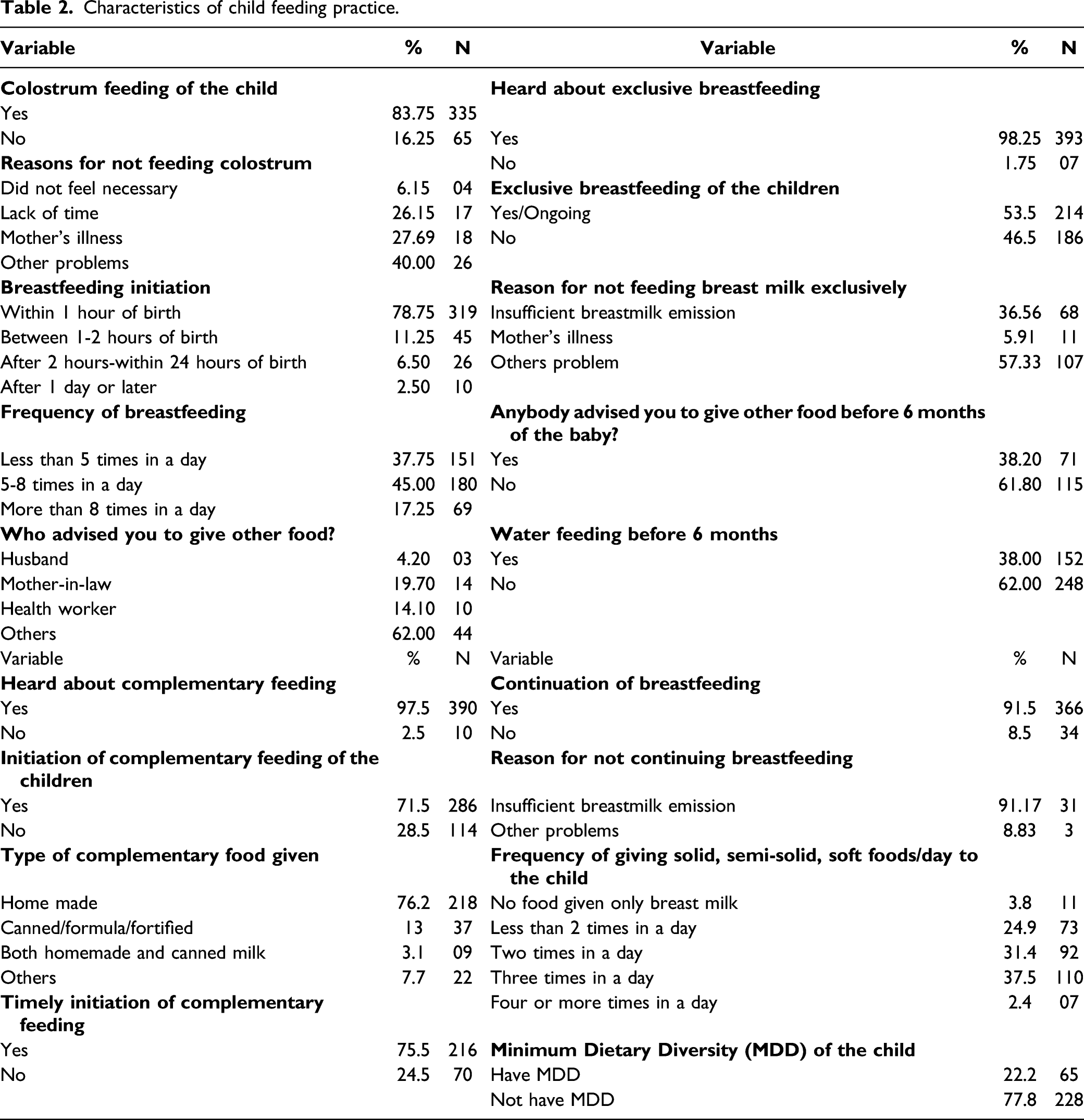
Homemade complementary feeding was given to most of the children (76.2%, N = 218). The prevalence of timely initiation of complementary feeding was 75.5% (N = 216). Continuation of breastfeeding was noted yes in 366 cases (91.5%) and no in 34 cases (8.5%). Only 22.2% (N = 65) children were found to have minimum dietary diversity (MDD).
Households’ Response to the Nine Household Food Insecurity Access Scale Items
Affirmative responses to items on the Household Food Insecurity Access Scale (HFIAS) by the participants.

Question 2 and Question 3 received the most frequent affirmative responses (81.3%). Affirmative responses for items indicating severe forms of food insecurity such as Questions 8 and 9, were low. The lowest affirmative responses were noted for Question 9 (1.0%).
In this study 16.5% households were identified as food secure 34% households were identified as mildly food insecure 44% households were identified as moderately food insecure, and only 5.5% households were identified as severely food insecure according to HFIAS. 19
Factors Associated With Exclusive Breastfeeding
Analysis of factors influencing exclusive breastfeeding practice.

AOR = Adjusted Odd Ratio; COR = Crude Odds Ratio; P value >.05*
AOR stands for Adjusted Odds Ratio and COR for Crude Odds Ratio, CI stands for Confidence interval, with COR representing the result (effect measure) from binary logistic regression and AOR representing the output (effect measure) from multivariate logistic regression. Children who were not fed colostrum have lower odds in exclusive breastfeeding than colostrum fed children (AOR .579 at 95% CI 0.257, 1.303). EBF (exclusive breastfeeding) practice was less likely among mothers who had initiated breastfeeding after 1 day or later of childbirth compared to mothers who had initiated breastfeeding within 1 hour of childbirth (AOR .134 at 95% CI 0.012, 1.442). Similarly, if we see the (Table 4) household food security variables, mothers of severely food insecure households were less likely to exclusively breastfed than mothers of food secure households (AOR .478 at 95% CI 0.133, 1.713).
Determinants of Timely Initiation of Complementary Feeding
Analysis of factors influencing timely initiation of complementary feeding.

Primary educated mothers were more likely to timely initiate the complementary feeding than illiterate mothers (AOR 1.180 at 95% CI 0.490, 2.839). Mothers of non-colostrum fed children showed lower odds of timely initiation of complementary feeding. Household food insecurity level are also a significantly associated factor of timely initiation of complementary feeding. Mothers of severely food insecure households were less likely to practice timely initiation of complementary feeding (AOR .193 at 95% CI 0.041, .914) than mothers of food secure households.
Discussion
In this part, our results were compared with previous studies in different regions and different times to discuss the reliability and contributions of our study. Our results were discussed in 3 aspects (1) socio-demographic characteristics that affect child feeding practices, (2) the prevalence of WHO recommended breast feeding practices, and (3) weaning food practices with household food security. At last, the limitations of our study were analyzed.
The majority of the mothers who participated were Muslim, with the remainder being Hindu. Religion was important because religion-based feeding practices can have an impact on childcare practice. 22 In our study, half of the moms were less than 25 years old mother’s age and more than 40% had a secondary education or higher, mothers’ education play a role for child feeding practice. Similar findings from a study on factors associated with antenatal and health facility delivery care in the same study area indicated that 45% of mothers had a secondary or higher level of education, which was slightly higher than our study finding and demonstrated a relationship between mother education level and child care and health services provision. 24 The contribution of female mothers income percentage has positive influence in child feeding practice shown in many studies are not assess here in our study where total family income are consider. 24 The age of the children, income level, family size all is important socio-demographic parameter for the childcare physically as well as mentally and household food security seen in many research studies. 25
The prevalence of EBF (early breast feeding) in this study was below medium range, which is in line with findings of other studies in Bangladesh.27,29 Hence, studies of Myanmar and West Bengal showed EBF prevalence similar like this studies.30,31 Although the prevalence we detected almost same to other study findings in Bangladesh but it is far below from WHO recommended prevalence of ninety percent. 32 So, the Breastfeeding is heavily reliant on demographic, economic, social, and biological factors, all of which have an impact on the quality of care provided to the infant and their health mostly seen in developing countries like Bangladesh, India, Myanmer and Pakistan as well. 33 In our study finding was lower than the WHO cut off point for good practice of complementary feeding 7 as well as from India. 34 However it was more than the reports from Northern Ethiopia 35 and Nigeria geographical dynamics may play a part for this difference in regions. 36
Timely initiation of complementary feeding was associated with some factors (Table 5) in this study. Mother’s age was negatively associated with timely initiation of complementary feeding. Mothers of 36 years or more age practiced timely initiation of complementary feeding less than ≤25 years old mothers in our study. Similar findings were observed in a previous study where <34 years old mothers showed lower odds in timely initiation of complementary feeding than 15-24 years old mothers may be the reason of more experience and maturity comply with education. 8 Mothers of severely food insecure households were less likely to practice timely initiation of complementary feeding than mothers of food secure households.
In this study, mother’s education level and household food insecurity level have shown a strong association with exclusive breastfeeding, timely initiation of complementary feeding and dietary diversity of children. Mother’s age, birth rank of the child, colostrum feeding of children, breastfeeding initiation and frequency of breastfeeding also have shown strong relation (univariate analysis) with exclusive breastfeeding practice and timely initiation of complementary feeding practice. 33 The profound influence of household food security on dietary intake and health and nutritional status of children is supported by a substantial body of research. 41 As far as we know, very few studies have investigated the association between household food insecurity and child feeding practices in Bangladesh. The results we have got confirms that there is a significant relationship between household food insecurity level and different child feeding practices of the mothers in this coastal area of Bangladesh. The study will add to the body of knowledge regarding pertinent literature and the relationship between child feeding practices and household food security in a contextual manner. The neutrosophic statistics are generated using the neutrosophic normal distribution, and they can be utilized in future comparison research studies to see if there are any strong relationships between the study parts. 42
Conclusion
This study has found a low prevalence of child feeding practices among the mothers (0-24 months childbearing) in the coastal region of Bangladesh. Majority of the mothers had at least education of primary level but many of them not followed the WHO recommended feeding practices. Nearly all mothers were familiar to exclusive breastfeeding practice but only half of them practiced it appropriately. Majority of mothers had given homemade complementary food to their children, but diversified diets were not included. Fruits, vegetables, and eggs were not provided by most of the mothers during preparation of complementary foods. Many of them had given weaning food not suitable to their babies less than 6 months age children because of some traditional superstition of their community. All of this contribute to poor child feeding practices and indicates immediate action to promote appropriate child feeding practices. Almost half of the households were identified as moderately food insecure and one third were mildly food insecure in this study. Moreover, this study also revealed that household food insecurity has a strong impact on child feeding practices of the mothers. Although we have not investigated the factors associated with food insecurity in this study, but factors such as low family income, poor education may be contributing towards household food insecurity in this region. So, the findings implicated that timely and well-organized interventions are necessary to improve the child feeding practices of mothers as well as their household food security in this coastal region of Bangladesh.
Footnotes
Acknowledgments
This paper and the research behind, it would not have been possible without the extraordinary support given by the teachers, staffs, students of the Food Technology and Nutrition Science, Noakhali Science and Technology University and study households participants with their enormous help and support. Special mention to the Dr Lokman Hossain for helping creating site map in arc map GIS.
Author Contributions
This research was carried out by all authors in collaboration. Author, Md Abdullah Al Mamun firstly suggested the study, wrote the proposal, and checked the analysis. First Author, Shownak
Saha designed the study, taken the survey interviews and went to different stakeholder’s office, run the analysis, and wrote the first draft of the manuscript. Authors, Dr LI Jianfeng, Ruhina
Binta A
Ghani, Syed Mahfuz-Al-Hasan and Ayesha Begum helped vigorously to carry out the research by giving opinions about study, interview questionnaire preparation, consent from subject, liaison with different government and non-government offices for interviewing, SPSS analysis and manuscript write up, English language improvement, Map creation of the study area etc.
Declaration of Conflicting Interests
The author(s) declared no potential conflicts of interest with respect to the research, authorship, and/or publication of this article.
Funding
The author(s) disclosed receipt of the following financial support for the research, authorship, and/or publication of this article: A very limited Funding was received by Research cell, Noakhali Science and Technology University for transportation to household.
Ethical Consideration
This study was approved by Ethical Review Board of Noakhali Science and Technology University, Noakhali. The researchers clarified the objective of this research and obtained informed consent from the respondents.
Availability of Data and Materials
Available upon request.
Consent for Publication
All of authors read and approved the final manuscript considering for publication.
