




Abstract
Interventions for the early sexual problem in adolescents require proper measurement of sexual intentions. The adolescent sexual intention scales have been widely used by researchers in the West. However, those scales are not very suitable for adolescents in eastern cultures such as Indonesia. As a religious society, Indonesian people have different sexual expectations from liberal western society. Religious teachings and societal norms shape sexual beliefs that reflect semi-restrictive sexual socialization. Thus, sexual intention measurement that represents the sexual beliefs of the subject under study becomes important. Therefore, this two-steps study aims to develop and validate the Youth Sexual Intention Scale (YSIS). In the first step, qualitative elaboration resulted in 27 themes of adolescent sexual beliefs, which turned into 31 items according to the Theory of Planned Behavior (TPB). In the second step, we selected 396 students using the cluster random sampling technique. We investigated 2 methods of validity, content validity using CVI and construct validity using confirmatory factor analysis (CFA). The content validity examination proved that all scale items had high validity (CVI = .93). Meanwhile, the CFA showed that the data was fit for the model (Chi-square 819,420, P <.001, RMSEA = .056, CFI = .978, TLI = .972). The CFA groups items into 4 dimensions, namely, sexual attitudes, subjective norms, perceived behavioral control, and sexual intentions. The reliability test shows an Alpha coefficient of .854. We conclude that 26-items YSIS is a valid and reliable instrument to measure belief-based youth sexual intentions (15–18 years) in religious culture.
Sexual intentions measurement is important in supporting the prevention and intervention of early sexual problems in adolescents.
The belief-based sexual intention measurement can provide a more accurate explanation of adolescent sexual intention, especially in religious country.
The instruments are beneficial in understanding sexual beliefs that becomes the foundation for detemining the intervention program’s focus, namely, by sexual attitude development, optimizing the referents’ role, and manipulating situational factors.
Introduction
Hormonal changes generate attraction to the opposite sex and encourage sexual desire among adolescents. Physical coupled with cognitive, social, emotional, and moral changes in adolescents affect adolescent sexual behavior, such as flirting, hugging, kissing, and coital sex behaviors such as oral, anal, and vaginal sex. 1 Meanwhile, vaginal sex is the highest-risk sexual behavior among adolescents. It does not only lead to unwanted pregnancies and the contraction of sexually transmitted infections It is also associated with several physicals, psychological and behavioral problems, such as low academic achievement, physical complaints, loneliness, and depression,2-4 had multiple partners, 5 and risky sexual behavior in adulthood. 6
However, the engagement rate of adolescents in vaginal sex is still high. In America, 33.3 to 53.2% adolescents aged 16–18 years have been sexually active.7,8 In Sub-Saharan Africa, there are 43.5% sexually active adolescents, 9 while the data obtained from 8 developing countries in Asia and the Caribbean showed that 4% to 77% of male adolescents and 12% to 64% of women engaging in vaginal sex are under the age of 18. 10
Western society adheres to a sexually permissive attitude so that they talk about sex issues openly. Individuals can express their sexual urges in public. Sexual socialization in adolescents focuses on practicing safe sex. Contrary to Indonesia, sexual behavior among adolescence is against the values held by the majority of the population. As a semi-restrictive society, people consider as a private matter and taboo discuss it openly. Parents expect teenagers to postpone sexual intercourse until the wedding day. Therefore, the community glorifies the virginity concept and strongly condemns extramarital sexual behavior, including children born from that relationship.11,12
However, studies prove adolescent sexual activity in Indonesia. 7.7–11% of adolescents have had sexual intercourse.13-15 A study on 15–19 years adolescents found that 41.8% of participants have engaged in sexual intercourse. 16 Meanwhile, 6.5–7.9% of adolescents are sexually active in Medan.17,18
Furthermore, sexual behavior among adolescents is closely related to their intentions. This intention refers to the level of readiness or objective to take any action, and it is the strongest predictor for the emergence of this behavior. 19 Consequently, the stronger the motive, the higher the opportunity of indulging in it and vice versa. Therefore, by measuring the intentional level to have vaginal sex, the behavior becomes predictable.
According to TPB, intention arises from the influence of behavioral attitudes and subjective norms, which are moderated by behavioral control. 20 This attitude is the result of an individual’s assessment of the consequences of certain behaviors. Subjective norms are an assessment of environmental pressure to either carry out or decline an action. Meanwhile, behavior control is an individual’s assessment of his ability to display the intended behavior. Both attitude, subjective norms, and behavioral control are formed by the beliefs that underlie the individual’s memory regarding targeted conduct.
Therefore, one way to measure behavioral intention is by measuring an individual’s belief regarding the consequences of behavior, environmental pressure, and ability to demonstrate the intended behavior. When an individual believes that there are many positive consequences of an action, the environment expects him to carry out such activity and that it is achievable, the behavioral intention will be even greater. Conversely, when individuals evaluate more negative consequences, that the significant figures prohibit them from acting and there are many difficulties in carrying out such action, there will be a low behavior intention.
Furthermore, in TPB, measurement of intention should apply the concept of TACT (target, action, context, and time) to produce accurate predictions. 21 The items in the measurement should contain the aspects of the achieved target, concrete action in question, the presence of a specific situation (context), and an obvious time frame. All constructs, attitudes, subjective norms, perceived behavioral control, and intentions should have the same formula. For example, “reading a sexual behavior journal for 2 hours every day to face the exam for the next month.” The target is facing the test, the action is reading a journal, the context is a journal on sexual behavior for 2 hours a day, and the time is a month ahead.
To measure intention in 2 ways, firstly, by formulating items through literature studies and secondly by eliciting subjects’ behavioral beliefs. 22 Elicitation study aims to explore the salient beliefs that the participants hold regarding the studied behavior. Elicitation studies is a qualitative approach on 20–25 participants to investigate the salient beliefs about the benefits and risks of sexual behavior, individuals that either support such behavior or not, and situations that make it easy/hard for these actions.
Most studies on sexual intension made use of expert opinion or literature as the basis for making item scales.23-27 These instruments measure sexual intention directly without using the underlying sexual beliefs, so unable to measure accurately. The indicators used are selected based on previous studies or are assumed to represent the sexual intentions of the population under investigation. Meanwhile, belief-based measurements that reveal indirectly through the sexual beliefs of the subjects studied are still limited. 28
Protogerou et al reviewed 11 studies in Africa and found 5 studies that developed belief-based intention instruments (condom use intention scales) but focused on safe sex intentions based on TPB. 29 Turchik et al and 30 Morales et al also developed belief-based safe sex intentions instruments in American and Columbia adolescents. Those are unsuitable for Indonesian youth because they came from a liberal Western culture and focuses on safe sex. Chitamun et al’s 31 study measured adolescent premarital sexual intentions based on sexual beliefs but they did not measure control beliefs because it uses the TRA framework. 32 Jalambadani et al developed a belief-based sexual intercourse intention instrument for Iranian married women, so it is inappropriate to measure premarital sexual behavior.
Furthermore, studies on the belief-based measurement of sexual intentions among Indonesian adolescents are still lacking. Several studies using the Youth Sexual Intention Questionnaire 25 developed through previous literature studies so that the instrument is considered unable to measure accurately. Therefore, this study aims to develop Youth Sexual Intention Scale, a belief-based measurement tool for adolescent premarital sexual intentions, and validate it in the Indonesian population.
Methods
It is a two-steps study, firstly, elicitation study with qualitative approach and secondly conducting quantitative approach. Elicitation study aims to elicit adolescent sexual beliefs consisting the behavioral, normative, and control beliefs. The quantitative approach aims to examine scale psychometric properties. Before the study, the Padjadjaran University Health Research Committee approved the research protocol (number 0519030473).
Qualitative Approach
The qualitative approach involving 30 sexually active adolescents aged 15–18 years conveniently. Only subjects who live in Medan dan received health reproductive service from PKBI North Sumatra were included in the study. The study used 9 questions with an open-ended self-report format containing a positive and negative evaluation of sexual intercourse, people or groups that support and prohibit subjects from having sexual intercourse, and sexual efficacy and environmental resources that make it easier and more complicated to do sexual intercourse. Before data collection, PKBI volunteers reach the suitable subjects and arrange the meeting schedule. On the appointed day, the researcher met with the participants and gave informed consent. They read and signed it before answering the questions.
Vaginal Sex Consequences, Referents, Situations (N = 30).

Quantitative approach
The 27 sexual belief then developed into scale items plus 3 items of sexual intention, so that the total is 31 items. The 31 items on the sexual intention scale were then tested to obtain validity and reliability evidence.
Participants
The study involved 396 students aged 15–18 from 4 high schools in Selayang District, Medan City. Students are the unit of analysis obtained by multistage cluster random sampling in selecting one district (from 21 districts in Medan) and 4 SMA (from 13 SMA). The minimum sample size is determined based on 34 Schreiber et al that the number of subjects is ten times the number of parameters tested.
Instruments
The YSIS is a belief-based instrument that contains 31 items, including 4 components: behavioral beliefs (11 items), normative beliefs (7 items), control beliefs (ten items), and sexual intentions (3 items), respectively. For the behavioral beliefs dimension, 5 answer choices, namely, highly unsuitable (score 1), unsuitable (score 2), somewhat appropriate (score 3), suitable (score 4), and very suitable (score 5). Meanwhile, for normative, control beliefs and sexual intention, the following answer choices, namely, strongly disagree (score 1), disagree (score 2), somewhat agree (score 3), agree (score 4), and strongly agree (score 5). Examples of behavioral beliefs items include having sexual intercourse within the next month I will get my partner’s attention, and having sexual intercourse within the next month, I will be at risk of getting pregnant/my partner is pregnant. Examples of normative belief items include my boy/girlfriend insists on having sexual intercourse within the next month, and my parents forbid sexual intercourse within the next month. Examples of control belief items include obtaining a suitable place will make it easier for me to have sexual intercourse in the next month, while the fact that my neighbors refuse casual sex would make it difficult for me to have sexual intercourse in the next month. Lastly, sexual intention items include I plan to have sexual intercourse within the next month, and I will try to have sexual intercourse within the next month. This scale defines sexual intercourse as vaginal sex behavior, namely, penis penetrating the vagina.
Procedures
A total of 20 students that have completed the research methodology courses were recruited as an assistant. The study assistants received 6 hours of training on the study methods, adolescent psychology, study objectives, and code of ethics on study procedures. Furthermore, the researcher collected data from October to December 2019, after school authorities gave permission and teachers and students signed informed consent. Data collection by the following procedures: 1. On the appointed day, the study assistant entered the classroom to call students one by one into a preserved room to fill in the scales. 2. For schools with limited classrooms, the researcher arranged students’ desks with a distance of 1.5–2 meters and 3 waves of scale filling. 3. The study assistants instructed participants individually. After the subjects were clear on what to do, the assistant left them alone in the room and waited outside. 4. After filling out the scale, each subject placed it in a closed envelope and left it on the table. 5. Another assistant escorted the subjects who had filled out the scale to another room not to meet students that were yet to fill the instrument.
Maintaining the confidentiality of the subject’s identity by filling in a private room and anonymous scale sheet was very important in this study because sexual behavior is a sensitive topic and is related to moral issues. Data management started with the separation of the identity sheet from the scale sheet. The researcher stored the scale in a closed cabinet for 3 years, and only researchers had access to open it. Before the study, the Padjadjaran University Health Research Committee approved the protocol (number 0519030473).
Data Analysis
The data obtained was analyzed by testing the content validity and model fit. Three subject matter experts (SME) in sexual behavior and adolescent psychology evaluated content validity. The SME rated the clarity, importance, and relevance of the items ranged from a score of 1 to 5. Afterward, the researcher calculated content validity index using the Aiken’s V formula, 35 where coefficient V > .8 is considered adequate. 36 Furthermore, the CFA was used to test the construct measurement model that builds scale using MPlus software. Meanwhile, model fit was shown with the Chi-square comparison indicator using degrees of freedom <.05, RMSEA <.06, CFI >.095, TLI >.095 and P > .05 for the chi-square value. 25
Results
Participants Characteristics (N = 396).
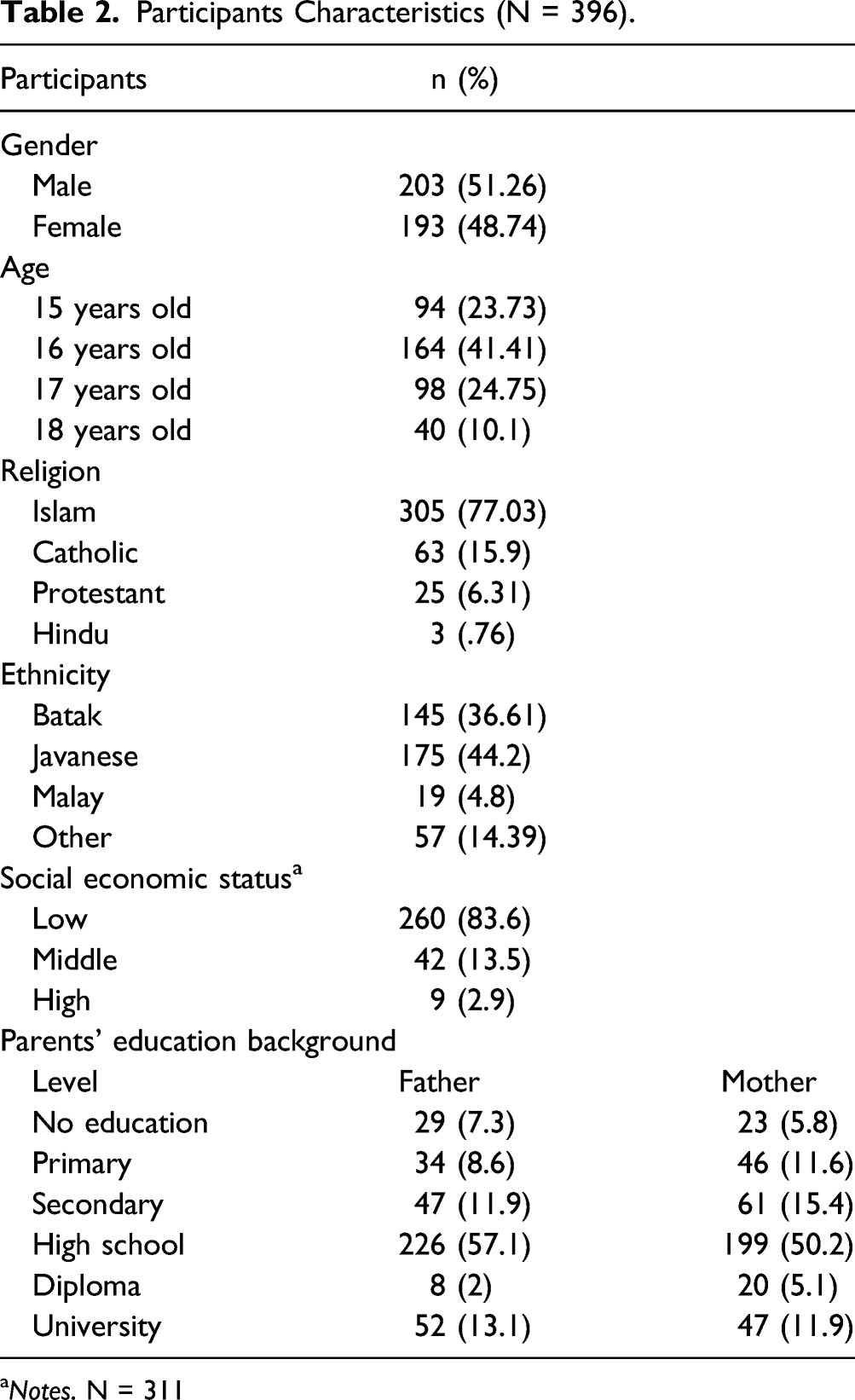
aNotes. N = 311
Participants Sexual Behavior (N = 396).

Sexual Intention Construct Correlation Matrix.
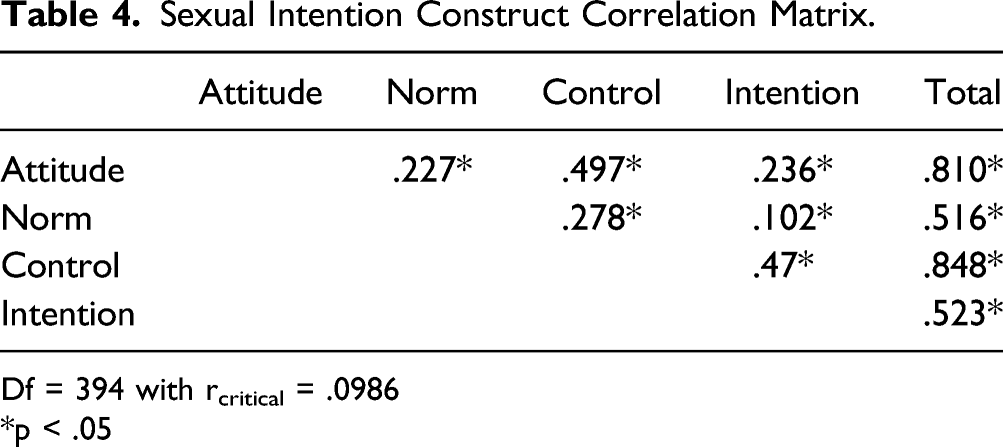
Df = 394 with rcritical = .0986
*p < .05
Content Validity
The 3 SMEs evaluated the content validity separately, and the opinion that the items used were valid to the measurement objectives (CVI = .93). From the expert’s input, the subjective norm item was changed: my partner refuses to have sexual intercourse in the next month became my girlfriend refuses to have sexual intercourse in the next month. Furthermore, the perceived control behavior item was changed: my environment rejects casual sex became my neighbors refuse casual sex.
Confirmatory Factor Analysis
Confirmatory fFctor Analysis of Unidimensional Youth Sexual Intention Scale.

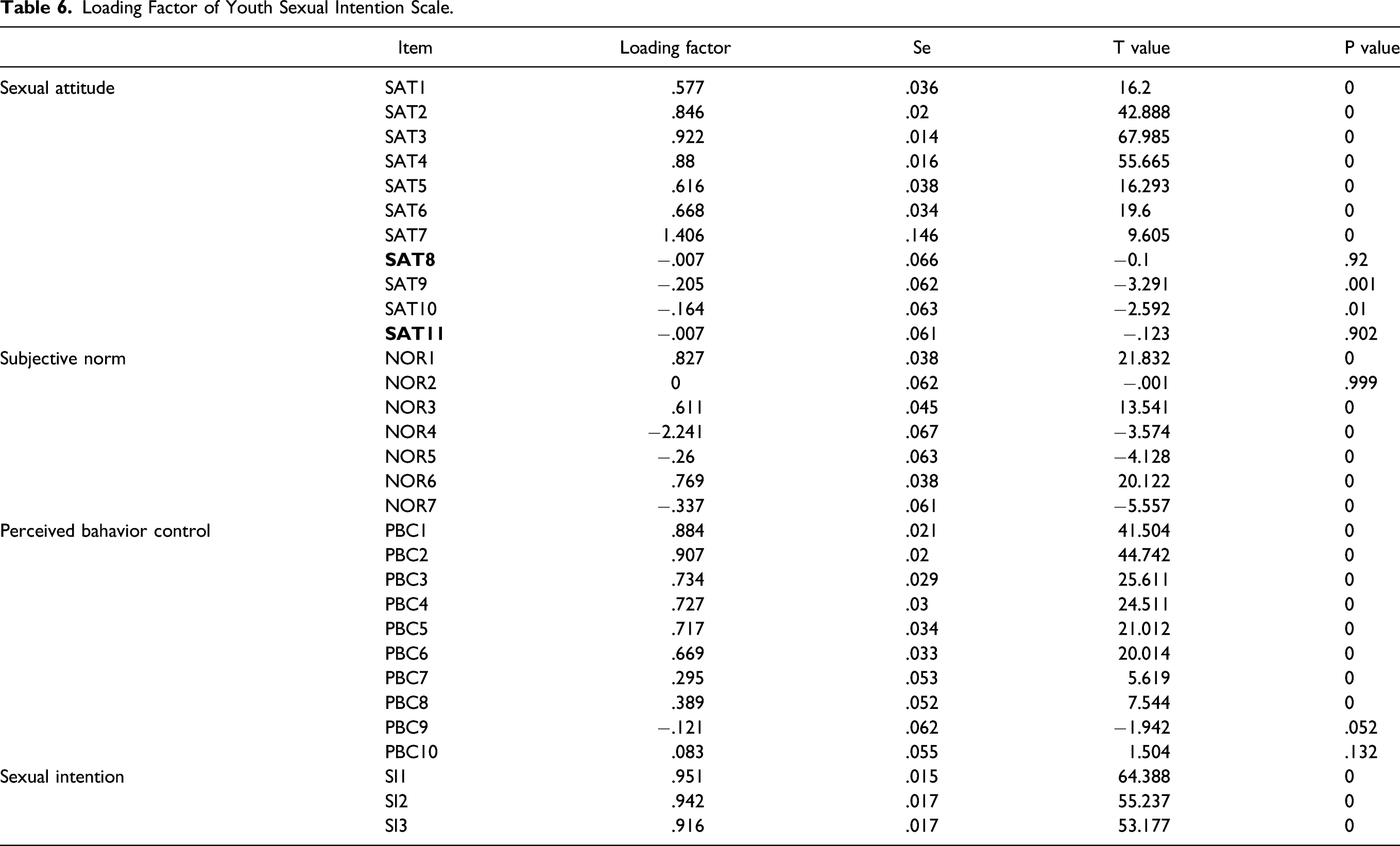
Loading Factor of Youth Sexual Intention Scale.
Reliability
Inter-Item Correlations.

Item Reliability Statistics.

Discussion
This study aims to develop and validate the YSIS, and the results showed that the goal was achieved. From CFA, we can infer that the scale data fit with the model using the recommended indicators, which include the comparison of Chi-square with the degree of freedom >.05, P-value < .05, RMSEA <.06, CFI >.095, TLI >.095 (Schreiber et al., 2006; Muhammad et al, 2017). The alpha Cronbach test also found that the scale is reliable (.7–.9) according to Guilford’s criteria. 37
The initial version scale consists of 31 items turned to 26 items with loading factors ranging from .26 to 1.406 after CFA (see appendix 1 and 2). This implies that a total of 5 items had low quality (t value> 1.96; P value> .05), namely, items 8, 11, 13, 27, and 28. Item 8: by having sexual intercourse within the next month, I will be at risk of getting pregnant/my partner is pregnant. The low validity of this item indicates that adolescents do not perceive pregnancy as a negative consequence which they have to face from sexual intercourse. The easy access to sexual information and contraceptives makes them less worried about pregnancy risk. Therefore, parental sexual communication emphasizes the risk of unwanted pregnancy is no longer of relevance to prevent vaginal sex behavior in adolescents. 38
Item 11: by having sexual intercourse within the next month, I will feel guilty. The low contribution of this item in measuring sexual intention indicates the collective cultural values internalization among adolescents. Society socialized youth to comply with community rules and have social responsibility. Therefore, they internalize that they should marry before sexual intercourse, and the public will punish the violation. Adolescents feel uncomfortable with social sanctions like a shame when the public discovers their sexual behavior rather than feeling guilty of not obeying applicable rules. 39
Item 13: my girlfriend refuses to have sexual intercourse within the next month. The low validity of this item indicates that the boyfriend’s rejection is not in line with the subject’s intention to have sexual intercourse. It implies that the partner acts as a driving force (not prohibiting) to having sexual intercourse. Therefore, many adolescents engaging in sexual intercourse by force of their sexual partners.40-42
Item 27: the things that will make it difficult for me to have sexual intercourse in the next month are the neighbors refusing casual sex. The low contribution of this item in measuring sexual intention indicates that the environment does not have a determining influence on adolescent sexual motives. The Indonesian society creates harmony, respects the elderly, and is submissive to the community as part of the collective culture. 43 However, there has been a shift in values among the urban youth, which are more likely to be individual, assertive in expressing their desires, and no longer adhering to the traditions. 44 This condition affects the behavior of Indonesian teenagers today, especially sexual behavior. The surrounding environment, which previously served as social control, 45 cannot prevent adolescents from against the norm. Furthermore, peer pressure has a more significant influence on adolescent sexual intentions comparing social-environmental standards.46,47
Item 28: the thing that will make it difficult for me to have sexual intercourse within the next month is that I have a busy life all day long. The low item validity indicates that the busyness and activities of adolescents do not affect the intention to have sexual intercourse. Routine daily activities and free time are associated with sexual intention among adolescents no longer in school.48,49 Conversely, for those still in school, school activities do not contribute to their sexual intentions. Although, sex functions to reduce the stress experienced in everyday situations. 50
The findings are useful as a measurement tool for adolescent sexual intentions, especially in urban areas. Researchers may use the YSIS on 15–18 years adolescents who have the same cultural characteristics as Indonesia, such as Malaysia, Brunei Darussalam, and other Southeast Asia countries. The belief-based measurements make it possible to explain what beliefs constitute the cognitive basis that shape adolescents' intentions to have sexual intercourse.
Despite the prominent contribution of measuring adolescent sexual intention, this study still has some limitations. Firstly, this study involving adolescents aged 15–18 years attending high school in Medan. Caution is required when using adolescent populations having different characteristics. Furthermore, using out-of-school teenagers or adolescents living in rural or suburban areas requires further studies. Secondly, in using scales on adolescents in other countries, the uniqueness of their value systems concerning social norms, religion, and globalization issues needs to be considered. Thirdly, further studies should apply to adolescents attending faith-based secondary education institutions such as Madrasah Aliyah, Islamic boarding schools, Catholic schools, and other faith-based schools.
Conclusion
The Youth Sexual Intention Scale showed satisfying psychometric properties to measure and provides reliable results. The belief-based inventory of sexual intentions implemented essential information about the cognitive foundation that shapes adolescent sexual intentions. This instrument supports the intervention programs for early sexual behavior problems among adolescents by focusing on the risk perceptions, taking advantage of the significant figures’ influence, and minimizing situations that make it easier for adolescents to have sexual intercourse.
Footnotes
Acknowledgments
The authors express gratitude to Ristekdikti as the doctoral scholarship provider, study assistants, all school principals and teachers, and all the study subjects.
Author’s Contribution
All authors equally contributed to this study. RL, ZRH and HA carried out the study and wrote the abstract, introduction and discussion sections. Meanwhile, RJ and B carried out data analysis and wrote the methods and results sections.
Declaration of Conflicting Interests
The author(s) declared no potential conflicts of interest with respect to the research, authorship, and/or publication of this article.
Funding
The author(s) received no financial support for the research, authorship, and/or publication of this article.

Appendix 1
Table A1. The 26-Items Youth Sexual Intention Scale.
Dengan melakukan hubungan seksual dalam waktu 1 bulan ke depan, saya akan:
1
Mengikuti gaya hidup remaja masa kini
2
Mendapatkan perhatian dari pasangan
3
Membuktikan cinta kepada pasangan
4
Dapat mempertahankan hubungan cinta dengan pasangan
5
Memperoleh uang
6
Menjadi rileks dari stress
7
Mendapatkan kepuasan seksual
8
Terjangkit penyakit kelamin
9
Kehilangan keperawanan/keperjakaan
10
Pacar saya memaksa melakukan hubungan seksual dalam waktu 1 bulan ke depan
11
Teman saya mendorong melakukan hubungan seksual dalam waktu 1 bulan ke depan
12
Orangtua saya melarang melakukan hubungan seksual dalam waktu 1 bulan ke depan
13
Anggota keluarga saya melarang melakukan hubungan seksual dalam waktu 1 bulan ke depan
14
Orangtua pacar saya membebaskan melakukan hubungan seksual dalam waktu 1 bulan ke depan
15
Guru saya di sekolah melarang melakukan hubungan seksual dalam waktu 1 bulan ke depan
Hal-hal yang memudahkan saya untuk melakukan hubungan seksual dalam waktu 1 bulan ke depan adalah:
16
Pasangan saya bersedia melakukan hubungan seksual
17
Saya menemukan tempat untuk melakukan hubungan seksual
18
Saya memiliki hasrat seksual
19
Saya tahu cara berhubungan seksual
20
Pasangan saya memiliki pengalaman seksual
21
Pasangan saya berpenampilan menarik
22
Saya tahu cara mencegah kehamilan
23
Saya memiliki pasangan yang aman (tidak membuat saya hamil dan tertular penyakit kelamin)
24
Saya berniat melakukan hubungan seksual dalam waktu 1 bulan ke depan
25
Saya berencana melakukan hubungan seksual dalam waktu 1 bulan ke depan
26
Saya akan berusaha melakukan hubungan seksual dalam waktu 1 bulan ke depan
Appendix 2
Table A2. The 26-Items Youth Sexual Intention Scale: English Version.
By having sexual intercourse within the next month, I will:
1
Live the lifestyle of today’s youth
2
Get my partner’s attention
3
Prove my love to the partner
4
Preserve my romantic relationship
5
Get some money
6
Relieve from distress
7
Get the sexual satisfaction
8
Infected with a sexually transmitted disease
9
Lose my virginity
10
My girlfriend/boyfriend force me to have sexual intercourse within the next month
11
My friend push me to have sexual intercourse within the next month
12
My parents prohibit me to have sexual intercourse within the next month
13
My family members forbid me to have sexual intercourse within the next month
14
My girlfriend/boyfriend’s parent allow me to have sexual intercourse within the next month
15
My school teacher ban me to have sexual intercourse within the next month
The things that make it easier for me to have sexual intercourse within the next month are:
16
My partner want us to have sexual intercourse
17
I found a suitable place to have sexual intercourse
18
I have a sexual desire
19
I know how to have sexual intercourse
20
My partner have experienced sexual intercourse
21
My partner is good looking
22
I know how to prevent pregnancy
23
I have a low-risk partner (against sexually transmitted disease and pregnancy)
24
I intend to have sexual intercourse within the next month
25
I plan to have sexual intercourse within the next month
26
I will try to have sexual intercourse within the next month