



Abstract
The sleep needs, experiences and viewpoints were explored for UK adolescents who have been excluded from mainstream education. Qualitative data was gathered through interviews with 9 participants, aged 11–15 years, who also completed questionnaires. The participants had symptoms of inadequate sleep, poor sleep hygiene behaviours and were not getting the recommended amount of sleep on school nights. Participants described sleep patterns involving often staying up late and having different sleep timing on weekends than weekdays and having difficulties with their sleep. Use of technology and the relevance of family were identified as important and associated with facilitating and hindering factors for sleep. Participants communicated that they lack control over aspects of their sleep and their lives. The experiences and views of the participants can inform professionals’ understanding of how to collaborate with adolescents to improve their sleep and highlight that continued development of sleep education programmes is timely.
Introduction
Sleep quantity and quality are associated with adolescent academic success and cognitive performance,1,2 socio-emotional functioning and adolescent mental health3,4 and adolescent physical health. 5 Evidence increasingly indicates that sleep is important for adolescent brain development.6,7
Adolescents worldwide are not getting adequate sleep to meet their sleep needs.8,9 Adolescents are recommended to have 8–11 h sleep. 10 Numerous factors present barriers to sufficient sleep, including developmental differences specific to the adolescent population that impact circadian regulation and sleep phase,11-13 the effects of technological devices,14-16 social communication via technological devices 17 and homework and extra-curricular activities. 18 These biological, psychosocial and societal pressures contribute to what has been coined the ‘Perfect Storm’ of factors bringing about inadequate sleep for adolescents. 19
School-based sleep education programmes can effectively increase sleep hygiene knowledge and improve the accuracy of sleep beliefs, but producing changes in adolescents’ sleep-related behaviours is challenging. It is suggested that adolescents’ motivation to change their behaviour is a key factor.20-22
Deeper insight into adolescent experiences and views are needed to inform the approach to supporting adolescent sleep needs. The present study uses qualitative methods to explore the sleep needs, perceptions and experiences of UK adolescents who have been excluded from mainstream education.
Qualitative research into healthy people’s sleep perspectives is limited. 23 There are complexities involved in supporting the sleep of young people who attend alternative and specialist provision, and limited research giving detailed, personal experiences of such individuals that allows their voice to be fully heard. 24 Incorporating these views can help us understand what enables a young person to be willing and able to improve their sleep.25,26
Qualitative studies have used interviews to explore topics including healthy sleep and barriers for sleep in Canada 27 and the US28,29 and focus group methodology for UK adolescents about their perceptions 30 and US adolescents about healthy sleep mechanisms. 31
Adolescents who have been excluded from mainstream education may have characteristics in common with populations of adolescents that research suggests suffer consequences of poor sleep.
Factors associated with exclusion include lower socioeconomic status, mental health and behavioural difficulties, social communication difficulties, antisocial activities and low school engagement. 32 UK school exclusion data33,34 shows that common reasons for exclusion are disruptive behaviour and physical assault and also that a high proportion of excluded children and young people have special educational needs, in particular social, emotional and mental health needs. This data also shows that rates of exclusion are higher for children and young people with indicators of lower socioeconomic status and disadvantage.
Poor sleep and sleep deprivation are associated with emotional and behavioural difficulties in adolescents, 35 including negative moods and emotional regulation36,37 and increased conduct problems and risk-taking behaviours.38,39 It is also associated with adolescent delinquent behaviour, 40 and this link may be mediated by low self-control. 41
People in socioeconomically disadvantaged groups tend to have reduced sleep and increased sleep problems.42,43 There is a negative association between indicators of lower socioeconomic status and sleep quantity, sleep quality and sleep problems for children and young people.44,45 Transitioning into poverty during childhood is associated with sleep problems in adolescence. 46 Disrupted sleep may be a mechanism through which low socioeconomic status is associated with poor health. 47
In summary, adolescents who have been excluded from mainstream education may be at increased risk of inadequate sleep, and improving their sleep quantity or quality may be associated with improvements in other areas of their development, functioning and wellbeing.22,48,49 Understanding their viewpoints and experiences will inform the development of support. Therefore this study explores the following research question: What are the experiences and perspectives of adolescents who have been excluded from mainstream education with regard to their own sleep and its impact on their daily lives, the views of others about their sleep and the topic of sleep generally?
Methods
Design
Qualitative data was collected using semi-structured individual interviews and analysed using thematic analysis. Quantitative self-report questionnaire data was collected to provide contextual information for the qualitative analysis. 50
Participants
Participants were 9 adolescents (1 female; 11-15 years) attending a pupil referral unit and a special school for children and young people with social, emotional and mental health needs. All young people at both settings had been excluded from mainstream education.
Procedure
Ethical approval was granted by University College London Research Ethics Committee (ID: 9567/002).
The parents and guardians of all secondary-aged young people (approximately 100) were invited to give informed consent for participation in the study. Consent was acquired for 10 young people, and 9 of these were attending their setting at the time of data collection; therefore, these 9 young people were given the opportunity to participate in the study.
The researcher (first author) carried out all 9 interviews, using a semi-structured interview schedule based on the research question. According to Braun and Clarke, 51 the sample size was sufficient for this study as it was between 6 and 10 interviews, although they indicate that a sample size of 10-20 interviews could also be appropriate. The average length of the transcribed interview content for each participant was 25 minutes.
The questionnaire comprised of 5 components: self-reported sleep duration for school nights and non-school nights; Chronic Sleep Reduction Questionnaire (CSRQ) 52 ; Paediatric Daytime Sleepiness Scale (PDDS) 53 ; Adolescent Sleep Hygiene Scale – revised (ASHSr) 54 and yes/no question for whether they take medication for sleep on a regular basis.
Analysis
The thematic analysis method used was Braun and Clarke’s reflexive, organic thematic analysis.51,55 This method recognises the active role of the researcher in identifying patterns across the data, framing the researcher as a storyteller telling the story of the data as understood through their unique lens.55,56 The analysis was inductive and data-driven in nature. 56 Triangulation of the quantitative and qualitative data was undertaken to give a richer, fuller picture of the information gathered, rather than to seek insight into any single truth behind the data. 51
Results
Contextual Quantitative Data
Total ASHSr, CSRQ and PDSS Scores for Each Participant that Completed the Questionnaire.

bScore indicates poor sleep hygiene (≤3.8 = poor and ≥4.9 = good). 54
The questionnaire responses aligned with the viewpoints and experiences communicated during the interviews.
Themes
Five themes were generated through the thematic analysis of the interview data, which are depicted in Figure 1. These included topics directly related to sleep and topics indirectly related to sleep or not related to sleep. Thematic map.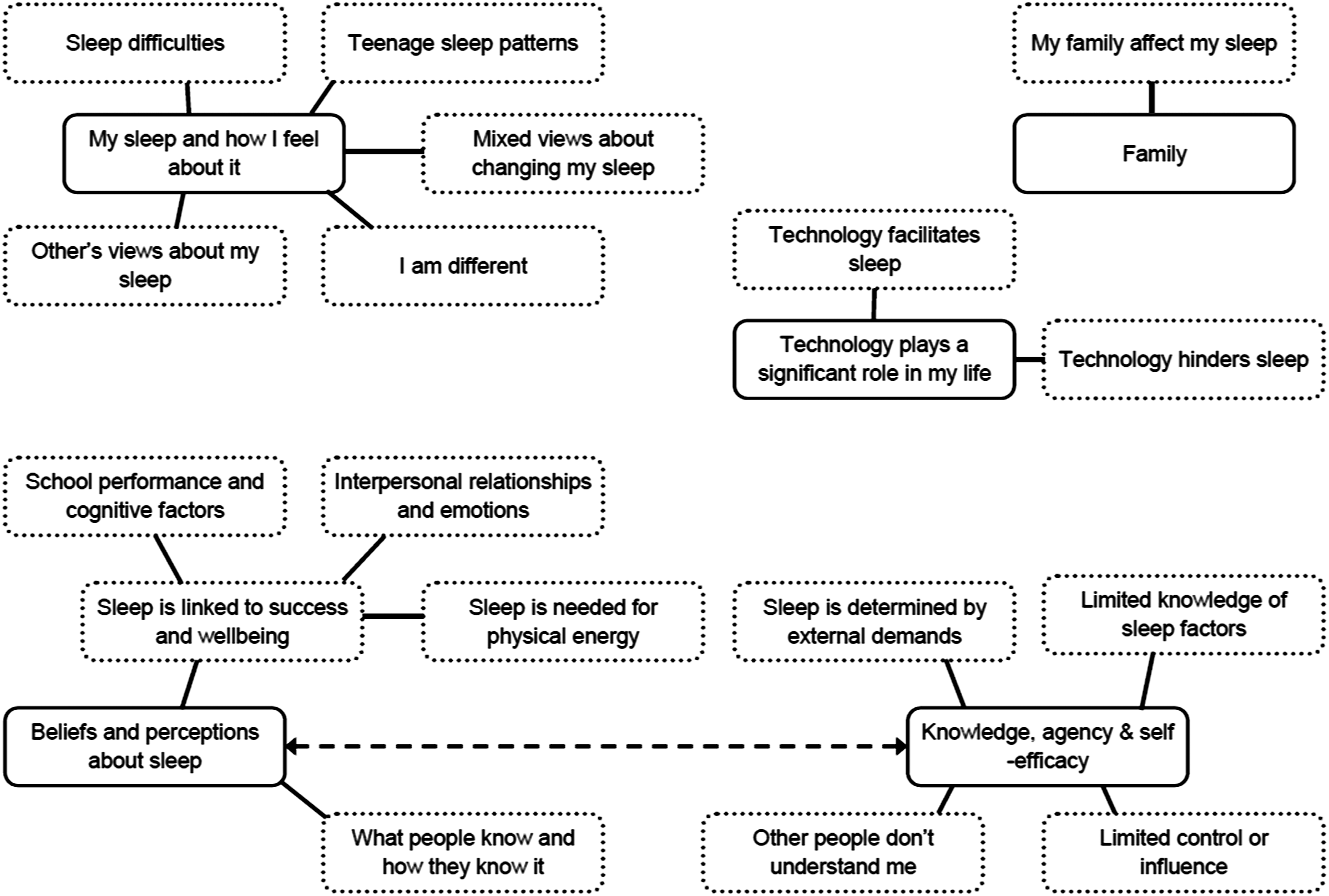
Theme 1: My sleep and how I feel about it
The aspects of this theme are described in 5 subthemes.
Subtheme: Teenage sleep patterns
The young people described their sleep patterns as characterised by staying up late, sleeping in late when they have the opportunity and having different sleep on weekends compared to during the week. This was also reflected in their self-reported sleep and wake times in the questionnaire responses.
Subtheme: Sleep difficulties
The young people described experiencing a range of sleep problems and difficulties including having difficulty falling asleep and waking in the night and some negative sleep experiences. Some of the young people take sleep medication and others have had, or considered, professional involvement relating to their sleep needs. One young person described experiencing sleep paralysis. “It’s, I just can’t sleep” (P2) “I just wake up in the middle of the night” (P7)
Subtheme: Other’s views about my sleep
With regard to their own sleep as individuals, the young people described both the viewpoint that other people in their lives think that they get enough sleep and the viewpoint that other people do not think they get enough sleep. There were mixed views about the perceptions of adults in their lives and of their peers about the participants’ own individual sleep. On adults thinking the young person does not get enough sleep: “Probably like my teachers cos where I’m always moody, right, they probably think that I’m moody cos I haven’t got enough sleep” (P1)
Subtheme: Mixed views about changing my sleep
Some young people reported that they want to and have tried to change their sleep in the past, and others were content with their sleep. On whether they try to change the amount of sleep they get: “Yep. All the time … I’m always tired” (P5) “I wish I could, I wish if like, I wish if like I snap my fingers [snaps fingers] I could go to sleep” (P7)
Subtheme: I am different
Many of the young people communicated beliefs that they are different to other young people their age and particularly regarding sleep. The word ‘weird’ was frequently used to describe aspects of their own sleep. They tended to describe themselves as getting less or more sleep than other young people their age, rather than identifying themselves as being similar. On whether one can tell if someone has had insufficient sleep: “Not in this school. Cos everyone’s too, like, different … cos we’re all different in our own ways so it’s not really picked up on” (P1) On why it matters that other young people are getting more sleep than the young person: “Cos they are getting their full sleep, I’m not … They’re concentrating, I wouldn’t be” (P8)
Theme 2: Beliefs and perceptions about sleep
Participants’ beliefs and perceptions about sleep are detailed in 2 subthemes. The participants also identified factors that have positive and negative influences on sleep, which were generally limited to external and environmental factors: noise and light are bad for sleep and sleep medication is good for sleep.
Subtheme: Sleep is linked to success and wellbeing
The young people identified 3 main ways in which sleep is associated with success and wellbeing. Firstly, they communicated that good sleep has a positive impact on learning and school performance, and that poorer sleep has a negative impact. They described it as affecting focus and attention and the ability to think. Secondly, they noted the impact they feel that sleep has on their, and others’, interpersonal relationships and emotions. They described having more difficulty in getting along with other people when they’ve had poor sleep and noted the impact that poorer sleep has on their emotional wellbeing. Thirdly, they made a strong association between sleep and physical energy, describing changes in physical energy as being key consequences of better and poorer sleep. “Gotta be awake, you gotta be alive to go to school, otherwise your brain doesn’t function properly” (P2) How poorer sleep affects the young person: “Just can’t think correctly” (P2); “Sometimes I just won’t participate in lessons, or something, it just really annoys me” (P2); “I won’t really pay attention like fall asleep in lessons” (P4) How poorer sleep affects other young people: “Make them grumpy and put them in a bad mood” (P2); “Um, “I don’t care” attitude” (P8) How poorer sleep affects the young person: “Cos I take it out on my mum” (P1); “Um, what I like is not really happy, I ain’t happy, I ain’t joyful” (P4) The consequences of poorer sleep: “I can’t move around more faster or stuff” (P4) The expected consequences of better sleep: “Probably have more energy” (P5)
Subtheme: What people know and how they know it
The young people communicated that they had knowledge and views about social norms regarding sleep, such as things that help or hinder it. They had mixed views about the sources of information for sleep knowledge. They mostly reported not having talked to adults about sleep or learning about it explicitly, although some felt that they had learnt about sleep from their parents. Most of the young people had a sense of the amount of sleep that children and young people need and the concept that this varies according to age. On norms about what helps or hinders sleep: “Counting sheep … Mmm. But that doesn’t work” (P1); “Go to bed at a sensible time … Having a routine” (P3); “Taking a bath before going to sleep … That’s actually true though” (P7) On where adults learned sleep facts: “He probably learned about it in school … High school” (P7)
Theme 3: Knowledge, agency and self-efficacy
The key features of this theme are detailed in 4 subthemes. Theme 2 and theme 3 describe patterns for related topics.
Subtheme: Limited knowledge of sleep factors
The young people communicated a belief that they do not have information about or know things about sleep-related factors or their sleep experiences. In some cases, the young people communicated that they knew nothing or very little about a particular phenomenon and in others the young people demonstrated some understanding of the phenomenon they were describing, but indicated that they felt uncertain or unknowledgeable about it. They communicated that there were many aspects of what was discussed that they had not thought about before. They made statements that suggested that they were not aware that they had incorrect information or were lacking relevant information regarding factors associated with their own sleep. This aligns with the quantitative data showing that 6 young people had poor sleep hygiene behaviours. When asked what happened when the young person woke up in the night: “I had a drink and went back to bed [interviewer asks what the drink was] energy drink” (P3) On how much sleep young people need: “Quite a bit, four, four, five hours maybe” (P4)
Subtheme: Limited control or influence
The young people communicated a general sense of a lack of control over their sleep and factors relating to sleep as well as other aspects of their daily lives. They seemed to feel unable to influence or change these things. “It’s not my fault I can’t get out of bed” (P1) “It’s the fact I’m always moody but I can’t help it when I’m moody, like I don’t realise” (P1)
Subtheme: Sleep is determined by external demands
The young people described their sleep schedule as being significantly influenced by demands placed upon them, with school timing determining rise-, and frequently bed-, time during the week and the absence of obligations on the weekend resulting in different sleep patterns. This was reflected in the quantitative data, which showed similarity of wake time on school days across the participants and a difference in sleep between school nights and weekend nights. Why the young person gets more sleep or goes to bed later on weekends: “Cos I don’t have school” (P1); “Cos I know I don’t have like I don’t have to do anything tomorrow” (P7); “Um it’s because I, I don’t get full, my full sleep on the weekdays so I just … the sleep just builds up in me and when it’s the weekend just, just relaxing” (P8)
Subtheme: Other people don’t understand me
The young people communicated ideas around other people, typically adults, in their life not understanding them, wanting different things to the young people compared to what they want for themselves and also the young people allowing misconceptions about their sleep for the adults in their lives. On adults having misconceptions about the participants’ sleep: “They think I go to sleep at nine … [laughs]” (P5); “She just keep knocking on the door pretend I go asleep every night” (P5);
Theme 4: Technology plays a significant role in my life
Technology plays a role in and influences many aspects of the young people’s daily experiences. The specific technology described included mobile phones, laptops and games consoles. The types of activities included consuming media (i.e. watching videos, television and film), playing games, consuming and engaging in social media and communicating with other people (i.e. using messaging services and talking). The young people described spending a lot of time using technology. They also described technology as a factor associated with their sleep and the sleep of other people (see subthemes).
Subtheme: Technology facilitates sleep
The young people use technology to help their sleep. For example, watching videos or playing music to help them fall asleep. In addition, some of the young people described their use of technology around sleep as being somewhat dependent, in that without their use of technology they find it harder to get to sleep. “It’s just, when I do wanna go to sleep, like when I just put my phone down, mmmm my desk, I just try to go to sleep and it won’t happen, I will have to watch YouTube just to fall asleep” … “It just helps but I can’t explain it” (P7) On what helps the young person to fall asleep: “Music, sometimes, if, sometimes if I, this is weird but games also cos my eyes will just go tired and tired and then they’ll shut” (P4)
Subtheme: Technology hinders sleep
The participants communicated views held by themselves and others that technology has a negative impact on sleep. They also spoke from their own experience about how their use of technology at night time had negatively impacted their sleep (e.g. staying up late to consume media and play games). The young people described technology as having a causal mechanism for bringing about poorer sleep patterns in themselves and other young people, in some cases describing it in ways that are akin to it being addictive or compulsive. “Like one really you just like look on, you just keep scrolling down for like hours … And you like, like ten minutes later like, what, what was I supposed to do? … When the noti-notifications just like pops up on Facebook, I just go on the Facebook app, go on the notifications just like, like tick it off but then there’s a video I just watch it, then I’m watching another video, and then it just … It’s, it’s so bad” (P7)
Theme 5: Family
Family was identified as relevant and important to the young people throughout the interviews. They referred to family members and in particular those that they lived at home with, often. They described their family as being a source of support and as caring for them.
Subtheme: My family affect my sleep
The young people identified that the family members they live at home with have both a positive and a negative impact on their sleep. They described having their sleep disturbed by siblings and their parents waking them up in the mornings. Things that disturb the young person’s sleep: “Like I said my sister crying, or somebody moving around” (P2) “My mum will like wake, wake me up and I just get on with life” (P4) “My brother that sleeps in the same bed and keeps kicking me” (P6)
Discussion
The findings give insight into the experiences and views of the young people interviewed. They described sleep patterns characterised as typically teenage, they reported sleep difficulties and mixed views about changing their sleep and they identified multiple ways they thought that sleep impacts success and wellbeing. Technology and family were communicated to be important and associated with facilitating and hindering sleep. A pattern of limited knowledge and limited control was identified for how the young people described their experiences and perspectives.
The experiences and perspectives of the young people interviewed here reflect broader research findings about adolescent sleep and behaviour. The young people interviewed described views and experiences that were in some respects similar but in other respects different to studies that used comparable qualitative methods with related adolescent populations to explore views and experiences about sleep.
The present study identified that the participants were not getting sufficient sleep as did 2 other qualitative studies, which also found in common that participants were using weekends to catch up on sleep 30 and had high likelihood of developing social jetlag. 31 The sleep patterns, habits and difficulties described by the young people interviewed here reflect adolescent patterns of sleep. Developmental changes during adolescence impact homoeostatic and circadian regulation of sleep, bringing about delayed sleep that can be incompatible with school timings and that is exacerbated by exposure to light at night time.12,13 Adolescents typically have longer and later sleep on weekends and a key factor influencing this is school start times.8,11 This intraindividual variability in sleep timings is prevalent in the adolescent population 58 and is associated with poorer perceived sleep quality and negative mood. 59
Social jetlag occurs when a discrepancy between social time (e.g. regulated by school) and biological time (e.g. circadian regulation and chronotype) develops due to having different sleep on weekends compared to weekdays leading to deterioration in wellbeing considered akin to jetlag from travelling between time zones.60,61 Social jetlag is a common and significant problem for adolescents 62 and the young people interviewed are vulnerable to it.
Participants identified barriers to sleep in common across the present study and comparable qualitative studies including environmental factors such as light and noise,27,28,30 family factors28,30 and using electronic devices before sleep.27,28,30,31 However, the participants in those other studies identified barriers to sleep that were not communicated by the young people interviewed here. Other young people identified emotional factors including stress, worries and excitement as being a significant barrier for their sleep,27,28,31 and cited activities such as participating in sports in the evening 27 and homework 28 as barriers. These differences may be associated with different routines and expectations of the young people. For example, that homework was not cited as a factor relating to sleep in the present study could be associated with the young people interviewed having different educational experiences compared to those who attend mainstream educational provision (which is the educational experience of the participants in other similar studies).
Just as described by the young people interviewed here, quantitative research has found sleep environment factors to be related to poorer sleep for adolescents, including noise inside and outside of the home, 45 including for adolescents attending an alternative school. 63
In line with what the young people interviewed described, a large amount of technology use in the daytime and night time is typical for adolescents, and use of technology at night time is associated with poorer sleep and daytime functioning.14-16,64,65 Mobile phone use and social networking engagement at night time have been associated with poorer wellbeing through the mediating variable of sleep disruption. 66
However, engaging in the use of technological devices can fulfil a range of needs including entertainment, distraction and relaxation and adolescents, including those interviewed here, use technologically mediated media as a sleep aid. 67 This was in common with the comparable study by Quante and colleagues, 31 where young people identified electronic device use as a potential facilitator to sleep. Young people such as those interviewed may benefit from using strategies to decrease negative consequences for sleep such as using device aeroplane modes and software that minimises blue light emitted by devices.68,69 Facilitators for sleep identified in comparable studies but not communicated by the young people interviewed here include physical activity 27 and participants describing a stronger recognition of parent impact for helping their sleep. 30
In both the present study and that conducted by Quante and colleagues, 31 participants demonstrated a lack of awareness of sleep hygiene behaviours, but in contrast the Quante et al participants could identify strategies they personally use to help their sleep, which the present participants tended not to do.
Other similar findings to some comparable qualitative studies were that the young people interviewed here identified an association between quality and quantity of sleep and factors including energy, mood, interpersonal interactions and learning factors such as concentration, memory and academic performance.27,30,31
Participants in a comparable study by Godsell and White 30 identified social pressures and expectations from peers as being a key factor impacting their sleep, which was not expressed by the young people interviewed here. It would be of interest to understand whether this difference is due to the methods and focus of the research or if this is related to differences in the experiences of the different populations in the studies.
The young people interviewed were similar to those in 2 other comparable studies in that some of them felt that their parents would not be content with the amount of sleep they were getting, 27 and they had mixed views about whether change was needed regarding their sleep.27,28 Participants in Orzech’s 29 study communicated more numerous and stronger messages about the nature of healthy sleep that came from adults and media.
Sleep education for young people such as those interviewed could increase their knowledge and support their ability to make choices and have a sense of control over aspects of their lives. A sleep hygiene intervention using Theory of Planned Behaviour has improved sleep outcomes and addresses perceived behavioural control, making it a relevant example for supporting young people such as those in the present study. 70
The young people interviewed described having not been taught or informed about sleep hygiene to any real extent. In the UK, sleep education is not specified in the National Curriculum (in contrast to other non-academic topics such as managing money and sex and relationships). Educators should consider the extent to which their education programmes incorporate meaningful sleep education.
The findings of the present study highlight factors for professionals working with young people to take into consideration. The young people interviewed perceived a strong association between quality or amount of sleep and physical energy. In contrast, professionals such as teachers may arguably be more interested in the cognitive, social or emotional consequences of sleep. In addition to seeking to educate young people to understand the consequences of sleep quality and duration, adults wishing to motivate adolescents to positively influence their own sleep quality and quantity could focus on the consequences that the young people may view as important. In addition, even when working in an educational setting or prioritising school-related sleep factors, the findings reveal the importance of considering the people and environments that young people experience outside of school.
The information gathered in the present study identifies areas that may be meaningful for young people when collaborating with them to positively influence their sleep. It raises issues for professionals to consider, and be curious about, when exploring sleep with young people they work with. It provides information for the development of sleep education and intervention programmes.
Footnotes
Declaration of Conflicting Interests
The author(s) declared no potential conflicts of interest with respect to the research, authorship, and/or publication of this article.
Funding
The author(s) received no financial support for the research, authorship, and/or publication of this article.
