



Abstract
Nowadays, one of the main beauty concerns among the youth is unwanted hair removal. This issue has led to health authorities’ concern about the health consequences of hair removal methods. So, this study aimed to identify and evaluate the risks of the common methods of unwanted hair removal and determine the safest method (2020). This descriptive-analytical study was done by distributing a questionnaire among 450 clients of barbers and hair salons in Kashan (2020). Data analysis was done by Excel 2013. Based on the items of the questionnaire, the advantages, disadvantages, and risks of each method were determined regarding the experts’ viewpoints and What-if method. The risks of the mentioned methods were evaluated by William Fine method. Finally, the safest method of unwanted hair removal was selected using the Analytical Hierarchy Process (AHP). The results showed that the most frequently used hair removal method is using the razor (72.5%) that causes the highest skin complications. The highest and lowest risk has been reported for epilation (waxing) and depilatory products. Also based on AHP, the best hair removal method was reported using depilatory products. According to the results, evaluation of the risks of beauty-related tools is so important for deciding about safe and secure methods of beauty-related measures such as hair removal.
Highlights
Hair removal is one of the aspects of personal hygiene, and there are several ways to do this, that each one can have benefits and potential risks for people’s health. Identify and evaluate each of the common methods of hair removal and determine the safest and most appropriate method. Introducing the safest method of hair removal can reduce the possible side effects of using other methods and as result, reduce the treatment costs and medical visits.What do we already know about this topic?
How does your research contribute to this field?
What are your research’s implications toward theory, practice, or policy?
Introduction
As a common aesthetic problem, unwanted hair has involved many people1,2 because in the modern world, hair-free body is considered an ideal and healthy body. 3 Unwanted hair growth is affected by different factors, such as genetic agents, nutrition, hormonal disorders, and pharmacological interventions.3,4 In severe cases, this condition can affect the people’s mental health by causing depression, anxiety, and distress and decreasing the quality of life.1,5 To resolve the problems caused by unwanted hair and improve the body appearance, there are different hair removal methods, such as shaving, epilation, chemical depilatories, laser, and epilator.6,7 Each of these methods has some advantages and disadvantages. Among the mentioned methods, shaving by razor and using depilatory products are considered the traditional hair removal methods. 8 Chemical depilatories have been widely used since years ago. 9 These products are produced in different forms, such as gel, foam, and cream, and they are commonly used in eastern countries, such as Iran and India.9-11 The third common hair removal method is epilation or waxing that extracts the hair root. 4 This method has long-term effects so that the hair growth can occur after 2–4 weeks. 12 Epilator and tweezers can also extract the hair root and they are usually used for removing the hair from small areas. 4 Unlike the mentioned temporary methods, laser is a permanent hair removal method. In addition, it can be used for treatment of different skin disorders, such as scar, acne, pigment disorders, and tattoo.13,14 According to studies, this method can be effective in hair reduction up to 90%. 15 However, the result may be different depending on individual factors, such as skin type, hair type, and hormonal condition. 14
Different hair removal methods can be significantly effective in beauty improvement, since nowadays, media promotion has changed people’s attitudes to the belief that unwanted hair removal is one of the main aspects of having a healthy and ideal body. However, from health viewpoint, frequent use of these methods can lead to health complications and it is considered a risk by the experts.3,16,17 Therefore, risk assessment can be significantly effective in determining the harm caused by any risk. 18 Different methods have been proposed for risk assessment. These methods include PHA, 19 William Fine, 20 FMEA, 21 HAZID, 22 and What-if. 23 What-if has been proved to be effective in assessing unknown risks based on the experts’ viewpoints. 24 This method can be used in specific areas, such as the use of chemicals. 25 Also, there are different methods of decision making and prioritization, such as AHP that is the most important. 26 AHP is widely used in different areas, such as chemical engineering, 27 robot building, 28 environment, and health.29,30
Increasing variety of hair removal methods in most parts of Iran and the absence of a comprehensive study on the side effects of these methods were the two important factors in the implementation of the present study. On the other hand, field studies have indicated the dating new hair removal methods in the study area. Lack of public knowledge about the side effects of each hair removal method was the main reason for a survey of health experts to prioritize the use of these methods.
Regarding the variety of hair removal methods and the existing health concerns, this study aimed to identify and evaluate the risk of using different hair removal methods by AHP and What-if. The study was conducted on the clients of barbers and hair salons in Kashan to determine the risk of each method and specify the safest hair removal method.
Methods
This descriptive-analytical study has been done among the 450 clients of barbers and hair salons (18 women’s barbers and hair salons and 12 men’s barbers and hair salons) in Kashan to evaluate the risk of hair removal method. Participants in the study were selected through convenience sampling. This study has been done in three stages:
The First Stage
Data collection was done by using a valid and reliable questionnaire. The questionnaire has been designed based on reviewing the literature and the proposed theories. It was distributed among 450 male and female clients of barbers and hair salons in Kashan who selected by random sampling (2020). The sample size was calculated using Equation 1

The selection of hairdressers was done in clusters, so that the region was divided into three parts culturally and geographically, then, a list of available men’s and women’s hairdressers was prepared and 6 hairdressers and 4 men’s hairdressers were randomly selected from each section and entered the study. People who completed the questionnaire must be 18 years of age or older and have at least a diploma.
The questionnaire consisted of two parts including contextual and demographic questions (gender, age, education, university subject, and residence place), the used hair removal methods, reasons for using the methods, number of hair removal times per month, related costs, caused skin complications, hair removal methods with the highest skin damages, anatomical area with the highest complications, and hair removal methods for the hands, feet, body (back and stomach), and genital area.
The collected data was analyzed by Excel 2013.
Ethics statement
Before distributing the questionnaires, the purpose of the study and the publication of the results were fully explained to the individuals by researcher. We also told them that it is not necessary to register the name in the questionnaire, so persons, with personal consent and voluntarily completed the questionnaire and verbally and written informed consent was obtained from all participants. This paper is one of the results of the project (No.:99011). That is approved Kashan University of Medical Sciences and also ethical code is IR. KAUMS.NUHEPM.REC.1399.009. All methods were carried out in accordance with the guidelines (Helsinki Declaration 2013) for biomedical research.
Validity and reliability
One of the most important components of validation for a questionnaire is its validity and reliability. The reliability of a questionnaire indicates the extent to which the same result is achieved at different times, places, and people, and it also wants the stability, coherence, and uniformity of the existing questionnaire. 31 In this study, the reliability of the questionnaire was estimated using Cronbach’s alpha coefficient, which is the most common method. 32
The validity of the questionnaire indicates that the used instrument measured exactly what it has suggested. 33 To determine validity of the instrument, researchers use a qualitative method (the Committee of Experts evaluation) and quantitative approach (Content Validity Index (CVI)). 34
In this study, in order to determine the validity of the researcher-made questionnaire, before starting the study, content and face validity analyses with 15 expert panels and 30 male and female clients in hairdressing salons were conducted.
After completing the questionnaires and surveys of these people, existing deficiencies were corrected and suggestions were considered, then statistical analysis was performed using SPSS22 software. Finally, the content validity of this questionnaire was desirable and Cronbach’s alpha coefficient for reliability evaluation was .83.
The Second Stage
After identifying different hair removal methods and evaluating their popularity based on the questionnaire, the criteria of choosing different hair removal methods and their advantages and disadvantages were determined by What-if and based on the experts’ viewpoint. The experts were health specialists with a 10-year background of inspecting beauty salons and dermatologists. At this stage, 5 experts were used. After identifying the risks and advantages of each method, they were classified based on their nature by the experts.
To evaluate the risks of each method, several factors such as risk intensity, probability, and the risk contact were ranked by William Fine method (Appendix 1(Supplementary Table S1)). Then, the risk score (rank) was calculated by multiplying the three mentioned factors (risk intensity (intensity of the damage caused by each method) × the probability of the damage × the frequency of risk contact = the risk rank).35,36 The experts determined the risk exposure rate based on the frequency of using hair removal methods.
The risks scores were classified by Pareto principle, that is, 20/80 rule. This rule suggests that the risks with a risk score of more than 80% (number 100) are considered an unacceptable risk that requires an immediate modifying measure. Meanwhile, the risks with a risk score of less than 20% (number 25) are considered acceptable and safe risk. 37 So, the score of each risk is specified in the range of 1–125 and the risks are categorized in three classes including the acceptable, medium, and unacceptable risks. 38
The Third Stage
After identifying and evaluating the risk of each of hair removal methods, the criteria (positive and negative effects for each method) were determined by skin specialists.
These criteria included safety, health, cost, access, and beauty. Then, pairwise comparison matrix was formed for the items to determine priority and importance of criteria. Then these skin specialists and beauty specialists filled the questionnaire form. In the first row and column of this matrix, the parameters were included in terms of their priority (from left to right and up to down). The main diameter of the matrix is filled by 1. Above the main diameter, the rows are valuated from the right to left in terms of their respective priority and finally, below the main diameter the rows are filled in a reverse manner. This matrix determines the weight and importance of each parameter. After specify the weight of criteria, skin specialists and beauty specialists take a score −1 to +5 for each criteria. So with applying weight of them, total score of methods calculated and select the best alternative.
Analytic hierarchy process (AHP) is a multi-criteria decision analysis (MCDA). MCDA includes the processes that evaluate the value of the items for a specific goal. AHP is used when there is a hierarchy of interdependent elements which make the decision making difficult. 39 This hierarchy has a structure similar to a tree. In the top of this hierarchy, there is the main criterion, and in the lower levels, there are the sub-criteria. 40 This process includes different choices in decision making and provides the possibility of sensitivity analysis on the criteria and sub-criteria. Also, it is based on pairwise comparison that simplifies judgment and shows the compatibility and incompatibility of a decision. It is the most important advantage of this method in multi-criteria decision making. The other advantage of this method is combination of qualitative and quantitative criteria. In addition, AHP has a strong theoretical basis and it is based on a set of obvious principles. 41 The nature of AHP is judgment and so it analyzes a problems based on the real information and the experts’ viewpoints. 42 AHP divides decision making problems into understandable parts. Each part is analyzed separately and finally, different parts are accumulated by a logical method proposed by Saaty and Malzewski. On the other hand, the main problem in decision making is how to weight the criteria. AHP is one of the mostly known methods of weight assessment. 39 In this method, comparison is done as presented in Appendix 2 (Supplementary Table S2).43,44
Results
In this study, 450 clients of barbers and hair salons in Kashan were evaluated from different subjects. This population included 200 men (42.50%) and 250 women (57.5%).
The Results of Risk Assessment
This study has investigated the 450 Clients of barbers and hair salons in Kashan. The clients were 19-53 years old. According to studies, the most common hair removal method reported by the studied population was using a razor (72.5%) and the least common method was using laser (11%) (Figure 1). Meanwhile, 65% of the people were encouraged to use to the mentioned methods due to their personal experience and 11.5% were encouraged by the media promotions. Frequency of hair removal methods.
The results showed that the most popular methods of unwanted hair removal among women are shaving with a razor and epilating, respectively. However, shaving with a razor and using depilatory products were the most popular methods among men. Also, in general, skin complications due to hair removal methods were more common in women than men.
In terms of the motivation for using the mentioned methods, the ease of using was the most frequent reason (57.5%) and causing lower complications was the least frequent method (14.5%). In this study, the highest frequency of hair removal intervals per month was twice a month (24.5%) and the least frequency was more than eight times a month (4.5%). The hair removal costs reported by the subjects included less than a dollar (40.5%), 1–3 dollars (39%), 3–4 dollars (9%), and more than 4 dollars (11.5%). The most common complications caused by hair removal were irritation and itching (42%), and chemical burn (.5%) was the least common complication (Figure 2). Frequency of skin problems.
In terms of the anatomic area, the most common complications were observed on the hands and feet (38.5%) and genital area (33.5%), and the least common area was the body (back and stomach) (15%). In terms of hair removal methods, 34.5% of the subjects used a razor or Epilady and only 7% of the subjects used laser. The most common hair removal methods used for the body and genital area was using razor and epilator was reported as the least commonly used method.
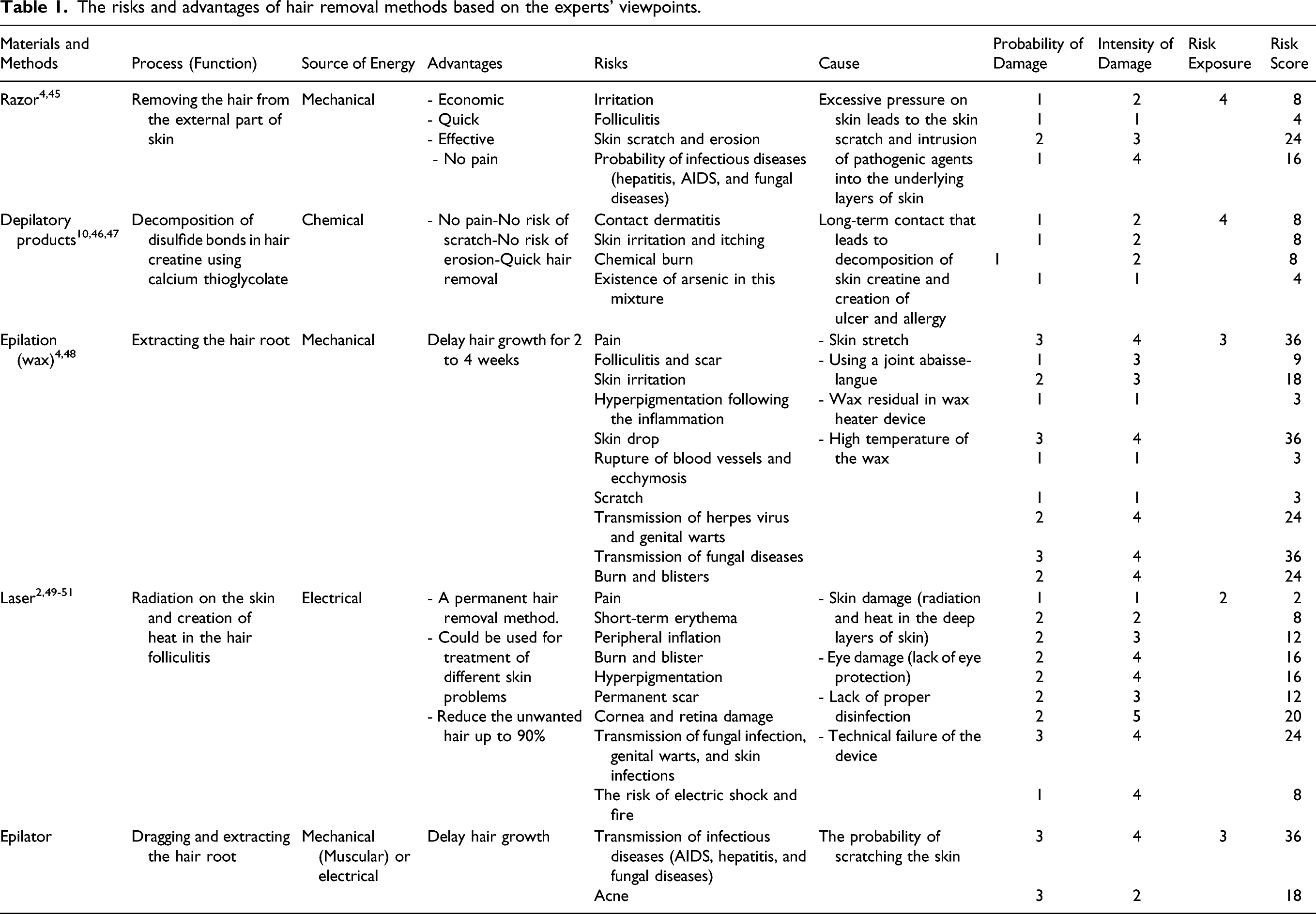
The risks and advantages of hair removal methods based on the experts’ viewpoints.
The Results of AHP
Comparison of hair removal methods.

According to result, the best hair removal method is using depilatory creams and powders regarding all their risks and advantages.
Discussion
Over the past several decades, media promotions in the internet and pornographic products have led to people’s attitude to a hair-free body. This issue has become a serious concern especially for women.52,53 Nowadays, removal of unwanted hair from different parts of the body has become a common habit in different cultures. 54 Regarding the technological development, different methods have been introduced for removal of unwanted hair. Each of these methods has several advantages, risks, and complications. It is necessary to choose a method that is simultaneously safe and effective. Therefore, this study aimed to evaluate the risk of using hair removal methods and choosing the best one.
The results showed the frequency of the use of razor for removing unwanted hair, which is consistent with the results of other studies. 55 A systematic review investigated the attitudes to different hair removal methods. The most common method (58%) was using a razor. 56 Using a razor is a traditional hair removal method that cuts the hair from the external part of skin and it is so popular due to its quick use, effectiveness, causing no pain, and being economic.4,45,57 The results of the other study showed that razor and laser were the most and the least common hair removal methods used by men. This finding is consistent with the results of the present study. 58 The laser radiation on the skin penetrates from the epiderm into the derm and after being absorbed by the melanin, it produces heat in the hair. Then, the produced heat is transmitted to the folliculitis, leading to hair damage and decreased growth. 49 Despite the permanent effects of this method, its popularity has decreased due to its high price, probable complications, and long-term treatment process.57,59
According to the present study, after irritation and itching, inflammation and skin redness were the most frequent complications reported by the clients of barbers and hair salons, which is consistent with the results of other studies. 45 Meanwhile, another study reported that using razor caused the highest complications compared to other methods. They stated that all subjects with skin complications had used a razor for hair removal. 60 A study was performed to investigate the methods of removing the genital area hair and their complications in 400 women from Saudi Arabia. They concluded that using a razor (33.5%) is the most common hair removal method and the most common complications of this method include scratching and tear caused by razor. 55 In a study, 83% of the patients referring to the emergency ward of U.S. due to skin damage had used a razor for hair removal. 61 Meanwhile, others have also approved that most of the skin damages are caused by using a razor. 50 It can be due to the erosion and small tears caused by using a razor.62,63
The results of this study showed that in terms of the anatomic area, hands and feet have the highest frequency of skin damages. Others reported that leg (97%), armpit (96%), and pubis (86%) are the main areas of hair removal. 52 This finding is also consistent with the results of the present study. It seems that the hair removal times are different for every part of the body depending on the visibility of that area. Therefore, the damages and complication caused to these areas have been more reported. 58
According to this study, the role of media promotions in changing the clients of barbers and hair salons’ attitudes to unwanted hair removal3,4 has led the people toward using cosmetics. Excessive use of these materials can bring a lot of profit for the manufacturers, importers, and sellers of these products, which is consistent with the current study.64,65 According to the results of risk assessment by AHP, the best hair removal method is using depilatory products. The hair removal mechanism in these chemicals is based on calcium thioglycollate, that decomposes the disulfide bonds existing in hair creatine, so that the weakened hair become isolated from the epiderm folliculitis by rubbing the skin. 46 According to studies, using depilatory products is a simple, efficient, and low-cost method to be used at home. It can reduce the unwanted hair up to 90% while causing the least skin problems.47,57,66 However, in the case of remaining on the skin for a longer time, it can cause skin reactions, such as burn and erythema especially in the genital area.47,57 Researchers suggest that using hair removing products can significantly reduce the microbial load of the skin. Therefore, it is considered a good way of hair removal for surgery areas. 62
Conclusion
Unwanted hair removal has become a common habit in different cultures and societies over the past several decades. It has become a serious concern especially for women. Different methods have been proposed for unwanted hair removal. However, despite causing skin damages, using a razor has been more popular due to the ease of use and its low cost. According to the findings of the present study, using depilatory products is the safest hair removal method in addition to its ease and economic aspects.
Supplemental Material
sj-pdf-1-inq-10.1177_00469580211059969 – Supplemental Material for Identifying and Evaluating the Risks of the Common Methods of Unwanted Hair Removal and Proposing a Safe Method Based on William Fine, AHP, and What-If
Supplemental Material, sj-pdf-1-inq-10.1177_00469580211059969 for Identifying and Evaluating the Risks of the Common Methods of Unwanted Hair Removal and Proposing a Safe Method Based on William Fine, AHP, and What-If by Mahdiyeh Mohammadzadeh, Rouhullah Dehghani, Samaneh Taghilou, and Mohsen Hesami Arani in INQUIRY: The Journal of Health Care Organization, Provision, and Financing
Footnotes
Declaration of conflicting interests
The author(s) declared no potential conflicts of interest with respect to the research, authorship, and/or publication of this article.
Funding
The author(s) received no financial support for the research, authorship, and/or publication of this article.

Supplemental Material
Supplemental material for this article is available online.
References
Supplementary Material
Please find the following supplemental material available below.
For Open Access articles published under a Creative Commons License, all supplemental material carries the same license as the article it is associated with.
For non-Open Access articles published, all supplemental material carries a non-exclusive license, and permission requests for re-use of supplemental material or any part of supplemental material shall be sent directly to the copyright owner as specified in the copyright notice associated with the article.
