



Abstract
Job satisfaction is determined as the measure to know the individuals’ feelings toward their work. The working conditions that can affect satisfaction and performance of the call center agents have received particular concern. This study aimed to determine the role of remote call center working on agents’ satisfaction compared to onsite workers. A cross-section study was conducted between December 2020 and April 2021 that include 124 agents working in a governmental medical call center in Saudi Arabia. Each agent was receiving a questionnaire that investigates his/her satisfaction with the job nature, supervisor support, job autonomy, job productivity, and performance. Seventy-seven physicians working onsite were compared to forty-seven physicians remotely working in the medical call center. The mean age of the physicians included was 43.17 ± 8.4 years, and most of them were male (>70%), married (>85%), and family medicine specialists (>50%). The mean years of experience in the medical field of the physicians included was 16.87 ± 8.07 years, and the mean years of experience in the medical call center was 1.44 ± .97 years. Onsite agents were more satisfied concerning job nature, supervisor support, productivity, and performance compared to remote agents (70.82 vs 53.47%, 63.38 vs 55.05%, and 66.51 vs 56.03%, respectively). However, onsite agents were less satisfied regarding job autonomy than remote physicians (46.81 vs 53.19%, P-value = .128). Overall, general satisfaction was more seen in physicians working onsite as opposed to remote workers in the medical call center in Saudi Arabia (64.90 vs 54.25%, P-value < .01).
Job satisfaction is determined as the measure to know the individuals’ feelings toward their work, either positive or negative.
This study could explain the different between onsite and remote agents and determine the barriers and facilitator for the satisfaction and performance of remote agents.
This study showed that onsite workers were more satisfied regarding the job nature, supervisor support, job productivity, and performance; however, remote workers were more satisfied regarding job autonomy in a medical call center compared to onsite workers, therefore, organizations should be more focused on workers’ satisfaction since it is correlated with productivity and performance, and by contrast, high workload, poor facilities in the work area, few training hours, and delay in salary will increase the rates of dissatisfaction among employees.
Introduction
The quality of services provided by any organization is related to the motivation and satisfaction of the employees of that organization. Job satisfaction is determined as the measure to know the individuals’ feelings toward their work, either positive or negative. 1 The response of each worker toward his job and workplace environment is important for the organization to improve and supply more positive energy to enhance agents’ performance and productivity. 2 Job satisfaction could be measured as a generalized passion about the job, or as a pattern of attitudes and behaviors about several aspects of the job. It relies on various factors, and agents may be satisfied with one or several aspects and unsatisfied with others of their career. Based on Herzberg’s theory, job satisfaction and dissatisfaction are two unrelated concepts and not two opposite ends of the same spectrum. As per this theory, when working atmosphere (factors of hygiene) are not strong, the worker is displeased; however, when these factors are strong or being better, it means that the employee is not unsatisfied, but also not always satisfied. 3
Call centers have increased rapidly in the last decades and attracted considerable attention from different fields and organizations including medical fields.4,5 The working conditions that can affect the satisfaction and performance of the call center agents have received particular concern, owing to their effect on organizational success in terms of profit, customer satisfaction, and lower costs.5-7 During the previous years, call center management has become more concerned about staff dispensation and less about the old fashion production-line orientation. 8
During the COVID-19 pandemic in 2020 and 2021, it was difficult for many workers including call center agents to work regularly in their working site due to mandatory quarantine restrictions and physical distancing. Because of that, the medical call center applied by the Ministry of Health in Saudi Arabia allowed their physicians to work remotely at home using a specific online system to deal with patients seeking telemedicine services. It was not common to see call centers’ agents work remotely, and agents were usually required to work in the call center sites in order to ensure acceptable performance and well monitoring. However, new technologies allow agents working in call centers to answer the calls out of the work area; which may enhance satisfaction and productivity. On the other hand, remote working could affect the job monitoring of agents.
This study could explain the different between onsite and remote agents and determine the barriers and facilitator for the satisfaction and performance of remote agents. Consequently, it could be possible to improve the productivity of remote agents and to stress on the role of this service during COVID-19 and during any possible future similar conditions. To the best of our knowledge, in Saudi Arabia there are no studies done about advantages, disadvantages, performance, and satisfaction of call center agents working remotely. Therefore, this study intended to investigate this issue.
Research Design and Methods
Study Design and Setting
An observational cross-sectional study was conducted between December 2020 and April 2021 that included all agents (N = 882) working in a governmental medical call center in Saudi Arabia. The sample size included 124 agents who accepted to participate in the study.
This study included only physicians working in the medical call center, and excluded pharmacists, dentists, psychiatrists, and nutritionists. Some of the included physicians are working per a rotation system, as they can have two or three different shifts within 2 months.
Data Collection
A predesigned questionnaire was used to collect data from the physicians. The questionnaire was revised for reliability and validity by experts. The questionnaire was distributed by hand to the onsite agents and through online form for the remote agents. It consists of six sections. The first section includes socio-demographic data of the physicians. Sections 2-5 include data about physicians’ satisfaction regarding job nature (the basic daily tasks carried out as part of the job), supervisor support (the extent to which the supervisors value their agents’ contributions and care about them), job autonomy (the process of how and when to complete their job tasks very well), and job productivity and performance (the ability and value that agents accomplish and bring to the organization for a specific time). These sections involve 5–8 questions with a 1–5 rating scale concerning agents’ satisfaction, in which 1 indicates very unsatisfied, and 5 indicates that the physician was very satisfied. The last section is an open-ended question regarding the physicians’ suggestions regarding improvement of their satisfaction and performance.
Statistical Analysis
The agents were divided into two groups (remote and onsite workers. Furthermore, another type of division of the agents into full-time workers and part-time workers. These groups were compared for agents’ satisfaction.
For the analysis of the results, Welch’s unpaired t-test, chi-square test, and Mann–Whitney U test were performed by using SPSS version 22. The data was saved and organized by using Microsoft Excel 2016 program. The level of significance was considered at P-value < .05.
Regarding the evaluation and analysis of the reliability and construct validity (convergent and discriminant validities) of the questionnaire model used, composite reliability (CR), Cronbach’s alpha, average variance extracted (AVE), and average shared variance (ASV) values were determined. Values of CR and Cronbach’s alpha more than .6 are indicative of good internal consistency reliability, while values of AVE greater than .5 and ASV less than AVE values are indicative of good convergent validity and discriminant validity, respectively.9,10
Ethical Consideration
Informed consent was taken from each physician after explaining the objectives and summary of the study. All the information taken was kept confidential and was not used for other purposes than this study. Those who refused to participate (N = 758) in the study were excluded. Refusal to participate in this study refers to the physicians who did not respond or decline to answer the questionnaire.
The study proposal was reviewed and approved by an ethics review committee (the Central Institutional review board committee) in the Saudi Ministry of Health. The approval letter for this study was given with the central IRB log number: 20-212M.
Results
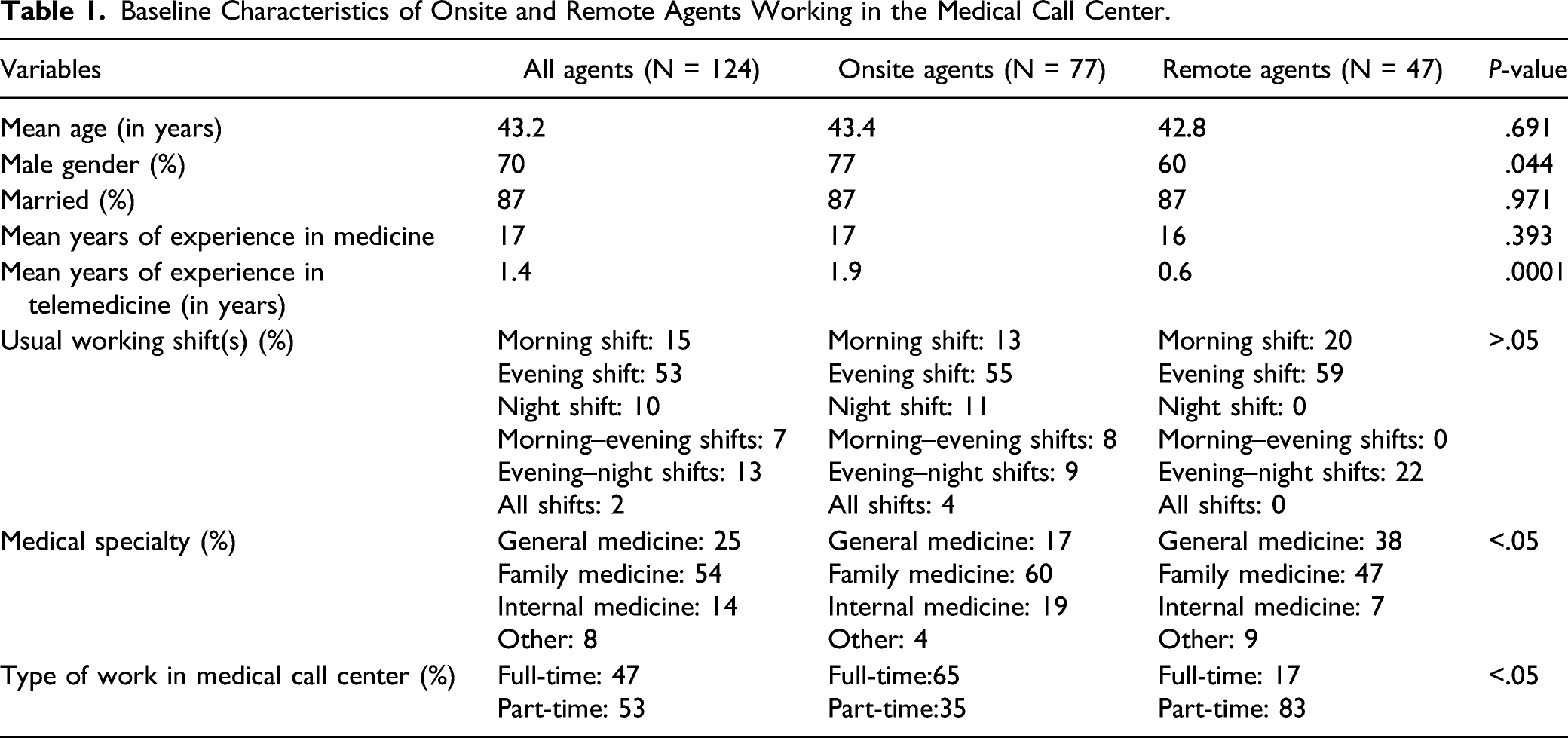
Baseline Characteristics of Onsite and Remote Agents Working in the Medical Call Center.
Baseline Characteristics of Full-Time and Part-Time Agents Working in the Medical Call Center.

Satisfaction of All Agents, Onsite Agents and Remote Agents Working in the Medical Call Center About Different Aspects.

Satisfaction of Full-Time Agents and Part-Time Agents Working in the Medical Call Center About Different Aspects.

Composite Reliability, Convergent Validity, and Discriminant Validity of the Scale Used in the Study That Based on Different Satisfaction Aspects (Constructs).
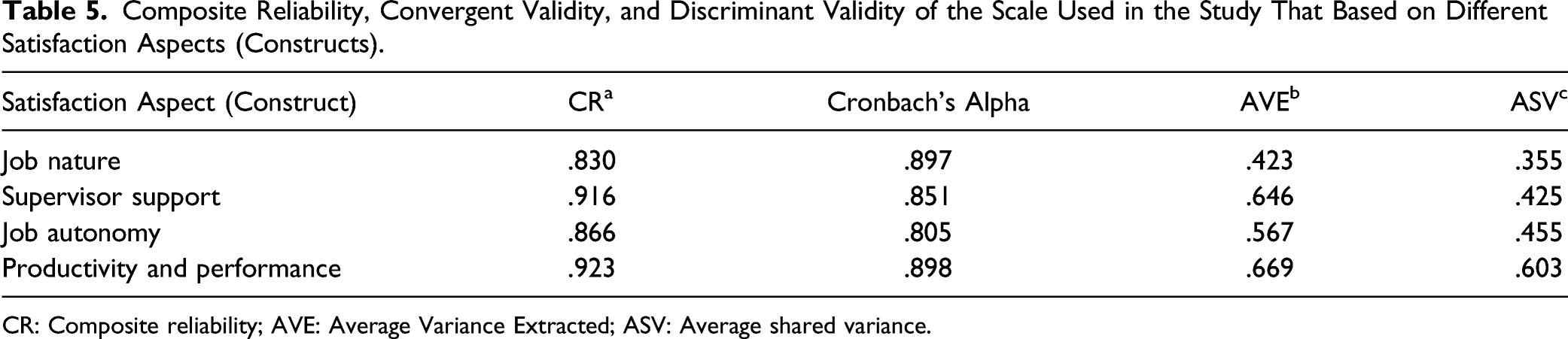
CR: Composite reliability; AVE: Average Variance Extracted; ASV: Average shared variance.
When including all agents (N = 124), the percentage of their satisfaction regarding job nature, supervisor support, job autonomy, job productivity, and performance were 64.18, 60.2, 49.32, and 62.48%, respectively. The percentage of general satisfaction among all included physicians was 60.81%.
Concerning the reliability, convergent validity, and discriminant validity of the questions related to Sections 2-5 of the questionnaire, the results of CR and Cronbach’s alpha, AVE, and ASV analysis were determined and their values are shown in Table 5.
Discussion
The call centers are widely available in both developed and developing countries. 11 Each call center has a specific scope that provides certain services. Various services could be provided by call centers including solve issues, book appointments, market items, and care of people. 12 Medical call centers provide medical information and assistant to people to decrease hospital visits and to help in dealing with patients’ various existing illnesses. 13 Usually, agents working in medical call centers mainly consist of physicians, psychiatrists, pharmacists, or nurses. 14
In general, the satisfaction rates among agents working in call centers were not very high and could depend on several factors that may include the job nature, workload, work management, type of customers, and even the marital and educational status of the workers. 15 In Europe, two previous studies showed that the mean satisfaction percentage of agents working in the call center was not more than 66%, which indicates moderate satisfaction.16,17 There were no or few studies published concerning the satisfaction of physicians that work in the medical call center; however, the mean satisfaction percentage of doctors working in European hospitals was 65%, which almost has the same satisfaction status of call center’s agents. 18
In this study, the researchers investigated the satisfaction of physicians working in a medical call center established by the Saudi Ministry of Health. During the study, the satisfaction was examined from different sides, including job nature, supervisor support, job autonomy, job productivity, and performance sides. The main endpoint of this study was to compare these satisfaction aspects between onsite and remotely working physicians, which this endpoint was something special for the study. The results of this study reveal that onsite workers were significantly more satisfied in most of the investigated aspects compared to those who worked at home (remotely). The remote agents were more satisfied regarding job autonomy satisfaction; however, there was no significant difference between these two groups. Moreover, the study also showed that part-time workers in the medical call center were more satisfied in all inquired aspects compared to full-time working physicians, but the study found a significant difference between the two groups in two aspects, including satisfaction about job autonomy, and productivity, and performance.
The possible explanation of these results includes the more availability of expert and older physicians in the onsite and part-time groups, which showed more satisfaction during working in the medical call center. The other expected reasons were evoked from the physicians’ comments. Most unsatisfied onsite physicians were mainly complaining of high workload, poor facilities in the work area, and few training hours. On the other hand, unsatisfied physicians that work remotely were complaining of delay in salary, high workload, and poor work facilities. It was obvious that most unsatisfied physicians were working as part-time at home. Most physicians that were working as full-time at work area unsatisfied because they felt very low self-determination during their work in the medical call center.
Based on the results of analyzing the reliability and construct validity of the questionnaire’s sections (job nature, supervisor support, job autonomy, and job productivity, and performance), the CR and Cronbach’s alpha values were >.8, and all the calculated ASV values were less than the AVE values respecting all sections. However, the AVE values were >.5 in three sections only (see Table 4). Therefore, the researchers can confirm the reliability and discriminant validity of the four sections, and also confirm the convergent validity of three section, including supervisor support, job autonomy, and job productivity, and performance. Despite the low AVE value (<.5) of job nature section which may affect its validity, the convergent validity of this section could still adequate as its CR is higher than .6. 19
The satisfaction regarding several aspects of remote workers were evaluated in some previous studies. Bentley et al. investigated the effect of organizational social support and teleworker support on the job satisfaction, social isolation, and stress among 804 remote agents working in 28 New Zealand organizations. They found that organizational and teleworker support were highly correlated with job satisfaction, while social isolation and stress were only affected by the organization social support. 20
On the other hand, Wang Bin et al. assessed the remote work challenges and job satisfaction during COVID-19 pandemic by using specific survey including 522 remote agents and by interviewing other group of remotely working Chinese agents. The results of the interviews with remote workers indicated that the agents prefer to work at the office, as they had more workload and interferences during working at home. Besides, the agents were feeling lonely and they were less active due to no external pressure. The better impact of remote working on job autonomy was the only positive point based on these interviews. Meanwhile, the results of the survey revealed that satisfaction respecting job autonomy and communication effectiveness was high; however, many agents were unsatisfied because of workload and feeling loneliness. 21
Furthermore, Galanti et al. investigated the effect of issues related to remote working during COVID-19 pandemic in Italy on the agents’ productivity, work engagement, and stress by using an online questionnaire in 209 remote agents. The study showed that social isolation issues were correlated with stress events, and could be described as potential obstacles during work. However, job autonomy and job productivity were highly correlated among remotely working agents, thus managers and human resource officers engaged in remote activities should consider job autonomy and self-leadership as potential enablers during daily work. 22
Conclusion
The percentage of satisfaction among all physicians working in medical call center regarding satisfaction regarding job nature, supervisor support, job productivity, performance, and general satisfaction aspects were high to some extent (>60%). When comparing onsite physicians and remotely working physicians, it was found that onsite agents were significantly more satisfied in most investigated aspects. Besides, part-time agents were feeling more satisfied than full-time agents in many aspects, and the difference between them was significant.
Practical Implication
This study showed that onsite workers were more satisfied regarding the job nature, supervisor support, job productivity, and performance; however, remote workers were more satisfied regarding job autonomy in a medical call center compared to onsite workers. Therefore, organizations should be more focused on workers’ satisfaction since it is correlated with productivity and performance, and by contrast, high workload, poor facilities in the work area, few training hours, and delay in salary will increase the rates of dissatisfaction among employees.
Footnotes
Acknowledgments
Special thanks to Dr Mazen Tabeekh, Dr Ahmed Melhim, Dr Wael Alzoubi, and Dr Yahia Dhawar (General Directorate of Medical Consultations, Saudi Ministry of Health) for their assistance in designing the questionnaire and collecting data.
Declaration of Conflicting Interests
The authors declared no potential conflicts of interest with respect to the research, authorship, and/or publication of this article.
Funding
The authors received no financial support for the research, authorship, and/or publication of this article.
