



Abstract
In 2015, a dust explosion occurred in New Taipei Water Park in Taiwan, and 499 casualties was appallingly high. In fact, the government spent 208 min of response time from receiving calls for emergency to sending the last wounded person to hospital. To stop a similar accident happening again, a well-prepared strategy, with an aim to reduce the rescue time, to respond to such an emergency is necessary. This study mainly focuses on the execution of mass casualty operations while both efficiency and quality of care are considered. We not only find that there is only 1 h or less to allocate rescue resources after a Burn Mass Casualty Incident (BMCI) happens but also shorten the response time. It is our first time to use a special method, called Critical Path Method (CPM), to analyze the rescue process. But before CPM is created, the benefit of available resources should be maximized, and timely, safe, and effective emergency medical services should be provided. With CPM, the interrelations of every activity can be visualized, and the most time-consuming activity can be found by this efficient time management. If the relationship between the predecessors and its successors operations of the most time-consuming activity item is reshaped, BMCI prehospital scheduling management becomes more effective based on its efficiency and quality of care.
Keywords
The rescue experience of the New Taipei water park explosion was written in the past documents, but whether the rescue process was efficient was not discussed.
The logical relationship and the duration of each activity can be visualized through the arrow diagram, and your priority in the first hour after the incident is the allocation of resources.
The visualization of the entire rescue process can be easily understood, and the optimization of the critical path improves the rescue process in BMCI.
Introduction
The New Taipei water park dust explosion occurred on June 27, 2015. There were 499 people killed or injured, and this explosion was the worst Burn Mass Casualty Incident (BMCI) in Taiwan. Before the explosion, colored corn starch powder was continuously thrown over the tourists, and people wore only bathing suits and had fun in the in-ground pool which had a depth of 2 m without water. Unfortunately, the powder was subjected to enough heat and caught fire, and panic spread through the crowd. People began to run, and fires worsened as the dust continued to be blown off the ground. Finally, most of victims suffered from large areas of serious burning and scalding.
As soon as the New Taipei City Fire Department received an emergency call, emergency personnel followed the procedure of BMCI, dispatched ambulances from the nearby fire branch for support, and established the Disaster Emergency Operation Center. The New Taipei City Fire Department also coordinated with nearby county (city) fire departments and the National Army for the support of ambulances. According to statistics, a total of 144 ambulances, 18 vehicles for transporting the lightly injured, and 1504 relief workers were deployed.1-3 Statistics suggested that 45.89% of victims were sent to hospitals within 208 min because of the assistance from the New Taipei City Government. In order to support life in such an emergency, the first-aid treatments and management of work schedule became important. Such management is defined as “prehospital scheduling management,” and the arrow diagram created by using Critical Path Method (CPM) is a way to visualize the management.
Joseph Horowitz believed that CPM has clearly shown the interrelations of every activity, and when work arrangement is discussed through the arrow diagram, the management, including every sequential incident, can be visualized.4,5 The visualization of CPM not only helps to make dependencies visible and clear but also makes better and detailed scheduling possible. The convenience of CPM helps us to see the relationship among the activities and their corresponding durations, and the optimal response and the blind spots can be found in the arrow diagram. Therefore, we argue that CPM is a good approach to the prehospital scheduling management of BMCI. Since the process of BMCI can be drawn into an arrow diagram, the parallel relationships of various events can be easily seen in CPM.6-8 We want to evaluate the accident and the resource allocation in a more effective way and optimize prehospital scheduling management.9-11 This study will introduce CPM to 1 BMCI case, which is New Taipei water park dust explosion, and our research goal is to improve the management and determine the best rescue process. If another mass casualty incident happens again, with time management tools, we expect the rescue response to become more effective, and CPM will help us to quickly arrange every activity in the rescue of the BMCI.
Methods
Both Chen et al. (2016) and Yeh and Shen (2017) had discussion of New Taipei water park dust explosion in 2015, which was one of the BMCIs, and the detailed activities in the emergency service of this incident can be found in their literature. Although the time chart of this dust explosion is known, the duration of each activity in the incident cannot be seen in the literature. That is, the duration of each activity should be calculated. Besides, if the interrelations of every activity can be visualized, the durations of activities and the sequential order of the rescue process can be easily understood.
In this paper, first of all, we will develop the Work Breakdown Structure (WBS) to break down complex activities into smaller, more management constituents. The process for rescuing a large number of people from burning and scalding is classified into 4 work packages: the notification of supporting ambulance, the arrival of fire branch close to the water park, the command center, and the last injured person sent to hospital. Each work package was then divided into smaller activities so that these activities were easier to manage and implement because excessive work division may lead to ineffective management. Also, for those activities which cannot be controlled and those time courses which cannot be estimated, we exclude them from our research. For those known activities, we group similar activities into 1 work package until each work package is an independent operating unit.12,13 Next, the hierarchical structure of our WBS should be moved to a critical path schedule. Each activity should be defined, and the logical relationship of the predecessors should be identified. Activities are arranged in chronological order, and the sequential order of activities is determined to draw the arrow diagram. The earliest activity is listed on the leftmost side, and the latest activity is listed on the rightmost side in the arrow diagram of the entire BMCI by using CPM. Then the most time-consuming activities can be determined in our priority management.
The discussion group includes our 3 authors who have backgrounds in disaster management, fire agency, and medicine, and 10 front-line firefighters who have passed EMT training; we focus on CPM that arrange activities to find a more effective emergency medical response to the BMCI. Every activity of the New Taipei Water Park dust explosion is examined and some potential activities which may influence the rescue of BMCI are included in our research. These chosen activities will be visualized to show the sequential order, and the duration of each activity will be quantified. Because of our professional judgments and diverse backgrounds, we will get a consensus about the better schedule management plan.
Results
Definition
The Work Breakdown Structure (WBS) shows many parts of the rescue process of the water park dust explosion, as shown in Figure 1. The second level of the WBS reflects our 4 work packages, which are the notification of supporting ambulance, the arrival of fire branch close to the water park, the command center, and the last injured person sent to hospital; the third level includes activities, which is defined as follows. The relationship of Activity A, B, C, D, E, F, G, H, and I can be seen in Figure 2.
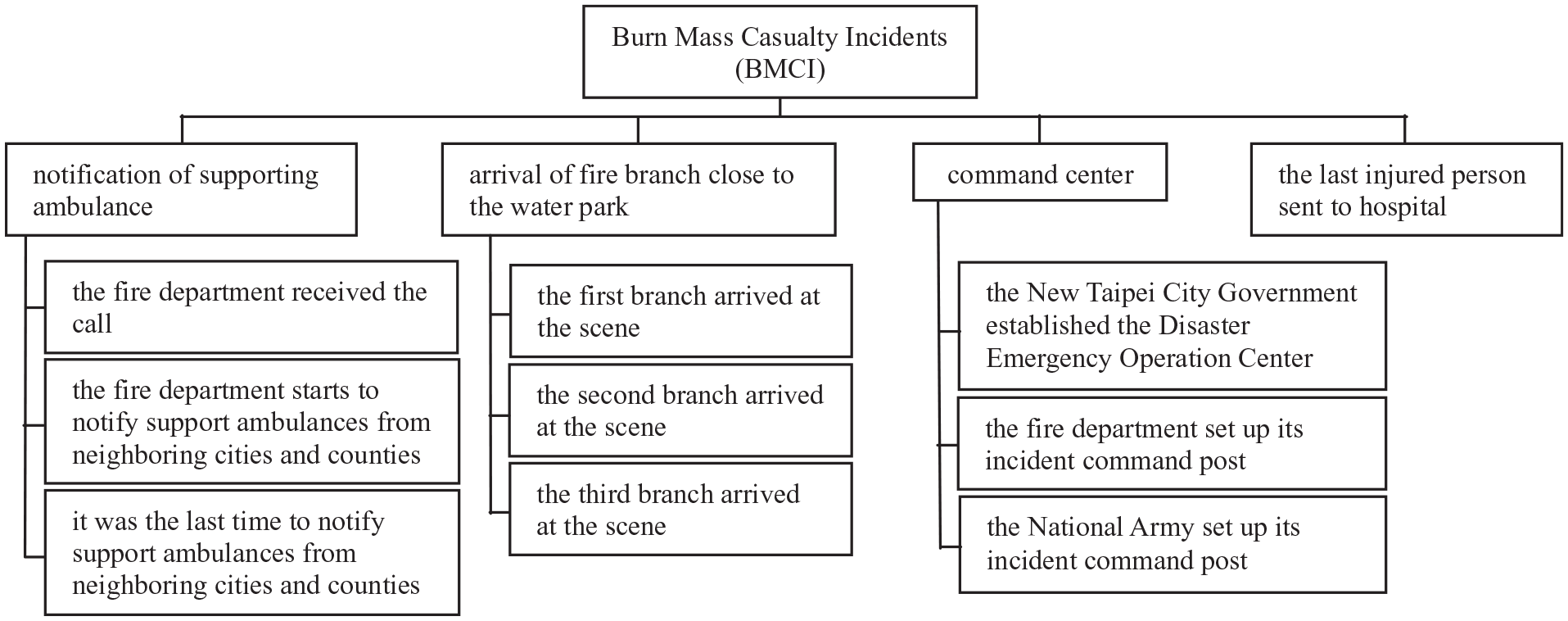
Work breakdown structure of BMCI.

Arrow diagram of the rescue process of the water park.
After the fire department (Emergency Dispatch Center) received a large number of incoming report calls (20:30) and concluded that there was a BMCI which could not be supported by insufficient local resources, the support ambulances from neighboring cities and counties would be notified to carry out rescues (Activity A, 20:37).
In the major cities (ie, Taipei City, New Taipei City, Taoyuan City, Taichung City, Tainan City and Kaohsiung City) in Taiwan, the average response time of the ambulances in fire departments is generally less than 5 min.14,15 However, this incident took place in the suburbs, and the time of arrival was related to the distance between the fire branch location and the disaster site and the traffic condition. As a result, During Activity B, C, and D, the neighboring fire branches arrived the water park at 20:42, 20:48, and 20:56, respectively, and the fastest fire branch took 12 min to arrive at the site.
While the fire branch under the jurisdiction of New Taipei City government arrived at the site and reported the disaster scene, the Disaster Emergency Operation Center was established within 30 min (Activity E, 21:00). Then the personnel of the fire, health and other departments of the local government was sent to the center for operation.
Next, an incident command post, which is located around the disaster area, was set up by the fire department to lead the local government to coordinate and dispatch the rescue teams (Activity F, 21:05), and the Commander of the jurisdiction would take advantage of the nice location to update the accident information and work effectively at the disaster site. However, the workforce from the fire department of the local government is not sufficient enough to carry out rescues for those who suffered from severe large-scale burns and scalds. For example, a large number of porters were needed to carry the injured to the ambulances (or buses). Thus, after the emergency message was received, the National Army also set up its incident command post (Activity G, 22:30). To deal with patients, the National Army would pack all the necessary gear and dispatch 219 people, including medics, ambulances, and trucks to the accident scene.
Last but not least, Activity H was the last time to notify support ambulances from neighboring cities and counties (23:05); Activity I was the time that the last injured person was sent to hospital (23:58).
Identify the Predecessors
Mandatory dependencies refer to the fact that the logical relationship between the predecessors and the successors operations cannot be changed
When a local government has verified that there is indeed a disaster and the Disaster Emergency Operation Center is established, relevant units rush to the spot, the functional grouping is launched, and the incident command post is set up according to the disaster situation, so the sequential order of Activity B, E and F cannot be changed. Activity B is the preceding operation of Activity E, and Activity E is the preceding operation of Activity F.
There are still injured persons on the spot waiting for ambulances to send them to hospitals, so Activity H is the preceding operation of Activity I.
Discretionary dependencies refer to the fact that the logical relationship between the predecessors and the successors operations is selective
The application for ambulance support from the neighboring cities and counties needs to be taken into consideration based on the scale of the disaster and the number of casualties, but the arrivals of nearby fire branches at the spot are not mandatorily in advance, so the sequential order of Activity A and B is selective.
After the local government establishes the Disaster Emergency Operation Center, it can provide relevant resources to the incident command post. However, the participation of the National Army in the disaster response work of the local government plays the role of assistance, so the sequential order of Activity F and G is selective.
Review the relevance of each activity, list the logical relationship between the predecessors and the successors operations (as show in Table 1).
The Logical Relationship of the Activities.

Drawing an Arrow Diagram
This research collated the time course for the BMCI of the dust explosion at the New Taipei water park based on definitions of various activities, and created an arrow diagram as shown in Figure 2.
Strategic Analysis
We implement priority management based on Activity G which used the longest time, from Figure 2. According to the various methods to shorten the working schedule proposed by PMBOK Guide, 16 we adopted 3 coping strategies namely reduction of activities, adjustment the logical relationship of activities and adjustment of the resource used, so as to achieve a prehospital management that strikes a balance between efficiency and quality.
Reduction of Activities
This refers to reducing or replacing the activities, making adjustments to only parts of the activities. Figure 2 showed that after the notification of supporting ambulances from neighboring cities and counties, it started from Activity A (20:37) to H (23:05), with an interval of 148 min. This suggested that there should be an optimizing measure, called crashing of time-course, by reducing the number of nearby ambulance notification request in order to shorten the interval time between Activity A and Activity H.
After we investigated the time that 144 ambulances arrived at the scene, it was learned from Figure 3. Most of the ambulances from the New Taipei City Fire Department arrived at the scene in 0.5 h or 2.5 to 3.5 h after the incident. The ambulances from neighboring counties and other related units continuously arrived at the scene beyond 0.5 h after the incident and the arrival time was concentrated at 1.5 to 2.5 h, which exceeded the average time of 1 h for journey time.

The situation when ambulances arrive at the scene.
It was found from this case that when the fire department faced a large number of injured people (499) for the first time, too much time was spent in applying for support in the form of ambulances from the neighboring cities and counties. In this case, the supply of ambulance vehicles seems always unable to meet the on-site necessity of sending the injured for medical treatment. In accordance with the statistics, 142 of the 144 ambulance (98.61%) that were from Taipei City, Taoyuan City, Keelung City and New Taipei City and it takes an average time of 1 h for the ambulance to travel from the station to the site of the dust explosion (assuming there was a good traffic). However, taking into account their own needs of their ambulance, the neighboring cities and counties were unable to dispatch more ambulance immediately. As a result, in order to prevent delay in ambulance dispatch due to the decision-making process, it is important to coordinate with neighboring cities and counties on the cross-city supporting mobilizable rescue resources on a normal basis. This will allow the cities to have a good estimate of the available rescue resources data. When there are incidents where the number of casualties exceeding the local government’s ambulance capability, the city can require supports from neighboring cities and counties immediately and eliminate the application process for such ambulance support. Besides, if the ambulances in the nearby cities can arrive in 1 h, the Activity H in Figure 2 can be removed.
Adjustment of Resources Used
It refers to directly increase the total amount of resources to catch up with the progress of work. That is, increasing the total amount of resources used by directly inputting casualty relief resources while rescuing the casualty. If the resources were invested separately, the progress would be delayed and lead to low efficiency results.
After each local governmental unit had stationed in the Disaster Emergency Operation Center, they should consolidate all the private and public resources, concentrate resources and coordinate the distribution to accelerate the allocation of resources and allow for a large increase in casualty relief resources within a short period. After the Disaster Emergency Operation Center has been established, it can provide the incident command post with sufficient relief and dispatch rescue human resources. The post can immediately deploy more nursing professionals, ambulances and first aid equipment to the site of the dust explosion, ensuring that there are enough resources and manpower as requested at the site.
A total of 1504 people participated in the disaster relief this time and the National Army dispatched 219 people (14.56%) to help out at the first instance. However, setting up an incident command post took 85 min more than that of the fire department.
According to the relevant literature collected, the number of manpower and vehicles dispatched by New Taipei City Fire Department mainly arrived at the spot within 1 h after the occurrence of the case; the cumulative growth range after 1 h was not big. Therefore, to strengthen the on-site rescue effectiveness, the total amount of resources needs to be input directly within 1 h to achieve the maximum effectiveness.
Adjusting the Logical Relationship of the Activities
This means that when the progress of certain activities was behind the schedule, some activities need to be performed simultaneously instead of in order, adjusting from the sequence to the parallel relationship. This is also known as fast tracking, since Activity G and Activity F were conducted simultaneously, rather than performing Activity G after performing Activity F. The Activity G and the Activity F were adjusted from the subsequent to the parallel work relationship.
From Figure 2, except for Activity G, the logical relationship between the predecessors and its successors cannot be changed, such as receiving the call, notifying the support of ambulance, the first branch arriving at the scene, establishing Disaster Emergency Operation Center, setting up incident command post, sending the last injured to hospital. There is a Mandatory Dependency between the predecessors and the successors, and the Successor starts after its corresponding predecessor is completed. Activity F is the predecessor of Activity G, but their logical relationship is not mandatory dependent. The National Army only plays an assistant role in the task of emergency response, which does not belong to the original mechanism that the local government should responds. Therefore, following the establishment of the Disaster Emergency Operation Center, the National Army has to set up the incident command post with the fire department together, or the National Army “crashes” the duration of the setting up the incident command post. The National Army will respond earlier, and, correspondingly, the resources increase.
In summary, if we can survey a number of the ambulance (for reducing the activities) and establish National Army rescue and disaster relief resource support mechanism (adjusting the resources used), we can adjust the logical relationship of the activities, allowing Activity G, the time for setting up incident command post by the National Army, and Activity F, the time for setting up incident command post by the fire department, shown in Figure 2, to be adjusted from the subsequent to the parallel work relationship. Therefore, after the establishment of the Disaster Emergency Operation Center, when the National Army is notified to assist in the disaster relief, if the National Army can set up the incident command post within 30 min after the establishment of the Disaster Emergency Operation Center (ie, within 1 h after the occurrence of the case), it is estimated that the last injured person can be sent to the hospital 1 h earlier (23:58→22:53) (as shown in Figure 4). The input of more rescue professionals in the same period of time for disaster relief can shorten the time it takes to complete the work.

Simulation of revised arrow diagram of the rescue process.
This allows more ambulance professional resources to be poured into the disaster relief work, shortening the time required for completion of rescue work. As the National Army can reach the site more rapidly with mobilizing professional emergency medical technician paramedic, ambulance and so on equipment under the support of National Army medical and hospital system for assisting acceptance of casualty relief, the efficiency of the private organizations is scarcely comparable to that of it. As a result, such adjustments of logical relationship of activity and resources used will definitely improve the relief efficiency on-site and reduce largely the processing time required for rescuing catastrophic injuries.
Discussion
This study found that Activity G was the most time-consuming according to the arrow diagram, so it was listed as the key time-course management item, and a crashing of time-course and fast tracking method should be adopted to shorten the rescue time. In addition, through the strategic analysis, it was found that the critical time point for adjusting the resource input is within 1 h after the occurrence of the case, so the relationship between Activity G and Activity F was adjusted from the predecessors and the successors operation relationship to the parallel work relationship. It is estimated that, due to the adjustment of the resource input, the completion can occur 1 h earlier, effectively reducing the time for on-site treatment of major injuries in a BMCI.
However, in the light of this case, the local government should consider the establishment of BMCI dispatching mechanism. Those with the highest dispatching level should include the establishment of the disaster emergency operation center, incident command post and external aid units, and it is most important to input professional rescue manpower and transportation means according to the disaster scale, especially the superior transportation capacity. 17 Therefore, at ordinary times, the fire department should investigate the number of ambulance vehicles that can be dispatched by fire departments of neighboring cities and counties in the early stage, while the health bureau should integrate the private ambulance resources, update and provide the number of ambulance vehicles regularly to the emergency dispatch command center of the fire department for file management.
For the transfer part, hospital capacity and ability should be taken into account, the injured should be properly diverted, the seriously injured should be sent by ambulances to burning and scalding wards for special treatment, and persons with minor injuries can be taken by buses and other means of transportation to more distant hospitals for treatment, so as to avoid excessive concentration in any 1 hospital.18,19 In order to speed up the on-site transfer capacity, the Central Government suggests that the Ministry of Health and Welfare and the National Fire Agency should consider planning the transfer information platform so that on-site rescue personnel can inquire about locations of acceptable hospitals and best routes by entering burns and scalds information, and hospitals can also receive such information and make preparations.
BMCI should be addressed as a special case, and professional personnel can address BMCI in a shorter time than non-professional ones can. Assuring a sufficient manpower can reduce the rescuer fatigue for long-lasting rescue.20-22 When a similar incident like BMCI happens again, it is necessary for the government to mobilize the maximum number of ambulances in order to reduce the effects of delayed mobilization of ambulances in the early stage. Therefore, this optimal dispatch procedure should be incorporated into a standard operating procedure, and obviously it is 1 correct BMCI dispatch mode.
Limitations
BMCI may involve issues of triage, traffic routes of disaster relief vehicles, selection of hospitals to be sent, etc., which all affect time schedule management. However, the 499 injured persons in this case were all patients with burns and scalds, so higher attention had to be paid to the cleaning of skin wounds to avoid secondary damage, such as infection. Thus the injured persons had to be sent to hospitals for medical treatment as soon as possible, and could not stay on the site for too long. Therefore, the key to shortening the time schedule management in this case study mainly focuses on the input of professional manpower and means of transportation.
Conclusion
This study clearly shows the interrelations of every activity through the arrow diagram. Priority management is carried for the most time-consuming activity on the path and the 3 factors, including reduction of activities, adjustments of logical relationship of activity and resources used, play important roles in matching working timetable. In this way, the critical time point of the most time-consuming activity, that is, the first hour after the occurrence of the accident, can be identified, and direct deployment of available rescue manpower and means of transportation can be made within that period of time, that is, the total amount of resource use is increased. In the future, both efficiency (1 h or less to maximize the benefit of available resources) and quality of care (surveying nearby medical resources; and offering timely, safe, and effective emergency medical services) should be considered in BMCI prehospital scheduling management, and arrow diagram will be created from retrieving the rescue records. These reliable strategies determine the best emergency response.
Footnotes
Declaration of Conflicting Interests
The author(s) declared no potential conflicts of interest with respect to the research, authorship, and/or publication of this article.
Funding
The author(s) received no financial support for the research, authorship, and/or publication of this article.
