




Abstract
The purpose of this study is to assess the health-promoting lifestyle behaviors of nursing students at Arab American University Palestine, Palestine. A cross-sectional design was used, 350 participants filled the Health Promoting Lifestyle Profile II. The total HPLP score was 138.57 ± 22. Spiritual growth had the highest mean and physical activity had the lowest subscale. A significant relationship between the age of students and the sub-scales of stress management as well as physical activity. However, gender and spiritual growth subscale differed significantly. Also, there was a significant difference between students’ year level and physical activity. University administrators and staff should provide guidance to progress with more actual strategies to improve nursing students’ health-promoting behaviors.
Health-promoting behaviors are at a moderate level among medical students.
Spiritual growth had the highest mean and physical activity had the lowest subscale. A significant relationship between the age of students and the sub-scales of stress management as well as physical activity.
The results of this study will help university administrators and nursing curriculum planners in designing, targeting, and implementing health-promoting programs to increase awareness in this population.
Introduction
University studying period is considered as exposing students to health-related problems. They have to cope with “leaving home, increased independence, changes in peer groups, new social situations, maintenance of academic responsibilities and increased access to alcohol or drugs.” 1 They are also exposed to smoking as the environment has a negative effect on their physical and mental health.2,3 Health-promoting lifestyle has 6 dimensions of spiritual growth, health responsibility, interpersonal relationships, stress management, physical activity, and nutrition. 4 Health promotion empowers people to manage contributing factors to their health and, when appropriate, to change their lifestyle to improve or maintain their health. 5
Nursing students are future health care providers, and they will play a key role in both modeling lifestyle and teaching healthy choices to clients. 6 Therefore, health promotion and maintenance among students of nursing are important for them individually and professionally. 7
In a study conducted in China, few students had a desirable healthy lifestyle. 8 Several studies in different counties such as Malaysia, Hong Kong, Iran, Jordan, and Turkey indicated a moderate level of lifestyle among medical students.9-17 Lifestyle, marital status, gender,13,16,17 parental education, educational level, family economic status, general health, and smoking may all affect a healthy lifestyle. 17
Since life at university is a transitional stage when students leave home and become independent some factors such as having a tight schedule, being away from family, skipping meals, using fast foods, dieting, as well as the type and amount of physical activity, may affect the students’ lifestyles. It is very important to establish health promotion among college-age students because it is relatively easier to change behavioral patterns during early adulthood. Thus, an effort to improve health promoting behaviors among college students is necessary. Despite the importance of this issue, few studies have explored the Health-Promoting Lifestyle Profile (HPLP) among nursing students, and literature from the Arab region for this particular group is even scarcer. There are limited data on health-promoting lifestyles among Palestinian university students. Therefore, the aim of this study was to assess the health-promoting lifestyle behaviors of nursing students at Arab American University, Palestine. The results of this study will help university administrators and nursing curriculum planners in designing, targeting, and implementing health-promoting programs to increase awareness in this population.
Research Question
What is the level of health promotion behaviors among nursing students at Arab American University?
Methods
Study Design, Setting, and Participants
A cross sectional, correlational design was used in this study. The study sample was a convenience sample of nursing students recruited from Arab American University Palestine University Palestine. The G*power version 3.0.10 used to estimate necessary sample size. Using a calculated medium effect size of 0.25 based on nursing research for One way ANOVA test to determine the differences between means of the groups, an alpha of 0.05, and power of 0.8 which is recommended based on the assumption of an expected difference resulted in a sample of 180 participants. To overcome the attrition rate and who refuse to participate, the final sample was 400 participants. The inclusion criterion for participation in the study was nursing student enrolled in the spring semester, 2018, and studied at Arab American University, Palestine
Data Collection
Two instruments were used to obtain the data needed from participants: (a) A demographic characteristics questionnaire including age, gender, Grade Point Average (GPA), and academic year that was developed by the researchers specifically for this study; and (b) the Health Promoting Lifestyle Profile II (HPLP II), 4 which measures the health-promoting behaviors of nursing students. It includes 52 items and it contains 6 sub-scales: health responsibility (9 items), nutrition (9 items), physical activity (8 items), stress management (8 items), interpersonal relations (9 items), and spiritual growth (9 items). The scale measures health-promoting behaviors ranging from never to routinely on a four-point Likert scale. By calculating the mean of the individual’s responses to all fifty-two items, a score for overall health-promoting behaviors is achieved. Similarly, the 6 subscale scores are obtained by calculating an average of the sub-scale item responses. The total HPLP II score is further classified into 3 levels: poor for the range 52 to 90, moderate for the range 91 to 139, good for the range 140 to 168, and excellent for the range 169 to 208. 4
The questionnaire was given in its original English language format to students as the learning nursing is in English language. The validity of this scale has been approved in some studies. 4 The overall scale of the original version of the HPLP II reported a Cronbach’s alpha of 0.94, and for the 6 subscales, it ranged from 0.79 to 0.87. 4 Cronbach’s α was 0.88 for total scale, and Cronbach’s α for subscales were varied from 0.80 to 0.86 in the current study, thus demonstrating high reliability.
Data collection process was started in February, 2018 and finished in July 2018. Approval was obtained from the faculty of nursing at AAUP prior to data collection. The researchers presented the students with the purpose of the study and obtained consent from each student for participation in the study. Students were informed that they were free to withdraw from the study at any time. Of the 400 participants, the questionnaires were completed by 350 participants, 88% response rate.
Data Analysis
As completed questionnaires were received, they were coded for analysis. Data were analyzed using version 23 of the Social Science Statistical Package (SPSS). We obtained a composite score for HPLP II and individual sub-scale scores as well as descriptive statistics (percentage, mean, standard deviation, minimum, and maximum). The data analyzed with Pearson’s correlation, t and analysis of variance (ANOVA) and considered the findings significant if the P value was <.05.
Results
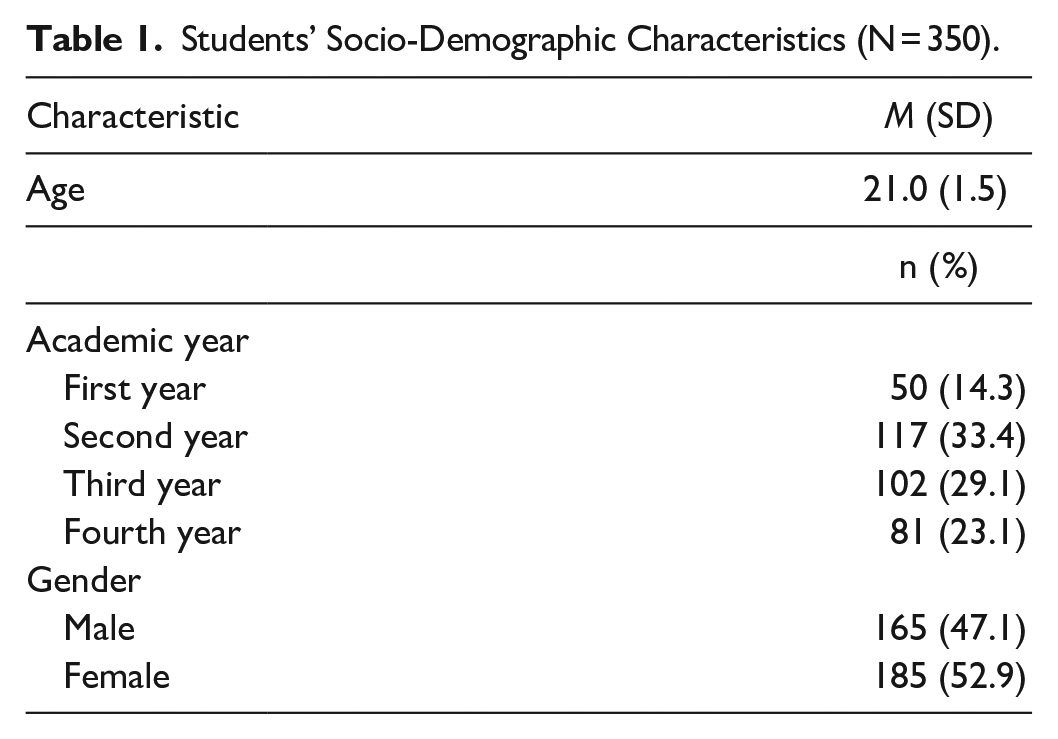
The mean of the participants’ age was 21.0 ± 1.5. The largest percentage of respondents was second year students, 117 (33.4%). Slightly more than half of the respondents were female 185 (52.9%) as shown in Table 1.
Students’ Socio-Demographic Characteristics (N = 350).
Total HPLP II mean was 138.57 ± 22.44 (range from 58 to 196). The highest mean for spiritual growth in the subscales was (26.13 ± 4.61), but the lowest for physical activity was (19.97 ± 5.34). Table 2 shows the mean item score for each subscale.
Nursing Students HPLP II Total and Subscales’ Mean Scores (N = 350).

HPLP = health promotion life-style profile; M = mean; SD = standard deviation; min = minimum; max = maximum.
To determine whether there is a difference in nursing students’ health-promoting behaviors based on socio-demographic characteristics, the results in Table 3 showed that there was no statistically significant difference between the total HPLP II score mean and the gender. However, the average score of female students was higher in spiritual growth subscales than the average score of male students, and this difference was statistically significant. Based on that, it needs further studies to investigate and clear the causes of that. At the same time, the average student score for the second year was higher than for other students of the sub-scale physical activity and this difference were statistically significant.
Associations and Differences of HPLP II Mean Scores with Demographic Variables (N = 350).

In the same flow, Pearson’s correlation results showed a statistically significant negative correlation between students’ age and stress management and physical activity sub-scales.
Discussions
The total HPLP score was 138.57 ± 22. Spiritual growth had the highest mean and physical activity had the lowest subscale. A significant relationship between the age of students and the sub-scales of stress management as well as physical activity. However, gender and spiritual growth subscale differed significantly. Also, there was a significant difference between students’ year level and physical activity.
The results of the study revealed that the mean score for HPLP II among nursing students was 138.57 ± 22.4. This indicated that students had a moderate level of health promotion. In previous studies, consistent results have been reported.9-17 This may related to loss of control on their time due to training shifts who is training sometimes in the morning and otherwise in the evening.
In this study, the participants obtained fairly higher scores for spiritual growth (26.13 ± 4.61), and this result was consistent with previous studies.16,18,19
On the other hand, several studies indicated that the health responsibility, stress management, nutrition, and self-actualization scores for nursing students were higher than spiritual growth.8,20-22
The current study reported that physical activity subscale scores was the lowest one (19.97 ± 5.33) and this result was similar to the results of previous studies.16,18,19 This result might be clarified from the social and cultural context as regular exercise behaviors are still not to some extent incorporated regularly into the daily life as leisure activities. Furthermore, it is not easy to access community sports centers that require sports fees. Another explanation might be that our student nurses have theoretical and clinical training so that they may feel tired from exercising. These findings are similar to Karadağ and Yildirim’s 21 study and to previous studies conducted in different countries have also confirmed similar findings.7,23,24
There was no statistically significant relationship between age and the overall HPLP II score. Indeed, only a statistically significant negative correlation existed between the student age and the interpersonal relationship sub-scale. Likewise, younger nurses revealed significant differences in physical activity, stress management, and health responsibility. 22 On the other hand, older students reported higher levels of overall lifestyles promoting health than younger students through other studies.25,26 There was no correlation, however, between the age of the university students and the total score of HPLP II. 27 These contradictory results of studies in this regard may require more research.
In the overall score of HPLP II, there was no statistically significant difference between genders. Stress management and health responsibility subscales average scores among male student were higher than female students, however, and this difference was statistically significant. This can be clarifies those female student tasks and taking care of brothers and sisters in order to prepare them to fit with future role as they become wives and mothers. This, in sequence, can make female students exhausted and worried, and hasn’t time and vitality to care for their health. Also, according to study results in Hacıhasanoğlu et al, 25 and Wei et al, 27 the average physical activity score in both studies was higher for male students than for female students, and this difference was significant. While another study conducted in Jordan did not show significant differences in physical activity and nutritional habits and gender between university students. 28 In contrast, the average score of female students was higher than that of male students in the sub-scales of self-actualization, health responsibility, interpersonal relationships, nutritional, and stress management in other studies.22,23,25,29,30
Conclusion
This study illustrates the accumulative influence of many variables that contribute to health-promoting behaviors of nursing students. The study provides guidance to university administrators and staff to develop more effective methods to enhance the health-promoting behaviors of nursing students.
Footnotes
Acknowledgements
The authors in this study would like to extend her appreciation to the study participants for their time.
Recommendations
Further studies should be conducted in both similar and diverse settings at regular intervals to identify needs, use feasible interventions, and evaluate proceedings.
Declaration of Conflicting Interests
The author(s) declared no potential conflicts of interest with respect to the research, authorship, and/or publication of this article.
Funding
The author(s) received no financial support for the research, authorship, and/or publication of this article.
