




Abstract
This paper discussed the influence of disability and the degree of disability on the intergenerational needs of the elderly in terms of time and economy. The data is from the CLHLS in 2018. And the study discussed from 3 dimensions: nursing time, economic support, and medical cost support provided by children. The results showed that disability had a significant impact on the care time and medical expenses provided by adult children (care time: β = 45.631, P < .001; medical expenses: β = 2017.664, P < .01). Compared with the elderly with low degree of disability, the economic intergenerational care needs of the elderly with severe disability increased significantly (β = 2108.078, P < .01). The results of sub sample regression show that the intergenerational care needs of the elderly in China are restricted by objective factors and have not been met. These findings revealed the current situation of intergenerational support for the disabled in China, and emphasized that the government should establish and improve the social formal care, gradually reduce the burden of care for children with disabled elderly families, and improve the quality of life of the disabled elderly.
Most studies based on the perspective of adult children to explore the burden of elderly disability on children, and did not reach an agreement.
This study further understands the current situation of intergenerational care needs among the disabled elderly in China, and discusses the financial needs of the disabled elderly.
Targeted policies and measures, including rehabilitation nursing system, promoting the construction of long-term care insurance system and community nursing are urgently required. So that the life quality of the disabled elderly can be improved, the care responsibility of their children can be moderately Shared, and the labor value of labor can be released.
Introduction
With the improvement of medical level and the adjustment of fertility policies, China has become the country with the largest elderly population in the world. 1 A prediction study on China’s population showed that China’s elderly population is growing,2,3 and the growth rate of the population is faster than that of other countries. 2 In 2019, there are 175.99 million elderly people over 65 years old in China, and the population aging rate is as high as 12.57%. 4 It is estimated that by 2030, the elderly population in China will reach 371 million, accounting for 25.3% of the total population. 5 The elderly are at high risk of disability and dementia. The disability rate of the elderly in China is between 10.48% and 13.31%. 6 With the deepening of population aging, the long-term care expenditure in many countries has increased significantly. 7 Internationally, 80% of caregivers care for their relatives, and family members are generally the main caregivers. 8 Influenced by the traditional culture of filial piety and the view of providing for the aged in China, family care is the most important and common way of care for the elderly in China,9-12 The data analysis of the one-time sampling survey of China’s urban and rural elderly population shows that 38% of the elderly get financial support from their children in cities, while 64.3% in rural areas. At present, China’s long-term care system is still in the exploratory stage. And there are not enough nursing facilities in China. More than 90% of the disabled elderly mainly rely on their families for informal care, with few forms of social care. 13 Therefore, we can use the time and financial support that the elderly actually get from their adult children to measure their intergenerational care needs. It is of great significance for the elderly and their children to explore the influence of disabled elderly on their intergenerational care needs.
Many studies have discussed the influence of adult children on the care of the elderly from the perspective of caregivers, but few studies have explored the care needs of the elderly from the perspective of the elderly. Some studies have pointed out that children’s care for the elderly mainly includes time care and financial supports.14-16 Time care mainly includes sharing housework with parents, daily life care, daily communication, and psychological comfort. Financial supports mainly refer to the help provided by children in the form of in-kind or cash for their parents’ daily life, nutrition, and health needs. 17 It was found that there is a negative correlation between children’s financial support to parents and their monthly care time, and there is a similar substitution relationship between siblings’ financial and time care for parents. A few studies discussed the relationship between financial supports and the health of the elderly from the dimension of economic intergenerational support or temporal intergenerational support. Financial supports has a positive impact on the health of the elderly, 18 but the impact varies with the income level of the elderly. It has the greatest impact on the middle-income elderly, while has the least impact on the low-income elderly. 19 In terms of time care, some scholars believed that informal care can significantly reduce the degree of depression and improve the life satisfaction of the disabled elderly. 20 However, others believed that family care generally reduces the well-being of the disabled elderly, puts physical and mental pressure to the elderly, and increases their sense of guilt. 21 Many scholars believe that economic intergenerational support and time intergenerational support will interact with each other and have certain endogeneity, which should be considered comprehensively. There is a negative correlation between children’s financial support to parents and their monthly care time.17,22 There is a similar substitution relationship between siblings’ financial and time care for parents. 23 Therefore, this study would comprehensively consider the 2 aspects and analyze the impact of intergenerational support on the elderly from the perspective of intergenerational support.
In the context of global aging, when the care needs of the elderly cannot be met, their quality of life will be greatly affected, leading to psychological problems, and increasing the utilization of medical services.24-26 It is necessary to understand the intergenerational care needs of the elderly and analyze the influence between intergenerational care needs and disability of the elderly. This study aimed to (1) describe the intergenerational care needs of the elderly over 65 in China; (2) explore the impact of disability on the needs of time care and financial support of the elderly; (3) study the differences in the care needs of urban and rural elderly due to the impact of disability, in the case of uneven distribution of medical resources and care resources; (4) explore how does disability affect the time care needs and economic care needs of the elderly, for those with different family economic status. From the perspective of the disabled elderly, this study roughly judges whether the care needs of the disabled elderly are met by investigating the current informal care needs of the disabled elderly in China, and proposes corresponding policy recommendations to better provide long-term care services for the disabled elderly.
Materials and Methods
Data Source
The data used in this study are obtained from the cross-sectional data of Chinese Longitudinal Health Longevity Survey (CLHLS) in 2018. The project is organized by the center for aging health and family research, Peking University. More than half of the counties and cities in 22 provinces (except Hainan Province) are covered. The survey started in 1998. And the 2018 survey included 15 874 elderly people over 65 years. The survey collected information including the economic status, health status, self-care ability, life care, and medical service level of the elderly. This study is to explore the care needs of the disabled elderly. Based on study design, we removed the individuals who have not answered the disability related questions or whose answers are not clear. Finally, this study obtained 15 855 observations, including 8761 urban elderly and 7094 rural elderly.
Variables
Care needs of the disabled elderly
This study explored the nursing needs of the elderly from 2 aspects: the financial needs and the time care needs. In the research sample, 51.14% of the samples mainly rely on their families, 33.37% rely on their own income, and only 15.48% of the elderly rely on the government or other means. Financial needs refers to the economic support that the elderly got from their younger generation. This variable is the sum of cash (or physical equivalents) given by the elderly’s son, daughter, and grandchildren in the questionnaire (including their spouses and all grandchildren living in the same or different places). Time care is based on the total number of hours of daily care provided by the elderly’s children, grandchildren in the past week.
Disability and Severity of disability
There are 6 questions in the daily activity ability section of CLHLS. They are whether you need help taking a bath, whether you need help changing clothes, whether you need help going to the toilet, whether you need help with indoor activities, whether you need to control your bowel and urine, and whether you need help eating. These 6 questions can be called basic daily activity ability (BADL), which is one of the most commonly used criteria to measure the ability of daily activities, 27 And the definition of disability levels of the elderly followed the classification in the project of China Research Center on aging. The degree of disability of the sample is divided based on the questions of the daily activity ability (ADL) in the questionnaire. Disabled states were defined as disability if the participant was unable to perform any 1 of 6 ADL items without help. If the participant do not have such problems, they will be considered as not disabled. Further, disabled states were defined as severe disability if the participant was unable to perform 5 or more of 6 ADL items without help; moderate disability if they could not perform 3 to 4 ADL items by their own; mild disability if they could not perform 1 to 2 ADL items by their own. 6
Covariates
In order to control other factors that may affect the elderly care needs, this study added other 4 types of covariates to be confounders in the model. The first type states social demographic characteristics of individuals, including age, gender, marriage, and education level. The second category describes the socioeconomic status measured with whether there is endowment insurance, medical insurance. The third type of covariates describes health related behaviors including smoking, drinking, exercise, and regular physical examination. In addition, when exploring the economic care needs of the elderly, the total household income was added as a covariate in the analysis. When exploring the needs of time care, we also added variables that will affect children’s time support for the elderly, including the number of people who live with them, and whether they are hospitalized.
Simultaneous Equations Model
Since the explanatory variables (ie, time care need and economic care need) are continuous variables, this study used the linear regression model to explore the impact of disability on the time care need and economic care need of the elderly. However, previous studies have shown that children’s time and money care for the elderly do not exist independently, and they are mutually causal. 22 Children need to work to provide financial support to their parents. When children’s working hours increase, they will reduce their care time for parents. Conversely, when the care time increases, it is difficult for children to provide more financial support to their parents. The care of the elderly in time and money is mutually causal, which leads to endogenous problems. If the endogenous problem was not well handled, it may lead to serious parameter estimation errors. Simultaneous equation model is a common method to deal with the endogenous problem of mutual causality and to analyze the net effect. 28 Therefore, this study used simultaneous equation model to establish equations for robustness test.


In the simultaneous equation,
Only when the system of simultaneous equations can be identified, can the solution of the equation be obtained. For any equation in the simultaneous equation model, the necessary condition for identification is


Where
Empirical Results
General Characteristics of Study Population
Overall, this study consisted of a total of 15 855 older adults, among whom 56.36% were males and 43.64% were females. Among these respondents, the mean age was 85.81 (SD = 11.68), and the general age of disabled older people was higher than the non-disabled elderly (P < .001). Illiteracy accounted for half (50.22%) of the study population, and the education level of the disabled elderly is lower than that of the non-disabled elderly. The marriage rate of the disabled elderly was 15.9%, with 47.8% in non-disabled elderly. The proportions of individuals participating in endowment insurance and medical insurance were 35.00% and 88.32% respectively. Most individuals did not smoke (85.23%), drink (85.87%). Of the 15 855 participants, 349 respondents did not answer the question, 4638 respondents (29.91%) have the habit of exercising. 10 557 respondents (67.39%) had regular physical examination, with 349 respondents did not answer the question.
As shown in Table 1, all subjects were divided into 2 groups: 11 678 (73.65%) were disabled and 4177 (26.35%) were non-disabled. It is found that the time needs of the disabled elderly are about 5 times that of the non-disabled elderly (63.337 vs 12.084). The financial needs of the disabled elderly are slightly higher than those of the disabled elderly (6453.913 vs 5354.49). The average demand for medical expenses of the disabled elderly is 1000 yuan (USD 105.1; CNY 6.62 per USD) higher than that of the disabled elderly (4739.234 vs 3662.447).
Characteristics of the study population.

Note. *** and * represent significant differences at 1%, 5% and 10% levels, respectively.
Intergenerational Support Needs of Disabled Elderly
In order to analyze the care needs of the elderly, this paper uses linear regression equation to explore whether disability and the severity of disability affect the care needs and economic needs of the elderly. As shown in Table 2, disability has a significant positive impact on the time needs of the elderly (P < .001), but has no significant impact on the economic needs of the elderly (P = .108). With the degree of disability increasing, the need for time care gradually increases (P < .001). However, the economic needs of the elderly have a significant positive impact only in the case of severe disability (P < .001).
Multiple linear regression model testing the association between disable and intergenerational support needs.
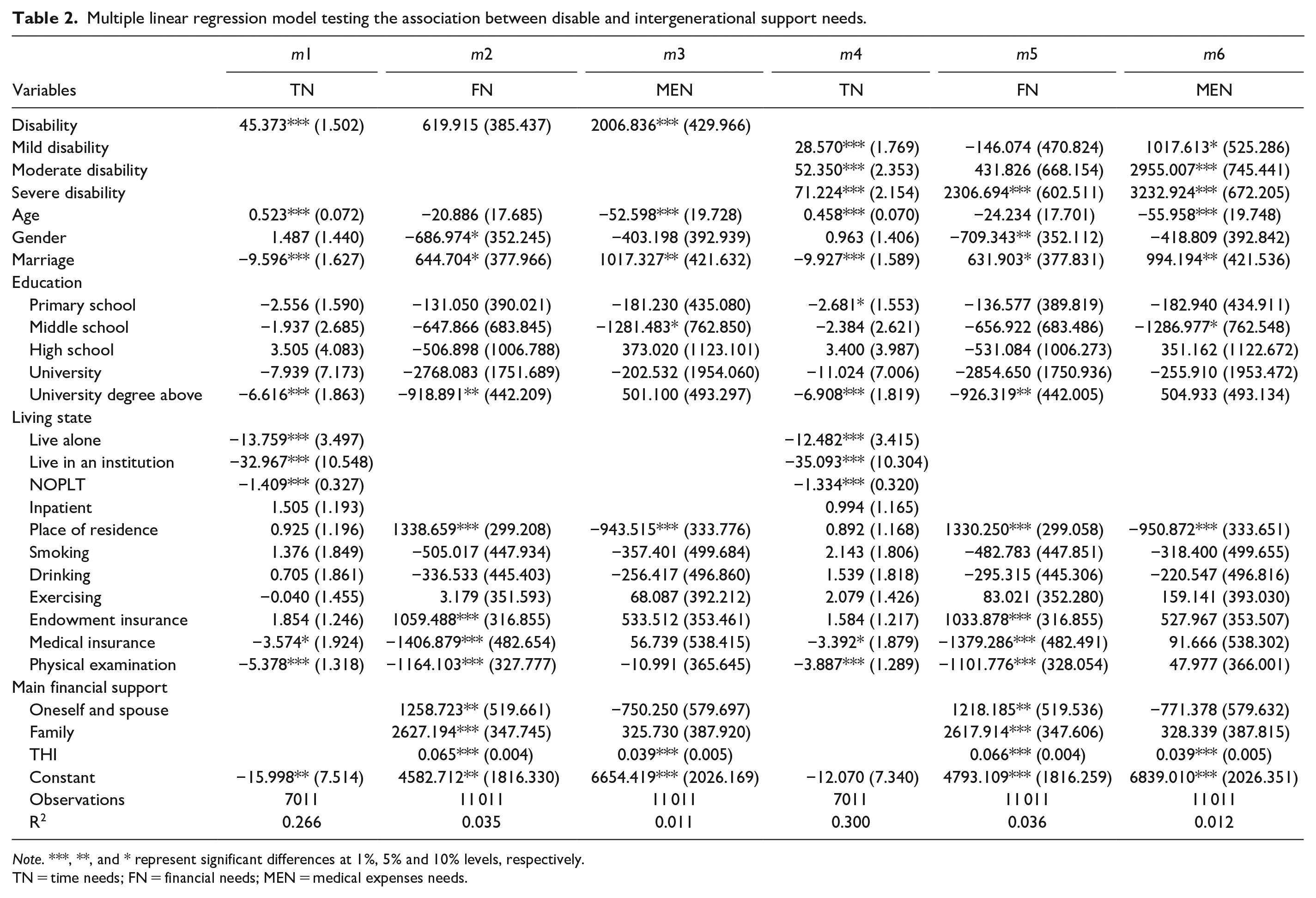
Note. ***, **, and * represent significant differences at 1%, 5% and 10% levels, respectively.
TN = time needs; FN = financial needs; MEN = medical expenses needs.
The Robust Check of Results
Considering that there may be mutual causality between the time care needs and economic care needs of the elderly, this study used simultaneous equations to test the robustness of the above empirical results, and further judged the impact of disability on the time care needs and economic care needs of the elderly. The regression results of simultaneous equations are completely consistent with the linear regression results, indicating that the endogeneity between the needs of time care and economic care of the elderly will not affect the estimated results (Table 3).
Simultaneous equations model testing the association between disable and intergenerational support needs.

Note. ***, **, and * represent significant differences at 1%, 5% and 10% levels, respectively.
TN = time needs; FN = financial needs; MEN = medical expenses needs.
Heterogeneous Effects
Because of the uneven distribution of medical resources between urban and rural areas in China. In order to further understand the impact of disability on the care needs of the elderly in different groups, this study analyzed the heterogeneity from 2 aspects, one is the difference between urban and rural areas, and the other is the difference in household income. Firstly, the samples were grouped according to the living area of the elderly. Results show that there is no difference in the influence of disability on the care time of the elderly in the urban and rural samples. There was no significant difference in the effect of disability severity on the elderly care time between the 2 groups. However, in terms of economic care, the urban elderly need more financial care from their families in case of severe disability (Table 4).
Urban and rural heterogeneity of disability to intergenerational support demand.

Note. ***, **, and * represent significant differences at 1%, 5% and 10% levels, respectively.
TN = time needs; FN = financial needs; MEN = medical expenses needs.
According to the family income, the samples were divided into 3 groups, namely, less than 10 000 yuan (USD 1051; CNY 6.62 per USD), between 10 000 and 100 000 yuan (USD 10510; CNY 6.62 per USD), and more than 100 000 yuan. The regression analysis was carried out using simultaneous equations. From the regression results (Table 5), it can be seen that the impact of disability on the time care needs of the elderly is inverted U-shaped with the family income. No matter what the family economic status is, the impact of disability on the economic care needs of the elderly is not significant. In terms of the impact of the severity of disability on the care needs of the elderly, the family with poor economic status has the greatest impact on the elderly’s time care need compared with the families with medium and high economic status. Under different household income level samples, the impact of different disability severity on the economic care needs of the elderly is the same, but high-income families have more subsidies for the elderly.
Family income heterogeneity of disability to intergenerational support demand.

Note. ***, **, and * represent significant differences at 1%, 5% and 10% levels, respectively.
TN = time needs; FN = financial needs; MEN = medical expenses needs.
Discussion
From the aspect of time care need and economic need, this study uses linear regression model to explore the impact of disability on intergenerational support needs of the elderly in China. Considering that there may be mutual causality between time care and financial support provided by children, this study uses simultaneous equation model to test the robustness and compares the heterogeneity between samples with different characteristics.
Consistent with the previous studies,9,10 the elderly in China prefer to be supported by their families. The results showed that disability will make the time care need of Chinese elderly from their adult children significantly positively change, while the impact on economic intergenerational support need is not obvious, which is inconsistent with the existing evidence. Probably because previous studies only discussed the financial burden of the disabled elderly, but did not take into account the time care factors. 29
In addition, to explore the reasons why disability has no significant impact on the financial needs of the elderly. The medical expenses demand of the elderly are constructed based on the outpatient expenses and hospitalization expenses paid by family members, 30 which were further used to judge whether the children’s financial support is used for health investment. It is found that disability has a significant positive impact on the medical expenses provided by the families (P < .001). And the more severe the disability is, the higher the medical expenses the families need to provide (P < .01) (Tables 2 and 3). Although older persons’ need for medical care have increased significantly, the overall intergenerational economic need does not change significantly after disability. A study on the burden of families with chronic diseases also draws a similar conclusion. 31 As the degree of disability deepens, the demand of the elderly for medical services is gradually increasing, 32 and medical expenditures have also increased. It indicated that the elderly’s living expenses are greatly reduced due to the inconvenience of activities. And the proportion of medical expenses in the total intergenerational economic support is increasing, which affects the total intergenerational economic support demand of the elderly. Therefore, when the disability is the most serious, there is a significant difference in demand for economic intergenerational support between the disabled elderly and non-disabled elderly.
In addition, some factors in the control variables also had a significant impact on the intergenerational support needs of the elderly (Table 3). The older the elderly, the more time care they need from their children. With the increase of age, the health stock of the elderly gradually deteriorates. And the health growth brought by health investment is gradually reduced. 33 Compared with the older elderly, the younger elderly are more willing to increase health investment, so they need more medical expenses provided by their children. Compared with the male elderly, the income status of female elderly is worse, there is no stable source of income, 34 and they need more support from their children. The older people with better education level have better income status and stronger self-care ability. They are easier to obtain high-quality information 35 and have less demand for intergenerational support of their children. Regular physical examination is helpful to improve the health level of the elderly. 36 Compared with the elderly who do not have regular physical examination, the need for intergenerational support of the elderly with regular physical examination is less.
This study found that the urban elderly have greater demand for medical expenses provided by their families, and with the increase of the severity of disability, the demand of the elderly is more obvious. This finding is basically consistent with the previous research conclusions. 37 The difference in medical level and economic level between urban and rural areas is the main reason for the difference in intergenerational demand of the disabled elderly. On the one hand, due to more abundant medical resources, higher level of medical institutions and more advanced medical equipment in cities, the cost of medical treatment for the elderly living in cities is higher. On the other hand, the opportunity cost of care for urban caregivers is higher than that in rural areas.
The demand for intergenerational care of the elderly is affected not only by the change of health status, but also by the supply of adult children. Previous studies did not discuss this issue in conjunction with supply and demand. The elderly with better family economic status have more demands for life and intergenerational support. On the other hand, the intergenerational care needs of the disabled elderly in China have not been fully released. A study on social long-term care of chronic diseases in China also believes that there is inequality in family economic conditions in long-term care system, 33 and social long-term care insurance should be more targeted at patients with lower social and economic. It is recommended that the government should constantly improve and develop social formal care from the social level, such as promoting the construction of long-term care insurance system and community nursing and rehabilitation nursing system. At the same time, targeted efforts should be made to improve the security of the disabled elderly for families with insufficient family care resources. With the help of social policies, the life quality of the disabled elderly can be improved, the care responsibility of their children can be moderately Shared, and the labor value of labor can be released.
There are some limitations in our analysis. Firstly, the use of cross-sectional data reflects the correlation between disability and intergenerational support needs of the elderly within a certain time range, but this effect may have a certain lag effect. Secondly, ADL is used as a unique dimension to measure the disabled state of the elderly, which may lead to an incomplete understanding of the problem. Thirdly, our study only focused on the aged in China. Similar studies among other populations should be considered in the future.
Conclusions
This study used the simultaneous equation model to study the influence of disability and the severity of disability on the intergenerational care needs of the elderly based on the data from latest issues of CLHLS in China. This is the first study to link the needs of care time and care economy to explore the impact of parental disability on their needs for children’s time and money care. Our results highlight that disability significantly increases the intergenerational care needs of the elderly, and as the disability deepens, the intergenerational care needs of the elderly also increase significantly. However, from the perspective of the elderly, subject to the economic status and time distribution of their children, their intergenerational care needs have not been fully met. Based on the results of the study, policy recommendations for care services for the disabled elderly are proposed. It can improve the level of care for the elderly disabled people and gradually reduce the burden of care for the disabled elderly family children.
Footnotes
Acknowledgements
The authors gratefully appreciate the support that CLHLS project team has provided.
Authors’ Contributions
GH and BL designed the study. LB led the data analysis and wrote the manuscript. LB and XXP participated in the data analysis. CN, GSY, LDC, and WD participated in the revision of the manuscript. All authors have read and approved the final manuscript.
Ethics Approval and Consent to Participate
Ethics approval for this study was not required because it was based on the publicly available data, CLHLS. The study subjects were not directly approached.
Declaration of Conflicting Interests
The author(s) declared no potential conflicts of interest with respect to the research, authorship, and/or publication of this article.
Funding
The author(s) received no financial support for the research, authorship, and/or publication of this article.
