




Abstract
Nursing skill education plays a very important part for the nursing education. It’s necessary to analyze the role of the case-based teaching (CBT) in nursing skill education, to provide insights into the nursing education. The sophomore nursing students who received nursing skill teaching from September 2019 to January 2020 were selected. The students either underwent traditional teaching (control group) or CBT (CBT group) intervention. The objective structure clinical examination (OSCE), autonomous learning ability, questionnaire for effects evaluation of CBT, and student’s satisfaction level on CBT were analyzed. A total of 146 participants were included. There were no significant differences in the gender, age and the final exam score as freshman between 2 groups (all P > .05). The OSCE scores and autonomous learning ability in CBT group were significantly higher than that of control group (all P < .05). The most students favored the use of CBT, and most students were satisfied with CBT. CBT is beneficial to improve the nursing skill and comprehensive ability of students, and it’s conducive to increase the interest of students, which merits application in nursing education.
Nursing skill education is a very important part of nursing education. The role of the case-based teaching (CBT) in nursing skill education remains unclear.
CBT is beneficial to improve the nursing skill and comprehensive ability of students. CBT is conducive to increase the interest of students.
Cases should be introduced for application in nursing skill education.
Background
Basic nursing course is the core course of nursing major, and it is one of the main courses to cultivate the core competence of nursing students. 1 Basic nursing course is a comprehensive subject in clinical nursing with coverage of a wide range of content. Previous studies2,3 have reported that students in nursing colleges have poor cultural foundations, unclear learning motivation, weak self-learning ability, and easy to waste the after-school time. At present, the mainstream 1-way teaching model of “teach-accept” is very common in the university. 4 It is difficult for teachers to understand that whether the review and consolidation have been carried out after class, so that teachers cannot teach according to student’s progress, and students reflect that it is difficult to learn and teachers feel difficult to teach. 5 Therefore, it is imperative to explore reasonable and effective nursing teaching.
Nursing skill teaching is an important part of basic nursing course. In the teaching course structure of basic nursing for undergraduate nursing students, the proportion of class hours accounts for 50% to 60%. 6 The traditional nursing skill teaching method is “demonstration-practice-guidance,” which focuses on nursing students to master the skill operation through imitation of the experimental process. 7 For this method, the students often lack in-depth thinking and joint discussion, and cannot combine clinical flexibly in practice. 8 The case-based teaching (CBT) is a mixed teaching method emphasizing case-based guidance, which is integrated with teaching objectives. 9 It’s been reported that CBT may have the advantage of emphasizing the enthusiasm of teaching, stimulating students’ interest in learning and improving students’ independent learning and interpersonal communication ability.10,11 However, currently there are still few reports about the application of CBT in nursing teaching, 12 and its application in nursing skills teaching needs further investigation. Furthermore, there are very few studies on the CBT use in nursing education in China. Therefore, we aimed to conduct this study to evaluate the role of CBT in nursing skill education, thereby providing reliable evidence to medical education.
Methods
This study was designed as a randomized controlled study without blind design. We aimed to conduct and reported this trial in comply with the guideline of Consolidated Standards of Reporting Trial (CONSORT). And since our study was a part of course reform in our university, and no potential harm might pose to students, and we had informed the students on the details of course changes before intervention. We did not register our trial prospectively.
Participants
The sophomore undergraduate nursing students of class 2018 who received nursing skill teaching from September 2019 to January 2020 were selected as the potential participants. The students were randomly assigned to the experimental and control groups based on the random number generated by computer. The inclusion criteria for the participants were: age ≥18 years; sophomore students voluntarily participated in this study. And the exclusion criteria were: students who have previously undergone the course of nursing skill, and the students who were unwilling to participant were also excluded. The included participants were randomly divided into control and CBT group, the control group underwent traditional teaching, whereas the CBT group underwent CBT. The flow chart of study design is presented in Figure 1.

The flow chart of study design.
The Traditional Teaching
Nursing skill teaching was a required course in our school. The objectives of this course were to input nursing skill to students to ensure that they obtained necessary basic nursing skills in clinical settings. The ratio of professors to students was 1:8 both for 2 groups. For control group, the traditional teaching mode was adopted. That is, “teaching-accepting,” the teacher leads the teaching process, and the students passively accept. In order to reduce the difficulty of learning, teachers arranged problems before class, and instructed students to consult textbooks and related basic knowledge to prepare for classroom teaching. During the class, the teacher inserted teaching materials such as pictures and videos, and personally demonstrated the nursing operation skills, and interspersed their key and difficult contents. After class, assignments were conducted to consolidate knowledge.
CBT
For CBT intervention, we used the preset typical clinical cases as the main body of the case, started the nursing skill teaching with situation simulation, and drove the problem setting as the link to finally achieve the teaching goals. In the course of teaching, it emphasized the students’ ability to learn actively and cooperated with each other, as well as the consistency and integration of nursing students’ personal knowledge, abilities and attitudes when providing nursing services to patients.
Before class, according to the teaching progress and arrangement, the teacher prepared a typical case, which was based on the common clinical diseases, and raised 3 to 4 questions related to the implementation of the operation to cultivate students’ clinical thinking and humanities care. A total of 23 cases were used, and the themes of all the 23 cases were presented in Table 1. All the cases were selected and validated by our teachers of CBT. For example, the oral care case: “Patient Wang, female, 65 years old, cough, expectoration and asthma for 3 weeks, was admitted to the community hospital for 5 days after infusion of antibacterial drugs with a history of diabetes. Physical examination: body temperature 38.5°C, pulse 80 times/min, 20 breaths/min, blood pressure 140/90 mmHg, dry oral mucosa and it’s covered with large white pseudo-membrane. Diagnosis: acute bronchitis, oral fungi Infection. Doctor’s order: oral care 2 times/d.” Questions: “a. The patient is in a poor condition. From what aspects will you conduct nursing evaluation? How will you arrange and fully reflect it in the communication? b. The patient has dry and cracked lips and bad breath, but patient refuses to touch to open the month, what will you do as a nurse on duty? c. The patient suddenly experiences discomfort symptoms such as nausea and vomiting during oral care, what may happen? How do you deal with it? d. How to carry out disease health education for this patient?” Teachers uploaded the case data and experimental report content to the WeChat (a kind of software like Facebook for social interaction) for the preparation of students 1 week in advance. There were 8 groups of nursing students, and each group was required for case performance. The task is to perform role-playing in the classroom according to the case design. The content was designed as a link, and the goal was to complete the implementation of nursing skill. The roles of case included at least 3 kinds, including nurses, patients, and family members. And the contents should include the disease-related knowledge interpretation, nursing evaluation, nurse-patient communication, and disease-oriented health education. All students could reserve an independent classroom 1 to 2 days in advance to conduct pre-rehearsal and practical practice of the scene display, and invited teachers to guide when necessary.
The Themes of All the 23 Cases.

In class, the teacher briefly analyzed and explained the case. After the teacher commented and emphasized the key content, the students began to case performance in groups, including that the team members took turns to play the roles of patient, family member, nurse and observer, etc, and carry out nursing care, communication and interaction according to the case information. Teachers toured between classes, answered students’ questions at any time, helping to correct operation details and adjusting communication orientation.
After class, students were required to submit the case reports, teachers reviewed and summarized the key points of nursing care amongst cases. And we reserved an open laboratory for case review and practice in groups.
Outcome Assessment
Objective structure clinical examination
Objective structure clinical examination (OSCE) required the students to finish multiple examination within the prescribed time to complete the examination content of each station, and the final comprehensive score was used for the result evaluation. 13 (1) Scope of skill test items: including bed sheet replacement, oral care, pressure ulcer prevention care, vital signs measurement, oxygen supply, and intradermal injection; (2) Test method: case-based assessment. According to the scope of the skill test, 1 clinical case was set for each operation, and a total of 6 test cases were composed; (3) Examination format: OSCE 3-stop assessment, that is, nursing evaluation-nursing care practice-health education. Candidates draw a case number in the station, and the test begins to time. The completion time of each station is 10 minutes. The weight ratio was 10% for nursing assessment, 70% for nursing care practice, and 20% for health education. The interrater reliability of OSCE was 0.785, and the OSCE was rated by the same 2 teachers.
Autonomous learning ability
The self-learning ability of 2 groups of nursing students was evaluated using the scale of nursing students’ autonomous ability compiled by Lin and Jiang . 14 The scale included 28 items in 3 dimensions of self-management ability, information analysis ability and learning cooperation ability. We used Likert 5 grades (1-5 points), the score range was 28~140, the higher the score, the better the autonomous learning ability. The scale Cronbach α coefficient was 0.863, and the split-half reliability was 0.766.
Questionnaire for effects evaluation of CBT
Based on previous reports,15,16 we designed a questionnaire for the effect evaluation of CBT. The questionnaire had a total of 18 items, and each item had a score range of 1 to 5 points, and the highest score was 90. The Cronbach α coefficient of this questionnaire was 0.723 with good reliability. The content included 4 aspects: effect on knowledge learning, feelings about CBT implementation and feelings about self-improvement, and further perfect strategy. The scale of Cronbach α coefficient was 0.801, and the split-half reliability was 0.738.
Student’s satisfaction level on CBT
The satisfaction of the nursing students on CBT were investigated, and the content included 5 aspects: was it better than traditional teaching; was it reduce the learning difficulty; was it increase learning interest; was it improve the communication skills; was it improve cooperation skills. And every aspect could be rated into strongly agree, agree and disagree.
Statistical analysis
SPSS 23.0 was used to analyze the data. Continuous data were expressed as mean ± standard deviation, and binary data were expressed as frequency and percentage. Comparison between 2 groups were conducted using independent sample t test or Wilcoxon rank test. And P < .05 was considered that the difference between groups was statistically significant.
Results
The Characteristics of Included Students
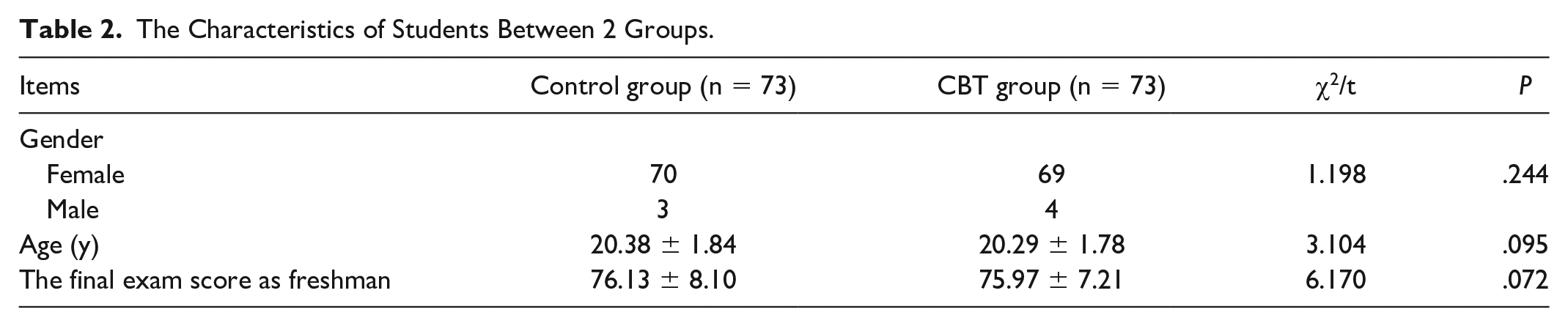
As Table 2 presented, a total of 146 participants were included, with 73 students in each group. The response rate of the survey was 100%, and no student dropped out during the intervention. There were no significant differences in the gender, age and the final exam score as freshman between 2 groups (all P > .05), indicating that the baseline data of the 2 groups of participants were comparable.
The Characteristics of Students Between 2 Groups.
The OSCE Scores
As Table 3 showed, OSCE scores in CBT group were significantly higher than that of control group (all P < .05), indicating that CBT was beneficial to improve the OSCE scores of students.
The Results of OSCE Between 2 Groups.

The Autonomous Learning Ability
As Table 4 presented, the autonomous learning ability in CBT group were significantly higher than that of control group (all P < .05), indicating that the CBT was beneficial to improve the autonomous learning ability of students.
The Autonomous Learning Ability Between 2 Groups.

The Effects Evaluation of CBT
As Table 5 presented, the most students favored the use of CBT and CBT was effective, indicating that CBT was prone to improve the teaching effects.
The Questionnaire Results for Effects Evaluation of CBT.

Student’s Satisfaction Level on CBT
As Table 6 presented, most students were satisfied with CBT, indicating that students support the use of CBT in the nursing skill education.
Student’s Satisfaction Level on CBT (n = 73).

Discussion
Traditionally, teacher’s teaching focuses on the technical operation process itself, and the students form the simplest operation awareness and operation imitation. 17 The lack of situational experience and simple imitation is not conducive to the master of nursing skills.18,19 Therefore, to a some extent, it limits the combination of student skills learning of knowledge theory and practice. The results of this present study have found that the CBT is beneficial to the master of nursing skills, and it’s conducive to the intrigue the interests of students and improve the communication and cooperative ability among students. Furthermore, students are pleased to accept CBT and favored the use of CBT.
For CBT, the teachers introduce typical cases into the classroom, integrate nursing practice into nursing situations, and create a medical atmosphere for students through scenario simulation and role-playing, which improves the authenticity experience of nursing students in the implementation of nursing.20-22 It leads nursing students into professional roles and cultivate professional consciousness to complete nursing behaviors with high degree of personal awareness. Nursing students enhance their social understanding by playing the positions and demands of fully experiencing different roles, and solidify the concept of vocational education that puts learning into practice. 23 During the question and dialogue session of the patient/family for the implementation of nursing care, on one hand, it can guide the nursing students to think professionally and quickly use the medical knowledge they have to answer. 24 On the other hand, the teacher can promptly correct possible omissions, deficiencies and even errors in the practice. 25 Promoting the learning and application of knowledge by nursing students through personal experience and personal experience is the original intention and goal of teaching design based on CBT methods.26,27 CBT is conducive to the reserve and enhancement of medical nursing knowledge for nursing students, and is conducive to flexibility and application when they are exposed to similar situations again.28,29
The CBT design is closely linked before, during, and after class. Nursing students are prepared to enter the classroom through team learning and independent learning to pave the way for the internalization of CBT knowledge, and it will be relatively easy to complete knowledge assimilation in the classroom. 30 In class, we systematize the learning of knowledge, to have a more comprehensive grasp of what they have learned. And the diversification of teaching methods further stimulates the learning motivation and interest of nursing students. 31 Nursing students actively participate, and good classroom interaction helps the nursing students complete the internalization of knowledge. 32 After class, the design of exercises and cases is designed for students to distinguish knowledge points that are easy to be confused. After-class exercises are an extension of classroom discussion, 33 so that the knowledge learned in the classroom can be effectively consolidated and strengthened. The CBT arouses the interest of nursing students in learning, and it facilitates the internalization of nursing skills.34-36
The social desirability in studies among the students with CBT should be considered. The school’s teaching methods are diversified, and on the basis of learning majors, more attention is paid to the cultivation of students’ comprehensive abilities in the CBT. The role of teachers has changed from the traditional “instructor” to “designer” and “guider.” Furthermore, students have more opportunities to choose and participate in “how to teach” and “how to learn.” 37 In CBT, teachers need to further play a guiding role in knowledge learning, encourage students to express personal considerations for patients’ benefits, and build confidence in learning.33,38 Moreover, it’s necessary to organize students to reflect and discuss in a timely manner, and cultivate the ability to actively find problems and deal with problems. 39 CBT is an exploratory reform carried out on the basis of traditional teaching. It is a change that pose great impacts on the study habits of nursing students.40-42 For the different obstacles faced by nursing students in case implementation, it’s necessary to point out their own shortcomings and the direction of making up later. 43 Therefore, in the cultivation of ability of nursing students, it is necessary to take the implementation and communication ability as 2 important evaluation indicators to measure in the ability assessment of nursing students. 44 At the same time, in nursing skill assessment, it is necessary to increase the proportion of the performance of nursing evaluation and nursing communication, making it more in line with the social needs of personnel training.45,46 However, even rough the response rate was 100% in our study, the students might have feel coerced to participate, thus biases might be existed.
Several limitations must be concerned in this study. Firstly, the case-based learning cases and OSCE cases were the same in our study, the same cases might be over-rated and might be not innovative for the nursing skills in clinical settings, the choices and verifications of cases should be considered discreetly in the future studies. It’s note-worthy that the OSCE was case-based, thus it potentially favored the CBT group. And it’s a major limitation that we did not have the data on validity of our survey questionnaire, thus, the significant biases might be existed. Secondly, WeChat is very popular amongst students, there may be some the cross-contaminations among 2 groups. Thirdly, the choice of satisfaction in this present study only included strongly agree, agree and disagree, it may direct students towards positive side of that scale, future studies with details on the level of satisfaction are needed. Furthermore, when reporting Cronbach of multi-dimensional tool, we only reported the overall tool alpha, but we did not obtain each subcategory alpha, future studies with checks on the subcategory alpha can be more convincing.
Conclusion
In conclusion, CBT is beneficial to expand teachers’ teaching ideas and mobilize students’ interest in learning, and the autonomous learning ability of nursing students has improved, and good teaching effects have been achieved. However, in the implementation process, it should be noted that the teachers should spend more energy and time on case teaching design, supervising students’ learning and answering questions. Future researches are needed to further explore the efficiency and quality of CBT.
Footnotes
Author Contributions
LL, ML designed research; LL, HJ conducted research; LL, QZ analyzed data; LL wrote the first draft of manuscript; HJ had primary responsibility for final content. All authors read and approved the final manuscript.
Declaration of Conflicting Interests
The author(s) declared no potential conflicts of interest with respect to the research, authorship, and/or publication of this article.
Funding
The author(s) disclosed receipt of the following financial support for the research, authorship, and/or publication of this article: This study was funded by the Jiangxi Province’s “Thirteenth Five-Year” Plan 2020(20YB327).
Ethical Approval and Consent to Participate
Our study has been approved by the ethics committee of Jingganshan University(2019094), and written informed consents have been obtained from all the participants.

Availability of Data and Materials
All data generated or analyzed during this study are included in this published article.