




Abstract
Big infectious diseases do harm to the whole society, and it is highly crucial to control them on time. The major purpose of this article is to theoretically demonstrate that the Chinese government’s intervention in large-scale infectious diseases is successful and efficient. Two potential strategies were considered: strategy 1 was infectious disease without government intervention, and strategy 2 was infectious disease with government intervention. By evolution model, this article illustrates the efficiency of big infectious disease reimbursement policy in China. Without government reimbursement, this article finds that high expenditures accelerate the disease infection. The number of infected persons decreases under big infectious disease reimbursement policy in China. The higher the treatment costs, the more important the government intervention. Big infectious disease reimbursement policy in China can serve as an efficient example to cope with big infectious diseases.
Big infectious diseases do harm to the whole society, and it is highly crucial to control them on time. We have done some data collection and research on big infectious diseases from an economic angle.
This research is to theoretically demonstrate that the Chinese government’s intervention in large-scale infectious diseases is successful and efficient. And this article intends to draw on the traditional infectious disease model to analyze the Chinese government’s compensation system for major diseases to reduce the harm of infectious diseases.
It is necessary to launch full reimbursement policy for infectious diseases under high expenditures incurred by treatment condition. The higher the treatment costs, the more important the government intervention.
Introduction
Infectious diseases always threaten the life of human being and even destroy social stability. People feel terrible when infectious diseases appear and nearly when there is no way to avoid the damage. Therefore, infectious disease is an important social issue and government should take step to control it. It is crucial for government to suppress infectious diseases.
In 2003, the outbreak of the serious infectious disease severe acute respiratory syndrome (SARS) took place in China, which was extremely horrible due to its spread and high death rate. According to statistics, 5327 residents in mainland China were infected with SARS, of which 349 died. Besides, 1755 cases were reported in Hong Kong, China, of which 300 infected people died. At the same time, 665 cases were infected in Taiwan, China, of which 180 died, and the death rate was about 10.7%. It is well known that China is a country with large population. Due to high population density, high mobility, and poor sanitation in some areas, SARS had spread rapidly. Although these conditions were conducive to the spread of SARS, the Chinese government took a compulsory means to control it. As soon as an infected person was identified, mandatory isolation and free treatment were provided to stop transmission and reduce mortality, which is the key for the infectious disease defense being successful
In mid-February 2018, a serious flu was spreading in the United States, and people were reported to die from the flu almost every day. According to experts, this is probably the worst flu in the United States in decades, which is comparable to the 2009 peak of swine flu. According to the statistics of the US Centers for Disease Control and Prevention (CDC), 4064 people across the country died from flu and pneumonia just in the third week of 2018, which is 10% of the mortality rate in the same period in the United States. And the situation is still deteriorating because the death toll is rising. During the swine flu in 2009 and 2010, a total of 60.8 million Americans were infected, 274 000 were hospitalized, and about 12 500 died. The death toll from the ongoing flu may far exceed this number. In the United States, even if the flu outbreak is not so severe, about 12 000 people are expected to die. If it is severe, the death toll may reach 56 000, of which 80% are elderly. The main reason for the high infection and deaths due to flu in the United States may be attributed to the nonfeasance of government because took no effective measures were taken against the spread of the infectious disease.
When comparing the conditions of the United States and China, we know that, on one hand, the population density of the United States is much less than that of China. On the other hand, the United States has the best medical conditions in the world. But the statistics data above show that the damage caused by infectious diseases in the United States is far serious than that in China. Even though the flu in the United States is much milder than SARS in China, there are still tens of thousands of people dying due to infectious diseases in the United States, but during SARS, the death toll in China was no more than 829. In comparison, the number of deaths from infectious diseases in the United States is at least 10 times that due to infectious diseases in China. From this, we can infer that there is something the Chinese government did much better than the American government during the big infectious disease period.
To control the infectious diseases, China chose compulsory segregation of patients and treated them for free. As a developing country, China’s medical level is not high enough, and its population is so large that it cannot withstand the serious consequences of infectious diseases. Therefore, it is essential to take coercive measures similar to that taken by China to control infectious diseases; it can be said that this method of controlling infectious diseases is successful. In other words, during the outbreak of infectious diseases, government intervention is extremely important for controlling them.
The main purpose of this article is to theoretically demonstrate that the Chinese government’s intervention in large-scale infectious diseases is successful and efficient. And this article intends to draw on the traditional infectious disease model to analyze the Chinese government’s compensation system for major diseases to reduce the harm of infectious diseases.
The infectious disease model was initially proposed. 1 Taking the situation and the types of infection diseases into account, many scholars extended the classical model of Kermack and McKendrick. For example, Bloom et al 2 addressed the path of sudden infectious diseases using the extended model of Kermack and McKendrick. And based on the Kermack and McKendrick model, Metcalf and Lessler 3 analyzed both the opportunities and the challenges in the control of infectious diseases. By combining the properties of infectious disease with the Kermack and McKendrick model, Cohen and Saran 4 considered malaria in Uganda and offered the corresponding treatment plan. Recently, the effects of insecticide on infectious diseases are analyzed. 5
Regarding governmental intervention in infectious diseases, Geoffard and Philipson 6 combined governmental policies with the infectious disease model and proposed governmental intervention to reduce public harm. Furthermore, Gersovitz and Hammer 7 introduced treatment expenditures in the infectious disease model with economic perspective. Recently, Kremer and Snyder 8 proposed treatment combined with recovery to cope with infectious diseases. Sims, Finnoff, and O’Regan 9 analyzed the treatment of unpredictable epidemics with behavioral economics.
There are also some research works on predicting infectious disease using big data to control medical cost.10,11 Recently, some researchers suggested using medical reimbursement to solve the dispute between hospitals and patients and some other issues.12-14 But very limited literature discussed about the reimbursement to cope with big infectious diseases in economics. Based on the successful experience of coping with SARS in 2003, this article resorts to the infectious disease model to capture the rationality of reimbursement in preventing big infectious diseases. The contribution of this article is to compare expenditures with government reimbursement and without government reimbursement, and this article finds the reimbursement policy to be successful in controlling expenditures. Therefore, it is necessary to launch full reimbursement policy for infectious diseases under high expenditures incurred by the treatment condition. The higher the treatment costs, the more important the government intervention.
Model Setup
Assume the number of population to be



Functions (1) to (3) meet the constraint
Model Analysis
According to
As we cannot obtain the analytic solutions from the above model, all the following analyses will by practice be numerical simulation with Excel, and the recursive formulas used in the simulation are as follows:


The initial setting is
Without Government Intervention
Observing functions (1) to (3), the following phenomena can be obtained: in the case of no government compensation (

High expenditures:
As Figure 1 shows, at high cost, even after 10 000 times of simulation, the number of infected people is still as high as 0.5. But Figure 2 illustrates that at low-cost condition, the number of infected people will drop to zero after about 1774 periods. The cost of treatment has an important impact on the transmission of infectious diseases. Figure 1 shows the relationships between the 3 groups and the cost of treatment. When the cost of treatment is high, the number of infections per stage increases (see Figure 1). Conversely, the number of infections drops sharply after a limited period, indicating that the infection is effectively and quickly controlled (see Figure 2). This conclusion is also in concert with the reality. For example, although common cold is contagious, it can be quickly controlled because of the low cost of treatment.

Low expenditures:
According to the assumption that the total population is constant, combined with the conclusion of Figure 2, when the treatment cost is low, the number of healers quickly reaches a maximum, and the number of infected persons is almost zero. This indicates that the epidemic is effectively controlled. According to Figure 1, the total number of social treatments and the total cost (the total number of infections multiplied by the individual treatment costs) were further analyzed. The cost for high-cost treatments was close to infinity; the number of low-cost treatments was 1654.48, and the cost of treatment was 8272.40. Therefore, it is explained in accordance with Figure 2. When treatment costs are low, the government does not have to intervene.
With Government Intervention
Finally, in the case of free treatment, patients’ willingness to treat reaches the highest, and the number of people healed per unit time is also the highest, which is the ideal state. In other words, if
Under the condition that the government provides certain compensation (
It is unrealistic for the government to compensate more than the treatment cost (
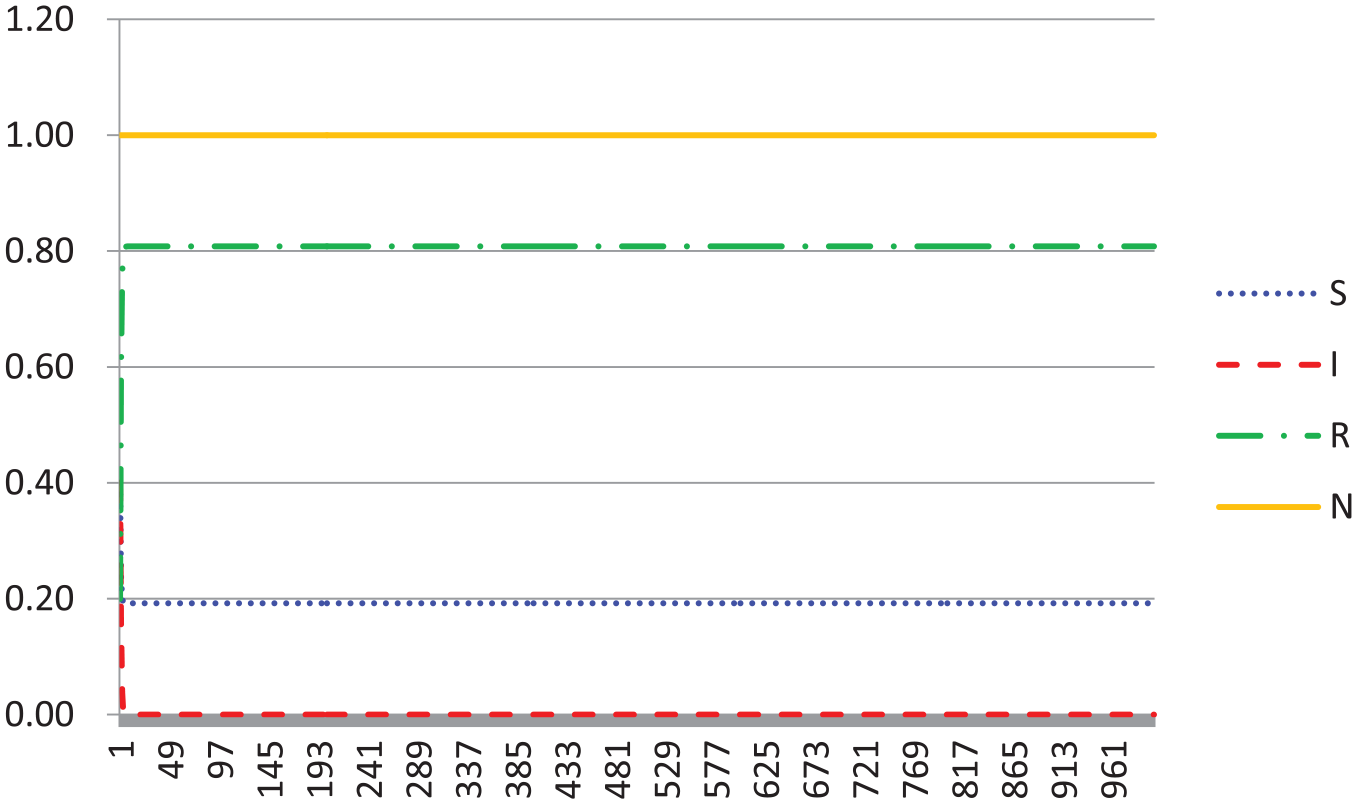
Full government subsidies:
Figure 3 shows that the number of infected people drops rapidly and will reach zero in the eighth period. Besides, according to Figure 3, we learn that only 5.59 people need treatment under full government subsidy, much less than that under no government intervention. But the total cost of treatment is related to unit person treatment cost, which is 55.88 at high cost and 27.94 at low cost. (These exact numbers themselves have no meaning; they are only used to show the gap between different conditions.) Figure 3 shows that when the cost of treatment is high, the expenditures of implementing the full compensation mechanism are also high.
Comparison Analysis
In the following, we will compare the number of people infected and the total cost of treatment in both cases to illustrate the impact of government intervention. As we cannot obtain a specific analytical solution using the calculation process mentioned above, the research process will obtain the results through the numerical simulation process. Assuming the total number of people to be
Following is the numerical simulation of the number of infected persons in different parameters, including 3 cases: high cost (

Numerical simulation results of the number of infected people.
From Figure 4, 2 important conclusions can be drawn: first, the treatment cost of infectious diseases has a critical influence on the evolution of infectious disease. Specifically, under the condition of high cost and no government intervention (
Concluding Remarks
This article extends the infectious disease model to introduce the big infectious disease reimbursement policy in China and shows why this reimbursement policy is successful. Without government reimbursement, this article finds that high expenditures accelerate the disease infection. Therefore, it is necessary to launch full reimbursement policy for infectious diseases under high expenditures incurred by treatment condition. The higher the treatment costs, the more important the government intervention.
The conclusions of this article offer theoretical support to control big infectious diseases. Moreover, for emerging infectious diseases, uncertainty yields high treatment expenditures and the government should establish complete reimbursement policy to control these diseases. However, the limitation of this article is lack of data verification of medical expenditures about big infectious disease from China and the United States. In addition, predicting infectious diseases using learning and big data may be the subject of future study.
Footnotes
Appendix
Numerical Simulation Results.

|
|
|
|
|
|
|
|
|
|
|
|---|---|---|---|---|---|---|---|---|---|
|
|
|
|
|||||||
| 0 | 0.40000 | 0.40000 | 0.20000 | 0.40000 | 0.40000 | 0.20000 | 0.40000 | 0.40000 | 0.20000 |
| 1 | 0.24000 | 0.55998 | 0.20002 | 0.24000 | 0.55730 | 0.20270 | 0.24000 | 0.16000 | 0.60000 |
| 2 | 0.10560 | 0.69435 | 0.20004 | 0.10625 | 0.68730 | 0.20645 | 0.20160 | 0.03840 | 0.76000 |
| 3 | 0.03228 | 0.76765 | 0.20008 | 0.03322 | 0.75570 | 0.21108 | 0.19386 | 0.00774 | 0.79840 |
| 4 | 0.00750 | 0.79239 | 0.20011 | 0.00812 | 0.77571 | 0.21617 | 0.19236 | 0.00150 | 0.80614 |
| 5 | 0.00156 | 0.79830 | 0.20015 | 0.00182 | 0.77678 | 0.22140 | 0.19207 | 0.00029 | 0.80764 |
| 6 | 0.00031 | 0.79950 | 0.20018 | 0.00041 | 0.77296 | 0.22663 | 0.19201 | 0.00006 | 0.80793 |
| 7 | 0.00006 | 0.79972 | 0.20022 | 0.00009 | 0.76807 | 0.23184 | 0.19200 | 0.00001 | 0.80799 |
| 8 | 0.00001 | 0.79973 | 0.20025 | 0.00002 | 0.76296 | 0.23702 | 0.19200 | 0.00000 | 0.80800 |
| 9 | 0.00000 | 0.79971 | 0.20029 | 0.00001 | 0.75784 | 0.24216 | 0.19200 | 0.00000 | 0.80800 |
| 10 | 0.00000 | 0.79967 | 0.20033 | 0.00000 | 0.75273 | 0.24726 | 0.19200 | 0.00000 | 0.80800 |
| 11 | 0.00000 | 0.79964 | 0.20036 | 0.00000 | 0.74766 | 0.25234 | 0.19200 | 0.00000 | 0.80800 |
| 12 | 0.00000 | 0.79960 | 0.20040 | 0.00000 | 0.74263 | 0.25737 | 0.19200 | 0.00000 | 0.80800 |
| 13 | 0.00000 | 0.79956 | 0.20044 | 0.00000 | 0.73762 | 0.26238 | 0.19200 | 0.00000 | 0.80800 |
| 14 | 0.00000 | 0.79953 | 0.20047 | 0.00000 | 0.73265 | 0.26735 | 0.19200 | 0.00000 | 0.80800 |
| 15 | 0.00000 | 0.79949 | 0.20051 | 0.00000 | 0.72772 | 0.27228 | 0.19200 | 0.00000 | 0.80800 |
| 16 | 0.00000 | 0.79945 | 0.20055 | 0.00000 | 0.72281 | 0.27719 | 0.19200 | 0.00000 | 0.80800 |
| 17 | 0.00000 | 0.79942 | 0.20058 | 0.00000 | 0.71794 | 0.28206 | 0.19200 | 0.00000 | 0.80800 |
| 18 | 0.00000 | 0.79938 | 0.20062 | 0.00000 | 0.71310 | 0.28690 | 0.19200 | 0.00000 | 0.80800 |
| 19 | 0.00000 | 0.79935 | 0.20065 | 0.00000 | 0.70830 | 0.29170 | 0.19200 | 0.00000 | 0.80800 |
| 20 | 0.00000 | 0.79931 | 0.20069 | 0.00000 | 0.70353 | 0.29647 | 0.19200 | 0.00000 | 0.80800 |
| . . . | . . . | . . . | . . . | . . . | . . . | . . . | . . . | . . . | . . . |
| 1774 | 0.00000 | 0.73813 | 0.26187 | 0.00000 | 0.00000 | 1.00000 | 0.19200 | 0.00000 | 0.80800 |
| . . . | . . . | . . . | . . . | . . . | . . . | . . . | . . . | . . . | . . . |
| 10000 | 0.00000 | 0.50808 | 0.49192 | 0.00000 | 0.00000 | 1.00000 | 0.19200 | 0.00000 | 0.80800 |
| . . . | . . . | . . . | . . . | . . . | . . . | . . . | . . . | . . . | . . . |
Acknowledgements
We sincerely thank the anonymous reviewers for their helpful and illuminating suggestions, but we take the full responsibility for this article. We would also like to thank all participants and the staff at the study sites for their cooperation.
Declaration of Conflicting Interests
The author(s) declared no potential conflicts of interest with respect to the research, authorship, and/or publication of this article.
Funding
The author(s) disclosed receipt of the following financial support for the research, authorship, and/or publication of this article: This work was supported by the Guangdong Social Science Foundation (GD2018CYJ01), the Foundation for High-level Talents in Higher Education of Guangdong, GDUPS (2019), Guangdong Provincial Natural Science Foundation (2018A030310669), the National Natural Science Foundation of P.R. China (71401057; 71771057), the Foundation for High-level Talents in Higher Education of Guangdong, GDUPS (2012), Humanities and Social Sciences Fund of the Ministry of Education (18YJC790156), Guangdong Social Science Foundation (GD17XYJ23), and Innovative Foundation (Humanities and Social Sciences) for Higher Education of Guangdong Province (2015WCXTD009, 2017WQNCX053).
