




Abstract
This study aimed to elucidate factors affecting the mental health status of older primary caregivers. Participants comprised 81 pairs of home care recipients aged ≥65 years and primary caregivers aged ≥65 years who were caring for the recipients. We used an individual interview method, which covered basic attributes, activities of daily living by Barthel Index, mental health status by Center for Epidemiologic Studies Depression Scale (CES-D), sense of coherence (SOC), and sense of care burden by Japanese version of the Zarit Burden Interview (J-ZBI). The score for the comprehensibility subscale of the SOC was significantly higher for the old-old caregivers compared with the young-old caregivers (P < .01). A significant positive correlation between the number of years of caregiving and the score for the SOC meaningfulness subscale was seen for the young-old caregivers (P < .05). For the old-old caregivers alone, negative correlations were seen between the CES-D score and the scores for all the SOC items. Multiple linear regression analysis using CES-D as the dependent variable showed a significant positive relationship to J-ZBI in all caregivers (P < .01). In contrast, a significant negative relationship was seen with meaningfulness, an SOC subscale only for the old-old caregivers. Meaningfulness as well as J-ZBI was extracted as a factor affecting the mental health status of the old-old caregivers, suggesting that higher SOC relates to lower stress levels with a remarkable decline in physical condition. Meaningfulness, an SOC subscale, is an important factor for improving the mental health of old-old caregivers.
Keywords
Several studies have been identified the causal factors affecting the mental health status of the primary caregiver, the caregiving burden, and quality of life; however, there are limited studies examining older caregivers by age group.
We attempted to reveal the differences in the relationship between sense of coherence (SOC) and psychological aspects such as mental health status according to the age group of the older caregiver; we evaluated that SOC was an important factor for improving the mental health status of older caregivers, especially in old-old, and enabling them to continue providing care.
Caregiving by the older caregivers is becoming a major concern for international society; our results show that the factors that affect the mental health of older caregivers are important for supporting caregivers and empowering them to keep up providing care in the aging society.
Introduction
According to the 2013 Comprehensive Survey of Living Conditions in Japan, 1 12.3% of home caregivers are older individuals aged 80 years or older, and 1 in 5 caregivers is 70 years of age or older. Moreover, 69.5% of all households need a caregiver, and of these, 62.3% are older households and must rely on an elderly individual for caregiving. With the rapid aging of society, the number of older individuals who are bedridden or have dementia is increasing unabated, and the caregiving function of the family is changing due to factors such as increased family nuclearization. Consequently, caregiving by the older caregivers is becoming a major problem of concern for society as a whole.
Although the Long-Term Care Insurance Act was enacted in 1997 for elderly individuals in Japan, who require assistance, a legal system that provides a foundation for assistance has not been adequately established regarding caregivers. 2 Under the Long-Term Care Insurance Act, an upper limit is placed on the fee paid for use of a service, but it has been pointed out that the law does not eliminate the sense of burden or feeling of depression experienced by the family caregivers. 3
Research on caregiving by the older caregivers is now advancing, and it indicates that caregivers experience anxiety about their physical condition as they age and about being unable to speculate about the future. 4 However, there is also the view that home care is somehow possible even in the case of caregiving by the older caregivers, who are generally considered to have lower caregiving capability. This requires a visiting nurse to perform daily detailed inspections of the care environment and the continuous presence of a key person who can communicate with health care personnel. 5
Sense of coherence (SOC) is a concept central to the salutogenic approach put forward by Antonovsky 6 and refers to stress-coping and the ability to maintain health. Specifically, it refers to the ability to cope with stress in difficult situations and not only protect one’s physical and mental health but turn it into sustenance for growth and development. 7 Studies of caregiving have found that individuals with a strong SOC sense a situation and lessen the stressors present 8 and that a strong SOC is related to a reduced sense of care burden and quality of life.9,10
Previous studies mainly dealt with caregivers in general, and few have focused on older caregivers. 11 There have been studies that extracted the elements that constitute situations where home care is difficult 12 and studies of the caregiving burden,13,14 the causal factors involved in the mental health status of the primary caregiver, 15 and the relationship between mental health and the sense of care burden.16,17 However, although there have been a couple of studies of the relationship between the mental health status of the caregiver and SOC, 18 we have found no studies that have examined primary caregivers by age group, ie, the young-old (65-74 years) and old-old (≥75 years). Several studies19-21 reported that SOC is increasing with aging. Therefore, SOC might be important for the old-old, because they have been able to continue to provide caregiving despite declines in their physical function with aging.
In the life cycle of humans, the older stage is considered a period in which a person can easily lose their purpose in life and therefore face a crisis. However, the older are also considered to have the power to regain their purpose in life by discovering the sources and objectives of a new purpose in life. 22 In fact, depression remained constant with increasing age of older people due to chronic diseases. 23 In this study, we attempted to elucidate the differences in the relationship between SOC and psychological aspects such as mental health status according to the age group of the older caregiver. Examining the factors that affect the mental health of older caregivers is very important for supporting caregivers in Japan’s aging society.
Study Objectives
The objective of this study was to compare young-old and old-old primary caregivers who were providing home care for older patients and elucidate their differences in SOC and the following psychological aspects: mental health status and sense of care burden. The other objective was to elucidate the factors that affect mental health status and investigate assistance for older caregivers.
Methods
Participants
We introduced 85 pairs among 688 users from 18 managers of 18 home-visit nursing services. We investigated 84 pairs with their consent. Three pairs were excluded as they did not suit the inclusion criteria. Thus, the participants comprised 81 pairs of home care recipients aged 65 years or older and primary caregivers aged 65 years or older who were caring for the care recipients. The inclusion criteria for caregivers were (1) serving care recipients for more than 6 months, (2) serving care at home, and (3) not having dementia. The inclusion criteria for care recipients were having all minor illnesses. The exclusion criteria for caregivers were inability to communicate in Japanese and, for care recipients, were to be hospitalized or residence in a nursing home.
Survey Period
The survey period is January 2014 to September 2016
Survey Method
With the consent and cooperation of the managers of a home-visit nursing service in provincial 4 cities in Japan, an investigator visited the homes of the participants and conducted an interview survey using a questionnaire (Figure 1).

Study flowchart.
Survey Content
Primary caregiver survey
Basic attributes: sex, age, relationship to the care recipient, whether living together, whether a substitute caregiver was available, level of care needed, number of years of caregiving, caregiving time per day, and hobby.
Activities of daily living (ADL): Barthel Index (BI).
An evaluation based on a report by Mahoney and Barthel 24 was arranged so that the total score possible for 10 items covering the following areas was 100 points: urination, fecal continence, toilet-related behaviors, eating, dressing, transferring between chair and bed, bathing, movement, and ascending and descending stairs. A higher score indicated a greater level of independence (ADL).
3. Mental health status: Center for Epidemiologic Studies Depression Scale–8 items (CES-D).
The scale, which was developed by Melchior et al, 25 consists of 8 items and 4 possible responses to each. A higher score indicates more severe depression, with a score of 7 points used as the cut-off point, ie, a score of 7 points or higher suggesting a “depressive tendency.”
4. Stress coping ability: SOC 13 items 5-point Likert scales (SOC).
This scale is a Japanese-language version created by Antonovsky. 6 The Japanese version was prepared by Yamazaki et al. 7 The scale consists of 13 items, with subscales for “meaningfulness” (5 items), “comprehensibility” (4 items), and “manageability” (4 items). There are 5 possible responses to each item, and a higher score indicates a stronger SOC.
5. Sense of care burden: Japanese version of the Zarit Burden Interview (J-ZBI).
The scale was developed by Zarit et al, 26 and the Japanese-language version was produced by Arai et al. 27
It consists of 22 items and 5 possible responses to each. A higher score indicates a stronger sense of care burden.
Care recipient survey
Basic attributes: sex, age, level of care needed, symptoms of dementia, and utilization of social resource services.
ADL: BI.
Analysis Methods
The basic attributes and CES-D, SOC, and J-ZBI were compared using the chi-square test and t-test, and Pearson’s product-moment correlation coefficient was determined. In addition, a stepwise multiple linear regression analysis with CES-D as the dependent variable and SOC and J-ZBI as independent variables were used to extract the factors that affected mental health status. SPSS 22.0 was used for the statistical analysis, and the P-value for significance was established at P < .05.
Ethical Considerations
Informed consent was obtained after the purpose of the study, and its methods were explained to the survey participants orally and in writing. They were also informed that participation was voluntary, participants would not be disadvantaged if they did not participate or withdrew from participation, the anonymity of the data would be protected and that the data would not be used for purposes other than the study, and the data would be promptly discarded after the study was completed. The study was approved by the research ethics committee of Ube Frontier University (No. 2013010).
Results
Attributes of the Survey Participants
The mean age was 75.9 ± 6.8 years for all caregivers, 69.6 ± 3.0 years for the young-old caregivers (young-old), and 81.0 ± 4.1 years for the old-old caregivers (old-old). The number of years of caregiving was 6.2 ± 7.8 years for the young-old and 3.2 ± 3.1 years for the old-old, the value for the young-old being significantly greater (t [44] = 2.19, P < .05). The number whose need for care was certified was 0 for the young-old and 9 for the old-old, the latter being significantly higher (P < .01). No difference in the BI scores was seen between the young-old (98.9 ± 2.1) and the old-old (98.1 ± 3.2), which were both relatively high (Table 1).
Attribute of the Primary Caregivers.

Nonpaired t-test and chi-square test, *P < .05; **P < .01.
Items with significant differences are in italics.
The mean age was 82.3 ± 8.0 years for all care recipients, 80.5 ± 9.4 years for those receiving care from young-old caregivers, and 83.7 ± 6.3 years for those receiving care from old-old caregivers, which were not significant differences. The BI scores were 30.8 ± 31.8 points for those receiving care from young-old caregivers and 52.4 ± 30.1 points for those receiving care from old-old caregivers. Thus, the ADL level was significantly lower (t [79] = 3.13, P < .01) and the level of Certified Care Need was significantly higher (P < .05) for those receiving care from young-old caregivers. The number of day-care services used was 0.9 ± 0.7 for those receiving care from young-old caregivers and 0.5 ± 0.5 for those receiving care from old-old caregivers, the former number being significantly higher (t [62] = 2.68, P < .05). No difference was seen in the use of home-visit services.
Comparison of Caregiver Attributes, Psychological Aspects Such as Mental Health Status, and SOC
No differences in mental health status were seen between the young-old and old-old. The total SOC scores and comprehensibility subscale scores of SOC were higher for the old-old than for the young-old: 52.2 ± 6.8 and 19.9 ± 2.9 points, respectively, for the old-old; and 49.1 ± 7.0 (t [75] = 1.93, P < .1) and 17.8 ± 3.2 (t [75] = 2.89, P < .01) points, respectively, for the young-old. No differences were seen for the other parameters (Table 2).
Comparison Between Age Group to the Psychological Aspects and SOC of the Primary Caregivers.

Note. SOC = sense of coherence.
Nonpaired t-test, **P < .01.
Relationship Between Caregiver Attributes, Psychological Aspects Such as Mental Health Status, and SOC
For the young-old caregivers, a positive correlation was seen between the number of years of caregiving and the meaningfulness scores (r = 0.363, P < .05). For the old-old, negative correlations were seen between caregiving time per day and the total SOC scores (r = −0.322, P < .05) and caregiving time and the manageability scores (r = −0.318, P < .05).
Relationship Between the SOC and Psychological Aspects of the Caregiver Such as Mental Health Status
For the young-old caregivers, negative correlations were seen between mental health status (CES-D) and the sense of care burden (J-ZBI: r = −0.755, P < .01). For the old-old, negative correlations were seen between mental health status and the sense of care burden (r = −0.677, P < .01), the total SOC scores (r = −0.496, P < .01), the meaningfulness scores (r = −0.500, P < .01), the comprehensibility scores (r = −0.371, P < .05), and the manageability scores (r = −0.371, P < .05), respectively. In addition, for the old-old, negative-positive correlations were seen between the sense of care burden and the total SOC scores (r = −0.384, P < .05), the meaningfulness scores (r = −0.396, P < .05), and the manageability scores (r = −0.356, P < .05).
Multiple Regression Analysis of Factors Related to the Mental Health Status of Caregivers
To examine the factors that define mental health status (CES-D), we used CES-D as the dependent variable and the sense of care burden (J-ZBI) and 3 subscales of SOC (meaningfulness, comprehensibility, and manageability) as the independent variables. In addition, CES-D was adjusted for sex and number of years of caregiving of the primary caregivers, and BI scores of the care recipients. For both young-old and old-old caregivers, a significant positive relationship was seen to the sense of care burden (J-ZBI). In addition, a significant negative relationship was seen for the meaningfulness subscale of the SOC only in the old-old. The results of multiple regression analysis were significant (P < .001), with R2 values of 0.55 for the young-old and 0.49 for the old-old, indicating a high goodness of fit (Table 3).
Results of Multiple Regression Analysis.
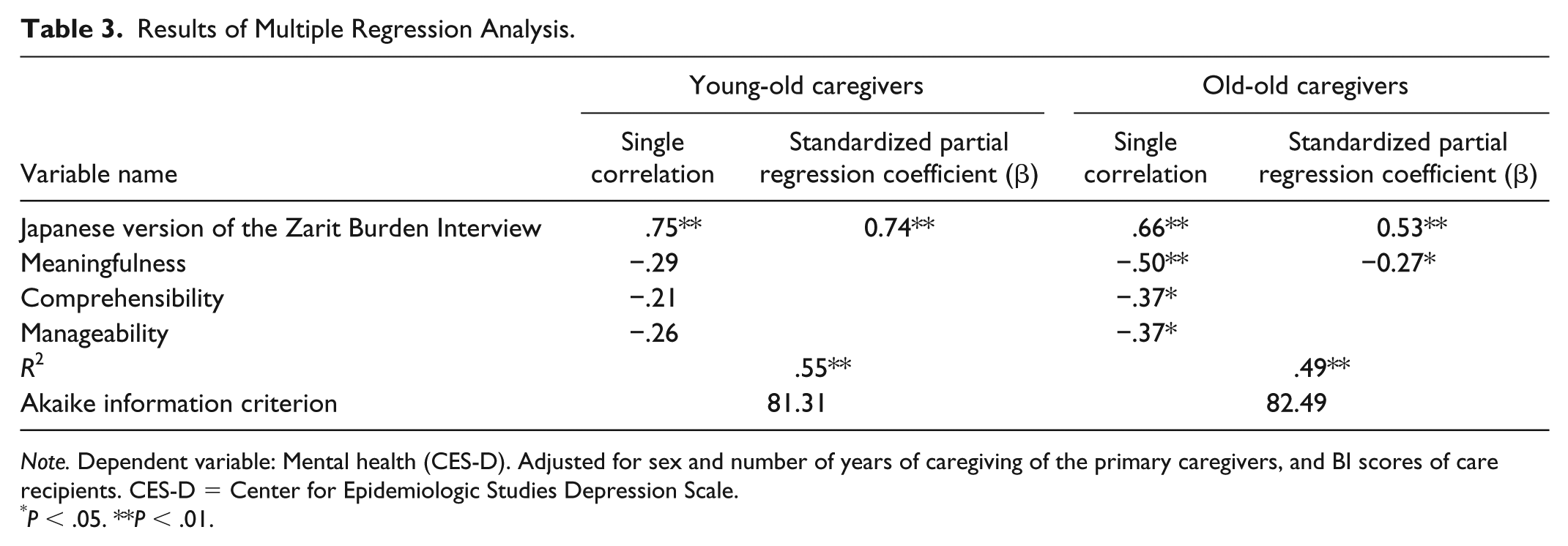
Note. Dependent variable: Mental health (CES-D). Adjusted for sex and number of years of caregiving of the primary caregivers, and BI scores of care recipients. CES-D = Center for Epidemiologic Studies Depression Scale.
P < .05. **P < .01.
Discussion
Although no difference in the BI scores of the caregivers was seen, both the young-old and old-old were at a high level of ADL and independence. However, more old-old than young-old were certified as needing long-term care. This was likely attributable to the decrease in physical function associated with aging. Although there are individual differences, the decline in physical function is considered to become most pronounced after 75 years of age, the point at which the old-old period begins. 28 Although caregiving by the old-old is considered a major burden on these individuals, the SOC is stronger in the old-old than in the young-old, and the strength of the SOC is important in caregiving. Individuals with a high SOC are thought to select and use appropriate coping strategies and relatively quickly depending on the circumstances. 7 In a survey by Togari and Yamazaki, 21 the mean total SOC score was 47.3 ± 9.2 points for older individuals in their 70s from the general population, and the mean for the old-old in this study was a high, 52.2 ± 6.8 points. In a survey by Potier et al, 29 caregivers with a higher SOC reported a significantly lower burden. Spouse caregivers with low SOC seem to be a vulnerable condition due to several negative effects of perceived health notion accumulated during the very early phases of the caregiving process. 18 These findings could help identify those at risk of low quality of life due to caregiving, dysfunctional coping, or lack of information about care. 30
Examination of the BI scores and level of care needed among the care recipients showed a higher ADL level for those receiving care from old-old caregivers as compared with young-old caregivers. It was inferred that the higher ADL level for those receiving care from old-old caregivers enabled these caregivers, who have decreased physical function, to continue providing home care.
In this study, the old-old caregivers showed higher scores for total SOC and comprehensibility, an SOC subscale, than the young-old caregivers. It is compatible with the study of Lövheim et al, 19 which reported that SOC is increasing with aging. The study of Silverstein and Heap 20 also reported that SOC increased with age, but only when maintained in health and social relationships. In addition, comprehensibility is a sense that allows the individual to predict and understand, to a certain extent, the variety of events that they will encounter in their future lives. 7 It is thought that the old-old draw on their previous experience and knowledge of caregiving to anticipate developments as they provide care.
Regarding the relationship between caregiver attributes and SOC, young-old caregivers with many years of caregiving experience scored high on the SOC meaningfulness subscale. Meaningfulness is a sense of wanting to overcome the difficulty, and it allows an individual to approach stressful events positively, enabling them to cope with such events. 7 The young-old appear to choose caregiving independently, assume that role, and find value in it by providing care over the long term. For the caregivers, the passage of time is considered a process of accumulating caregiving experience, and it provides skill, knowledge, and confidence pertaining to long-term care.
For the old-old, however, caregiving time per day was negatively correlated with the total SOC score and manageability. Thus, when the SOC score was high, caregiving time was shorter. Manageability is the sense that a person can somehow cope with an event by themself, no matter how difficult the event, and that they can call on those around them for help in coping with stress. 7 Individuals who have high of manageability are able to use the support of those around them, including social resource services and relatives, which leads to a reduction in caregiving time.
Assessment of the relationship between SOC and psychological aspects of the caregiver such as mental health status showed that the sense of care burden was lower when the mental health status was high for both the young-old and old-old. Similar results were seen in a previous study about the relationship between depression and the sense of care burden. 29 A positive relationship between mental health status and SOC was seen for the old-old alone, suggesting that SOC is a latent capability of individuals, which is important for maintaining a favorable mental health status.
As a result of multiple linear regression analysis, sense of care burden was extracted as a factor defining mental health status for both the young-old and old-old. Meaningfulness, an SOC subscale, was extracted as a factor for the old-old. Caregivers having a purpose in life has been cited as a factor that reduces the sense of care burden. 31 Suyama et al 32 stated that rather than viewing caregiving as simply a mechanical responsibility and feeling a sense of burden associated with it, caregivers engage in this work with the sense that is worthwhile and gives them purpose. Moreover, Suganuma and Sato 33 described how caregivers experience a sense of satisfaction, pleasure, and learning through their work. SOC was a significant factor affecting mental health status, and this was strongly associated with the SOC meaningfulness subscale.
Meaningfulness, which is an element of motivation, is the most important of the SOC subscales, and the assessments of others are critical for viewing one’s own experience as having the value. Having the presence and opportunity to talk about one’s own experience and thoughts about caregiving provides a chance to view the experience positively. Matsuoka 34 showed that the stress response decreases with an increase in caregiving awareness expressed as the obligation or desire to provide care. This indicates the importance of support that enables the caregiver to feel that caregiving is worthwhile and provides purpose. Stressful life events further weaken a relatively weak SOC, but a strong SOC is unaffected by such events. 35 The support that increases SOC from an earlier stage is important for the older caregivers.
To maintain and strengthen the SOC of older individuals, it is important to incorporate mental development, interpersonal relations, and physical activity into their daily life. 7 To allow caregivers to receive support, they require time free of caregiving duties, and support that includes caring for the care recipient is therefore needed. This suggests a need for support that strengthens the SOC of older caregivers to maintain the mental health of the elderly individual and prevent its decline.
A limitation of this study was that the survey was conducted in defined provincial cities in Japan, and its generalizability may therefore be limited. Another limitation was too small sample size, and we were not able to analyze sex effects. In the future, the research intends to conduct in various provinces in Japan involving a larger number of samples to validate these current study findings and to evaluate the feasibility in policy implication.
Conclusions
A factor affecting the mental health status of young-old and old-old caregivers providing home care for older care recipients was the sense of care burden, whereas SOC had a significant effect for the old-old caregivers alone. Among the SOC measures, a particularly strong relationship was seen for the meaningfulness subscale. SOC is important for improving the mental health status of older caregivers and enabling them to continue to provide care, suggesting that support that increases SOC is important. An investigation that increases the survey area and number of participants is needed.
Footnotes
Acknowledgements
We are deeply indebted to the caregivers and managers and staff of the home-visit nursing services who assisted in this study.
Declaration of Conflicting Interests
The author(s) declared no potential conflicts of interest with respect to the research, authorship, and/or publication of this article.
Funding
The author(s) received no financial support for the research, authorship, and/or publication of this article.
