




Abstract
This examination seeks to determine the influence of proximal density to nurse education resources (nursing schools) on nursing home care quality outcomes in Alabama. Motivated by the social network theory, which highlights the influence of relational closeness on shared resources and values, we hypothesize that nursing homes that have higher levels of nursing education resources within a close proximity will exhibit significantly higher nursing home quality outcomes. As proximal density to nurse education resources increases, the opportunity for nursing homes to build closer, stronger ties increase, leading to higher quality outcomes. We examine this hypothesis via ordered logistic regressions of proximal density measures developed through geographic information systems (GIS) software, nurse education resource data from Johnson & Johnson’s Campaign for Nursing’s Future (n = 37), and nursing home quality outcome data from Centers for Medicare and Medicaid Services’s (CMS) Nursing Home Compare from 2016 (n = 226). The results find that increases in proximal density to nurse education resources have a negative and significant association with nursing home quality outcomes in Alabama. Additional sensitivity analysis, which examines the degree to which the nature of this relationship is sensitive to health care facilities’ location in high-density areas, is offered and confirms principal findings. Because nursing programs generally have stronger ties with hospitals, the findings suggest that the nursing homes in areas with higher nurse education resources may actually face greater competition for nurses.
Previous research indicates a strong association between quality of care and nurse staffing across health care settings and contexts.
The results of this study contribute to understanding the impact of the nurse education resource shortage on care quality outcomes, and it introduces a novel measure of organizational geographic access to resources, proximal density.
The objective of this examination is to advance our understanding of the impact of the nursing shortage on care quality outcomes by examining the influence of nurse education resources on nursing home quality outcome while utilizing geographic information systems (GIS) theory and methodology, offering practitioners and policy makers a novel lens through which to appreciate the implications of the persistent nursing shortage.
Introduction
As the largest group of health care professionals nationwide, nurses are a primary health care resource who give much of the care that patients receive. 1 Previous research indicates a strong association between quality of care and nurse staffing across health care settings and contexts. 2 Specific to the present study, the link between nurse staffing and quality has been found in nursing homes, in which the need for nursing care is the primary reason for admission.3,4 However, the national nursing shortage continues to be a significant threat to health care organizations’ abilities to satisfy their needs for qualified and capable nursing staff.5-7 The nursing shortage thus threatens to undermine national health care quality initiatives as nurse staffing is critical in health care quality improvement.3,8,9
The lack of nursing schools has long been identified as a key driver in the national shortage of nurses.10-12 For decades, scholars have examined the influence of the availability of nursing education resources (ie, nursing schools) on the nursing shortage, yet few have examined the degree to which availability of these resources influence care quality outcomes. The objective of this examination is to advance our understanding of the impact of the nursing shortage on care quality outcomes by examining the influence of nurse education resources on nursing home quality outcome. Doing so while utilizing GIS theory and methodology offers practitioners and policy makers a novel lens through which to appreciate the implications of the persistent nursing shortage.
The purpose of this examination is to determine the influence of proximal density to nurse education resources on health care quality outcomes in Alabama nursing homes. Proximal density is a measure of the concentration of resources relative to a specific location. In this study, proximal density is used to measure the number of nurse education resources within a specified proximity to a nursing home (ie, 100 miles). Alabama offers a unique context to examine these relationships as it is a majority rural state, with 55 of its 67 counties considered as rural. Alabama has a large Medicare population, 20% of the state’s population, and 15.4% of Alabama’s adult population (2016) is eligible for Medicaid.13,14
However, most of these patients reside in rural areas while the majority of the state’s nursing homes are in its large, urban areas. 15 Proximal density measures are developed through GIS software relevant to a sample of Alabama nursing homes (n = 226) and nursing schools (n = 37). These measures are analyzed along with nurse education resource data from Johnson & Johnson’s Campaign for Nursing’s Future and nursing home quality outcome data from Centers for Medicare and Medicaid Services’s (CMS) Nursing Home Compare via ordered logistic regression. Study results find that as the proximal density of nurse education resources increase in the state of Alabama, nursing home quality ratings diminish. Additional sensitivity analysis of Alabama hot spots supports initial findings.
Background
The nursing shortage has been identified as a major threat and has remained so despite the high level of scholarship pointing to its negative impact on care quality.6,12,7 Nursing shortages have been associated with nursing turnover and burnout, which are germane to organizational performance and profitability as well as care quality outcomes such as increased likelihood of adverse safety events and reduced patient satisfaction ratings.16,17 These relationships, researched primarily in hospitals, have also been confirmed in nursing home settings. 18 Because of the multitude of the costs connected to the nursing shortage, there is an economic, business, and health care case for the need of more nurses in health care. 19
However, despite the pressing need to increase nursing staff, the shortage continues to expand. For example, vacancy rates for Registered Nurses (RNs) across health care facility types rise annually and are 8.1% as of 2017. 20 In nursing homes, RNs provide clinical care, coordination of care, oversight of care planning and its implementation. 21 Other nursing professionals show similar vacancy rates as RNs, such as Licensed Practical Nurses (LPNs) and Certified Nursing Assistants (CNAs), which are each critical to nursing home care delivery as they provide paraprofessional care, such as activities of daily living. 22
A key factor in the persistence of the nursing shortage is the number of nursing schools equipped to prepare the next generation of nurses. 23 In the United States, aging faculty, budget constraints, and limited student capacities at existing nursing school programs limit their ability to increase the amount of workforce-ready nurses. 24 According to American Association of Colleges of Nursing’s report (2014-2015), US nursing schools turned away 68 938 qualified applicants due to an insufficient number of faculty, clinical sites, classroom space, clinical preceptors, and budget constraints. This report also finds that almost two-thirds of the nursing schools point to faculty shortages as a reason for not accepting all qualified applicants into baccalaureate programs, suggesting that this shortage persists despite popular interest in a nursing career. 24
Although the existence of a nursing shortage is generally true, the degree to which organizations are operating within a local shortage varies. 25 Some nursing homes exist in a chronic shortage; others might operate within a surplus. On one hand, nursing homes in close proximity to nursing schools have ready access to newly minted nurses on annual or semi-annual bases. On the other hand, nursing homes that are geographically isolated from nursing schools lack this perennial influx of capable, qualified nursing staff. This variation suggests that the deleterious effects of the nursing shortage on health care quality outcomes may be responsive to whether or not these health care organizations have geographic access to nurse education resources.
The context of the present examination, the state of Alabama, is projected to operate in a persistent and sustaining statewide nursing shortage.26,27 Overall, Alabama ranks among the states with some of the lowest amounts of nurses, and, by 2020, there are projected to be nearly 27 000 RN job openings across the state.22,28 In addition to the shortage in Alabama, the state has been identified as bearing some of the worst health care outcomes in the nation. 28 However, the net effect of the shortage of nurses statewide may not impact all Alabama nursing homes in the same way across the state’s rural and urban areas. Figure 1 shows all of the nursing homes and nursing schools (nurse education resources) across the state of Alabama. The geographic isolation of job vacancies in rural areas of the state may make these positions more difficult to fill as opposed to the state’s urbanized areas, where both nursing schools and nursing homes are more numerous.

Location of nursing schools and nursing homes in Alabama.
Hypothesis
A theoretical lens that aids in explaining the degree to which geography might influence relationships is the social network theory. Social network theory is based on the assumption that social relations are key to explaining both individual action and collective outcomes. 29 Social network theory suggests how human and nonhuman elements work together to describe how organizations work in autonomy while remaining in a network.30,31 Ultimately, the proximity network is made up of subparts which work together to create and strengthen associations. 30 In this study, the network consists of the physical proximity, which includes the nursing homes and nurse education resources, and the professional proximity consistent of nursing students and professional nurses. 32 Professional values of nurses entail respect and dignity for the patient population, largely learned through nursing education resources.33,34 The network strength depends, in part, on the geographic location in which nurses work, the relationships between nurse education resources and facilities, and other complex sociocomplex elements. Based on the theory, networks with weak ties are expected to be less involved with each other whereas strong ties are more apt to exhibit tightly knit relationships. 35
Typically, stronger network ties between organizations correspond to relationships that facilitate more beneficial outcomes for each entity.30,36 As proximal density between entities increases, closer, stronger ties will emerge between them. In the context of this examination, social network theory suggests that nursing homes within close proximity to many nurse education resources (higher proximal density) will develop close, strong ties with these education resources. The strength of these relationships will likely build trust between the care facilities and education resources leading to the facilitation of coordination and cooperation and will be more likely to exhibit good quality outcomes. 37 Within a specific Alabama nursing home’s proximity network, there may or may not be any resource output (nursing school) at all, and thus no opportunities to build or strengthen network ties. In such settings, with their lack of available physical proximity partners, there is a limited ability to build trusts and cooperation among the professional proximity members. We thus hypothesize that as the greater proximal density of nurse education resources is, the more likely nursing homes are to exhibit high levels of quality outcomes.
Methods
Data and Sample
The sample of Alabama nursing homes was collected from the Nursing Home Compare (2016) data set made available by Medicare.gov. The Nursing Home Compare data set provides information on all nursing homes that are Medicare and Medicaid certified in the nation, 227 of which are in Alabama. This database provides each nursing home’s overall rating score, staffing, and patient outcome information. For the nurse education resources, The Campaign for Nursing’s Future data set made available through Johnson & Johnson. This data set provides information about nursing programs across the nation including address, total enrollment, and nursing programs offered. The state of Alabama has 37 nurse education resources with programs ranging from diploma degrees to doctorate degrees. The nurse education resources in Alabama were cross-referenced with the Alabama Board of Nursing and the Alabama Health Action Coalition databases as additional validation. The analytic sample includes the entire population of Alabama nurse education resources (n2 = 37); however, the nursing home quality ratings for one institution were dropped based on available data and thus the analytic sample is 226 nursing homes (n1 = 226).
Variables
Key dependent variables examined in the study include each nursing home’s overall care rating, health inspection rating, quality measure rating, and staffing rating. The 4 measures are each reported as a 5-star rating system which considers the multidimensional nature of nursing home quality; thus, the star rating variables range from 1 star (much below average) to 5 stars (much above average). The Staffing rating is based on 2 measures: (1) RN hours per resident day, and (2) total staffing hours (RN + LPN + nurse aide hours) per resident day. The Quality Measure rating is based on 16 performance measures that are currently posted on the Nursing Home Compare website. The Health Inspection rating is based on the number, scope, and severity of deficiencies identified during the 3 most recent annual inspection surveys, as well as substantiated findings from the most recent 36 months of complaint investigations. The Overall rating is the reported result of a 5-step process administered by CMS: (1) begin with health inspection rating, (2) add 1 star if the staffing rating is 4 or 5 stars and greater than the health inspection rating. Reduce 1 star if the staffing rating is 1 star (3) add 1 star if quality measure rating is 5 stars and subtract 1 star if it is 1 star (4) if health inspection rating is 1 star, overall rating cannot change by more than 1 star based on staff and quality measure rating (5) if a nursing home has a special focus facility, the maximum overall rating is 3 stars.38,39
The key independent variables for the proximal density of nurse education resources included 100-mile proximal density, 50-mile proximal density, 25-mile proximal density, 10-mile proximal density. The proximal density variables were developed by using GIS software to approximate distances between nurse education resources and nursing homes. Graph layout algorithms visualized proximal density matrices from the results leading to the ability to convey specific characteristics of the data. To identify the distance between the nursing homes and nurse education resources, geocoding was utilized. Using Google Maps, addresses were obtained for all schools and nursing facilities and stored in Excel. The addresses were then used through the geocoding provider MapLarge1 to identify their exact latitude and longitude. These coordinates were then added to a shapefile of Alabama, which was obtained from the Census Bureau’s Tiger/Line® Files. One coordinate point was manually corrected due to an error in the geocoding. These points were then reprojected along with the Alabama shapefile into UTM 16N, Universal Transverse Mercator projection for which Alabama is most accurately displayed. The distance between the schools and nursing home facilities was calculated using the Generate Near Table tool in ArcMap 10.4. This provided a measurement in miles between a nursing home to the nearest nurse education resource.
Additional variables are included to control for variation across nursing homes. These control variables each come from the Nursing Home Compare data set and include size, ownership, and whether the nursing home resides within a hospital. The number of residents in the facility during the 2-week period prior to inspection and are used to measure the Size of the nursing home and is coded as a continuous variable. Ownership is comprised of 3 dichotomous variables to assess whether nursing homes identify as for-profit, nonprofit, or government entities, with nonprofit as the reference category. And, In Hospital is a dichotomous variable which measures whether the nursing home operates within a hospital which may indicate additional resource availablity. 40
Analysis
A series of analyses were undertaken to determine the influence of proximal density of nurse education resources on nursing home quality outcomes. In each model, ratings were broken down into categories to examine proximal density association with nursing home’s star rating. To test the association of proximal density with nurse education resources, an ordered logistic regression was performed at each of the proximal density distances (100, 50, 25, and 10 miles) on each of the 4 nursing home quality star ratings (Overall Rating, Health Inspection Rating, Quality Measure Rating, and Staffing Rating). We report odds ratios for these outcomes. Table 1 provides summary statistics relating to the dependent and independent variables. Summary statistics reveal that nursing homes in Alabama have relatively lower health inspection ratings when compared with the other star ratings. In addition, the best rating for nursing homes in the state is the quality measure rating. On average, specific to Alabama nursing homes, there are 17 nurse education resources within a 100-mile proximal density, 6 within 50 miles, 3 within 25 miles, and 1 within 10 miles.
Summary Statistics.

Results
The results from an ordered logistic regression model in the form of odds ratios are presented in Tables 2 to 5 with significance reported at the .05 level. Table 2 shows the results for Overall Star Rating. These results show a negative and significant association of proximal densities of nurse education resources with nursing home overall star ratings at the 50-mile (odds ratio = 0.924, P = .054), 25-mile (odds ratio = 0.825, P = .001), and 10-mile (odds ratio = 0.759, P = .001) proximities. For government owners, the odds of a high star rating are 0.287 times lower than for not-for-profit owners at the 25-mile proximal density (P = .040). The results find that for every additional nurse education resource within 50 miles of a nursing home, the odds of the nursing home having a 4-star or greater Overall Star Rating are 0.924 times lower, ceteris paribus.
Ordered Logistic Regression Analysis for Factors Associated With Overall Rating.

Note. 95% confidence interval. Coefficients reported for thresholds.
In Table 3, Health Inspection Star Rating results also indicate a significant negative association of proximal density of nurse education resources with health inspection star ratings at each of the proximity distances: 100 miles (odds ratio = 0.963, P = .047), 50 miles (odds ratio = 0.887, P = .005), 25 miles (odds ratio = 0.797, P = .000), and 10 miles (odds ratio = 0.769, P = .001). A significant association of Size was also found with the 25-mile (odds ratio = 0.993, P = .027) and 10-mile (odds ratio = 0.994, P = .038) proximal densities. Results indicate no significance for Quality Measure Rating or Staffing Rating (Tables 4 and 5).
Ordered Logistic Regression Analysis for Factors Associated With Health Inspection Rating.

Note. 95% confidence interval. Coefficients reported for thresholds.
Ordered Logistic Regression Analysis for Factors Associated With Quality Measure Rating.
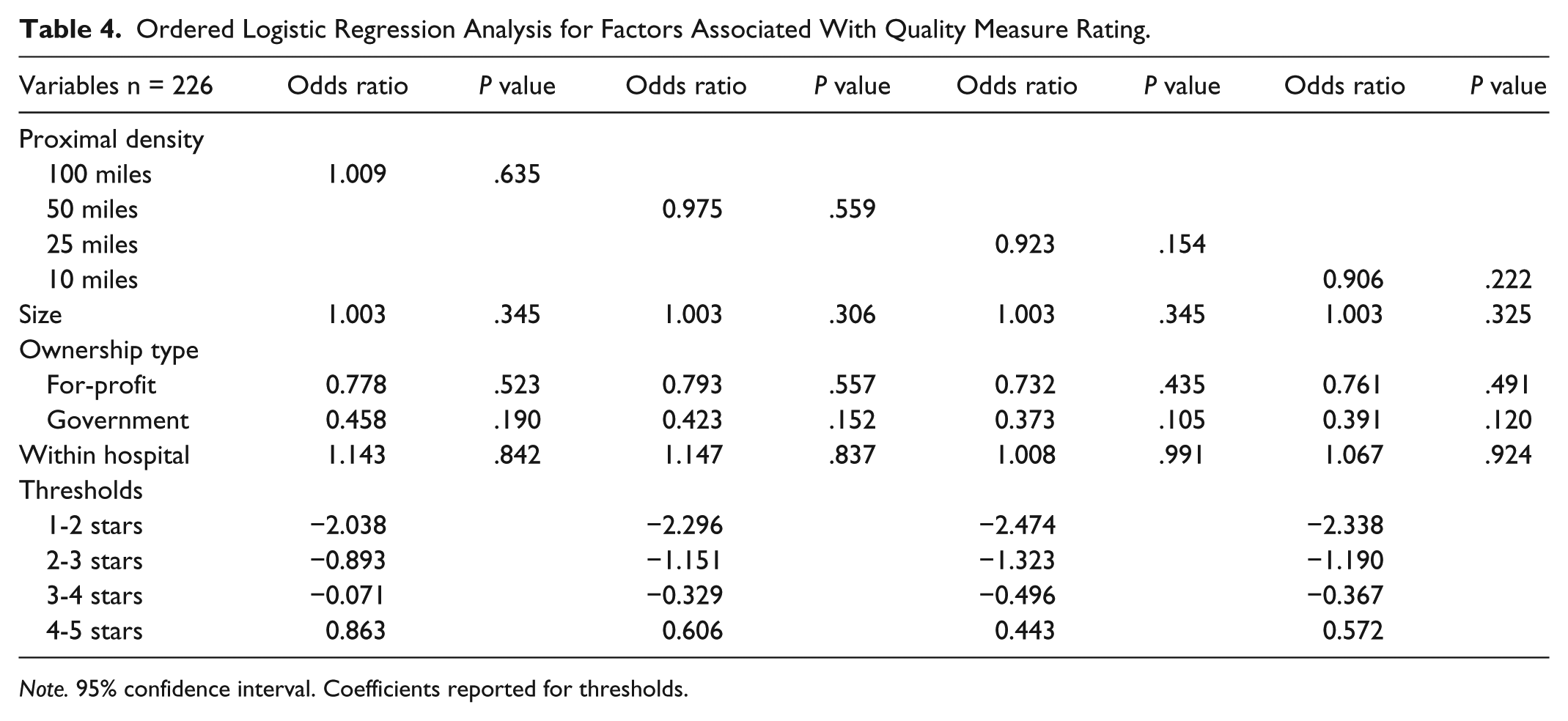
Note. 95% confidence interval. Coefficients reported for thresholds.
Ordered Logistic Regression Analysis for Factors Associated With Staffing Rating.

Note. 95% confidence interval. Coefficients reported for thresholds.
An additional sensitivity analysis was administered to determine whether the results of the principal findings are responsive to whether or not a nursing home is located within a “hot spot.” Hot spots areas are where the number of facilities is significantly different and higher than in neighboring counties. Because of the intensity of competition in hot spots, it may be the case that the nature of this relationship is different, in kind, based on whether you are in a “hot spot” or not. The results of this analysis are not presented but support the findings of the principal analysis.
Discussion
The results of the ordered regression of proximal density of nurse education resources on nursing home quality star ratings indicate a negative and significant relationship in which as the proximal density of nurse education resources increase nursing home quality outcomes diminish. Further translation of the results reveals that as proximal distances increase, the odds of receiving a higher star rating decrease. This result fails to support the hypothesis of a positive and significant relationship. In addition, this finding is significant in the Overall and Health Inspection star ratings and in the opposite hypothesized direction. Supplemental sensitivity analyses confirm these findings hold in areas of high concentration as well.
As the findings do not support the hypothesis, they fail to provide support for the social network theory. In the context of this study, nurses would be viewed as a human capital resource, and in instances when resources are more difficult to obtain, competition for those resources increase. Thus, the social network theory suggests that as competition for nurses increase, the probability of nursing homes seeking to make strong, close ties with nurse education resources should increase. However, our findings suggest that in instances with a higher concentration of nurse education resources in close proximity to a nursing home, the critical resources may be viewed as readily available. Furthermore, the results of the study reach significance in the opposite direction, which suggests that, in this context, nursing homes in closer proximity to nurse education resources are negatively associated with the development of close, strong ties.
This finding may be explained in part by the manner in which nursing homes view the proximal availability of nurses. As the majority of both the nursing homes and the nurse educational resources exist within the urban areas of the state (“hot spots”), nursing homes may perceive nurse availability as an ease of access to this valuable resource. In other words, the perceived availability of nurses in close proximity from a variety of potential sources suggests to nursing home administrators that the replacement costs of nursing staff are low. In addition, nursing home administrators in close proximity to nurse education resources often face greater competition for newly minted nurses due their shared proximity to hospitals.
Nursing programs generally having stronger ties with hospitals, which, in part, is due to the majority of nurses working in hospitals post-educational program at the state, local, and private level. 41 Adding to this dynamic, in some cases hospitals collaborate with nursing programs to fill education needs, lending to a preexisting relationship between nurses and future employers. 42 Hospitals generally offer higher salaries then nursing homes for nurses as well. 43 This has implications for nurse staffing recruitment and retention for nursing homes where competition for qualified nurses exists.44,45
As this is an examination of measures within a single state, the results are not generalizable to other states and contexts and no such claims are made. However, examining these relationships within a single state offers the benefit of eliminating all threats to the validity of the findings related to variations in state regulatory environments. Although this finding may be unique to the study context, nursing home administrators in all contexts could benefit from the understanding that proximal density to nurse education resources could be used to their competitive advantage. The differences in practice and the variations in demand across nursing levels present nontrivial considerations and a potential threat to the validity of the findings. For the sake of examining the concentration of available nurses, variations in the nursing level of each nursing education resource were not considered in this study and, instead, this examination holds all nursing levels as equal. Although the majority of nurse education resources that offer nursing programs at the higher levels (RN and above) also offer lower level (LPN and lower) programs, there is considerable variation in the level and mixture of nursing programs offered by each nursing education resource.
The results of this study contribute also to understanding the impact of the nurse education resource shortage on care quality outcomes. Findings support the notion that the geographic location of nursing education resources may change organizational behavior and performance outcomes. The findings suggest that when organizations operate in what is perceived to be a nursing surplus based on the proximal density to nurse education resources, organizations exhibit less commitment to nursing staff. In addition, the findings provide evidence that the perception of high concentrations of nursing staff replacements result in lower levels of patient reported quality in Alabama nursing homes.
Another contribution of this study is that it introduces a novel measure of organizational geographic access to resources, proximal density. The influence of this measure could be utilized to further explore the degree to which resource concentration influence organizational behavior and decision-making. In addition, this study finds that the proximal density of nurse education resources exhibits a direct relationship to nursing home care quality outcomes. Future works should seek to examine the influence of the concentration of nurse and other staffing resources on other health care outcomes and in other health care facility types. Specific to the findings of this study, future research should examine the degree the findings of this study are unique to the study context by examining these relationships in a national, generalizable sample. That being said, this study yields important new information regarding the extent to which the nursing shortage in Alabama is related to nursing home quality outcomes.
In addition, there has been a general lack of attention specific to nursing homes and long-term care quality outcomes. By addressing this gap, future policy initiatives are better equipped to understand how the nursing shortage influences these types of facilities, which are the fastest growing sector of the US health care delivery system. 45 In addition, the results of this study also identify the need to further develop social network theory; specifically, this study brings to light that the manner and contexts within which entities can develop close, strong ties may be influenced in part by the nature of their relationships and power differentials between the networking parties.
Footnotes
Declaration of Conflicting Interests
The author(s) declared no potential conflicts of interest with respect to the research, authorship, and/or publication of this article.
Funding
The author(s) received no financial support for the research, authorship, and/or publication of this article.
