



Abstract
The current study examined the bidirectional associations between perceived social support from parents, teachers, and peers with students’ internalizing and externalizing behavior problems across lower secondary school. A total of 1,746 students (47.7% girls; Mage = 13.76) in Finland completed questionnaires in Grade 7 and again in Grade 9. Based on a cross-lagged panel model, only peer support and internalizing problems showed a negative bidirectional association over time. Internalizing problems negatively predicted parental support, while parental support negatively predicted externalizing problems. Additionally, externalizing problems negatively predicted teacher support. The findings highlight the unique associations with different social support sources and show how a lack of social support may foster behavioral problems, yet the presence of behavior problems can also elicit reduced social support.
Keywords
The transition across schools is especially impactful as students enter a new academic environment while navigating numerous social changes and dynamic development in neurobiological, cognitive, and identity domains (Mastorci et al., 2024; Roeser et al., 2024). It is considered a period of vulnerability, in which internalizing and/or externalizing behavior problems may worsen (Evans et al., 2018). Students with behavior problems display lower academic engagement and achievement (Okano et al., 2020; Olivier et al., 2020), as well as higher rates of school absenteeism (Lomholt et al., 2022). It is therefore important to consider the development of behavior problems in lower secondary school (Roorda & Koomen, 2021) and identify protective factors that reduce their occurrence.
Social support has been shown to act as a buffer against negative stressors and protect against the development of mental health problems (Cohen & Wills, 1985; Simoni et al., 2020), whilst behavioral problems can also negatively impact received social support (Rueger et al., 2022). Findings from a meta-analysis reveal reciprocal associations between students’ behavior problems and perceived social support, yet evidence remains mixed due to methodological and conceptual variations (Rueger et al., 2022). It is important to consider the source of social support (i.e., from parents, teachers, peers), which take on different meaning during adolescence and show differential associations with behavior problems (Rueger et al., 2010). Furthermore, when studies focus solely on one source of support (i.e., independent associations) significant associations usually emerge, yet when studies simultaneous consider multiple sources (i.e., unique associations) only few remain significant (Rueger et al., 2010). Lastly, an examination of both internalizing and externalizing behaviors during adolescence is crucial. Hence, the current investigation aimed to examine the cross-lagged unique associations between perceived social support and behavior problems as students navigate lower secondary school.
Developmental Pathways of Social Support
The transition to secondary school is considered a period of vulnerability, in which not only academic factors fluctuate (Lomholt et al., 2022; Okano et al., 2020; Olivier et al., 2020), but internalizing and/or externalizing behaviors may worsen (Evans et al., 2018). A difficult transition period can have lasting negative impacts on students’ well-being and educational outcomes (Jindal-Snape et al., 2020). Social integration, marked by supportive peer and teacher relationships, can help ease anxiousness associated with the transition (Harris & Nowland, 2021). However, students with anxiety and poorer social skills have difficulties socially integrating (Harris & Nowland, 2021). Furthermore, parents and teachers often focus more on assisting students with academic than social adjustment (Harris & Nowland, 2021) and relationships with parents and teachers in primary school predict students’ emotional and behavioral problems in secondary school (Jaruseviciute et al., 2023). School transitions are therefore seen as a complex interaction between pre-existing and evolving internalizing and externalizing behaviors, shaped in part by interactional dynamics with various social partners.
In these social interactions and as a marker of quality relationships, lies perceived social support. When considering the influence of social support on well-being and the development of mental health problems, social support theory highlights various theoretical perspectives that essentially converge on the same underlying mechanisms (Lakey & Cohen, 2000). Within the conceptual framework, two empirically supported process models are commonly distinguished (Cohen & Wills, 1985). The stress buffering model proposes that social support protects persons from the likely detrimental impact of stressful events, while the main effect model proposes that social support has beneficial value irrespective of stressors (Cohen & Wills, 1985). Under consideration of the main effect model, social support improves general well-being, positive affect, and self-worth, thereby allowing for the adaptive social-emotional development (Cohen & Wills, 1985; Serrano-Villar et al., 2017) and academic adjustment (Vasalampi et al., 2018). The absence of social support is therefore often linked with the development or growth of internalizing and externalizing behaviors (Gregory et al., 2020; Wright & Wachs, 2019). However, from a bioecological perspective of human development, different sources of social support are important for developmental outcomes (Bronfenbrenner & Morris, 2006; Rueger et al., 2016). As such the social support from parents, teachers, and peers can each independently affect the social-emotional development of children and adolescents (Rueger et al., 2016).
Although social support is often considered only a predictive factor, the stress-generation theory postulates that internalizing behaviors can lead to the erosion of social networks and in turn loss of social support (Hammen, 2006; Rueger et al., 2022). Furthermore, the socialization theory posits that students’ display of internalizing and/or externalizing behaviors at school determines their interactions and relationships with teachers (Roorda & Koomen, 2021). As such, social support is adjusted depending on the perceptions and relationships between the individuals. Adolescents with behavior problems typically have difficulties forming relationships with teachers and peers (Krull et al., 2018; Pakarinen et al., 2018), which in turn may decrease the amount of social support received from them. Taken together, there is theoretical backing for the notion that perceived social support can influence the development of behavior problems, while behavior problems can also impact the perceived social support. A review of the literature also reveals longitudinal studies that examined associations between behavior problems and social support during adolescence.
Social Support and Internalizing Behavior Problems
Longitudinal studies have shown that parental, peer, and teacher support independently predict lower levels of internalizing behaviors across middle school (Grades 6–9; Gregory et al., 2020) and high school (Grades 7–12; Simoni et al., 2020). However, the unique predictive effect of teacher and peer support often fade when parental support is simultaneously considered (Gregory et al., 2020; Lien et al., 2016). Burke et al. (2017) found that internalizing behaviors did not predict parent support across Grade 6 to 7. Similarly, close friend support did not predict internalizing behaviors, except during the last 6 months of Grade 7 (Burke et al., 2017). Furthermore, bidirectional associations between friend support and internalizing behaviors have been found during the transition from primary school (Bernasco et al., 2021) and across 6th to 9th Grade (Siennick & Turanovic, 2024). However, bidirectional associations did not always emerge as significant, with Stice et al. (2004) finding that depressive symptoms predicted peer support 2-years later among girls in middle school, but not vice versa. Furthermore, parental support predicted depressive symptoms, but not vice versa (Stice et al., 2004). Extracting longitudinal correlations for a meta-analysis, Rueger et al. (2022) showed small yet significant bidirectional effect between parental support and depression in youth, with no gender differences. Lastly, supportive relationships with teachers negatively predict internalizing behaviors in early adolescence but not in middle adolescence, and associations in the other direction were not found (Murray et al., 2021).
Social Support and Externalizing Behavior Problems
Longitudinal studies show that parental, peer, and teacher support uniquely predict lower levels of aggressive behaviors 1 year later in middle school (Grades 7–8; Wright & Wachs, 2019). Dickson et al. (2018) reported that externalizing behaviors did not predict friend support over 1 year during middle school (Grades 6–7). Studies examining bidirectional associations during adolescence are scarce, yet do show a trend for unidirectional associations. For instance, parental support in Grade 7 was found to predict delinquency in Grade 8, while delinquency in Grade 7 did not predict parental support in Grade 8 (Walters et al., 2024). Murray et al. (2021) found that supportive teacher and peer relationships at age 11 predict aggressive behaviors at age 13, yet not from age 13 to 15. Aggressive behaviors at age 13 predicted supportive teacher relationships at age 15 (Murray et al., 2021). Roorda and Koomen (2021) found that externalizing behavior consistently predicted supportive teacher relationships across 3-month periods in lower and upper secondary school (Grades 7–8; Grades 10–11). Conversely, supportive teacher relationships did not predict externalizing behaviors (Roorda & Koomen, 2021).
Collectively, these study findings underscore that examinations of bidirectional associations between social support and behavior problems during secondary school remain scarce and display mixed findings, promoting scholars to call for more research to enhance our understanding, replicate findings, and reflect on the generalizability thereof (Rueger et al., 2016; Walters et al., 2024). Especially studies that include different sources of perceived social support and utilize longitudinal designs are considered vital research endeavors (Burke et al., 2017; Rueger et al., 2016; Rueger et al., 2022). The combination of gaps in the literature and ongoing calls for further research paved the way for the conceptualization of the current investigation.
Current Investigation
The current investigation sought to examine the bidirectional associations between perceived social support and behavior problems, distinguishing between the social support from parents, teachers, and peers. We specifically chose to focus on lower secondary school, a pivotal stage marking the transition to a new educational environment in which students need to navigate new social structures (Evans et al., 2018; Harris & Nowland, 2021; Roeser et al., 2024). The first timepoint occurs in Grade 7, which represents the initial adjustment phase, while the second timepoint takes place 2 years later, in Grade 9. This period offers a distinctive opportunity to examine the association between behavior problems and different social support sources. Parental support tends to remain more stable as it involves ongoing interactions with the same family members, providing a consistent foundation for the students (Virtanen et al., 2022). When transitioning to Grade 7, students are introduced to new subject teachers with whom they often have no prior relationship, nor do teachers have an established understanding of the students’ needs and behavior problems. Additionally, students navigate continuity and discontinuity with peers, as they transitioned with familiar students from their primary school, while new class constellations and unfamiliar students from other schools are present (Virtanen et al., 2022).
An important methodological consideration that impacted the findings of previous research, is the focus on either the independent or unique associations of each social support source (Rueger et al., 2010). Some studies have purposefully focused on determining the individual and independent predictive effect of a specific social support source (e.g., Stice et al., 2004), whilst others focus on determining the unique predictive contribution under consideration of other social support sources (Rueger et al., 2010). Importantly, the interpretations are not comparable, yet both provide valid and valuable insights (Rueger et al., 2010). Although presenting independent associations, the focus of the current investigation is on the unique associations to determine which sources emerge as noteworthy above and beyond other sources of support.
Thus, the aim of the current investigation was to examine which bidirectional associations emerge between the different sources of social support and behavior problems for students across lower secondary school. Specifically, we investigated whether perceived social support from parents, teachers, and peers would act as a predictor of behavior problems (relationship-driven model), students’ internalizing and externalizing behavior problems would predict social support (student-driven model), or whether they would bidirectionally influence each other over time (bidirectional model). Given the mixed findings across studies examining the independent and unique associations of different sources of social support (Gregory et al., 2020; Rueger et al., 2010), which revealed varying unidirectional and bidirectional associations with behavior problems (e.g., Murray et al., 2021; Siennick and Turanovic, 2024; Stice et al., 2004; Walters et al., 2024), we based our hypotheses on conceptual frameworks emphasizing that low perceived social support can foster behavioral problems (Cohen & Wills, 1985; Lakey & Cohen, 2000), and behavioral problems can elicit reduced social support (Hammen, 2006; Roorda & Koomen, 2021; Rueger et al., 2022). We thus hypothesized bidirectional associations, namely that (1) all sources of support would be negatively associated with behavior problems 2 years later, and vice versa, that (2) both behavior problems would be negatively associated with support from all sources 2 years later.
Methods
Procedure and Participants
The data used for the current investigation come from the First Steps study (Lerkkanen et al., 2006–2016), with ethical approval obtained from University of Jyväskylä. In the study, approximately 2,000 children were followed from kindergarten to the end of lower secondary school (Grade 9) in four Finnish municipalities. Participation was voluntary and written consent was obtained from parents/guardians. In Finland, students complete 6 years of primary school before transitioning to compulsory lower secondary school, which spans from Grade 7 to Grade 9. The sample of the present study consisted of 1,746 students, whose data were collected in the spring of Grade 7. Of these 52.3% were boys and 47.7% were girls, with a mean age of 13.76 (SD = 0.33). They completed questionnaires on school premises during normal school lessons. Trained research assistants administered the questionnaires in the classrooms. Two years later, in the spring of Grade 9 (Mage = 15.73, SDage = 0.33), the students completed the same questionnaires again. Regarding parental school education (i.e., highest amongst both parents), 57.2% completed higher secondary school and 22.3% completed only lower secondary school or less (20.5% missing).
Measures
To assess perceived social support students were asked to complete a short version of the Student Engagement Instrument (SEI; Appleton et al., 2006). Twelve items were answered on a scale ranging from (1) strongly disagree to (4) strongly agree, forming the scales Parental Support (e.g., supportive, helpful), Teacher Support (e.g., caring, listening, fair), and Peer Support from schoolmates (e.g., accepting, supportive, caring) as perceived by students.
To assess behavior problems students completed the self-report version of the Strengths and Difficulties Questionnaire (SDQ; Goodman, 1997; Koskelainen et al., 2000). The Internalizing Behavior Problems scale included 10 items on emotional problems (e.g., worrying, nervousness, fearful) and peer problems (e.g., reclusive, disliked, teased). The Externalizing Behavior Problems scale included 10 items on hyperactivity (e.g., restless, fidgety, impulsive) and conduct problems (e.g., stealing, lying, fighting). All items were answered on a scale ranging from (1) not true to (3) certainly true.
Data Analyses
A total of 1,746 participants took part in Grade 7, of which 122 did not complete questionnaires in Grade 9. We conducted an analysis of missing data patterns, which revealed between 1.5% and 9.3% missing values for perceived social support and behavior problem variables. The high percentage of missing values for parental educational (20.5%) is due to this information being assessed separately from the parents. Little’s MCAR test was not significant, χ2 = 369.86, df = 338, p = .11, indicating that the data were missing completely at random. The data were imputed in the cross-lagged path model in AMOS, with a regression imputation based on maximum likelihood. This imputed dataset was also used for reporting all correlational analyses in the results section. Separate models were built for the confirmatory factor analysis (CFA) of the instruments, utilizing maximum likelihood estimations and model fit indices as mentioned below. For the SEI a correlated three factor model was chosen, and for the SDQ a correlated two factor model (with internal cross-loading between items for emotional problems, peer problems, conduct problems, and hyperactivity). Furthermore, the internal consistency reliability of the subscales was tested with Cronbach’s alpha (α) and McDonald’s Omega (ω).
Independent associations between the sources of perceived social support and behavioral problems were investigated using zero-order correlations. Unique associations between perceived social support and internalizing and externalizing behaviors were examined with a cross-lagged path model in AMOS 29. The model included within-time correlations (i.e., correlations between all variables in Grade 7 and correlations amongst error terms in Grade 9), autoregressive paths (i.e., prediction of variables in Grade 9 by the same variable in Grade 7), and cross-lagged paths (i.e., prediction of variables in Grade 9 by other variables measured in Grade 7). Cross-lagged paths between the different sources of social support were not included, nor between internalizing and externalizing behaviors. Gender and parental education were included as covariates, with direct paths to all variables in Grade 9, and correlations with all variables in Grade 7. Values higher than .90 for Comparative Fit Index (CFI)/Tucker-Lewis Index (TLI) indicate an adequate model fit (Bentler & Bonett, 1980; Marsh & Hau, 1996), and lower than .06 for root mean square error of approximation (RMSEA) indicate a good fit (Hu & Bentler, 1999).
Results
Instrument Reliability
The intercorrelations among scales of each instrument were moderate in magnitude (.33 to .44; see Table 1), suggesting that the scales are measuring related but distinct constructs with low possibility for multicollinearity. The internal consistency was good for the SEI scales (α/ω > .80) and adequate for the SDQ scales (α/ω > .70) in both Grades 7 and 9 (see Table 2). As shown in Table 2, the CFA demonstrated a good fit for the three-factor model of the SEI in Grades 7 and 9. The CFA for the two-factor model of the SDQ revealed less than adequate model fit values in Grades 7 and 9; removing reversed items slightly improved model fit, but values remained below the threshold.
Correlations Between Perceived Social Support and Behavior Problems in Grades 7 and 9.
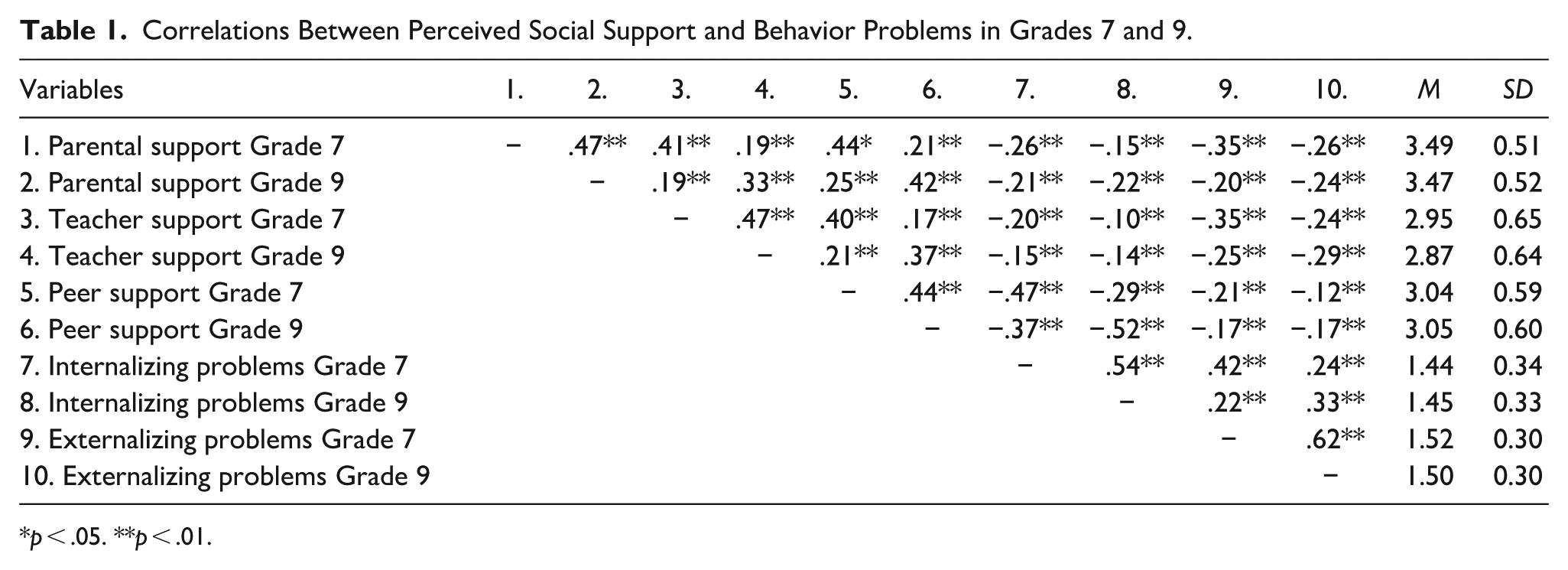
p < .05. **p < .01.
Internal Reliability and CFA Model Fit Indices of the Instruments in Grades 7 and 9.
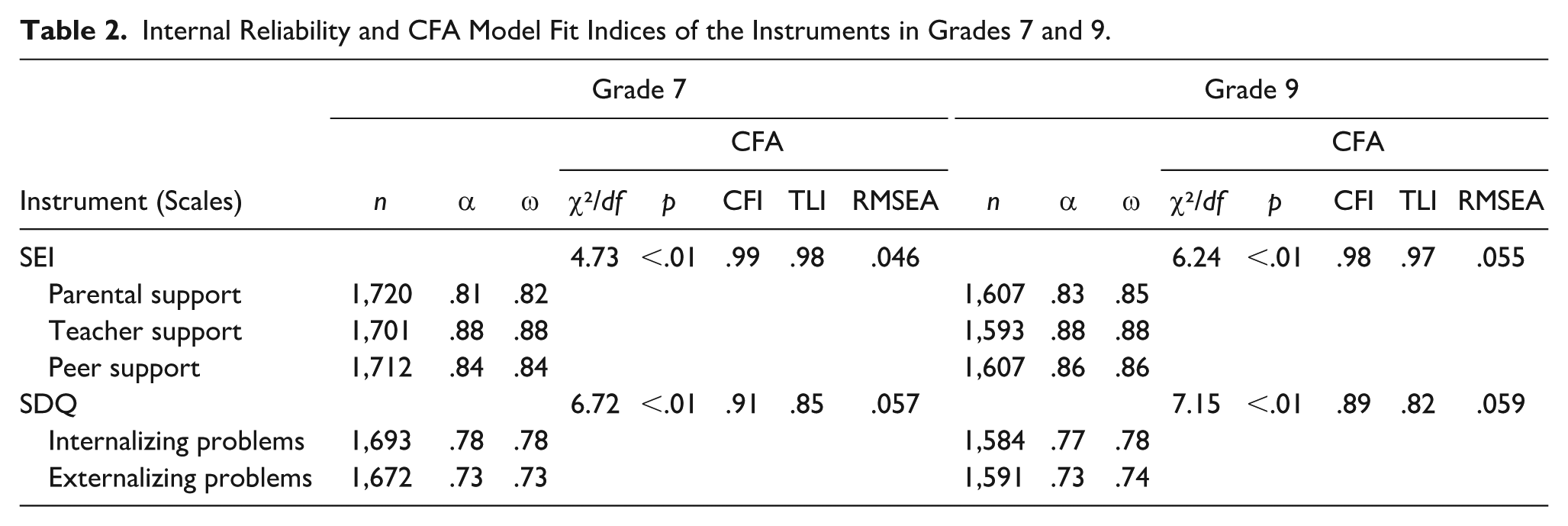
Independent Associations: Correlations
Table 1 displays all correlations between the social support and behavior problem scales in Grades 7 and 9. Social support from all sources in Grade 7 was significantly and negatively related to behavior problems in Grade 9. Specifically, support from parents, teachers, and peers showed independent associations with both internalizing and externalizing behaviors. Furthermore, behavior problems in Grade 7 were significantly and negatively related to social support from all sources in Grade 9. Specifically, both internalizing and externalizing behaviors showed independent associations with support from parents, teachers, and peers. Most correlations emerged as small, apart from peer support and internalizing behaviors, which revealed a moderate correlation. All correlations remained significant when examined separately for girls and boys.
Unique Associations: Cross-Lagged Path Model
The tested cross-lagged path model demonstrated good fit values, χ2(9) = 5.56, p = .78, CFI = 1.00, TLI = 1.00, RMSEA = .00 (90% CI [0.00, 0.02]). Table 3 displays the regression coefficients for the autoregressive paths and the cross-lagged paths, as well as the covariate paths. All autoregressive paths were significant, and for each variable in Grade 9 the strongest predictor was the same variable in Grade 7 (β’s ranging from .34 to .60). Figure 1 depicts the significant cross-lagged paths in the tested model. Perceived parental support in Grade 7 negatively predicted externalizing behaviors in Grade 9 (β = −.05, p = .03), whilst externalizing behaviors in Grade 7 negatively predicted perceived teacher support in Grade 9 (β = −.09, p < .001). Furthermore, internalizing behavior in Grade 7 negatively predicted parental support in Grade 9 (β = −.11, p < .001). Emerging as the only bidirectional association, perceived peer support in Grade 7 negatively predicted internalizing behavior in Grade 9 (β = −.06, p = .02), and internalizing behavior in Grade 7 negatively predicted perceived peer support in Grade 9 (β = −.19, p < .001). The beta-values of the individual paths from internalizing behavior to parent and peer support were moderate, whilst all other cross-lagged paths were small. Under consideration of all predictor variables, a substantial amount of variance explained in all Grade 9 variables (R2ParentSupport = .24, R2TeacherSupport = .23, R2PeerSupport = .23, R2InternalizingBehavior = .31, R2ExternalizingBehavior = .40).
Regression Coefficients from the Tested Cross-Lagged Panel Model.
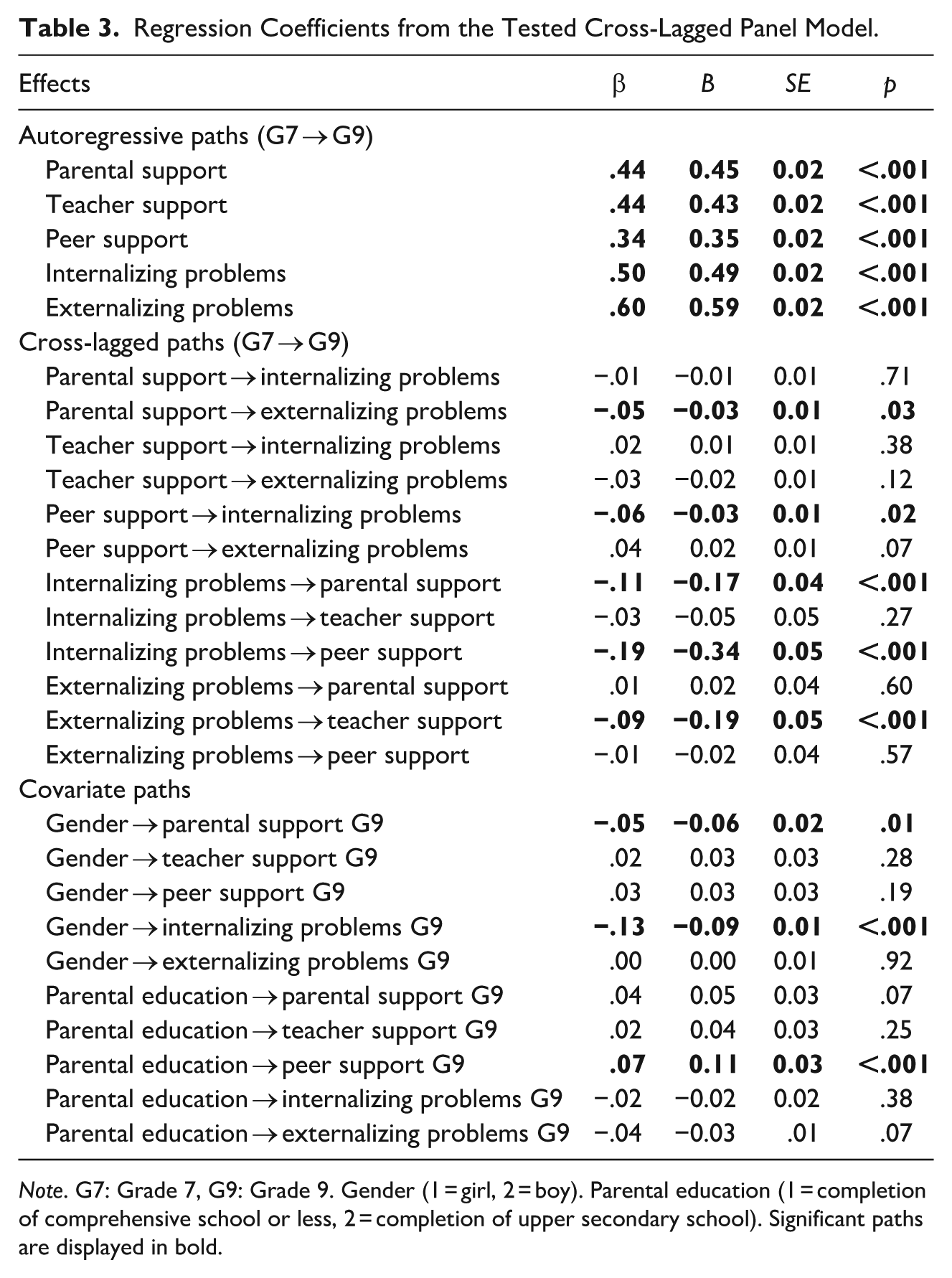
Note. G7: Grade 7, G9: Grade 9. Gender (1 = girl, 2 = boy). Parental education (1 = completion of comprehensive school or less, 2 = completion of upper secondary school). Significant paths are displayed in bold.
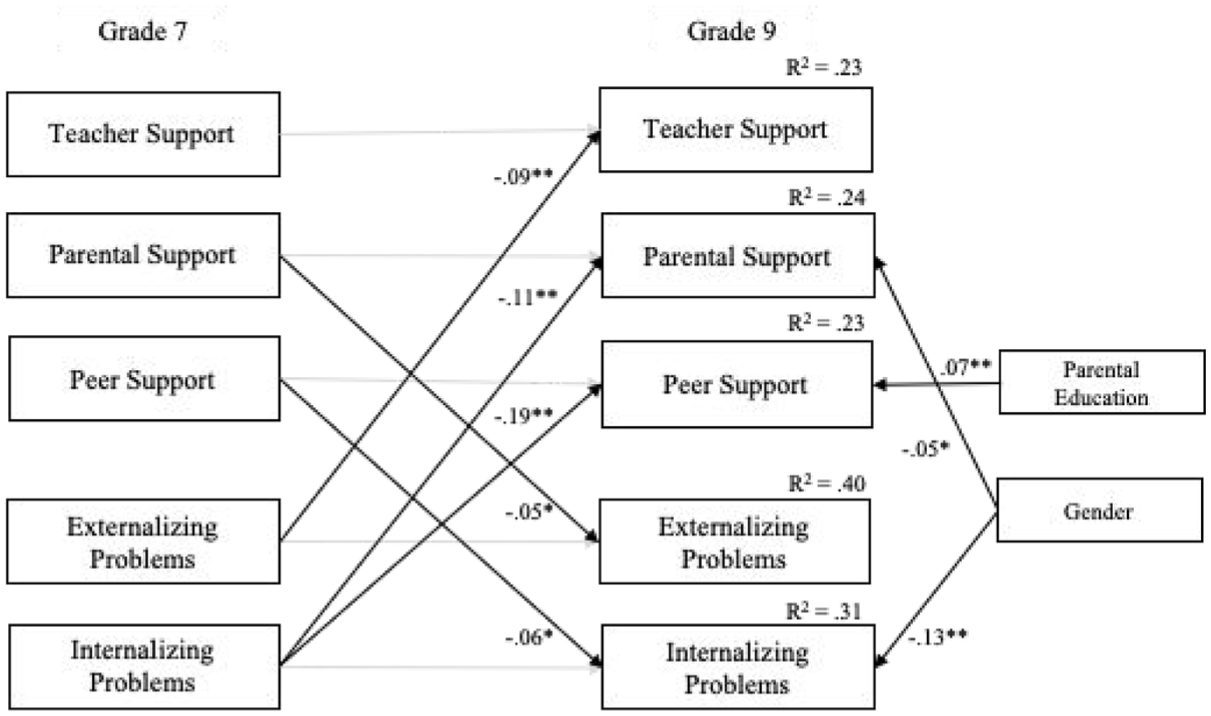
Significant cross-lagged paths for perceived social support and behavior problems across lower secondary school.
Discussion
The aim of the current investigation was to examine whether bidirectional associations emerge between the different sources of perceived social support and behavior problems for students across lower secondary school. An examination of the independent associations aligned with previous findings (e.g., Gregory et al., 2020; Walters et al., 2024) and developmental frameworks (e.g., bioecological model of human development, Bronfenbrenner & Morris, 2006), revealing that all sources of social support are longitudinally correlated with internalizing and externalizing behaviors, and vice versa, all behavior problems are longitudinally correlated with reduced perceived social support from parents, teachers, and peers during lower secondary school. These findings underscore theoretical contemplations that perceived social support can promote behavioral problems (e.g., social support theory, Cohen & Wills, 1985; Lakey & Cohen, 2000), and behavioral problems can elicit reduced social support (e.g., stress-generation theory, socialization theory; Hammen, 2006; Roorda & Koomen, 2021), thereby showing that influence in both directions (Rueger et al., 2022). However, with the cross-lagged model we further examined the bidirectional effects, which included autoregressive paths and controlling for gender and parental education. Based on this, unique associations between the source of perceived social support and behavior problems were determined, along with examinations of unidirectional and bidirectional effects.
Social Support and Externalizing Behavior Problems
No bidirectional associations were found between perceived social support and externalizing behaviors. The findings showed that perceived parental support remains crucial for adolescents’ social-emotional development, as it was the only remaining significant source predicting externalizing behaviors at the end of lower secondary school. Like our findings, Walters et al. (2024) found only that parental support in Grade 6 predicted delinquency in Grade 8, but not vice versa. It could be that bidirectional associations with parental factors are more likely during childhood than adolescence (Arım et al., 2011). As parental support is the main predictor of externalizing behaviors in lower secondary school, parental programs that emphasize the importance of quality time and support over the transition period can be beneficial (Knoppick et al., 2018).
Aligning with previous findings on teacher-student relationships (Murray et al., 2021; Roorda & Koomen, 2021), externalizing behaviors negatively predicted teacher support 2 years later but not vice versa. During adolescence, teacher support is likely overshadowed by the retained importance of parents and gaining significance of peers (Goldstein et al., 2005), as well as structural school changes, whereby classroom teachers are replaced with subject teachers in lower secondary school. Yet externalizing behaviors are related to reduced support from teachers over time, aligning with findings that teacher-student relationships are often more conflictual with students demonstrating externalizing problems (Lei et al., 2016; Pakarinen et al., 2018). However, it is especially these students who benefit from emotionally supportive teachers (Hoogendijk et al., 2020), which further underscores the need for secondary school teachers to receive more training on relationship building (Lind et al., 2017). Furthermore, it is important to provide teachers with supervisory support and resources, so that they have the capacity to form supportive relationships with their students (Chan et al., 2023).
Neither peer support nor externalizing behaviors predicted the other. Although mixed findings are reported, studies have shown no concurrent or longitudinal unique associations between classmate and friend support and externalizing behaviors during adolescence (Attar-Schwartz et al., 2019; Dickson et al., 2018; Schüürmann & Goagoses, 2022). Attar-Schwartz et al. (2019) note that the findings do not necessarily indicate that peers are insignificant for students’ externalizing behaviors, but rather that parental support plays a more crucial role. Rather than having a direct effect, it could be that peer support operates as a stress buffering mechanism, playing a bigger role for adolescents exposed to adverse environments (e.g., Korol et al., 2020; Tucker et al., 2020).
Social Support and Internalizing Behavior Problems
The cross-lagged model revealed that perceived parental support at the onset of lower secondary school did not predict students’ later internalizing behaviors. This is contrary to the association with externalizing behaviors, and findings from a meta-analysis that showed reciprocal independent associations between parental support and depression (Rueger et al., 2022). Despite independent associations, our findings reveal that when simultaneously considering other sources of support, parental support is no longer a significant predictor of internalizing behaviors. This was also reported by Nilsen et al. (2013), whereby parental support at age 14 was not predictive of depression 2 years later when also including peer and teacher support. However, internalizing behaviors did predict decreased perceived parental support at the end of lower secondary school. Adolescents and young people with depressive symptoms have disclosed that they often withdraw from others and are hesitant to share their feelings, even putting up a façade so that others will not notice, and avoid seeking help (Achterbergh et al., 2020; Yamaguchi et al., 2023). The social withdrawal and concealment of problems could result in reduced parental support (Zhang et al., 2024), as parents may not realize the necessity of providing increased social support. Improving parents’ mental health literacy, which could guide them at identifying internalizing behaviors during adolescence, can be an important first step (Johnson et al., 2023; Marsico et al., 2022).
In the current investigation, perceived teacher support did not show an association with internalizing behaviors in any direction, aligning with studies that found teacher support did not predict depressive symptoms when accounting for other sources (Gregory et al., 2020; Nilsen et al., 2013; Zhang et al., 2024). Although ideally internalizing behaviors should elicit increased teacher support, the current findings reveal no longitudinal association. This could be due to internalizing behaviors not being noticed or being deemed less serious by teachers (Splett et al., 2019), indicating the need for multitiered systems of social support at school (Weist et al., 2018). Even in lower secondary school, teachers should promote a positive school climate, with supportive relationships benefiting students with behavior problems (Voight & Nation, 2016).
The unique association between perceived peer support and internalizing behaviors was the only one to demonstrate bidirectionality. Thus, the less peer support at the beginning of the lower secondary school, the more internalizing behaviors 2 years later, and the more internalizing behaviors at onset, the less peer support they perceived later in lower secondary school. Although previous findings are inconsistent, there are studies which similarly found bidirectional associations (e.g., Bernasco et al., 2021; Burke et al., 2017). Increased social withdrawal and higher school absenteeism may explain why students with internalizing behaviors perceive less social support from their peers (Achterbergh et al., 2020; Finning et al., 2019; Zhang et al., 2024). Furthermore, adolescents with behavior problems often struggle to convey their positive attributes to peers (Goagoses & Eilts, 2024) and form connections with classmates (Krull et al., 2018), who are then less likely to offer support. Lacking social support may be perceived as peer rejection as well as evoking feelings of loneliness and lack of school belonging, which in turn exasperate internalizing behaviors (Achterbergh et al., 2020; Platt et al., 2013; Raniti et al., 2022). The bidirectional associations underscore the need for school-based programs that target both students’ internalizing behaviors and support for schoolmates. For instance, the Michigan Peer-to-Peer Depression Awareness Program enlists students to improve their depression literacy, help create a supportive school environment, connect peers with appropriate resources, and encourage both others and themselves to seek help when feeling depressed (Parikh et al., 2018). Furthermore, the findings underscore the need for social-emotional learning to extend into secondary school (see Rutledge et al., 2015; Tan et al., 2018), with sensitization therefor among teachers and continued resources for schools.
Limitations and Future Directions
Although the utilization of cross-lagged models has some limitations (Hamaker et al., 2015), they remain a useful analysis tool for developmental research, offering important explorative insights for examined associations (Selig & Little, 2012). While CFI/TLI values for the SDQ were slightly below the .90 threshold, RMSEA and internal consistency values indicated adequate model fit and reliability. This may by a reflection of modeling the SDQ with only two factors rather than the original three (i.e., prosocial scale not included), and that internalizing/externalizing problems are broadband scales including a wide range of symptoms (Achenbach et al., 2016). Future research could explore how perceived social support from one source may influence that from another; for instance, studies have shown that peer acceptance predicts teacher support (Weyns et al., 2018), hinting that peer support could affect teacher support over time. Furthermore, it might be important to consider how support perceptions are formed by children and adolescents with behavior problems. Perceived social support is in part a cognitive process (Lakey & Cassady, 1990), and children with behavior problems show differences in their social information processing (Crick & Dodge, 1994), which could alter how received social support is processed and interpreted. So, although perceived social support is often regarded as more important than received support (Haber et al., 2007), future studies that assess both could provide valuable insights, particularly when focusing on students with behavior problems.
Conclusion
This current investigation contributes to the much-needed body of research showing how social support can shape behavior problems during lower secondary school, and how, in turn, behavior problems can impact perceived social support. By examining bidirectional associations between perceived social support and behavior problems, the findings reveal distinct patterns that advance the understanding of these complex dynamics. Continued accumulation of such findings will allow for stronger conclusions and broader generalizability across educational contexts. While only peer support and internalizing behaviors showed a reciprocal association, further unidirectional associations were also identified. Importantly, the results point to actionable avenues for prevention and intervention, as the distinct associations with different sources of social support highlight the need for a multifaceted approach that strengthens supportive relationships with parents, peers, and teachers for students with and without behavior problems.
Footnotes
Data Availability Statement
The datasets generated during and/or analyzed during the current study are not publicly available.
Declaration of Conflicting Interests
The authors declared no potential conflicts of interest with respect to the research, authorship, and/or publication of this article.
Ethical Approval
The data used for the current investigation come from the First Steps study, with ethical approval obtained from the University of Jyväskylä.
Funding
The authors disclosed receipt of the following financial support for the research, authorship, and/or publication of this article: The present study is a part of the EDUCA Flagship funded by the Research Council of Finland (nro 358924) and grant from the same funding resource (nro 268586).
Informed Consent Statements
Participation was voluntary and written consent was obtained from parents/guardians.
