



Abstract
The Positive Youth Development (PYD) framework emphasizes adolescents’ strengths and the role of supportive environments in fostering positive development (Lerner et al., 2015). This study investigates the role of psychological need satisfaction (PNS) in PYD outcomes across structured and unstructured out-of-school time (OST) contexts. Data were collected from 832 U.S. adolescents (mean age = 15.78, SD = 1.16, 56.2% female, 53.4% non-Hispanic White) involved in afterschool programs (structured context) who also reported using local parks (unstructured context). Structural equation modeling assessed the relationship between demographic variables, participation frequency, PNS, and PYD. Results indicate that participation frequency had the strongest relationship with PNS in both types of OST. Furthermore, satisfaction of the need for relatedness in parks, and competence and relatedness in programs, were significantly related to adolescents’ PYD. These findings underscore the importance of fostering psychological need satisfaction in both structured and unstructured OST to support adolescents’ developmental needs.
Keywords
Supporting adolescents’ development requires understanding how different contexts influence them (Smetana et al., 2006). Positive youth development (PYD) emphasizes that development occurs through interactions between individuals and their contexts, which include physical settings, social environments, and broader societal norms (Bronfenbrenner & Morris, 2006; Lerner et al., 2014). These contexts can amplify adolescents’ strengths by offering opportunities for exploration, fostering supportive relationships, and promoting values (Daniel et al., 2012; Zarrett et al., 2009), making it essential to explore their role in fostering PYD. Several frameworks have been designed to operationalize PYD. In this study, we adopt the five Cs model of PYD developed by Lerner et al. (2005), which identifies five foundational components of adolescent thriving: competence, confidence, connection, character, and caring. These dimensions are theorized to collectively support the sixth C of contribution to self, family, community, and civil society (Lerner et al., 2005).
In Western industrialized countries, adolescents spend nearly half of their day outside school, highlighting the importance of out-of-school time (OST) as a developmental context (Wight et al., 2009). OST activities provide valuable opportunities for skill-building, social connection, and a sense of belonging, all of which support PYD (Zarrett et al., 2009). These activities can be categorized as structured or unstructured, differing in organization, supervision, and emphasis on skill-building (L. L. Caldwell & Faulk, 2013; Mahoney et al., 2006).
This study focuses on two OST contexts: after-school programs as structured OST and local public parks as unstructured OST, to explore how these settings relate to psychological need satisfaction (PNS) and PYD. Examples of afterschool programs in our study include academic programs, community service programs, arts and music clubs, organized sports, and recreation programs. Specifically, we examine whether psychological need satisfaction (autonomy, competence, and relatedness) mediates the relationship between adolescents’ demographic variables and participation frequency in these contexts and their PYD outcomes. PNS is a critical mechanism through which PYD is fostered (Deci & Vansteenkiste, 2004) as it supports outcomes such as prosocial behaviors, positive affect, and mental health (Alivernini et al., 2023; Buenconsejo & Datu, 2024). However, there is a lack of research comparing how structured and unstructured OST contexts satisfy adolescents’ psychological needs. Addressing this gap can provide valuable insights to help families and community organizations create environments that effectively support youth development.
Positive Youth Development in Out of School Time Contexts
The PYD framework highlights adolescents’ strengths, such as competence, confidence, character, caring, and connection, and emphasizes that these strengths can be fostered through supportive environments (Lerner, 2018). Structured OST contexts, like afterschool programs, are considered to be supportive environments that enable growth and well-being through positive interactions and skill-building opportunities (Lerner et al., 2015). Participation in structured programs and organized sports is associated with positive developmental outcomes (Ettekal & Agans, 2020) such as socioemotional development (Berger et al., 2020), physical and psychological well-being (H. A. Caldwell et al., 2022), and academic achievement (Vandell et al., 2022).
However, adolescents also spend time in unstructured OST contexts (Afterschool Alliance, 2020). Unstructured OST includes activities without structured goals, guidance, or supervision, like watching TV or going to parks or malls (Kim et al., 2020). While there is a common assumption that unsupervised time may lead to delinquency or risky behavior (L. L. Caldwell & Faulk, 2013), it is important to recognize that adolescents seek an increased sense of autonomy during this period of life (Harris-McKoy & Cui, 2013). Unstructured OST offers adolescents an opportunity to exercise autonomy by choosing activities independently (Walker et al., 2020). Additionally, unstructured OST contexts such as parks and green spaces promote physical activity, enhanced mental well-being, and prosocial behavior (Hunter et al., 2019). However, unstructured OST contexts such as parks and green spaces have received less attention in developmental literature (Mainella et al., 2011).
Participation frequency significantly impacts the benefits of OST involvement; adolescents who consistently engage in OST activities are more likely to experience PNS and PYD (Fredricks, 2011). However, the availability of both structured and unstructured OST opportunities and the quality of adolescents’ experiences in them are related to individual and community-level demographic factors. For instance, systemic inequalities shape access, as Black and Latinx communities disproportionately encounter barriers like limited programs, transportation challenges, and high costs, restricting participation in high-quality OST programs (Afterschool Alliance, 2020). These inequalities also contribute to disparities in experiences within parks, with safety and comfort often varying by racial and ethnic background (Hoover & Lim, 2021). Residential community type adds another layer of complexity; urban youth may have access to more structured OST programs, but face challenges like overcrowded parks or safety concerns that discourage unstructured outdoor activities (Rivera et al., 2022). In contrast, rural youth may have greater access to natural environments but fewer structured programs (Afterschool Alliance, 2020). Gender differences further shape participation; female adolescents, for example, report a reduced sense of safety in parks (Liu et al., 2024). It is therefore important to examine PYD in OST contexts in relation to these demographic factors.
Psychological Need Satisfaction: A Tool for Positive Youth Development
Psychological need satisfaction (PNS) is essential for optimal development (Deci & Vansteenkiste, 2004). As operationalized in Ryan and Deci’s (2000) self-determination theory (SDT), the three basic psychological needs are autonomy, competence, and relatedness. Autonomy refers to perceiving one’s actions as voluntary and self-endorsed. Competence involves perceiving one’s actions as effective and having mastery over one’s environment. Relatedness includes feelings of closeness and connection in daily interactions (Deci & Ryan, 2000; Ryan & Deci, 2020).
Studies show that satisfaction of these psychological needs predicts positive developmental experiences in youth (Alivernini et al., 2023; Tadesse et al., 2022). Specifically, prior research shows that PNS can positively predict prosocial behaviors and positive affect in youth and greater psychological well-being (Alivernini et al., 2023; Buenconsejo & Datu, 2024). Afterschool programs can foster PNS and promote PYD (Bean et al., 2021), helping youth internalize skills and apply them in other settings (Deci & Vansteenkiste, 2004). However, because such programs are designed for specific skill-building goals, they may offer less autonomy than unstructured OST contexts. The freedom offered in unstructured OST activities has the potential to both promote PYD (Ward & Zabriskie, 2011) and to be detrimental to youth health and development (Weybright et al., 2019). Unstructured OST may increase the likelihood of risky behaviors (L. L. Caldwell & Faulk, 2013) and has been linked to higher odds of substance use (Kotlaja et al., 2018). However, the heightened need for autonomy during adolescence (Harris-McKoy & Cui, 2013) makes autonomy-supportive contexts crucial for fostering self-determination (Ramsing & Sibthorp, 2008).
Parks and green spaces have only recently begun to be specifically studied for their potential association with PNS (Landon et al., 2021). Previous qualitative work demonstrates that parks and green spaces offer adolescents opportunities to explore behaviors autonomously, develop social and individual identities by meeting peers and exploring their own world, unaccompanied and unsupervised by adults (Lloyd et al., 2008). Unstructured OST supports healthy development by enabling self-expression (e.g., Kleiber, 1999). Additionally, local park use enhances place attachment (Bazrafshan et al., 2021), fulfilling the need for belonging by reinforcing social ties and community connection (Scannell & Gifford, 2017). Given the distinct characteristics of OST contexts, it is crucial to explore the nuances of need satisfaction within these contexts and its relationship with adolescent development.
The Present Study
Employing structural equation modeling, this study examines the relationships among demographic variables such as age, gender, race, residential type, and our focal constructs: PNS in afterschool programs and parks, and PYD. Specifically, this study addresses the following research questions:
How does frequency of attendance/visitation relate to PNS in afterschool programs and parks?
What is the relationship between demographic variables (age, race, gender, and community type) and PNS in afterschool programs and parks?
What is the relationship between PYD and PNS in afterschool programs and parks?
Understanding how OST activities support adolescents’ PNS and foster PYD provides insights for improving program efficacy and guiding families, community organizations, and municipalities in creating contexts that better support youth.
Method
This study used cross-sectional survey data from U.S. adolescents, exploring their experiences in afterschool programs and local parks. Mplus (version 8.10) was used for modeling analyses. Missingness analysis showed that out of 832 participants, only 24 (2.8%) submitted surveys containing missing data. Little’s MCAR test showed that the missingness was not completely at random (χ2 = 1,315.353, df = 984, p = .000). A pattern of missingness was identified for the variable age, however, age was not a key variable in this study and showed less than 1% missingness. To address this missingness and mild non-normality, maximum likelihood estimation with robust standard errors (MLR) was used in the analyses (Shi et al., 2021).
Procedures
A nationally representative sample was collected using a survey distributed through a Qualtrics panel to adolescents aged 13 to 17 between April 2023 and July 2023. Qualtrics is a national research panel, which maintains a diverse pool of U.S.-based respondents (Qualtrics, 2020). Adult members of the research panel received an invitation to allow their adolescent children to take this study’s survey. Prior to participation, both parental consent and adolescent assent were obtained in accordance with institutional review board (IRB) guidelines. Rigorous data screening was conducted by the Qualtrics team and the authors to ensure data quality. Participants who failed multiple attention check questions, provided nonsensical responses to open-ended questions, and completed the survey in an unreasonably short amount of time were removed from the sample. Responses coming from the same IP address with matching demographic information were also removed (see Agans et al., 2024 for the importance of careful screening of online data).
Participants
Participants in this study were representative of the U.S. adolescent population. 832 U.S. adolescents (average age = 15.78, SD = 1.16, 39.8% male, 56.2% female, 4.0% nonbinary) participating in an afterschool program and with access to a local park within 15 min participated in the study. When completing the racial demographic question, participants could select all that applied to describe their racial identity. In this sample, 112 (13.5%) participants were identified as multiracial, 539 (64.7%) participants identified as White, 181 (21.7%) identified as Hispanic or Latino/Latina, 108 (12.9%) identified as Black or African American, 76 (9.1%) identified as Asian or Asian American, 17 (2.0%) identified other race/ethnicity, 16 (1.9%) identified as Middle Eastern or North African, and 10 (1.2%) identified Native Hawaiian or other Pacific Islander as a part of their racial identity. Participants occupied the following residential community types: 93 (11.2%) large city, 252 (30.3%) suburb of a large city, 200 (24.0%) smaller city, 218 (26.2%) town, and 69 (8.3%) rural area. Regarding afterschool program attendance, 34 adolescents (4.1%) reported attending once a month, 100 (12%) several times a month, 154 (18.5%) once a week, 260 (31.3%) multiple times a week, 189 (22.7%) almost every day, and 94 (11.3%) every day. In terms of park visitation frequency, 98 adolescents (11.8%) reported visiting parks once a year, 114 (13.7%) once every 6 months, 134 (16.1%) once every 3 months, 239 (28.7%) once a month, 145 (17.4%) once a week, 74 (8.9%) three times a week, and 28 (3.4%) every day.
Measures
Demographics
Participants reported demographic information including age, race/ethnicity, gender, and residential community type. Age was reported as an open-ended response. For gender, participants selected from male, female, and nonbinary. Race/ethnicity was reported by selecting all applicable options: White, American Indian or Alaska Native, Asian or Asian American, Black or African American, Hispanic or Latino/Latina, Middle Eastern or North African, Native Hawaiian or other Pacific Islander, and Other. Participants who marked more than one option were labeled multiracial. To report residential community type, participants selected from large city, suburb of a large city, smaller city, town, or rural area.
Program Attendance Frequency
Participants were first asked if they participated in an afterschool program. If they answered yes, they were then asked, “How frequently do you participate in your afterschool program?” Response options included: once a month, multiple times a month, once a week, multiple times a week, almost every day, and every day.
Park Visitation Frequency
To assess how frequently adolescents use their local park, they were asked to answer the question “How frequently do you visit your local park?” with the response options being never, yearly, once in 6 months, once in 3 months, once a month, once a week, 3 times a week, and daily. A local park was defined as “a park you can get to in 15 min or less.”
Psychological Need Satisfaction
To assess PNS in afterschool programs and parks, we adapted Ryan and Deci’s (2000) need satisfaction scale, which includes 22 items on a 7-point Likert scale (1 = lowest level, and 7 = highest level). Item examples are “My youth program helps me make friends” for afterschool programs, and “I consider the people I regularly interact with in my local park to be my friends” for parks. We observed Cronbach’s alphas of .61 for park autonomy, .41 for park competence, .77 for park relatedness, .74 for program autonomy, .69 for program competence, and .83 for program relatedness. As suggested by Taber (2018), the value for an individual Cronbach’s alpha coefficient should exceed .7 to show the construct’s reliability. However, the lower reliability of park autonomy, park competence, and program competence is consistent with previous CFA analyses, which have shown lower reliability for the constructs of autonomy and competence (Johnston & Finney, 2010).
Positive Youth Development
Levels of PYD were measured using Geldhof et al.’s (2014) 17-item very short measure of the five Cs of PYD. This measure assessed a total PYD score with subscales for each of the five Cs: competence, confidence, connection, character, and caring. Participants used Likert scales from 1 (Strongly disagree) to 5 (Strongly agree) to indicate their agreement with items such as “I have a lot of friends” and to rate how important items were to their lives (e.g., “Helping to make the world a better place”). Cronbach’s alpha for the overall PYD scale in our sample is .84. Prior studies suggest that the total score for the very short measure of the five Cs of PYD should be used because it reliably reflects the overall positive youth development construct, and subscale scores may not provide reliable information beyond the total score (Geldhof et al., 2014).
Data Analysis
Structural equation modeling (SEM) was used to explore our proposed model . SEM combines multiple regression and confirmatory factor analyses (CFA) to estimate complex relationships among multiple dependent and independent variables, allowing researchers to holistically test a model (Hair et al., 2021). To assess the proposed SEM model, we utilized both measurement models and structural models. The first phase evaluated the measurement model, while the second phase assessed the structural model. Within the structural model, simple effect contrast coding was applied to the categorical variables. The simple effect contrast coding allowed for the estimation of parameter estimates for sociodemographic characteristics in the context of a reference category (Kline, 2023). The reference categories -white (race), male (gender), and living in a large city (residential community type)—were chosen as these groups were expected to have the greatest access to, and higher PNS in, local parks and youth programs.
Results
Phase One: Measurement Model
CFAs assessed the validity of each latent construct (Table 1). The first CFA confirmed that indicators loaded as expected on the three latent constructs of PNS (i.e., autonomy, competence, and relatedness) in the park context. The second CFA confirmed loadings on the same three latent constructs of PNS in afterschool programs. The third CFA confirmed a bi-factor model of PYD, with 17 indicators loading on the latent construct of PYD and on the five latent constructs representing the 5Cs of PYD (i.e., competence, confidence, connection, character, and caring).
Summary of Global Fit Statistics for Confirmatory Factor Analyses.
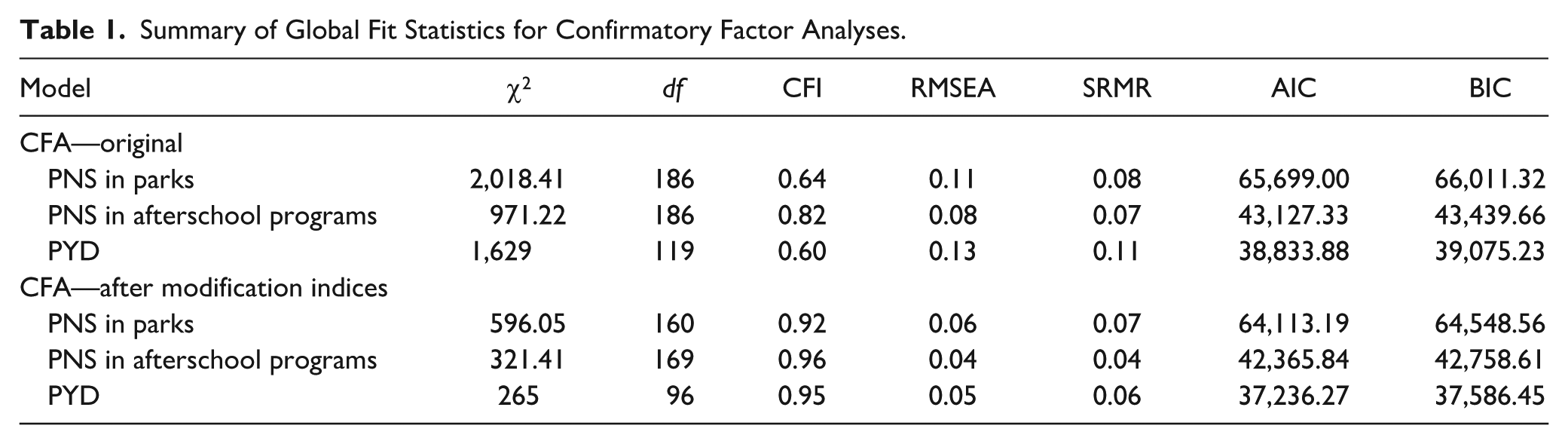
The initial CFA models for PNS in parks and after-school programs showed poor model fit, as none of the indicators met acceptable thresholds. Following Johnston and Finney’s (2010) approach, who first tested PNS as a model through CFA, and based on the recommendation of the modification indices (e.g., MI, STDYX EPC), alternative models were created in which a fourth latent method factor was used for reverse coded items. Model fit was further improved by adding error covariances where theoretically appropriate. After these modifications, the overall fit of the PNS CFA models suggested a good fit to the data (Table 1).
The third CFA focused on PYD and aimed to confirm a bi-factor model previously identified as the best fitting model for the construct (Geldhof et al., 2014). Our initial bi-factor CFA model for PYD did not converge. After several modifications via error covariances (i.e., MI, STDYX EPC), the model showed acceptable fit statistics. The modified model had a lower AIC and BIC than the original, suggesting a better fit to the data (Table 1). Overall, all CFA results suggest an acceptable fit to the data, allowing for the addition of structural paths between latent constructs. A summary of the final CFA models is displayed in Table 2.
Confirmatory Factor Analyses for Structural Equation Model.

Variable code refers to SEM model.
Standardized estimates and SE values using STDYX standardization. All estimates were significant at p < .05.
Measured variables were allowed to cross-load onto a fourth need satisfaction latent variable Method Factor.
p < .05. **p < .01. ***p < .001.
Phase Two: Structural model
The proposed structural model examined park visitation, program attendance frequency, and sociodemographic variables (age, race, gender, and residential community type), and their relationship with the three latent constructs of PNS in parks and programs, and subsequently PYD . Although age was included in the proposed model for due diligence, prior studies have found age to be unrelated to PNS (Gagné, 2003) and PYD (Conway et al., 2015). Therefore, it was removed from the final model when no significant paths between any of the PNS constructs and PYD were found. The final model, using robust maximum likelihood estimation (MLR), is displayed in Figure 1. Regarding model fit, multiple global fit indices were assessed and suggested an overall acceptable fit to the data (χ2/df = 5,322.22/2,583, p = .000, CFI/TLI = 0.88/0.87, RMSEA = 0.03, SRMR = 0.07).
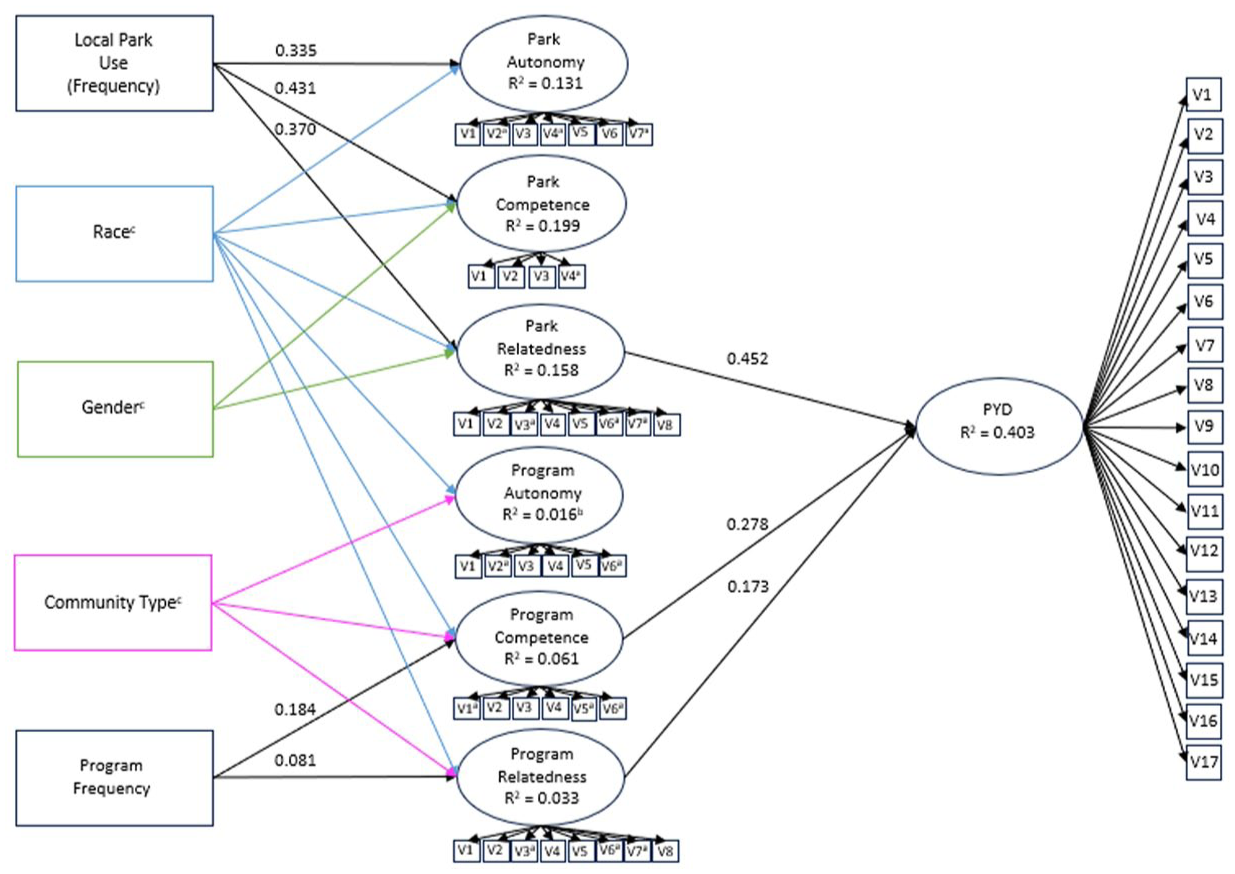
Final structural equation model predicting PYD in structured and unstructured contexts.
Structural Pathways for Structural Equation Model.
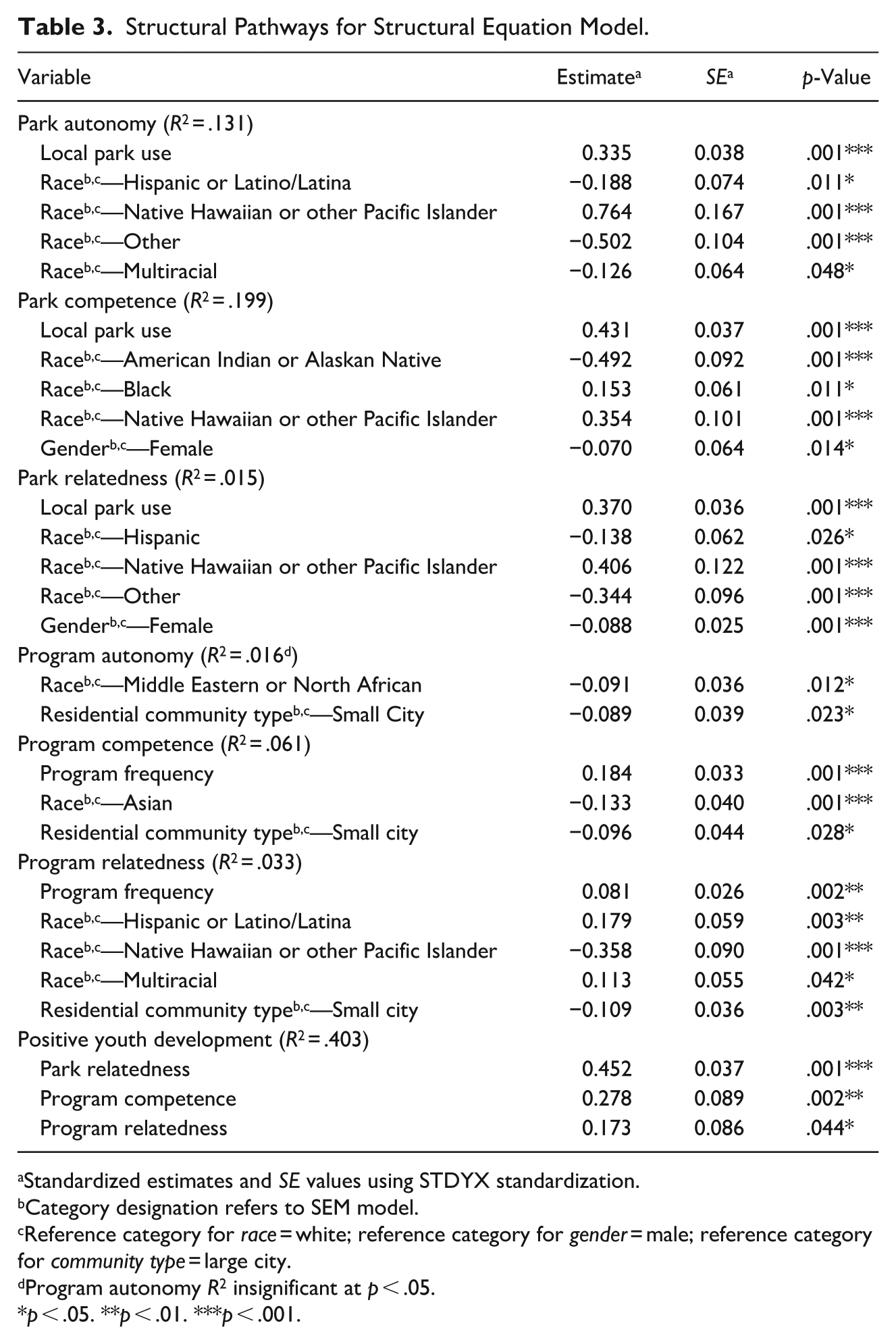
Standardized estimates and SE values using STDYX standardization.
Category designation refers to SEM model.
Reference category for race = white; reference category for gender = male; reference category for community type = large city.
Program autonomy R2 insignificant at p < .05.
p < .05. **p < .01. ***p < .001.
While a significant chi-square test alone indicates a poor-fitting model, chi-square analyses are sensitive to sample size, and given the large sample used for this study’s SEM analyses, a significant chi-Square result was expected. In these instances, the ratio of a model’s Chi-Square value to the degrees of freedom is often used to assess model fit, with a ratio of 3:1 serving as the acceptable threshold (Hooper et al., 2008; Kline, 2023). This ratio in our final model was 2.06:1 (χ2/df = 5,322.22/2,583) and well below that threshold, suggesting that the significant Chi-Square test result is not indicative of poor model fit. Further, our CFI/TLI values (0.88/0.87) are just below the traditional cutoff of 0.90, and prior research (Hooper et al., 2008; Hu & Bentler, 1999; Kline, 2023) has established that this minimal divergence is acceptable given that all other reported indices suggest a good fit to the data. As such, the final model was deemed acceptable.
Structural Model for Park Visitation Frequency, Demographics, and PNS
Using Cohen’s (1988) effect size benchmarks, the R2 values indicated that frequency of park visitation and participants’ race/ethnicity together significantly explained a moderate portion of the variance in park autonomy (R2 = .131). Additionally, frequency of park visitation, race/ethnicity, and gender together explained a moderate portion of the variance in park competence (R2 = .199) and relatedness (R2 = .158). Specifically, the local fit of the model showed that frequency of park visitation had a moderate significant relationship with all three constructs of PNS in parks: autonomy (β = .335), competence (β = .431), and relatedness (β = .370). Results also indicated that adolescents’ race/ethnicity and gender were significantly associated with PNS in parks, although we only interpret the results for groups with at least 5% representation in our sample. Specifically, results suggest that when compared to white adolescents, multiracial (β = −.126) and Hispanic or Latino/Latina (β = −.188) youth exhibited significantly lower scores on autonomy satisfaction in parks. Adolescents identifying as Hispanic or Latino/Latina (β = −.138) exhibited lower scores on relatedness satisfaction in parks when compared to white adolescents. Adolescents that identified as Black (β = .153) exhibited significantly higher scores on competence satisfaction in parks when compared to white adolescents. Gender was also found to have a significant relationship with PNS in parks as female adolescents exhibited significantly lower scores on competence (β = −.070) and relatedness (β = −.088) satisfaction in parks than males (Table 3).
Structural Model for Afterschool Program Attendance Frequency, Demographics, and PNS
Frequency of afterschool program attendance, race, and residential community type significantly explained the variance in program competence (R2 = .061) and relatedness (R2 = .033), with minimal explained variance (Cohen, 1988). The variance explained in program autonomy was not statistically significant (p = .103). Frequency of program attendance was only significantly associated with competence (β = .184) and relatedness (β = .081). Race/ethnicity and residential community type were also significantly related to PNS in programs. Specifically, Asian adolescents exhibited significantly less competence satisfaction in programs than white adolescents (β = −.133), while Hispanic or Latino/Latina (β = .179) and multiracial (β = .113) adolescents displayed more. Adolescents in small cities showed significantly less program autonomy (β = −.089), competence (β = −.096), and relatedness (β = −.109) compared to adolescents from a large city (Table 3).
Structural Model for PNS and PYD
The local fit of this model showed that, of the three PNS constructs in parks, only park relatedness (β = .452) was significantly associated with participants’ PYD. Of the three PNS constructs in afterschool programs, only program competence (β = .278) and relatedness (β = .173) were significantly associated with participants’ PYD. Overall, park relatedness, program competence, and program relatedness explained a substantial portion of the variance in PYD (R2 = .403) (Cohen, 1988) (Table 3).
Discussion
This study explored the relationship between PNS and PYD in structured and unstructured OST activities. The findings help understand how demographic variables, visitation/attendance frequency, and residential community type are related to PNS in parks and programs. Additionally, the study compares how these structured and unstructured OST activities satisfy adolescents’ psychological needs and examines the relationship between park and afterschool program PNS and PYD.
Park & Afterschool Program Visitation/Attendance Frequency and PNS
We found significant positive associations between park and program visitation/attendance frequency and PNS. For parks, we found that more frequent visitation was associated with satisfaction of the needs for relatedness, competence, and autonomy, extending research linking time in nature with benefits like improved mood (Li et al., 2018) and mental health (Piccininni et al., 2018). The relationship between parks and PNS has only recently begun to be explored (Landon et al., 2021), and to our knowledge, no prior studies have assessed adolescents’ PNS in parks. This makes the findings of this study especially important, as they begin to set a course for future research. For programs, attendance frequency was positively associated only with competence and relatedness satisfaction, and these associations were weaker than those for parks. Compared to parks, where adolescents can visit more freely, attendance in structured OST contexts may feel less autonomous due to parents’ schedules (Mahoney et al., 2009) or registration fees (Jayanthi et al., 2018). Afterschool program practitioners could foster a sense of autonomy by offering choice and ensuring adolescents’ voices are heard. Measuring program engagement quality rather than mere attendance (Fredricks, 2011) may also provide a better window into how afterschool programs satisfy psychological needs.
Although the path to relatedness was significant in both contexts, our findings revealed a stronger association for park visitation frequency than afterschool program attendance. Parks are often seen as places for socialization (Lloyd et al., 2008), likely because they offer more freedom in choosing companions. This freedom may be related to both visitation frequency and adolescents’ relatedness. In contrast, afterschool programs are typically grouped by age, skill level, or activity type (Mahoney et al., 2009). These findings suggest that while parks naturally support the need for relatedness, structured OST might benefit from intentional approaches to support relatedness among participants.
It was surprising to find that competence satisfaction was more strongly associated with park visitation than with program attendance, especially since afterschool programs are often designed to promote skill development (Mahoney et al., 2006). One possible explanation is that adolescents may attend afterschool programs to develop skills in which they feel less competent (e.g., music lessons, sports practice, tutoring), while in parks, they may engage in activities in which they already excel. Additionally, the voluntary nature of park visitation allows adolescents to disengage if they feel less competent, while attendance is expected in structured programs. Thus, attendance in each context could be motivated by different factors, shaping the relationship between visitation/attendance frequency and PNS. Further research is needed to explore the directionality of these associations.
Demographic Variables and PNS in Parks and Afterschool Programs
Our findings demonstrate that demographic factors are associated with PNS in both parks and afterschool programs. In parks, gender and race/ethnicity were associated with PNS constructs, while race/ethnicity and residential community type were associated with PNS constructs in afterschool programs. Regarding gender, females reported lower levels of competence and relatedness in parks compared to males. Previous research suggests that females often feel less safe in parks (Danis et al., 2014; Lloyd et al., 2008), and a reduced sense of safety has been linked to lower PNS (Liu et al., 2024). Gender was not significant in afterschool program PNS, as both girls and boys reported equal developmental opportunities (Fusco, 2008).
Regarding race/ethnicity, there is an unfortunate lack of research on adolescents of various racial and ethnic backgrounds and their PNS in parks and afterschool programs. Related research in park contexts has mainly focused on racial identity’s association with adolescent park use, producing inconsistent results (Marquet et al., 2019; Ries et al., 2009), and some research has shown racial/ethnic variation in the sense of belonging in afterschool programs (Corbolotti, 2023). Our findings show that race/ethnicity is associated with all three PNS constructs in both parks and afterschool programs. These associations varied widely and, given the small sample sizes in several of the groups showing significant results, suggest a need for more focused research in this area rather than representing generalizable findings. Future research should recruit racially diverse samples and examine the role of race/ethnicity in adolescents’ park and program experiences rather than simply their frequency of visitation or attendance.
Regarding residential community type, residents of small cities reported lower PNS in programs compared to those in larger cities. This may reflect differences in resources, program quality, or public funding support in smaller cities (Afterschool Alliance, 2020). It suggests that efforts to enhance PNS and PYD outcomes should consider the unique challenges and opportunities presented by different residential community types.
Park & Afterschool Program PNS and PYD
Our study revealed that PNS in both parks and programs is related to PYD, consistent with prior research showing that contexts supporting PNS promote PYD outcomes (Tadesse et al., 2022; Ward & Zabriskie, 2011). However, the strength of the relationship between PNS and PYD varied by context. Satisfaction of the need for relatedness in parks had the strongest relationship with PYD, followed by competence satisfaction in programs, and relatedness satisfaction in programs. This finding was unexpected, as unstructured OST contexts like parks have often been described as negatively impacting youth health and development (L. L. Caldwell & Faulk, 2013; Weybright et al., 2019).
Moreover, contrary to our expectations, autonomy satisfaction was not significantly associated with PYD in either context. Prior research suggests that autonomy in unstructured settings enables adolescents to explore freely and make independent choices (Walker et al., 2020), but autonomy may also contribute to some youth making unhealthy choices in these contexts (L. L. Caldwell & Faulk, 2013). In structured settings, autonomy support and providing opportunities for youth to make choices have been recognized as a key factor for fostering engagement and positive development (Zarrett et al., 2021). Future research should explore whether specific aspects of autonomy, such as freedom in social interactions or activity choice, relate to PYD.
Overall, our findings highlight the developmental potential of unstructured environments like parks, which may be overlooked in favor of more structured programs. While structured OST contexts, such as afterschool programs, are typically designed to promote skill development and competence (Lerner et al., 2015), unstructured settings like parks appear to offer important opportunities for social connection. This distinction challenges the assumption that structured settings are inherently superior for promoting positive development (L. L. Caldwell & Faulk, 2013) and underscores the importance of understanding how different activities and contexts are related to various psychological needs. Future research and interventions should leverage the unique strengths of both structured and unstructured contexts to create balanced OST contexts that support relatedness, competence, and autonomy to better support youth development.
Limitations and Future Directions
There are several limitations to consider when reviewing our findings. First, in SEM, it is best practice to use continuous data or Likert scales with more than five response options (Hair et al., 2021), and the PYD measure was on a 5-point Likert scale. Second, while we accounted for several demographic variables, we did not account for SES (e.g., parental education, household income) due to data limitations. This is an important limitation, as social class may intersect with race/ethnicity and influence access to OST contexts, experiences of need satisfaction, and developmental outcomes. Future research should incorporate measures of socioeconomic background to better understand these dynamics. Additionally, while our study provides valuable insights into the role of PNS in structured and unstructured OST contexts, it did not include the interrelation between demographic variables and participation frequency. This decision was made to reduce model complexity and maintain a clear focus on our primary research questions. Future research could investigate how demographic characteristics influence participation in these contexts and whether such factors moderate the relationship between PNS and PYD. Moreover, longitudinal, mixed-methods research will be needed for a deeper understanding of the relationship between PNS in different OST contexts and PYD over time. Additionally, longitudinal studies could investigate whether PNS mediates the relationship between demographic variables and PYD, or whether prior levels of PYD influence youth experiences of PNS in OST contexts.
Another limitation relates to the internal consistency of some of the psychological need satisfaction subscales. Specifically, we observed Cronbach’s alphas below the conventional threshold of 0.70 (Taber, 2018) for park autonomy, park competence, and program competence. While low internal reliability can raise concerns about the precision of measurement, it does not fundamentally compromise the validity of the study, particularly in the context of structural equation modeling, which estimates latent constructs and accounts for measurement error directly (Kline, 2023). Furthermore, these results align with previous studies that have noted similarly modest reliability coefficients for autonomy and competence subscales (e.g., Johnston & Finney, 2010). Nonetheless, these lower alphas suggest that future studies should further refine the measurement of autonomy and competence in OST settings.
Conclusion
This study explored associations between PYD and PNS within structured and unstructured OST contexts. Our findings illustrate the importance of both types of OST contexts for promoting PYD. Specifically, we found that satisfaction of the need for relatedness in both structured and unstructured OST was positively associated with PYD, aligning with literature that underscores social connection as a crucial component of PYD (Lerner et al., 2005). These findings underscore the importance of PNS across contexts where young individuals spend time (Deci & Vansteenkiste, 2004) and support research highlighting the social benefits of afterschool programs and identifying parks as places where adolescents can build and explore social connections (Lloyd et al., 2008). Future research should investigate how different OST contexts can be optimized to support PYD, considering the varying influences of demographics and participation frequency. To foster PYD, it is essential for both structured and unstructured OST contexts to focus on fulfilling adolescents’ psychological needs.
Footnotes
Acknowledgements
The authors gratefully acknowledge the valuable support of Dr. Pui-Wa Lei, who provided expert guidance on statistical analyses. We also extend our gratitude to the study participants for sharing their data, making this research possible.
Data Availability Statement
Data can be requested from the last author.
Declaration of Conflicting Interests
The authors declared no potential conflicts of interest with respect to the research, authorship, and/or publication of this article.
Funding
The authors disclosed receipt of the following financial support for the research, authorship, and/or publication of this article: This work was supported by funding from the Pennsylvania State University College of Health and Human Development.
Ethics Approval
APA ethical standards were followed in the conduct of the study; and the Institutional Review Board at the Pennsylvania State University approved the study.
