



Abstract
This study employed the Cyberball paradigm, to investigate the impact of ostracism on need satisfaction in 84 Italian students aged 11 to 14. Believing they were playing with anonymized classmates, participants experienced inclusion or exclusion with partners either chosen by them or assigned randomly. Results revealed that need satisfaction was strongly influenced by inclusion/exclusion, with a noteworthy moderating effect of the team-building processes: in inclusive rounds, choosing teammates increased both the sense of belonging to the group and self-esteem, while in ostracizing rounds, choosing teammates did not exacerbate belongingness-related need threat but led to lower self-esteem reports. This shows that having agency in building one’s own group is a risky proposition: good outcomes become more rewarding, yet exclusion imposes a greater loss of self-esteem.
Introduction
The term “ostracism” refers to a wide variety of human behaviors that result in deliberately excluding or avoiding someone. To ostracize means to treat someone as if they do not matter, to ignore them, or to behave as though they do not exist (Wesselmann & Williams, 2017). Examples of this phenomenon vary from subtle acts like avoiding eye contact, refusing to communicate (“silent treatment”), or displaying a lack of warmth (“cold shoulder”), to more explicit forms of exclusion, such as religious excommunication, government banishment, or exile (Williams, 1997). Ubiquitous and extremely prevalent in humans and many other species of social animals (Goodall, 1986; Lancaster, 1986; Williams, 2009), ostracism transcends cultures and historical periods (Gruter & Masters, 1986; Williams, 2007)). Instances of this behavior appear across all ages and life phases (Abrams et al., 2011; Asher & Coie, 1990; Crick et al., 1999; Over & Carpenter, 2009; Wölfer & Scheithauer, 2013). Children, adolescents, and adults experience it in a variety of contexts, such as educational institutions (Buhs et al., 2006), workplace environments (Banki, 2012; Miceli & Near, 1992), religious settings (Gruter & Masters, 1986), and romantic relationships (Gottman, 1980). Particularly problematic is the fact that ostracism often happens without explicitly stating the reasons for exclusion or displaying overt signs of hostility toward the individual (Williams, 2007), so that it may be considered a “non-behavior” difficult to assess, measure, and observe (Williams, 1997).
In light of such behavioral variety, it is possible to distinguish different types of ostracism based on the degree of exclusion (full, partial), the perceived motives behind it (role-prescribed, punitive, defensive, oblivious), the reason for exclusion (clear, unclear), and the type of isolation the victim experiences (physical or social) (Williams & Sommer, 1997). While physical ostracism implies an actual physical separation, social ostracism involves being ignored while in the physical presence of others (Williams & Sommer, 1997).
Modernity has resulted in a significant portion of our lives taking place online, including social interactions. This implies that social exclusion now often manifests in new forms within virtual contexts. This dynamic often plays a key role in cyberbullying. Thus, social exclusion now often manifests in new forms within virtual contexts, such as evidenced by various examples identified in previous research, such as receiving no Likes on a posted status update (Lutz & Schneider, 2021; Reich et al., 2018; Schneider et al., 2017; Wolf et al., 2015), not being tagged in or being excluded from others’ posted pictures (Büttner & Rudert, 2022), or not receiving messages in chat rooms (Donate et al., 2017) and messaging services (Latina et al., 2023; Lutz, 2023).
Recent studies have shown cyberostracism has remarkably similar negative effects to those observed in traditional social ostracism (Niu et al., 2018). This highlights the importance of addressing the case of social exclusion in its evolving forms within contemporary society.
More broadly, an evolutionary perspective on ostracism sheds light on its adaptive nature. According to this view, ostracism serves to regulate individual conduct and protect the group (Williams, 2007). More specifically, individuals perceived as dangerous, unpredictable, non-contributing, or non-compliant with expectations are excluded: isolating such deviant members strengthens the group by making it more cohesive, which in turn results in a higher chance of survival. This evolutionary framework is supposed to remain relevant in contemporary times, influencing not just face-to-face interactions within social groups (Feinberg et al., 2014) but also extending its impact to virtual interactions (Galbava et al., 2021; Slonje et al., 2013).
However, it is crucial to highlight the dual nature of ostracism’s impact. While the group thrives, the victim faces devastating consequences. Especially in nature, exclusion from a group often results in a lack of access to shelter, support, and resources, ultimately leading to probable death due to malnutrition or attack (Williams, 2007; Zadro et al., 2004). To cope with the severity of these consequences, humans have evolved the ability to detect signs of being ostracized triggering physiological and emotional responses aimed at prompting behavioral changes (Williams, 2007, 2009; Williams & Zadro, 2005). When we are excluded, we feel pain and negative emotions (Williams, 2007) whether the exclusion occurs physically (Chow et al., 2008; Giesen, & Echterhoff, 2018) or in online contexts (Alhujailli et al., 2020), and pain induced by cyberostracism is akin to physical pain, as shown by fMRI studies indicating activation of the same areas of the brain implied in processing physical pain (Lieberman & Eisenberger, 2006; Williams, 2007). Moreover, ostracized people experience decreased mood levels and various negative emotions, such as sadness, anxiety, depression, anger, and feelings of loneliness and unworthiness (Williams, 2007).
According to Williams’s Temporal Need-Threat Model (Williams, 2009), negative emotions are a consequence of the fact that ostracism threatens 4 basic human needs: belongingness, self-esteem, control, and meaningful existence. Belongingness refers to the desire to form frequent, positive, significant, and stable interpersonal relationships that characterize humans as social creatures (Leary & Baumeister, 1995; Maslow, 1943). Ostracism frustrates such necessity, hence its profound impact on an individual’s mental health and overall well-being (Leary & Baumeister, 1995; Williams, 2009). Self-esteem is also threatened: when an individual is ostracized, given attributional ambiguity, they will search for explanations, possibly focusing on self-attributions and self-blame for inappropriate behavior. Ostracism also threatens the targets’ perceived control over their social context, given that when ostracized individuals often are not able to elicit reactions from others. Finally, the need for a meaningful existence is jeopardized, as the individual does not feel recognized for existing and being worthy of attention. To avoid these feelings and restore need satisfaction (need-fortification hypothesis), people often end up conforming, obeying, complying, and inhibiting the socially undesirable behaviors that triggered ostracism in the first place (Williams, 2007, 2009).
Even if ostracism is pervasive across all life phases, its effects can vary across different age groups, with adults, adolescents, and children demonstrating different reactions (Abrams et al., 2011; Pharo et al., 2011). While all groups experience negative effects on mood, adolescents (13-14 years old) tend to report the greatest threats to belongingness. Adolescents are especially sensitive to exclusion compared to other age groups (Pharo et al., 2011), as group affiliation, peer relationships, judgment, and acceptance become more important in this period of life (Abrams et al., 2011; Blakemore & Mills, 2014; Bolling et al., 2011): most of their time is spent with peers, and social support is derived more from peers than from parents (Larson & Richards, 1991; Sullivan et al., 2006). This also results in peer evaluations being a crucial factor in adolescents’ feelings of social or personal worth (O’Brien & Bierman, 1988), and peer rejection being often interpreted as a signal of one’s unworthiness as an individual (Blakemore & Mills, 2014). Similarly, also peer status (i.e., popularity) has been shown to mediate neural processing of social exclusion (de Water et al., 2017). In particular, the middle school period is crucial, as it marks a time of transition when preadolescents and early adolescents struggle with self-identity and self-esteem (Rhodes et al., 2004). The combination of these conditions may intensify the negative impact of exclusion, leading to heightened emotional reactions (Blakemore & Mills, 2014; Bolling et al., 2011). Our study aims to contribute to a deeper understanding of this critical age and explore avenues for the prevention of negative consequences, such as depression and anxiety, or even, in the most extreme cases, suicide (Kim & Leventhal, 2008) and school shootings (Williams, 2009).
To date, ostracism has been thoroughly explored using a variety of methodologies across multiple research domains (Williams, 2007). Some scholars employed survey scales with robust psychometric properties (Crick & Grotpeter, 1996; Werner & Crick, 2004), while others opted for experimental studies that incorporated rejection paradigms (Twenge et al., 2003; Zadro et al., 2004). Notably, the Cyberball paradigm (Williams et al., 2000) has emerged as the most widely used assessment method, appearing in 241 published articles by 2018 (a list of Cyberball publications is available at Kipling Williams’ website). Cyberball is a computerized ball-tossing game in which three players, one of which is an actual participant, pass a virtual ball to one another several times. This game allows researchers to manipulate ostracism levels, by setting the number of times the ball is passed to the participant. Cyberball task has proven to be comparable to real face-to-face social interactions in evoking strong negative emotions (Williams et al., 2000), and the ostracism experienced via this methodology was shown to increase self-reported distress, lower mood levels, as well as needs satisfaction relative to belongingness, self-esteem, control, and meaningful existence (Williams, 2007). A meta-analysis of 120 Cyberball studies (N = 11,869) demonstrated a large effect of this manipulation on fundamental needs (Hartgerink et al., 2015). However, despite the substantial number of studies conducted, it has been noted that the majority of studies involving the Cyberball paradigm have concentrated on young adult populations, while research examining its impact on children, middle-aged individuals, or older adults remains limited or scarce (Hartgerink et al., 2015). This observation underscores the importance of examining the effects of ostracism on understudied populations. Our study addresses this gap by focusing on early adolescents, offering new insights into the effects of ostracism in this age group.
Previous research on the use of Cyberball in early adolescents provides valuable insights on the significant impact social ostracism has on their emotional state (Ruggieri et al., 2013). Being exposed to cyberexclusion during this critical developmental stage consistently results in reports of lower positive mood levels and decreased need satisfaction. Moreover, despite participants’ familiarity with the Cyberball paradigm, post-exclusion distress persists one month later (Zadro et al., 2006). This underscores the profound and lasting effects of social exclusion in adolescence (Davidson et al., 2019). Accordingly, functional brain imaging studies reveal that adolescents experience greater affective consequences compared to adults, an indication of the ongoing development of their ability to regulate distress resulting from ostracism as they transition to adulthood (Sebastian et al., 2010). Taken together, these findings suggest that even minimal experiences of ostracism, through Cyberball procedure, are emotionally distressing and carry enduring consequences throughout adolescence (Nida & Saylor, 2016), possibly because group membership is a relevant indicator of peer acceptance.
Notwithstanding this substantial body of evidence, there is still lack of data on how specific aspects of group membership, such as group choice, might moderate the effect of ostracism on need threat in adolescents. At school, adolescents are members of their class, one of the most relevant groups in shaping an individual social and personal image at that age (Hendrickx et al., 2016). Within the classroom setting, subgroups naturally form, characterized by distinctions between preferred and non-preferred peers. Students often actively choose to belong to specific groups or display interest in certain social circles. However, acceptance or exclusion from these groups can occur, even online, with significant consequences for the individual’s social standing, psychological health, and emotional well-being (Kollerová & Killen, 2021; Marengo et al., 2021). Thus, we hypothesize that being excluded from a group for which the student had previously expressed an explicit preference may strengthen the consequent need threat.
Previous research in social psychology supports this prediction. In general, in-group/out-group dynamics play a crucial role in ostracism (Arpin et al., 2017; Gonsalkorale & Williams, 2007; Sacco et al., 2014), even though this has been verified in different contexts compared to the classroom. Partners choice in a game like Cyberball can be thought of as an action which results in the formation of two different factions: an ingroup to which one belongs, and an outgroup composed by everybody else. Since we place great importance on social connections and group memberships (Walton et al., 2012), some studies suggest that experiencing inclusion or ostracism from in-group members intensifies the emotional impact of the experience (Leary & Baumeister, 1995), and this could be due to a stronger need threat. Secondly, group choice has been found to positively influence the strength of connections, a sense of belonging, and needs fulfillment (Obst & White, 2007), as well as inducing a greater sense of community (Compas, 1981) and strengthening group effects like ingroup bias (Finchilescu, 1986) and affective commitment (Ellemers et al., 1999). For these reasons, it is plausible that exclusion from a group of one’s choice should produce a stronger need threat, as compared to exclusion from groups that were never chosen by the ostracized member. However, to the best of our knowledge no study investigated the role of “group-making” and “group-formation” on ostracism, despite being particularly relevant in adolescence. For this reason, we implemented a modified version of the Cyberball paradigm to investigate the effect of ostracism on need-threat of middle school students in different group-selection dynamics.
Hypotheses
Prior to conducting the experimental study, the following predictions were formulated on the impact of ostracism and team-building processes on the level of need threat experienced by participants.
Participants subjected to ostracism (exclusion conditions) will perceive the team as being less cohesive compared to those in the inclusive conditions (
In our study, the manipulation fits within a mixed set of findings regarding the possibility of moderating reactions to ostracism. While the Temporal Need-Threat Model assumes that immediate responses are resistant to moderation, a recent meta-analysis (Hartgerink et al., 2015) does not fully support this hypothesis. Instead, there is greater consensus on the moderation of “reflected” or delayed responses, where, due to the nature of our experimental task, our manipulation and findings are more likely situated.
Methods
Participants
We conducted an a priori power analysis with G*Power 3.1 (Faul et al., 2009). We set a minimum detectable effect size of f = 0.2, an α level of 0.05 and a power of 0.9. This analysis suggested a required total sample size of N = 68. Data collection for the present study was performed at school, during class periods, at pre-established dates and times, scheduled with the school principals. To ensure the well-being of the participants, a clinical psychologist was present during each of the three experimental sessions to supervise the experiment and monitor the emotional state of the individuals involved. In collaboration with the school principal, we selected three different classes consisting of students from the sixth, seventh, and eighth grades, resulting in a total sample size of 84 participants, with 36 of them being female. All participants were Italian native speakers aged between 11 and 14 years old (M = 13 ± 1) and were tested on the same day. 30 participants had received in the past a diagnosis of specific learning disorder (SLD). The study was approved by the school direction committee and by the Joint Ethical Committee for Research of Scuola Normale Superiore, Scuola Superiore Sant’Anna and Scuola IMT Alti Studi Lucca (resolution N. 9, 15 February 2024). In addition, informed written consent to participate in the study was collected from all the participants’ parents in the days preceding the experiment. Data collection took place over three separate experimental sessions, with each session corresponding to a different class. Students from different classes did not interact with each other for the duration of the experiment. At the start of each session, the students were provided with a tablet that was logged into Qualtrics, displaying the welcome screen.
Instruments
Cyberball Task
The Cyberball paradigm (Williams et al., 2000) was employed in our study, with each round consisting of 30 ball tosses. Each round involved three players: one actual participant and two AI players who were perceived as real classmates through the implementation of an introductory cover story (Figure 1). Each participant played four different rounds with two key factors being manipulated in a 2 (social dynamic: inclusion vs. exclusion) × 2 (team-building process: random pairing vs. deliberate choice) within-subjects experimental design. We chose a within-subjects design for its superior statistical power and ability to control for individual differences, minimizing noise in the interpretation of results. This approach allowed us to isolate the effects of the experimental conditions more effectively. Additionally, having participants engage in repeated rounds of the same game closely mirrors the frequent, daily experiences of inclusion and exclusion that children encounter in classroom settings, making the study more ecologically valid.
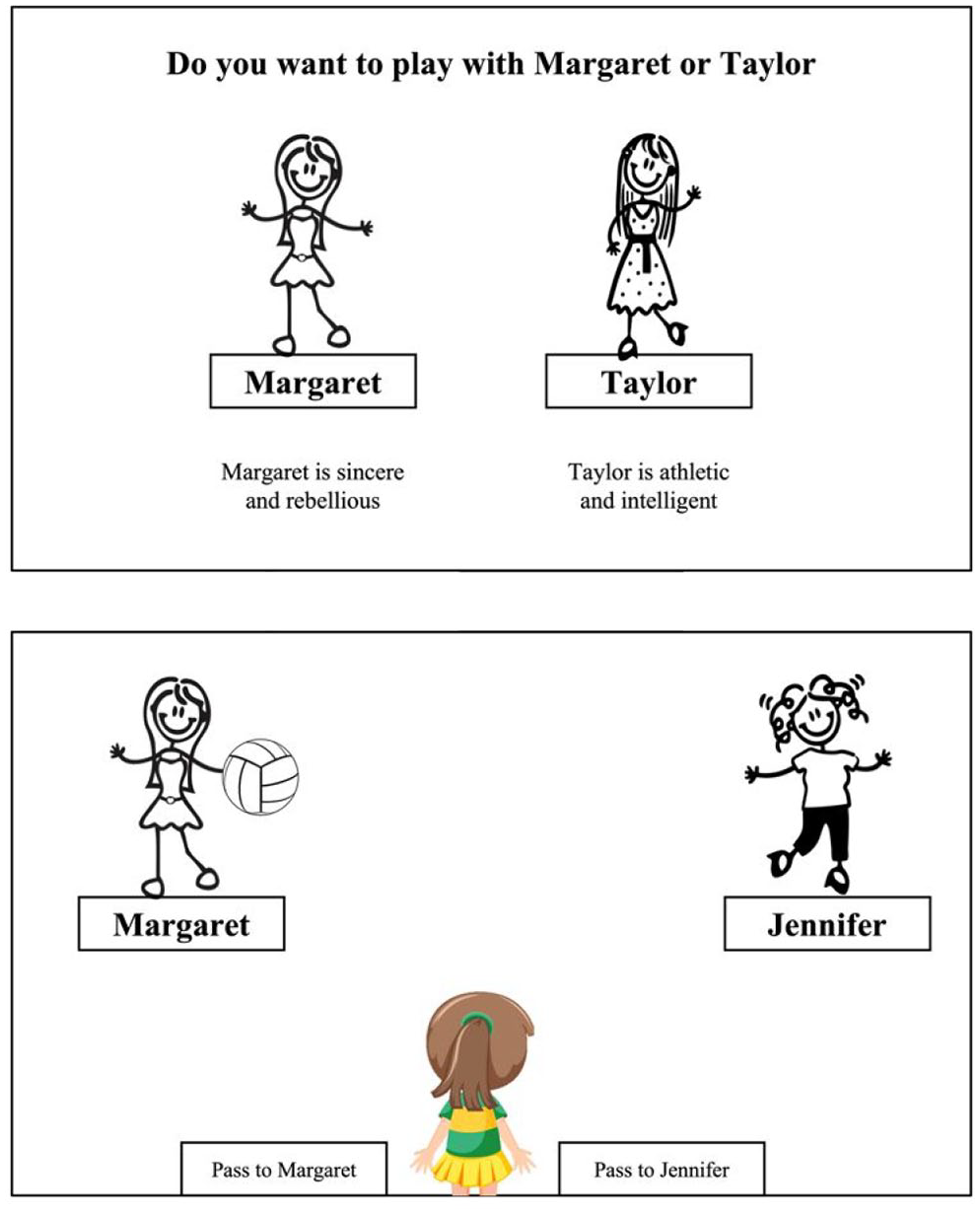
Teammate selection condition and cyberball task visual. The left panel shows an example of what participants saw in choice conditions: participants were able to select their teammates by choosing one of two players who were characterized using two positive-valenced adjectives. This operation was repeated twice, as the teams were formed by three participants. On the contrary, in the random pairing condition (not illustrated), participants were not able to select their team members but were randomly assigned to a formed team. The panel on the right shows what the participant saw during the Cyberball game. The participant’s avatar is at the center of the screen, whereas other team member’s avatars are displayed on the sides. When the experimental participants received the ball, they must choose who to pass it to by clicking on the corresponding button.
While the participants in the inclusive rounds received an equal number of ball tosses as the other players, ensuring full inclusion, in the ostracizing rounds, after 10 ball tosses, the participants experienced total exclusion from the other players, i.e. the ball was never again passed to them. Additionally, contrary to the “random pairing” rounds where participants were paired with two randomly selected players, the “deliberate choice” rounds allowed participants to choose the other students who would be involved in the subsequent round (Figure 1). To simulate an authentic selection process, other players were characterized using two adjectives randomly selected from a predefined list of 60 adjectives that described attitudes and personality traits.
Need threat/satisfaction and team evaluation as state variables
To comprehensively assess the level of post-round need satisfaction experienced by our study participants, we measured the threat to two psychological needs using Williams’ (2009) Need Threat Scale (NTS). We focus on the needs of belongingness and self-esteem. Specifically, we employed a set of 10 items adapted from NTS. The NTS questionnaire is a self-report measure consisting of 20 items that specifically examines threats to fundamental needs arising from social exclusion (Jamieson et al., 2010). After completing each round, participants were asked to respond to a 10-items need threat scale (adapted from Van Beest & Williams, 2006). This 5-point Likert scale included two sub-scales designed to evaluate threats to basic needs related to belongingness (e.g., “I felt I belong to the group”) and self-esteem (e.g., “I felt good about myself”): items 1-5 measured belongingness and items 6-10 self-esteem. The internal reliability of each factor was totally satisfactory (Cortina, 1993; Dunn et al., 2014): Belongingness: α = .90; ω = .90; Self-esteem: α = .83; ω = .83. Secondly, after each round the team and player evaluation was assessed using two single items describing the synergy of the team (“based on this game, how do you judge your team?”- from “not tight at all” to “very tight”) and the participant’s opinion on other players (“based on this game, how do you judge your teammates?”- from “very negative” to “very positive”).
Trait Measures (Control Variables)
Trait self-esteem was assessed using the Rosenberg Self-esteem Scale (RSE; Rosenberg, 1965), which is a commonly employed measure of dispositional self-esteem. Participants expressed their level of agreement with statements such as “I take a positive attitude toward myself” and “I am able to do things as well as most other people” using a 4-point Likert scale. The scale demonstrated strong internal consistency (α = .83; ω = .83). Secondly, to evaluate sense of belongingness as a trait variable, we employed the 12-item questionnaire of the General Belongingness Scale (Malone et al., 2012) focusing on individuals’ personal perception of belongingness with others (including both friends and family), rather than the need to belong. Respondents indicate their level of agreement on a 7-point scale, ranging from 1 (“Strongly disagree”) to 7 (“Strongly agree”), in response to statements such as “When I am with other people, I feel included” and “I have close bonds with family and friends”. The scale proved to be reliable (α = .84; ω = .84). We included trait-level variables to examine whether they moderated the effects of ostracism on state self-esteem and state belongingness. Specifically, we aimed to see if the impact of ostracism varied based on participants’ pre-existing levels of trait self-esteem and belongingness. By incorporating these dispositional measures, we sought to determine if individuals with lower trait self-esteem (measured by the Rosenberg Self-Esteem Scale, RSE) or a weaker sense of belonging (measured by the General Belongingness Scale, GBS) experienced a stronger threat to their state self-esteem and belongingness when exposed to ostracism. This approach allowed us to account for individual differences and clarify other effects.
Procedure
The entire experimental procedure was built on Qualtrics.com and lasted about 20 min (M = 20.88; SD = 10.11). All participants ran the experiment using their individual tablets, provided by the school, during school hours. The three sessions were administered by a qualified research assistant who instructed students to work independently and silently during the game. Participants were informed that they would participate in an online ball-throwing game together with other students from the same class.
At the beginning of the task, participants were presented with the main instructions and completed some basic demographic information (age and gender). Participants were then presented with the following cover story: “Cyberball is an online game designed to foster cohesive teams. The presence of trustworthy teammates is very important both in sports and in everyday life. You will now play a few rounds of Cyberball, where you will pass balls together with your classmates”. To enhance the credibility of the cover story, participants were asked to create an avatar by selecting a fictitious name from a provided list, along with two positive adjectives from a set of 60 options (e.g., friendly, smart, honest, polite) to introduce themselves to the other players. The chosen names did not match their own or those of their actual classmates, ensuring anonymity. Participants were told they would be playing with classmates participating at the same time, but in reality, these “players” were preset computer-controlled avatars. This procedure was specifically designed to reinforce the illusion that the avatars, characterized by names and adjectives, represented real classmates, as participants had just gone through the same avatar creation process. When they later chose teammates and saw a name accompanied by two adjectives, it increased the likelihood that they believed they were interacting with real peers. Each participant went through four rounds of the Cyberball game in a random order: the screen displayed three ball-tossers, the middle one representing the participant. After receiving the ball, participants were instructed to click on one of two buttons, indicating their desired recipient for passing the ball. This action initiated a visual animation in which the ball moved toward the selected player.
Immediately after each round, participants were presented with a report page that provided information on the number of times each player received the ball. Subsequently they were asked to complete the NST questionnaire and express their judgments regarding the team and other players.
At the end of the experiments, participants completed the Rosenberg Self-esteem Scale (Rosenberg, 1965) and the General Belongingness Scale (Malone et al., 2012). Finally, all the students were debriefed and thanked for their participation. The research assistant explained that Cyberball was developed with the aim of investigating exclusion within educational settings and revealed that each avatar was controlled by the computer, meaning that the participants did not actually play with their classmates. The clinical psychologist and the research assistant addressed any questions raised by the students regarding the task.
Statistical Notes
The statistical analyses were performed using IBM SPSS 27.0 (IBM Corp) and R via jamovi (https://www.jamovi.org/). We set a significance level of α = .05, and all p-values were reported. The unstandardized estimate (β) and its 95% Confidence Intervals are reported in cases where significant effects emerged. Kolmogorov-Smirnov test was employed to assess the normality of the main model-dependent variable (Need Satisfaction). In case of violation of the assumptions for parametric analysis, the Z-score for medium-sized samples was calculated by considering the skewness and kurtosis measures to assess the normality of the distribution (Kim, 2013; Skewness = −.16; SE = .94; Kurtosis = −1.19; SE = .18). Consequently, we implemented a Generalized Linear Mixed Effect Model (Stroup, 2012). Random effects were incorporated for participant intercepts and slopes in each model. This accounted for variations in participants' baseline levels of Need Satisfaction (random intercept) and their differing patterns or slopes of Need Satisfaction change depending on the round (random slope). This approach enables us to capture variations both between participants in their baseline Need Satisfaction levels and within participants in the patterns of Need Threat change. By considering the correlation and heterogeneity in Need Satisfaction measurements within and between participants, we can obtain more reliable estimates of the fixed effects (Judd et al., 2012). All the reported GLMM were initially run with the inclusion of sociodemographic characteristics such as gender, class, age, and diagnosis as fixed factors. However, these variables were subsequently removed from the models one by one to enhance model fit, as indicated by improvements in AIC (Akaike Information Criterion) and BIC (Bayesian Information Criterion) values, due to their non-significant main effects or interactions (Bates et al., 2015). A simulated sensitivity power analysis was also performed using the mixedpower package in R (Kumle et al., 2021) for mixed models to ensure that our sample size (N = 84) was sufficient to detect the effects of interest with adequate statistical power (β > .80).
Results
In order to evaluate the impact of ostracism and team building on the team and players’ evaluation, we performed two Generalized Linear Mixed-effect Model (GLMM). We included social dynamics (inclusion vs exclusion) and team building process (random pairing vs deliberate choice) as fixed factors and the RSE and GBS scores as a covariate. To control for individuals’ variability, students intercepts and slopes were included as random effects.
As regards team evaluation (H2), social dynamics (β = 1.98 95%CI [1.81, 2.16] SE = .08, p < .001), team building process (β = −.14 95%CI [−.24, −.003] SE = .05, p = .012), and GBS (β = .32 95%CI [.14, .50] SE = .09, p < .001) all reached statistical significance. Contrarily, the main effect of the RSE score (p = .12) and the social dynamics × team building process (p = .39) interactions failed to show significance. Bonferroni-corrected post-hoc suggested that in inclusive rounds the team was perceived as more close-knit (M = 3.45; SE = .05) as compared to ostracizing rounds (M = 1.46; SE = .06) and that the possibility of choosing teammates increased team’s synergy perception (M = 2.53; SE = .04), as opposed to the rounds in which players were selected randomly (M = 2.39; SE = .05). These results validate both H2a and H2b.
Findings for the players’ evaluation model yielded symmetrical results (Social dynamics: β = 1.85 95%CI [1.69, 2.00] SE = .08, p < .001; Team building process: β = −.16 95%CI [−.24, −.07] SE = .04, p < .001; GBS: β = .31 95%CI [.15, .48] SE = .08, p < .001; RSE: p = .49; Social dynamic × team building process: p = .33). Players were judged more positively in the inclusive rounds (M = 3.40; SE = .05) as compared to the ostracizing ones (M = 1.55; SE = .05), confirming H3a. Similarly, the possibility of choosing teammates had a positive impact on players’ evaluation. Participants reported a more positive perception of the other players (M = 2.55; SE = .04) when they had the opportunity to select their teammates (H3b), compared to rounds where players were selected randomly (M = 2.39; SE = .04). This finding suggests that inclusive rounds fostered a sense of closeness within the team and that allowing individuals to have some control over the composition of their team can enhance their perception of working together effectively.
We also performed a GLMM on Need Satisfaction scores measured using two subscales of NTS (H1). Social dynamics (inclusion vs exclusion), the team building process (i.e., random pairing vs deliberate choice), and fundamental needs (belongingness and self-esteem) were modeled as fixed effects. RSE and GBS scores were included as covariates. Random factors were the same as in the previous model. The GLMM highlighted a significant main effect of social dynamics (β = 2.52 95%CI [2.33, 2.71] SE = .10, p < .001), fundamental needs (β = .51 95%CI [.32, .69] SE = .10, p < .001) and GBS (β = .32 95%CI [.15, .49] SE = .08, p < .001). The team building process (β = .03, p = .73) and RSE (β = .14, p = .07) failed to show any significance. However, we found a significant interaction between social dynamics × team building process × fundamental needs (F = 5.93, p = .015). Subsequent Bonferroni-corrected post-hoc analysis of the interaction proved that in inclusive rounds the possibility of choosing teammates increased both belongingness (M = 4.38; SE = .07) and self-esteem satisfaction (M = 4.35; SE = .07) as compared to random pairing rounds (Belongingness: M = 3.91; SE = .07; Self-esteem: M = 3.84; SE = .07; ps < .001), thereby confirming H1b. On the contrary, in ostracizing rounds the possibility of choosing teammates did not affect the belongingness satisfaction (p = 1.00) but decreased self-esteem scores (M = 2.37; SE = .07), when compared with random pairing rounds (M = 2.82; SE = .08; p < .001), thereby offering only partial confirmation of H1c. In short, having the chance to choose teammates increased both belongingness and self-esteem needs satisfaction in inclusive rounds. However, in ostracizing rounds, the possibility of choosing teammates did not affect belongingness-related threat, although it did result in a lower self-esteem compared to rounds with random pairing (Figure 2).
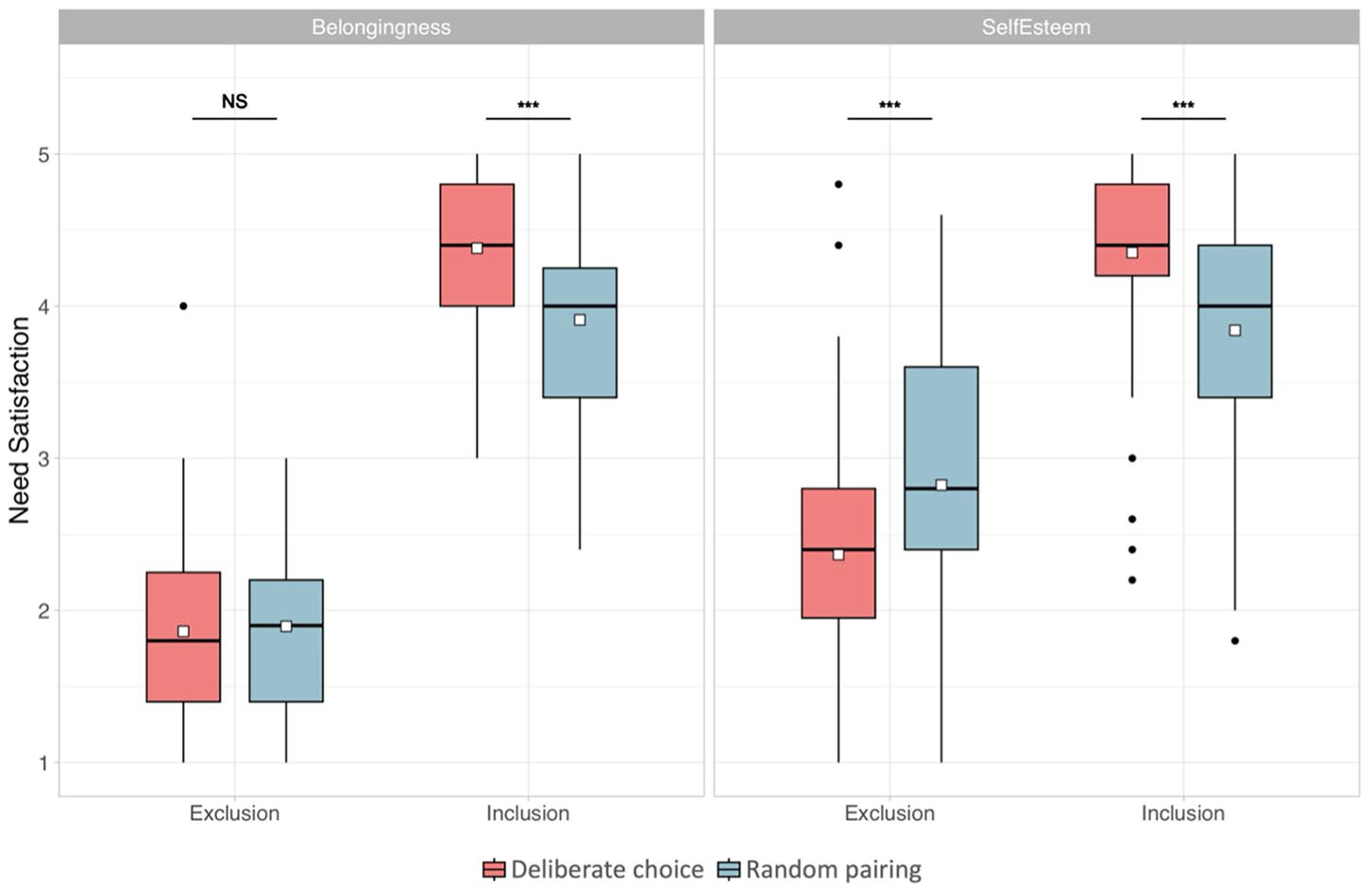
Needs satisfaction levels reported by participants in relation to ostracism and player choice. Individuals in the choice conditions demonstrated a moderated pattern of need-threat levels, reporting lower self-esteem when excluded and higher self-esteem when included. Moreover, they exhibited increased levels of belongingness when included. The boxplot represents the interquartile range, with the lower and upper fences corresponding to the 25th and 75th percentiles, respectively, and the median positioned in between. The bars extend to the 10th and 90th percentiles, while white dots denote the mean values.
A sensitivity analysis was employed to estimate the Minimum Sample Size to detect the effect on Need Satisfaction with a statistical power of .80. Results indicated that a sample size of 84 was sufficient to detect the significant effect of the dynamic (power > .99) and the effect of the need (power = .99) as well as their interactions (power > .87). These findings confirmed our model appropriateness to identify the effects we observed.
Discussion
This study investigates the impact of ostracism and team-building processes on perceived needs threat/satisfaction utilizing the Cyberball paradigm with middle school students. The results confirm that exclusion elicits need threat, which are intensified, in terms of loss of self-esteem, when ostracism is perpetrated by someone who had been previously chosen as a social partner. The silver lining is that when the individual is included in the interaction, having selected one’s partners heightens both self-esteem and sense of belongingness to the group. While previous literature offered valuable insights concerning the negative effects of ostracism on adolescents’ fundamental needs, the role of “group-making” and “group-formation” in influencing ostracism’s need threat has been overlooked. Our study aims to fill this gap, providing a more comprehensive analysis of the intricate interactions between ostracism, group formation, and need threat in preadolescents and early adolescents.
Our results confirm that group acceptance is particularly meaningful in this age cohort, as students who experienced exclusion reported lower needs satisfaction and higher needs threat levels. Specifically, experiencing peer exclusion (i.e., not having the ball passed to them) significantly reduced their self-esteem and feelings of belonging to the group. These results strengthen previous findings on the detrimental effects that ostracism has on need satisfaction of young people.
Crucially, we found that being included or excluded by a group you actively chose to play with elicits different need-threats, compared to being included or excluded by a group you did not choose, but were randomly assigned to. Choosing one’s team members has a polarizing effect on ostracism’s consequences, intensifying both positive and negative emotions. Specifically, students who chose their playing partners and were included felt better about themselves (higher post-round self-esteem reports) and reported a stronger sense of belonging to the group (higher post-round belongingness reports). In contrast, when students chose their team and later on faced exclusion, it resulted in lower self-esteem, with no significant difference in sense of belonging.
In terms of self-esteem, our results suggest that, when adolescents choose team members, they may experience a sense of agency that, in turn, elicits a greater emotional commitment. In the event of inclusion, this choice is likely to strengthen perception of self-worth, which here is boosted both by the fact of being a successful group member (an effect that is also present when groups are created randomly) and by the fact that one’s choice of partners proved effective (a bonus available only when group selection was deliberate). Thus, the act of choosing can be interpreted as a sign of social competence and recognition of one’s decision-making abilities, thereby fostering an increase in self-esteem. Conversely, in case of exclusion, the intensified emotional commitment may result in more significant damages to self-esteem, as the initial choice was accompanied by positive expectations, which were later disconfirmed: here the ostracized participant is forced to question both their adequacy as a team member, and their wisdom in choosing their partners.
On the other hand, while it is clear that actual inclusion and sense of belongingness are strongly correlated, the observed divergence between the decrease in self-esteem and the absence of a significant decrease in the sense of belongingness among students who chose their team members and were subsequently excluded by them suggests a partial dissociation between personal perception (e.g., self-esteem) and group evaluation (e.g., belongingness). This unexpected result highlights the complex interplay between the emotional cost of rejection and the intrinsic desire to fulfill social needs. The act of choice may elevate expectations of positive social interactions, making the subsequent exclusion more impactful on self-esteem. On the contrary, we suggest that since group dynamics and peer acceptance are so relevant during adolescence, to be excluded by someone you choose, or by someone you do not choose, makes you feel like an outsider just the same. Previous studies using Cyberball have shown that ostracism hurts even if inflicted by outgroup members, or by someone we despise (e.g., KKK members; Gonsalkorale & Williams, 2007). In our study, this means that, in terms of sense of belongingness, ostracism may be equally hurtful, regardless of whether it is acted by people we chose (e.g., ingroup members of the choice condition), or by people that were randomly assigned to play with us (e.g. members of the group in the no-choice condition). However, in interpreting these results, caution is advisable, since this null result might also be the product of a floor effect determined by a reduced sensitivity of the implemented scale, leading to a failure to discern between these two conditions. Further studies will be needed to discriminate on this specific point.
In general, we can conclude that choosing friends appears to carry inherent risks, as choice amplifies the need threat consequences: in particular, our findings suggest that the act of choosing teammates results in both more pronounced negative consequences when facing exclusion, and a greater sense of need satisfaction during inclusion. Sometimes the risk of picking your friends pays off, but when it does not, the consequences might be dire. This is consistent with the idea that choice favors the emergence of in-group dynamics, so that, when individuals choose their group, this enhances the strength of connections, sense of belonging, identification with the group, as well as affective commitment (Obst &White, 2007).
In examining the team and player evaluations, we found a positive impact of the choice condition on players’ evaluations, emphasizing the significance of allowing individuals some control over team composition in enhancing perceptions of effective collaboration. Similarly, participants subjected to ostracism perceive the team as less cohesive compared to those in the inclusive condition, and deliberate choice enhances the perception of team cohesion compared to random pairing. These results, while serving as a manipulation check, contribute to our understanding of how preadolescents and early adolescents respond to social dynamics. The preference for inclusive rounds, where participants felt a sense of closeness within the team, underlines the importance of fostering an inclusive environment in educational and social interventions. Furthermore, the positive influence of deliberate choice on team and player evaluations suggests that providing individuals with agency in forming social connections can enhance their perception of group dynamics.
While this study offers important insights, it is not without limitations. First, although the sample size was adequately powered to detect small effects, it may still lack sufficient diversity across several dimensions, (e.g., cultural background, socioeconomic status). This limitation could affect the generalizability of our findings. However, we do not consider this a critical issue because the primary aim of our study was to establish foundational causal relationships rather than to produce broadly applicable conclusions. Subsequent studies should strive for larger and more diverse samples to enhance the external validity of the results. Second, the experimental nature of the study, while a strength in terms of controlling variables and establishing causal relationships, may sacrifice some ecological validity. In real-life contexts, the dynamics of inclusion and exclusion are often more complex and less structured than what can be simulated in a controlled environment. We believe this limitation does not diminish our core findings, as the controlled setting allows for clearer causal inferences. However, future investigations could explore these dynamics in more naturalistic settings to capture the complexities of real-life interactions, thus improving ecological validity.
Additionally, we acknowledge that our study measured only two of the four fundamental needs proposed by Williams (2009)—belongingness and self-esteem (the inclusionary need cluster)—while omitting the power/provocation needs (control and meaningful existence). This decision was primarily motivated by concerns related to cognitive load and participant fatigue. Including all four needs would have necessitated additional subscales after each round of the Cyberball task, potentially increasing the length of the experiment and risking participant disengagement or reduced attentiveness. Future work should address this gap by investigating both the inclusionary and power/provocation clusters to provide a more comprehensive understanding of the fundamental needs affected by social dynamics.
Finally, although the original Cyberball paradigm has proven highly effective in manipulating ostracism across numerous studies (e.g., Hartgerink et al., 2015; Williams et al., 2000), its design limitations merit attention, particularly when applied to younger populations. Specifically, “players” in the classic version are minimalistic, represented as stick figures without hair or clothing, this may limit the level of engagement and emotional immersion, especially for early adolescents. To address this, we bettered the visual presentation of Cyberball, enhancing the appearance and interactivity of the virtual players. In our modified version, the avatars are more visually detailed and relatable, featuring distinct characteristics such as clothing, facial expressions, and more dynamic animations. This modification aims to increase the ecological validity of the task by creating a more immersive and socially relevant experience. By offering a more engaging environment, we hypothesize that this adapted version of Cyberball will improve the external validity of the findings, particularly by eliciting stronger emotional responses and more accurately reflecting the real-world social dynamics of ostracism in younger age groups.
To conclude, the present study contributes to offering a more complete comprehension of ostracism dynamics in pre-adolescents and adolescents, specifically by clearing the intricate interactions between ostracism, group formation, and need threat. Choice is an aspect which frequently characterizes group membership and social dynamics (i.e. we often choose what groups to belong to) and knowing that the impact of ostracism is intensified when individuals choose their playing partners can be useful for professionals working in the sector to fully comprehend the inherent risks associated with enabling choice in group selection. Strategic interventions and teaching methods can be implemented consequently: further studies are needed to verify to what extent these results may apply to cyberbullying.
Footnotes
Acknowledgements
Not applicable.
Author Contributions
MM, MN, FP conceptualized the survey, MM, AS, FP designed the experiment. MN collected the data. MM analyzed the data, SM, MM, and MN reviewed the relevant literature; all authors interpreted the data, and SM, MM, and FP wrote the manuscript. All authors approved the current version of the manuscript.
Declaration of Conflicting Interests
The author(s) declared no potential conflicts of interest with respect to the research, authorship, and/or publication of this article.
Funding
The author(s) disclosed receipt of the following financial support for the research, authorship, and/or publication of this article: This research was partially supported by the PRIN 2022 research project “COOPDEV – Cooperation nudges for sustainable development: leveraging behavioural insights to encourage cooperative behaviour in environmental social dilemmas” (PRIN 2022, 2022T43ACR), funded by the European Union, Next Generation EU, Mission 4, Component 2, CUP B53D23014840006, and by the PRIN 2022 PNRR research project “B-Hu-Well – Boosting human wellbeing with behavioural insights” (PRIN 2022 PNRR, P202227LNS), funded by the European Union, Next Generation EU, Mission 4, Component 2, CUP B53D23030060001.
Data availability

Ethics approval
The present research obtained ethical approval from the direction committee and by the Joint Ethical Committee for Research of Scuola Normale Superiore, Scuola Superiore Sant’Anna and Scuola IMT Alti Studi Lucca (resolution N. 9, 15 February 2024).
Participant Consent Statement
Informed written consent to participate in the study was collected from all the participants’ parents in the days preceding the experiment.
Permission to Reproduce Material from Other Sources
This work does not contain material reproduced from external sources.