




Abstract
We investigate how context might influence adolescent boys’ and girls’ ambition and the impact of gender role conformity and social status. Adolescent participants (N = 270) reported their ambition in one of three experimentally manipulated contexts: future education, future work, or a control. Boys experienced a significant negative drop in ambition in a future education context versus control. There was no difference for girls. Gender role conformity moderated the effects for boys such that the more conform, the less ambitious in an educational context. There was no moderating effect for girls. Social status had no moderating effect. Explanations are discussed, including how negative academic gender role stereotypes may affect boys’ ambition and the importance of addressing boys’ cultures at school.
Keywords
Introduction
Research on adolescent ambition shows conflicting results when it comes to gender differences. As such, Duckworth and Seligman (2006) concluded that girls are more ambitious than boys because they get higher grades. On the other hand, Jerrim et al. (2020) believed that boys are more ambitious than girls because boys are more likely to enter elite universities. Most recently, Bygren and Rosenqvist (2020) found no gender differences between adolescent boys and girls when it comes to the level of education—the higher the level, the more ambitious for both genders. Research on ambition in adults shows similar conflicting results. Women are believed to be less ambitious than men because they have lower managerial intentions (van Vianen & Keizer, 1996), but at the same time believed to be more ambitious as they are more likely to desire promotion than men (Strovik & Schøne, 2008).
Ambition is mostly defined in terms of educational and work attainments such as the willingness to work full-time and the type of work preferred (Dick & Hyde, 2006; Hakim, 2000), the desire for promotion and professional future (Ashby & Schoon, 2010), the desire for top universities (Jerrim et al., 2020), the level of grades (Duckworth & Seligman, 2006) or managerial intentions (van Vianen & Keizer, 1996). It is thus evident that ambition research is very much focused on educational and work contexts. Results from qualitative and quantitative studies have found that ambition might be subjected to contextual influences (e.g. Abouzahr et al., 2017; Harman & Sealy, 2017; Pisinger et al., 2019), but to our knowledge, experiments on the influence of context on ambition have not been performed before. Perhaps different contexts such as education and work are the reasons, we see conflicting results in ambition research on adolescents. We, therefore, ask: If context is made salient will that change how boys and girls score on ambition?
Influence of Context on Ambition
Hyde (2005) conducted a meta-analysis of gender studies and presented the gender similarities hypothesis: that men and women are more alike than different and that whenever gender differences occurred it was due to the context. Hyde found that gender roles and social context strongly determined a person’s actions and that this is true for both men and women. This has also been shown to be true for competition, risk taking, negotiating, and confidence (Amanatullah & Morris, 2010; Gneezy et al., 2009; Meyers-Levy & Loken, 2015).
Looking at ambition, Harman and Sealy (2017) found that corporate cultures influence women’s perception of ambition. Here, positive cultures that support women’s goals and definition of success had a positive effect on women’s ambition levels whereas negative cultures saw a greater number of women opting out of the workplace. Abouzahr et al. (2017) conducted a large survey of 200,000 people and found that women’s level of ambition exceeded that of men when entering the labour market, but their level of ambition declined over the first 2 to 4 years of professional life and ended up being lower than that of men. In a study among 27,000 Danish high school students, Pisinger et al. (2019) found that both boys and girls enjoy high school but that boys are more likely to drop out, to take school less seriously, and to get lower grades than girls. Pisinger et al. (2019) concluded that these results most likely stem from boys being less ambitious than girls in an educational context.
A study by Ammassari et al. (2022) found that small differences in a political context combined with perception of gender roles can influence young women’s desire to pursue a career in politics. By examining the nascent political ambition of young wing party members, they found that men and women are equally interested in pursuing a non-electoral political career, but when it comes to elected political positions, men are more interested to pursue these than women (Ammassari et al., 2022) despite being in the same political context. Ammassari et al. (2022) suggest that the reason why young women are less likely to pursue elected political positions is due to gender expectations that women are more likely to be penalized for wanting political power than men and that women are socialized into acting behind the scenes rather than center stage. The study from Ammassari et al. (2022) shows that not only can context be an influence but is also shows the importance of including the influence of gender roles when exploring context as a factor.
Educational Versus Work Contexts
Many Western societies uphold a gender stereotype that expects girls to do well in school, just because they are girls (Miller, 2017; Wolter et al., 2015). This means that both parents, teachers and others have greater expectations and put greater academic demands on the girls. This creates a link between being a girl and doing well in school. Girls who follow this gender stereotype will typically do well in school. On the other hand, the opposite gender stereotype exists more often in relation to boys, that is, that parents and teachers do not have the same expectations that boys are academically oriented or adept (Miller, 2017; Wolter et al., 2015). Boys are therefore not subjected to the same requirements and expectations in an educational setting.
This kind of gender role expectation can easily affect how boys and girls view their level of ambition in relation to school and academic performance. When boys are constantly being met by lower expectations from teachers and parents and being seen as less ambitious than girls in an educational context, it affects their own perception of ambition: they are less academically ambitious because they are boys (Zimmerman, 2018). Yu et al. (2020) examined the link between exam grades and the students’ perception of gender roles and their own gender role identity. They found that boys who strongly follow traditional male gender stereotypes get lower grades than students who do not follow gender stereotypes very strictly. This is especially the case when boys experience incongruity between being a student and being masculine (Elmore & Oyserman, 2012); if being academically adept is seen as predominately feminine, then asserting a masculine identity can only be done by not being academically ambitious (Zimmerman, 2018).
In a Swedish study of academic achievement, Skolverket (2006) found that girls from primary school to university level outperform boys academically. The report examined possible explanations for this difference and found that it is partly due to the delayed maturity of boys, partly due to gender role incongruity. Skolverket found that boys experience incongruity between their identity and masculinity perception and the role of being a student in school; boys are expected to be loud, messy and not good at school, and girls are expected to be the opposite.
Though boys are seen as less ambitious when it comes to an educational context, it is the opposite once the students enter a work context. Myklebust (2019) investigated perceived barriers in young Norwegian women who had chosen a nautical education, a very male-dominated field. Myklebust found that it was not the girls’ skills or abilities that were questioned in relation to their choice of education, but instead their future role as mothers. The girls were met with expectations that, as women, they naturally have the primary responsibility for their future family and children and thus a responsibility to choose a job where this role expectation can be fulfilled. The girls were not seen as ambitious because they had entered a male-dominated work field, but rather that they would be poor caregivers for not prioritizing children and family.
Research has shown that ambition is seen as a positive trait in men, yet criticized in women. In a professional context, it is common to associate an ambitious woman with descriptors such as “difficult to work with.” In 2003 professor Frank Flynn from Columbia Business School presented half his class with a case study using the name “Heidi” on it and gave half the class the same case study but with the name changed to “Howard” (Katsarou, n.d.). When the students were polled about their impressions of Heidi and Howard, the students rated both as equally competent, but when asked who they would prefer to work for, Howard was almost universally seen to be a more appealing colleague, with Heidi seen to be selfish and “not the type of person you would want to hire or work for.” Leadership research has found that stereotypical masculine perceptions dominate the perception of a leadership role and that it negatively affects women in a work context leading to women being less ambitious about pursuing top managing positions (e.g. Spangsdorf & Forsythe, 2021).
In gender role congruity theory (Eagly & Karau, 2002) ambition and being ambitious is seen as agentic characteristic, that is, prescriptively male. The examination of gender roles as constructed within this theoretical frame provides insight into the “normative” expectations of the roles that manifest from the constructs. These dimensions provide theoretical context for the expectations that, “a group will be positively evaluated when its characteristics are perceived to align with the requirements of the group’s typical social roles” (Diekman & Goodfriend, 2006, p. 369). Applying this to ambition, it is clear that the male roles and measures of success fall into what Eagly and Karau (2002) categorized as “agentic.” However, women tend to either self-select into, or be encouraged into roles that are more social, what the researchers categorized as “communal” which includes being concerned with the welfare of others and a tendency toward being affectionate and nurturing.
Although we know that not all men can be described as being agentic and that not all women feel comfortable in roles categorized as communal, Eagly and Karau argue that these bifurcated roles are innately gendered, thereby causing gendered implications when applied in educational, professional, or research contexts. According to this approach, if both men and women consider being ambitious to fulfill an agentic role, and lack examples that support communal roles, women must either co-create their gender and ambition identity (Faulkner, 2001) or approach their work with pre-determined congruities existing between their identities as Sader (2011) observed. However, the gender similarities hypothesis would argue that the agentic role of being ambitious may differ depending on the context as well as how likely a person is to conform to gender roles. It is acceptable for girls to be ambitious in school but not at work and the opposite for boys. The role of being ambitious thus may change depending on the context in which ambition is expressed.
Gender Role Conformity as Moderator
According to social role theory (Eagly & Wood, 2016) differences observed between men and women are the result of a combined impact of socialization, gender stereotypes, gender roles, and physical differences that direct the behavior of men and women. Expectations about gender roles and the behaviors expected from women and men influence people to adhere to gender stereotypes. Gender roles and gender stereotypes are learned and internalized through socialization where children learn which behaviors are considered to be appropriate or inappropriate in society. Adolescence is a critical period in which gender attitudes and behaviors intensify and new gender roles emerge (John et al., 2017). As roles are cognitive schemas that are associated with specific goals and expectations that organize and guide individuals’ perception and preferences, the social roles individuals assume affect their choice of goals and motivation (Arieli et al., 2020).
Gender role conformity is the act to which men and women conform to the prevailing gender norms in society (Kachel et al., 2016). In Western societies, conformity to feminine roles has been linked to characteristics and behaviors such as caring for others, modesty, domesticity, passivity, and communal behavior (Eagly & Wood, 2016; Kachel et al., 2016) and masculine roles has been linked to characteristics such as assertiveness, risk-taking, dominance, and competition (Kachel et al., 2016; Mahalik et al., 2005). According to Eagly and Crowley (1986) and Hyde (2005) contexts can yield men and women to adapt their behavior according to what is expected of them in that context.
Yet, in her study, Fuller (2009) found that context alone does not necessarily make a difference for the behavior of girls. Fuller (2009) followed three groups of high school girls from a working-class area in the UK. She concluded that how the girls were received and viewed at school only partly influenced their educational and future occupational choices; the amount of emotional support from their families and the girls’ self-identification were equally responsible for how they perceived the school environment and, thus, their ambitions. Fuller (2009) found that low aspiring girls were more likely to identify with traditional gender roles of motherhood and being with a partner to be giving them status rather than educational achievements, thus for these girls following a traditional gender role was more rewarding than pursuing education. Middle aspiring girls also identified with more traditional gender roles of motherhood and family but from a point where they wanted to combine family life with a job. They were predominately focused on traditional female-dominated occupations such as nursing, teaching, and social care. High aspiring girls, on the other hand, were more likely to identify with their future occupations seeking to enter university and getting high-paid jobs to be more self-sufficient and economically independent. In all, gender role conformity was the driving factor of the influence of the educational context just in different ways for each group of girls.
Both Yu et al. (2020) and Skolverket (2006) found a link between gender role identity and academic performance in young students and that this influences how the students view themselves in terms of ambition. Yu et al. (2020) observed that students who adhered to traditional gendered ideals in terms of behavior and appearance were more likely to emphasize the importance of status than students who were less concerned about gendered roles or ideals. A study by Van Grootel et al. (2018) concluded that teenage boys who do not really want to exhibit stereotypical masculine behavior often feel pressured to conform to social expectations of masculine behavior, primarily because they believe that their classmates expect them to. Thus, boys who would rather be bookish can end up appearing as lazy and disruptive students who do not bother with school or homework because they believe that this behavior is expected of them or that the behavior gives them status in class.
Carter et al. (2019) found that men are more likely to conform to gender roles than women. The ability to violate gender-role norms does not seem to be the same for men. Instead, men may be pressured to comply with most gender norms because they could otherwise run the risk of having their masculinity questioned, which could put their social status in jeopardy (Vesciuo et al., 2010). Powerful individuals are “more guided by activated constructs” (Guinote, 2010, p. 159) such as social norms. The relationship between power and masculinity can be an explanation for why men, in general, attempt to retain power to maintain their identity (Schultheiss et al., 1999, 2003, 2005; Sellers et al., 2007). If we expect that ambition will change due to context, does conformity to gender roles then moderate the relationship between context and ambition? For example, will boys who conform less to gender roles yield similar results to that of girls in an educational context?
Social Status as Moderator
Studies on goal achievement have shown that the socioeconomic status (SES) of parents is a significant factor in the types of goals young students choose (Giota & Bergh, 2021) and that socioeconomic factors such as parents’ educational level and income can affect how adolescents perform academically (Jamil de Montgomery & Sievertsen, 2019), their adult earnings (Ashby & Schoon, 2010), and their choice of education or future job (Carneiro & Heckman, 2003). In a British study from Sabates et al. (2011) adolescent ambitions (educational and occupational expectations at 16 and educational and occupational attainment as adults) were shaped by socioeconomic factors in childhood. As such, the majority of adolescents with high and aligned ambitions belonged to the highest social classes. However, this may be due to social stratification in the UK with high-income parents being able to afford private tutoring, good private schools, and university tuition fees benefiting their children to have a better alignment between educational expectations and adult attainments. However, in Scandinavian countries there seems to be a paradox in that despite comprehensive social security systems and education free of charge, the countries still see great inequalities in educational and occupational achievements among adolescents from low socio-economic backgrounds (Holm & Jæger, 2007). In their study, Holm and Jæger (2007) found that, in a Danish setting, using only economic stratification as explanation is not plausible. Rather the inequalities in achievement between different social groups must be viewed from both economic, social, and cultural capital, where social and cultural capital are the non-monetary background factors. They suggest that when examining achievement of goals, perception of one’s social status is a better approach than parents’ income levels. This is in line with the findings of Keller and Zavalloni (1964) who found that wealth is not a good measure of ambition as people have access to different resources and may not perceive the attainment of wealth as possible. We are therefore curious to learn whether social status moderates the relationship between context and ambition so that the higher the social status the less influence of context.
The Current Study
As the influence of an educational versus work context has not been examined experimentally before, especially not in young students, we have chosen to conduct a 2 × 3 factorial experiment with Danish high school students. The dependent variable is ambition. The independent variables are 1) Context with three levels: future education, future work, and control group, and 2) Gender of participants: male, female. The control group was not presented with a context, but instead an unrelated task. The moderator variables are conformity to gender roles and social status.
In the experiment we want to examine the following hypotheses:
H1: When future education context is made salient, we expect girls to have a higher score and boys to have a lower score on ambition than the control group.
H2: When future work context is made salient, we expect boys to have a higher score and girls to have a lower score on ambition than the control group.
H3: The relationship between context and ambition will be moderated by conformity to gender roles such that the effect of context will be weaker for those who do not conform.
H4: The effects between context and ambition scores will be moderated by social status such that the effect of context will be weaker for those students that come from high social status backgrounds.
Materials and Methods
Five Danish high schools participated in the study during the Fall of 2021. Classes were selected at random at each school and an online questionnaire was then distributed to the students. The manipulated variable (future education, future work, control) was randomized in the questionnaire so that no one, including the researchers, would know which group (education, work, control) the students would be assigned to. The online questionnaire was created using the survey program Qualtrics. In the findings of Eagly and Crowley (1986) and Hyde (2005) social influences through the presence of others within the chosen context are believed to drive changes in behavior in men and women in that context. We, therefore, decided to mimic this social influence by carrying out the experiments in the classrooms at the schools and have the researcher present while the students completed the questionnaire.
Participants
Power analysis in G*Power v3.1 revealed a minimum sample size for this study was 200 respondents for an experiment with two independent variables and one dependent variable. The data collection resulted in 282 responses. Incomplete responses were left out of the study. The current study thus has 270 participants (46.7% boys, 53.3% girls, 0% non-binary, 0% did not wish to inform). 97.4% are between 14 and 22 years of age (M = 16.9, SD = 3.2) and 2.6% are over 22 years of age. The students represent different types of Danish high schools with 18.9% from 9th-grade high school, 24.8% are from HF (higher preparation exam), 28.9% are from STX (general high school exam), 9.6% are from HTX (technical high school exam), and 17.8% are from HHX (mercantile high school exam).
The three experimental groups consisted of 92 students in the control group, 89 students in the future education group, and 89 students in the future job group.
Ethical Considerations
No incentives were used to encourage participation. The online questionnaire contained a page with information and a consent form to which the participants actively had to give consent in order to proceed to the questionnaire. The students were 100% anonymous in the questionnaire as no personal information was collected. For students under the age of 18, the schools informed the parents about the study, however, the students participating in the study provided their own consent.
Before the students were given a link to the questionnaire, they were informed about consent, the option to decline participation, and that they could withdraw from the study at any time without consequences. The students were also informed about anonymity and confidentiality.
Some deception was used when presenting the experiment to the students. The students knew that they took part in an experiment and that it was about ambition. However, we did not disclose that we wanted to examine whether context or conformity to gender roles influence the students’ scores on ambition as we did not want to make this salient to the students to avoid contaminating the responses. We also chose not to disclose this information in the debriefing document as we did not want the students to share this knowledge with other students who were to participate in the experiment at a later date.
Measures
The measures of the questionnaires were presented in a specific order to ensure that context would act as the manipulating factor. The questionnaire contained questions about type of school, age and gender as well as social status, conformity to gender roles and ambition scale.
Social Status
A Danish-translated version of the youth version of the Subjective Social Status scale was used in this study to measure the participant’s subjective perception of social status in society (Steen et al., 2020). This instrument consists of a 10-rung ladder with instructions. Cronbach’s alpha for this measure is not available, but several studies have found good test-retest results (e.g. Giatti et al., 2012; Ritterman et al., 2009).
We analyzed the scale as a continuous variable. The instruction for the questionnaire used for the ladder measuring social status in society was as follows: “Imagine that this ladder pictures how the Danish society is set up. At the top of the ladder are the people who are the best off—they have the most money, the highest amount of schooling, and the jobs that bring the most respect. At the bottom are people who are the worst off—they have the least money, little or no education, no job or jobs that no one wants or respects. Now think about your family. Fill in the circle that best represents where your family would be on this ladder.”
Conformity to Gender Roles
Kachel et al. (2016) developed the Traditional Masculinity-Femininity scale (TMF) which is a one-dimensional measure of conformity to gender roles. The advantage of the TMF is that it is measured on a global level and not by various specific indicator items. Different from other masculinity-femininity gender role scales such as Bem’s Sex Role Inventory (Bem, 1974) and the Conformity to Feminine Norms Inventory (Mahalik et al., 2005 and Conformity to Masculine Norms Inventory (Mahalik et al., 2003) which infer masculinity-femininity from the degree of affirmation of specific traits and behaviors, the TMF aims to directly assess masculinity-femininity. The TMF is thus independent of specific stereotype content regarding masculinity and femininity that depends on culture and time (e.g., ambitious as masculine, caring as feminine). The TMF consists of six items only: One for gender-role adoption (“I consider myself as . . .”), one for gender-role preference (“Ideally, I would like to be . . .”), and four for gender-role identity (“Traditionally, my 1. interests, 2. attitudes and beliefs, 3. behavior, and 4. outer appearance would be considered as . . .”) to measure an individual’s gender-role self-concept in a parsimonious way. The 6 items are measured on a 7-point Likert scale ranging from 1 (Mostly masculine) to 7 (Mostly feminine) and have shown to have a Cronbach’s α from .89 to .90 (Kachel et al., 2016).
Context
The manipulated variable was designed to make context salient. The variable contained three conditions: Condition A (future education context), Condition B (future work context), and Condition C (an unrelated task). Condition C was used as control. Condition A and B consisted of a task asking the students to describe a future higher education school day or future work day. The students were only presented with one of the three conditions which were distributed randomly. Condition C was an unrelated task presenting the students with three optical illusion pictures in which the students were asked to locate the number of faces, horses, and animals.
Ambition
Ambition was measured based on the 6 items developed from the definition provided by students in two studies (the authors, in review) (I set high goals; I am highly motivated; I strive for success; I see myself as ambitious; I always aim very high; I push myself to set goals that are difficult to reach). The ambition scale was measured using a 7-point Likert scale with 1 (Completely disagree) to 7 (Completely agree) and has a Cronbach’s α at .90.
Data Analysis
We analyzed H1 and H2 using 2 × 3 factorial ANOVAs with ambition as dependent variable, context as independent variable with three levels (control group, future education group, and future work group) and gender of participants as independent variable (male, female). Prior to the ANOVAs we examined Levenes’ test for homogeneity of variances for each of the three context groups. We performed post hoc tests using Tukey honestly significant difference as sample sizes are equal. For effect size, we used partial eta squared as recommended by Keppel (1991) as it allows for comparison of effect size with future experimental studies. Partial eta squared values are .01 (small effect), .06 (medium effect), and .14 or higher (large effect) (Keppel, 1991). For H3 and H4 we conducted two moderation analyses using PROCESS (v4.1, Model 1 and Model 3; Hayes, 2018) with ambition as dependent variable, context as independent variable, and for H3) conformity to gender roles, and for H4) social status as moderator variables. For H3 the moderation analysis was carried out on each gender group separately as conformity to gender roles is a continuum measure in which a low score equals mostly masculine and a high score equals mostly feminine and the level of conformity is therefore opposite for each gender group.
Results
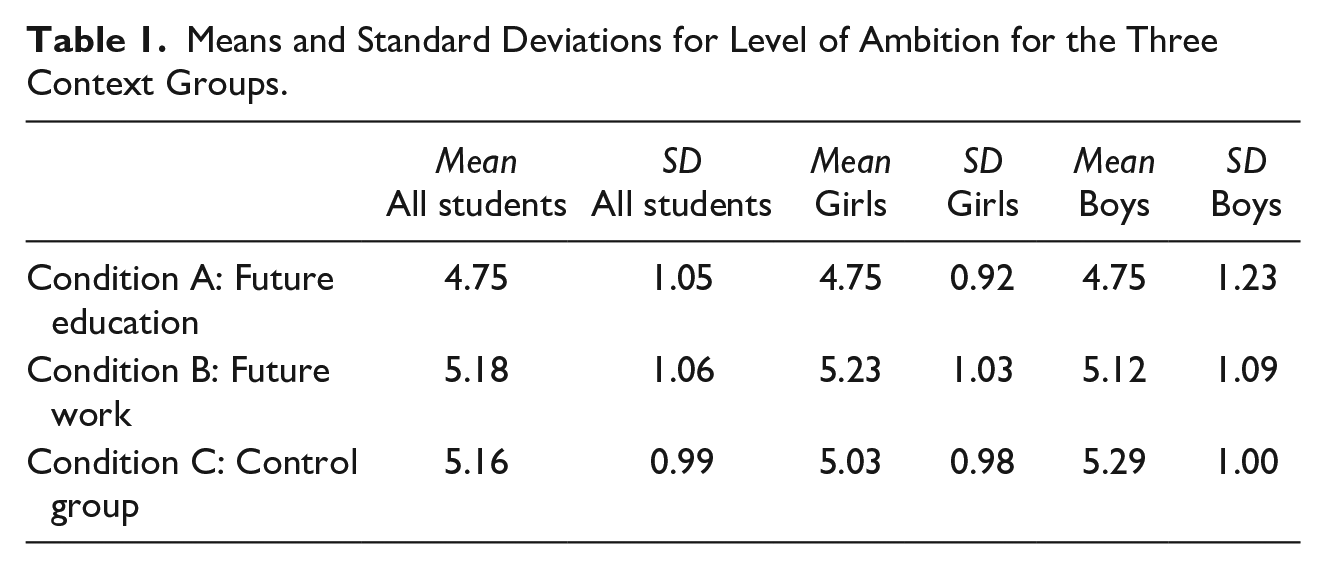
Means and standard deviations can be seen in Tables 1 and 2.
Means and Standard Deviations for Level of Ambition for the Three Context Groups.
Means and Standard Deviations for Social Status and Conformity to Gender Roles.
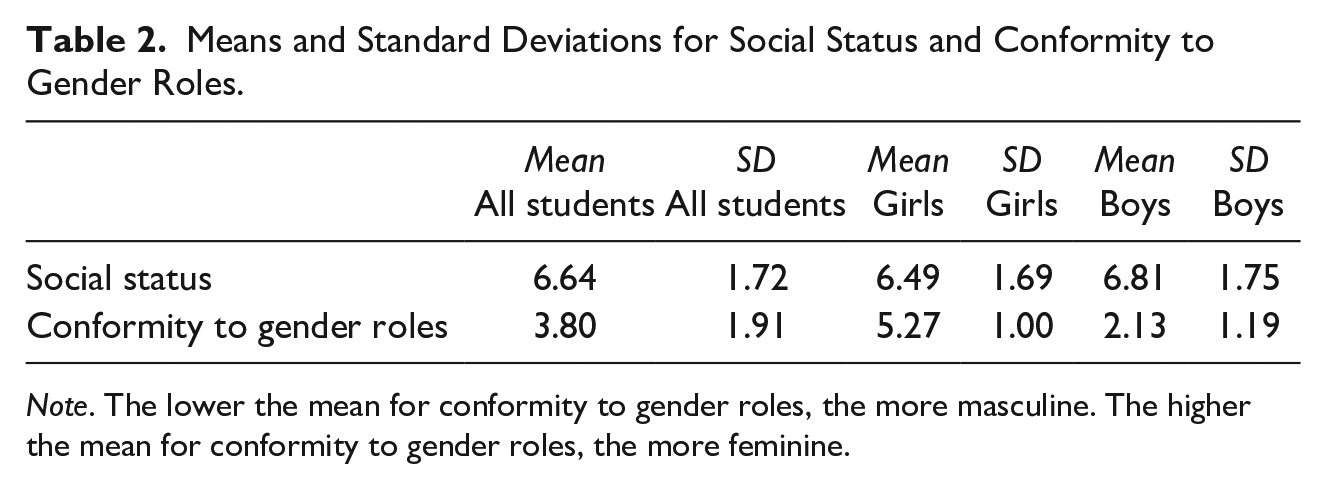
Note. The lower the mean for conformity to gender roles, the more masculine. The higher the mean for conformity to gender roles, the more feminine.
First, a factorial ANOVA was conducted to compare the main effects of gender and context (independent variables) as well as their interaction effects on ambition scores (dependent variable). Levene’s test of homogeneity was not significant, F (5, 270) = 1.61, p = .16. There was no main effect of gender F (2, 270) = .15, p = .70, and also no interaction effect of context and gender F (2, 270) = .77, p = .46. However, there was a main effect of context F (2, 270) = 4.67, p < .01. The main effect of context yielded a medium effect size of η2p = .034. Post hoc analysis (Tukey) indicated that the control group (M = 5.16, SD = 0.99) had significantly (p < .02) higher ambition scores than the future education group (M = 4.75, SD = 1.05), but not significantly (p = .99) higher ambition scores than the future work group (M = 5.18, SD = 1.06). To see if there would be differences between the three context groups within each gender, we performed a simple contrasts analysis (one-way ANOVA with spilt file on gender). The analysis showed that for boys there was a significant difference between the control group and the future education group (p < .05), but not between the control group and the future work group (p = 1.00). For girls, there was no significant difference between the control group and the future education group (p = .54) or between the control group and the future work group (p = .95) (see Figure 1). The main effect of context is therefore found within the group of boys.
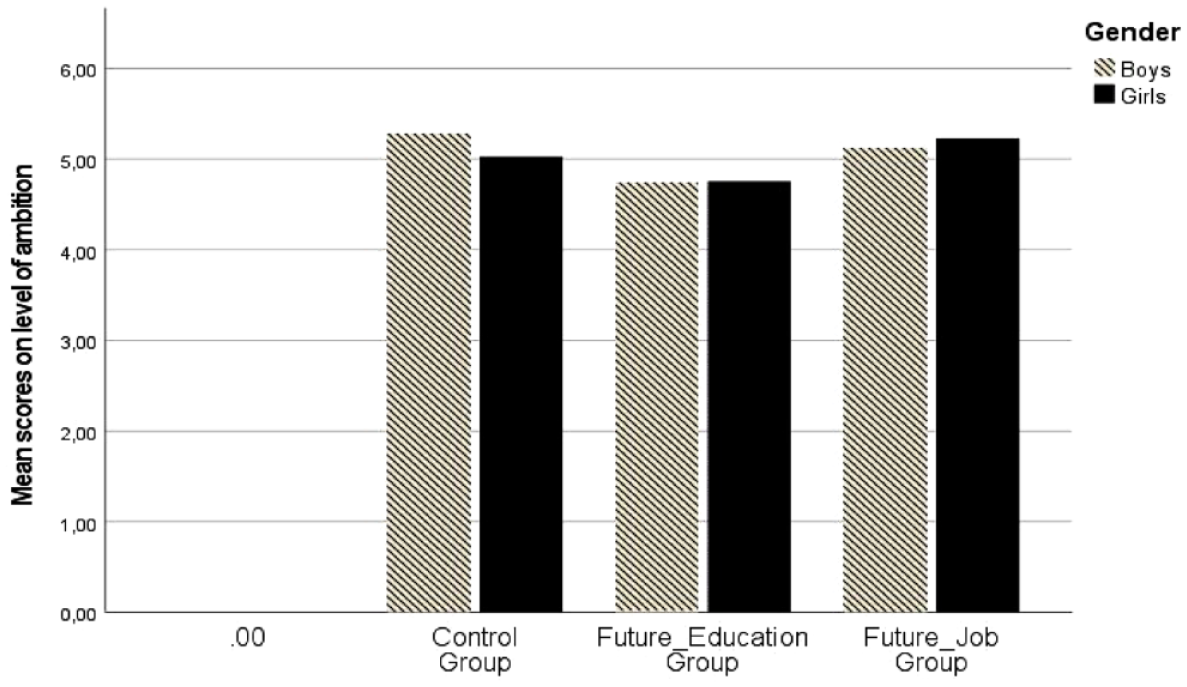
Comparison of mean scores between context groups.
Overall, we did not find any gender differences in ambition scores between the three context groups meaning that H1 and H2 cannot be accepted. However, we found a significant difference within the group of boys between the control group and the future education group. This difference is mainly driven by boys’ high ambition scores in the control group.
We then examined H3 to see if conformity to gender roles moderated the effect of context such that the effect of context will be weaker for those boys and girls who do not conform. The moderation analysis was carried out on each gender group separately and showed that the relationship between context and ambition scores was not moderated by conformity to gender roles for girls in either the future education group b = 0.21, 95% CI [−0.48, 0.35], t = −0.30, p = .76, or in the future work group b = 0.19, 95% CI [−0.30, 0.49], t = 0.46, p = .64 when compared to the control group. For boys there was no moderation effect in the future work group b = 0.19, 95% CI [−0.31, 0.42], t = 0.29, p = .77, however, we found a moderating effect of conformity to gender roles in the future education group b = 0.23, 95% CI [−0.97, −0.05], t = 2.18, p = .03 compared to the control group such that the more conform (i.e. the more masculine), the lower the ambition level. H3 is therefore partially accepted.
Finally, for H4, we performed a similar moderation analysis to see if social status moderated the effects of context such that the effect of context will be weaker for those boys and girls who come from a high social status background. The moderation analysis showed that the relationship between context and ambition scores was not moderated by social status, b = 0.23, 95% CI [−0.14, 0.60], t = 1.22, p = .23, and that a combined moderation effect of gender and social status did not affect ambition scores in either the future education group, b = 0.09, 95% CI [−0.27, 0.45], t = 0.48, p = .63, or in the future work group b = −0.14, 95% CI [−0.49, 0.20], t = −0.81, p = .42, when compared to the control group. H4 can therefore not be accepted.
Discussion
This study examined how context affects ambition scores in adolescents and whether there would be gender differences in the influence of context. We used an experimental approach to explore causality. We argued that girls, when presented with a future educational context, would score higher than the control group, that boys would score lower, and that this would be the opposite for boys and girls when presented with a future work context. We also expected the relationship between ambition scores and context to be moderated by conformity to gender roles such that the effect of context would be weaker for those students who did not conform to traditional gender roles. Lastly, we expected that social status would moderate the relationship between ambition scores and context so that students from a high social status background would be less influenced by context than students from medium and lower social status backgrounds.
Results show that ambition levels are indeed influenced by context, but only within the group of boys in the future education context. In the future work context, there was no difference compared with the control group for either boys or girls. We could not establish an absolute gender difference in the influence of context on ambition. But we found that within the group of boys there is a significant difference between the control group and the future education group. This supports Hyde’s (2005) gender similarities hypothesis that boys and girls are more alike than different. Yet, the gender similarity hypothesis states that gender differences in studies are the results of contextual influences. However, despite finding a moderate effect of context, we could not find support for the hypothesis in the sense that context is the source of gender differences. We used the same approach as Eagly and Crowley (1986) mimicking social influence by being present at the experiments as this have shown to be a key element driving gender differences in study results but despite that we did not find any gender differences in the influence of context, at least not when it comes to ambition in adolescents. One explanation could be that we have used a definition of ambition that is not affected by gender bias in a social context. This is in line with the findings of Zell et al. (2015) who tested the gender similarity hypothesis using a meta-synthesis approach. They found that when it comes to social behavior and personality variables gender differences hardly exist and that the differences are greater within one gender than across genders (Zell et al., 2015). Another explanation could be that, in line with the findings of Fuller (2009), context itself is not the driving force of differences in behavior between men and women, rather it is the self-identification (and conformity) with gender roles that drives these changes which may explain why we found differences within the group of boys despite being subjected to the same educational context.
The effect of context on boys and girls was not moderated by social status. Interestingly, the effect of context on girls’ ambition levels was also not moderated by conformity to gender roles, but the more conform boys are to gender roles, the lower they score on ambition in the future education group.
So why are boys affected by gender role conformity in an educational context? A long tradition of research shows that perceptions of masculinity, boy culture, and negative stereotypes about boys’ academic ability guide boys’ behavior in a school setting. Morris (2012) found how boys’ adolescent peer groups disparage academic efforts and endorse school-related rebellion in an attempt to keep up ideas of “a real boy.” Epstein (1998) found that boys who are committed to schoolwork get called “queer” by classmates questioning both their masculinity as well as their sexuality. Mittleman (2022) concluded that negative stereotypes depicting working hard in school as feminized and portraying boys as having less academic ability lead not only boys themselves but also parents and teachers to have lower academic expectations and demand less of boys. Similar negative stereotypes are found in Danish and Scandinavian contexts with studies showing that boys and girls are met with highly gendered expectations in schools (Undervisningsministeriet, 2017). In their study on gender differences in educational attainment, Yu et al. (2020) concluded that boys and girls should not be viewed as two independent groups but rather that differences between the two gender groups are driven by sub-groups within each gender group. Based on their research, they classified boys and girls into seven groups depending on their educational attitude and attainment. Differences in educational attainment are predominately driven by “cool guys” (boys who are very competitive, take risks and are very concerned with their appearance and having success with the girls) and “tough guys” (boys who exhibit an image of being “hard” or “tough” and who come across as confident and assertive) who tend to get very low grades, and by “relational girls” (girls who are not concerned with their appearance and who emphasize relationships with others) and “tomboys” (girls who are not interested in traditional feminine behavior and are often considered “one of the boys”) who tend to get very high grades. Yu et al. (2020) recommend that instead of addressing the differences between boys and girls in an educational context, focus should be on the sub-groups of boys and girls who are the source of the large grade differences found between boys and girls.
Another interesting result is the fact that future work context did not affect ambition scores in either boys or girls. This follows the findings of Abouzahr et al. (2017) in which women’s level of ambition are high when completing their higher education but declines as they enter the labour market and gain experience with corporate cultures and gender stereotypes in the workplace. Adolescent girls equally show high levels of ambition similar to boys, and this is likely a result of optimistic hopes for the future and the fact that adolescents have not yet gained experience with a job context and possible gender stereotypes in the work place. Generally, boys and girls have the same expectations about their future work life, but as gender stereotypes become more pronounced with age (younger people are stereotyped less than older cohorts) it has a negative influence on women’s ambition levels in adulthood (Lopez-Saez & Lisbona, 2009).
Limitations and Future Studies
There are three major limitations in this study that could be addressed in future research. First, our study only had boys and girls, but no students identified as non-binary. Examining groups that identify as other than female or male may yield different results of the influence of context on ambition. Non-binary groups are more often subjected to negative stereotypes (Martin & Thomsen, 2021) that, when combined with stereotypes relating to educational settings, may create a stronger negative impact on ambition. Second, our study focused on gender. However, as context can be highly influenced by social norms, intersectional stereotypes between gender and ethnicity or gender and race can alter the influence of context. For example, in Denmark boys of immigrant parents do worse academically when compared to ethnic Danish boys (Fallesen, 2015: Jakobsen & Liversage, 2010). This could lead to different results within the group of boys as boys of immigrant parents may be even more affected by negative stereotypes pertaining not only to their gender but also their ethnicity. This could benefit from being explored in future studies. Finally, to our knowledge, this is the first study to examine the influence of context on ambition using an experimental method. Previous studies have primarily utilized either qualitative (e.g. Harman & Sealy, 2017; Sools et al., 2007) or correlational methods (e.g. Ashby & Schoon, 2010; Jerrim et al., 2020; van Vianen & Keizer, 1996). There is a need for more experimental studies to fully understand how context influences ambition positively or negatively in an educational setting including studies among different age groups.
Conclusion and Practical Implications
The purpose of this research was to examine if a future education or future job context could influence how adolescents score on ambition. Based on the analysis of our experiment, we can conclude that there is no gender difference between boys and girls when it comes to the effect of context on ambition. However, we found an indirect effect of context within the group of boys as a future educational context has a negative effect on boys’ ambition scores, whereas there are no differences in ambition scores for girls regardless of context. This supports the gender similarities hypothesis; that boys and girls are more alike than different. But we did not find support for the gender similarities hypothesis that context is the main driver of gender differences. Instead, we found that boys’ ambition scores were moderated by gender role conformity so that the more conform the less ambitious in an educational context.
As an educational context can have a negative effect on boys’ ambition levels, schools and teachers are encouraged to be aware of the explicit and subtle stereotypes concerning education and academic ability that teachers and students often carry, as well as making these stereotypes explicit to parents. Heyder and Kessels (2015) concluded that teachers’ stereotypical perceptions can have great significance for boys. Yu et al. (2020) recommend specifically targeting the sub-groups of boys who are especially affected by masculine gender stereotypes as it has a negative effect on their perception of school and academic attainment. By addressing these kinds of gender role stereotypes both in class and at the school, teachers can work together through peer-to-peer supervision to change pedagogical and didactic practices aiming at raising ambition levels of these sub-groups of boys in an educational setting.
Footnotes
Author Contributions
All authors contributed to the study conception and design. Material preparation, data collection, and analysis were performed by Sabrina Spangsdorf. The first draft of the manuscript was written by Sabrina Spangsdorf and all authors commented on previous versions of the manuscript. All authors read and approved the final manuscript.
Declaration of Conflicting Interests
The author(s) declared no potential conflicts of interest with respect to the research, authorship, and/or publication of this article.
Funding
The author(s) received no financial support for the research, authorship, and/or publication of this article.
Ethics Approval
The study involves human participants, including children under the age of 18. This study was performed in line with the principles of the Declaration of Helsinki. Approval was granted by the Psychology Ethics Committee at Exeter University on 1 October 2021.
Consent to Participate
Informed and signed consent was obtained from all participants before the study was undertaken. No identifiable personal information was collected.

Data Availability Statement
Data from this study can be obtained by contacting the first author.