



Abstract
Services for youth experiencing homelessness (YEH) are designed with limited input from the youth themselves. This study explored the experiences and recommendations for services aimed at mitigating the negative effects of homelessness among youth. A total of 45 interviews were conducted with YEH (ages 15 to 24, M = 21.5 years) who experienced at least one night of homelessness. Transcripts were coded by using a modified constructivist grounded theory approach. YEH reported myriad challenges to navigating disjointed programming and misguided policies. Recommendations from YEH for policy and programmatic change include peacekeeping and diffusion training for program staff, trauma-informed approaches, and conflict resolution among agency staff; and integrate creative outlets and transitional services into existing programs. Programming supporting YEH must extend beyond meeting only basic needs to creating opportunities for safety, autonomy, and growth. Programs targeting youth homelessness need input from YEH in their design and implementation.
Introduction
Approximately one in 10 American young adults ages 18 to 25, and at least one in 30 adolescents ages 13 to 17 are experiencing homelessness in the past year (Beharry et al., 2018; Morton, 2018; Morton et al., 2017). These are youth who are living in places not meant for human habitation, in shelters or transitional housing (or other temporary housing arrangement), or staying with others (e.g., couchsurfing) while lacking a safe and stable alternative living arrangement (Morton, 2018). Risks for homelessness are highest among those who have children, who are Black/African American and/or Hispanic, LGBTQ+ (i.e., sexual and gender minority people), and/or who did not complete high school (Beharry et al., 2018; Hickler & Auerswald, 2009; Morton, 2018; Morton et al., 2017). Youth experiencing homelessness (YEH) are at high risk for a range of adverse physical, mental, social, and behavioral health outcomes that include food insecurity, sexual risk behaviors, criminal justice system involvement, ongoing or chronic homelessness, and substance use (Gultekin et al., 2020). Services are urgently needed for mitigating adverse outcomes among YEH.
Prior to homelessness, YEH frequently experience significant family conflict, trauma, and home disruptions including abuse, neglect, discrimination (especially for LGBTQ+ youth), entrance into foster care, and loss of caregivers (Morton et al., 2017; Tompsett et al., 2009; United States Interagency Council on Homelessness, 2018). Compared to adults experiencing homelessness, YEH report higher numbers of friends in their social networks, as well as more contact with friends and family members (Tompsett et al., 2009), with peer networks playing an important access point for resources and supports (Chew Ng et al., 2013; Morton et al., 2017). YEH also tend to be mobile in their geography and sleeping settings (Morton et al., 2017). YEH may move in and out of homelessness more frequently than adults (Tompsett et al., 2009) and frequently use informal, drop-in style services rather than longer-term shelters (Pedersen et al., 2016; Slesnick et al., 2016). Services and programming for supporting YEH should be tailored to the unique needs of younger people.
Few studies focus on how services and programs may be improved based on feedback from YEH who access and use them (Josephine Ensign, 2006). YEH face systemic and institutional barriers to services such as long wait times, inconvenient hours of operation, inflexible or unrealistic agency policies, unsafe agency settings, complexity of navigating uncoordinated services across multiple agencies. YEH also face interpersonal and intrapersonal barriers such as perceived stigma or discrimination from agency staff, feeling devalued or misunderstood, preference for reliance on self or peers rather than agencies (Black et al., 2018; De Rosa et al., 1999; Garrett et al., 2008; Hudson et al., 2010; Parast et al., 2019; Pedersen et al., 2016; Thompson et al., 2006). These barriers to services intended to help YEH can interact to create situations that place YEH at greater risk. For example, referral barriers can contribute to reluctance to rely on agencies, which may increase risks to health and safety.
YEH may have particular insights on how best to enhance existing programming and address service gaps. Given unique needs among YEH (e.g., geographically mobile, peer-focused), we employed a participatory action research approach using “walking tour” interviews led by young people to engage YEH in understanding specific experiences of YEH in San Francisco, CA. This study builds upon our understanding of how YEH ages 15 to 24 experience the programs and services intended to support YEH and mitigate adverse outcomes of homelessness.
Methods
The study is part of a larger study that utilized a youth participatory action research (YPAR) approach and included YEH in the study design, implementation, and analysis (Anyon et al., 2018). The youth research team included young people who were “exiting” homelessness into permanent supportive housing, undergraduate students with lived experience of homelessness and/or extensive service experience, and undergraduates with extensive experience working with YEH.
The youth research team conducted 45 “walking tour” interviews with YEH to create rich descriptions of their lived experiences. Walking tour interviews allow participants to point out physical locations of their experiences and provide sociospatial context for phenomena discussed in the interview that are less easy to capture in a traditional interview, particularly in urban environments (Carpiano, 2009; Teixeira & Gardner, 2017). Walking tour interviews are a way to “meet [participants] where they are” and engage directly in the environments where they live their lives (Carpiano, 2009). The interviews were conducted by the youth researchers after receiving training in qualitative interviewing methods by the second author, a licensed clinical social worker with a background in qualitative research who was then a doctoral student and the study project director. In the larger study, participatory photo mapping was a key data collection method, in which participants indicated locations of meaning and then could select to take photos of those locations (Teixeira & Gardner, 2017). Geospatial data was linked to the photos and locations. The photos and geospatial data were not included in the analysis that produced the findings reported here. Protocols were reviewed and approved by a university Institutional Review Board prior to data collection.
Interviewed YEH were 15 to 24 years of age and had experienced at least one night of homelessness, defined as being without sure, safe, and stable shelter, in San Francisco within the past 6 months. Youth were approached at street and service sites in five neighborhoods that had been identified in the previous Point-in-Time Count as areas with the highest numbers of unhoused youth (Lin et al., 2017). These five neighborhoods were: Haight-Ashbury, the Tenderloin, the Castro, the Mission, and the Bayview. Each of these neighborhoods have cultural histories characterized by diverse and often under-resourced populations, even while many of these neighborhoods have been gentrifying in recent years.
In the walking tour interviews, participants guided the research team through their neighborhood, sharing their expertise on the places, spaces, and people connected to violence, safety, and resources for YEH. Interviewers provided a broad definition of violence to participants that included physical, sexual, emotional, social, structural, and other forms of harm. Participants who were unable or unwilling to conduct the walking tours or were in areas where safety concerns precluded an outdoor tour, the participants conducted “virtual walking tours” with interviewers using mapping software and a tablet to discuss their neighborhood on a virtual map. Demographics were collected as part of the opening questions of each interview. Interviews were audio recorded using two different recording devices in order to ensure data capture given the loud urban environment. As grounded theory was the primary qualitative analytic method used in the study, and as the study was designed to collect data from each of the identified neighborhoods, the final number of participants was based on an assessment of saturation of themes and distribution of interviews across neighborhoods (Charmaz, 2014).
Analysis Approach
Interview transcripts were coded by using a modified constructivist grounded theory approach (Chun Tie et al., 2019). The research team conducted initial, open coding of interviews through which they identified prominent conceptual categories in the data and developed a codebook (Chun Tie et al., 2019). These conceptual categories were used to apply codes to excerpts of text within interview transcripts. As a study utilizing a YPAR approach, youth research team members engaged in open coding of data and provided subject matter expertise through their lived experience, which attends to need for inter-subject comprehensibility throughout the research process. Youth researchers conducted initial analyses in direct collaboration with the professional researchers, including the second author.
Following initial open coding, the first and second authors identified and reviewed the codes and excerpts on participants’ perceptions of and experiences with policies and programs. Then, the first author conducted intermediate, focused coding and memoing to refine existing categories and to generate new dimensions from these categories (Chun Tie et al., 2019; Lempert, 2007). This process was repeated until theoretical saturation, or when new analyses yielded no additional explanations of the categories, in consultation with the second and third authors (Chun Tie et al., 2019; Lempert, 2007). This process generated core concepts on how youth experienced existing services and programs that were intended to help, but fell short. Core concepts explained where gaps in services and programs intended to support YEH in meeting needs, and highlighted participants’ insights for and recommendations on how to amend or tailor existing programs and services. Focused coding and memoing were conducted using Dedoose v8.3 and MS Word (Lieber et al., 2011).
Findings
We conducted 45 interviews with youth 16 to 24 years of age (mean: 21.5), of whom 33% were cisgender women, 47% cisgender men, 9% transgender women, 5% transgender men, and 5% nonbinary. The racial demographics of the sample were 51% White, 22% Black, 5% Latinx, 2% Asian or Pacific Islander, and 15% multiracial (all multiracial participants identified as Black and Latinx). Thirty-eight percent of the participants reported being straight, 13% gay or lesbian, 20% bisexual, 7% queer, and 22% did not answer. We conducted 12 interviews in the Haight, 12 in the Tenderloin, 8 in the Castro, 7 in Bayview, and 6 in the Mission districts of San Francisco.
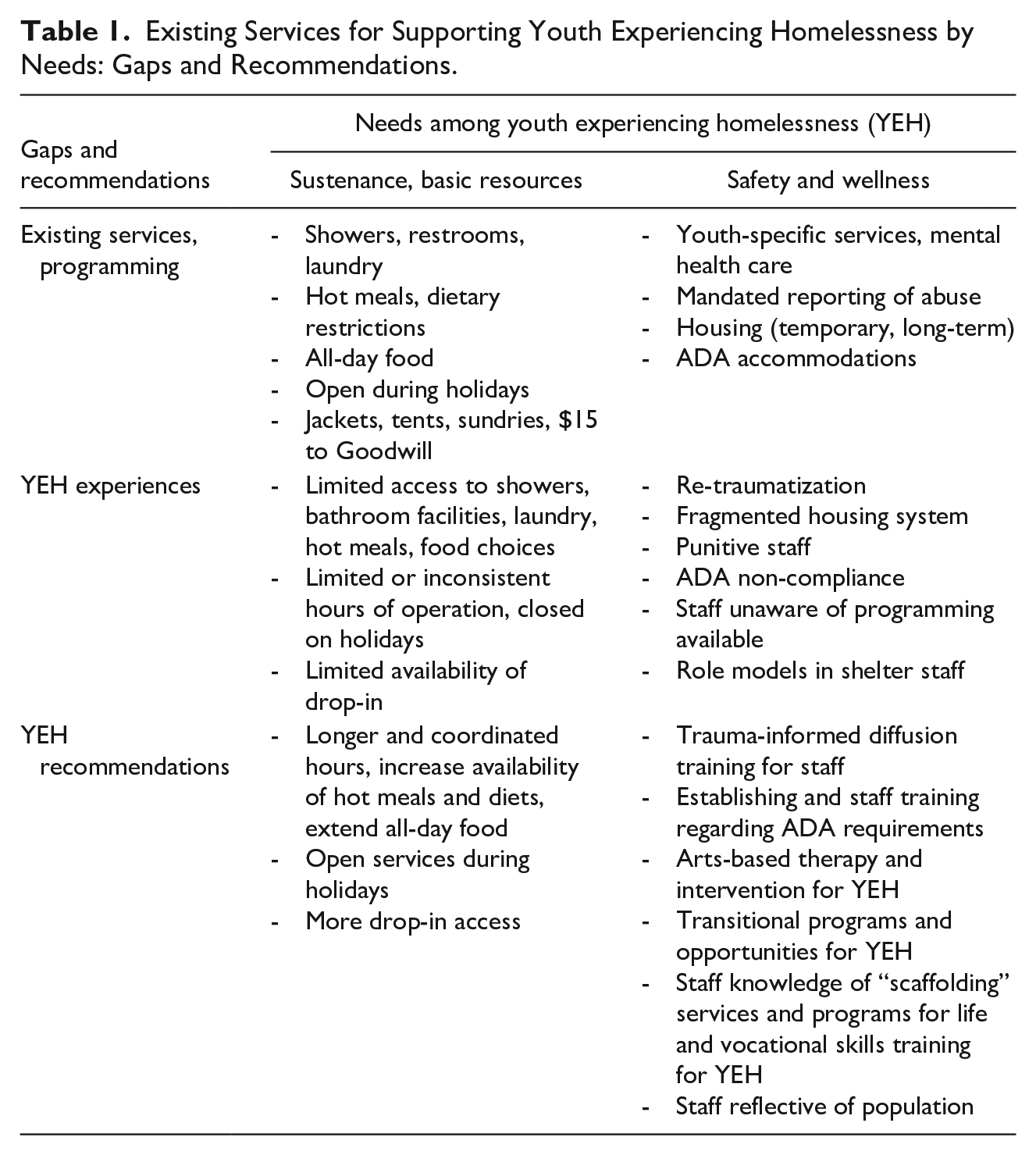
As summarized in Table 1, we present the experiences of YEH with accessing existing programming and services intended to support YEH in meeting needs. We then present YEH’s recommendations for gaps in services and changes that could mitigate unintended negative effects and maximize the intended positive impacts. We present experiences and recommendations on services for basic needs followed by those related to safety and wellness. Self-reported demographics are presented as reported by each excerpt.
Existing Services for Supporting Youth Experiencing Homelessness by Needs: Gaps and Recommendations.
Services That Meet Basic Needs
YEH Experiences
YEH described various services and resources available for meeting basic needs, which include food, personal hygiene, and clothing. Not only were services and resources (e.g., hot meals, hygiene kits, jackets, tents) necessary, but access on a “drop-in” basis was critical for YEH to be able to meet sustenance needs. Furthermore, being able to access necessary resources and services in one place is often a primary reason for YEH to visit the location. A 21-year-old Russian lesbian/queer person explained: Um, food is the main [reason why I go to this location, which] is really good at – they have like their own caterer, and the food just stays out. It’s not a set time [when] you have to be there for the food; you can just drop in and get food, which is really nice. And then from 1:30 until 4:30, they have Navigation, where you can get one pair of socks or underwear every other week, uh, two clothing items every week, and then other hygiene supplies every day, and two tins of food. So that’s really good. And then um, here at [agency], there’s the meal that’s provided. . . and also the resources of showering, laundry, which is – laundry is really great. . . Today, I’m going to the [agency] drop-in to get a jacket. . . So [agency] were like, “Oh, we’ll take you to Goodwill with 15 bucks” and I was like, “Deal.”
Access to shower and bathroom facilities regardless of day of week or holidays was rare. A 22-year-old African American bisexual man highly values access to shower facilities all days of the week and during holidays: People go to [redacted] for their showers; they’re open. I like how they’re open Monday through Friday, even if it’s a holiday on a weekday. It’s like l love that. I love that, and they are one of the very few in the Bay Area that actually got that.
Shower facilities required YEH to travel outside the locations where they typically “hang out.” In a pinch, participants who needed travel to shower described that they used hygiene kits with essential supplies. For this 22-year-old Mexican transgender straight woman, access to showers required traversing the city: Yeah, so I would go to Lava Mae, which was either in the Hayes, or the Mission, or the TL. I think one day of the week it’s in fucking – it’s in Bay View area, or something like that. But yeah, I was always going somewhere else to take a shower. Well, you could get a hygiene kit. Like, deodorant or fucking shampoo or anything like that, toothbrushes or toothpaste when you go to [agency]. Or you could go to like, [agency], and they got hygiene supplies and stuff like that. But when it comes to the showers, yeah, I would go to other places, yeah.
YEH Recommendations
Participants appreciated the various essential resources and services accessible on a drop-in, extended basis, although choice may be elusive for many YEH when they must be able to access essential resources and services to meet basic needs, as illustrated by this 23-year-old straight woman in Bay View/Hunter’s Point: I think like food is a best help a homeless person can get because that’s like a hot – you know a hot meal is the hardest thing to get when you’re living on the street? It’s not like fast food and. . .some people are even like. . .vegans and vegetarians and stuff like that. And sometimes, they can only get what they get, so it’s like I don’t know; I couldn’t really say like what’s the best way to help somebody, because for me it would be –the best help that I get is food, and like cash to get on public transportation, to be able to get around and be productive. But everybody is different. Like I said, people can help with food, but what if this person doesn’t eat this, or allergic to it, you know? And it’s like, you can’t be really picky if you’re on the streets. You can, but you’re not gonna eat.
Participants remarked on spending most of their days navigating a complex web of services across town. Allowing YEH to drop-in for obtaining services and resources all in one place during coordinated hours of operation across agencies are some of the ways to mitigate the difficulty in accessing essential resources. All-in-one services at expanded times may not alleviate the need to travel to services, but it would reduce the need to travel to multiple locations in a single day.
Services That Meet Safety and Wellness Needs
YEH Experiences
When accessing safe spaces, YEH may be particularly vulnerable to the unintended negative impacts of misguided or arbitrarily enforced policies. Participants suggested that agency-specific rules intended to ensure safety at daytime “chill outs” (i.e., safe spaces for youth to access agency staff they can just talk to during the day) can unintentionally exacerbate the adverse impacts of homelessness. For example, several daytime spaces for YEH do not allow for resting while on the premises, yet these are some of the few places of safety that elude YEH when agencies close for the night. A 21-year-old Black straight man in the Tenderloin described how such policies may be enforced arbitrarily: You’re not allowed to sleep inside [agency]. Yeah, but the staff will wake you up and they are very selective about who they don’t wake up.
Ensuring safety and access to housing is often made difficult by administrative delays in the housing application process which participants suggested can be long, circuitous, and uncertain due to a lack of coordination and disjointed communication. These barriers can prolong meeting basic needs, as in the case of a 22-year-old Black gay man in the Castro who was not informed of his housing approval until more than two months after it was granted, and only by chance, which also delayed his access to food: The process for getting housing was horrible. It was very long. . .I give them my email, as a way of contact. And they never emailed me. . .at the time I wasn’t living at [shelter]. . .I think the day after I left [the shelter], that’s when I got my housing, but I wasn’t aware of it until I went back and was there for an additional two and a half months. And even then, it was a horrible process, because they wouldn’t do what they said they would do. Like, for the food cards, they were supposed to [provide] food cards. They wouldn’t bring them on time. I would have to wait for someone else to do it.
Even with appropriate documentation, misguided policies pertaining to pets and service animals, which are protected under the Americans with Disabilities (ADA), can unintentionally force YEH to have to choose between receiving services or to have their animals with them. A 24-year-old White straight woman in the Tenderloin explained: I had a dog with me; he was my service animal. He was a seizure alert dog. And when I went to the shelter, they made me cage him. Yeah. And then my dog being a husky, big-ass dog broke their kennel and then came straight to me. He didn’t go to the kitchen; he didn’t try to get no food, you know, he came straight to me. They made me padlock him into the kennel after that, like a big-ass metal lock. No, he left because he wasn’t with me, and he didn’t know what was going on with me, and he’s supposed to be with me at all times. Well, so they made me padlock him in the kennel and then he started howling. And then they told me either I had to leave and take him with me, or I had to find someone to watch him for the night. And so I had called my friend and told him like what was going on. He was pissed but like both of us knew that there wasn’t really much to do, because it’s either I sleep outside, or he watches my dog – and I don’t sleep outside.
When imposed rigidly, policies intended to protect YEH may pose an unnecessary barrier in the therapeutic context. A 23-year-old White straight man in the Haight recalled being discouraged to describe experiences with violence during a counseling session so that the counselor can avoid mandated reporting.
I tried discussing with one of the counselors there about my life in trying to get counseling about being so angry. And always I was met with was ridicule and “Oh, don’t say that or I’ll have to call the cops, blah blah blah blah blah blah blah.” How else am I supposed to get my fucking emotions out, you stupid fucking curd? So I just left before I actually voiced those words to the woman that was doing my counseling. They were pissing me off. Like, fucking woman won’t let me talk about anything that had to do with violence and a lot of my life is violence. (Laughs) Yeah. It’s like, “What the fuck am I doing here in counseling like . . .” I’m supposed to talk about my fucking problems, but here, you are fucking not letting me talk about my problems; you stupid bastard! She wanted me to explain like – she wanted me to start from the beginning, and like, the beginning of my life is being raised around bikers who kill people and sell meth, and she didn’t want me talk about any violent part. It’s like, Fucking cut out like ages one to fucking four.
Participants emphasized that shelter staff should be trained to diffuse challenging situations that do not further provoke the actors involved. They further underscored that staff should not resort to punitive interactions with YEH that potentially retraumatize and further victimize YEH. A 21-year-old Black gay man in the Tenderloin illustrated how staff threatened to revoke the very resource that YEH need for survival: It was a lot going on, and trying to diffuse the situation, one of the staff members was just like on some other stuff. And he tried to say to everybody, “If all of you don’t be quiet, all of y’all is gonna be cut out.” And I said to him, “that’s easy for you to say because you have somewhere to go.”
Participants referred to positive experiences with supportive case managers, staff, and other providers, offering insights into the kind of opportunities for creating positive experiences when interacting with YEH. These experiences have the potential to leave positive imprints that contribute to building rapport and trust in the lives of YEH for whom trust has been eroded. An 18-year-old White woman in the Haight explained: [Agency] offers like a bunch of different stuff. Like, any time I need like anything, I go to the [redacted location], and I have a case manager there named [redacted], who’s like, prime time lady. Like I don’t know, she could – like, my friend went in there the other day, trying to get clean off of alcohol because he is dying of liver failure, and he asked to get clean. And she got him into an outpatient within 24 hours and got him on pills and stuff to help him quit drinking, so there is that.
Participants placed high importance in interacting with staff who reflect the population (e.g., race, language, homelessness experiences). As YEH may be more willing to trust staff who come from having experiences of homelessness themselves as young people, the employment of a representative workforce validates the spaces’ commitment to promoting inclusivity nonverbally. A 21-year-old White straight man in the Haight described his case manager as: . . .one of my favorite people ever. [Redacted] is a great person too. He looks out for us. He’ll help you in any way he possibly can. Like, he’s really dope about looking out for us because he was out here at one point too, so he understands, yeah. So he’ll help stuff.
YEH Recommendations
Almost all participants referred to past experiences with direct or indirect forms of trauma growing up, which emphasized the importance of trauma-informed services designed for YEH, for whom trauma may be contributor to homelessness. As such, YEH recounted the importance of staff training in trauma-informed approaches that recognize that YEH are carrying experiences that influence their reactions in other interpersonal interactions. YEH recalled positive experiences with staff who served as important role models. YEH also highly valued programs that offer creative outlets and healing spaces, programs in art and music, which were vital for mental health and wellbeing. A 21-year-old White man in the Mission voiced appreciation for a program in music production that gave access to recording equipment and allowed him to immerse in a creative process towards healing: It’s definitely very healing. So sometimes, it can be like very healing, where you gain insight and things need to change in your life. And other times, it’s just, I just did all this damage to my body for no reason, and now, I’m gonna have to be like real healthy to counteract it because I don’t wanna die when I’m hurting.
To move past the instability in past and current environments, many participants desired programs that could teach life skills for transitioning from homelessness into adulthood and independence. This 21-year-old Black gay man in the Tenderloin expressed: Just because I take you off the streets and put you in a shelter and then house you, don’t mean you know how to clean up after yourself. It don’t mean that you know how to wipe the toilet after you pee. . .wash the dishes after yourself, clean up after yourself, smell good.
Similarly, youth emphasized the need for institutional scaffolding to facilitate their ability to navigate institutional barriers in education and employment, as this 19-year-old White woman in the Haight remarked: Well, I mean if people are wanting to get off the streets and like, be off the streets for good, you know, and they get into these housing programs, the aftercare that they could supply – I mean there’s job programs everywhere, so you have those posted up. Uh, caseworkers who would work at these shelters, they should know about these things. They should know about the GED programs, the free college programs, job programs, intern programs, like, just all the programs that could help you benefit your life, which goes from GED, to college, to internships, to jobs, like you should just – if you’re a caseworker, working at a shelter like that, I feel like those are the things you should know about.
Several YEH desired more guidance in engaging in educational activities that can otherwise be overwhelming. Resources like education may need to come with tailored programming for YEH who have little experience with didactic or other forms of formal education. Such transitions require programs in place to specifically guide YEH in navigating institutional barriers in education and employment. As illustrated by this 20-year-old White transgender man in the Haight, YEH may need support in navigating educational resources that may seem overwhelming without experience with institutionalized learning: I feel like a lot of people, myself included, just need more resources for like education and stuff. . .Because like there’s the library, but you go to a library and like there’s books on everything there, and it’s overwhelming.
Discussion
The present study explored insights from YEH regarding their experiences with extant services and programs to understand how their design and implementation may be enhanced. We analyzed the data for the needs that YEH had identified as particularly difficult to meet due to gaps and limitations in services and programs, as well as needs for which YEH had specific recommendations for improvement. By exploring personal accounts from YEH with existing programs and services, findings illustrated where programs and services for YEH may have fallen short in meeting needs, but also where they succeeded in meeting needs for basic resources, safety, and wellness. While some areas may need more improving than others, the positive experiences from YEH highlight the importance for services and programs to achieve the intended maximal impact on YEH.
In navigating services to meet basic needs, participants described experiencing a myriad of agency-specific policies and rules that require a minimum level of aptitude, adaptation, and functioning. Access to food, clothing, shelter, hygiene, and health care are available at different times across different agencies and only during certain hours of the day, week, month, and holidays. Limited hours and locations of services increase risks for YEH who must carefully plan their days and routes. Unexpected changes in hours and locations, arbitrarily enforced rules, and overly punitive measures increase vulnerability and marginalization that YEH face. As such, many YEH struggle to obtain the support they need. Expanding hours (including during holidays) and locations for shower and restroom facilities, postal mail, hot meals, hygiene supplies, and wellness kits with socks and underwear can help to mitigate risks to safety for YEH.
Experiences of YEH with authority reinforce the importance of using trauma-informed approaches in providing services to and interacting with YEH for whom choice and autonomy in how basic needs are met are often limited when experiencing homelessness. Early exposure to violence is among the strongest predictors of homelessness in youth, placing them at higher risk for experiencing abuse while homeless and for suffering more serious psychological consequences (Davies & Allen, 2017). Punitive measures can further retraumatize youth and should not be taken by staff at agencies intended to help and support YEH. Findings are similar to other research with YEH, including perceived discrimination and lack of caring by agency staff and health care professionals, law enforcement, and society (Hudson et al., 2010). Insights from YEH for how policies and practices may be changed to better support YEH include training in trauma-informed, peacekeeping and diffusion strategies when engaging YEH. Emerging evidence emphasizes potentially effective strategies for peer support workers and service providers for engaging YEH (Erangey et al., 2022).
Programs that offer creative, arts-based outlets and transitional opportunities are particularly promising for enhancing capabilities and building new skills important for daily living, especially during formative years (Marshall et al., 2022). Few interventions for persons experiencing homelessness focus on enhancing meaningful activity engagement important to skills for daily living or transitioning from homelessness among youth (Ferguson, 2018). Employment-based interventions focused on YEH, and in particular, those focusing on social enterprising skills, have shown non-statistically significant or mixed results for employment, community integration, and substance use (Marshall et al., 2022). Arts-based programming that allows alternative forms of expression that help YEH not only to manage trauma and cope with stress, but also to engage in self-care and meaning-making practices that have been shown to promote mental health recovery (Fairchild & McFerran, 2019; Marshall et al., 2020; Marshall et al., 2022; Schwan et al., 2018) and in the transition from homelessness and housed (Marshall et al., 2019, 2020). Emergent evidence also demonstrates how YEH manage stress and mental health through peer-based mindfulness and yoga interventions and informal resources, such as pets and/or support animals (Petering et al., 2021; Schmitz et al., 2022). Consistent with existing evidence, YEH may benefit from aftercare support around navigating traditional systems once transitioned out of services (Morton et al., 2020).
Limitations
Even in our relatively small sample of YEH, experiences ranged widely by homelessness history, substance use, race/ethnicity, gender identity, and sexual orientation. YEH have vastly different needs for services and programming that require a system that can respond dynamically to needs without exacerbating the impacts of homelessness and marginalization among YEH. We caution against extending our findings to the experiences of YEH to other regions of the U.S. with different networks and policies underpinning such services, even as our sample was particularly diverse in terms of race, ethnicity, gender identity, sexual identity, and experience with homelessness.
Conclusions
YEH require dynamic supports that respond to varying needs ranging from basic daily sustenance to long-term independence. Current programs and services designed to meet the needs of YEH typically lack input from YEH and may have unintended negative impacts on health and wellbeing (Gwadz et al., 2018). Developmentally, ages 15 to 24 represent formative years when youth are developmentally primed for the rest of their life. The Lancet Commission on Adolescent Health and Wellbeing defines adolescent wellbeing as having enhanced capabilities and opportunities to achieve developmentally important goals (Patton et al., 2016). As such, policies and programming for mitigating the impacts of homelessness for YEH must extend beyond meeting only basic needs in creating opportunities for safety, autonomy, growth, and support. There are myriad programs targeting youth homelessness underpinned by well-intended policies and procedures, but few offer empirical evidence to demonstrably show long-term positive impacts (Altena et al., 2010; Morton et al., 2020). More longitudinal research is necessary to evaluate programs and policies for YEH that incorporate YEH input (Hao et al., 2021; Morton et al., 2020).
Footnotes
Declaration of Conflicting Interests
The author(s) declared no potential conflicts of interest with respect to the research, authorship, and/or publication of this article.
Funding
The author(s) received no financial support for the research, authorship, and/or publication of this article.
