



Abstract
Social media (SoMe) is an important part of how young people socialize and communicate with each other and there are concerns that this may negatively impact peer relationships. The aim of this article was to explore how high school students experience the impact of SoMe on their peer relationships and the quality of these relationships. We performed qualitative semi-structured interviews with 12 Norwegian high-school students. Results showed that SoMe changed the quality of peer relationships as well as online and offline communication. The impact of SoMe on peer relationships depended on whether the students had both online and offline peer relations. Unlike offline relationships, where the youth experienced real friendships, online relationships were primarily described as contacts. The results suggest that online peer relationships often resemble affiliations rather than attachments. This may negatively impact social competence, especially among students whose peer relationships are mainly online-based.
Introduction
Digitalisation and technological development has led to social interaction moving from physical and public places to online spaces (Gripsrud, 2017; Vanden Abeele et al., 2016). In particular, social media (SoMe) is actively used among adolescents and young adults for socializing without being physically present in interactions with others (Ahn, 2012; Schønning et al., 2020; Tjora, 2018). The use of SoMe makes it easier to maintain contact with friends and family, and somehow makes the world seem smaller. However, there are concerns that its use also leads to distancing from physical surroundings and interpersonal contact that may adversely affect young people’s well-being (Ahn, 2011; Cyr et al., 2014; Desjarlais & Joseph, 2017; Vanden Abeele et al., 2016).
Peer-relationships are considered to be a key factor in the social integration and individual development of young people (Décieux et al., 2019; Reitz et al., 2014). As a consequence, the impact of SoMe on youths online and offline peer relationships is a central theme in current research within both health and social sciences. Several recent systematic reviews reveal important tensions and themes for further exploration. SoMe seems to have contradictory effects on social connectedness, (Dredge & Schreurs, 2020; Hjetland et al., 2021; Ryan et al., 2017; Schønning et al., 2020; Webster et al., 2021). Among the benefits of SoMe use are a sense of social belonging and social capital (Dredge & Schreurs, 2020). Décieux et al. (2019) highlighted the importance of online relationships to feel a sense of belonging when a physical relationship is not possible. However, SoMe may also affect peer relationships negatively because of its influence on the individual’s social skills and may lead to social isolation, poor mental health, and even peer aggression (Cyr et al., 2014; Demir et al., 2012; Dredge & Schreurs, 2020; Ryan et al., 2017; Schønning et al., 2020; Webster et al., 2021).
Some previous research on SoMe and peer relationships brings focus to the differences in quality of peer-relationships in online and offline contexts. Desjarlais and Joseph (2017) found that online self-disclosure seems to facilitate offline self-disclosure and, thereby, enhances the quality of both online and offline friendships. Mesch and Talmud (2006) concluded that offline relationships were closer than online relationships. They defined closeness as a function of social equality, content, activity diversity, and the duration of the relationship (Mesch & Talmud, 2006). The use of SoMe may help expand the social network, create relationships, and maintain existing relationships, but this does not seem to apply to everyone. According to some authors, those with a lack of offline relationships are more likely to use SoMe to escape and avoid real life problems, potentially amplifying negative consequences such as social isolation (Lee, 2009; Lin et al., 2018). From this, we can see that there are still unanswered questions regarding the role SoMe play in young adults’ peer relationships, in particular it is unclear whether the positive effects of SoMe on peer relationships outweigh the negative, and we do not know enough about how young people experience the difference in quality of online versus offline peer relationships. The aim of the current article was therefore to explore how high school students experience the impact of SoMe on their peer relationships and the quality of these relationships. There seems to be a predominance of quantitative research in the field, which allows us to draw important conclusion about youth perspectives but does not allow for more in-depth exploration of these issues. The literature therefore calls for more research using a qualitative approach to explore experiences with SoMe from the first-hand perspective of young adults (Décieux et al., 2019; Nesi et al., 2018; Prinstein & Giletta, 2020; Schønning et al., 2020). With this article we contribute new knowledge on young adults’ perspectives and experiences on this important topic. This should be of interest to several stakeholders in the field including teachers, youth workers, politicians, and youth researchers.
Theoretical Framework
To frame the results of the article we chose to draw on relational theory (Schibbye, 2012), the concepts of attachment and affiliation (Bowlby, 1988), and social competence (Semrud-Clikeman, 2007). The relational theory of Schibbye (2012) focuses on the individual as well as the interactions between people. Seeing the other, being seen, and acknowledging the other is what defines a relationship. It is central that we depend on others to become independent. Being in a relationship with another provides an opportunity for individual development and creates room for self-assertion, individuality, and connection. We use Schibbye here to consolidate the fact that relationships are important to young people’s development both individually and socially and as a point of departure to explore just how peer-relationships might be affected by SoMe.
Furthermore, to understand the development and role of close relationships or friendships, the concepts of attachment and affiliation by Bowlby (1988) are useful. To understand the development and role of close relationships Bowlby (1988) used the concepts of an attachment bond which represents a special kind of social relationship (Bowlby, 1997) characterized in terms of the development of preferences for certain individuals through repeated social contact (Allen & Tan, 2016; Cassidy, 2016). Attachments serve as a way of coping with distress by strengthening one’s sense of security and support. To achieve this, relationships should be experienced as lasting, safe, and sincere. The first attachment bond is usually to parents, but in adolescence peer relationships take on more and more of the qualities of attachments and close friends become the major source of emotional and social support (Wilkinson, 2004). Affiliation is aimed at achieving companions, alliances, stimulation, and knowledge. Here, relationships are often more superficial, experienced as transient and only beneficial to achieving short-term goals (Allen & Tan, 2016; Cassidy, 2016). SoMe has been proposed to change the quality of youths peer relationships (Desjarlais & Joseph, 2017), and since the concepts of attachment and affiliation can illustrate different qualities of peer-relationships, they might help us explain more clearly what that change in quality actually entails.
Lastly, to establish and keep peer-relationships, young people must have the tools to successfully engage with others, which makes the concept of social competence relevant (Semrud-Clikeman, 2007). Social competence refers to social, emotional, and cognitive skills and behaviors that are needed for successful social adjustment. It is defined as the ability to effectively handle social interactions and refers to being able to get along well with others, form and maintain close relationships, respond in adaptive ways, take others’ perspectives, learn from past experiences, and apply that learning to changes in social interactions (Semrud-Clikeman, 2007). Social competence precedes expectations for future interaction with others and is essential for creating relationships (Semrud-Clikeman, 2007). Since SoMe changes social interaction patterns and the way youths social interactions are performed (Schønning et al., 2020), one may argue that their development of social competence may also be altered in some way.
Methods
Design and Data Collection
The current study involves a qualitative methodology which employs a hermeneutic-phenomenological approach and data was collected using individual semi-structured qualitative interviews (Befring, 2002; Kvale & Brinkmann, 2009; Laverty, 2003; Smith & Osborn, 2003). We used convenience sampling (Malterud, 2017). The participants were recruited from a senior high school in a relatively small municipality in the east of Norway. To be included in the study, the participants had to be ≥18 years old, a high school student, able to speak Norwegian and able to give informed consent. Through a collaboration with the public health coordinator in the Municipality, the principal and the school nurse were contacted and provided access to contacting the high school students. The study was presented to five different classes of about 15 to 20 high school students, this means that about 75 to 100 students were asked to consider participating in the study. Eighteen of these students expressed interest in participating in the study, two had to be excluded because of their age. After 12 interviews the researchers determined that there was adequate information power and that data saturation had been reached (Malterud et al., 2016). The participants were 18 or 19 years old; all were students in the third and final year at senior high school. There was an equal gender distribution. The participants studied different high school subjects (i.e., science and arts).
User Participation
In line with current recommendation for user participation in research (Brett et al., 2014) and to ensure relevance of the current research project, participants from the Student Council at the high school in question were included in the design of the interview guide by commenting on a first draft. Comments applied to content and formulation of interview questions. Additionally, two pilot interviews were conducted with the purpose of testing and improving the interview guide, and securing that questions asked would result in answers that contributed to the research question. Researchers experiences with two pilot interviews, and comments from interviewees lead to a change in the interview guide. Questions were sharpened and reformulated in form as well as themes to better meet the purpose of the study. Pilot interviews were conducted with a purpose of testing the guide and not performed as full interviews. Hence, they were not included in the material.
Interviews
Interviews were conducted in the autumn of 2019 during school hours. They took place in a secluded room at the high school facilities and lasted 30 to 60 minutes. A semi-structured thematic interview guide (Kvale & Brinkmann, 2009) included questions as: “What are your experiences of using social media?”, “Is there anything you react negatively/positively to when using social media?”, “How do you think social media impacts your social network and relationships with others?”. An open and flexible approach was emphasized. Allowing an in-depth exploration of the participant’s subjective experiences to come forward (Kvale & Brinkmann, 2009). Interviews were tape recorded and transcribed near-verbatim by the last author (MFH).
Data Analysis
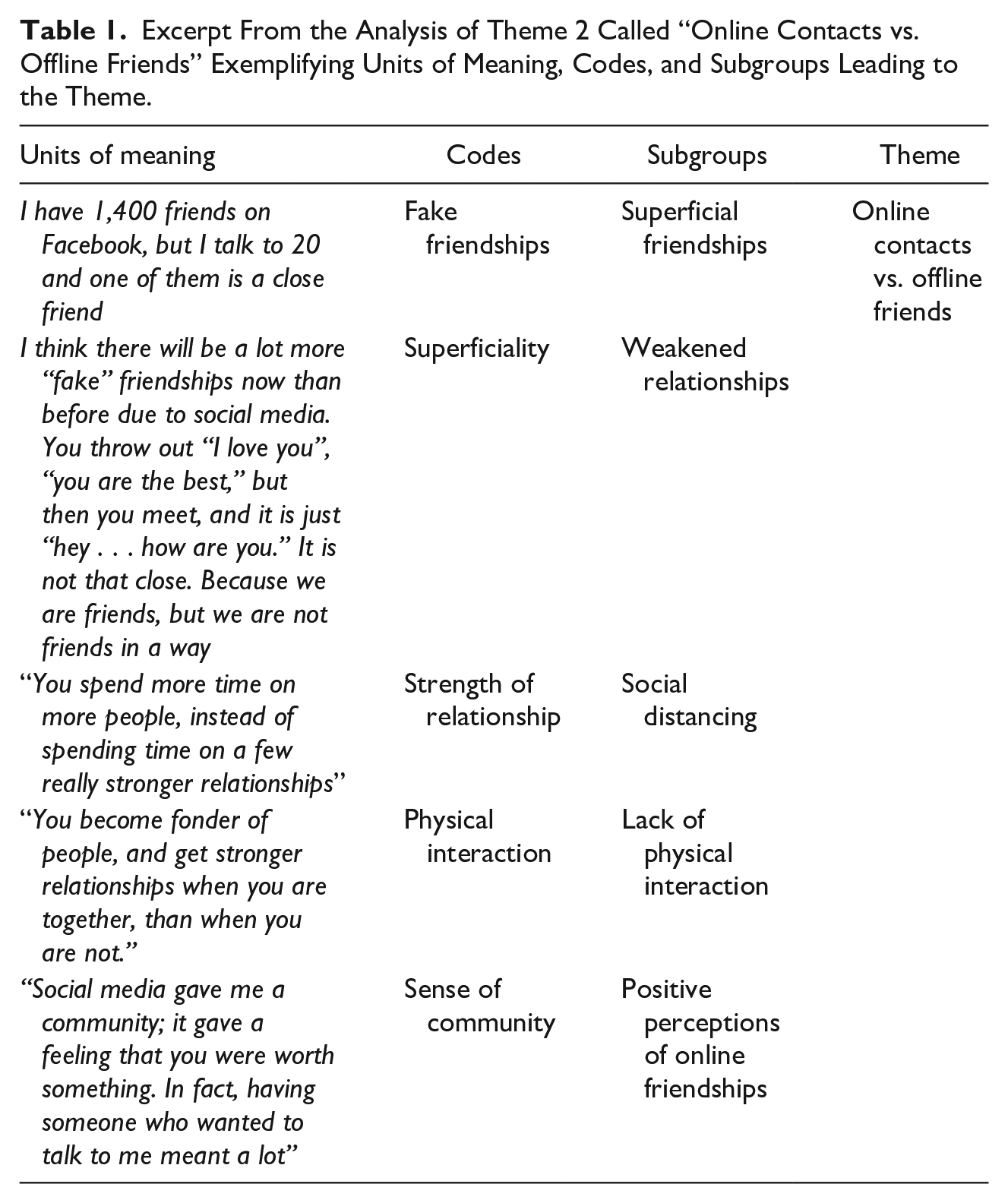
This is the second article based on the current dataset, a previously article by Fjelnseth and Sjølie (2021) explored loneliness and identity on SoMe. The data for this article was analysed with the use of systematic text condensation by Malterud (2017). The first step was to read the transcribed interviews to establish an overall impression of the content and map potential themes. Then, the transcripts were systematically reviewed to identify units of meaning that related to the themes from the first step. These unites of meaning were sorted into codes. The knowledge each code represented was then abstracted, extracted, and sorted into subgroups. The knowledge in each subgroup was summarized in an artificial quote (see Table 1). This artificial quote served as a working note for the writing and presentation of the final results presented as themes (Malterud, 2017). The analysis was primarily data-driven, and the theoretical framework was chosen after the initial analysis. The last author was the main analyst, and the first author validated the coding. The writing up of final themes was done by all authors in agreement. The fact that three authors, with different professional backgrounds, were involved in the analysis enhanced confirmability (Lincoln & Guba, 1985).
Excerpt From the Analysis of Theme 2 Called “Online Contacts vs. Offline Friends” Exemplifying Units of Meaning, Codes, and Subgroups Leading to the Theme.
Ethics
The study was approved by the Norwegian Centre for Research Data (registration number 576998). All the participants gave written informed consent to participate in the study. Student participants were informed prior to the interviews about their right to refrain from answering questions, as well as stopping the interview (Foss & Ellefsen, 2004). Ethical challenges related to the duty of confidentiality and safeguarding the participant (Foss & Ellefsen, 2004) arose as some students showed signs of depression and possible suicidal thoughts. This was handled in collaboration with the school nurse. The researcher conducting the interviews encouraged the person in question to seek help from the school nurse.
Results
Three main themes were developed through the analysis and represent the findings with regards to the role of SoMe on peer relationships and the differences in quality of these relationships according to the high school students. The themes are; “The impact of SoMe depends on offline/online friendship patterns”, “Online contacts versus offline friends,” and “SoMe alters peer communication quality both online and offline.”
Theme 1: The IMPACT of SoMe Depends on Offline/Online Friendship Patterns
Most students saw both positive and negative sides to SoMe. One student said: “I think it can both strengthen and weaken a social network, based on how you use it.” (Participant 3) Overall, participants expressed that the importance of SoMe to a peer relationship depended on the existing friendship pattern of each individual student. It seemed like there was a difference in the approach to SoMe in online and offline peer relationships based on whether or not the individual had opportunities to have both types of relationships. We found that there seemed to be two distinct groups among the participants. One group had both online and offline peer relationships and for them the importance of SoMe was more ambiguous. The smaller group had only or mostly online relationships and these students valued SoMe as a contributor to engaging relationships and reported that their social network was positively influenced by SoMe:
Often when you cannot meet physically, you base your friendship on what you have left, which is social media (Participant 1).
For those who had offline relationships, SoMe could be more destructive than constructive to a relationship. This group of students pointed to an understanding that SoMe could ruin a relationship by allowing them to distance themselves from what they considered most important:
I feel that one can lose friends just because of social media. That you are more interested in social media than in your friends (Participant 4).
The participants believed this could lead to a lack of meaningful offline relationships:
You see people sitting together in groups and talking to people who are not there (Participant 7).
Furthermore, these students contended that the fact that they had become very addicted to using SoMe in social settings was detrimental to already existing offline relationships, and also made it harder to start new offline relationships:
I’m having a hard time getting friends now that everyone’s so busy with their phone. They are more concerned with writing and looking at what has been posted, instead of having a direct conversation (Participant 5).
They believed that physical social distance could be a result of habits, considering that much of the interaction with others took place on SoMe:
I think it has something to do with the fact that you isolate yourself more easily. Because if you start to lose physical contact then it is easier to think that it is not so important maybe (Participant 6).
Despite awareness of the negative impact of SoMe on relationships, the participants still chose to actively use it, stating that they had become addicted to it:
It’s an addiction. I am addicted, too. I cannot just hang up my phone. Or I can for an hour or two. But I also want to see what is going on. Because it’s on social media it happens (Participant 4).
The group with no or little offline network relationships did not necessarily have an offline relationship that could be affected by SoMe. Consequently, these students used SoMe in situations where they felt lonely in order to get in touch with those they considered their best friends:
Like me, I did not have many friends, so I chose to withdraw from everything social in reality more or less to be able to be with someone I actually have something in common with and have a sense of belonging (Participant 2).
Theme 2: Online Contacts Versus Offline Friends
The impact of SoMe on peer relationship quality differed between the two groups. Students who saw the opportunity for both online and offline relationships considered the peer relationships they had on SoMe to be mainly superficial and impersonal. They did not characterize their online relationships as deep and close. These relationships were described more like a contact than a real friend and were more intended to be a “visual image” (Participant 9). Another student said:
I think there will be a lot more ‘fake’ friendships now than before due to social media. You throw out “I love you”, “you are the best”, but then you meet, and it is just “hey . . . how are you”. It is not that close. Because we are friends, but we are not friends in a way (Participant 7).
However, not all online relationships were necessarily that superficial. The degree to which the relationship was superficial or impersonal seemed to depend on the method of communication or type of SoMe used:
It is a little superficial to have a conversation about how it’s going over Snapchat [. . .] It becomes a little harder to maintain relationships when it becomes so impersonal (Participant 8).
As soon as they met and spent time together, the students experience a different relationship. The time spent on a relationship had implications for its strength. “You spend more time on more people, instead of spending time on a few really stronger relationships” (Participant 9). SoMe tended to consume time, and the time available was divided between offline and online relationships:
Now everyone is at home on their own screen. It’s not like you meet just to sit and talk anymore [. . .] I know that if we had been more together instead of chatting, we would have had a closer friendship (Participant 8).
Offline relationships contributed to creating memories. Students who emphasized the importance of offline relationships wrote off SoMe as limited when it came to creating memories together: “We explored things and created memories. I have no memories of being at home being on social media” (Participant 8).
The group who described that most or even all their relationships unfolded on SoMe experienced these relationships as close and sincere, and in offline situations they felt alone and excluded:
Social media gave me a community; it gave a feeling that you were worth something. In fact, having someone who wanted to talk to me meant a lot (Participant 2).
Interestingly, this group also valued offline relationships equal to those who had both online and offline relationships.
It was okay that I had more or less a hundred people who wanted to play online with me every day, but I never got the social part in reality [. . .] I feel that you must have physical contact to get that [social need] covered (Participant 2).
Hence, those who had few or no offline relationship appeared to be at loss. The participants believed that offline relationships could be experienced as stronger, compared to online relationships. “You become fonder of people, and get stronger relationships when you are together, than when you are not” (Participant 9).
Finally, a shared experience among both groups seemed to be that a large social network, whether online or offline, was irrelevant if you did not feel closeness and support from this network:
It’s better to have the four friends who I know care about me and who would have been there right away if anything happened, than to have ten friends who do not care at all (Participant 2).
Even if an online relationship was not as genuine and real as an offline one, it was perceived as better than not having any relationship at all.
Theme 3: SoMe Alters Peer Communication Quality Both Online and Offline
The students expressed that there had been a social change and that it affected how they communicated and interacted with each other:
People are not able to communicate as well with each other as they did before. We do not have to. Because we get away with it when we have social media (Participant 7).
They contended that since much of the communication between peers was now done via SoMe, they no longer communicated or interacted as much offline compared to their perception of what previous generations did:
Why are there signs in the streets that say drive carefully, children are out playing. They are not out playing anymore. They sit on their iPod and play Minecraft or sit and watch YouTube (Participant 7).
The students said that they no longer spoke as much verbally, with words and sentences. Their form of communication was mainly based on pictures, videos, and short quotes via digital platforms. They expressed awareness of the cause, as well as the negative consequences:
I think social media damages social lives. I think it may have something to do with the fact that a lot of the communication is online. And we lose our social antennae. You might get a little scared of being offline because one is used to being connected to data or mobile screen (Participant 7).
They also described how this affected their well-being and could lead to loneliness:
I was in a much better place when I was out with friends all the time and having fun, than now where I sit at home in bed and send a Snap of my face every day [. . .] You become lonelier in the end. The only thing to do was to Snap people, there was no one to hang out with (Participant 8).
In addition to noticing a gradual reduction in oral/verbal communication, the participants also referred to a change in what was being talked about and where it was being talked about. There seemed to be an intricate set of rules related to topics one could or could not talk about online or offline. There were some topics you could talk about with a person online, but not offline, and vice versa. Although most created online relationships with peers with whom they had no physical interaction, some created online relationships with people from their physical environment. However, their interaction did not evolve to an offline relationship. “There are some in the class who I talk to a lot on social media, but not in reality” (Participant 2). The participants described that this affected the peer relationships negatively, weakening relationships, and creating unpleasant situations:
The friendship probably slips a little more apart. You get used to not seeing each other. And that friendship is gone [. . .] I feel that when you meet your friends again, there is a bit of a strange atmosphere at the beginning (Participant 9).
Despite this, some participants also referred to a particular phenomenon in which physical proximity did not necessarily mean more communication and openness; in fact, it seemed to be the opposite. They claimed that they would not talk to each other as much without SoMe. This was because they felt they could speak more openly and honestly on SoMe describing offline contact as more intimidating:
I know I would not dare to do the same physically. I can be much more open on social media. I have not managed to have the conversations with my friends physically that I have with them on social media (Participant 3).
Furthermore, SoMe was positive in that it could serve to brake barriers to asking for help and support:
Some posts that they need someone to talk to, and then there are 60 people who answer. And then you do not feel alone. I do not think anyone has stood up in the canteen and said they need to talk to someone (Participant 8).
To conclude, the impact of SoMe on peer relationships seemed to be dependent on the existing online or offline friendship pattern of the student. Furthermore, the impact of SoMe on the quality of peer relationships was mostly perceived as negative. Online peer relationships were generally viewed as less close and meaningful than offline relationships, however were valued positively when these were viewed as the only possible relationships. According to the students, SoMe seemed to have influenced both online and offline peer communication negatively, however talking about sensitive topics and asking for help in times of need was perceived as facilitated by SoMe.
Discussion
The aim of this study is to explore how high school students experience the impact of SoMe on their peer relationships and the quality of these relationships. The results showed that students who had both online and offline relationships valued their offline relationships more, whereas those who mainly had online peer relationships experienced more quality in these relationships. However, all the students seemed to value offline relationships more and expressed that SoMe had changed the quality of interpersonal communication both online and offline. Furthermore, the results indicate that the use of SoMe is addictive.
The students’ experiences are supported by Schibbye’s (2012) relationship theory. Individuals must experience being seen and understood to create a genuine relationship (Bowlby, 1988; Schibbye, 2012) and our results indicate that frequent use of SoMe might obstruct this. According to Schibbye’s (2012) theory, we are dependent on others to become independent. It is through confirmation and recognition of and by the other that we gain a relationship with ourselves and develop a differentiated and independent self. In line with this, the students experienced feeling better about themselves when they were physically present with others and created memories. However, the students also described a possible mental distance despite a physical presence when others were immersed in online activity in their presence. This led them to feel unseen and downgraded. In accordance with this, Vanden Abeele et al. (2016) described that co-present phone use during face-to-face interactions was perceived to affect communication quality negatively, and this could arguably also have a negative influence on social competence (Semrud-Clikeman, 2007). Our findings indicate that the feeling of being unseen and downgraded by the other, make the physical relationship suffers. The relationship does no longer serve the purpose of developing the other. Both individuals in the relationship as well as the relationship itself does not fulfil its mission. Using the theory of Schibbye (2012) the students’ experiences allow us to assume that SoMe use could impact negatively on the young adults’ “social selves” as it disrupts the natural physical presence.
Schibbye (2012) also claimed that a connection through relationships with others is important to how individuals experience and relate to further social interaction. In line with this, we found that evolving an online relationship to an offline relationship seemed difficult. Arguably this could be a result of lack of social competence and knowledge regarding physical interactions caused by an online focus and minimal physical interaction. In accordance with both theory (Semrud-Clikeman, 2007) and prior research (Cyr et al., 2014; Dredge & Schreurs, 2020; Hjetland et al., 2021; Mesch & Talmud, 2006; Ryan et al., 2017) it could be argued that frequent use of SoMe and a lack of physical interactions inhibit the individual’s social competence development. This may explain why some students experienced that after use of SoMe and engagement in online relationships, interaction in offline peer-relationships was challenging. The students expressed that they did not communicate as well in person anymore. Frequent use of SoMe might limit their ability to communicate in person, as they are gaining less practice in how a face-to-face interaction unfolds, especially one that is without interruption from co-present checking of SoMe. Some students even described offline situations as intimidating, as they were used to being connected to a mobile screen and they experienced physical interactions as uncomfortable even with their best friends. Hence, online communication seems to exclude important factors for favourable social development (Dredge & Schreurs, 2020; Semrud-Clikeman, 2007). We wonder if the students’ experience of discomfort in physical interaction is a result of them mostly practicing online communication, focusing on visual images and audio files, and the interpersonal distance between sender and receiver. If so, our findings seem to indicate that SoMe can be a risk for social interaction as presented by Schibbye (2012).
Semrud-Clikeman (2007) claimed that social competence is the basis for expectations for future interaction and relationships. Students describe how superficial SoMe relations are more difficult to maintain. The students’ choices to use SoMe seemed to affect their social competence development more directly when SoMe disrupt physical relations, which could indirectly impact on their ability to build good friendships or what Bowlby (1988, 1997) would term attachments (Demir et al., 2012). The time young people spend online replaces time they would otherwise spend physically interacting with family and friends (Lee, 2009; Vanden Abeele et al., 2016). In our material this shows in how students rarely leave SoMe behind in physical interaction. This again might weaken an offline peer relationship by preventing offline affiliation relationships to develop into relationships characterized by attachment (Bowlby, 1988; Cassidy, 2016). Arguably, this might cause a vicious spiral where a lack of physical interaction leads to reduced social competence (Semrud-Clikeman, 2007) and reduced competence leads to avoiding physical interactions. In other words, by focusing on their online relationships high school students could in the worst case end up with all their social relationships being affiliations.
However, the students also experienced finding value and friendships in an online environment. The students expressed a tendency to talk more openly in their online relationships, it was easier to talk about sensitive topics and easier to ask for help online. It seemed like they achieved the mental and physical distance necessary for them to dare talking about emotions and other sensitive topics. This openness can be positive to a peer relationship. It can lead to connection in a relationship and provide security and closeness which are attributes more characteristics of attachments than affiliations (Ahn, 2012; Allen & Tan, 2016; Bowlby, 1988; Décieux et al., 2019; Schibbye, 2012). Some of the students expressed experiences of companionship, alliances, stimulation, and knowledge through online relationships, but for most of the students these relationships were experienced as superficial and easily ended. Generally, the students claimed that they must have a physical relationship to truly feel an attachment to others. They experienced that contacts on SoMe were not really their friends. Therefore, our results overall indicate that online relationships were essential to some, but that these relationships were more often than not affiliations and not attachments, which are necessary for the growth of a strong individual (Bowlby, 1988; Cassidy, 2016; Schibbye, 2012). This aligns with previous studies describing that young people’s online relationships tend to be more shallow (Cyr et al., 2014; Hjetland et al., 2021; Mesch & Talmud, 2006; Ryan et al., 2017). These peer-relationships could be for visual purposes only. Consequently, lack of close and genuine interaction and communication when SoMe is used could negatively impact relationship quality among high school students, especially for those who lack valuable offline relationships.
Implications for Practice and Further Research
The results imply that the use of SoMe might to some extents have escalated out of control. As physical meetings are replaced or supplemented by online communication there is a risk of losing relational skills necessary for general well-being. Schools and youth services should draw attention to exploring and facilitating young people’s ability to relate to peers physically, mentally, and emotionally in their everyday life. As digital aspects of society increases, the changing patterns and quality of interpersonal relationships need to be addressed in practice and in research. A focus on finding a balance in online/offline social interaction seems necessary.
Further research on the impact of SoMe on the social competence of young people is warranted. We did not explore the differences in relational impact depending on the different types of SoMe platform, and we suggest this as a topic for future research in order to provide a better understanding of the role of SoMe in youth peer relationships.
Strengths and Limitations
A strength of this study is the relevance of the research and the use of qualitative methods to elicit high school students’ own voices about the topic at hand. Involvement of representatives from the student council and pilot interviews also arguably makes the study more relevant. The results increase our knowledge of the differences in students’ experiences regarding the impact of SoMe on peer-relationships and the quality of these among young adults. Furthermore, we aimed to ensure validity and reliability by providing a thorough description of data collection procedures and the analysis in this article.
The last author who conducted the interviews is considered a digital native and positively served the analytical process by being someone who has in-depth experience with SoMe, however, this could also cause field blindness which is a possible limitation (Moen & Middelthon, 2015). To meet this challenge related to pre-understanding, all or parts of the data was read by two researchers independently (Malterud, 2017). Another limitation is the rather small number of participants in the study. Data saturation (Malterud et al., 2016) was reached, but there are important discussions in the filed regarding this concept, so we do not fully know whether a larger number of interviews would have served to nuance the results even more. Qualitative studies do not aim for generalization, rather a possible transferability perceived by the reader. With this in mind, we believe the findings of this study could be found relevant and interesting beyond the immediate context in which it was performed (Morse, 1999).
Conclusion
The results of this study reiterate that the impact of SoMe on young adults’ peer-relationships is complex. The high school students experienced that the use of SoMe changed the quality of peer relationships and communication both online and offline. The impact of SoMe on peer relationships depended on whether the students had both online and offline peer relations. SoMe use entails distancing from physical interactions which may negatively affect social competence, especially among those who have mainly online peer relationships. The results indicate that SoMe may contribute to increasing the number of superficial online relationships at the expense of developing close offline relationships. This may result in young people experiencing less attachments and more affiliations in both online and offline relationships. These results point to an understanding not sufficiently covered by previous research on young people’s perspectives and experiences regarding changing peer relationship quality related to SoMe. The article may contribute to gaining a better understanding of the role of SoMe in peer relationship-building among young adults.
Footnotes
Declaration of Conflicting Interests
The author(s) declared no potential conflicts of interest with respect to the research, authorship, and/or publication of this article.
Funding
The author(s) received no financial support for the research, authorship, and/or publication of this article.
