



Abstract
This study examines the association between school-based discrimination and social-emotional learning (SEL) for Latinx students and the potential protective role of school commitment to diversity, equity, and inclusion (DEI). We also examine whether these associations differ based on Latinx youth’s gender and sexual orientation. The sample included 2,017 Latinx youth (ages 11–21; 49% girls) from middle schools and high schools across the United States based on path analyses, we found that school-based discrimination is negatively associated with SEL and that commitment to DEI buffers the negative impact of discrimination on SEL. Multigroup analyses revealed some differences in the path analyses among girls compared to boys and sexual minority youth compared to heterosexual youth. Our findings suggest that school commitment to DEI can be protective against the negative effects of school-based discrimination on SEL for Latinx students and highlight the importance of considering within-group differences among Latinx youth.
Introduction
Developing social-emotional competencies has been identified as instrumental for positive youth development (Taylor et al., 2017). Social-emotional learning (SEL) can enhance students’ psychological well-being, social relationships with adults and peers, and academic performance (Mahoney et al., 2018; Ross & Tolan, 2018). However, the social and structural inequities in the United States may negatively affect the SEL development of youth who come from historically marginalized communities (Jagers et al., 2018). Latinx youth, who represent the largest ethnic minority group in the United States, can experience unique stressors, such as discrimination from peers and adults in their schools, that can negatively impact their SEL (Reyes & Elias, 2011). The negative impact of discrimination may be particularly salient for Latinx youth who are additionally marginalized by other identities, such as their gender and sexual orientation (Delgado et al., 2019; Schmitz et al., 2020). To address potential inequities in the development of SEL for Latinx youth, it is important to identify factors that may protect Latinx youth from the negative impact of school-based discrimination. School environments that center diversity, equity, and inclusion (DEI) in their practices, for example, may mitigate the negative impact of stressors, such as experiences of school-based discrimination, on Latinx youth’s SEL (Bellmore et al., 2012). Overall, the goal of this study is to examine the association between experiences of school-based discrimination and SEL for Latinx youth, and the potential protective role of school commitment to DEI.
Positive Youth Development and Social-Emotional Learning
Positive youth development (PYD) frameworks were developed to counter the deficit and risk-oriented narrative that dominated the psychology field (Damon, 2004; Lerner et al., 2009). PYD is a strengths-based approach that emphasizes the value of developing supportive environments and relationships that can nurture youth’s assets. One of the youth assets that has been highlighted in the PYD literature is SEL. SEL can be defined as the “capacity to recognize and manage emotions, solve problems effectively, and establish positive relationships with others” (Zins & Elias, 2006, p. 1). The Collaborative for Academic, Social, and Emotional Learning (CASEL) additionally proposes five core competencies of SEL: self-awareness (able to understand one’s emotions, thoughts, and values), self-management (able to manage emotions, thoughts, and values), social awareness (able to understand the perspective of others and empathize with them), relationship skills (able to establish and maintain healthy relationships), and responsible decision making (able to make choices that consider ethical standards; CASEL, 2020). Both the PYD and CASEL frameworks suggest that SEL promotes the healthy and successful development of youth.
Aligned with the PYD and CASEL frameworks, there is considerable evidence that SEL is associated with positive developmental outcomes. Specifically, longitudinal studies have found that SEL competencies during childhood predict mental wellbeing and academic achievement (Jones et al., 2015; Oberle et al., 2014). Moreover, several large meta-analyses found that participating in SEL interventions predicts increased prosocial behaviors (e.g., helping others), decreased problem behaviors (e.g., fighting), and improved self-perceptions (e.g., self-esteem) and academic performance (Durlak et al., 2011; Mahoney et al., 2018; Taylor et al., 2017). Conversely, experiencing challenges with SEL is associated with externalizing problems (e.g., delinquent behavior) and internalizing problems (e.g., depression) during adolescence and adulthood (Cook et al., 2010; Moffitt et al., 2011). Overall, there is vast evidence showing that supporting and promoting the SEL of youth is beneficial for their development.
Latinx Students’ Social-emotional Learning and School-Based Discrimination
Given the structural and social inequities that Latinx youth face in the United States, it is important to find ways to promote their SEL development (McMullin, 2016; Reyes & Elias, 2011). Latinx youth face high rates of poverty that compromise their access to valuable services like health care (Gonzales et al., 2012) and high-quality schools with more educational opportunities, such as lower student-to-teacher ratios and advanced placement classes (Walsemann et al., 2013). Moreover, Latinx youth who come from immigrant families face the challenge of having to acculturate to mainstream American society (Umaña-Taylor & Alfaro, 2009; Umaña-Taylor & Updegraff, 2013). These structural challenges often contribute to social-emotional challenges among Latinx youth, such as mental health problems including high rates of depression, anxiety, and substance abuse (Isasi et al., 2016). A promising way to mitigate the adversity that Latinx youth face is through promoting their SEL development (Reyes & Elias, 2011). SEL competencies, such as self-awareness and self-management, can be valuable assets for Latinx youth in coping with the daily stressors they face. However, to better understand how to promote the SEL development of Latinx youth, it is important to investigate the extent to which stressors, such as school-based discrimination, shape their SEL development.
Discrimination can be defined as the unfair and/or prejudicial treatment of people based on their perceived group membership (e.g., race/ethnicity, gender, age, or sexual orientation). School-based discrimination more specifically occurs within a school environment by teachers, school staff, and/or peers. For Latinx students, experiences of discrimination based on their ethnic identity within the school setting is not uncommon. This may include increased experiences of stereotype-based treatment including lower academic perceptions and expectations from biased teachers (Riegle-Crumb & Humphries, 2012), fewer recommendations for advanced classes (Borman & Dowling, 2010), and more severe discipline referrals (Skiba et al., 2011). Moreover, Latinx students may experience forms of discrimination from their peers such as social exclusion, bullying, and harassment (Shramko et al., 2018). These experiences of school-based discrimination have been linked with worse academic outcomes among Latinx students including poor academic performance (Benner & Graham, 2013), lower perceived academic competence (Hughes et al., 2016), and lower sense of school belonging (Brown & Chu, 2012).
Because students spend a significant portion of their time in schools and the relationships they form with teachers and peers influence how they think about themselves and the world around them, it is likely that experiences of school-based discrimination will also undermine Latinx student’s SEL outcomes. Although there is abundant literature on the detrimental effects of school-based discrimination on a range of developmental outcomes, more empirical studies are needed to examine its relationship with SEL. Therefore, the current study builds upon the extant literature to examine the relationship between school-based discrimination and SEL among Latinx students.
School Commitment to Diversity, Equity, and Inclusion as a Protective Factor
Although school-based discrimination, as described, is often a real stressor that Latinx youth disproportionately face, from a PYD and strength-based approach, Latinx youth possess valuable assets that can serve as protective factors. Previous studies with Latinx youth have found that both individual characteristics (e.g., self-esteem) and social relationships (e.g., parent support) can mitigate the negative influence of discrimination on youth outcomes (Chen et al., 2020; Delgado et al., 2019). For example, an empirical study found that higher levels of self-esteem minimized the negative association between discrimination and depressive symptoms for Latinx youth (Umaña-Taylor & Updegraff, 2007). However, there has not been much insight on potential protective factors at the institutional level. In the school setting, protective factors at the institutional level can include practices, norms, and commitments that are felt school wide as an integral part of the overall school climate. In this study, we examine how school-wide practices that focus on DEI can buffer the negative influence of school-based discrimination.
Prior research suggests that school climates that respect DEI are critical (Chang & Le, 2010; Schachner, 2019), and are associated with milder experiences of peer discrimination among Latinx youth (Bellmore et al., 2012; Brown & Chu, 2012). Conceptually, a culturally competent school climate (e.g., commitment to DEI) provides fertile ground for students’ social-emotional development; hence, a culturally competent school climate has the potential to sustain students’ SEL outcomes in situations of adverse experiences like school-based discrimination (Berg et al., 2017). As such, we hypothesize that practices and commitments that strive to counter discrimination—for example exposure to diversity, consideration for cultural needs, and fair treatment, to name a few—might buffer the negative influences of discrimination on student SEL. Whereas, schools with weak or even problematic ethos around DEI might place their students in a vulnerable position when discriminatory incidents emerge. Researchers have found that school’s valuing of multiculturalism buffers the negative effect of discrimination on Latinx students’ academic outcomes; yet, whether such a protective effect of school commitment to DEI also applies to SEL outcomes remains to be tested (Brown & Chu, 2012).
Differences Based on Gender Identity and Sexual Orientation
Although the Latinx community is incredibly diverse in terms of their sociocultural background and characteristics, most developmental literature has treated the Latinx community as a homogenous group (Raffaelli et al., 2005). It is important to consider how within-group differences among Latinx youth may shape their development (Raffaelli et al., 2005). A young person’s gender identity and sexual orientation may be two within-group differences that are important to understand in relation to school-based discrimination, SEL, and school commitment to DEI (Delgado et al., 2019; Schmitz et al., 2020).
Previous studies have found significant gender differences in the relationship between discrimination and developmental outcomes (Alfaro et al., 2009; Delgado et al., 2019). For example, a study with Mexican-origin adolescents found that perceived ethnic-based discrimination was associated with lower academic GPA and higher externalizing behavior for boys, but not for girls (Umaña-Taylor et al., 2012). This suggests that Latino boys may be more vulnerable to the negative effects of discrimination compared to Latina girls. Moreover, there is also empirical support for gender differences in youth’s development of SEL. Previous studies have found that adolescent girls score higher than boys on social-emotional skills that align with those of the CASEL framework, such as perspective taking, problem solving, and self-management (Romer et al., 2011; Ross et al., 2019; Van der Graaff et al., 2014). These findings suggest that there may be gender differences to consider when examining the relationship between school-based discrimination and SEL for Latinx youth.
Sexual minority youth (i.e., youth who identify as gay, lesbian, bisexual, pansexual, or queer) tend to report more challenges with their mental health and greater levels of discrimination and victimization compared to their heterosexual peers (Burton et al., 2013; Russell & Fish, 2019). Yet, while the research about the SEL development of sexual minority youth is scarce, there is some indication that sexual minority youth relative to heterosexual youth experience more challenges with social-emotional skills, such as emotion regulation (Hatzenbuehler et al., 2008; Stettler & Katz, 2017). Youth who identify both as Latinx and as a part of a sexual minority group may experience multiple marginalizations that leave them more vulnerable to experiencing the negative effects of school-based discrimination (Schmitz et al., 2020; White et al., 2018). Particularly, youth whose sexual minority status intersects with an ethnic minority identity may experience cumulative effects of discrimination (Hayes et al., 2011). Thus, given the vulnerability of experiencing multiple marginalizations for Latinx youth who identify as a sexual minority, it is valuable to consider how their unique experience may compare to that of their same-ethnic peers who identify as heterosexual.
Current Study
The current study aims to understand the relationship between school-based discrimination and SEL for Latinx youth, and the potential moderating role of school commitment to DEI. Given the strong association between SEL and positive developmental outcomes, it is valuable to investigate the extent to which Latinx youth’s experiences with school-based discrimination can impact their SEL development. Additionally, it is important to consider potential protective factors that may mitigate the harmful effects of school-based discrimination. In general, prior research has focused on examining individual youth characteristics and social relationships as protective factors and less so on institutional practices. To address this gap, we examine school commitment to DEI as a potential protective factor for the relationship between school-based discrimination and SEL. A second goal of this study was to consider whether the relationship between school-based discrimination, school commitment to DEI, and SEL differs based on the gender identity and sexual orientation of Latinx youth. Given the vulnerability of youth with multiple marginalized identities and the dearth of research on the within-group differences among Latinx youth, it was valuable to examine these differences. The current study addresses the following research questions:
How is school-based discrimination associated with Latinx students’ SEL?
Does school commitment to DEI buffer the negative impact of school-based discrimination on Latinx students’ SEL?
Does the relationship among school-based discrimination, commitment to DEI, and SEL differ across Latinx student’s sexual orientation and gender identity?
Method
Procedures
We conducted secondary data analysis of the Developmental Relationships Survey, which was collected from August 2020 to June 2022 by Search Institute (www.search-institute.org) via partnerships with schools, youth-serving organizations, and community coalitions across the United States. In most cases, these partners paid for Search Institute’s survey services to better understand the development and experience of the youth that they serve. Search Institute provided these partners with a detailed administration guide to support survey administration (e.g., how to obtain youth assent, how and when to introduce the survey), but had limited oversight over the data collection process.
Youth completed the survey, which took approximately 15 min, electronically on computers, tablets, or mobile devices using a web-based survey that was hosted via a secure data collection platform. It was made clear to the participants that their survey responses were confidential and voluntary, and that choosing to not participate would not impact their relationship with the respective organization collecting data. No incentives for participating in the survey were provided. Detailed information about the Developmental Relationships Survey and methodology is available on the Search Institute’s website (https://pub.search-institute.org/file/survey/dr/DR_Surveys_Technical_Manual.pdf).
Participants
Because of the focus of the current study, the overall sample (N = 12,779) was limited to youth who identified as Latinx and/or Hispanic and were recruited from middle schools (grades 6–8) or high schools (grades 9–12). Therefore, 10,762 youth were excluded from the study because they did not meet these criteria. A total of 2,017 students from 26 schools were included in the current study. The age of the participants ranged from 11 to 21, with an average age of 14.73 years (SD = 2.00). About half of the participants identified as a girl (51.1%), 45.2% identified as a boy, and 3.7% identified with another gender (e.g., non-binary). About 2.0% of the sample identified as transgender. Of the 2,017 youth who identified their ethnicity as Latinx and/or Hispanic, 31.45% identified as multiracial (i.e., identified belonging to another racial/ethnic group, such as Black, Asian, White, or Native American).
Measures
School-based discrimination
Students were asked about their experiences of discrimination at their school, using the following prompt: “We are interested in times when people treated you differently (in-person or online) based on something about you (like your skin color, appearance, beliefs, or sexual orientation). When you are at school, how often do the following happen to you because of something about you?” There were a total of six items that captured different ways that students could experience discrimination, including harassment and exclusion. Example items include the following: “I am treated with less respect than other people”; “People keep me from being part of activities or in their group”; “People threaten or harass me.” The responses ranged from (1) Never to (4) All of the time. An observed variable of the summative score of the six items was created to represent student’s experiences of school-based discrimination (α = .85).
School commitment to diversity, equity, and inclusion (DEI)
Students were asked about their perceptions of their school’s commitment to diversity, equity, and inclusion (DEI) through a 4-point, six-item scale. Example items include the following: “All people are treated fairly no matter who they are”; “We learn how to work with people from different backgrounds”; “My teachers consider cultural needs and practices.” The responses ranged from (1) A Little True to (4) Completely True. The average of the six items in the scale was used to develop an observed variable of the student’s perception of their school’s commitment to DEI (α = .83).
Social-emotional learning (SEL)
Students were also assessed on their social-emotional learning (SEL) based on the five competencies outlined in CASEL’s SEL Framework: self-awareness, self-management, social awareness, relationship skills, and responsible decision-making. The SEL scale included 19 items that were assessed on a 4-point scale ranging from (0) A Little Like Me to (3) Extremely Like Me. The score of the items assessing the five competencies were averaged to create an observed variable representing the students’ SEL (α = .83).
Student demographics
Students also reported on their demographic information, including their grade level, gender identity, sexual orientation, English Language Learner (ELL) services, Individualized Education Plan (IEP) services, and family financial strain. For this study, gender was measured using a dummy code variable (girls = 1 and boys = 0). Participants who identified as non-binary or self-described their gender were excluded from the analytic analyses due to the small sample size (n = 73). Similarly, students’ sexual orientation was measured using a dummy code variable (heterosexual = 1 and sexual minority = 0). Students were coded as a sexual minority if they identified as gay, lesbian, bisexual, queer, or pansexual. Our definition of sexual minority aligns with that of the Centers for Disease Control and Prevention (2022), which does not include transgender and gender non-binary students. All students who identified as a sexual minority were grouped together given the small sample size for each individual sexual minority group. Students also reported whether they received ELL and/or IEP services or not. From students’ responses, dummy codes were used to create two separate variables: ELL services and IEP services (Yes = 1 and No = 0). Lastly, family financial strain was assessed through the following prompt: “Which of the following statements best describes your family’s financial situation?” Response options included: (1) we cannot buy the things we need sometimes, (2) we have just enough money for the things we need, and (3) we have no problem buying the things we need.
Analytic Strategy
Because the data were collected within schools, potential clustering effects were examined using the SEL variable as an outcome. The variation of school means across the 26 schools and the variation in student means within schools were calculated using a multilevel model. The intraclass correlations (ICCs) revealed little variance at the school level for SEL (ICCs = 0.014; p > .05). Therefore, we used robust (sandwich estimator) standard errors and a robust chi-square test with a single-level path model to account for the hierarchical data. This method reduces the chances of inflation of the parameter estimate, which can occur when the hierarchical nature of data is not considered. The method was employed by using the “TYPE = COMPLEX” option in Mplus along with the school as the cluster variable (Muthén & Muthén, 2017).
To examine the association between school-based discrimination and student SEL as moderated by students’ perceptions of their school’s commitment to DEI, we conducted a series of path analyses. Our first model (Model 1) examined the association between students’ experiences of school-based discrimination and SEL. In the main effects’ model (Model 2), students’ experiences of school-based discrimination was included as the independent variable, SEL as the dependent variable, and commitment to DEI, family financial strain, gender identity, sexual orientation, grade level, ELL services, and IEP services served as control variables. Subsequently, a third interaction model (Model 3) was specified. An interaction term (School-based discrimination × commitment to DEI) was added to the main effects model (Model 2) to test the moderating role of commitment to DEI. All continuous variables were standardized to reduce multicollinearity and aid in the interpretation of the interaction effect, and all exogenous variables were allowed to correlate. We also used regions of significance, known as the Johnson–Neyman technique, to evaluate the interaction (Preacher et al., 2006). This method defines regions of significance on the moderator and represents the range of moderator values at which the simple slope of the outcome on the predictor is significantly different from zero (Preacher et al., 2006).
Because a second goal of the current study was to understand how the relationships between school-based discrimination, commitment to DEI, and student SEL may vary across different subgroups of students (i.e., gender identity, sexual orientation), multigroup analyses were also conducted. Multigroup analyses were conducted to test whether pathways between school-based discrimination, commitment to DEI, the interaction between discrimination and commitment to DEI, and SEL differed by students’ gender identity (girls [n = 1,044]; boys [n = 924]) and sexual orientation (sexual minority [n = 293]; heterosexual [n = 1,325]). The three main pathways were tested to examine differences using one-by-one Wald tests (Liao, 2004). All analyses were completed using Mplus version 8.0. The following fit indices were used to evaluate model fit: (1) comparative fit index (CFI) greater than 0.95, (2) root mean square error of approximation (RMSEA) below 0.06, and (3) standardized root mean square residual (SRMR) below 0.08, indicated good fit (Hu & Bentler, 1999).
A missing-value analysis was conducted using SPSS version 26. Little’s MCAR test was conducted on all measures and showed that the pattern of missing values was not missing completely at random, χ2(33) = 667.04, p < .001. Full-information maximum likelihood (FIML) estimation with auxiliary variables (e.g., gender, sexual orientation, grade level, family financial strain, ELL services, and IEP services) was used in all models to improve estimation under conditions of missing data (Enders, 2010).
Results
Descriptive statistics and bivariate correlations of the main variables of interest are in Table 1. Bivariate correlations show that student experiences of school-based discrimination was negatively correlated with SEL (r = −.17, p < .001) and school commitment to DEI (r = −.23, p < .001). SEL was positively correlated with school commitment to DEI (r = .48, p < .001). Students who identified as sexual minority tended to report more experiences of school-based discrimination (r = .22, p < .001), and lower levels of SEL (r = −.13, p < .001) and school commitment to DEI (r = −.15, p < .001) compared to their heterosexual peers. Students who identified as girls tended to report higher levels of SEL (r = .05, p < .05) compared to boys.
Descriptive Statistics and Bivariate Correlations of Main Variables of Interest.
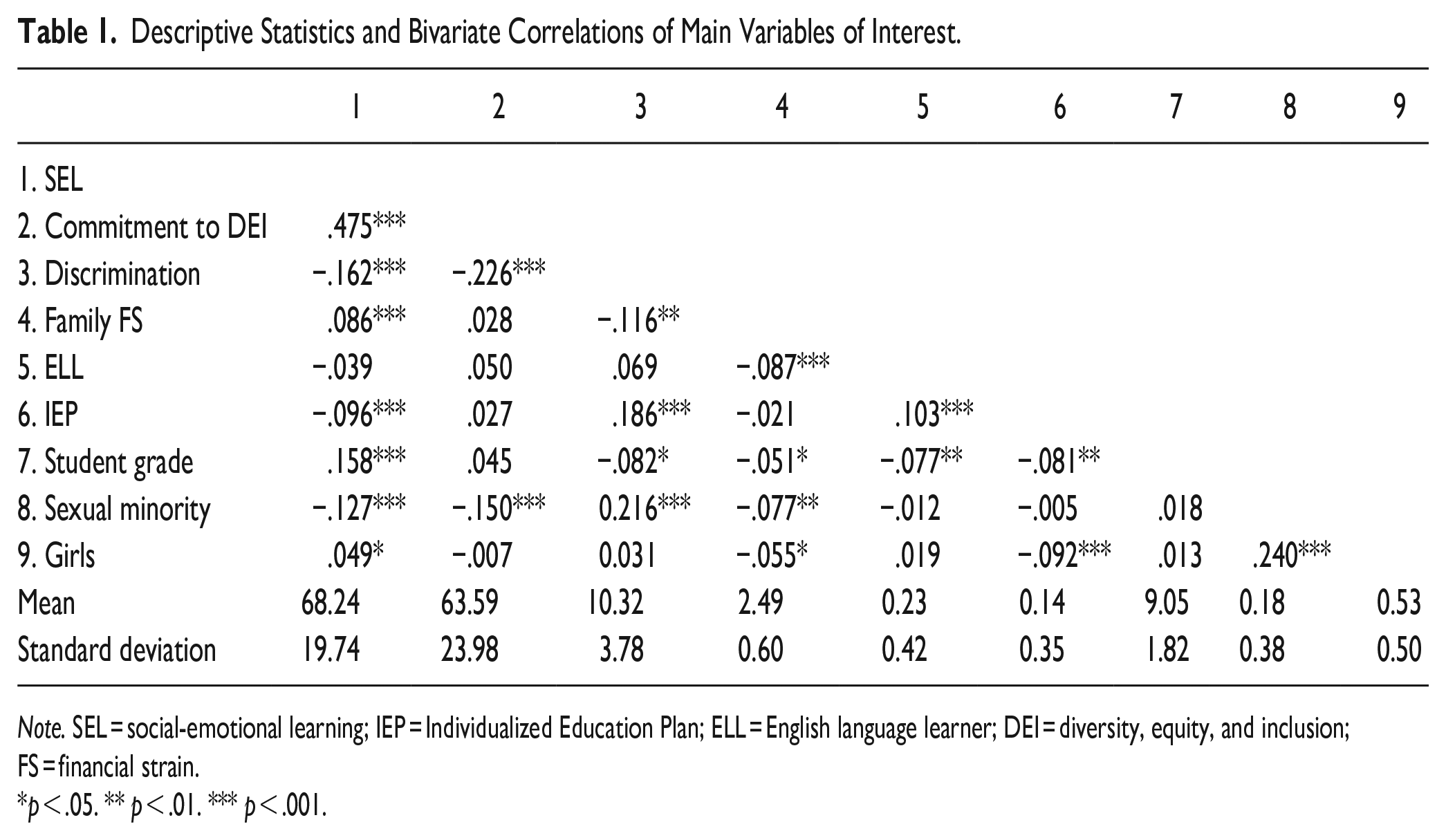
Note. SEL = social-emotional learning; IEP = Individualized Education Plan; ELL = English language learner; DEI = diversity, equity, and inclusion; FS = financial strain.
p < .05. ** p < .01. *** p < .001.
Main Effects Models
Model 1 showed that school-based discrimination was negatively associated with greater SEL (β = −.13, SE = 0.06, p < .05), while accounting for student gender identity, grade level, sexual orientation, family financial strain, ELL services, and IEP services. Model 2 showed that commitment to DEI was positively associated with greater SEL (β = .47, SE = 0.04, p < .001), but that experience of school-based discrimination became unrelated to SEL (β = −.03, SE = 0.05, p > .05). Both Model 1 and Model 2 were just-identified, CFI = 1.00, SRMR = 0.000, and RMSEA = 0.000 (see Table 2).
Main Effect Models and Moderation Model Examining the Buffering Effect of Commitment to DEI on the Negative Impact of School-Based Discrimination on Social-Emotional Learning.
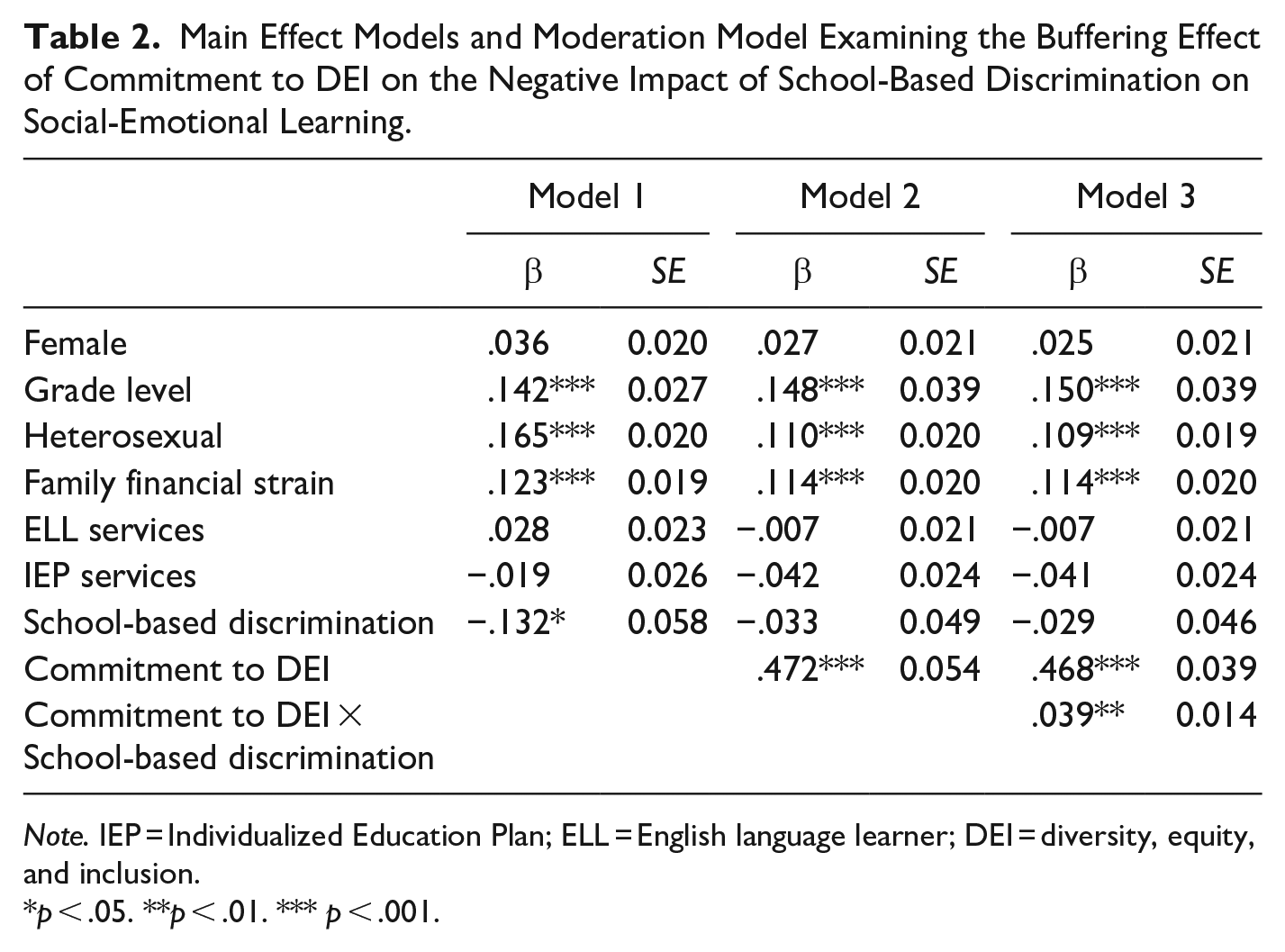
Note. IEP = Individualized Education Plan; ELL = English language learner; DEI = diversity, equity, and inclusion.
p < .05. **p < .01. *** p < .001.
Interaction Effects Model
Model 3 showed that commitment to DEI was positively associated with SEL (β = .47, SE = 0.04, p < .001) and discrimination was unrelated to SEL (β = −.03, SE = 0.05, p > .05). The interaction term between commitment to DEI and discrimination was significantly associated with greater SEL (β = .04, SE = 0.01, p < .01), indicating that the effect of discrimination on students’ social-emotional competence differed as a function of students’ perceptions of their school’s commitment to DEI (see Table 2 and Figure 1). This model was just-identified, CFI = 1.00, SRMR = 0.000, and RMSEA = 0.000.
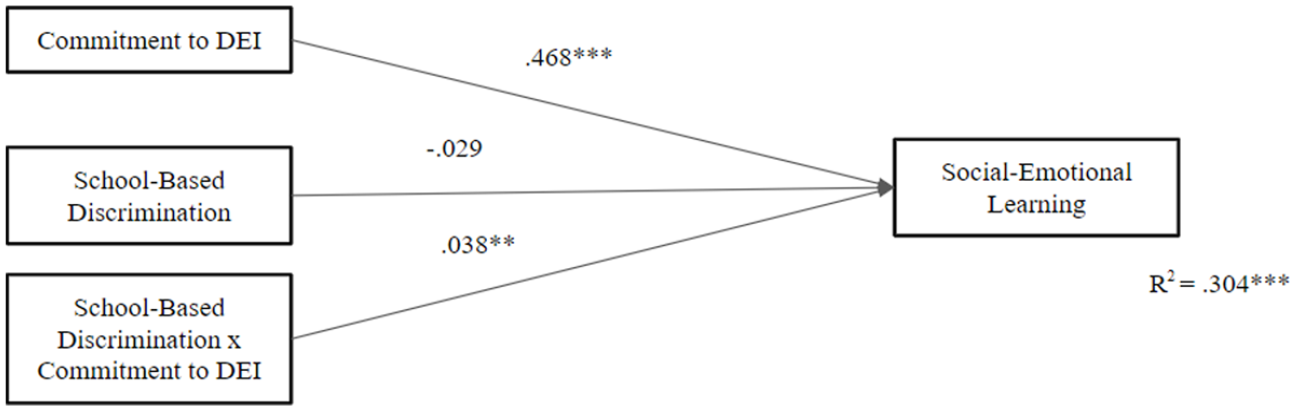
Moderation model examining the buffering effect of commitment to DEI on the negative impact of school-based discrimination on student social-emotional learning.
At low levels of commitment to DEI, greater school-based discrimination was negatively associated with Latinx student’s SEL (simple slope at 1.5 SD below the mean; β = −.08, p < .05). In contrast, at high levels of commitment to DEI, school-based discrimination was not significantly associated with Latinx student’s SEL (simple slope at 1.5 SD above the mean; β = .02, p > .05). Commitment to DEI appears to be protective, such that under conditions of higher commitment to DEI, school-based discrimination did not have as negative of an impact on student’s SEL as it did under conditions of low commitment to DEI (see Figure 2).
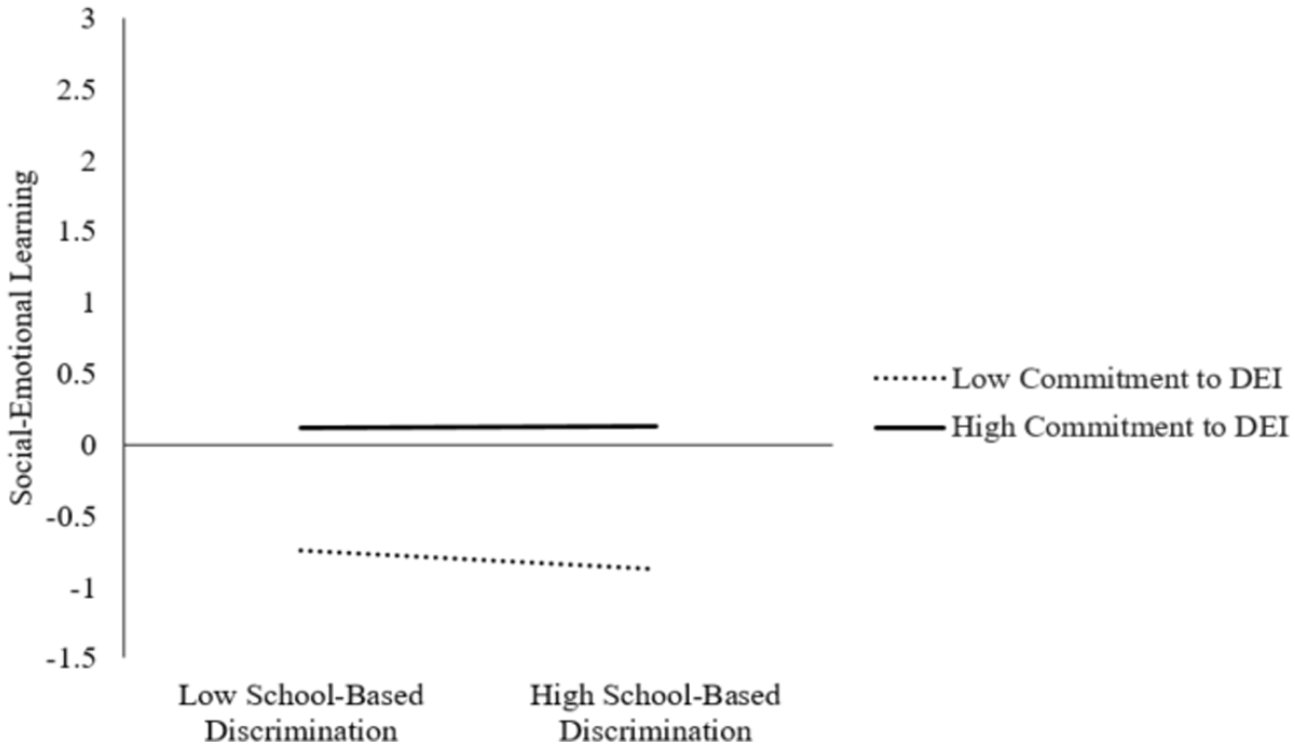
The Interaction between commitment to DEI and school-based discrimination in relation to Latinx student’s SEL.
Multigroup Models
To assess the pathways between school-based discrimination, commitment to DEI, the interaction between discrimination and commitment to DEI, and SEL across gender identity and sexual orientation, multigroup modeling was used, with gender identity and sexual orientation serving as the grouping variable in two separate models. Grade level, family financial strain, ELL services, and IEP services again were included as covariates.
Gender identity model
First, an unconstrained model was estimated in which all pathways, correlations, means, intercepts, variances, and residual variances were allowed to differ between boys and girls. This model was fully saturated (df = 0). Wald tests (pathway comparison option available in Mplus) were used to compare all pathways of interest across gender identity. Results indicated that there were significant differences between girls and boys at the model level, Wald test (df = 8) = 61.06, p < .001. Individual Wald tests were then used to compare pathways of interest across gender identity one-by-one. The pathway from commitment to DEI to SEL significantly differed across gender identity, Wald test (df = 1) = 6.92, p < .01, such that commitment to DEI was more strongly associated with SEL among boys (β = .53, p < .001) than girls (β = .41, p < .001). The pathway from discrimination and commitment to DEI × discrimination to SEL did not significantly differ across gender identity.
Sexual orientation model
When examining pathways across sexual orientation, results indicated that there were significant differences between youth who identify as a sexual minority and youth who identify as heterosexual, Wald test (df = 8) = 43.20, p < .001. The pathway from discrimination to SEL significantly differed across sexual orientation, Wald test (df = 1) = 4.82, p < .05, such that discrimination was negatively associated with SEL among youth who identify as a sexual minority (β = −.11, p < .01), but unrelated among youth who identify as heterosexual (β = −.02, p > .05). The pathway from commitment to DEI and commitment to DEI × discrimination did not significantly differ across sexual orientation.
Discussion
The current study aimed to investigate the association between school-based discrimination and SEL, and the potential moderating role of school commitment to DEI for Latinx youth. We found that Latinx youth’s experiences with school-based discrimination were negatively associated with their SEL. Furthermore, Latinx students who were in schools with a high commitment to DEI were protected against the negative effect of high levels of school-based discrimination on SEL, whereas this was not the case for Latinx students in schools with a lower commitment to DEI. An additional aim of this study was to investigate whether the relations between school-based discrimination, SEL, and school commitment to DEI differed based on Latinx youth’s gender identity and sexual orientation. We found that some of the paths among these variables varied among girls compared to boys and among youth who identified as a sexual minority compared to those who identified as heterosexual.
Previous empirical studies have documented the negative association between discrimination and a variety of developmental outcomes for Latinx youth, such as academic achievement (Benner & Graham, 2011; Hughes et al., 2016). To our knowledge, however, no studies have examined the association between school-based discrimination and SEL. We found that Latinx student’s experiences of school-based discrimination were negatively associated with their SEL. Our findings add to the existing literature that emphasizes the harmful effects of discrimination on the development of Latinx youth (Reyes & Elias, 2011). The accumulating empirical evidence shows that it is critical to find ways to protect Latinx youth, who are part of the largest ethnic minority population in K-12 schools (Musu-Gillette et al., 2016), from the detrimental effects of discrimination. Particularly, our study emphasizes the importance of finding ways to mitigate the negative effect of school-based discrimination on SEL, which has been identified as instrumental for the positive development of youth and may be especially valuable for Latinx youth who experience daily adversities (Gonzales et al., 2012; McMullin, 2016).
In general, the extant literature on factors that can protect Latinx youth against the negative effects of discrimination have focused on examining individual factors (e.g., self-esteem) and relational factors (e.g., parent support; Delgado et al., 2019; Umaña-Taylor and Updegraff, 2007). Given that Latinx youth’s experiences with school-based discrimination are embedded within the larger institutional context, it is valuable to also investigate whether institutional practices can mitigate the negative effect of discrimination. We found that Latinx youth who reported that their schools had a high commitment to DEI reported similar levels of SEL regardless of whether they experienced high or low levels of school-based discrimination. Our findings suggest that school commitment to DEI can protect Latinx youth from the negative effects of discrimination, and ultimately support their SEL development. These findings shift the burden from what Latinx youth could do individually to guard against discrimination, to what schools should do institutionally to make sure their Latinx students thrive. Specifically, we highlight the value of implementing practices that address DEI issues, such as considering students’ cultural needs, in schools that seek to better support the SEL development of Latinx youth. Our findings align with the recent push in the field to incorporate an equity lens into the implementation of SEL (i.e., transformative SEL; Jagers et al., 2018, 2019). For example, practices such as encouraging students to leverage their cultural assets, building community among students, and establishing a respect of cultural diversity, can be transformative for the SEL development of marginalized students, including Latinx youth.
Given the vulnerability of youth with multiple marginalized identities and the lack of research on the within-group differences among Latinx youth, a second goal of our study was to test whether the associations between school-based discrimination, SEL, and school commitment to DEI varied based on youth’s gender identity and sexual orientation. We found that the moderation model did not significantly differ between girls and boys or sexual minority youth and heterosexual youth. This finding suggests that commitment to DEI buffered the negative association between school-based discrimination and SEL across youth regardless of gender identity and sexual orientation. Thus, implementing school-wide practices that address DEI can potentially address the harmful effects of discrimination for all students, regardless of their individual differences. The implication of this finding is that implementing interventions that target institutional-level practices may have a wider reach for addressing inequities in developmental outcomes like SEL than interventions that focus on youth’s individual characteristics (e.g., self-esteem).
Although we did not find significant differences for the moderation model, we did find significant differences for some of the paths in the overall model. For youth’s gender, the association between school commitment to DEI and SEL was stronger for boys compared to girls. This finding has important implications as previous research has found that boys report lower levels of SEL compared to girls (Romer et al., 2011; Ross et al., 2019) and our findings suggest that school commitment to DEI may be particularly beneficial for the SEL of Latino boys. Hence, implementing institutional practices that focus on DEI may be helpful in addressing the inequities of SEL development between boys and girls. For the differences based on youth’s sexual orientation, we found that school-based discrimination was negatively associated with SEL among sexual minority youth but unrelated among heterosexual youth. This finding highlights the need for schools to consider the complexity of intersectional identities since DEI efforts that treat Latinx youth as a heterogeneous group may neglect to support Latinx youth with multiple marginalized experiences. Schools should address this through centering intersectional experiences, such as that of Latinx youth who identify as sexual minorities, in their school policies, staff training, and curriculum development (Russell et al., 2021).
Limitations and Future Directions
Our study made several important contributions to the extant literature including being one of the first studies to examine school commitment to DEI as a protective factor on the negative impact of school-based discrimination on Latinx students’ SEL. However, some limitations should be considered. First, we cannot be certain about the directionality of the links between school-based discrimination, SEL, and school commitment to DEI. Although the model we tested is consistent with previous theoretical and empirical work (see Benner & Graham, 2013; Hughes et al., 2016), suggesting that school-based discrimination does predict students’ SEL, it is possible that student’s SEL predicts their experience with school-based discrimination. Therefore, it is recommended for future studies to conduct a longitudinal assessment to gather insights on the temporal precedence of these relations. Another potential limitation of this study is that we used a general measure of school-based discrimination. Our measure did not account for the reasons why youth were being discriminated against (e.g., ethnic-based discrimination, gender-based discrimination) or who they were being discriminated by (e.g., teachers vs. peers). Yet, our study does provide initial evidence for the negative relationship between school-based discrimination and SEL, and this relationship may vary when assessing the type or source of discrimination. Lastly, the comparisons that we made in our study were based on binary measures that did not capture the full extent of the diverse experiences of Latinx youth. For example, our study did not include non-binary youth, who may experience school-based discrimination in distinct ways compared to girls and boys. Although our study makes important contributions to the literature by considering the within-group diversity and intersectional experiences of Latinx youth, it is important for future work to consider the experiences of non-binary Latinx youth (Raffaelli et al., 2005; Schmitz et al., 2020).
Conclusion
According to developmental scholars and practitioners, SEL development is essential for the positive development of youth. However, our study findings show that experiencing school-based discrimination can be detrimental for the SEL development of youth who come from marginalized groups, such as Latinx youth. We also found in our study that a potential way to mitigate the negative influence of school-based discrimination on SEL is through school practices that focus on addressing DEI issues. Specifically, Latinx youth who are enrolled in schools that have a strong commitment to DEI may be protected against school-based discrimination compared to Latinx youth in schools that have a weak commitment to DEI. Our findings also show the value of considering within-group differences among Latinx youth as we found differences based on youth’s gender identity and sexual orientation. Overall, our study highlights that the implementation of DEI practices in schools is a viable strategy for supporting the SEL development of Latinx youth.
Footnotes
Acknowledgements
We thank the youth participants in this study for being part of the Developmental Relationships Survey.
Declaration of Conflicting Interests
The author(s) declared no potential conflicts of interest with respect to the research, authorship, and/or publication of this article.
Funding
The author(s) disclosed receipt of the following financial support for the research, authorship, and/or publication of this article: This study is supported by the Search Institute Summer Scholars Fellowship, which is made possible by an Altria Group grant awarded to Search Institute.
