



Abstract
The central focus of this study is the perceived frequency and consequences of ethnic microaggressions. Research in this area of adolescent literature on ethnic discrimination is underdeveloped. Evidence showing that microaggressions are not interchangeable with blatant forms of discrimination and can have a severe negative impact on well-being is scarce. This study focuses on (a) three subdimensions of microaggressions (denial of ethnic reality, emphasis on differences, and negative treatment, (b) differences in frequency based on Muslim affiliation, country of origin, and generational status, (c) the relationship of microaggressions with self-esteem and sense of academic futility, and (d) the protective role of teachers. We use a dataset of 2,763 students of immigrant descent from 64 Belgian secondary schools. The results show that a denial of ethnic reality and negative treatment are related to less self-esteem and more academic futility. The opposite is true for emphasis on differences.
Keywords
Blatant forms of ethnic discrimination have detrimental effects on the mental well-being of adolescents (Benner et al., 2018; Stevens & Dworkin, 2019). Yet ethnic discrimination is dynamic and complex and manifests itself in many different forms (Speight, 2007). Microaggressions are a subtler and unconscious form of discrimination seen in “brief, everyday exchanges that send denigrating messages” (Sue et al., 2007, p. 273). Knowledge about the perceived frequency and consequences of microaggressions for adolescents is limited and deserves more research attention (Benner et al., 2018).
First, microaggressions capture a phenomenon common among ethnic minorities. Microaggressions do not refer to isolated incidents, but to everyday encounters (Huber & Solorzano, 2014; Sue et al., 2007). Second, ethnic discrimination is a multilayered concept that has its origin and is expressed at the micro, meso, and macro levels of society (Huber & Solorzano, 2014). For this reason, it is important to explore microaggressions because, while they represent denigrating messages about ethnic minorities that are expressed in micro-interactions, they have their origin in structural ethnic inequalities. Third, research on both overt and subtle discrimination shows that different types of discrimination can have different outcomes for adolescents (Huynh & Gillen-O’Neel, 2016). Thus, these forms of discrimination are not interchangeable. Fourth, research on the consequences of microaggressions for adolescents is limited but shows that experiencing microaggressions takes a toll on adolescents’ mental well-being. For example, they experience worse sleep quality (Huynh & Gillen-O’Neel, 2016), have lower levels of academic achievement and experience more negative affective states (Datu, 2018).
The current study expands our understanding of ethnic microaggressions and adolescents by exploring three research questions. First, who is the target of microaggressions? While the original conceptualization of microaggressions is related to race, more recent research utilizes a broader understanding of this concept in relation to different racial and ethnic groups (Wong et al., 2014). However, it is not clear how ethnicity and related characteristics such as religion influence the experience of microaggressions. Since this study was conducted in Europe, we focus on religion, generational status, and country of origin. This focus expands our knowledge in a field characterized by studies conducted in the United States. It allows us to compare insights and understand how microaggressions materialize in a less racialized context (Wimmer, 2013). Second, how are ethnic microaggressions related to self-esteem and academic futility? These outcomes have been linked with overt expressions of ethnic discrimination but not with microaggressions (Benner et al., 2018; D’hondt et al., 2016; Lambert et al., 2009). Third, can teacher support and multicultural teaching, as perceived by the adolescents, play a protective role in the relationship between microaggressions and self-esteem and academic futility (i.e., the feeling that educational outcomes are not contingent on an individual’s own behavior)? The resilience framework shows that certain resources, for example, ethnic identity, can protect against the negative consequences of discrimination (Shelton et al., 2005). However, few researchers have considered the role of teachers, especially in relation to microaggressions (Civitillo et al., 2021; Cohen & Wills, 1985; Huynh & Gillen-O’Neel, 2016; Snyder et al., 2020).
Theoretical Background
Perceived Frequency of Microaggressions
An important gap in the literature on ethnic microaggressions is the lack of knowledge about who experiences microaggressions and to what extent (Wong et al., 2014). Qualitative research has shown that adolescents can be confronted with several types of microaggressions (Colak et al., 2020; Kohli & Solórzano, 2012). Few studies, however, have taken these existing types as a starting point and compared the experiences of microaggressions across ethnic groups (Wong et al., 2014).
A microaggression does not happen in isolation, but involves an exchange between two individuals, each belonging to a certain ethnic group and each influenced by differences in ethnic group status or, in other words, by differences in power and privilege (Huber & Solorzano, 2014; Wirth, 1945; Wong et al., 2014). This dynamic determines the likelihood of being the target of microaggressions as well as the type of microaggression used. For example, adolescents belonging to an ethnic minority are more often the target of ethnic microaggressions than adolescents belonging to the dominant ethnic group because of the difference in power. This power difference is related to one’s ethnic group status or to the distinct boundary between the dominant ethnic group, which has higher social status and greater privileges, and ethnic minority groups, which have a lower social status and less privileges (Wirth, 1945). However, reality is more complex than the simple distinction between ethnic majority and ethnic minority and consists of different intersecting dimensions of ethnicity (Wimmer, 2013). Which dimensions are salient for differentiating between those with high social status and those with low social status will depend on context and time. We conducted this study in Europe in 2021; therefore, we explore differences in experiences of ethnic microaggressions according to region of origin, religion, and generational status. We combine this idea of salient boundaries between “us” and “them” with the idea that the greater the (visible) social differentiation between the dominant ethnic group and people with a different ethnic background is, the more likely they will experience discrimination (Alba, 2005; Lamont & Molnár, 2002; Pescosolido & Martin, 2015).
More specifically, we differentiate between migration from within Europe and from the Global South, as research indicates that there is an ethnic hierarchy: the dominant group on top, followed by migrants from within Europe, and (visible) minorities from the Global South at the bottom (Heath et al., 2008). In the public debate, the most important distinction being made regarding religion is between Muslim and non-Muslim affiliation, as there is a perception that Islam is a threat to secular European values (van den Brandt, 2017). Research also shows that Muslim affiliation is an important source of discrimination (Alanya et al., 2017; Alba, 2005; Ponce, 2019). Regarding generational status, the hypothesis is that second- and third-generation immigrants are less visible (e.g., in terms of language) and therefore less of an object of discrimination (Alba, 2005). In addition, it is important to explore the perceived experience of microaggressions when distinct characteristics are considered simultaneously (Huber & Solorzano, 2014).
H1: Students with a European immigrant background will perceive less microaggressions than students with an immigrant background from the Global South.
H2: Muslim students with an immigrant background will perceive more microaggressions than non-Muslim students with an immigrant background.
H3: First-generation students will perceive more microaggressions than second- and third-generation students.
Microaggressions, Self-Esteem, and Academic Futility
Self-esteem and academic futility are both part of an adolescent’s self-concept. Self-concept is “a person’s perception of him or herself. These perceptions are formed through one’s experience with and interpretations of one’s environment, and are influenced especially by reinforcements, evaluations of significant others, and one’s attributions for one’s own behaviour” (Shavelson & Bolus, 1982, p. 1). Self-esteem and futility are related but conceptually distinct features of self-concept (Gecas, 1989; Ross & Broh, 2000). Self-esteem has to do with the “individual’s positive or negative attitude toward the self as a totality” (Rosenberg et al., 1995, p. 141). Academic futility is a concept that is parallel to “locus of control,” but explicitly focuses on the school (Brookover et al., 1978). It has to do with students’ sense of being able to function adequately in the school system. Low futility is related to the feeling that the system can be mastered. It would be interesting to relate microaggressions to both concepts—self-esteem is about a global self-evaluation, futility about a specific self-evaluation—and this has, to the best of our knowledge, not yet been done.
Furthermore, in the literature, the source of self-esteem is one’s immediate social network (Ross & Broh, 2000). Self-esteem results from experiences with and appraisals of close friends, family, and other close adults, such as teachers. Academic futility, in contrast, results from one’s idea about the environment (Bandura, 1982). It finds its origin in society’s ethnic and social stratification, since the likelihood of reaching desired goals is not random. Since the origins of self-esteem (significant others) and of academic futility (environment) are different, we want to explore whether this difference effects how microaggressions relate to these two outcomes.
In addition, we also implicitly explore the idea of internalization. This mechanism may explain why microaggressions have detrimental consequences, namely, because adolescents internalize denigrating messages, which changes how they see themselves and the world around them (Kohli & Solórzano, 2012). This mechanism is especially relevant in the context of microaggressions, because this type of ethnic discrimination is not about one explicit incident, but about small incidents that communicate you do not belong, you are not the norm until a person starts to believe this; this could result in lower self-esteem and a higher sense of academic futility (Speight, 2007).
H4: Microaggressions will be negatively related with self-esteem.
H5: Microaggressions will be positively related with academic futility.
The Promotive and Protective Role of Teachers
Finally, we follow the core idea of the risk and resilience framework: not every person will react in the same way to risk, in this case, to ethnic microaggressions. It is important to consider sources of resilience in an adolescent’s life that can buffer the negative impact of stressful experiences (Cohen & Wills, 1985; Snyder et al., 2020).
We examine if and how teachers can be a source of resilience for adolescents who experience ethnic microaggressions. Adolescents spend most of their waking hours in school and research shows that teachers can make a substantial difference in their lives, especially for those at risk (Muller, 2001; Niehaus et al., 2012). The role a teacher plays in the classroom includes different dimensions, from class management to providing a supportive relationship to students. We focus on teacher-student relationships and multicultural teaching (Bear et al., 2011; Guyton & Wesche, 2005). Teacher-student relationships is about the relationships characterized by teachers who are caring, respectful, and emotionally supportive (Bear et al., 2011). Multicultural teaching is about teaching multicultural education, which can be defined as “a democratic approach to teaching and learning that seeks to foster cultural pluralism within culturally diverse societies and an interdependent world” (Bennett et al., 1990).
The role teachers play is twofold. On one hand, the student-teacher relationship and multicultural teaching can benefit all students, regardless of their experiences of microaggressions (Cohen & Wills, 1985; Snyder et al., 2020). The risk and resilience framework defines this relationship as a promotive factor because it promotes the well-being of the adolescent regardless of risk. On the other hand, the student-teacher relationship and multicultural teaching may potentially be more helpful—or may be only effective—for students who have been exposed to microaggressions. Teaching practices can then be considered protective factors that have a positive impact because they protect adolescents from the aversive effects of microaggressions.
The literature demonstrates the promotive effect of supportive teacher-student relationships on adolescents’ academic outcomes and mental health (Bear et al., 2011; Klem & Connell, 2004; Košir & Tement, 2014; Suldo et al., 2014) and, more specifically, on the self-esteem of adolescents (Colarossi & Eccles, 2003). The research on multicultural teaching and different achievement and mental health outcomes is less developed, but points in the same direction (Aronson & Laughter, 2016; Celeste et al., 2019).
Knowledge about the protective role of positive teacher-student relationships and multicultural teaching is more limited (Civitillo et al., 2021). Inspired by insights into the protective role of social support, we expect to find that supportive teacher-student relationships will have a positive effect on the well-being of adolescents because their teachers communicate that they are esteemed and accepted (Cohen & Wills, 1985). This positive message can help students who experience microaggressions to not internalize denigrating messages, for example. Multicultural teaching may also be a source of esteem support, since multicultural education starts from the idea that there is value in diversity (Urbiola et al., 2017). It may also be a source of informational support, since informational support is directed towards “defining, understanding and coping with problematic events,” which can be seen as an important task of multicultural education in relation to ethnic discrimination and microaggressions (Bennett et al., 1990; Cohen & Wills, 1985, p. 313). Hence, we may expect that positive teacher-student relationships and multicultural teaching will play a protective role against the negative impact of microaggressions on self-esteem and academic futility, because these may change the perception of microaggressions and/or help adolescents to cope.
However, research on social support indicates that the protective effect of esteem support and informational support will appear only if teachers are in a position to respond to the needs experiencing microaggressions elicits. Since microaggressions are embedded in broad societal structures, not in educational settings, the question remains if teachers will be able to protect adolescents at risk? The empirical evidence is inconclusive. One study found that school belonging buffered the negative impact on sleep of overt ethnic discrimination, but not of microaggressions (Huynh & Gillen-O’Neel, 2016). Another study found that positive teacher-student relationships buffered the negative effect on global self-esteem and emotional school engagement of personal and group ethnic discrimination, but not of school climate (Civitillo et al., 2021).
H6a: Positive teacher-student relationships will be positively related to self-esteem and negatively related to academic futility (promotive effect).
H6b: Multicultural teaching will be positively related to self-esteem and negatively related to academic futility (promotive effect).
H7a: Positive teacher-student relationships will buffer the relationship between microaggressions and self-esteem and academic futility (protective effect).
H7b: Multicultural teaching will buffer the relationship between microaggressions and self-esteem and academic futility (protective effect).
Method
Sample
This research was conducted using data from the SIS-dataset (Maene et al., 2021). A multistage sampling frame was applied to generate a multitopic dataset focused on ethnic diversity and the phenomenon of tracking (for more information, see Maene et al., 2021). Data was collected in the second half of 2017. Surveys were conducted among students in the third year (Grade 9 in the US) of secondary education in 64 schools in Belgium. The principals distributed an information letter to all students and their parents informing them about the research theme and the anonymous and voluntary participation of the students. This letter gave parents the option to withhold consent. In total, 80% of the students participated by completing questionnaires in their classroom.
To answer the research questions, we used a subsample of 2,763 pupils with an other-than-Belgian descent in 64 secondary schools. Ethnicity was assessed primarily based on the birthplace of the adolescent’s maternal grandmother. This is common practice in Belgium, as most students of immigrant descent are second or third generation and have Belgian nationality (OECD, 2008).
Measures
Self-esteem was measured using seven items of Rosenberg’s (1965) Global Self-Esteem scale. We used a 5-point Likert scale ranging from absolutely disagree to completely agree. Three items were reverse coded. We obtained a Cronbach’s alpha of .769. The mean score was 3.60 (SD = 0.70). The higher the students scored, the stronger their feelings of self-esteem.
Sense of academic futility was measured by Brookover et al.’s (1978) scale consisting of five items. We used a 5-point Likert ranging from absolutely disagree to completely agree. An example item is “At school, students like me don’t have any luck.” One item was reverse coded. We obtained Cronbach’s alpha of .791. The mean score was 2.07 (SD = 0.75). The higher the students scored, the stronger their feelings of futility.
Ethnic microaggressions is based on a measure developed by Huynh (2012) and has three subdimensions. Emphasis on differences focuses on the assumption that one is a foreigner and will remain a perpetual foreigner. An example item is “You are asked where you are really from.” Denial of ethnic reality focuses on comments that dismiss or invalidate individuals’ experiences of bias and discrimination. An example item is “Someone tells you that racism does not exist anymore.” Negative treatment focuses on being treated as a second-class citizen. An example item is “Someone assumes you are a bad student.”
Because this scale was developed for Latino and Asian American adolescents in an American context, we initially adapted a few items to better fit the Belgian context. For example, in the subdimension negative treatment, “you are mistaken as a service worker” was replaced by “somebody avoids sitting next to you on the bus or tram.” Subsequently, we submitted the three-factor model to a confirmatory factor analysis. The initial model showed an adequate to good model fit for all indices but the CFI (χ2(51) = 603.055, RMSEA = 0.065, SRMR = 0.057, CFI = 0.912). To increase model fit, we examined the modification indices and concluded that three items cross-loaded on the other subdimensions. The removal of these items substantially improved model fit (χ2(24) = 175.898, RMSEA = 0.050, SRMR = 0.033, CFI = 0.964). Furthermore, we tested this model for measurement invariance (MI) along the different dimensions of ethnicity used in this study. This MI is a validity check for self-reported measures to confirm that different groups can be compared with each other (van de Schoot et al., 2012). Hence, for each dimension of ethnicity (Muslim vs. non-Muslim; first generation vs. second and third generation; European vs. Global South), we verified whether those two groups could be compared with each other in how they filled out the measures of ethnic microaggressions. We obtained configural, factor loading, and intercept invariance for all three dimensions of ethnicity according to the Chen (2007) criteria. The results of the strictest model are Muslim versus non-Muslim (χ2(60) = 220.371, RMSEA = 0.047, SRMR = 0.037, CFI = 0.960), first generation versus second and third generation (χ2(60) = 253.654, RMSEA = 0.051, SRMR = 0.038, CFI = 0.953), and European versus Global South (χ2(60) = 253.896, RMSEA = 0.051, SRMR = 0.039, CFI = 0.955). Hence, we can make meaningful comparisons in relation to the perception of microaggressions. The dimension emphasis on differences consists of three items, with a Cronbach’s alpha of .740. Denial of ethnic reality consists of two items, with a Cronbach’s alpha of .783. Negative treatment has four items, with a Cronbach’s alpha of .735.
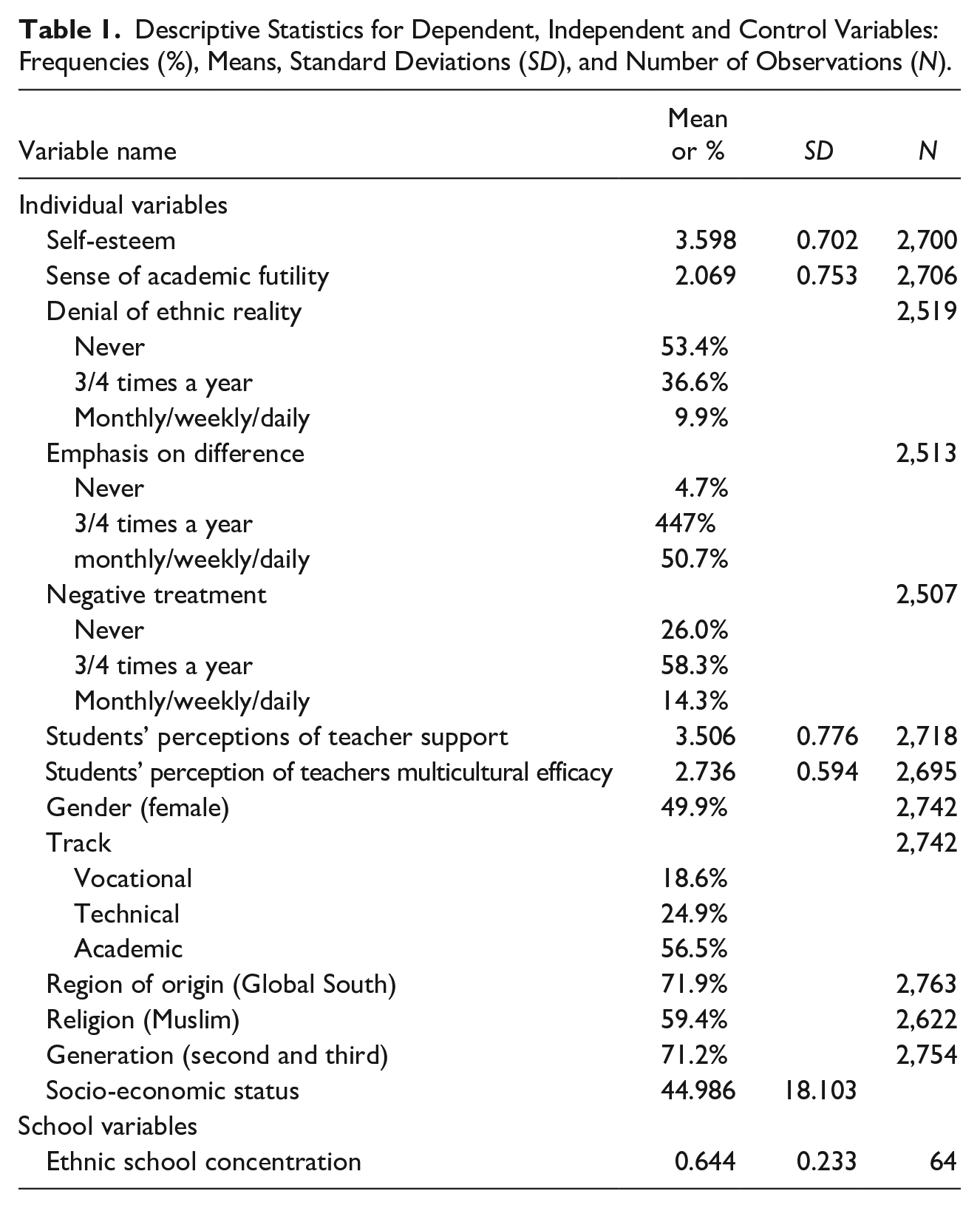
Adolescent had to indicate how often they had experienced each item of ethnic microaggressions on a 6-point Likert scale: 0 = never, 1 = once a year, 2 = three to four times a year, 3 = once a month, 4 = once a week, 5 = almost every day. We chose to operationalize microaggressions as a categorical not a metric variable, because this fits the structure of the data better and it allows us to gain more insight into the effect of cumulative experiences. The variables were recoded into three categories: 0 = never, 1 = once to three to four times a year, 2 = monthly/weekly/daily. Table 1 presents the descriptive statistics.
Descriptive Statistics for Dependent, Independent and Control Variables: Frequencies (%), Means, Standard Deviations (SD), and Number of Observations (N).
Teacher support is a subdimension of the Delaware School Climate Survey (Bear et al., 2011). It consists of eight items. We used a 5-point Likert scale ranging from absolutely disagree to completely agree. An example item is “Teachers respect the students.” We obtained a Cronbach’s alpha of .900. The mean score is 3.51 (SD = 0.78).
Multicultural teaching is a measure inspired by the work of Guyton and Wesche (2005) and consists of 10 items. It taps specifically into how students perceive the effectiveness of their teachers in applying multicultural education. An example item is “Can most of the teachers in this school adapt their teaching materials to suit the multicultural class group?” We used a 4-point Likert scale ranging from they are not able to do this to they are fully able to do this. We obtained a Cronbach’s alpha of .859. The mean score is 2.74 (SD = 0.59).
Country of origin is a subdivision of “other-than-Belgian descent” in two categories: European (=0) and Global South (=1). There were eight participants with Australia or the US as country of origin. Given the small number and the fact that these students have non-European roots but do not belong to the Global South, these participants were not included in the analysis.
Muslim is based on the religious self-identification of the adolescents: other-than-Muslim (=0) and Muslim (=1). Generational status is based on whether the adolescent is born in Belgium or not: first generation (=0) and second or third generation (=1).
Gender is a dichotomous variable (male = 0, female = 1). In the sample, 49.9% identified as female.
The Belgian school system distinguishes between academic, technical, vocational, and arts tracks. In this sample, 18.6% followed a vocational track, 24.9% a technical track, and 56.5% an academic track. No students followed the art track.
Socioeconomic status of students was measured using the International Socio-Economic Index of Occupational Status (ISEI; Ganzeboom et al., 1992) derived from the International Standard Classification of Occupations (ISCO-88). This metric variable has a range from 16 to 90. The highest score of the two parents was used to measure the students’ socioeconomic background. The mean score was 44.99 (SD = 18.10).
Ethnic composition at the school level is a variable based on the ethnicity of the students (as explained above). It is based on the proportion of students with an other-than-Belgian descent in Grade 6. It ranges from 0.13 to 1 with an average of 0.64 (SD = 0.23).
Analytic Strategy
To better understand who becomes the target of microaggressions, we started with crosstabs in SPSS 26 to investigate the relationship between the three dimensions of microaggressions and religion (Muslim vs. non-Muslim), generational status (first vs. second or third), and region of origin (European vs. Global South). Furthermore, to explore the intersection of the latter three dimensions, we initially started with H1 (European < Global South immigrant background), H2 (non-Muslim < Muslim), and H3 (second and third < first generation) and compared the frequencies of first-generation Muslim students with an immigrant background from the Global South with second- and third-generation non-Muslim students with a European immigrant background. Hence, we compared the group of adolescents whose ethnic status consisted of categories in which we expected to find the fewest ethnic microaggressions with those adolescent groups whose ethnic status consisted of categories in which we expected to find the most ethnic microaggressions.
Next, we used multilevel regression to relate microaggressions with self-esteem and academic futility and to investigate the protective role of teachers. Multilevel modeling was the most appropriate method because of the hierarchical structure of the data: students are nested within schools. We performed the multilevel analyses in MlWin 3.04. First, we estimated the unconditional model to determine the amount of variance that occurs between schools. Then we began with the control variables on the student level (gender, track, socioeconomic status, country of origin, generational status) and the school level (ethnic composition). We chose not to include Muslim affiliation because of the multicollinearity with country of origin.
We then added the different dimensions of microaggressions to test the association between microaggressions and self-esteem and futility. To test the role of teachers, we added teacher support and multicultural teaching as a main effect, followed by an interaction term for each of the microaggression subdimensions. This allowed us to verify if teacher support and multicultural teaching played a promotive and/or protective role. All metric variables were grand mean centered.
Results
Perceived Frequency of Ethnic Microaggressions
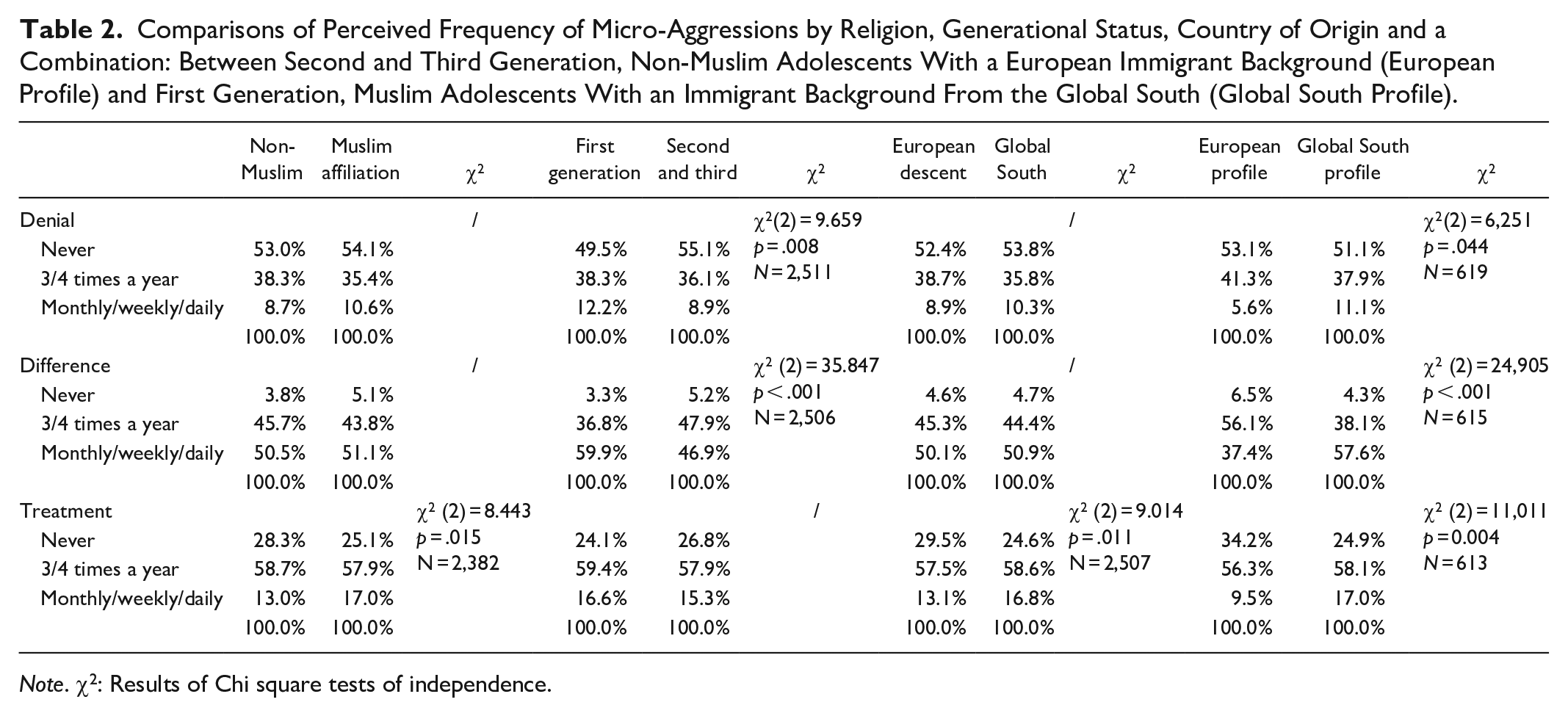
Table 2 presents the perceived frequency of ethnic microaggressions divided among three dimensions of ethnic microaggressions and three subdimensions that define ethnic status. Four clear results emerged.
Comparisons of Perceived Frequency of Micro-Aggressions by Religion, Generational Status, Country of Origin and a Combination: Between Second and Third Generation, Non-Muslim Adolescents With a European Immigrant Background (European Profile) and First Generation, Muslim Adolescents With an Immigrant Background From the Global South (Global South Profile).
Note. χ2: Results of Chi square tests of independence.
First, there are large differences in frequency depending on which dimension of microaggressions is considered. Denial of ethnic reality is perceived the least, followed by negative treatment, while emphasis on difference is perceived by almost all adolescents. Second, adolescents who are Muslim, first generation, or have an immigrant background in the Global South do not necessarily perceive more microaggressions. Perceived frequency depends on the microaggressions and the ethnic status dimension. Hence, H1 (European immigrant background < Global South immigrant background), H2 (non-Muslim < Muslim), and H3 (second and third generation < first generation) can only be partly confirmed. Third, students with a Muslim affiliation perceive more negative treatment than students with a non-Muslim affiliation (χ²(2, N = 2,382) = 8.443, p = .015); the same is true for students with an immigrant background in the Global South versus students with a European descent (χ²(2, N = 2,507) = 9.014, p = .011). Fourth, first-generation students perceive more denial of ethnic reality (χ²(2, N = 2,511) = 9.659, p = .008) and emphasis on differences than second- and third-generation students (χ²(2, N = 2,506) = 35.847, p < .001).
Table 2 contains a comparison between first-generation Muslim students with an immigrant background from the Global South with second- and third-generation non-Muslim students with a European immigrant background. This comparison allowed us to gain more insight into how the intersection of the three dimensions of ethnic status are related to perceived frequency of microaggressions. The results show that this intersection is relevant in relation to all three dimensions of microaggressions: denial (χ²(2, N = 619) = 6.251, p = .044), difference (χ²(2, N = 615) = 24.905, p < .001), and treatment (χ²(2, N = 613) = 11.011, p = .004). The “European” profile has fewer and less frequent experiences of microaggressions than the “Global South” profile.
Microaggressions, Self-Esteem, and Academic Futility
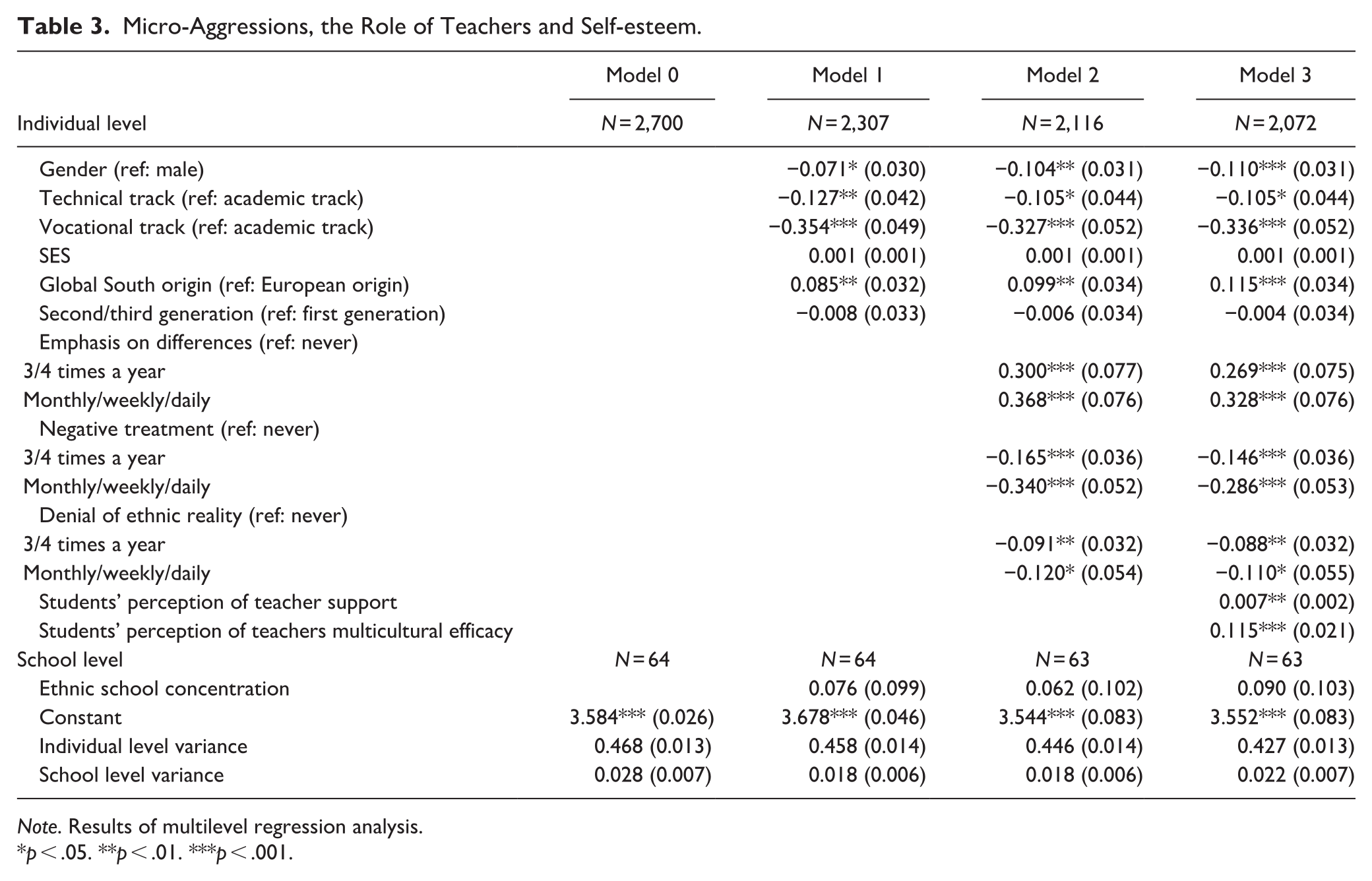
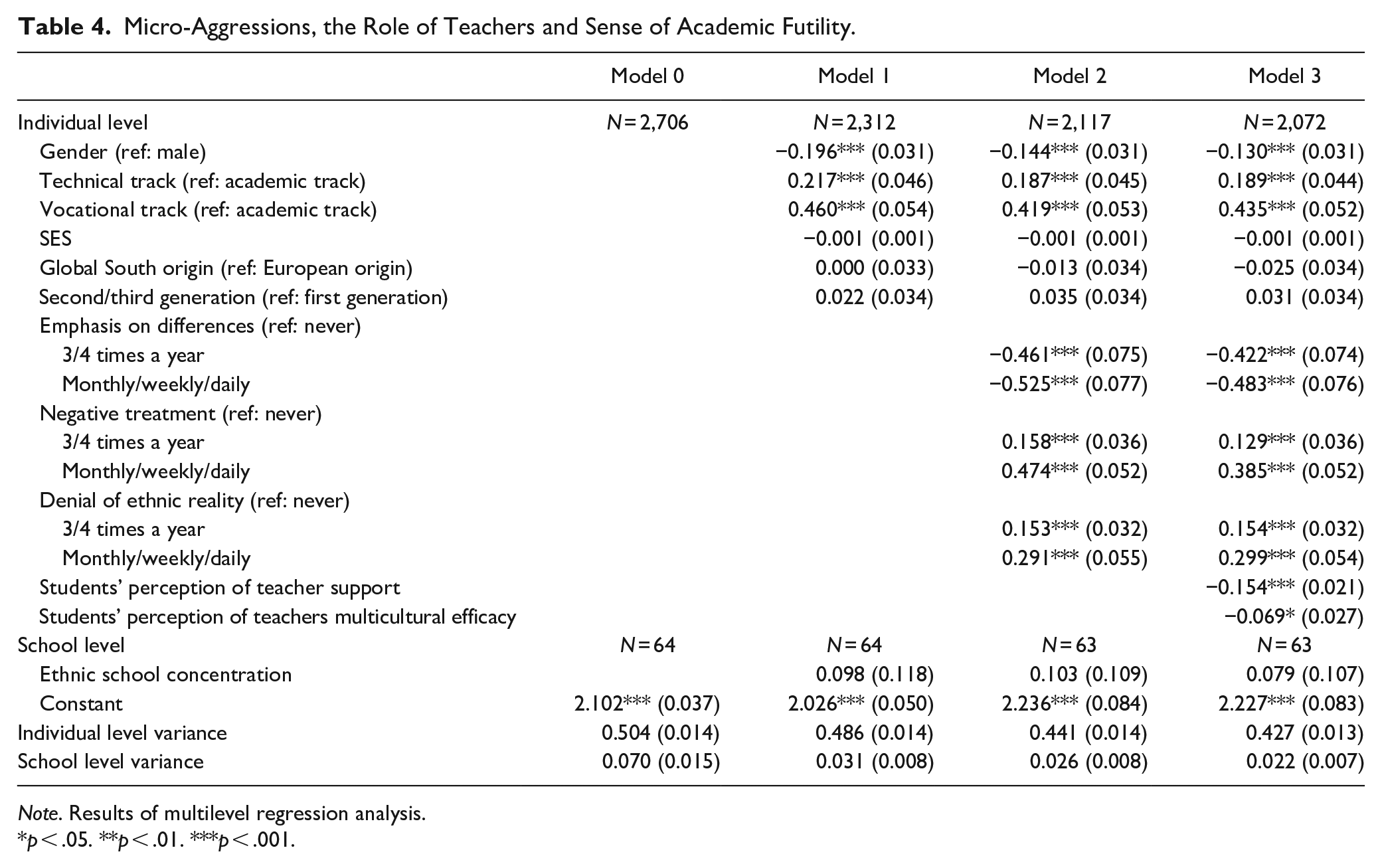
The unconditional model indicated that 5.6% of the variance in self-esteem was situated at the school level (s²u = 0.468, s²e = 0.028) as was 12.2% of the variance in academic futility (s²u = 0.504, s²e = 0.070). Furthermore, we see that female students have less self-esteem, but feel less academically futile than male students. If we compare the academic track with technical and vocational tracks, we observe a decrease in self-esteem and an increase in academic futility. Socioeconomic status and the ethnic concentration of the school are not significantly related to self-esteem and academic futility. The same is true for Muslim affiliation, country of origin, or generational status.
If we focus on microaggressions, several observations can be made. First, in contrast to H4 (microaggressions negatively related to self-esteem) and H5 (microaggressions positively related to academic futility), emphasis on differences is related to more self-esteem and less academic futility; this effect gradually increases with the frequency of experiences. Second, in line with H4 (microaggressions negatively related to self-esteem) and H5 (microaggressions positively related to academic futility), negative treatment is related to less self-esteem and more academic futility. We see a close relationship between cumulative experience and the size of the negative impact. Third, denial of ethnic reality is negatively related to self-esteem and positively related to sense of academic futility (confirmation of H4 and H5). Especially for academic futility, we see a close relationship between cumulative experience and size of the negative impact. Fourth, the effect sizes for microaggressions are larger overall in relationship to futility than to self-esteem.
The Promotive and Protective Role of Teachers
The main effects of students’ perception of multicultural teaching and of teacher support show that both elements are promotive of the well-being of the adolescents, in line with H6a (teacher support related positively to self-esteem and negatively to academic futility) and H6b (multicultural teaching related positively to self-esteem and negatively to academic futility). These two elements are related to more self-esteem and less academic futility. Next, we added an interaction term with each subdimension of microaggressions and of, respectively, teacher support and multicultural teaching. We could not find any significant interaction; hence, we could not confirm the protective role of teacher support (H7a) and multicultural teaching (H7b). To not overburden Tables 3 and 4, we did not add these insignificant interaction terms.
Micro-Aggressions, the Role of Teachers and Self-esteem.
Note. Results of multilevel regression analysis.
p < .05. **p < .01. ***p < .001.
Micro-Aggressions, the Role of Teachers and Sense of Academic Futility.
Note. Results of multilevel regression analysis.
p < .05. **p < .01. ***p < .001.
Discussion
This study focuses on the perceived frequency and consequences of ethnic microaggressions. Research in this area of adolescent literature on ethnic discrimination is underdeveloped, especially in Europe. However, the evidence, although scarce, does show that microaggressions are not interchangeable with more blatant forms of discrimination and that the cumulative character and subtlety of such incidents can have a severe negative impact on well-being (Datu, 2018; Huynh, 2012; Huynh & Gillen-O’Neel, 2016; Kohli & Solórzano, 2012). Hence, this study expands this existing but limited knowledge by focusing on (a) three subdimensions of microaggressions (denial of ethnic reality, emphasis on differences, negative treatment), (b) differences in perceived frequency based on Muslim affiliation, country of origin, and generational status, (c) the relationship of microaggressions to self-esteem and academic futility, and (d) the promotive and protective role of teachers.
Five results merit further discussion. First, this study shows that focusing on only the distinct boundary between ethnic majority and ethnic minority members is insufficient. Other important subdimensions of ethnic status must be considered. Depending on the type of microaggressions, different dimensions are relevant. Adolescents from the first generation perceive significantly more microaggressions that emphasize their being different and deny their ethnic reality in relation to ethnic bias and discrimination than adolescents from the second and third generation do. This significant difference in perception is not found when we compare adolescents according to their Muslim/non-Muslim affiliation or their ethnic origin in the Global South/Europe. In contrast, we do find that adolescents with a Muslim affiliation compared to non-Muslim adolescents perceive significantly more microaggressions related with negative treatment (e.g., somebody assumes that you are a bad student). The same is true if we compare adolescents whose ethnic origin is in the Global South versus Europe. Hence, although these are perceptions and not objective measures, these findings imply that microaggressions do not occur at random and the type of messages adolescents are confronted with depend on their ethnic status. We follow Huynh’s (2012) operationalization and its related three themes. In future research, it would be interesting to build on this taxonomy and to use it in different contexts and with different ethnic groups to explore which themes are relevant in which context and which ethnic and/or related characteristics trigger different types of ethnic microaggressions (Wong et al., 2014). Furthermore, ethnic status as a combination of different subdimensions (religion, generational status, region of origin) places some adolescents at higher risk of experiencing ethnic microaggressions than others, hence, it is important to investigate this in more detail in future research.
Second, despite their subtle character, microaggressions are related to lower self-esteem and a higher academic futility. However, not every message is received as negative. Questions such as being asked where you are really from are related to more self-esteem and less futility. Further research is necessary, as it may be that this type of microaggression captures an element of positive interest in one’s ethnic origin and therefore is not being perceived as a microaggression. Because microaggressions are subtle in nature, it would be interesting to explore how and which personal and situational characteristics influence the attribution processes to identify a remark as being microaggressive. Another potential route to explore is the correlation between ethnic-identity salience and the type of remarks related to ethnic difference, as previous research has linked ethnic-identity salience with more positive mental well-being (Shelton et al., 2005).
Third, in the literature on microaggressions, the cumulative nature of microaggressions is a central characteristic and a source of stress (Huber & Solorzano, 2014; Kohli & Solórzano, 2012). Our findings reflect the idea that more frequent experiences are also related to a more negative impact. Fourth, qualitative research has suggested that microaggressions can affect adolescents’ worldview and how they see themselves, as they may internalize microaggression messages (Kohli & Solórzano, 2012). Generally, the pattern for both outcomes is similar, but the impact on academic futility seems larger. More research, including longitudinal research, is necessary to substantiate this, but our findings seem to indicate that adolescents internalize microaggressions and that this especially affects their ideas about the control they have of their school environment.
Fifth and finally, teachers play a promotive role in the well-being of adolescents; however, this positive effect does not differ between students who did or did not experience ethnic microaggressions. Hence, based on these findings, we cannot state that teachers play a protective role. As social support literature states, the protective effect will only appear if teachers can respond to the needs linked to the microaggressions (Cohen & Wills, 1985). We already wondered whether teachers would be able to support adolescents who experience ethnic microaggressions, as this experience is not explicitly linked to the educational setting. Based on this study, the answer is negative; however, additional research, including research on different aspects of the teacher’s role, needs to be conducted before we can make a clear statement about this.
Limitations and Future Research
A thorough understanding requires additional research, as this study has several limitations. First, the cross-sectional character of this study limits the possibility to capture the causal relationships between the different researched variables. Longitudinal research could provide better insight into how different relationships develop and how different variables impact each other. Second, this study is limited to the Belgian (Flemish) context; a comparison between different countries would help to understand how ethnicity is linked to different types of microaggressions and their perceived frequency (Wimmer, 2013). It would be especially interesting if the three types of microaggressions operationalized by Huynh (2012) could be extended with an explorative qualitative study. The development of such an instrument could then be used to make cross-contextual comparisons. Third, the current study could not find evidence that teacher support is a protective source; however, given the importance of the educational setting, future research should further explore which elements within a school could make a difference.
Conclusion
Ethnic microaggressions have an impact on adolescents’ self-esteem and academic futility. Research has paid little attention to this type of more subtle ethnic discrimination, but the findings of this and other existing studies show the importance of learning more about who they impact, what the consequences are, and how elements within a school context could protect adolescents against this type of negative experience. Hence, we hope that the findings of this study pave the way for future studies so research can support initiatives to tackle this type of ethnic discrimination.
Footnotes
Correction (March 2024):
“Teacher support” and “Teachers multicultural efficacy” values in table 3 are updated.
Author Contributions
Material preparation and data collection was performed by Charlotte Maene. The data analysis was performed by Fanny D’hondt. The first draft of the manuscript was written by Fanny D’hondt and all authors commented on previous versions of the manuscript. All authors read and approved the final manuscript.
Declaration of Conflicting Interests
The author(s) declared no potential conflicts of interest with respect to the research, authorship, and/or publication of this article.
Funding
The author(s) disclosed receipt of the following financial support for the research, authorship, and/or publication of this article: Funded by Research Foundation-Flanders as part of the research projects: Strategic Basic Research—S004119N and G024516N.
