



Abstract
This study examines whether and how an individual’s subjective, or self-rated, popularity is related to one’s structural position in the peer network, as measured by betweenness centrality and structural hole measure. Data were drawn from the original fieldwork conducted in Laos (N = 1,490; boys = 40%; Mage = 13), a low-income country in Southeast Asia. Using friendship nominations, we constructed a global network matrix based on which sociometric variables were calculated. Findings from hierarchical linear models showed that net of sociometric and other controls, network brokers—those who span more structural holes or bridge across more disconnected dyads pairs—indeed perceive themselves as being “more popular.” Subjective, net of objective, measure of popularity should be incorporated as a critical component in the lives of young people.
Introduction
A substantial literature exists regarding the importance of peer status in the lives of youth. Status is typically conceptualized along the lines of popularity (being popular or influential) and preference (being well-liked), which are related but distinct. As such, they constitute different aspects of status formation, that is, a popular child is not necessarily liked and vice versa (van den Berg et al., 2020). Peer status defined as popularity, in particular, has been shown to correlate with a wide range of behavioral, health, and social outcomes including: delinquency (Allen et al., 2005; Mathys et al., 2013), smoking (Alexander et al., 2001), drinking (Fujimoto & Valente, 2015; Gommans et al., 2017), eating disorder (Smink et al., 2018), prosociality (Pattiselanno et al., 2015), goal trajectory (Dawes & Xie, 2017), social contentment (Ferguson & Ryan, 2019), social functioning (McElhaney et al., 2008), group affiliation (Jones & Estell, 2010), antipathy relations (Berger & Dijkstra, 2013), and interpersonal conflict (Cillessen et al., 2014; Faris & Felmlee, 2011). While studies vary considerably in terms of empirical topics, the vast majority share an analytic commonality: they operationalize popularity as the main predictor objectively in terms of the number of peer (friendship) nominations.
With this approach, prior research largely takes the concept of popularity as a given and, as a result, does not probe its antecedents. Why are some adolescents popular while others are not? More specifically, why do some perceive themselves to be more (less) popular vis-à-vis their peers? Our study has a two-fold purpose. First, it contributes to the scholarship by addressing this question which, for the most part, has escaped systematic attention. Second, perceived popularity has been almost exclusively defined in terms of observers—that is, in terms of alters’ perception. By contrast, we reorient the definition by conceptualizing it from the perspective of focal actors (ego). In doing so, our study demonstrates that self-rated popularity has a concrete relational, or network structural, basis independent of “sociometric status” measured by peer nomination (van den Berg et al., 2020). Specifically, using a unique survey fielded in a Southeast Asian country, we analyze multilevel associations between adolescents’ objective locations in the web of relational network and subjective (i.e., self-rated) assessments of their respective positions on the status hierarchy.
Popularity refers to the “rank ordering of children or adolescents in peer groups” within a classroom or a grade, with those ranked at the top considered “popular” (Cillessen & Marks, 2011, p. 26). Studies show that how individuals fare in the popularity contest is closely related to stages of relational development (Nangle et al., 2003) as well as the emergence of healthy social functioning from adolescence to adulthood (McElhaney et al., 2008). Others find that popular adolescents are more likely to be prosocial, have higher-quality friendship and better academic performance, and are more cooperative (Allen et al., 2005). On the other hand, popular adolescents may be prone to engage in delinquent behaviors, including aggression (Cillessen & Mayeux, 2004), truancy (Allen et al., 2014), and substance use (Tucker et al., 2011).
Because popularity has been narrowly conceptualized in terms of being liked by others in a social setting (e.g., classroom or school; Cillessen & Bukowski, 2018; Cillessen & Marks, 2011; Jones & Estell, 2010), the role of self-assessment has been all but ignored in the literature. Typically, researchers gauge the level of individual popularity via the sum of “incoming ties” using a name generator (Faris & Felmlee 2014; Fujimoto & Valente 2015; Pattiselanno et al., 2015). With this measure, they investigate the extent to which “objective popularity” accounts for the variance in alcohol consumption (Fujimoto & Valente, 2015), smoking behavior (Ennett et al., 2008), peer victimization (Faris & Felmlee, 2014), psychosocial adaptation (Allen et al., 2005), and aggression (Pattiselanno et al., 2015), among others. In doing so, prior research assumes ex ante that an adolescent who receives more peer nominations, an objective phenomenon, necessarily considers oneself to be more popular, a subjective outcome.
The present study problematizes this implicit assumption by asking the following: What is the relationship between “subjective popularity” and one’s structural position in the overall peer network? Do subjectively popular individuals have network characteristics that are different from their less popular counterparts? If so, how? Analogous to self-rated health (SRH), the most frequently used generic health indicator (Bamia et al., 2017; Cullati et al., 2020; Lazarevič & Brandt, 2020), we propose that subjective or self-rated popularity (SRP) is an essential aspect of adolescent well-being that merits recognition and attention (Gruenenfelder-Steiger et al., 2016; Reitz et al., 2016). In the literature on social determinants of health (Kawachi & Berkman, 2003; Story & Glanville, 2019; Tsoli et al., 2018), a wealth of evidence exists on how SRH is shaped by factors such as social networks and social capital. Similarly, we seek to explore whether and the extent to which SRP may be related to relational and positional dynamics within the friendship network. Earlier findings indicate that adolescents with higher indegree centrality are seen as more influential (Malacarne, 2019). For example, those with higher outdegree centrality better control the flow of social activities and earn more attention from others (Liu et al., 2017). And high eigenvector centrality denotes multiple friendship nominations, or greater relative status (Faris & Felmlee, 2011; Felmlee et al., 2018; Malacarne, 2019).
Closer to our primary objective, adolescents with high “betweenness centrality” play a critical role in the peer network as they connect, bridge, and link multiple sub-groups in it (Felmlee et al., 2018). Importantly, such individuals are perceived by others to be of higher status given their influence over the information flow, capacity to connect disparate groups, etc. (Ennett et al., 2008). Our main argument is that adolescents whose networks have higher betweenness scores—those who bridge across more disconnected dyads (Hypothesis 1)—or span more “structural holes” (Hypothesis 2; Burt, 1992; Everett & Borgatti, 2005; Freeman, 1977) rate themselves higher on the subjective popularity index. Peer network analysis is premised on the basic notion that patterns of friendship ties have profound implications for how information, social norms, and social support are structured and channeled (Haynie, 2001). They are indeed critical for understanding a wide variety of outcomes related particularly to mental health and subjective wellbeing. We maintain that analyzing network determinants of self-rated popularity, as a critical dimension of adolescent health and well-being, can contribute significantly to this line of scholarship.
Study Aim
In the network literature, high betweenness centrality is closely associated with the notion of network brokerage (Kwon et al., 2020), which is defined by, among others, privileged access to relationally embedded information and resources. It is also synonymous with autonomy and power (Burt, 1992, 2015). Hence, given their advantageous locations, network brokers enjoy relatively higher status (Burt, 2015). According to research, such individuals are more likely to be recognized as having leadership qualities in the context of equally ranked peers (Burt et al., 2021). Using an experimental design that effectively addresses the issue of endogeneity, it is shown that people with more structural holes are seen by others to be (unofficial) leaders. In other words, brokerage position produces strategic advantages in terms of creativity, productivity, evaluation, and compensation. Though a voluminous body of evidence is available on adults, no study has examined the role of brokerage in relation to self-evaluation of peer status among youths. Our study fills this gap.
In doing so, we propose and demonstrate that occupying a brokerage position in the friendship network confers status in the form of subjective or self-rated popularity, over and above measures of objective popularity. This is because people with more structural holes or relational bridges can better tap relevant information (e.g., gossip; for a related view, see Estévez et al., 2022); exercise autonomy by controlling disconnected others; effectively mediate conflicts; minimize potential collusion; enjoy more favorable terms of relational exchange; maintain better reputation, etc. In short, consequently, such individuals (i.e., network brokers) ought to perceive themselves as more popular, independently of how others perceive them. Testing our thesis requires the availability of global friendship data, that is, detailed information on exactly who is friends with whom within a clearly demarcated boundary such as a school. With the benefit of exclusive access to such information using a large student sample, we discuss the data and present our findings below. According to a recent meta-analysis, “so far the majority of studies on peer relations using sociometric measures have been conducted with North American and European samples” (van den Berg et al., 2020, p. 80). By shifting the analytic focus to a non-Western context, we add to the extant scholarship.
Methods
Participants and Procedures
Data are drawn from an original survey conducted in Lao PDR (People’s Democratic Republic), or Laos, a low-income country with a sizable youth population (e.g., 0–14 years: 31.25%; 15–24 years: 20.6%; CIA World Factbook, 2022). The survey was part of a multi-year research project funded by a government grant, for which the corresponding author of this study was the Principal Investigator. The Lao Student Health Survey was designed by benchmarking the National Longitudinal Study of Adolescent to Adult Health, or Add Health, (https://addhealth.cpc.unc.edu/) on US study participants. Its primary goal was to measure and analyze social determinants of health and well-being among youths in a developing country. The bulk of findings concerning adolescent network and related outcomes is based on the Add Health, which cannot be extended outside its empirical boundary. Analyzing the Lao sample can allow for their generalizability in a novel, non-western context.
The fieldwork was conducted across six secondary schools located in and around the capital city: Choa Anuvong, Nong bone, Nong duang, Phan mun, Vientiane, and Xaysettha. Data are hierarchically nested, with students clustered in classrooms across six schools. Boys make up a little less than half (43%) of the total survey respondents. The average age is around 15 (varies between 10 and 18). The study protocol was approved by the National Ethics Committee for Health Research (NECHR), a branch of the National Institute of Public Health in Laos. For the purposes of this study (reasons related to the availability of information on the global friendship network), we focused on Vientiane Middle and High School, the largest and the oldest among those surveyed, with the effective sample size of 1,490 students in 53 classrooms. This sample consists of all students in attendance (on October 27, 2016) who completed the questionnaire by hand during a homeroom period.
Measures
Outcome Measure
Self-rated popularity
The outcome is operationalized using a ladder-type, 11-point ordinal scale ranging from 0 (lowest rung) to 10 (highest rung). A higher value indicates greater subjective popularity.
Main Predictors
Consistent with the ADD health, the name generator in Lao Student Health Survey is based on the following item: “Please name close friends, both male and female, who currently attend the same school as you.” Based on raw peer nomination data, ego networks are formed, each with a single actor (ego) connected to others (alters) and the links among those alters (Everett & Borgatti, 2005). This provides binary input for the matrix where the value of 1 indicates the presence of a dyadic friendship and 0 otherwise. To operationalize the main predictors, we constructed a square (n x n) matrix based on friendship nominations, where n is equal to the analytic sample size (1,490 students).
Betweenness centrality
Formally, betweenness centrality is expressed as
Structural hole
The concept of structural hole is formally defined as
Potential Confounders
Our models adjust for a list of potential confounders including: age (van Aalst & van Tubergen, 2021), gender, physical health (Dijkstra et al., 2009), socioeconomic status (Plenty & Mood, 2016), life satisfaction, relationship with parents (Wainright & Patterson, 2008), as well as school-related factors such as friendship satisfaction, classroom relations, and academic evaluation (Freitas et al., 2018; Litwack et al., 2012; Ramos-Vidal, 2016; Wong & Siu, 2017). As a more stringent test of our network brokerage argument, we further include the following sociometric measures that may confound the focal association: indegree, outdegree, network size, and eigenvector (Perry et al., 2018; Wasserman & Faust, 1994). Indegree refers to the number of received friendship nominations. Outdegree is based on the number of friends nominated by the focal actor. Network size is the sum of indegree and outdegree measures. And eigenvector is the number of indegree (friendship ties) weighted by the level of connectedness for the nominators. Lastly, by averaging student-level measures, we add a variable for the quality of relations among classmates as well as aggregate versions of the above four network control variables as well as our main predictors (Betweenness centrality and Structural hole). Details on coding criteria and descriptive statistics are provided in Table 1.
Variable Description and Coding Procedure (Lao Student Health Survey 2017).
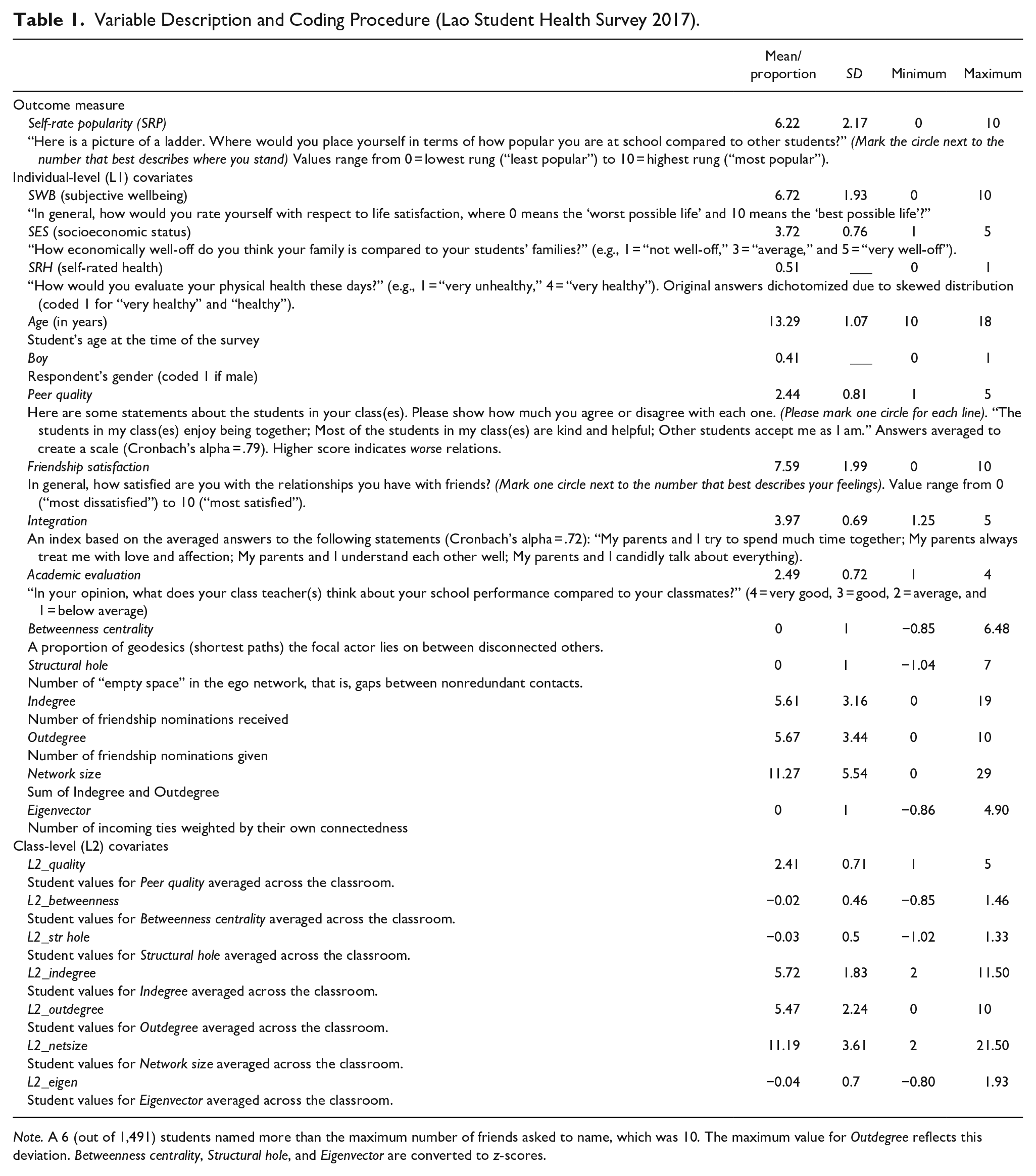
Note. A 6 (out of 1,491) students named more than the maximum number of friends asked to name, which was 10. The maximum value for Outdegree reflects this deviation. Betweenness centrality, Structural hole, and Eigenvector are converted to z-scores.
Analytic Approach
The sample consists of 1,490 students (with the mean age of 13.29 and the standard deviation of 1.07) nested in classrooms across schools. Since data are hierarchically nested, we estimated mixed-effects models with students at level 1 (L1) and classrooms at level 2 (L2). All variables were grand-mean centered and multilevel modeling was conducted using the latest version of HLM 8 (Raudenbush et al., 2021). Part of the visual presentation for the findings was done using the Stata software (StataCorp, 2015). Statistical significance was set at α = .05. For network analysis, we utilized the specialist package UCINET 6 (Borgatti et al., 2002) and Gephi 0.9.2 (Bastian et al., 2009), an open-source analytic tool, to create sociograms and centrality measures.
Results
Network Visualization
To get a visual sense of our main hypothesis surrounding the measures of network brokerage, we present a figure for illustration. The calculation is based on Betweenness centrality, the proportion of times an ego lies on the shortest path (geodesic) between each pair of ego’s friends (Freeman, 1977). The panels in Figure 1 refer to three sample students with different Betweenness centrality scores, ranging from the minimum (Panel A), the mean (Panel B), and the maximum (Panel C). The focal actor whose egocentric network is showcased appears inside the circle. A male student with ID 947 (Panel A) has only two outgoing, but no incoming, ties. That is, the student named two friends, relationships that are not reciprocated. And there are no other disconnected pairs that this student links relationally. By contrast, in Panel B, a female student with ID 1410 is nominated by five others and sits on the path connecting multiple dyads, or students who do not share a direct friendship tie. This is reflected in her higher Betweenness centrality score (21.5). With the value of 186.01, Panel C depicts another male student who is one of the most central figures in the peer network under consideration.
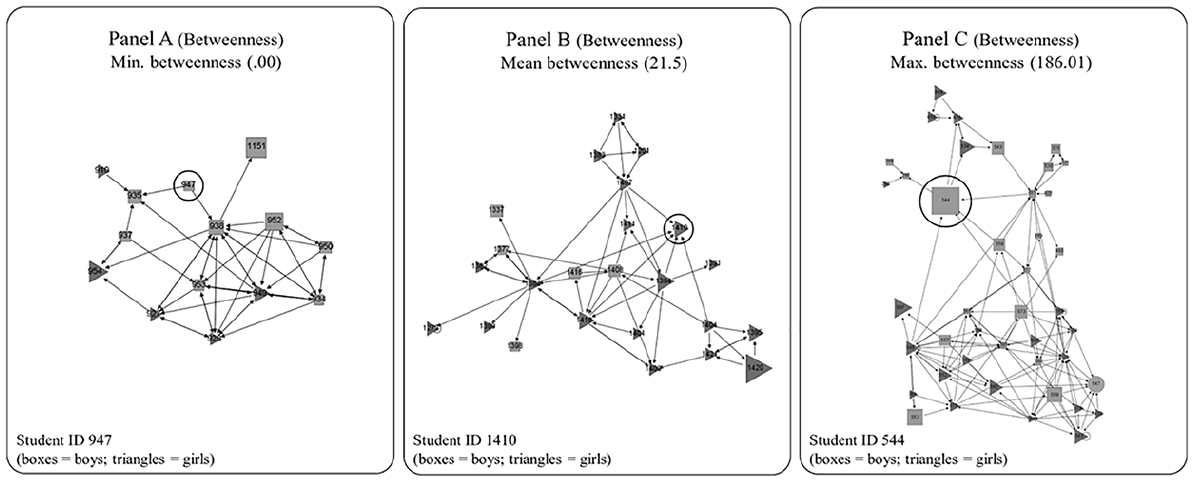
Student-level network structure by the betweenness centrality score.
Visually, his location in the friendship structure stands out from the other two, as he is positioned in such a way as to bridge across several subgroups (cliques). The egocentric network in this panel is also larger and more heterogeneous in terms of the gender makeup vis-à-vis those in Panels A and B. In comparison with his counterparts, the focal actor in Panel C thus captures the notion of “network brokerage.” We also used the structural hole measure to replicate this visual representation in a consistent manner. Due to space constraint, this alternative figure is not included in the main text but is available from the corresponding author on request. For the reasons stated previously, our hypothesis predicts that a male student with the highest Betweenness centrality (ID 544 from Panel C in Figure 2) would, all things equal, perceive himself to be relatively “more popular.” To statistically confirm our hypothesis, we now proceed with multilevel analysis.
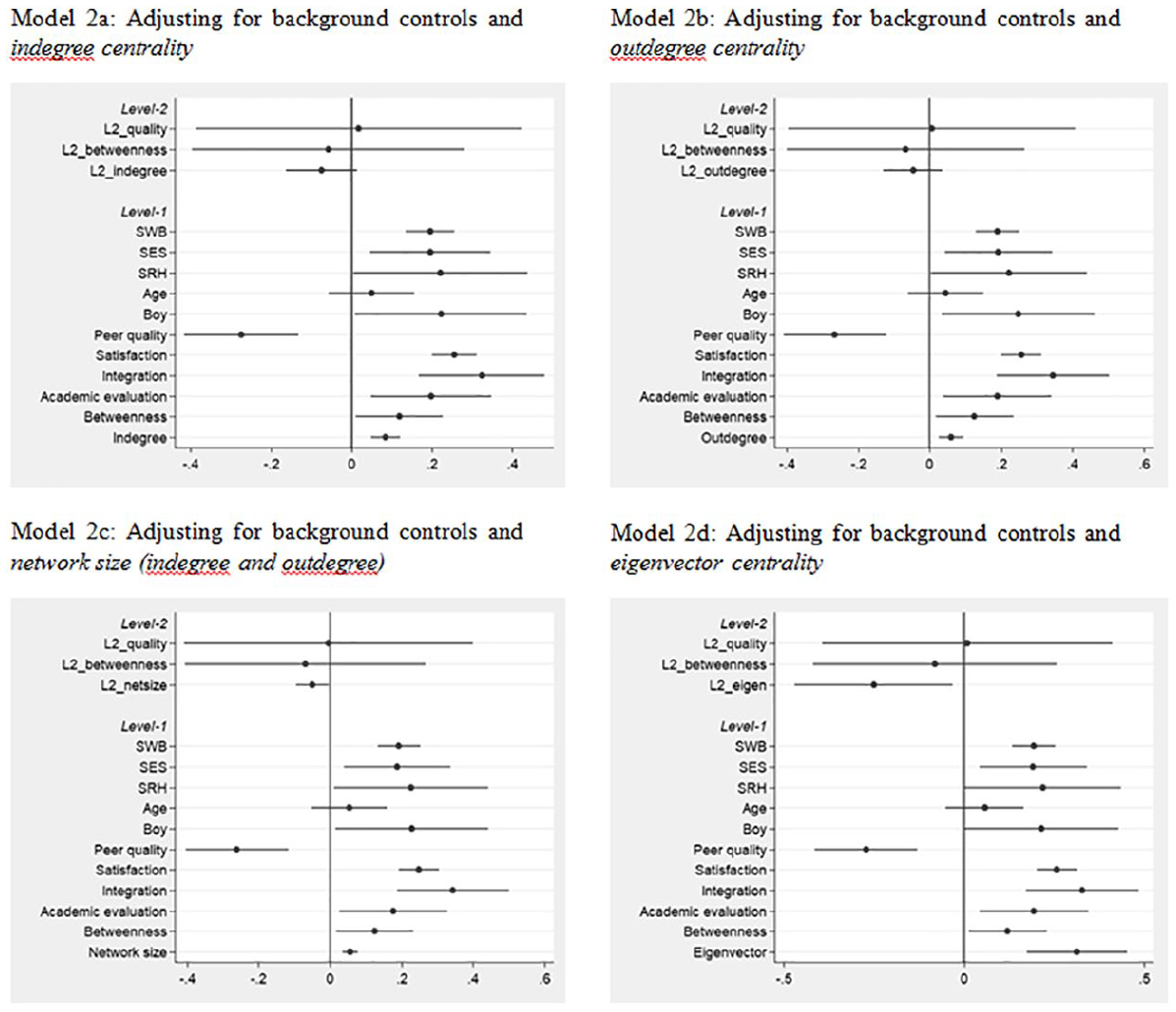
Multilevel Estimates Predicting Self-Rated Popularity with Betweenness Centrality: Model 2a: Adjusting for background controls and indegree centrality, Model 2c: Adjusting for background controls and network size (indegree and outdegree), Model 2b: Adjusting for background controls and outdegree centrality, and Model 2d: Adjusting for background controls and eigenvector centrality.
Multilevel Findings
Our main evidence for hypothesis testing is summarized in Figure 2 (using Betweenness centrality) and in Figure 3 (using Structural hole). In the bivariate analysis without any of the controls, we found the relationship to be significant (for Betweenness centrality, b = 0.133, p = .009; for Structural hole, b = 0.125, p = .026), in initial support of them. For each, there are four models. The first one includes the background controls plus Indegree centrality. The second replaces it with Outdegree centrality. The third one includes Network size. For the fourth one, the sociometric measure is Eigenvector centrality. These network variables are independently included in the analysis, in addition to sociodemographic and other confounders, for the purpose of ruling out alternative explanations. In general, ego networks with more structural holes or bridges are larger in size. Hence, while we propose network brokerage as the key mechanism underlying self-rated popularity, the outcome of interest may be driven by the sheer volume of peer nominations one receives (Indegree centrality), the number of friends one nominates (Outdegree centrality), a combination of both (Network size), and incoming ties from students who are well-connected or perceived to be popular by others (Eigenvector centrality). By holding constant these variables, we offer a more stringent test of our argument concerning the link between subjective popularity and brokerage.
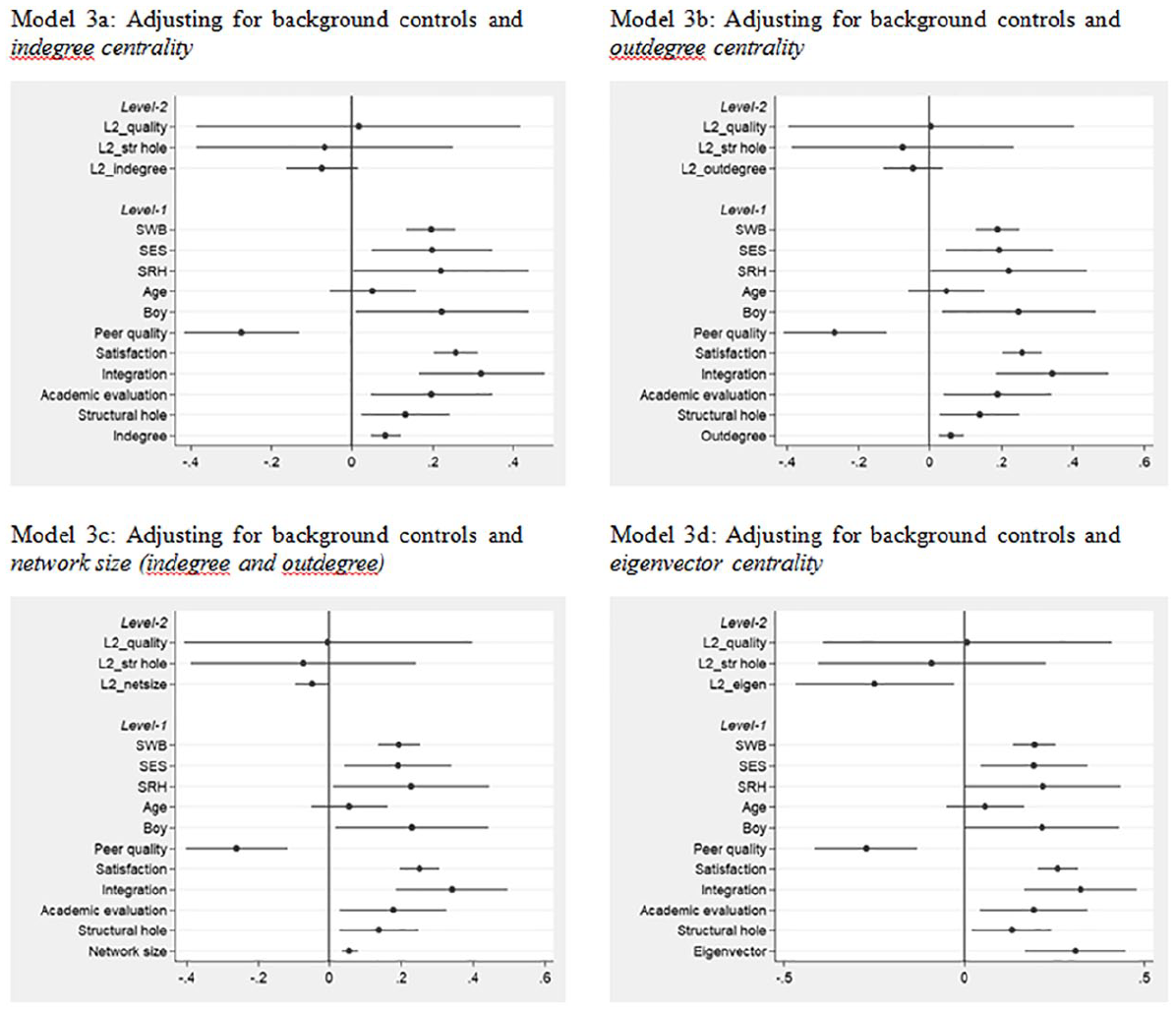
Multilevel estimates predicting self-rated popularity with Structural Hole: Model 3a: Adjusting for background controls and indegree centrality, Model 3c: Adjusting for background controls and network size (indegree and outdegree), Model 3b: Adjusting for background controls and outdegree centrality, and Model 3d: Adjusting for background controls and eigenvector centrality.
For parsimonious visual presentation, we use statistical results from the “reml” command in Stata (with unstructured covariance options) to graphically display parameter estimates with 95% confidence intervals (CIs). Model 2a in Figure 2 includes a variety of controls at the individual level (age, gender, family SES, life satisfaction, SRH, quality of classroom relations, friendship satisfaction, parental integration, academic evaluation, and indegree centrality) and at the classroom level (L2 classroom relations, L2 indegree centrality, and L2 betweenness centrality). Net of these multilevel confounders, we find that adolescents who score higher on network brokerage—are located on more paths connecting otherwise disconnected dyads—rate themselves higher on the subjective popularity scale. In Model 2b, Indegree is replaced with Outdegree and L2 Outdegree, and the main result is the same: network brokerage significantly predicts self-rated popularity. In Models 2c and 2d, which additionally control for Network size/L2 netsize and Eigenvector/L2 Eigen, respectively, the key variable (Betweenness centrality) remains consistently robust in support of our hypothesis. Based on these findings, we conclude that Hypothesis 1 is empirically borne out.
Alternative Analysis
For robustness check, as shown in Figure 3, we re-estimated the previously reported models using Structural hole as an alternative measure of network brokerage, which is conceptually related to but distinct from Betweenness centrality. In the dataset, the Pearson correlation between the two is high (r = .89 p < .001). Models 3a to 3d using the structural hole variable complement the earlier ones based on the betweenness measure. Adjusting for background controls at individual (L1) and classroom (L2) levels—including factors such as quality of life, friendship satisfaction, classroom relations, and academic evaluation that would confound the focal relationship under investigation—adolescents who have access to more structural (relational) gaps between nonredundant peers see themselves as being more popular. Across all eight models in both figures, the 95% CIs appear above the critical threshold of zero for our main predictors (Betweenness centrality and Structural hole). That is, irrespective of how the concept is operationalized and net of controls including sociometric confounders, brokerage position in the friendship network is robustly positively related to self-rated popularity among the Lao adolescent sample. Multilevel findings illustrated in Figure 3 thus provide evidence also in support of Hypothesis 2.
Discussion
Peer status is a powerful and persistent determinant of myriad adolescent outcomes (van den Berg et al., 2020). In prior research, perceived popularity serves as the predominant concept in measuring and making sense of status among youth. Importantly, it has been construed as something that is specifically assessed by others. As such, researchers typically gauge popularity using peer nominations, for example, the number of times an individual is mentioned by classmates in a school context. To the extent that a student is named more frequently, that student is said to be “objectively” popular—objectively in the sense that the level of popularity is seen as commensurate with the external evaluation given by peers. While fully recognizing the insightfulness of findings based on this methodological approach, we reasoned that others’ perceptions and self-perception of popularity are not necessarily synonymous. For various reasons, a student who is nominated by a greater number of others may not have a comparably high self-assessed popularity, and vice versa.
In recognition of this likely possibility, we sought to address an issue that has not been explored: whether adolescent network brokers have a greater “subjective” sense of popularity. How does this concept of self-rated popularity relate to the broader literature on the lives of youth and young adults? Considering subjective popularity, in fact, has critical implications for the research on various health-related outcomes. In our data consisting of Lao students, we found that subjective popularity covaries significantly with self-rated health (r = .155, p < .01), quality of life (r = .308, p < .01), depression (r = −.226, p < .01), and even suicide thought (r = −.099; p < .01) and suicide plan (r = −.086; p < .01). In other words, it is not an inconsequential variable but a robust predictor of both physical and mental health. By contrast, using the same data, the conventional measure of objective popularity based on friendship nominations (i.e., indegree measure) was not significantly related to any of the above outcomes. As such, these additional findings complement our thesis that it is the subjective dimension of popularity that really matters and that it has an underlying relational basis characterized by network brokerage.
Conventional wisdom suggests that popular kids tend to cut across several peer cliques rather than being narrowly embedded in a particular subgroup detached from the rest. In this study, instead of taking this assumption as self-evident, we treated it as a testable hypothesis and subjected it to empirical investigation. To that end, we took advantage of the primary data fielded in a novel setting, the country of Laos. In the scholarship, popularity has been operationalized by such sociometric measures as indegree centrality and eigenvector centrality (Faris & Felmlee, 2014; Ferguson & Ryan, 2019; Fujimoto & Valente, 2015; Pattiselanno et al., 2015). While holding constant these proxies for peer-evaluated popularity and other controls, we find that Lao students with higher betweenness centrality and structural hole values indeed perceive themselves as being more popular.
The bulk of research on youth and adolescence uncritically equates self-rated popularity with popularity gauged by peer nomination. That is, one’s “internal” popularity assessment is either implicitly conflated with others’ “external” appraisal (e.g., indegree and eigenvector measures) or not explicitly recognized as distinct phenomena. In contrast, we differentiated them throughout this study, both conceptually and methodologically. According to results from the Lao Student Health Survey, the two are clearly not the same. For example, the correlation between Betweenness centrality and Eigenvector centrality is relatively weak (r = .061, p < .05), as is that between Structural hole and Eigenvector centrality (r = .096, p < .01). Hence, contrary to existing assumptions, one’s own perceived location on the popularity totem pole does not closely correspond with how popular s/he is perceived by peers. As such, we contribute to the literature by introducing a novel and somewhat unexpected finding: how ego is connected to others and how they themselves are interconnected has critical implications for adolescent self-perception in terms of popularity.
Being popular is an indispensable dimension of peer status, a top priority in adolescence (van den Berg et al., 2020). Importantly, our conception of popularity is one that is subjectively understood and evaluated concerning oneself. In short, it is “ego-centric” (self-rated) popularity. Our methodological approach thus deviates from that of existing studies which mostly measure “alter-centric” popularity by asking respondents to name those who are either liked and/or popular. Certainly, others’ perception does matter. What we show in this paper, however, is that self-perceived popularity is not wholly determined by but is independent of peer perception. Based on two alternative measures of sociometric centrality, that is, betweenness and structural hole, we tested the extent to which self-rated popularity is related to network brokerage. The main findings discussed above offer a network-based answer to the issue that motivated our research: inequality among adolescents in terms of popularity rankings and perceptions.
According to our analysis, first and foremost, popularity is a function of one’s structural position in the social network, net of ascriptive and achieved characteristics. Using sociocentric or global network data, the present study offers evidence that network brokerage significantly predicts self-evaluation of popularity among school-based children in one of the poorest countries in Asia. Theoretically, we advance the extant scholarship by shedding light on the concept of popularity, which has been mostly operationalized as part of an explanans in previous research. In this study, we shift the focus by considering it as part of an explanandum (i.e., why some view themselves as being more popular than others). Our main conclusion is that network brokers—those who function as relational bridges—enjoy benefits that enable them to be more influential (hence popular) in the context of peers.
Findings presented above should be interpreted in view of some data limitations. Because of the cross-sectional design of the study, inferring conclusive causality is not possible. That is, it is possible for subjectively popular kids to navigate the web of peer relations and consciously or strategically carve out brokerage positions. While school-based children may not have full capacity or control in achieving this goal, the possibility of reverse causation cannot be ruled out, Future research could advance our understanding by using longitudinal data, which would enable scholars to establish a better temporal (i.e., causal) order. Also, though our models adjusted for various confounders, sources of unobserved heterogeneity nevertheless remain. They include, for example, personality traits: more extroverted students may be more likely to construct and maintain structural holes in their friendships. Another unobserved (unobservable) confounder is motivation or desire to be a network broker among peers. The major implication of our finding deserves repetition: when it comes to popularity, it is the subjective rather than the objective dimension that is more important. Studies analyzing health outcomes should incorporate self-rated, in addition to other measures of, popularity as a central predictor. In closing, systematic cross-national research is needed to better understand from a comparative perspective if and how self-rated popularity and peer-rated popularity independently as well as interactively shape the lives of young people.
Footnotes
Declaration of Conflicting Interests
The author(s) declared no potential conflicts of interest with respect to the research, authorship, and/or publication of this article.
Funding
The author(s) disclosed receipt of the following financial support for the research, authorship, and/or publication of this article: This study was funded by a grant from the National Research Foundation of Korea (NRF-2014-2014S1A5A2A03066021).
