




Abstract
Youth with conduct problems have poorer academic outcomes than their typically developing peers. The objective of the current study was to examine how sexual minority status was associated with trajectories of teacher-rated mathematics and language arts (i.e., reading and writing) achievement in seven consecutive years across the transition to adolescence among youth with childhood histories of conduct problems (N = 383). Sexual minority status (as assessed via indicators of identity, attraction, or behavior during adolescence in the eighth year of the study) was not associated with initial mathematics or language arts performance at time 1, but was associated with declining mathematics achievement during the transition to adolescence. These findings suggest that sexual minority status is linked to change in some aspects academic achievement among youth already at risk for poorer academic achievement (i.e., youth with conduct problems).
Keywords
Youth with conduct problems, or problems characterized by persistent aggressive, hostile, and rule breaking behavior (American Psychiatric Association, 2013), have lower levels of academic achievement than their peers (Bevilacqua et al., 2018). Understanding variation in achievement among these youth matters, as educational attainment is linked with variation in their socioeconomic, health, and judicial outcomes (Author, 2011; Caspi et al., 1987; Masten et al., 2005; Miech et al., 1999; Sagatun et al., 2015). One group of youth for whom the transition to adolescence is particularly challenging are sexual minority youth, or youth who report same-sex attraction, same-sex sexual or romantic behavior, or identities indicating some same-sex attraction (Poteat & Anderson, 2012; Russell & Fish, 2019). While previous research has examined how race/ethnicity and gender condition the impact of conduct problems and related behaviors on educational achievement (Kremer et al., 2016; Sayal et al., 2015), how sexual minority status shapes academic experiences of youth with conduct problems has not been explored. The objective of the current study is to examine how sexual minority status was associated with trajectories of teacher-rated mathematics and language arts achievement during the transition to adolescence among youth with childhood histories of conduct problems.
Academic Achievement and Sexual Minority Youth
Academic achievement during compulsory education is typically operationalized by teacher’s assessment of students ability (ranking and grades) or standardized test scores (Boonk et al., 2018) and is often domain-specific (e.g., achievement in math, language arts). This achievement is negatively impacted by school contexts characterized by hostility, high levels of peer victimization, chaos, and coercion (Baly et al., 2014; Furrer et al., 2014; Ladd et al., 2017; Nakamoto & Schwartz, 2010). Some work suggests that sexual minority youth report lower levels of academic achievement compared with their heterosexual peers (Birkett et al., 2009; Dessel et al., 2017; Pearson et al., 2007; Poteat et al., 2011; Russell, Seif, & Truong, 2001), although these disparities may be limited to bisexual youth, and sexual minority girls (Mittleman, 2022; Mollborn & Everett, 2015). According to the minority stress theory (Meyer, 2003), disparities in outcomes between sexual minority and heterosexual youth are posited to reflect the higher levels of stressors (i.e., discrimination, fear of discrimination, or the observation of discrimination directed toward other sexual minority individuals) due to stigma associated with sexual minority status. Focusing on the developmental timing of differences between sexual minority and heterosexual youth can help us understand when minority stressors start to matter in the lives of sexual minority youth.
Despite the insight provided by identifying when disparities between heterosexual and sexual minority youth emerge, to date, most existing research examining the link between sexual minority status and academic achievement is cross sectional (Birkett et al., 2009; Mittleman, 2022; Pearson et al., 2007; Poteat et al., 2011), or focuses on educational attainment at a single time point (Mollborn & Everett, 2015). And while sexual minority populations are at elevated risk for multiple types of minority stressors across the lifespan (Rice et al., 2021), developmental collision theory posits that the transition to adolescence is a particularly difficult period for sexual minority youth (Russell & Fish, 2019). This theory is supported by research suggesting that during early adolescence, identity development and the initiation of sexual and romantic interest coincides with increasingly negative peer attitudes regarding adherence to heterosexual norms (Bishop et al., 2020; Poteat & Anderson, 2012; Sterzing et al., 2018). Cross-sectional approaches preclude the identification of the emergence of potential disparities in academic achievement related to sexual minority status, an important first step in identifying the mechanisms explaining these disparities.
Conduct Problems and Sexual Minority Youth
While understanding the school contexts of sexual minority youth in general is pertinent for improving outcomes among this vulnerable population, focusing on youth with conduct problems is supported by three reasons. First, a limited literature suggests that sexual minority youth report higher levels of conduct problems and related externalizing problems than their heterosexual peers (Li et al., 2021; Marshal et al., 2012; Perales & Campbell, 2019; Williams et al., 2005). If sexual minority youth are more likely to be represented among youth with conduct problems, it heightens the need to understand how sexual minority status is associated with variation in outcomes among youth with conduct problems.
Second, discrimination associated with sexual minority status may exacerbate regulatory difficulties associated with conduct problems. Emotion regulation, a key factor in allowing children and adolescents to control the behaviors associated with conduct problems (Frick, 2012), is compromised by persistent experiences of homophobic discrimination (Burton et al., 2018; Hatzenbuehler et al., 2008). Emotion regulation also supports academic achievement (van Lier et al., 2012; Shi & Ettekal, 2021). Among youth who are already experiencing difficulties with their emotional regulation (i.e., youth with conduct problems, Frick & Morris, 2004; Mullin & Hinshaw, 2007), having a stigmatized sexual identity may increase the likelihood of negative academic outcomes by further reducing their regulatory capacity.
Third, a combination of sexual minority status and conduct problems may also make sexual minority youth more vulnerable to punishment in schools, an experience associated with poorer subsequent academic performance (Jabbari & Johnson, 2022). Sexual minority youth are more likely to experience disciplinary measures in schools, even after accounting for differences in rule breaking behaviors (Mittleman, 2018; Poteat et al., 2016; Snapp et al., 2015). One explanation highlighted by the findings of Poteat et al. (2016) supports the role of minority stress in explaining these disparities. While sexual minority youth and heterosexual youth did not differ in number of infractions they had committed, the link between punishable infractions and disciplinary action was stronger among sexual minority compared with heterosexual youth. Other qualitative work suggests that sexual minority youth feel that they are the targets of additional suspicion because of their gender non-conformity (Snapp et al., 2015). As conduct problems status is linked with more rule violating behaviors (American Psychiatric Association, 2013), youth with both histories of conduct problems and sexual minority identities may experience more sanctioning as (1) as due to being youth with conduct problems, they are more likely to have committed an infraction and (2) within youth with conduct problems, sexual minority status may increase the likelihood of being sanctioned compared to heterosexual youth who engage in similar behaviors.
The Current Study
Variation in educational attainment among youth with conduct problems is important for understanding their health and wellbeing outcomes across the life course (Caspi et al., 1987; Masten et al., 2005; Miech et al., 1999; Sagatun et al., 2015; Temcheff et al., 2011). This study extends previous work by focusing on how sexual minority status is associated with teacher-rated trajectories of mathematics and language arts achievement during the transition to adolescence among youth with childhood histories of conduct problems. Following from developmental collision theory, while we expected no initial differences in teacher-rated academic achievement across sexual minority status, our hypothesis was that compared to their heterosexual peers, children who later report sexual minority status (i.e., reported same-sex attraction, same-sex sexual or romantic behavior, or sexual minority identities) were expected to experience declining teacher-rated academic performance across the transition to adolescence.
Method
Participants and Data Collection
Data were drawn from an ongoing study of children with conduct problems in Quebec, Canada, which received ethical approval from the ethics committee of the first author’s institution. All participants had to consent to participate in the current study (i.e., parents, teachers, the children themselves). The study started between 2008 and 2010 when the participants were ages 6 to 10 years old (M = 8.39, SD = 0.93). Children were eligible to participate if during the screening they obtained a score that reached the borderline clinical cut-off (93rd percentile) or above on the Conduct Problems and the Oppositional Defiant Problems DSM-Oriented Scales of Achenbach System of Empirically Based Assessment (ASEBA; Achenbach & Rescorla, 2001; Ebesutani et al., 2010), as rated by either teachers or parents. This highest score approach is a validated method of identifying children with conduct problems (Lapalme et al., 2020).
Participants were recruited into the screening via two methods. First, participants from 155 schools in eight school boards in four regions of Quebec were recruited based on being referred to school services for conduct problems. One in every four boys and all girls referred for services for conduct problems were invited to participate in the screening (n = 370), with a participation rate of 75.1%. When these children were screened, 339 individuals (40% girls) were retained for the final sample due to scoring in the borderline clinical range or above on the oppositional defiant or conduct disorder subscales. Focusing on youth who had been referred to services for conduct problems in public schools is an ecologically valid method of identifying children with conduct problems, as 95% of children in Quebec attend public school (Government of Quebec, 2013). Children are most often referred for services for conduct problems based on teacher recommendations reflecting observations of children’s classroom behavior.
Second, due to concerns about potential biases regarding teachers’ perceptions of (and thus referrals for) conduct problems, a second strategy was employed. Students from low-income neighborhood schools were screened using parent and teacher ASEBA scores on the oppositional defiant and conduct problems scales (n = 881; participation rate of 71.5%). Participants were retained if they were at or above the threshold for oppositional defiant or conduct disorder (i.e., if the child scored in the 93rd percentile or above). This approach identified an additional 95 children (57.9% girls). In total, 93.5% of the 434 participants in the study were born in Quebec, with the majority being of French-Canadian origin.
Following recruitment (time 1), and every year for the subsequent 7 years (time 2–time 8), participants were visited in their homes by research assistants who aided participants and their families in completing questionnaires on a wide range of behaviors. Following parental consent, teachers were contacted by a research assistant via telephone and those who consented completed a battery of questionnaires about each participant, including information about their academic achievement.
Measures
Math and language arts achievement were measured using items from the teacher-reported Academic Performance Rating Scale from time 1 to time 7 (DuPaul et al., 1991). Mathematics and language arts (i.e., reading and writing) achievement were both assessed with a single item: “Estimate the accuracy of completed written math work/language arts work (i.e., percent correct of work done).” Teachers could choose between five response options being: 1 (0%–64%), 2 (65%–69%), 3 (70%–79%), 4 (80%–89%), and 5 (90%–100%), with this variable being treated continuously for all multivariate analyses.
Sexual minority status was assessed at time 8 (Mage = 15.30; SD = 0.95), and only individuals who reported information on one of the three sexual minority variables were retained for the analytic sample (N = 383). Participants were first asked which of the following options best described their sexual identities. Options were heterosexual (n = 327, 195 boys), bisexual (n = 33, 7 boys), and gay or lesbian (n = 7, 1 boy), or unsure (n = 16, 9 boys). They were then asked who they had been sexually/romantically attracted to, with the options being boys (2 boys, 124 girls), girls (195 boys, 5 girls), boys and girls (6 boys and 26 girls), or not feeling attraction to anyone (8 boys, 16 girls). They were then asked with whom they had had sexual relations, with the options of boys (2 boys, 68 girls), girls (101 boys, 2 girls), boys and girls (2 boys, 13 girls), or no sexual partners (107 boys, 88 girls). Individuals who reported either a sexual minority identity (i.e., gay, lesbian, or bisexual identities), some same sex attraction or some same-sex behavior were coded as sexual minorities (n = 48), and the remainder of the participants were coded as not sexual minorities (n = 335). Participants who were unsure about their identities were not classified as sexual minorities in the current study (Supplemental Material Information available from the first author on request).
Conduct problems were assessed using two scales from the DSM-Oriented Scales of ASEBA (Achenbach & Rescorla, 2001; Ebesutani et al., 2010). The Conduct Problems subscale includes 17 items for parents and 13 items for teachers, and had Cronbach’s alphas of .93 and .87, respectively, in this sample. The Oppositional Defiant problems subscale includes five items for both teachers and parents, and had Cronbach’s alpha of .83 and .92, respectively, in this sample. Both scales used 3-point Likert scale (0 = not true, 1 = somewhat or sometimes true, and 2 = very true or often true). The scales were first used to identify participants who had scores at or above the 93rd percentile during the initial behavioral screen. To account for potential higher levels of conduct problems among sexual minority populations, a factor was also constructed from continuous t-scores of parent and teacher-reported oppositional defiant and conduct disorder subscales of the ASEBA at time 1, and was used as a control variable in the longitudinal analyses. Higher scores indicated higher levels of conduct problems. The factor structure is available from the first author on request.
Because of their well-known associations with academic achievement, the following measures were also included as covariates. Gender was assessed by asking parents if the child was a boy or a girl at time 1. Differences in the models by gender are available from the first author on request. Family socioeconomic status was measured in two ways. First, family income was reported by the parent at time 1 using a 20-point ordinal scale ranging from 1 ($0–$999) to 20 (more than $160,000). The scale was weighted to ensure an equal distance between each of its units, with higher scores indicating higher family income. Primary caregiver educational attainment based on parent report at time 1, and due to non-normal distribution was classified as high school degree or less, or more than a high school degree. Finally, verbal intelligence was estimated using the French-Canadian version of the Peabody Picture Vocabulary Test (PPVT; Dunn & Dunn, 2007). The PPVT measures receptive vocabulary of children, is a good indicator of cognitive skills (Dunn & Dunn, 2007), and was included as a continuous variable in the analyses, with higher scores indicating larger vocabularies. Because children varied in age at the first wave of data collection (ages 6–10 years old), we also controlled for the child’s age at T1 in the analyses. Age was computed by subtracting the child’s birth date from the day they completed the first wave of data collection.
Planned Analyses
Differences across sexual minority identity were first explored using ANOVAs for continuous variables (i.e., academic outcomes, child age), or χ2 for categorical variables (i.e., gender, parental education). These analyses are presented in Table 1. Then, the factor structure for the conduct problems variable was tested using Mplus 7.4. To address the primary research objective, we performed latent growth curve modeling (LGCM) to assess change in academic outcomes (i.e., math, language arts, and academic success) over time (Muthén & Muthén, 2017). LGM has previously been used to assess change in academic achievement (Hong & Ho, 2005; Scammacca et al., 2020), and provides information on within and between person variation over time. The first models identified the respective initial shape of math and language arts achievement, testing linear and non-linear models. The best fitting model was determined by the χ2 significance test, the root mean square error of approximation (RMSEA, acceptable at 0.06 or below), a Tucker-Lewis Fit index (TLI, acceptable at greater than 0.95), a Standardized Root Mean Square Residual (SRMR, acceptable at <0.08), and a comparative fit index (CFI, good at 0.95 or above; Hu & Bentler, 1999), as well as the significance of the mean and variance. The second set of models regressed sexual minority status, along with age, gender, parent’s level of educational attainment, family socioeconomic status, verbal intelligence, and conduct problems as control variables on the intercept and slope of the academic trajectories.
Descriptive Statistics for Sexual Minority (n = 48) and Heterosexual (n = 335) Participants.
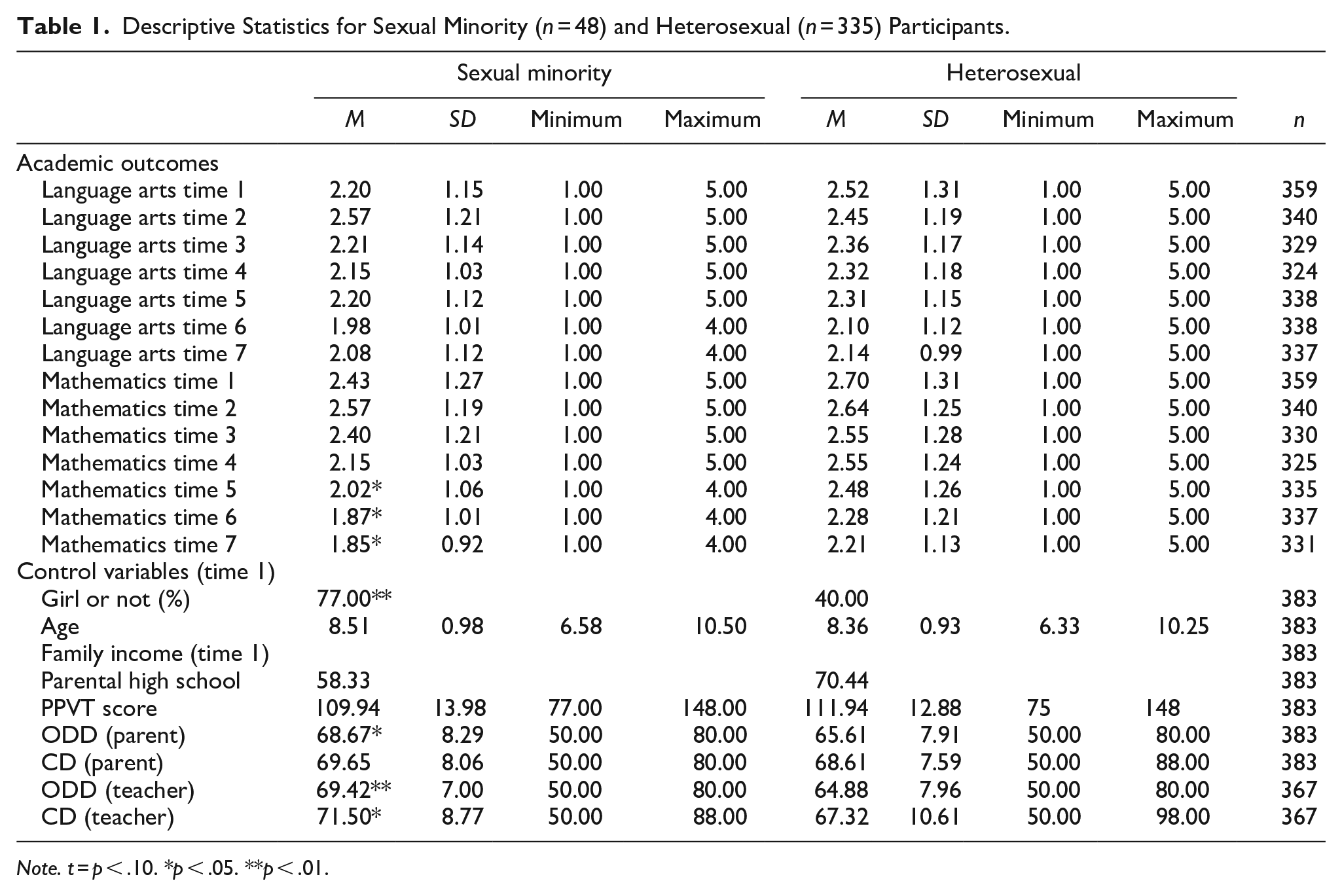
Note. t = p < .10. *p < .05. **p < .01.
Full information maximum likelihood was used to address missing data when performing LGCM. The 383 participants who participated at the eighth measurement point were retained for this study. For these 383 individuals, only 7% of data was missing, but complete data was available on only 50% of participants. Little’s missing at random test (χ2 (1038) = 1,010.04, p = .73) was non-significant, indicating that data was missing completely at random, such that the use of full information maximum likelihood was appropriate for addressing missing data (Enders & Bandalos, 2001).
Results
Academic outcomes were normally distributed with skews ranging between −1.00 and 1.00 and kurtosis ranging between ranging between −2.00 and 2.00 (Curran et al., 1996). No significant differences were observed across sexual minority status for language arts at any time point, while sexual minority youth had lower mathematics achievement than heterosexual youth at times 5 (M = 2.02 (95% CI [1.69, 2.36]) among sexual minority youth versus M = 2.48 (95% CI [2.33, 2.62]) among heterosexual youth; F (1, 334) = 4.85, p = .03), 6 (M = 1.87 (95% CI [1.56, 2.17]) among sexual minority youth versus M = 2.28 (95% CI [2.14, 2.42]) among heterosexual youth; F (1, 336) = 4.92, p = .03), and 7 (M = 1.85 (95% CI [1.56, 2.14]) among sexual minority youth versus M = 2.21 (95% CI [2.08, 2.34]) among heterosexual youth; F (1, 330) = 3.80, p = .048). To put this in context, starting at time 5, the mean score for sexual minority youth would put them at a mean grade closer to 65%, while for heterosexual youth, this would put them at a mean grade closer to 67%. At times 6 and 7, this would put sexual minority youth with a mean grade below 65%, while heterosexual youth were reported as having mean grade above 65%. This would place sexual minority youth below the requirements for most postsecondary academic or vocational training programs. Sexual minority youth were also rated by their parents and teachers as having more oppositional defiant disorder symptoms at time 1. Correlations between math and language arts achievement across time ranged between .62 and .79 across the seven time points. Correlations between predictor variables are available by request from the first author.
Change in Academic Achievement
For math achievement and language arts achievement, LGCM models were fit to compare linear and non-linear models. Linear models were selected for both mathematics and language arts achievement for two reasons. First, the fit for the linear models for mathematics and language arts achievement were good for both models. Second, the means and variances for intercepts (M = 2.70, p < .01; variance = 1.00, p < .01) and slopes (M = −0.07, p < .01; variance = .01, p < .01) for mathematics and means and variances for the intercepts (M = 2.68, p < .01, variance = .99, p < .01) and slope (M = −0.08, p < .01; variance = .01, p < .01) of language arts were significant (see Figure 1 for mathematics achievement, and the figure for language arts achievement is available from the first author on request). The significant, negative slopes suggest that teacher-rated achievement in both language arts and mathematics declined across time. Third, only the variance for the intercept was significant with the quadratic model, and the cubic models would not converge for either outcome. Due to our interest in understanding how covariates are associated with change over time in academic achievement outcomes, we focused on linear models for the current study.
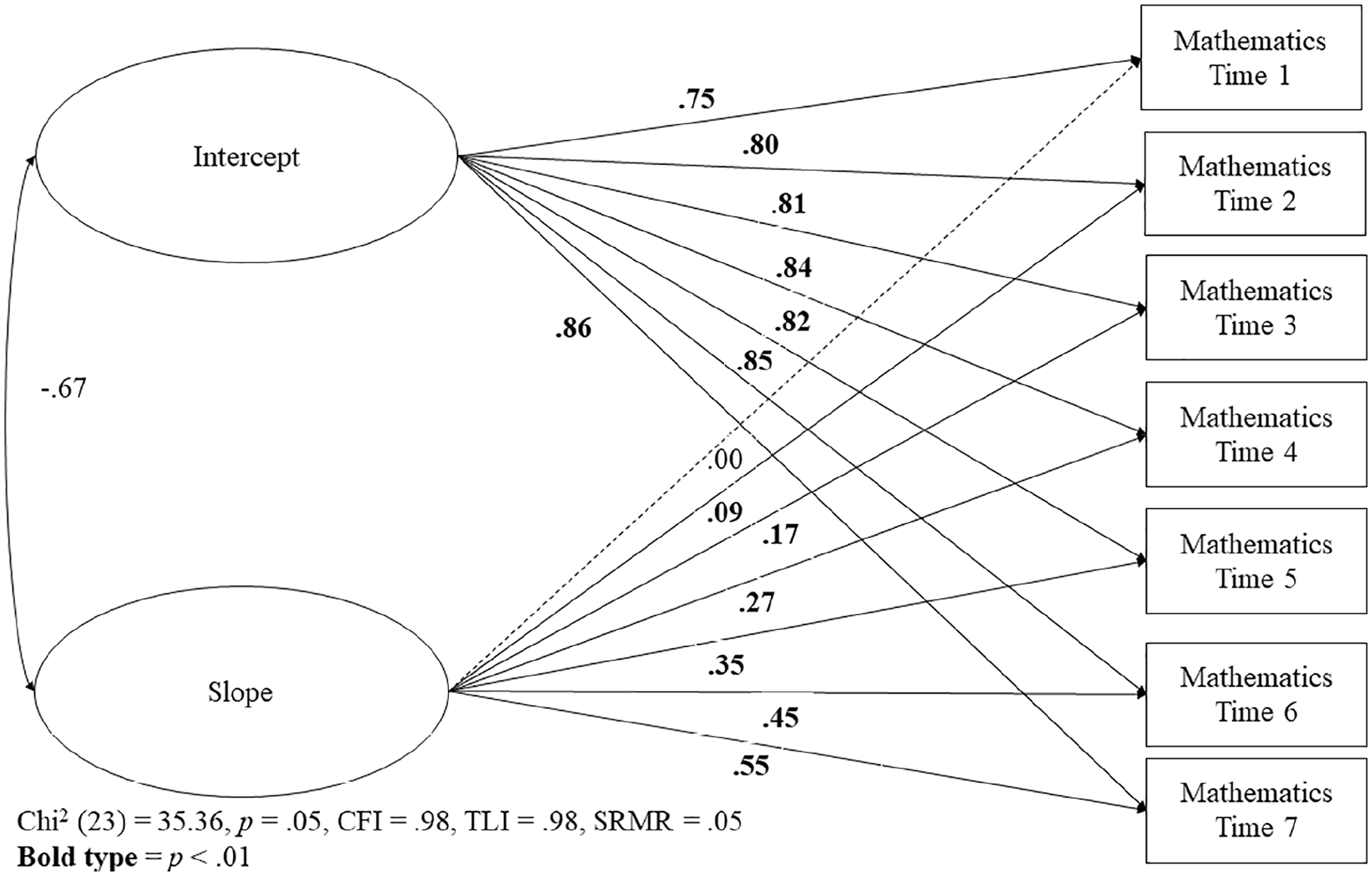
Factor structure for the latent growth curve models for mathematics achievement.
Math Achievement
Results of the LGCM for math achievement are shown in Table 2, and line graphs of the estimated means for each time point are presented in Figure 2. Sexual minority identity was not significantly associated with differences in the initial level of math achievement, but was associated with declining math achievement across the transition to adolescence. Said another way, by time 7, sexual minority youth were described by their teachers as having 0.38 points lower mathematics scores when compared to their heterosexual peers. To help put these numbers into context, at time 7 teachers assigned 48% of sexual minority students the lowest possible value on the scale provided, while assigning on 36% of heterosexual students the lowest possible value on the scale provided. This difference was not accounted for by verbal ability, conduct problems, family income, parent educational attainment, gender, and participant age.
Latent Growth Curve Models for Trajectories of Academic Achievement Over Time (N = 383).
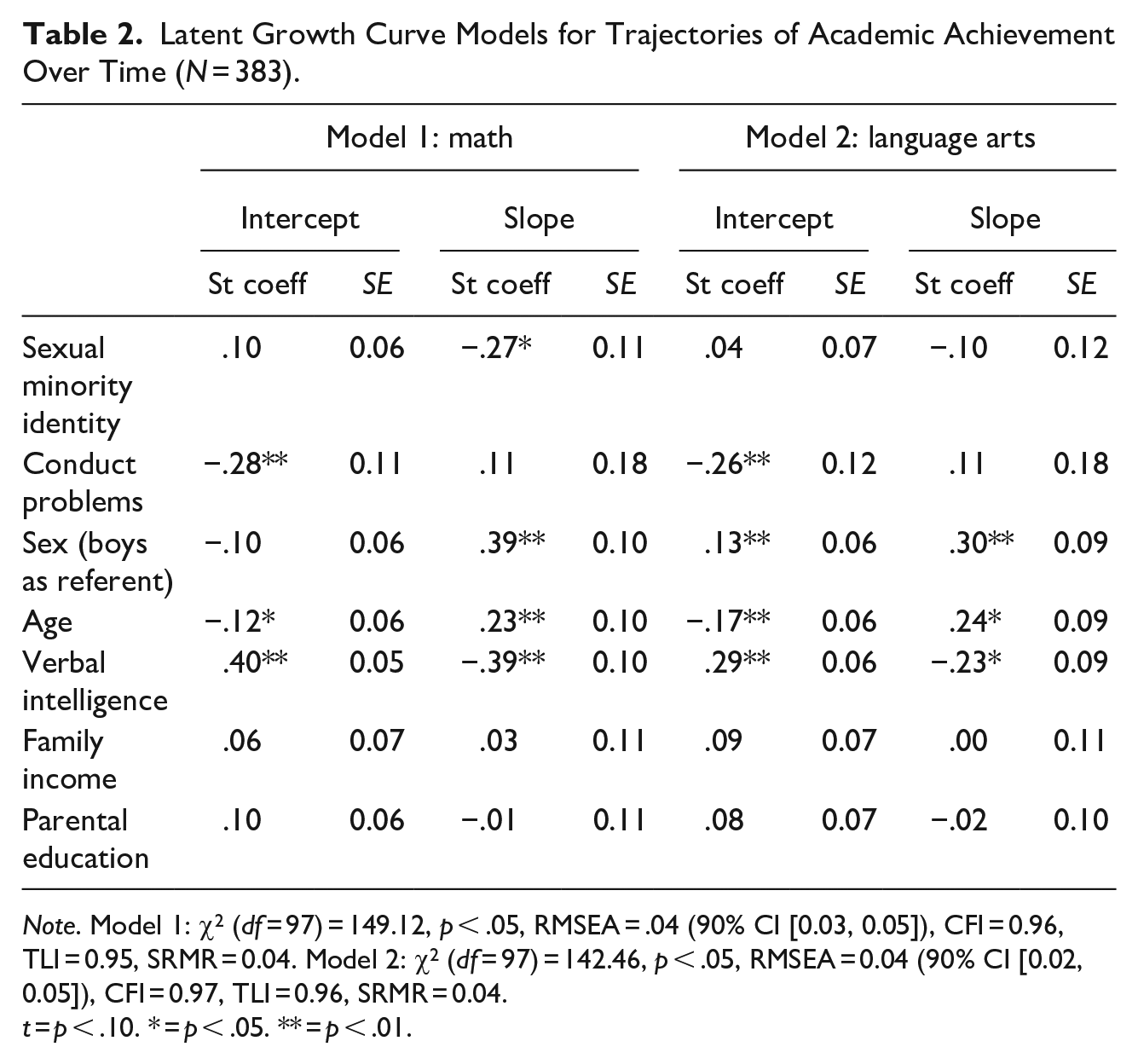
Note. Model 1: χ2 (df = 97) = 149.12, p < .05, RMSEA = .04 (90% CI [0.03, 0.05]), CFI = 0.96, TLI = 0.95, SRMR = 0.04. Model 2: χ2 (df = 97) = 142.46, p < .05, RMSEA = 0.04 (90% CI [0.02, 0.05]), CFI = 0.97, TLI = 0.96, SRMR = 0.04.
t = p < .10. * = p < .05. ** = p < .01.
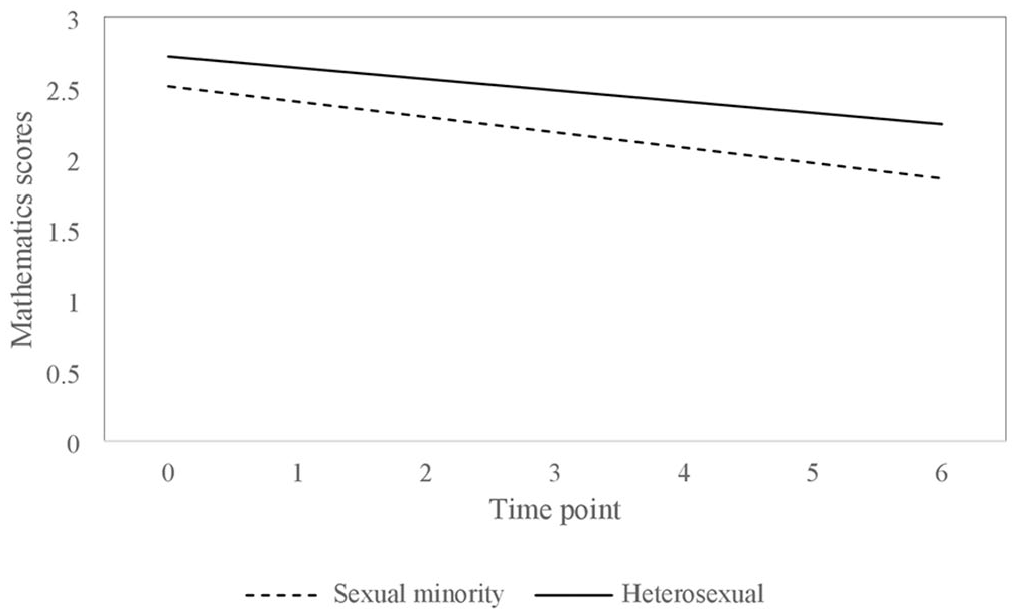
Estimated means for mathematics scores by sexual minority status.
Language Arts Achievement
Results for the trajectories of language arts achievement can be found in Table 2, and the estimated means are available by request from the first author. Sexual minority identity was not associated with either the slope or intercept of language arts achievement during the transition to adolescence.
Discussion
Individuals with childhood histories of conduct problems consistently experience poorer academic achievement compared to youth without these problems (Bevilacqua et al., 2018). The considerable school-based resources employed to support youth with conduct problems (Costello et al., 2014; Kang-Yi et al., 2016), as well as the limited efficacy of this programming for individual outcomes (Dempsey et al., 2016; Morgan et al., 2010) suggests that more insight is needed to understand variation in academic achievement among this population. Given the increased vulnerability for conduct problems among sexual minority youth (Li et al., 2021; Marshal et al., 2012; Perales & Campbell, 2019; Williams et al., 2005), understanding how sexual minority status is associated with academic achievement among youth with conduct problems may be able to inform our understanding regarding this variation. Compared to youth with heterosexual identities, sexual minority youth, while not initially reported by their teachers as having lower levels of mathematics or language arts achievement, had steeper declines in mathematics achievement when compared to their heterosexual peers. The potential implications of these findings are discussed in greater details below.
The association between sexual minority status and declining mathematics achievement over the transition to adolescence is broadly supportive of the developmental collision theory (Russell & Fish, 2019). In line with this model, the link between sexual minority status and any psychosocial outcome (i.e., academic achievement) would be anticipated to worsen as sexual minority status become more salient (Bishop et al., 2020), peer attitudes toward sexual minority status worsen (Poteat & Anderson, 2012), and experiences of homophobic bullying increase (Sterzing et al., 2018). More work is needed to identify the mechanisms by which sexual minority youth experience decreased in academic achievement over time. Future studies with larger sample sizes should explore the mediating role of peer and teacher relations in accounting for declining academic achievement in mathematics scores among sexual minority youth during this period.
Although sexual minority status was anticipated to be associated with declines in both mathematics and language arts achievement, sexual minority status was only linked with greater declines in mathematics achievement. One possible explanation for these findings lies in how initial intelligence was controlled using an assessment more reflective of language arts achievement (i.e., the Peabody Picture Vocabulary test) than other forms of achievement (Dunn & Dunn, 2007). Supplemental Material analyses (available on request from the first author), however, did not suggest that sexual minority status was associated with either initial levels or change over time in language arts achievement when this measure of verbal intelligence was excluded from the analyses. The link with mathematics but not language arts may reflect how mathematics achievement, more so than language arts achievement, are sensitive to adverse social environments (Baly et al., 2014; Ladd et al., 2017), and suggest that future research examining differences between sexual minority and heterosexual youth focus on distinct spheres of academic achievement.
Finally, the current study examined individuals with childhood, rather than concurrent conduct problems, and adolescent sexual minority status. This approach offers the potential advantage of avoiding the problem of confounding concurrent responses to discrimination with symptoms of conduct problems (i.e., aggressive behaviors), in line with research linking the aggressive behaviors of sexual minority youth (i.e., fighting) with victimization (Russell, Franz, & Driscoll, 2001). At the same time, we may not have measured conduct problems early enough to fully avoid the confounding impact of sexual minority status on peer experiences. Disparities in social stressors between heterosexual and sexual minority youth have been observed as emerging by age nine (Martin-Storey & Fish, 2019; Mittleman, 2019), and psychosocial functioning disparities are observed by 10 (Gilbey et al., 2020). Although some work suggests that psychosocial disparities occur after the emergence of social stressor disparities (Mittleman, 2019), and that the disparities between sexual minority and heterosexual youth increase from childhood to early adolescence (Xu & Rahman, 2022), future studies starting in early childhood will be important for clarifying when and for whom sexual minority status is associated with poorer functioning.
Limitations
The current study had several notable strengths including longitudinal data on academic achievement among adolescents with childhood histories of conduct problems. These findings should, however, be considered in light of several limitations. First, focusing on youth with conduct problems provided novel information on youth at risk for poor academic outcomes (Bevilacqua et al., 2018; Fu et al., 2016). While understanding the specific vulnerabilities of youth with conduct problems is important, we do not know if the same processes would be observed among a general-population sample of youth, particularly given that some sexual minority youth (i.e., gay boys) may have better academic outcomes than their heterosexual peers (Mittleman, 2022). Future research should examine if conduct problems moderate the association between sexual minority status and trajectories of academic achievement over time.
Second, our sample size was limited by the number of youth reporting sexual minority identities, at least some same-sex sexual behavior, or at least some same-sex sexual attraction. Despite the fact that that the percentage of youth reporting sexual minority status in our study paralleled numbers found in large-scale studies (Fish & Baams, 2018; Martin-Storey, Pollitt, et al., 2021), it is still a comparatively small number of youth. Furthermore, as would be expected, more girls than boys endorsed indicators of sexual minority status, limiting our discussion on gender differences. While these findings provide important initial insight on a particularly vulnerable group of individuals, future work including larger samples of sexual minority youth may help clarify the current findings.
A third limitation was that the only assessment of gender available during adolescence was childhood gender as reported by parents. Reports of gender identity from early in adulthood (i.e., 4 years after time 8) with this sample indicated that 97% of youth identified as the gender indicated by their parents at the beginning of the study, and we felt it would be inappropriate to use young adult self-reported gender when describing adolescents. Future work examining vulnerability to poorer academic outcomes among gender minority youth with conduct problems is particularly important, as gender minority youth experience higher levels of many stressors at school (Eisenberg et al., 2017; Martin-Storey, Santo, et al., 2021).
Fourth, the majority of youth in the current sample identified as white (88%), precluding further analyses by race/ethnicity. Given the lack of research on sexual minority status among youth with conduct problems, we feel that these findings make a contribution to the existing literature despite this limitation. Future work confirming these findings with a larger and more diverse sample may be better able to examine the impact of race/ethnic identities on the research questions examined in the current study.
Fifth, while teacher’s judgement has been found reliable to assess student achievement (Kaufmann, 2020; Urhahne & Wijnia, 2021) and children in need of academic support, these evaluations are not the same as standardized test scores. The longitudinal design of our study, the importance of teacher evaluations for student outcomes, and the lack of mean differences on achievement scores at most time-points between heterosexual and sexual minority youth (see Table 1), however, lessens this limitation. The use of well-validated and recognized measures (e.g., Academic Performance Rating Scale) further adds to the robustness of study findings. Future studies should replicate our findings, however, with standardized achievement measures.
Conclusion
Compared to their heterosexual peers, sexual minority youth declined more rapidly in their mathematics achievement during the transition to adolescence. This decline was observed during a developmental period where the social environments of sexual minority youth become increasingly hostile. While these findings need to be replicated with larger and more diverse samples, and while more research is needed to identify the mechanisms that explain these academic declines over time, our study suggests the importance of considering how sexual minority status shapes the experiences of youth with conduct problems in school contexts. Ultimately, these findings support sexual minority status as being linked to trajectories of academic achievement—and specifically mathematics achievement—during adolescence. While more work is needed, these findings suggest the need to sensitize teachers and other educational professionals to the specific challenges of sexual minority youth and the need to provide further support to this vulnerable group of individuals.
Supplemental Material
sj-docx-1-yas-10.1177_0044118X221140515 – Supplemental material for Sexual Minority Status and Academic Achievement During the Transition to Adolescence Among Youth With Childhood Conduct Problems
Supplemental material, sj-docx-1-yas-10.1177_0044118X221140515 for Sexual Minority Status and Academic Achievement During the Transition to Adolescence Among Youth With Childhood Conduct Problems by Alexa Martin-Storey, Gabrielle Garon-Carrier, Michèle Déry and Caroline Temcheff in Youth & Society
Footnotes
Declaration of Conflicting Interests
The author(s) declared no potential conflicts of interest with respect to the research, authorship, and/or publication of this article.
Funding
The author(s) disclosed receipt of the following financial support for the research, authorship, and/or publication of this article: This work was supported by the Canadian Institutes of Health Research under Grant [number FRN 82694]; The Social Sciences and Humanities Research Council of Canada under Grant [SSHRC-37890]; by a Canada Research Chair awarded to the first author by the Social Sciences and Humanities Research Council of Canada, and by Fonds de recherche du Québec – Société et culture under Grant [FRQSC-196505]. Given the ongoing longitudinal nature of this study, as well as the informed consenting procedure used with participants and their families, data for this study are not publicly available. Analysis code for this study are available by emailing the corresponding author. We report how we determined our sample size, all data exclusions, all manipulations, and all measures employed in the study. Finally, we would like to thank the participants who gave their time to participate in this study.

Supplemental Material
Supplemental material for this article is available online.
Author Biographies
References
Supplementary Material
Please find the following supplemental material available below.
For Open Access articles published under a Creative Commons License, all supplemental material carries the same license as the article it is associated with.
For non-Open Access articles published, all supplemental material carries a non-exclusive license, and permission requests for re-use of supplemental material or any part of supplemental material shall be sent directly to the copyright owner as specified in the copyright notice associated with the article.
