



Abstract
The goal of this study was to determine the significance of variable order when it comes to using child and parent reports of parental support to predict delinquency. It was hypothesized that a social context variable (parental support as rated by the parent) would precede a perceptual variable (perceived parental support competence as rated by the child) in predicting delinquency, but a perceptual variable preceding social context would not. This hypothesis, based, in part, on social cognitive theory, was tested in a sample of 3,490 adolescent Australian youth (1,742 boys, 1,690 girls) using a three-wave path analysis. As predicted, the parental support to perceived parental support competence sequence led to delinquency, but the perceived parental support competence to parental support sequence was non-significant. These results indicate that a social context variable is capable of affecting behavior indirectly, in this case, by shaping the affected child’s perception of the social context.
Criminological theories frequently look to social context variables like parenting, peers, and neighborhoods in an effort to explain crime and delinquency. Parental support, a major component of Hirschi’s (1969) social bonding and Cullen’s (1994) social support theories of crime, for instance, is moderately predictive of delinquent behavior (Hoeve et al., 2009). This does not mean, however, that the connection between parental support and delinquency is either simple or direct. That is because the effect of parental support on a child’s delinquency could be indirect and mediated by one or more intervening variables. Thus, while parental support may play a role in suppressing delinquency, that role might require involvement of the child’s thoughts, feelings, and perceptions. The research question driving the current investigation asked whether a social context variable—mother- or father-reported parental support—was capable of impeding delinquency by creating a perception of parental support competence in the child.
There is a story to be told here and that story holds that social context variables like parental support exert their effect on child behavior by affecting the child’s thinking and perception. The mechanism, in this case, is how parenting behavior is perceived by the child and how this perception affects the child’s propensity to engage in delinquent behavior. In the present study, this indirect mechanism was contrasted with an alternate model in which child perception predicted parental behavior, resulting in delinquent behavior. The importance of variable order needs to be discussed but first we must review prior research on mediation of the parental support-child delinquency relationship and find a conceptual model that can help explain this relationship. The next two sections do just this by providing a review of prior attempts to identify the mechanism behind the parent support-child delinquency nexus and offering social cognitive theory as a conceptual model capable of explaining this relationship.
Identifying a Mechanism for the Parenting-Delinquency Relationship
In contrast to the large body of research available on parental support/control and crime (Bruce, 2002; Hoeve et al., 2009, 2012), there are only a handful of studies testing the indirect effect of parental support on delinquency. In one such study, de Vries et al. (2016) determined that cognitive distortions mediated the relationship between parental attachment and aggression, whereas deviant peers and parental monitoring mediated the relationship between attachment and delinquency. A year later, Ishoy (2017) discovered that the association between parental hostility and property offending was mediated by low moral reasoning. The results of these two studies were limited, however, by certain methodological issues. First, de Vries et al. (2016) employed cross-sectional data, whereas Ishoy (2017) made use of two waves of data instead of three. Second, neither study tested the total indirect effect with bootstrapped confidence intervals, the current standard for research in mediation analysis (Hayes, 2022). In a pair of studies that used at least three waves of data and tested the total indirect effect with bootstrapped confidence intervals, low self-efficacy for academic success/peer delinquency (Walters, 2019) and peer delinquency/gang affiliation (Walters, 2020b) were found to mediate the relationship between low parental support and child delinquency.
Social Cognitive Theory
In contrast to the passive learning models proposed by practitioners of classical and operant conditioning, where an organism’s behavior is believed to be shaped and determined by external stimuli and environmental contingencies, social learning theory adopts an active or agentic perspective. It does so by inserting the organism between the stimulus and response (SR) of traditional behaviorism to create an SOR model. Social cognitive theory, an offshoot of social learning theory which emphasizes learning through observation and the development of cognitive skills, maintains that these organismic processes exist in the form of thoughts, feelings, and perceptions that allow the individual to act on their environment rather than being the passive recipient of environmental influence (Bandura, 2001). The learning process, according to social cognitive theory, normally begins with social context variables like parents, peers, and neighborhoods but does not end there. Instead, these social context variables are internalized with cognitive processes that symbolize the person’s experience and aid in the interpretation of social events (Schunk & DiBenedetto, 2020). The individual then acts on these perceptions in an effort to shape their environment as much as their environment shapes them.
Variable Sequencing
Two variable sequencing rules have been developed to explain the role of internalization in delinquency development, an issue central to social cognitive theory: “affect before cognition” and “perception before belief.” In testing the first rule, Walters (2020a) ascertained that hostility (affect) preceded cognition (reactive criminal thinking) when it came to mediating the violence victimization-to-perpetration progression in a group of serious delinquent youth. The second variable sequencing rule, “perception before belief,” maintains that the individual will perceive something about a social object before incorporating that information into a new or existing belief system. Using longitudinal data and controlling for prior levels of each predicted variable, Walters et al. (2022) demonstrated that perceived parental competence in the areas of support and control, as assessed by the child, predicted future child delinquency via the mediating effect of changes in moral cognition and cognitive control. Perceived parental competence, on the other hand, failed to mediate the moral cognition/cognitive control-delinquency relationships.
Present Study
The present study tested a third conjectural rule, “social context before affect or perception.” A three-wave model in which a social context variable (parental support as reported by the parent) and a perceptual variable (perception of parental support competence as reported by the child) were cross-lagged at Waves 1 and 2 to form two pathways (parental support → perceived parental support competence; perceived parental support competence → parental support). These two pathways were then evaluated in terms of their ability to predict delinquency at Wave 3. It was hypothesized that only the parental support → perceived parental support competence pathway (“social variable before perception’), and referred to here as the target pathway, would be significant and that this pathway would be significantly stronger than the perceived parental support competence → parental support or comparison pathway. Demographic control variables (age, sex, race, and socioeconomic status) that are known to correlate with delinquency (Gomis-Pomares et al., 2022) were included in the analysis as were prior measures of each predicted variable designed to allow assessment of change in each outcome given the dynamic nature of social cognitive theory (Bandura, 2001).
Method
Participants
The sample for this study was drawn from the Longitudinal Study of Australian Children (LSAC: Australian Institute of Family Studies, 2018), a large-scale investigation of Australian school children. The LSAC is divided into two cohorts: a birth (B) cohort, which follows participants from birth, and a kindergarten (K) cohort, which has been following participants since they entered kindergarten. Both cohorts were constructed using a two-stage cluster sampling technique in which postcodes were randomly selected, followed by random selection of children from each designated postcode. The K cohort was used in the current investigation because it covered the age range and variables that were of prime interest in this study. Of the 3,685 children from the K cohort who had data on at least one of the 10 variables from this study, 3,490 (1,742 boys, 1,690 girls), 94.7% of the total, had data on at least three of the six core variables under investigation (i.e., parental support at ages 14/15 and 16/17, perceived parental support competence at ages 14/15 and 16/17, and delinquency at ages 14/15 and 18/19) and were thus included in the current study. The vast majority of participants were non-indigenous (97.8%), with 2.0% self-identifying as aboriginal and 0.2% as Torres Straight Islanders. The average age of participants at the start of the study was 14.41 years (SD = 0.49) and the mean monthly household income was $2,584.00 (SD = 1,759) in Australian dollars.
Weights and Waves
Each participant in the LSAC is assigned cross-sectional and longitudinal sample weights. There were two reasons for this. First, the weights account for the child’s probability of being selected for and included in the LSAC. Second, the weights are adjusted for non-response. Because the present study was conducted over a 4-year period (age 14/15 to age 18/19), longitudinal sample weights up through Wave 8 (age 18/19) were utilized as part of the regression analyses. The LSAC-K waves included in the current investigation—Waves 6 (age 14/15), 7 (age 16/17), and 8 (age 18/19)—were renamed Waves 1, 2, and 3, respectively, for the purposes of the current investigation.
Ethical Considerations
Starting in 2004, parents and children enrolled in the LSAC were interviewed every 2 years. These biennial interviews asked questions about parenting, family life, education, health, developmental trajectories, and behavioral adjustment. LSAC staff acquired informed consent from the parents of participating children for both parental and child participation in the interviews and children provided their informed assent to participate. The secondary analysis of these data for the current study was approved by the Institutional Review Board at Kutztown University.
Measures
There were 10 variables included in this study, six core variables and four control variables. The six core variables included repeated measures of a parental support scale, repeated measures of a perceived parental support competence scale, and repeated measures of a self-reported delinquency scale. The control variables were age, sex, indigenous status, and household income.
Parental support
This study made use of cross-lagged independent and mediating variables in which parent-rated parental support of the child was crossed with child-rated perceived parental support competence. The parental support scale was composed of six items (“talk to child about what is going on in his/her life”; “talk to child about his/her friends”; “talk to child about his/her plans for the future”; “talk to child about problems at school”; “talk to child about future jobs”; “talk to child about courses he/she should take at school”), each of which was rated on a five-point scale (1 = never/almost never, 2 = rarely, 3 = sometimes, 4 = often, 5 = always/almost always) by the parent most familiar with the child’s behavior. Individual item scores were then summed to create a scale that could range from 6 to 30. The parental support scale achieved excellent internal consistency during Waves 1 and 2 of the LSAC (α = .90–.92).
Perceived parental support competence
The other cross-lagged variable included in this study was a measure of perceived parental support competence completed by the child. This measure contained six items (“my parents accept me”; “my parents understand me”; “I trust my parents”; “I can count on my parents”; “my parents pay attention”; “I talk with my parents when I have a problem”). Each of these items was rated on a four-point scale (1 = almost never or never true, 2 = sometimes true, 3 = often true. 4 = almost always or always true) and the results summed to produce a total score that could range from 6 to 24. There were two additional items assigned to this scale, but they were removed after it was determined that they achieved weak and/or inverse correlations with the other six items. The internal consistency of this 6-item scale for the first two waves of the present study was excellent (α = .92–.93).
Delinquency
The dependent variable for this study consisted of a child’s self-report of past-year involvement in 19 different delinquent acts (“got into physical fights in public”; “skipped school for a whole day”; “stole something from a shop”; “drew graffiti in public places”; “carried a weapon like a knife, gun or piece of wood”; “took a vehicle for a ride/drive without permission”; “stole money or other things from another person”; “ran away from home and stayed away overnight or longer”; “purposely damaged or destroyed others’ property”; “damaged a parked car”; “went around with a group of three or more kids damaging/fighting”; “been suspended or expelled from school”; “broke into a house, flat or vehicle”; “stole something out of a parked car”; “started a fire in a place where you should not burn”; “used force/threats to get money/things from someone”; “been caught by police for something you had done”; “sold illegal drugs”; and “attacked someone with the idea of harming them”). A frequency scale was used to rate each item (0 = not at all, 1 = once, 2 = twice, 3 = three times, 4 = four times, 5 = five or more times) and the scores summed to produce a total score that could range from 0 to 95. Given that delinquency is a set of disparate behaviors deemed illegal by society rather than a unified construct, the reliability of this measure was assessed over time rather than between items (Huizinga & Elliott, 1986). Two-year stability estimates for delinquency in the LSAC-K were moderate (r = .46–.48).
Control variables
Four demographic control variables were included in this study: age (in years), sex (1 = male, 2 = female), indigenous status (1 = non-indigenous, 2 = indigenous), and monthly household income. Monthly household income was measured in Australian dollars and ranged from $0 to $15.440.
Research Design and Statistical Analyses
A path analysis was performed using a three-wave fixed-sample panel design in which the independent and mediating variables were cross-lagged at Waves 1 and 2 and analyses were performed with prospective data in an effort to test assumptions derived from social cognitive theory. Two pathways were identified and contrasted. The first of these pathways, labeled the target pathway (parental support → perceived parental support competence → delinquency), was designed to represent internalization. It was predicted that this pathway would be significant. The second pathway was labeled the comparison pathway (perceived parental support competence → parental support → delinquency) and was predicted to be non-significant. It was further reasoned that the target pathway would achieve a significantly stronger effect than the comparison pathway. Causal order was established with a longitudinal design in which there was no overlap between adjacent waves (VanderWeele et al., 2016). Causal direction was established with precursor measures of each predicted variable, which turned each outcome (mediators and dependent variable) into lagged variables (Cole & Maxwell, 2003).
Statistically, the approach adopted in this study involved calculating and comparing the total indirect effects for the target and comparison pathways using 95% confidence intervals created with bias-corrected bootstrapped standard errors (b = 5,000). A confidence interval is considered significant when it does not include zero. Sensitivity testing designed to rule out omitted variable bias (variance attributed to unmeasured confounders) was performed using Kenny’s (2013) “failsafe ef” procedure, (rmy.x) × (sdm.x) × (sdy.x)/(sdm) × (sdy), and sensitivity testing designed to rule out endogenous selection bias (Elwert & Winship, 2014) was implemented by removing the precursor measures from each regression equation and recalculating the coefficients. A low “failsafe ef” means the design is susceptible to unmeasured covariate confounders, and a reduction in a path coefficient with removal of a precursor measure could signal the presence of a collider effect. Descriptive statistics, correlations, and collinearity diagnostics were calculated with SPSS 26 (IBM, 2019), whereas the regression analyses were performed with MPlus 8.3 (Muthén & Muthén, 1998–2017).
Missing Data
The current study experienced a modest to moderate amount of missing data (9.2% of all responses). Over half the sample had complete data on all 10 study variables (55.7%) and another 22.9% were missing data on just one variable. Of the remaining participants, 7.9% were missing data on two variables, 10.4% were missing data on three variables, and 3.1% were missing data on four to seven variables. The following variables had more than 5% missing data: Household Income (10.5%), Perceived Parental Support Competence-2 (16.1%), Parental Support-2 (17.5%), and Delinquency-3 (30.3%). Missing data were handled with full information maximum likelihood (FIML). By maximizing the likelihood function for non-missing data, FIML estimates standard errors and population parameters for the entire sample. Research indicates that FIML is less biased and more efficient than such traditional missing value procedures as listwise deletion and simple imputation (Allison, 2002), although listwise deletion was used to create a sample without missing data for the purpose of performing a supplemental analysis.
Results
Table 1 provides descriptive statistics and correlations for the 10 variables upon which the current study was based. Because the outcome variable (Delinquency-3) was highly non-normal (skew = 5.80, kurtosis = 50.67), several adjustments were made. First, significance was determined with a bias-corrected bootstrapped confidence interval rather than a significant normal theory effect obtained with the Wald Z test given that bootstrapping has been found to be effective with non-normal outcome measures (DiCiccio & Efron, 1996). Second, in an effort to address the overdispersed (positively skewed) distribution of Delinquency-3 scores, a negative binomial model was estimated in a supplemental analysis even though the data did not conform to a true negative binomial distribution. A preliminary analysis was conducted on the three regression equations in an effort to assess whether the results were affected by multicollinearity. A collinearity analysis revealed no signs of multicollinearity between predictor variables in any of the three regression equations (tolerance = .600–.995, variance inflation factor = 1.006–1.666).
Descriptive Statistics and Correlations for the 10 Variables included in this Study.
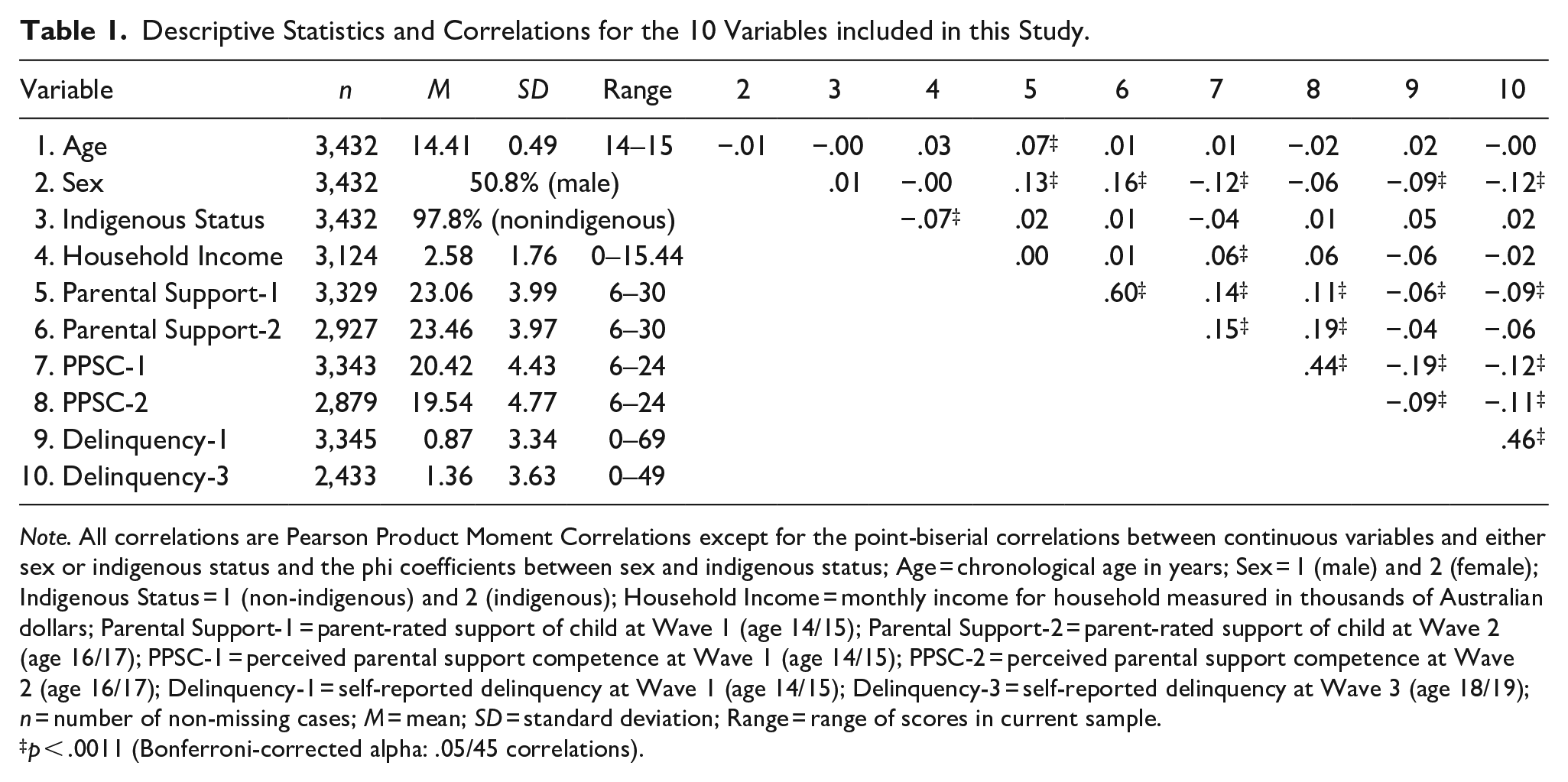
Note. All correlations are Pearson Product Moment Correlations except for the point-biserial correlations between continuous variables and either sex or indigenous status and the phi coefficients between sex and indigenous status; Age = chronological age in years; Sex = 1 (male) and 2 (female); Indigenous Status = 1 (non-indigenous) and 2 (indigenous); Household Income = monthly income for household measured in thousands of Australian dollars; Parental Support-1 = parent-rated support of child at Wave 1 (age 14/15); Parental Support-2 = parent-rated support of child at Wave 2 (age 16/17); PPSC-1 = perceived parental support competence at Wave 1 (age 14/15); PPSC-2 = perceived parental support competence at Wave 2 (age 16/17); Delinquency-1 = self-reported delinquency at Wave 1 (age 14/15); Delinquency-3 = self-reported delinquency at Wave 3 (age 18/19); n = number of non-missing cases; M = mean; SD = standard deviation; Range = range of scores in current sample.
p < .0011 (Bonferroni-corrected alpha: .05/45 correlations).
Possibility of a Collider Effect
A sensitivity test designed to evaluate and rule out endogenous selection bias by removing the precursor measures from the equation and redoing the analyses, revealed that several of the variables in the main analysis may have been subject to a collider effect when precursor measures were present. Normally, when precursor measures and their lagged effects are removed from a regression equation the other coefficients increase in magnitude because the autoregressions created by precursor measures are usually large. In the present study, the Wald Z scores for several key paths (e.g., Parental Support-1 → PPSC-2; PPSC-2 → Delinquency-3) declined slightly when the precursor measures were removed from the various regression equations. The standardized beta coefficients, on the other hand, either improved or stayed the same with removal of the precursor measures. Because these anomalous patterns could signal a collider effect, the analyses performed with and without precursor measures are presented side-by-side in Table 2.
Three-Equation Path Analysis of Parental Support-Perceived Parental Support Competence-Delinquency Relationship With and Without Precursor Measures.
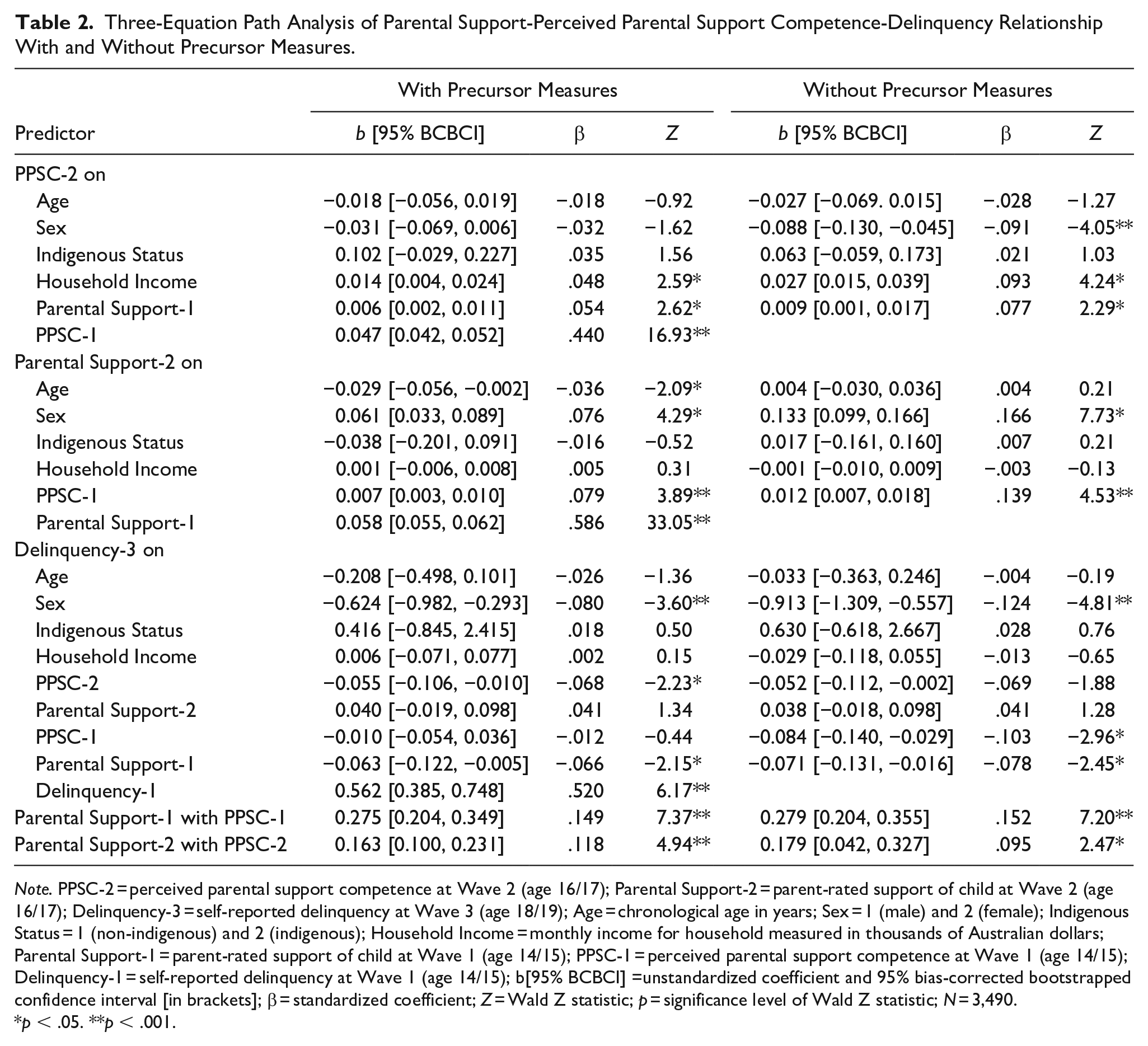
Note. PPSC-2 = perceived parental support competence at Wave 2 (age 16/17); Parental Support-2 = parent-rated support of child at Wave 2 (age 16/17); Delinquency-3 = self-reported delinquency at Wave 3 (age 18/19); Age = chronological age in years; Sex = 1 (male) and 2 (female); Indigenous Status = 1 (non-indigenous) and 2 (indigenous); Household Income = monthly income for household measured in thousands of Australian dollars; Parental Support-1 = parent-rated support of child at Wave 1 (age 14/15); PPSC-1 = perceived parental support competence at Wave 1 (age 14/15); Delinquency-1 = self-reported delinquency at Wave 1 (age 14/15); b[95% BCBCI] =unstandardized coefficient and 95% bias-corrected bootstrapped confidence interval [in brackets]; β = standardized coefficient; Z = Wald Z statistic; p = significance level of Wald Z statistic; N = 3,490.
p < .05. **p < .001.
Main Analysis
The results outlined in Table 2 indicate that regardless of whether precursor measures were included in the analysis, the results supported the hypothesis that the sequence of variables should run from parent-reported supportive behavior to offspring perceptions of parental support competence, not the other way around. Although the Wald Z-score for the b path of the target pathway only approached statistical significance when precursor measures were removed (p = .06), the bias-corrected bootstrapped confidence interval for this path was significant, as was the bias-corrected bootstrapped confidence interval for the total indirect effect (see Table 3). Consistent with predictions, the total indirect effect for the target pathway was significant, the total indirect effect for the comparison pathway was non-significant, and the difference between the two pathways was significant, regardless of whether precursor measures were included in the respective regression equations or not. Figure 1 provides an overview of both sets of results.
Summary of Specific Indirect Effects and their Comparisons for Models With and Without Precursors.
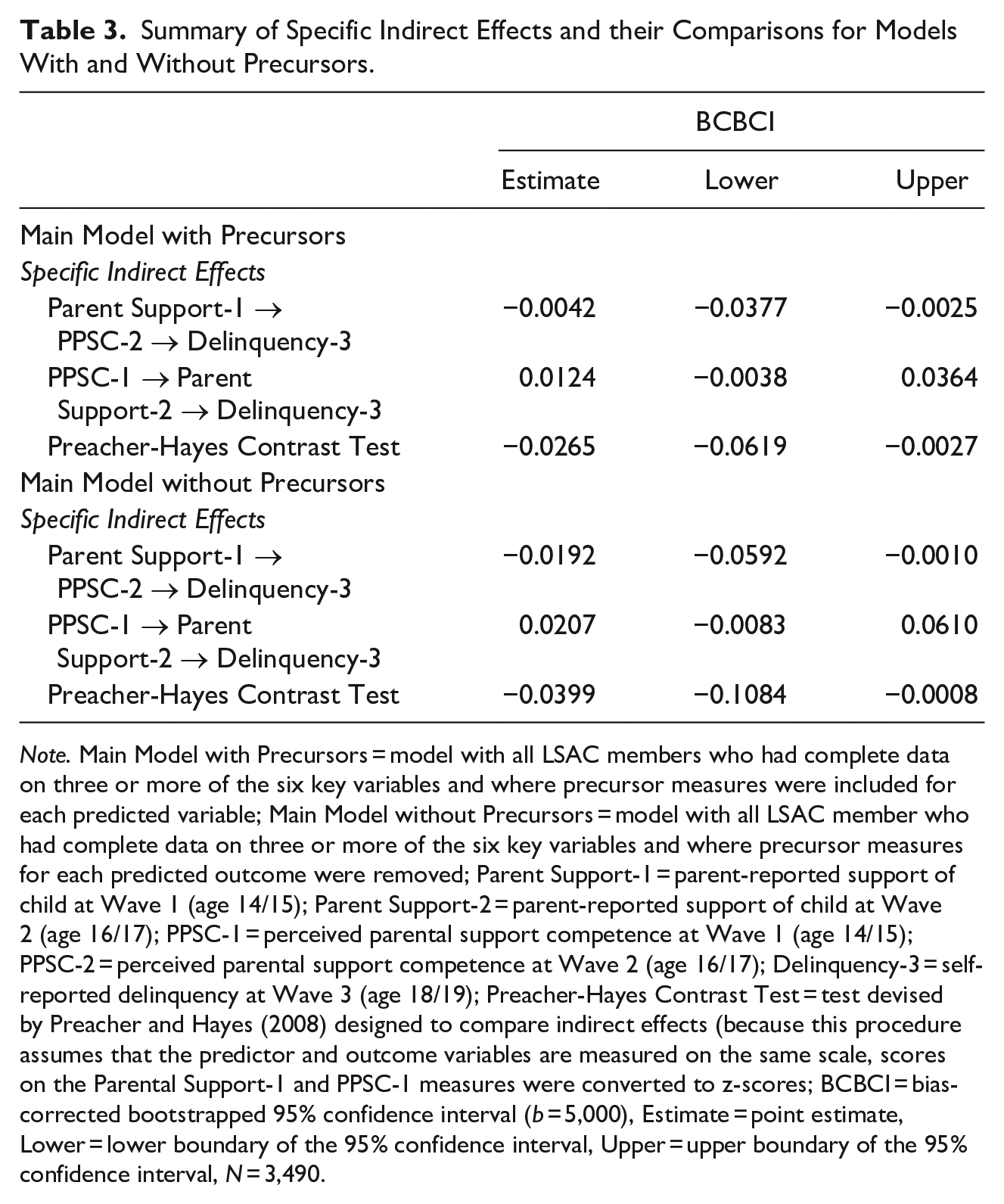
Note. Main Model with Precursors = model with all LSAC members who had complete data on three or more of the six key variables and where precursor measures were included for each predicted variable; Main Model without Precursors = model with all LSAC member who had complete data on three or more of the six key variables and where precursor measures for each predicted outcome were removed; Parent Support-1 = parent-reported support of child at Wave 1 (age 14/15); Parent Support-2 = parent-reported support of child at Wave 2 (age 16/17); PPSC-1 = perceived parental support competence at Wave 1 (age 14/15); PPSC-2 = perceived parental support competence at Wave 2 (age 16/17); Delinquency-3 = self-reported delinquency at Wave 3 (age 18/19); Preacher-Hayes Contrast Test = test devised by Preacher and Hayes (2008) designed to compare indirect effects (because this procedure assumes that the predictor and outcome variables are measured on the same scale, scores on the Parental Support-1 and PPSC-1 measures were converted to z-scores; BCBCI = bias-corrected bootstrapped 95% confidence interval (b = 5,000), Estimate = point estimate, Lower = lower boundary of the 95% confidence interval, Upper = upper boundary of the 95% confidence interval, N = 3,490.
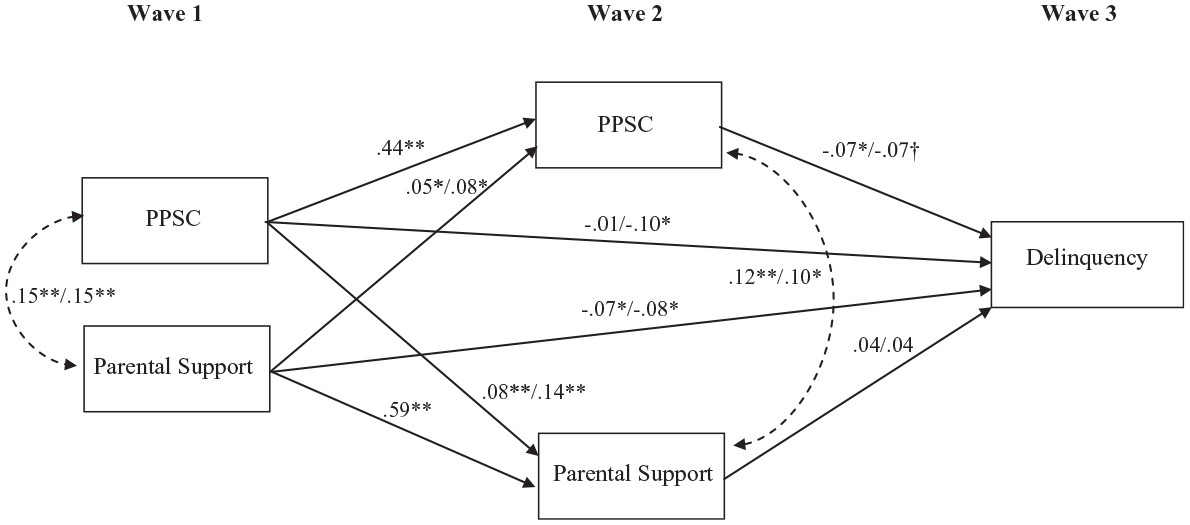
Results of the main path analysis with and without precursors.
Two sensitivity tests were conducted as part of the main analysis. Removing the precursor measures from their respective regression equations was designed to test for endogenous selection bias. The results of this sensitivity test were already discussed. The second sensitivity test was designed to investigate the likelihood of omitted variable bias. Using Kenny’s (2013) “fail-safe ef” procedure, it was determined that an unobserved covariate confounder would need to correlate .10 with the mediating variable (Wave 2 perceived parental support competence) and .10 with the dependent variable (Wave 3 delinquency), after controlling for the independent (Wave 1 parental support) and mediating (Wave 2 perceived parental support competence) variables in the case of the latter, to fully eliminate the coefficient on the b path of the significant target pathway. These numbers indicate that the mediating results observed in this study were modestly robust to the effects of unobserved covariate confounders.
Supplemental Analyses
Two supplemental analyses were performed. The first supplemental analysis was a negative binomial regression of the highly skewed Wave 3 delinquency measure (Overdispersion Z = 16.72, p < .001). The analysis was performed with a maximum likelihood with robust standard errors (MLR) estimator and Monte Carlo integration. A negative binomial model was estimated even though the data did not conform to a true negative binomial distribution (i.e., counts above five on individual items were truncated at five). As such, the highest possible score a participant could receive on the delinquency measure was 95. The results of the negative binomial analysis revealed significant a (β = .05, p < .01) and b (β = −.21, p < .01) path coefficients for the target pathway and a significant a path (β = .08, p < .001) but nonsignificant b path (β = .05, p = .577) for the comparison pathway. 1 Constructing 95% confidence intervals using Preacher and Selig’s (2012) Monte Carlo Method for Assessing Mediation (MCMAM) technique there was evidence of a significant total indirect effect for the target pathway (Estimate = −0.00318,95% CI = −0.00682, −0.00536) but not for the comparison pathway (Estimate = 0.00069, 95% CI = −0.00194, 0.00358).
The second supplemental analysis was designed to test whether the results were sufficiently robust to extend down to all participants with complete data. Listwise deletion produced a sample of 1,894 youth with scores on all 10 study variables. Similar to the results obtained when missing data were handled with FIML, the a (β = .07, p < .01) and b (β = −.09, p < .01) paths of the target pathway were both significant, whereas only the a path of the comparison pathway was significant (β = .09, p < .001; b path β = .02, p = .530). As with the main analysis, the total indirect effect for the target pathway was significant (Estimate = −0.0222, 95% BCBCI = −0.0518, −0.0069) and the total indirect effect for the comparison pathway was not (Estimate = 0.0074, 95% BCBCI = −0.0140, 0.0355), although this time the difference between the two pathways was non-significant (Estimate = −0.0296, 95% BCBCI = −0.0735, 0.0010).
Discussion
In clarifying the research question and confirming the study hypothesis, the current results demonstrate that a social context variable played a rule in decreasing delinquency by altering the child’s perception of the social context. In other words, parents who were viewed by their child as more competent in providing social and emotional support had children who were less likely to be involved in delinquency. By internalizing the external social context, in this case, parental support, and acting on this symbolized interpretation of the social environment, the child, in effect, reduced their own chances of engaging in future delinquent behavior. These results are consistent with prior studies showing that internalized processes like cognitive distortions (de Vries et al., 2016), moral disengagement (Ishoy, 2017), and weak academic self-efficacy (Walters, 2019) are capable of mediating the parental support-delinquency relationship. More recently, Walters et al. (2022) discovered that perceived parental competence suppressed future delinquency by increasing cognitive control and moral cognition. These results are consistent with the notion, central to social cognitive theory, that a change in social context impacts on behavior by encouraging a change in perception or affect, each of which are then followed by a change in belief or cognition, respectively. This is the first study, however, to the author’s knowledge, that indicates social context must precede rather than follow perception for there to be an effect.
Theoretical Implications
The social cognitive model tested in this and the two previous studies (Walters, 2020a; Walters et al., 2022) proposes a four-variable sequence starting with a social context variable, followed by two mediator variables, either perception followed by belief or affect followed by cognition, and ending with a behavioral outcome like crime or delinquency. In none of these studies, including the current one, was the full four-variable sequence evaluated. Either there were an insufficient number of data waves to evaluate all four variables simultaneously, or a reasonable measure of one or more key variables was unavailable. Hence, the present study disclosed that a social context variable (parental support) preceded an internal perceptual variable (perceived parental support competence), whereas previous studies have shown that perception precedes belief (Walters et al., 2022) and affect precedes cognition (Walters, 2020a). Thus, while all of the relations proposed in the three rules (“affect before cognition,” “perception before belief,” “social context before affect/perception”) have been verified, the full four-variable model has yet to be tested.
Practical Implications
Interventions designed to improve parenting skills in caregivers have been shown to be effective in preventing and reducing youth delinquency (Piquero et al., 2016), although the focus of such programs has usually been on improving parental control rather than on enhancing parental support. As previously stated, research denotes that parental support is just as important as parental control in preventing future delinquency and reducing current offending (Hoeve et al., 2009). A growing body of research, in fact, indicates that positive parent-child communication (Parker & Benson, 2004), high levels of parental warmth (Yun & Cui, 2020), and ample amounts of parental involvement in a child’s home and school activities (Pritchard, 2001) are all associated with lower levels of child delinquency and antisocial behavior. Working with the child to harden internal perceptions of parental support competence, while reinforcing the child’s willingness to disclose personal information to parents (Kapetanovic et al., 2019) and improving their ability to internalize parental messages through self-instructional training (Rivera-Flores, 2015) may also be of value in preventing future crime. In fact, a supportive parent-child relationship has been found to increase the effectiveness of parental control strategies designed to reduce child antisocial behavior (Kapetanovic & Skoog, 2021).
Limitations
Sample size can be considered both a strength and weakness of this study. It is a strength in the sense that a large sample provides increased power to reject the null hypothesis and increased opportunity for additional analyses like the listwise deletion supplemental analysis conducted in the present study. It is a weakness to the extent that it allows for the misinterpretation of trivial effects as clinically significant findings. Effect size indicators such as the standardized beta and the “failsafe ef” coefficient suggest that while the results were modest in magnitude, the practical cost-effective implications that can be drawn from these results highlight their importance. A second limitation of this study is that while parental support was assessed with parental (social context) and child (perceptual) measures, parental control was not. That was because parent-assessed parental control was not covered as part of the Wave 2 (age 16/17) interview. Although this limits the conclusions that can be drawn from this study to parental support, they do not detract from the significance these results have for the connection between parental support as reported by a parent and parental support as perceived by the child. A third limitation is that while both parents were often asked to provide ratings, this was not the case with parent-rated parental support at Wave 1 (age 14/15). Here, the parent most familiar with the child’s behavior was asked to provide the rating. It was therefore not possible to average mother and father ratings of parental support during the Wave 1 interview. Although this could potentially limit the comprehensiveness of the ratings, it bears repeating that the parent who completed the rating was the one most familiar with the child’s behavior.
Conclusion
Although previous research has uncovered support for the “affect before cognition” (Walters, 2020a) and “perception before belief” (Walters et al., 2022) rules, the current study sought to demonstrate that social context precedes perception and not vice versa. This provides preliminary evidence of an internalization process, consistent with social cognitive theory, that could be important to both development and learning. Future research could be of assistance in teasing apart the different possibilities, such as the prospect that an alternate social context like peers, siblings, or neighborhood interacts with or mediates the effect of parental support on delinquency or that additional factors internal to the child (thoughts, feelings, and perceptions) mediate the effect of parental support on delinquency in concert with perceived parental support competence and understanding the actual process by which social context is internalized.
Footnotes
Acknowledgements
The author would like to express his gratitude to the Australian Government Department of Social Services (DSS), the Australian Institute of Family Studies (AIFS), and the Australian Bureau of Statistics (ABS) for providing access to the Growing Up in Australia: Longitudinal Study of Australian Children database.
Anonymize Information
page 7, The secondary analysis of these data for the current study was approved by the Institutional Review Board at IRB.
Declaration of Conflicting Interests
The author declared no potential conflicts of interest with respect to the research, authorship, and/or publication of this article.
Funding
The author received no financial support for the research, authorship, and/or publication of this article.
