



Abstract
Although scholars are attuned to the particular transitional dilemmas faced by middle school students, inquiry into middle school breaktimes is largely limited to research on bullying and peer victimization. This study interrogates the geography of middle school breaktime to expand understanding of student safety and recognize the ways that the state’s intervention in school spaces creates particular challenges for young learners. By investigating breaktimes at three middle schools and employing a critical geography lens in data coding and analysis, we demonstrate how the organization of space shapes student experiences. Findings suggest that scholars should consider breaktime as a “thirdspace” within the middle school day—one that offers vast potential for positive student development, but is marginalized due to its status as “non-academic” time. Findings reveal that school leaders and staff may better support students by addressing the ways that breaktimes are differently navigated by students along ethnic, socioeconomic, age, and gender lines.
Keywords
The early adolescent years of middle school are some of the most important developmentally as they are marked by rapid developmental changes that affect young people’s appearances, priorities, and passions—all of which affect their schooling experiences (Anderman & Mueller, 2010; Wigfield et al., 2005). The main reason for this is the changes in “. . .brain structure, function, and connectivity [that] mark adolescence as a period of opportunity to discover new vistas, to form relationships with peers and adults, and to explore one’s developing identity. It is also a period of resilience that can ameliorate childhood setbacks and set the stage for a thriving trajectory over the life course” (National Academies of Sciences, Engineering, and Medicine, 2019, p. 1). For this reason and others related to the different structures of elementary and middle school, the transition to middle school is complex to navigate (Eccles & Wigfield, 1997; Mullins & Irvin, 2000). It is often the first time students are required to exert autonomy by switching classrooms and teachers for different subjects, using lockers, and making their way to and from school on their own. In some cases, friendship groups are split up or reconfigured, limiting students’ social safety net. Yet, schools can scaffold the transition by engaging in practices that support autonomy (Alley, 2019) and motivation (Gnambs & Hanfstingl, 2016; Ryan & Deci, 2020). School climate initiatives that focus on meaningful peer-to-peer and student-teacher relationships as well as physical and emotional safety are also associated with improved student outcomes (Loukas & Murphy, 2007; Voight & Nation, 2016; Wang et al., 2010; Way et al., 2007; Wilson, 2004).
Non-academic environments are central locations for positive youth development (Eccles & Gootman, 2002). In these spaces, youth—particularly youth who have been marginalized in school environments—have opportunities to build relationships with peers and adults, learn new skills, feel a sense of safety and belonging, develop their identities, and importantly, have fun (Barber et al., 2009, 2014). Although schools are much more structured spaces than out-of-school environments, there may be potential for similar youth benefits during non-instructional time in middle school. There is a substantial body of research that supports the importance of a positive school climate to promote academic success (for a summary see Thapa et al., 2013), but much research on non-classroom spaces focuses on negative encounters such as bullying, harassment, and violence (Hall, 2017; Hicks et al., 2018).
To support student engagement it is also important to consider the organization of school space and the ways it is accessed by students (Gruenewald, 2003). The main unstructured time in middle schools happens at scheduled breaks, including the free time surrounding the midday lunch break. No longer primarily an opportunity for child development through play (London, 2019b; Massey et al., 2021), middle school breaktime—a time akin to what is called recess in elementary schools—is a time for students to exercise autonomy, socially interact, and form their identities (Boulton, 1992; Jarrett & Duckett-Hedgebeth, 2003; London, 2022). In this study, we employ a critical geography framework to explore the possibilities and constraints of middle school breaktime. Using the concept of “thirdspace” as discussed by Soja (1996), we contemplate the ways that the timespace of breaktime is marginalized in today’s educational environments, and the potential it holds for reimagining what school connection looks like. Our analysis centers equity issues, particularly as they play out by age, gender, ethnicity, and socioeconomic status. Our data collections include observations and interviews at three middle schools in the same local area. We used a community-engaged research approach and provided training to 25 undergraduate researchers and one high school student through the data collection, coding, and analysis processes.
Literature Review
The concept of “space” at middle school has been previously investigated, although studies do not concentrate explicitly on breaktimes. In studying space, researchers have looked to students themselves to identify the school spaces in which interactions occur, and how the spatial location affects their feelings about those encounters (Biag, 2014; Wellenreiter, 2021). How students relate to one another is context driven. In the classroom students may adhere to rules in their peer interactions, but in unstructured spaces like the hallway or on the school bus, these interactions can look and feel very different. Unsurprisingly, middle school students understand very well how the spaces at their schools are used, and whether interactions that happen in certain spaces make them feel safe or unsafe. Biag (2014) engages a class of gifted students in an exploration of an urban school environment, and finds that in places such as a particular bathroom or crowded hallway, students feel unsafe and identify a need for more adult supervision. The students in a midwestern, midsize city middle school observed by Wellenreiter (2021) identify similar school venues as places for social interaction, but they identify a need for less supervision and more autonomy coupled with better communication about behavioral expectations. Adolescent students in Canada report that the school yard is a high frequency location for bullying and that adult presence alone is insufficient to counteract these behaviors (Vaillancourt et al., 2010). In fact, research has shown that in some cases, youth-adult relationships with non-parental adults can be damaging and not protective, including behaviors that are disrespectful, inappropriate, and contradictory which serve to reduce youth motivation, self-esteem, and connection to adults (Buehler et al., 2020).
Many studies of non-classroom spaces in secondary schools focus specifically on bullying, victimization, and other negative interactions. Perceptions of bullying and victimization among middle school students is quite high, with one study finding that as many as 70% of students self-identifying as a bully, a victim, or both (Swearer & Cary, 2003). Problematic peer interactions in middle school can hinder students’ adjustment to the middle school environment (Nansel et al., 2003) and affect their academic outcomes (Juvonen et al., 2011). The bullying and victimization literature is vast and it is not our intent to focus undue attention on this issue except to note that whereas there is extensive research on the ways school spaces enable negative peer interactions, there is very little research on how school leaders and staff can support positive interactions among youth during their breaktimes.
The concept of thirdspace highlights the entanglement of “spatiality-historicality-sociality” and the “real-and-imagined” and denotes the liminal space between cultures (i.e., in-school and home) that gives way to something new (Soja, 1996). As it applies to school contexts, Di Cesare et al. (2016) define thirdspace as “the intersection where new knowledge and discourses emerge from the blending and merger of understanding and experiences from a child’s home, community, and peer network with the more formalized learning encountered in schooling” (70). In terms of its liminality, breaktime can be thought of as a thirdspace for several reasons. First, it falls at the intersection of home (particularly with regard to whether food is brought to school and what type), peer networks, and school spaces during non-instructional times. Because it is outside the structure of classroom spaces, it is typically considered by educators and policymakers to be marginal to the central mission of teaching and learning (London, 2019a). Attending to the margins is important to scholars such as hooks (1990), who understands marginal locations as spaces of radical potential, in this case to provide space and time for critical thought that challenges the lessons taught during the structured school day. McKittrick (2006) argues that margins are best understood as central to, rather than anomalies of, the story at hand. This framing is essential to our study, as we argue that the marginalized breaktime space is integral to the school day and the education of young people, and therefore, as hooks argues, holds potential. Gutiérrez (2008) highlights how youth learn in marginal spaces and calls attention to the influence of the market economy in legitimizing particular ways of teaching and learning and where these processes are assumed to take place. For these scholars, unconsidered spaces of learning are those that hold significant possibilities for educational justice.
To what extent this possibility is realized and how students negotiate within the spaces offered to them is the focus of this study. We explore the ways that middle school breaktime organizers engage or ignore the potential of breaktime through their practices and policies, and the constraints imposed by space and resources, with explicit attention to equity issues related to age, gender, ethnicity, and socioeconomic status.
Method
We worked closely with administrators and principals in two school districts and three schools to design the study, which follows efforts in both districts to improve recess time in elementary school. The study was approved by the University of California, Santa Cruz Institutional Review Board as exempt from review because data collections involved only observations of existing school activities and interviews with adults about their roles at school. No individual-level data about or from students were collected by the researchers.
Data Collection
The study data include breaktime observations and interviews with adults who work at the schools. We used this study as an opportunity to offer community-engaged research opportunities to 25 undergraduate students for credit and 1 high school intern, a model that is unique to our institution’s community engagement approach (Greenberg et al., 2020).
Study schools
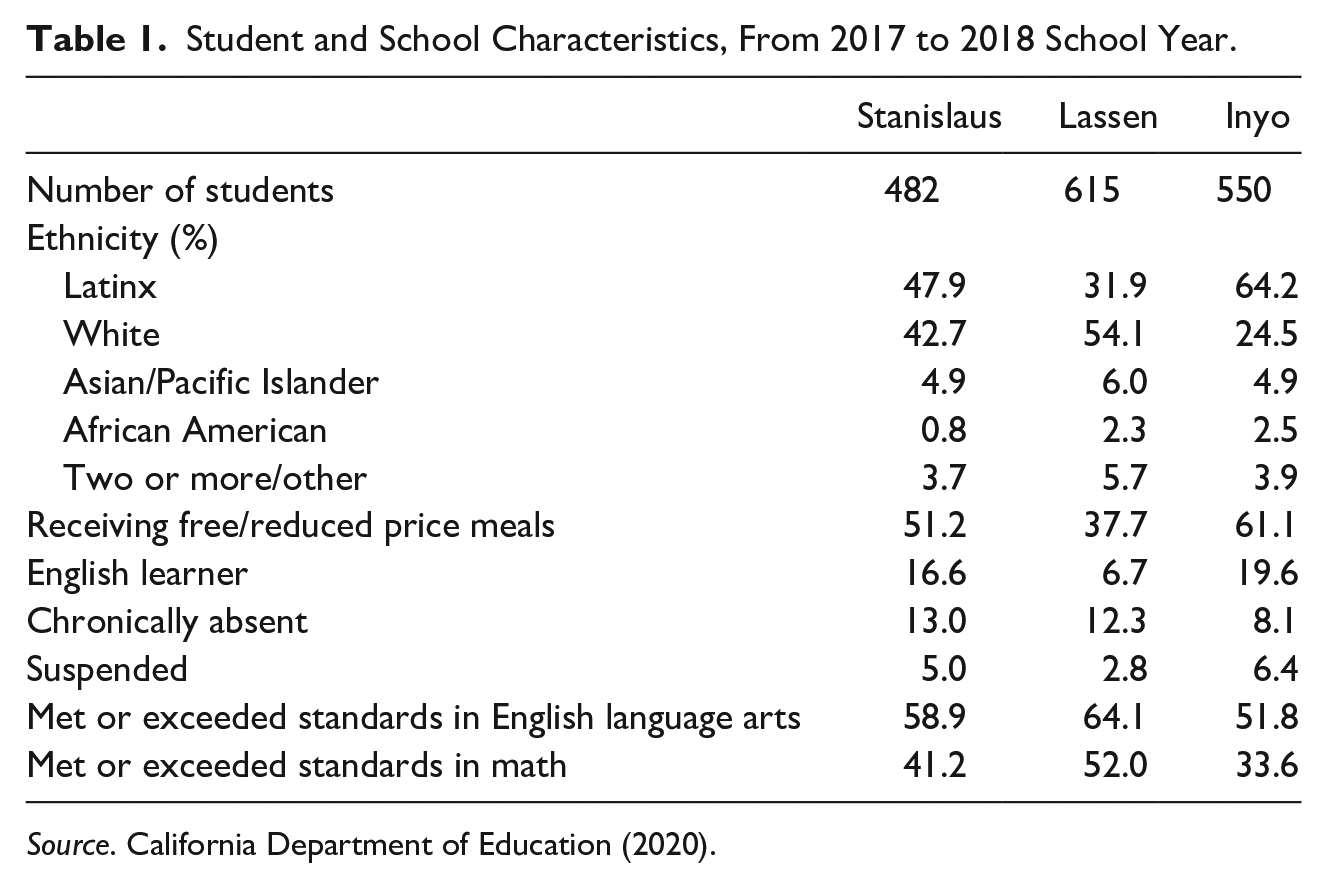
The three middle schools, referred to with pseudonyms in the article, were in the same geographic region in California but within two different school districts. Table 1 shows their characteristics, including outdoor space, student characteristics, attendance and discipline, and test scores. Lassen Middle School serves a student population that is about half White with 38% qualifying for free and reduced price meals through the National School Lunch and School Breakfast Programs. In contrast, both Stanislaus and Inyo Middle Schools serve higher concentrations of Latinx students (48% and 64%, respectively), English learners (17% and 20%), and students who qualify for free and reduced price meals (51% and 61%). Being chronically absent equates to missing 10% or more of the school year and in 2017 to 2018, the year in which the data collection occurred, Stanislaus had the highest rate (13%) followed by Lassen (12%) and then Inyo (8%). Inyo had the highest suspension rate at 6%. Students at Lassen were most likely to have met or exceeded the standards in English language arts (64%) and math (53%). Both Stanislaus and Inyo had lower rates, with Inyo in particular falling below its peer institutions in test scores. Notably, Lassen has the largest student population and the smallest outdoor space.
Student and School Characteristics, From 2017 to 2018 School Year.
Observations
We recruited 25 undergraduate students at our university and 1 local high school student who we then trained to conduct observations at all three middle schools. Four student team leaders scheduled 2 days of observation at each school and recruited team members to participate in the observations, with between three and five observers at each site for each observation. We consider the outdoor space at each school where most students gathered to be the primary breaktime space. Our team identified “alternative” breaktime spaces (e.g., classrooms, the library, and the computer lab) at each school and one researcher would rotate to observe these spaces at each site. The article authors observed breaktimes alongside the research team. Undergraduate researchers took field notes and at the end of each session sat together to compare their notes and complete an observation form. The team leader was responsible for collecting and collating the field notes. In total we collected twelve observations across the three middle schools, as each school had a break at mid-morning “brunch” and lunch (four observations over 2 days at each of the three schools).
Adult interviews
The two article authors conducted 16 interviews, which were taped and transcribed with interviewee consent. Interviews were conducted with principals, assistant principals, school counselors, and campus supervisors at each school and with several school district representatives. Interviews lasted between 30 and 60 minutes and, for middle school staff respondents, focused on the experiences of each adult with breaktime, the different structures schools had in place or considered putting into place and how those were working, challenges they perceived as stemming from this time, and their approach to interacting with students during breaks. We also learned about their views on what is developmentally appropriate for middle school breaktime, as compared to elementary school recess.
A key limitation of our approach is that we do not include student voice. Two of the three schools collected student surveys that coincided with the research, but the questions posed were not sufficient to fully understand how students felt about their breaktimes. Future research should include student voice as a key data source. Other limitations include our focus on just three schools in one geographic area as well as our data collection at one point in the school year.
Data Analysis
All data were coded and analyzed for themes using both inductive and deductive methods. The middle school observation data were analyzed by a team of six undergraduates, including the four team leaders and two other team members, with training and support from the article authors. Students and the article authors each read the collated notes from the 12 middle school observations and together generated a set of themes that related to: (1) the space provided for breaktime activities; (2) students’ engagement in various activities, including by gender and ethnicity; (3) adult activities and interactions with students; (4) alternative spaces accessed by students; and (5) perceived challenges and/or problems.
The two authors and one undergraduate student then worked with these codes to develop themes for the interview data. We each read all the interviews and again using both inductive and deductive methods generated the codes for the data. Hice-Fromille then coded observational and interview data in Nvivo. Data were analyzed in Nvivo for themes related to developmentally appropriate activities, space, equity issues, and safety.
Breaktime space and rules
We consider the organization of space to be central to the breaktime experience, and therefore include here a description of the outdoor and indoor spaces that were accessible for students during their two breaks per day—brunch in the mid-morning (10–20 minutes) and lunch later in the day (30–40 minutes). At each school, all students were on break at the same time and each school was located geographically in a region where students were able to be outside on most days. Our observations confirmed that Lassen, the school with the largest student population and smallest space, felt more crowded than the other schools during breaktime; there was not enough seating for all students to eat at a bench or table and food was not allowed on the turf field, which left many students standing or sitting on the blacktop while they ate. This was especially the case during lunch because all students were required to eat for 10 minutes before they could be dismissed to other outdoor locales (the only school with this policy) (Table 2).
Facilities and Activities Available During Breaktime.
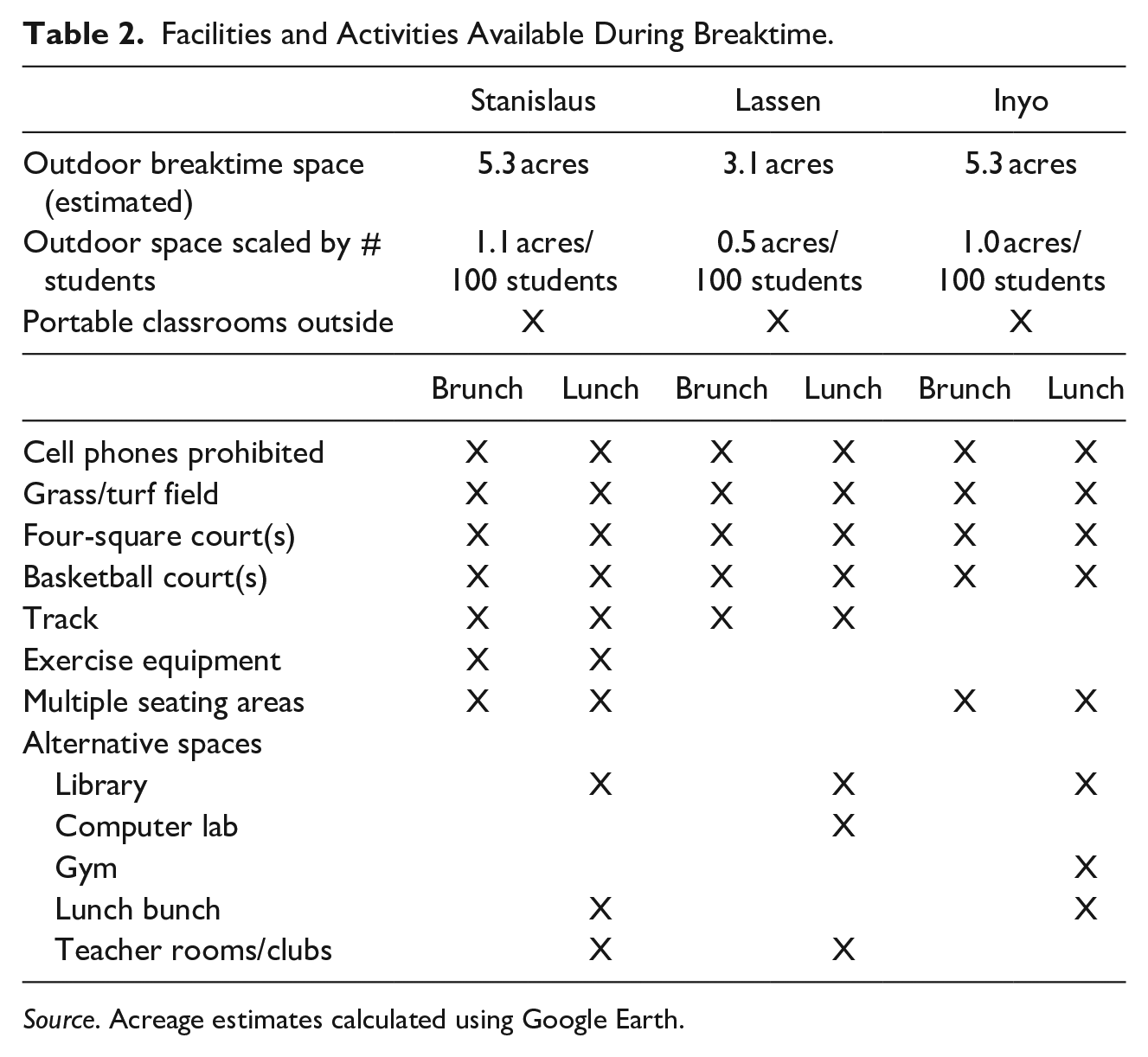
Source. Acreage estimates calculated using Google Earth.
All three schools had alternative spaces students could occupy, including the library (three schools), teachers’ rooms (2), gym (1), and computer lab (1). Two schools also had a “lunch bunch” run by a counselor in a smaller and more structured space for students who were identified by staff as developmentally unprepared to navigate lunch by themselves every day of the week. Each school offered meals and snacks which were served from an outdoor window. Students queued outside the window to receive their free, reduced, or full price meals or food items, which resulted in long lines. Lassen had a policy that allowed sixth grade students to be released 5 minutes earlier than older students with the hope that staggered release time would shorten the wait for all students, but especially for sixth graders. The other two schools made no accommodations for students of different grades.
Findings
California has no requirements, standards, or curricula for breaktime in any grade level, and the research literature on recess has not identified a set of practices or even goals for this time in middle school. Thus, each of the schools in this study organized breaktime with its own set of criteria. London (2022) provides a detailed description of the activities in which students engaged during their breaks and adults’ views of their roles in scaffolding breaktime as a safe space for students. Here we focus specifically on how the space contributes to the experience and organization of middle school breaktime. Considering middle school breaktime from a critical geography perspective, we identify two key themes related to equity and space: (1) race and class dynamics in space and time for students eating free and reduced price meals at school and (2) gender roles and spatial dynamics and the ways that they intersect according to age.
The Geography of the Lunch Line
As a thirdspace issue, the lunch line at all three study schools represented a marginal place in the breaktime geography that divided students by socioeconomic status and ethnicity in visible and visceral ways. At each school there was just one lunch line, but students who received free and reduced price meals had no option but to wait in that line, whereas other students could avoid the long line by bringing food from home. Although there are no statistics available about the ethnicities of students who receive free and reduced price meals at these schools, our observations indicate an overwhelming presence of Latinx students in the lunch line. Observation field notes document the density of the line as the most crowded area during the break, which limited student movement for all students, not just those waiting in line. For example, the researchers at Lassen observed that the majority of students started their lunch break by either joining the lunch line or sitting to eat lunches from home. Although sixth grade students could get their lunches first, the lunch line was still very congested and there was insufficient seating for all students. Field notes indicated that students ran around and through the line and play-wrestled with one another as they waited for their lunches. At the other schools, field notes documented that students similarly formed food lines, and researchers noted that some students rushed out of class as soon as the lunch bell rang to try to secure a spot close to the head of the line.
In all three schools, affordable food was available to lower-income students, but the organization of breaktime challenged their food access. The length of the lunch line required students, particularly those receiving free and reduced price meals, to conduct a daily calculus for determining the amount of time that they dedicated to eating, playing, and socializing—all of which are significant contributors to their daily and overall academic and social development. We noticed that even those students who brought lunch from home navigated whether or not to forgo eating (or significantly reduce the amount that they ate) to engage in other activities. However, the lunch line itself played a role in lower-income students’ navigation of their breaktime, deepening the inequities of food access for students who received free and reduced price meals.
Several staff noted the challenge that long lunch lines presented for students wishing to use the breaktime to engage activities other than eating. One counselor stated:
Brunch is 15 minutes most times [but] kids go to their locker, . . . so you’re really talking about 10 minutes. I think you go out there and you kind of weigh in your mind, do I want to get myself started in this or do I just want to sit, eat my snack, be with my friends and be ready to go back to class on time. . .And lunch, same thing. Like if you have to wait in the lunch line. . . Or they will choose not to get lunch from the cafeteria or whatever so that they can have their time to [play, etc.].
This counselor’s concern is for the entire student body, without referencing the specific challenges for lower-income students. Any student may opt to skip eating their lunch or avoid waiting in the long line to secure more time for socializing and play, but for those who require school meals, this will mean forgoing their meal altogether.
A principal also expressed concern over the time students spent eating during breaks relative to the time they engaged in other activities:
We wish they would eat more. They eat very quickly, and they kind of eat very little. We offer food throughout the day. Before school, brunch, lunch, and after school. And a lot of that is free . . . [They’re eating so little] because they want to go play . . . We might be limiting that because we don’t allow food in certain areas. So you can’t. . .snack on your sandwich and play basketball. You have to come over here. If your social group isn’t over here, you might just bypass eating altogether and go play . . . And kids sneak the food. And they’re sneaking the food because they want to do both things. I get that. They want to play, and they want to eat. You don’t want to hang out over here and eat.
This principal contrasted breaktime rules at the middle school with those of the elementary schools: “Elementary schools have rules about so many minutes you have to eat, and then you get to go play, and there’s always friction there about how many minutes eating, how many minutes playing.” While concerned about the time allotted to students who want to both eat and play, this principal suggests that enforcing rules about how long students must eat is not age-appropriate for middle schoolers. The lack of guidance about breaktime policies for middle school students led each administrator to decide for themselves what was age-appropriate, and only one of the three schools had a mandated number of minutes to eat lunch before students were released to play.
A campus supervisor who monitored breaktime took further issue with the problems surrounding food, of which the lunch line was only one part. She revealed that she keeps bread, peanut butter, and jelly in her office and that other campus staff will send students to her office when they report needing something to eat. She stated how she would improve breaktimes at the school if the decision were at her discretion:
This is just my personal opinion, I would feed the kids. Not that we don’t feed the kids, we do, obviously. But I really, truthfully think that food totally alters somebody’s mind because it alters mine. If I’m hungry, just don’t talk to me. I need to eat in order to be able to function and a lot of our kids are so pumped to go and play sports and to hang out with friends, that they either eat later, or they don’t eat at all, or whatever the case is. So, I feel like just mandatory food. . . we have 15 minutes for us to sit down to eat, then you have your normal breaktime. Which obviously isn’t an option. I get that. But to me, that would be super important.
This respondent grappled with the possibility of mandating an amount of time in which students had to sit and eat during break. However, concern about students’ eating habits influenced their opinion that the main way to improve student breaktime was to ensure that students had adequate food and sufficient time to eat it.
Schools provided contradictory messages about the importance of eating. On the one hand, adult respondents knew and appreciated the importance of fueling the body for the sake of the brain. On the other hand, all schools enforced restrictions on when and where food was allowed (e.g., not on the turf, not in classrooms), creating a disincentive to eat for those who want to exercise or socialize or play during break. Furthermore, although the food line was a known problem, none of the schools had successfully created policies or practices to reduce its length.
Age, Gender, and Spatial Dynamics
All three schools offered students the space to enact autonomy, within limits. The position of breaktime as a thirdspace in school is therefore potentially beneficial to middle schoolers, who can bring together their home environments, social networks, and individual interests to create a meaningful break for themselves. Our observations indicate there were constraints on this autonomy, however, imposed by available space and by the students themselves. There was not equal access to space for all age and gender groups in any of the breaks we observed, and there were stereotypically gendered manifestations of how, even within the thirdspace of breaktime, some groups were further marginalized along age and gender lines.
The schools’ outdoor spaces privileged sports and other physical activities that can be played on fields or basketball courts, which all three schools featured prominently. Although sports like soccer and basketball were attractive to both boys and girls in single-gender school sports and adult interview respondents assured us that students of both genders participated in out-of-school leagues, observations indicated that breaktime attracted mostly older boys to these venues. When asked to explain the gendered division of athletic participation at breaktime, one counselor who monitored breaktime told us,
I don’t know, after school sports are divided by gender, so that’s what they’re used to. It seems like that’s maybe why it’s taken over by boys just because they’ve taken over and the girls are like, “Well, I guess that’s the boy thing.” Girls do like to hang out and chat, so maybe it’s been natural the way both of them have gone.
A counselor at another school had a similarly inconclusive response about girls’ lack of participation in active games or sports:
I think it’s what they want to be doing, for sure. Should they be doing it? I don’t know. I tried to get them kind of involved. But, they just want to hang out on the turf with their friends and talk about boys, sometimes. When I walk by they’re always talking about boys. But, I try to get them involved. When the teen center comes, I’m always like, “Go! Go, play over there.” And then, sometimes you can get them to go. But, I would say that a lot of the eighth-grade girls, I’ve noticed, kind of, just stick to their cliques and they just, kind of, hang out. They don’t really participate.
Despite our observations that physically active breaktime activities were segregated by age and gender, we did not witness any incidents in which boys’ activities overtly overwhelmed girls’ activities and only one interview respondent recalled an example where this had happened. At Lassen, some seventh grade girls were interested in starting a four-square game. With its limited space, they set up away from the field and the basketball courts. Before long, a set of seventh grade boys also wanted to play and essentially took over their game. A counselor who reported this to us noted:
. . .it’s great for the kids to play together, but . . . what [the girls] really want is like a game that [they] can control and play, and maybe the boys can figure out how to play next to them. They’re young. . .the way that they interact is that the boys just took over and the girls kind of acquiesced.
This example offers an important insight into the ways that space, in this case limited space, deterred one group from playing while another group dominated. The game four-square, which requires painted lines in a divided square on the pavement and a bouncy ball, is a typical elementary game, but it has many different permutations and can be made challenging and competitive. At Inyo, we observed that some students also gravitated to the four-square courts and challenged each other to play using only their feet. The principal reported that this was especially popular with sixth-grade boys:
The four-square group is not the most mature group of kids. When we first painted the four-square lines, I was like, “Really? Four-square? Middle school? I don’t really see it.” Pretty soon, we had to paint three because it was very popular. I love the four-square court because there are rules, and the kids know them. We’ve had to put them on a poster. And they know how to get in line. It gives them something to do. So, instead of sixth grade boys chasing each other through the quad, they’re playing four-square, and they’re waiting in line, and they’re making friends.
With the luxury of space, Inyo was able to turn a small game into a popular activity for sixth-grade boys, a group for whom breaktime can be challenging.
Staff at Lassen and Stanislaus also reported that sixth-grade boys had the hardest time at breaktime because they wanted and needed to be active and yet their options were limited. Three months prior to their arrival at middle school, they were the oldest kids on the elementary school play yard and had their pick of activities. In middle school, where active space is dominated by older boys, their options dwindled. Both these schools contracted with a local teen center to run games 2 days a week at lunch, and by all accounts these games were most popular with sixth-grade boys. Having an adult to help them find/make their space opened opportunities for them in terms of play. When asked which students were most likely to play when the teen center staff were there, a school administrator responded that it was, “sixth grade boys who, probably, you know, aren’t as confident joining a soccer game or any of the sort of established cliques of ball games that happen out there.”
The teen center was not present on any of the days that we conducted observations and we did not see the sixth grade boys come together to play; however, contracting with the teen center represents one of the ways that these schools offer alternative spaces for students to access during breaktime. Alternative spaces include the gym, library, art room, music room, classrooms, clubs, and other places where students could gather to talk, play, read, or do other activities they enjoyed with an adult present. These are spaces where students could feel safe even within the constraints of teachers’ or other adults’ rules and expectations, and as such allowed students to negotiate their needs (Schmidt, 2013).
Alternative spaces tended to be dominated by girls, and in some cases the youngest girls. The library, we learned, was the domain of the “socially disenfranchised,” according to one counselor and it served a key need for younger girls. Field notes indicate that the library was a space for quiet activities, including reading, book club discussions, card games, quiet conversation, and in some cases interaction with the librarian. At one school, students could use the computers in the computer lab which was attached to the library and on the days we were there, computers were being used exclusively by boys. Unlike the chaos and crowds of the outdoor yard, field notes indicate that the library spaces were easily large enough to fit all the students who were present and there was no pressure to interact with others.
The “lunch bunch” similarly served younger boys at Inyo and Stanislaus who were socially not equipped to access the larger breaktime spaces without support. According to interview respondents, In the lunch bunch, students had supervised instruction in interacting with others mostly through eating together and playing board games. Again, this was a quieter environment away from the chaotic outdoor space that could overwhelm a student without the social skills to navigate the space.
Still, despite the many different spaces and attention to students’ needs, there seemed to be missing options for at least some younger students at each of the schools, particularly the active boys who wanted to run and play at breaktime. On the margins of the play space and without an organized activity, they engaged in “rough and tumble” play (Pellegrini, 1989) which was often perceived as fighting—and sometimes did escalate into conflict—which was seen as unsafe by adult monitors, as described in interviews.
Constraints on breaktime activities imposed by available space also affected older students, particularly girls. The observation that they socialize more than play begs an important question about autonomy and constraint in the school landscape. When Inyo opened its gym for intramural sports at lunch, girls of all ages played. And respondents at Lassen similarly reported that in prior years when they had the gym available, girls played sports at lunch. So, it may be that socializing among older girls is not always a first choice, but rather a choice constrained by space and resources.
Discussion
In this study, we explored the ways that space and organization of middle school morning and lunch breaks affected student activities and engagement during those times. We highlight two key themes related to equity and space during breaktime: (1) race and class dynamics for students eating free and reduced price meals at school and (2) age and gender dynamics in social engagment and play.
Despite a general neglect of middle school breaktime in the literature, education researchers have long noted concerns about the lunch portion of school breaks. For example, research has shown that top-down school policies about food access fail to consider the socio-cultural, economic, and political factors of a school and school communities lack shared visions of health and wellness (Ardzejewska et al., 2013). A long running debate in the elementary school lunch literature involves whether students should eat or play first, with nutrition researchers documenting that playing first results in more calories ingested and less food waste (e.g., Hunsberger et al., 2014); this is especially true for older elementary boys (e.g., Bergman et al., 2004). We found just one study that investigated middle school lunch experiences, showing that long lunch lines regularly deterred students from eating because students’ main goal for that time was to socialize with friends (Smith et al., 2015). The busy lunch environment can be uncomfortable for students who are less confident navigating the long lines and crowds; the high activity in lunch spaces and the unattractive option of waiting in line for longer than they would have to consume their food influenced students’ decisions to find quick, alternative food options such as from campus vending machines (Asada et al., 2017).
Our study adds to this body of research by documenting that long lines and crowds present a challenge for some students without affecting the experiences of others. In particular, students who receive free and reduced price meals and who must wait in line are more highly affected by the problem, and in the schools we visited, observations indicated a predominance of Latinx students waiting for their food. Latinx students at these schools had fewer minutes available for free time to interact with peers, play games, join clubs, or relax than their White and wealthier peers, which creates inequities along ethnic and class lines.
We also noted inequities by age and gender in how breaktime space is accessed and used. In the very small prior literature on middle school breaktime, a question has emerged as to why the oldest boys on the school yard seem to “rule the school.” Boulton (1992) examined British middle school students’ activities and noted that older boys were involved mainly in physically active games whereas girls were most likely to be socializing. He concluded that exclusion from games of younger boys and most girls was due to the behaviors of older boys, who controlled the active games and sports on the play yard. Focusing on U.S. middle schools, Jarrett and Duckett-Hedgebeth (2003) found the same pattern of activity, but concluded that girls’ socializing during breaktime was not simply about their exclusion from physically active games; it was a key need for this age group. Findings offer support for both Boulton’s hypothesis of girls’ exclusion and Jarrett and Duckbett-Hedgebeth’s hypothesis of social interactions as normal developmental activity for girls.
Our findings indicate that in addition to gender, age is an important consideration for equitable access to space. Notably, younger boys had the hardest time accessing outdoor space to play and at two schools required the assistance of an adult, whose key role was to organize games, in order to play together as a group. At Inyo, younger boys self-organized without the presence of an adult, but chose a game that was reminiscent of their elementary experiences, with a new twist to make it more challenging. Younger girls were the most likely to pick indoor alternative spaces, including the library, which one interview respondent called the domain of the “socially disenfranchised.” As observers, we wondered if it was really disenfranchisement, or more of an intentional strategy to remove themselves from the chaos of the limited outdoor space.
The social geography of the county in which these schools are situated further adds to the contextualization of breaktime space. White, non-Latinx households garnered an average of 36% higher income than Latinx households (Data Share, 2021; Department of Housing and Urban Development, 2021), confounding ethnicity and socioeconomic status as seen in the lunch line. Where schools had higher concentrations of more advantaged families, Parent Teacher Associations (PTAs) could fundraise for programing that could be engaged by all students, such as arts, science, and other enrichment activities. In this way, the economic affluence of the area positively impacted the opportunities for students during their breaktimes if those PTA funded activities or materials (e.g., balls and cones) were engaged during breaks.
Still, supplemental PTA funds were not sufficient to diffuse the most intractable of the breaktime problems. For example, a school district administrator expressed a desire to hire additional employees who were trained to lead games during breaktimes to support students’ physical activity and to guide those students who needed social support in starting and joining coordinated games. The cost of living in the area, the administrator alluded, made it impossible for the schools to retain consistent personnel in these positions as the compensation was not attractive enough to garner steady commitment. Even if this kind of position could be funded by the school or district, offering activities and adult support during breaktime without addressing the issue of the lunch lines could further marginalize students who eat free and reduced price meals at school.
As Helfenbein (2021) posits, “considering the city as curriculum includes an understanding of the state as its principal author. The spaciocurricular lesson here is in the uneven distribution of varying relationships between citizens and the state” (79). Thus, the local scale of primary and alternative spaces at three middle schools reveals much about inequitable social and economic relations in the surrounding county and state of California. Students’ spatial negotiations at breaktime reflect constraints imposed by, and agentic resistances to, the market-driven state.
Implications for Practice and Conclusion
As Gruenewald (2003) notes, social experience is contextual and the space in which it occurs affects engagement in different ways. Overlaying a critical geography perspective to the study of middle school breaktimes, we identify the ways that breaktime, as the marginal space in the school day, can contribute to inequitable student experiences according to ethnicity, socioeconomic status, age, and gender. We conclude that even with the close attention to space provided by school leaders at the three schools we visited, these inequities were perceived as insurmountable in the current fiscal and staffing environment, and that students themselves would need to adjust to the space, rather than adjusting the space to better meet students’ needs. This work aligns with other recent studies of marginalized school spaces, including Shange’s (2019) study of a progressive school in San Francisco. She finds that hallways exemplify liminal spaces in which Black youth engage acts of refusal that reveal the ways that schools remain ensconced within a social system rooted in antiblackness that perpetuates inequities through regulatory norms.
Our work, like Shange’s, highlights that even in progressive locales with well-meaning and well-informed school personnel at the helm, attention and resources are constrained in ways that continue to marginalize students. Our analysis of the intractable and problematic lunch line demonstrates how the regulative capacity of schools functions through the organization of breaktime spaces to manage young bodies. Further, we remain attuned to the ways that teachers and students challenge the economic demands of the state, such as by providing students with peanut butter and jelly sandwiches to quell mid-day hunger and escaping to quiet rooms to seek respite during the busy academic day.
When positioned in the broader fiscal context of California, which ranks 30th among states in per pupil spending (Farrie & Sciarra, 2021), breaktime is clearly at a disadvantage. Inadequate funding ties the hands of administrators who recognize the need to attend to issues like the lunch line and having the gym open at breaktime, but without additional resources find themselves unable to address them. Even in California’s policy sphere, which has “school climate” as one of eight components in its accountability plan, there is no spending category for breaktime and there are no mandates for providing school breaks or guidelines on how to do that well. This context serves to further minimize the value of breaktime and students’ access to non-classroom spaces that support their development.
London (2022) finds that monitors’ key priority during breaktime is to keep students safe. To them, this means building trusting relationships so that they are aware when altercations might happen and helping to address students who are having social or emotional problems during that time. This also means attending to physical safety needs for students who are playing or roughhousing. Protecting physical and emotional safety is an important goal for monitors. Yet, almost no respondents identified food insecurity or not being able to find a “space” to exist in the yard as safety issues. Exploring the meaning of safety for middle school students from a critical geography lens highlights that with constrained space, breaktime can lead to inequities of experience by ethnicity, socioeconomic status, age, and gender.
Why is this important? Learning happens everywhere, not just in classrooms. Breaktime spaces may be marginal to the structure of the academic schedule, but they are central to middle school education. When students forgo their breaktime to wait in long lines or are constrained in their autonomy by the space available to them, this impacts their abilities to develop socially, emotionally, and physically. Breaktime is an important learning space for students, and educators and policymakers must recognize its value in supporting students’ well-being.
Footnotes
Acknowledgements
We would like to thank the 25 former undergraduates and 1 former high school student who interned for this project and collected observations of breaktime. We also thank the school leaders and staff who contributed to this work by welcoming us to campus and sharing their views and experiences.
Declaration of Conflicting Interests
The author(s) declared no potential conflicts of interest with respect to the research, authorship, and/or publication of this article.
Funding
The author(s) received no financial support for the research, authorship, and/or publication of this article.
Ethical Approval
The study was approved by the University of California, Santa Cruz Institutional Review Board as exempt from review because data collections involved only observations of existing school activities and interviews with adults about their roles at school. No individual-level data about or from students were collected by the researchers.
