




Abstract
This multi-method qualitative study explores how immigrant-origin (I-O) youth express civic engagement on social media, and how youths’ immigrant identities shape their online civic engagement. We analyzed 2,203 Twitter posts collected over a 6-month period from 32 racially and ethnically diverse I-O youth (an average of 69 posts per participant). Interviews with 11 participants supplemented Twitter analysis. Using a critical consciousness framework as a guiding lens, we identified three broad themes: Using Critical Reflection to Shift Culture and Minds, Navigating and Drawing on Multiple Identities, and Building Collective Political Efficacy. Findings contribute to a growing body of literature on how I-O youth are harnessing social media as agents of their own, and their peers’, critical consciousness development.
Keywords
Young people historically have been at the forefront of collective civic action on social media (Carney, 2016; Jenkins et al., 2018), and during the COVID-19 lockdowns in the U.S. beginning in March 2020, social media became a primary context in which youth civically engaged (Greenhow & Chapman, 2020). Youths’ online civic engagement was further sparked in May 2020 by the tragic murders of Black people across the U.S. and a corresponding surge in participation in the Black Lives Matter movement (T. T. Nguyen et al., 2021). Although online youth civic engagement is a growing field of inquiry (Jenkins et al., 2018), scant research inductively explores how immigrant-origin (I-O) youth, who represent a large and growing percentage of young adults in the U.S. who were either born abroad or whose parent(s) were born abroad (Súarez Orozco et al., 2018), are civically engaged on social media. In addition to important sociopolitical events in 2020 including COVID-19 and Black Lives Matter, I-O youths’ online civic engagement during this time period may have been impacted by rising xenophobia and hate crimes against immigrant groups (Pierce et al., 2020), and the 2020 Supreme Court decision upholding Deferred Action for Childhood Arrivals (DACA). I-O youth are using digital tools to mobilize for change through national and community-based movements (Seif, 2016; Shresthova, 2013; Zimmerman, 2016), and given the unique sociopolitical circumstances of 2020 it is increasingly important to study their online civic engagement.
Youth civic engagement encompasses individual and community actions to improve society (Wray-Lake, 2019), and is defined both by individual-level behaviors, such as advocating for policy change or supporting non-profit organizations (see Garcia & Mirra, 2021), as well as by youths’ participation in collective actions to dismantle oppressive systems and pursue liberation (Ginwright, 2010; Watts et al., 2011). Critical consciousness (CC), a process of becoming aware of structural injustice and positioning oneself to participate in systems change (Freire, 1973), can be viewed under the broader umbrella of civic engagement (Watts et al., 2011), and can be used to explore the civic engagement of I-O youth (C. Nguyen & Quinn, 2018). Research with youth holding marginalized identities, including I-O youth, shows that social media is a context for youth to develop and express CC (Anyiwo et al., 2020; George Mwangi et al., 2019). Therefore, the purpose of the present study is to inductively explore I-O youths’ civic engagement on social media, utilizing CC as a sensitizing concept.
Immigrant-Origin Youths’ Civic Engagement
I-O youths’ transnational identities may spur local and global civic engagement in distinct ways from their U.S.-born peers as they maintain ties to other countries or regions while developing new cultures and communities in the U.S. (Ferguson, 2013; Watson & Knight-Manuel, 2017). Notably, the internet provides a way for I-O youth to network with young people across the globe and stay informed about international affairs (Elias, 2013; Fine et al., 2021). In addition, I-O youth are constantly negotiating and constructing an “American” identity (Taylor & Marri, 2012), including in digital contexts (Knight-Manuel, 2011; Shresthova, 2013; Watson et al., 2014), a process that is not captured in current definitions of civic engagement but may be a civic behavior that informs youths’ political attitudes, knowledge, and behaviors. Undocumented Latinx (Seif, 2016; Zimmerman, 2016) and African (Watson et al., 2014) I-O youth have utilized social media to re-define and re-imagine citizenship and American identity in the U.S., although scholarship is needed with additional racial and ethnic groups of I-O youth.
I-O youth experience distinct processes of U.S. racialization that interact with their ethnicity, immigrant status, nation of origin, and religion, and which may shape their civic engagement (Ayón & Becerra, 2013; Mathews et al., 2019). As I-O youth develop their social identities during adolescence, they may encounter harmful narratives and prejudices about their group (Suárez-Orozco et al., 2018; Watson & Knight-Manuel, 2017). McLean and Syed (2015) argue that for youth holding historically marginalized identities, building alternative narratives to counter negative discourses is a critical component of identity development. Research finds that I-O youth turn to online communities to counter harmful narratives and prejudice while celebrating their cultural strengths and history (Knight-Manuel, 2011; Perera et al., 2021; Shresthova, 2013). I-O youth are not monolithic; among their many identities and experiences, immigration is one aspect lacking in scholarship of their online civic engagement.
Critical Consciousness
Critical consciousness (CC), as envisioned by Brazilian educator Paulo Freire (1973), is a process in which individuals critically analyze societal inequities and their own place within this system to take liberatory action and work toward dismantling oppressive systems. CC provides a theoretical foundation for how young people become engaged in advancing social justice through three mutually influential dimensions of critical reflection, critical motivation, and critical action (Diemer & Rapa, 2016; Watts et al., 2011). Through critical reflection, youth become aware of the historical causes and structural nature of oppression, as well as their own positionality within these systems. Youth express critical reflection on social media by reframing history, challenging stigma and prejudice, and creating new narratives that affirm youths’ identities and experiences (Gross, 2017; Seif, 2016). Scholarship suggests that building online communities based on a shared racial identity may prompt critical reflection (Kelly, 2018). Critical motivation is defined by feeling agency and capacity to participate in collective action (Diemer & Rapa, 2016; Watts et al., 2011). Critical action is defined as collective action for justice and liberation, and is expressed online by calling out injustice and holding people accountable, organizing protests or other collective actions, and building and mobilizing communities for change (George Mwangi et al., 2018; Zimmerman, 2016). Some scholarship also considers raising others’ critical reflection and motivation as critical action (Watts & Hipolito-Delgado, 2015), which is especially relevant in the context of social media where youth post about issues to large audiences with the goal of engaging or motivating others.
Youths’ CC is also linked to building an empowering and efficacious identity in ways that may lead to collective liberation (Kiang et al., 2021; C. Nguyen & Quinn, 2018; Sulé et al., 2021). A view of CC as encompassing actions to resist injustice, such as advocating for policy change, as well as actions to build empowered communities, such as challenging narratives and mutual aid, aligns with scholarship arguing that CC should encompass collective actions addressing the psychological effects of oppression (Carmen et al., 2015; Ginwright, 2010). For instance, I-O youth may counter the psychological effects of oppression online by forming an empowering collective racial and ethnic identity and building relationships and communities that can be mobilized to dismantle oppressive systems (Seif, 2016; Zimmerman, 2016). Yet with the exception of George Mwangi et al. (2019), who explore Black immigrant students’ CC development (including but not limited to online activism) in response to racial injustice at their university, CC research centering I-O youth has not yet been conducted on social media, leaving a gap in our understanding of how I-O youth are leveraging digital tools as part of their CC.
The Current Study
Our primary aim was to explore how I-O youth are civically engaged on social media, and a secondary aim was examining how youths’ immigrant identity may shape their online civic engagement. A strength of this multi-method qualitative study was in utilizing youths’ social media posts over 6 months in conjunction with interviews to member check our findings. Critical consciousness (Watts et al., 2011) was the primary sensitizing concept for the findings. This study is not representative of all I-O youth, but rather centers the voices and online presence of one sample of racially and ethnically diverse I-O youth to shed light on their experiences.
Methods
Procedures
Sample
The sample included 32 young people (ages 18–23) on Twitter living in the U.S. who posted about social or political issues (described below). 15 youth confirmed their first or second generation immigrant status, and the remaining 17 youths’ I-O status was inferred from their use of flag emojis and the content of their posts (described below). Seventeen youths’ age was confirmed; an additional eight youths’ profiles indicated they were undergraduates, and seven youths’ undergraduate status was inferred based on the content of their posts. The sample was 60% female, representing 22 countries of origin and residing in 12 states in the U.S. Of the 11 youth interviewed, 64% (n = 7) identified as female, and represented East Asian, African, Middle Eastern, South Asian, and Central American countries of origin (see Table 1).
Participant Demographics.
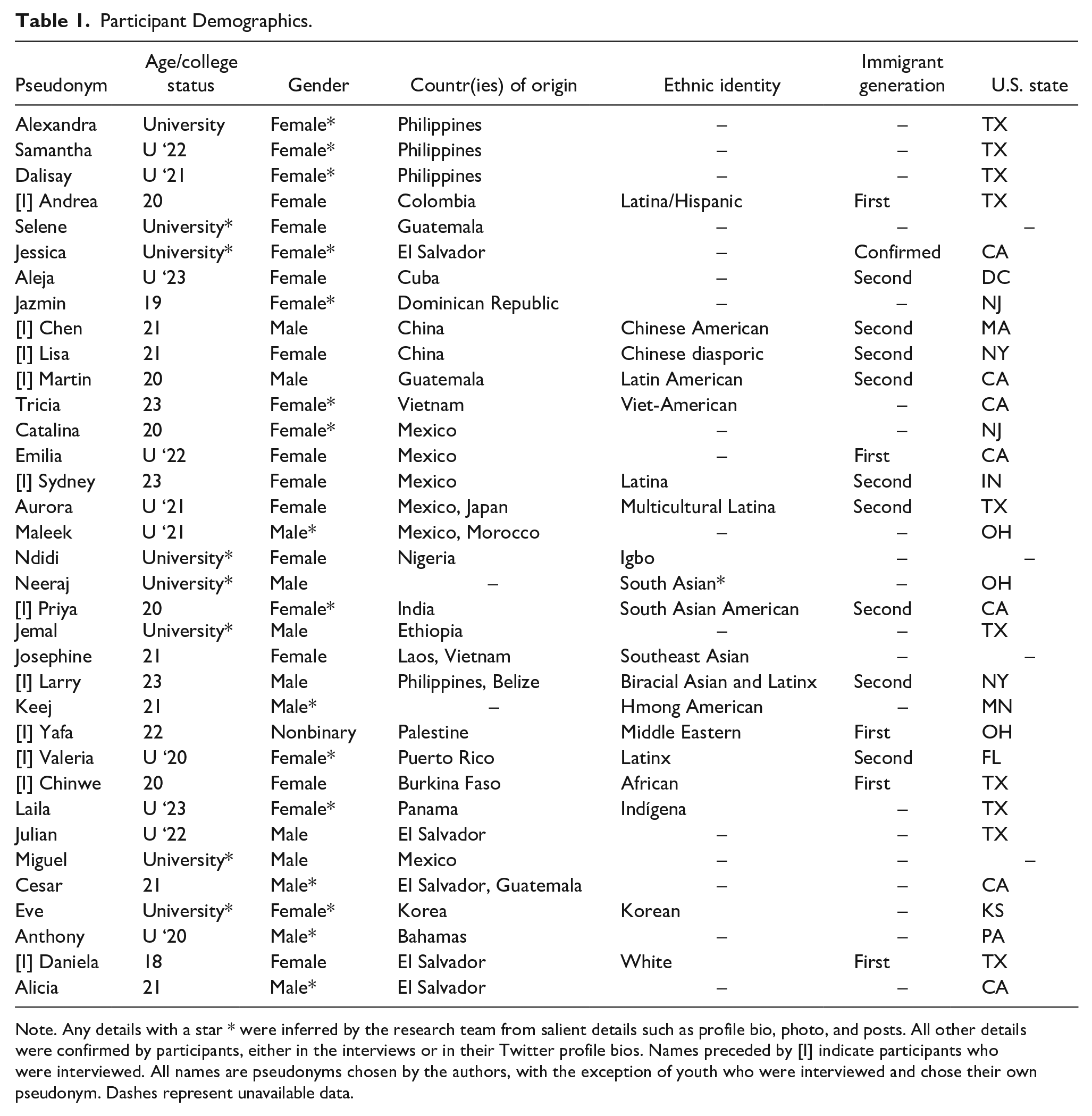
Note. Any details with a star * were inferred by the research team from salient details such as profile bio, photo, and posts. All other details were confirmed by participants, either in the interviews or in their Twitter profile bios. Names preceded by [I] indicate participants who were interviewed. All names are pseudonyms chosen by the authors, with the exception of youth who were interviewed and chose their own pseudonym. Dashes represent unavailable data.
Data Collection
Twitter posts
We aimed to recruit I-O youth who represented a range of civic engagement, from digital activists to those who posted on sociopolitical topics once a month. We also aimed to recruit a sample of I-O youth who were representative of the most common countries and regions of origin in the U.S. immigrant population, based on the Pew Research Center’s (2016) data on countries of origin for foreign-born residents. For instance, Mexico was the most common country of origin for U.S. immigrants, at nearly 27% of all immigrants, so our team aimed to recruit Mexican-origin youth at around 27% of our overall sample.
First, we identified four youth- and immigrant-focused organizations on Twitter. We chose Twitter because of its reputation as a space for social and political discourse and activity, and selected participants from the following accounts: Florida Immigrant Coalition (~9,600 follow- ers), California Immigrant Youth Justice Coalition (~7,800 followers), United We Dream—Texas (~2,500 followers), and United We Dream (~132,000 followers). These organizations were selected because they represented different regions of the U.S. and had a high number of followers across the country, which we reasoned would lead to a more geographically representative sample. By clicking on each account’s followers, we viewed a list of individual accounts.
Next, we scrolled through each organization’s followers list to identify participants who (a) were located in the United States, (b) self-identified as immigrant-origin (as signaled by country flags or words such as “Chicana” in youths’ profiles), (c) were between the ages of 18 to 23 (as signaled by age or undergraduate affiliation in youths’ profiles), (d) posted about sociopolitical issues, and (e) had the Direct Messaging feature on Twitter available so we could send them an opt-out message (described below). Participants confirmed their first or second generation status when they responded to the direct message or at the time of their interview. However, we did not receive confirmation from 17 youth. For these youth, we made inferences based on country-of-origin affiliations (e.g., use of national flags). The affiliations in youth’s bios who confirmed their status did not differ from youth who did not respond, suggesting that the indicators we used were reflective of I-O status. Our team was intentionally broad in how we viewed social and political issues to include any topics that youth themselves might deem a social or political issue. In addition to including posts about traditionally political topics such as elections or civil rights, and established forms of civic engagement such as volunteering or community organizing, we also included any discussion of contemporary societal debates or conversations such as COVID-19, climate change, or social identities such as sexuality, gender, and immigrant identity.
After identifying around 70 participants through these four organizations, we chose a final sample of around 30 youth based on country and region of origin (Pew Research Center, 2016). This initial sample was predominantly Latinx, missing youth whose familial origins were in the Philippines, Ethiopia, and Korea, and regions including the Middle East and the Caribbean. Therefore, we conducted a second wave of recruitment via the Twitter followers of additional university-based organizations for youth from these countries or regions of origin. These organizations were found by searching on Twitter for student organizations serving specific groups of I-O youth. For example, three participants were recruited through a Filipino Student Association, and two participants were recruited through an Arab Students Association. Although this study does not aim to generalize our findings to all I-O youth, we believe our recruitment strategy resulted in a broad array of youth ranging from highly civically engaged on Twitter, to those who posted rarely about sociopolitical issues, as well as representative of the countries and regions of origin most common in the U.S. foreign-born population.
We contacted all participants through Direct Message on Twitter to describe the study, including eligibility, and to give participants the option to opt-out. The message did not require any response if participants consented to being included in the study. The message asked “Please let me know if you do NOT want to be included in the study by replying “I don’t want to be in the study” to this message.” Twenty-three participants responded to the message to confirm their eligibility or express enthusiasm about the study, and nine participants did not respond. Because all participants were active on Twitter, we believe the nine participants saw the message and chose not to opt-out. For each participant, up to 20 screenshots per month from January to June 2020 were taken of posts pertaining to civic engagement, including both tweets and retweets. The number of screenshots was limited to keep the overall data sample manageable.
Interviews
In December 2020, 1-hour semi-structured interviews were conducted over the phone with 11 participants from the sample. All participants were invited for the interview via Direct Message. Interviewees represented 11 different countries of origin; the majority identified as female and second generation (see Table 1). Given that all participants posted most in English, participants were recruited and interviewed in English. Participants provided their verbal consent in English before commencing with the interview. The interview protocol asked participants to describe their immigrant background, how they were civically engaged online, and how their immigrant and other social identities may shape their online civic engagement. Sample interview prompts included: “Can you tell me about your journey of being civically engaged on social media?” and “Because this is a study of how immigrant-origin youth are civically engaged on social media, we’re wondering whether you feel like [input self-described immigrant identity/experiences] influences your civic engagement on social media? If yes, in what ways? If no, what else do you think influences your social media? We used a survey at the end of the interview to confirm participants’ demographic information. The last portion of the interview used member checking (Creswell & Miller, 2000), described below. Participants were paid $15.
Data Analysis
This study used a multi-method, inductive approach guided by reflexive thematic analysis (TA), a method of iteratively interpreting qualitative data by developing themes as “patterns of shared meaning underpinned or united by a core concept” (Braun & Clark, 2019, p. 593). Critical consciousness was the core concept guiding our analysis. This study followed components of reflexive TA including data familiarization, having multiple coders, implementing coding reliability measures, and discussion and memoing around researcher positionality (Braun & Clark, 2020). Multiple data sources, including Twitter posts and interviews, allowed us to compare themes between participants, adding confidence to our findings. Participants’ demographic characteristics were considered not as single-option categories but rather as “multiple identities” in line with Wiley et al. (2019). Although we did not conduct analysis comparing youth holding different identities, we did consider youths’ multiple identities as we coded their posts to explore how their identities may influence the topics in which they engage.
Analysis began during data collection, when team members each immersed themselves in one participant’s posts and held weekly meetings to inductively develop a guideline for which posts would be included as “civic engagement.” The guideline included categories such as calling out injustice, as well as current social and political topics described in the data collection section above, including immigration, COVID-19, and the Black Lives Matter movement. These categories were not based on the core concept of CC, but rather emerged inductively from initial data collection. In addition, any posts where youth discussed their identities were included in the data. Once the guideline was developed we conducted reliability testing which resulted in an 89% average agreement rate, and disagreements were reconciled through discussion.
When Twitter posts for all participants had been collected based on the guideline, we began to analyze the screenshots in Dedoose and to develop a codebook. We each immersed ourselves in one to two participants’ posts, generating memos that were used for group discussion. The core concept of CC, which had informed the way we conceived of civic engagement to be a way of resisting systems of oppression and pursuing liberation, was confirmed through initial data immersion. In weekly team meetings, we next used reflexive Thematic Analysis to develop a codebook based on our memos and structured under the three CC dimensions of critical reflection, critical motivation, and critical action. An additional parent code was created for identity-based posts. We focused our analyses on common experiences between participants rather than identifying potential differences across groups (e.g., racial/ethnic groups), as we centered immigrant identity in this study. After the codebook was developed, the first and second authors worked to ensure consensus in their usage of codes before applying the codebook until saturation, at 1,958 out of 2,203 screenshots (89%).
After coding was completed, the first three authors read through the corpus of their memos and generated memos on overarching themes. The first author conducted code co-occurrence analysis in Dedoose to explore whether certain codes were more likely to be applied together, supporting the development of sub-themes such as Celebrating Shared Identities to Empower and Mobilize. Discussions with the fourth author based on these consolidated memos led to the final themes. Member checking (Creswell & Miller, 2000) was utilized at the end of the interviews, in which participants were asked to review three codes (such as calling out injustice), and then to categorize three of their tweets based on the codes. In this way, participants gave their opinion both on the codes and how their data were coded. The authors supplemented Twitter analysis by reviewing participants’ interviews (when available), and used the interviews to explore participants’ views of our coding of their posts. In addition, the first author coded and analyzed interviews for the three CC dimensions to supplement Twitter analysis and to center participants’ voices in the study findings.
Researcher Positionality
We are cognizant of the history of extractivist research by universities on Black, Indigenous, and people of color that follows in the tradition of European colonialism. Our team centered participants’ own voices and interpretations of their experience wherever possible. The four authors acknowledge their identities and how they have led them to this work. The first author is a white, non-immigrant origin female doctoral student who became interested in I-O youth due to her Jewish and Swedish families maintaining close ties to their immigrant experience and relatives in Europe. Her husband is a first generation Indian American. The second author is also a white, non-immigrant origin female doctoral student. Her interest in I-O youths’ civic engagement emerged from her years as a social studies teacher working with immigrant youth. Her husband is a first generation Mexican American. The third author is a second-generation male American undergraduate student whose parents immigrated to the United States from India and Colombia. His interest in the experiences of I-O youth primarily stems from his own upbringing. The fourth author is a white, non-immigrant origin cisgender female middle-aged faculty member with interests in the civic engagement of youth with diverse backgrounds. She approached the data fully open to learning from I-O youth as experts of their own experiences and cognizant of her privileges and lack of personal experience with the topic.
Findings
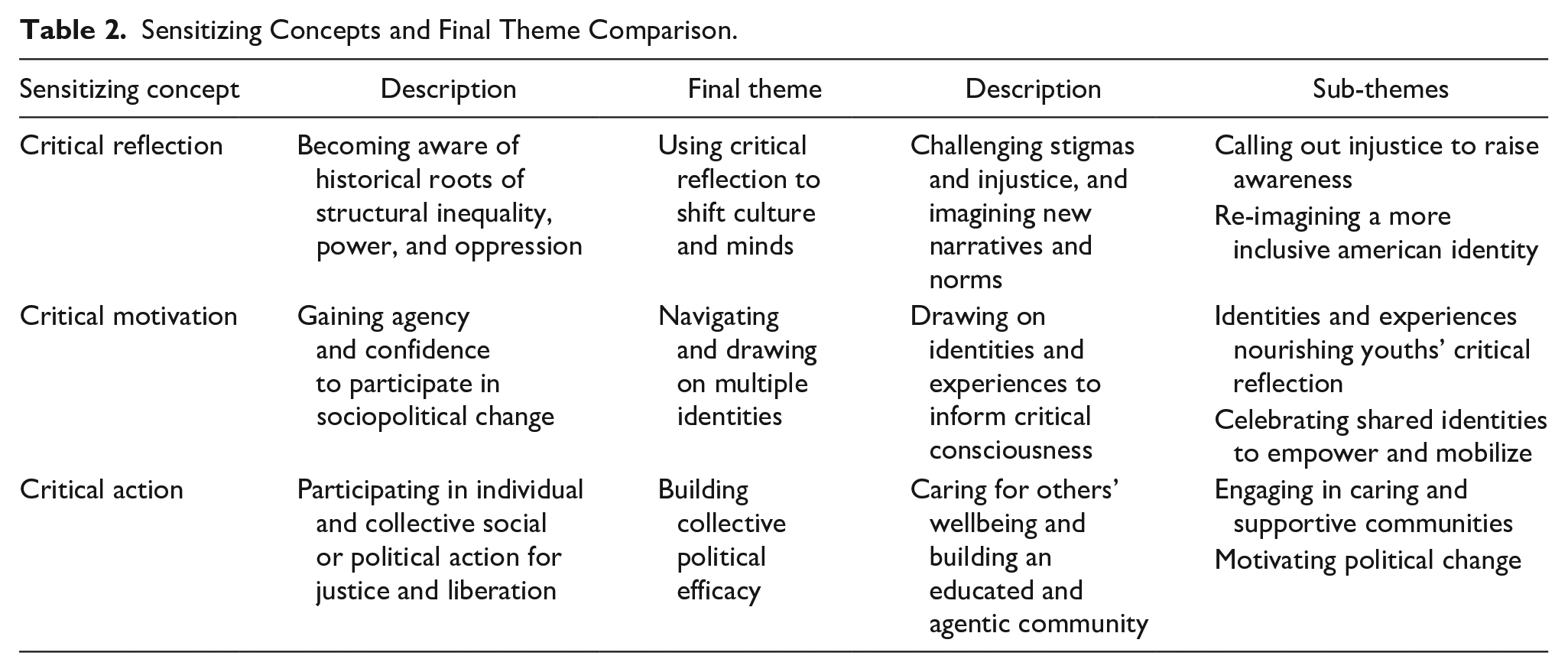
We identified three themes demonstrating I-O youths’ agency in building their own and others’ critical consciousness online: using critical reflection to shift culture and minds, navigating and drawing on multiple identities, and building collective political efficacy (see Table 2). None of the themes fit cleanly into just one CC dimension, and many tweets corresponded with all three CC dimensions. As youths’ tweets were on a public platform, we considered all tweets in this study to be a form of action. In other words, we considered youth to be displaying aspects of CC if their posts intended to raise others’ CC. Due to advances in reverse search technology, in order to protect participants’ anonymity, we do not quote full original tweets in our findings that were posted by participants themselves. We have also assigned pseudonyms to each participant.
Sensitizing Concepts and Final Theme Comparison.
Theme 1: Using Critical Reflection to Shift Culture and Minds
Youth used Twitter to critically reflect upon the historical roots of intersecting systems of oppression to educate and galvanize their followers. Lisa, a Chinese-diasporic female, described this process as an effort to “shift culture and minds.” We identified two sub-themes: calling out injustice to raise awareness and re-imagining a more inclusive American identity.
Sub-theme 1: Calling out injustice to raise awareness
Calling out injustice was used to challenge societal narratives and bring marginalized issues into the public consciousness. On April 5th, 2020, Julian, an El Salvador-origin male, retweeted another user who shared a report: “Of course they have: Hospitals Have Left Many COVID-19 Patients Who Don’t Speak English Alone, Confused and Without Proper Care.” This tweet amplified the injustice experienced by patients and reminded readers that discrimination of non-English speakers is widespread, extending beyond COVID-19. During the rise in the Black Lives Matter movement in spring 2020, youth called out injustice to expose media biases. On June 11th, 2020, Samantha, a Philippines-origin female, retweeted a news organization’s post raising concerns about a spike in COVID-19 cases due to the Black Lives Matter protests: “what abt memorial day weekend? grad parties?. . .but ok the protests are the issue.” This tweet called out the media for biased reporting while also aiming to shift followers’ perspectives.
Youth often called out injustice to motivate changes in thinking or behavior among followers with whom they shared an identity. On July 2nd, 2020, Daniela, an El Salvador-origin first generation female, retweeted criticism about Ted Cruz: “Texans need a TRUE Latinx senator. . .NOT A WHITE-WASHED one that opposes everything his constituents stand for.” In the interview, Daniela explained that this tweet aimed to erode Cruz’s support from the Latinx community: “I think definitely calling out [injustice] — the main thing about that [tweet] was just representation overall, because what’s the point of having a, quote unquote, Hispanic representative if he’s not actually doing things that are going to help the people in his state?” Thus, calling out injustice was used to change how youths’ followers thought about sociopolitical issues, and to elevate certain causes in the public consciousness.
Sub-theme 2: Re-imagining a more inclusive American identity
Youth used Twitter to shift views about who is considered “American,” critically reflecting upon historical and continued discrimination while imagining a more equitable future. Laila, a Panama-origin Indígena female, retweeted on June 13th, 2020: “you’re local, not native. remember who the land belongs to,” re-framing U.S. identity to center Indigenous peoples and reckoning with the U.S.’s historic and continuing disenfranchisement of Indigenous communities. Youth utilized multiple languages in their posts, showing their intentionality in re-imagining American identity to include languages other than English. On February 17th, 2020, Aurora, a Mexico- and Japan-origin second generation female, retweeted: “Chicano = A Mexican American.” This tweet supplants the term “Mexican American” with Chicano, broadening U.S. language to recognize the Chicano community. Thus, youth shifted views and norms around what it means to be “American,” re-imagining a more inclusive American identity.
Youth drew connections between the U.S.’s history of imperialism and violence, and current oppressive policies and narratives. Around the July 4th Independence holiday, youth pointed out the hypocrisy of the U.S.’s founding story alongside subsequent state-sanctioned violence. On July 1st, 2020, Priya, an India-origin female, retweeted: “Soldiers are going missing, black people are getting killed and kidnapped, children are being raped and put in cages by the government. This whole country is run by pedophiles. But ya’ll also gonna celebrate Fourth of July.” Priya explained that her personal experience prompted this tweet: I’ve always kind of seen the injustices that are prominent here. Especially growing up an immigrant with parents who don’t speak English. . .I’ve never celebrated the Fourth of July, and especially this year, with everything that was going on, I think that probably definitely resonated with me, with my immigrant identity.
Thus, youths’ posts challenged the U.S.’s founding mythologies and re-told history to expose historic and current injustice, shaping a critical narrative about the United States.
Chinwe, a Burkina Faso-origin female, explained in the interview that she had tweeted a quote from Frederick Douglass that “this fourth of July is yours, not mine.” Chinwe described her feelings about the holiday based on being an international student and a Black student: Just reflecting on the past fourth of July that I’ve had, on top of being an international, there were often times I’d be the only Black person in my grade. . .a lot of the people that follow me [on Twitter], they want to be active citizens, like American citizens, but the immigration system says they can’t. . .I know my ancestry and I know where I come from, but not a lot of Black Americans can say that. They’re not included the way they should be, and celebrated the way they should be in America, especially on the fourth of July because they weren’t even necessarily free when the fourth of July began.
Chinwe’s description shows how I-O youth can feel excluded from U.S. culture and history, and how they use social media to reframe the U.S.’s founding narrative to encompass a more complete history that acknowledges injustice and imagines a more inclusive American identity.
Theme 2: Navigating and Drawing on Multiple Identities
Youth drew on multiple identities in their posts, spanning student, state, university affiliation, documentation status, country of origin, class, ethnicity, survivor, sexuality, gender, race, sibling, and many others. We identified two sub-themes: identities and experiences nourishing youths’ critical reflection, and celebrating shared identities to empower and mobilize.
Sub-theme 1: Identities and experiences nourishing youths’ critical reflection
Youths’ transnational identities and experiences were expressed in their critical reflection, particularly in their awareness of and interest in global affairs, and their sensitivity to the connections between the U.S. and other countries. During the onset of COVID-19 restrictions, youth often compared the U.S. to their country or region of origin. Tricia, a Vietnam-origin female, retweeted on March 31st, 2020, that Vietnam had “not a single death from coronavirus among its 96 million people’’ in clear contrast to the U.S., which had experienced over 4,000 deaths at that point. Priya explained that I-O youth often brought a global perspective into their critical reflection: “I think a majority of children of immigrants engage with issues often from a diasporic lens, so talking about issues at the intersection of domestic and international politics.” Thus, personal ties outside the U.S. played a large role in the issues in which I-O youth engaged, and how they critically analyzed these issues.
Youth drew upon their identities and personal experiences to critically reflect upon intersecting oppressions in the U.S. On April 22nd, 2020, Valeria, a Puerto Rico-origin female, retweeted a post that was shared by several female youth in this study: “Are you the eldest daughter of an immigrant household? Or are you normal?” Valeria explained that this post spoke to the unique and intersecting oppressions she faced as a Latinx eldest daughter: Latinx culture tends to be very machista and to be very patriarchal. . .You are not a daughter, you are a co-parent. And that is so hard. And one of the reasons that I posted that is because I know that a lot of my friends have lived similar experiences, know exactly what I’m talking about, because I wanted other people to be seen and heard and validated in that experience.
Valeria’s reflections on this posts’ connections to intersecting oppressions, and desire to validate and empower other immigrant daughters, show how youth drew upon their multiple identities and personal experiences in their critical reflection.
Sub-theme 2: Celebrating shared identities to empower and mobilize
Youth merged critical reflection with posts that celebrated their identities, educating their followers while building an affirming collective identity. Ndidi, a Nigeria-origin female, retweeted on April 13th, 2020, to normalize “black natural hair. all textures. and when you see a black woman rocking her natural hair, stop asking if they’ve ever thought about straightening it.” In the context of historic and continuing discrimination against Black women wearing natural hairstyles, this post encouraged non-Black people to recognize potential stereotypes they held, while also empowering Black women by celebrating their natural hair. Ndidi’s post shows how celebrating a shared identity, and in particular affirming aspects of an identity that are marginalized, is a part of I-O youths’ critical consciousness expression online.
Youths’ posts celebrated the civic engagement of people with a shared identity, inspiring and mobilizing their followers. On April 24th, 2020, Valeria tweeted that if Alexandria Ocasio-Cortez, a Puerto Rico-origin immigrant, could be elected to Congress then “what the fuck can I not do?” This post celebrated Congresswoman Ocasio-Cortez’s accomplishments and looked to a future where other immigrant women could aspire to similar achievements. Similarly, many youth retweeted celebratory posts about I-O youth graduating from college. Chen, a China-origin male, explained how celebrating the accomplishments of immigrant and Asian American youth could inspire and motivate others: I interned at my congresswoman’s office last year. And my high school made a post about me on social media. . .it’s also kind of empowering because my high school is majority white. . .And I felt like it was a good thing to share that post about me, because it shows that there are not only pathways for people who are of a minority background, or an immigrant background even, to be civically engaged and to be active in politics. . . I think seeing, having that post up there, might have acted as an inspiration for others.
For Chen, representing and celebrating the civic engagement of immigrant and minority youth could empower and motivate others to create sociopolitical change. Whether critically reflecting upon and affirming a shared identity, as with Ndidi, or highlighting the accomplishments of others with a shared identity to influence others’ critical motivation, like Valeria and Chen, celebrating shared identities was an important aspect of youth’s online critical consciousness.
Theme 3: Building Collective Political Efficacy
This theme encompassed youths’ actions to build critical motivation and mobilize for change. Sub-themes included engaging in caring and supportive communities, and motivating political change.
Sub-theme 1: Engaging in caring and supportive communities
Youth described online communities as safe spaces to learn about and take collective action. These communities could be formal, such as a digital organizing group, or informal, such as engaging in what Martin called “Central American Twitter” by following other Central American users and utilizing certain hashtags. One way that youth cared for their communities was by promoting self-care so that they were able to continue their civic engagement. As Yafa, a Palestine-origin nonbinary person explained, “It [burnout] can affect you really negatively, and it can make you want to stay away from all of this [civic engagement] at the end. So I think self care is very important, especially when the issue that you’re fighting for affects you personally.” Youth used Twitter to promote self-care and de-stigmatize mental health, creating caring online communities where youth were empowered to take care of their psychological wellbeing.
Youth also provided psychological support to their followers during emotionally challenging events. On June 8th, 2020, Catalina retweeted a message to DACA recipients: “I cannot even begin to imagine the amount of stress and uncertainty that #DACA recipients have to continue to hold on to right now. I am so sorry that this country is failing you. You all deserve to be citizens. You all deserve the right to education.” Catalina’s post validated DACA recipients’ emotional distress and provided support in the context of oppressive anti-immigrant policies. On February 27th, 2020, Andrea retweeted: “it’s hard being first gen/low-income. it’s hard feeling like my clinic teammates or classmates are always so much more prepared than me because they don’t have the same obligations outside of classes.” These posts expressed how difficult a shared experience could be for one’s psychological wellbeing, normalizing and validating these emotions. By pointing to structural causes of the issue (such as intersecting oppressions faced by first generation students), these posts also alleviated potential feelings of guilt or imposter syndrome, which could be an empowering reminder for their followers.
Sub-theme 2: Motivating political change
This sub-theme reflects tweets that provided a sense of political agency by building youths’ confidence in their capacity to create change. Some posts were celebratory of political successes in ways that honored youths’ political contributions, such as Priya’s retweet celebrating a coalition of Indian American Hindu students and union activist students: “These amazing undergrads are not afraid to speak truth to power. Student struggles in India and here give us hope and [fire emoji].” Other posts celebrated political victories that centered immigrants. On June 18th, 2020, when the Supreme Court ruled against the Trump Administration’s efforts to end DACA, multiple youth in the sample like Julian posted celebratory comments: “the fight doesn’t stop here. . .we’re here to stay man.” These posts celebrated political victories, which youth in the interviews explained was important in their continued civic engagement efforts, because it reminded them of their collective political power and motivated them to act.
Youth often included a transnational perspective in empowering others with reminders of the historic power of social movements. Larry, a Philippines- and Belize-origin male, described using Twitter to encourage Asian Americans to participate in Black Lives Matter protests. On June 3rd, 2020, he retweeted a video of a young Tiananmen Square protester on a bicycle, a red headband around his forehead and a grin on his face. Larry explained his reasons for posting: I think a lot of Asian people think that being politically active is not for them. And I think this [post] was a way of kind of nodding to that and being like, actually, there’s been well documented cases of Asian people being politically active. . .And so I wanted to share with people that it [protesting] doesn’t need to be about the rage that you feel, you can also feel a lot of other things and that’s completely acceptable.
Youths’ tweets uplifted and celebrated successful movements in the U.S. and around the world, empowering their followers with a sense of collective critical motivation in creating change that often centered the contributions of those who shared a similar ethnic or immigrant identity.
Discussion
This study inductively explored how immigrant-origin (I-O) youth expressed civic engagement online, and how their immigrant identities shaped their online civic engagement. Framed by the sensitizing concept of critical consciousness (CC), we explored youths’ online civic engagement in their own words by analyzing a combination of their Twitter posts and interviews. All three dimensions of CC appeared in youths’ posts, reflecting their agency and intentionality in bringing themselves and others to awareness through critical reflection; providing psychological support and political empowerment through critical motivation; and encouraging others to take collective action to dismantle oppression. Youths’ interviews further reinforced that their social identities and personal experiences nourished their CC online.
Multiple Identities and Experiences Nourish Youths’ Critical Consciousness Online
Youth described strong linkages between their identities and their CC on social media, including the accounts they followed and retweeted, and the topics in which they engaged. Youth who were interviewed described how following people with whom they shared an identity broadened their understanding of global inequality and oppression and ways to take action, but also provided opportunities for celebration, affirmation, and support. In particular, youth often amplified other immigrants from their country of origin, or who shared a regional (e.g., Central American) or ethnic (e.g., Indigenous) identity. Our findings align with the work of Sulé et al. (2021), who demonstrated that when Black youth engaged in challenging structural racism, they were simultaneously affirming their own identity and their group’s humanity.
The social identities of each young person in this sample shaped their CC online, and youths’ social identities (and their relative importance) were unique to each individual. Social identities encompassed demographic categories (e.g., gender, sexuality, geographic location, and religion) as well as experiences (e.g., documentation status, historical trauma, sexual assault survivor, and student). Youth often moved beyond pan-ethnic labels to specifically contextualize their own cultural experiences. Using broad racial and ethnic categories in this study (such as “Asian American” or “Latinx”) would have meant the richness and nuance of youths’ online CC, particularly ways their critical reflection and motivation merged, would have been lost. Our findings suggest that the racial and ethnic categories often used in scholarship with I-O youth may be insufficient to encompass youths’ full social identities and civic engagement on social media. Furthermore, our findings underscore the importance of qualitative research in centering I-O youths’ own views of how their multiple identities merge to shape their online CC.
Critical Consciousness is Embedded Within Youths’ Social Media Posts
We identified each of the three CC dimensions embedded within youths’ posts. First, we see strong evidence of critical reflection (Rapa et al., 2020), with youth calling out injustice and reframing American identity to encompass marginalized groups and to educate their followers. Youths’ efforts to raise awareness about sociopolitical issues online points to avenues for researchers to explore how youth may be directing their own, and their peers’, sociopolitical education online in ways that may complement or further school-based civic education. In line with prior conceptualizations of critical reflection and motivation as a reciprocal process (Watts et al., 2011), we found that youths’ critical motivation was more often tied to their critical reflection, as well as building caring and supportive communities, than to actions such as encouraging voting or attending protests. Also corroborating research on the importance of youths’ racial and ethnic identity in their CC development (Kiang et al., 2021; Mathews et al., 2019; Pinedo et al., 2021), we found that youth empowered their followers with whom they shared a racial or ethnic identity with psychological and material support. They also encouraged a sense of collective efficacy by celebrating political victories and reminding followers of the power of social movements, both in the U.S. and abroad. These findings point to the promise of future research that explores how critical motivation and reflection merge for youth who are building an efficacious and empowering collective identity.
Finally, our study reflects the ways in which critical action manifests on social media, such as encouraging people to vote, sign petitions, or call one’s representatives. We conceived of all the posts in this study as a type of critical action, which extends traditional ways of defining and measuring youths’ critical action to encompass their attempts to encourage other youths’ critical consciousness development (Watts & Hipolito-Delgado, 2015). Scholarship does not often study the role of youths’ critical actions on their peers’ CC development, but our findings suggest that this is a clear direction for future research, as I-O youth may use social media to spur critical reflection, motivation, and action among their followers.
Complicating Distinct Dimensions of Critical Consciousness Online
Often research on youths’ CC is focused on separately understanding each dimension and how one might predict or inform the other (e.g., Rapa et al., 2020). Our analysis of Twitter posts suggests that in youths’ everyday lives, critical reflection, motivation, and action are often integrated and inseparable. Developmental research on CC may benefit from thinking of CC more holistically and understanding when and how youth integrate these dimensions online and otherwise. Moreover, future research should take into consideration how young people themselves intend their tweets to be read, as our study demonstrated that youth may speak to multiple audiences in a single post, with a distinct dimension of CC for each audience. We validated our understanding of youths’ intentions in the interviews by asking how youth themselves would categorize their tweets. Most of the time youth did agree with our analysis, but their responses also added richness and nuance to their intentions in posting that we could not have determined without their voices and input. We believe qualitative research utilizing youths’ social media posts is strengthened by allowing youth to explain their motivations in posting.
Expanding Dimensions and Measures of Youths’ Critical Consciousness Online
Our findings have implications for future research to expand definitions and measures of youths’ CC. First, we demonstrate that pursuing individual, relational, and collective psychological wellbeing is embedded within youths’ CC development online (Watts et al., 2011), and that social media may be a particularly important space for youth to take care of their own and others’ wellbeing (Kelly, 2018; Zimmerman, 2016). Yet, other research demonstrates that experiencing vicarious trauma online, such as viewing videos of undocumented immigrants kept in cages by the government or Black people killed by the police, can negatively impact Black and Latinx youths’ mental health (Tynes et al., 2019). It is important for research on social media use to consider benefits as well as harms of social media and better understand how youth navigate these complex experiences. Youth’s online CC should be studied in relation to psychological wellbeing. Future scholarship could consider how pursuing psychological wellbeing is part of youths’ online CC, such as whether it functions as a form of critical action or may instead be embedded throughout youths’ CC development.
Second, our findings reinforce the importance of developing an empowered collective identity in youths’ CC online (George Mwangi et al., 2018; Kelly, 2018; Knight-Manuel, 2011), particularly for I-O youth holding marginalized identities who face historic and continued structural oppression in the U.S. Further research is needed to explore how developing collective identities may function within youths’ CC, such as whether collective identification is a fourth dimension of CC (Watts & Hipolito-Delgado, 2015), especially on social media where youth have agency in seeking out and building communities based on shared identities. Finally, future scholarship should consider how raising others’ CC could be conceptualized as a form of critical action. Raising others’ CC is not included in common measures of the CC dimensions (e.g., Rapa et al., 2020), but our findings provide evidence that this may be a primary way I-O youth are enacting systems change on social media.
Limitations
Our study offers rich insights into I-O youths’ online civic engagement, however limitations exist. First, a comparative analysis of youths’ posts based on their social identities was beyond the scope of this study given sample size constraints, leaving avenues for future investigation. Second, our analyses were constrained to one period of heightened online sociopolitical activity due to the confluence of the COVID-19 pandemic and resurgence in Black Lives Matter protests. Thus, future research can consider I-O youths’ online CC across additional sociopolitical periods. Third, we selected our sample through national immigration- and youth-focused organizations, and future research could sample youth engaged online in different types of organizations and sociopolitical interest areas. Fourth, we recruited youth from just one social media platform. There is much left to be learned about how youth post across platforms to gain a more comprehensive and holistic view of their online civic lives. Finally, because some youth never responded to our direct message to confirm their demographic information, we had to make inferences about their social identities based on their descriptions. Future researchers should think about other ways to confirm youths’ identities and social positions.
Conclusion
This study inductively explored how I-O youth, who represent one-quarter of youth in the U.S., expressed civic engagement on social media, and how their identities shaped their civic engagement. We found that youth are agentic and deeply intentional in building empowered and efficacious communities on social media to mobilize for systems change, and that CC was an appropriate frame for their posts. This study adds to the emerging literature documenting I-O youths’ civic engagement on social media as a group, and how their multiple identities and personal experiences nourish all aspects of their CC online. This study provides rich avenues for future research, including how raising others’ CC online may function as a form of critical action, and how celebrating shared identities may support youths’ CC process. In addition, our findings highlight understudied facets of I-O youths’ CC, such as re-imagining a more inclusive American identity and pursuing individual and collective psychological wellbeing, demonstrating ways that I-O youth are civically engaged online that educators, policymakers, and scholars can celebrate and support.
Footnotes
Acknowledgements
This paper is part of an overarching research project studying immigrant-origin youth’s civic engagement on social media. Although analysis and writing for this paper was completed by the four authors, other critical aspects of the study including data collection and code development were supported by Jaime Garcia (UCLA), Aditi Rudra (UCLA), Taina Quiles (UVA), Bethany Jo Murray (UCLA), and Dr. Carola Suárez-Orozco (University of Massachusetts Boston).
Declaration of Conflicting Interests
The author(s) declared no potential conflicts of interest with respect to the research, authorship, and/or publication of this article.
Funding
The author(s) disclosed receipt of the following financial support for the research, authorship, and/or publication of this article: The authors would like to acknowledge their gratitude to the UCLA Bedari Kindness Institute for funding this project.
