




Abstract
In this article we examine whether different agents of socialization—family, school, and peers—are differentially associated with offending among different immigrant groups. Our expectation is to find that the association between delinquent friends and offending is stronger for first- and second-generation immigrants than for youths of native Swedish background. We use data from four nationally representative self-report studies of 21,504 adolescents with an average age of 15 years in Sweden. The results show that both first- and second-generation immigrants report committing more offenses than natives. The association is rather weak and the two predictors account for only a marginal amount of the variance in total offending. The results also show that the association between delinquent friends and offending is stronger for both first- and second-generation immigrants than for natives.
Both national and international European research show youth of immigrant background to be overrepresented in registered and self-reported offending (Hällsten et al., 2013; Salmi et al., 2015; Svensson, 2015; Torgersen, 2001). This overrepresentation is more marked in relation to registered crime, whereas some self-report studies have found no differences (e.g., Klement, 2019; Salmi et al., 2015). In contrast to European studies, research from the United States has instead reported results showing that immigrants commit fewer offenses than natives (Ousey & Kubrin, 2018).
It is likely that the overrepresentation seen in European studies based on police data is at least partly due to differences between immigrant and nonimmigrant youth in the likelihood of being registered by the police, for example, as a result of racial profiling or the overpolicing of areas with a high proportion of immigrant or minority residents (e.g., Schclarek Mulinari, 2020). The research also shows that part of the overrepresentation is explained by differences in parental socioeconomic status and neighborhood resources during childhood (e.g., Hällsten et al., 2013). But we know very little about the intermediate mechanisms through which these factors are transformed into higher levels of offending. Various explanatory models have been discussed, but scholars agree that more research is needed to identify explanations for the difference (Hällsten et al., 2013; Mears, 2001).
One limitation of the existing research in this area is that much of it has been based on data from official registers, which do not include the information required to test hypotheses about the mechanisms underlying the overrepresentation. One important hypothesis—which has also been confirmed in more general youth crime research—is that differences in offending may be linked to levels of attachment to agents of primary and secondary socialization, that is, the family, school, and peer group (e.g., Hirschi, 1969). These agents can prevent offending by promoting prosocial norms and by exerting informal social control, while the peer group may also promote norms and attitudes that instead increase the likelihood of offending. As register data largely lack information on ties to these socialization agents, they cannot be used to study their effect on immigrant youths’ overrepresentation in crime. Such analyses require self-report data.
Using data provided by 21,504 adolescents in four waves of a large national self-report study on youth crime, this study examines whether relations with the family, school, and peer group are differently associated with offending among immigrant and nonimmigrant youth respectively. Such differences are quite possible, as the groups occupy qualitatively different positions in relation to these important agents of socialization and social control.
This article focuses on the question of “immigration” irrespective of variations in the ethnicity of those who comprise the group identified as having an immigrant background. The issue addressed is thus whether there are aspects of the immigrant experience which are common to all those migrating to a different country that may impact upon the relationship between factors commonly regarded as predictors of delinquency and levels of involvement in offending.
Theory
There are several possible theoretical explanations for immigrant youths’ overrepresentation in crime. These focus on inter alia background differences in, for example, social class (Merton, 1968), social bonding (Hirschi, 1969), peer associations (Sutherland & Cressey, 1955), culture conflict (Sellin, 1938), and neighborhood of residence (Shaw & McKay, 1942). In this article, we draw on elements from two different theoretical perspectives, social bonding, and social learning, in order if possible to explain the differences in offending reported in previous research. As noted above, we will be focusing on the role that three major agents of socialization, family, school, and peer group, may play in immigrant youths’ overrepresentation in crime.
Within the social bonding perspective, the family is in many ways viewed as the “extended arm” of conventional society, via which conventional values are conveyed to children (Hirschi, 1969). Hirschi (1969, p. 18) has argued “that the more strongly a child is attached to his parents, the more strongly he is bound to their expectations, and therefore the more strongly he is bound to conformity with the legal norms of the larger system.” If on the contrary individuals are not bonded to their parents and do not care about their expectations, they are “free to deviate.” The relationship between family factors and offending is well established (e.g., Hirschi, 1969; Hoeve et al., 2009; Nilsson, 2017; Stattin & Kerr, 2000). Strong emotional bonds between child and family improve the likelihood of the child internalizing these conventional values (Grusec, 2011; Svensson et al., 2017; Tangney & Dearing, 2002). The stronger a child’s emotional ties to parents, the lower the likelihood of offending (Hirschi, 1969; Hoeve et al., 2012; Hoffmann & Dufur, 2018). Beside conveying norms and values, research shows that the family also reduces the risk of offending via parental monitoring (e.g., Nilsson, 2017; Stattin & Kerr, 2000).
The other agent of conventional social control commonly discussed in connection with the social bond to society is the school (Hirschi, 1969). Hirschi (1969), for example, has argued that bonds to school, such as attachment to teachers, involvement in school activities and commitment to school, are all important in the explanation of offending; the stronger an individual’s bonds to school, the lower the probability of offending. School also functions as an important agent of socialization. Here children learn skills and attitudes that enable them to integrate into society, and research shows that school continues to function as an important agent of prosocial socialization during youth (e.g., Wentzel & Looney, 2007). Many studies have reported significant correlations between offending and various indicators of attachment to school (e.g., D. C. Gottfredson, 2001; C. O. Hart & Mueller, 2013; Hirschfield, 2018).
In school, children and youth also come into contact with various peer groups, whose significance tends to increase as children enter their teenage years (D. Hart & Carlo, 2005). Through socialization within the peer group, the norms and values of other peer group members also become significant (Akers, 1998; McGloin & Thomas, 2019; Sutherland & Cressey, 1955). During youth, the norms and values conveyed via peer group bonds assume an increasingly strong position in relation to those conveyed by the other agents of socialization (Giordano, 2003). The correlation between offending and associating with peers who commit offenses is among the most robust in youth crime research (e.g., Akers, 1998; Hoeben et al., 2016; Knecht et al., 2010; Warr, 2002; Weerman, 2004). In social learning theory, this association is interpreted as involving delinquent friends influencing adolescents via the transmission and reinforcement of deviant norms that condone and encourage norm-breaking behavior (Akers, 1998; Sutherland & Cressey, 1955). There has been some discussion as to whether this association should be seen as a selection effect (Glueck & Glueck, 1950; M. R. Gottfredson & Hirschi, 1990; Hirschi, 1969) or as a “true” causal effect of social influence (Akers, 1998; Sutherland & Cressey, 1955). Previous longitudinal research supports the view that the association reflects both a selection effect and a causal effect (e.g., Erickson et al., 2000; Haynie, 2001; Matsueda & Anderson, 1998; McGloin & Thomas, 2019; Weerman, 2011).
One important question is whether the significance of these three socialization agents may differ between youths of immigrant and nonimmigrant background. As regards the role of school, research shows that youths of immigrant background generally have more difficulty developing strong bonds to school than nonimmigrant children (e.g., Bunar, 2012; Kallstenius, 2010).
Research from the United States suggests further that the role played by the peer group as a source of information is more important for children of immigrant parents than for those with native-born parents. This is inter alia due to immigrant parents generally having less of the cultural competence specific to their new country than native-born parents, whose children acquire various types of “tacit knowledge” about life in the society in question more or less “automatically.” This may, for example, involve knowledge about how to get a weekend job, what types of associations are open to young people and where to turn to join such associations (cf. Waters, 1999). Thus while native-born parents can provide this information to their children, the children of immigrant parents must more often turn to what might be termed “alternative learning environments”—including the peer group. By extension, this leads to the peer group becoming more important for children of immigrant background than for children of native-born parents (Waters, 1999).
Previous Research
Both national and international research has found that youth of immigrant background account for a larger proportion of self-reported offending than youth of native nonimmigrant youth (e.g., Salmi et al., 2015; Vasiljevic et al., 2020; Vazsonyi et al., 2006). Studies in this area employ different definitions of immigrant background, with the most common definition primarily focusing on those who have at least one foreign-born parent. Results from these studies are in line with those described above, and show that youths with at least one foreign-born parent report more offending than youths with two native-born parents (e.g., Oberwittler, 2004; Svensson & Pauwels, 2010). Studies employing definitions based on additional categories together depict a more nuanced and in part contradictory picture. While Swedish studies have shown that youths born abroad (first-generation immigrants) offend more often than youths born in Sweden to foreign-born parents (second-generation immigrants; see, e.g., Andersson, 2000; Martens, 1997), studies from other countries instead show offending to be somewhat more common among second-generation immigrant youth (Vazsonyi et al., 2006; Vazsonyi & Killias, 2001). Studies based on Swedish police data have also shown that being registered for violent crime is more common among first-generation immigrants, whereas being registered for property crime is more common among second-generation immigrants (Kardell & Martens, 2013). A Norwegian study, which employed a third categorization, found offending to be higher among youths with one immigrant parent than among youths with two immigrant or two native-born parents (Torgersen, 2001). Given these contradictory results, we feel it is motivated to focus on different groups of youths of immigrant background.
Relatively few studies have specifically tried to explain why individuals of immigrant background are overrepresented among offenders. One such study is that of Hällsten et al. (2013). It aimed to explain differences in registered crime by reference to the parents’ socioeconomic background and differences in the residential environment. The results show that differences in social background and neighborhood resources explain much of the difference in registered offending between the children of immigrant and native-born parents. Self-report studies have noted that self-control and deterrence are associated with offending for both first- and second-generation immigrants and for youths with native-born parents (Vazsonyi & Killias, 2001). Other research has found that family factors also tend to affect offending in similar ways among youths of native-born parents and among first- and second-generation immigrants (Vazsonyi et al., 2006). In a Finnish self-report study, Salmi et al. (2015) found that the association between immigration and offending remained significant after controlling for a number of theoretically relevant predictors. The results also showed that weak parental monitoring and risky routines appeared to be most important in explaining the overrepresentation in offending of immigrant youth.
Other studies have included immigrant background as a background variable in broader analyses (e.g., Oberwittler, 2004; Pauwels, 2012). Here the aim has not been to study differences in offending between youths of immigrant and native background respectively, but to test different theoretical models. One conclusion from these studies is that the correlation between immigrant background and crime tends to remain following controls for the variables included in the theoretical models, but that the variance explained by immigrant background is rather low (e.g., Kardell & Martens, 2013; Svensson & Pauwels, 2010). As these studies include immigrant background only as a background variable, however, they have not tested whether the theories function better or worse in explaining the offending of youths of immigrant and nonimmigrant background respectively. There is thus reason to test more complex models to improve our knowledge about why youths of immigrant background are overrepresented in offending.
In summary, some studies have tried to explain certain aspects of why individuals of immigrant background are overrepresented among offenders. One of the most comprehensive and sophisticated of these is based on register data (Hällsten et al., 2013). As has been noted above, one problem associated with register studies is that they do not allow for an examination of how family, school, and peer group processes might help us to understand differences in offending. Another study that has examined the overrepresentation of immigrant youth in offending is that by Salmi et al. (2015). One major limitation of this study, however, is that it does not examine different dimensions of immigrant background. The above research review thus shows a clear lack of studies that have systematically examined how differences in offending between youths of immigrant and native background may completely or in part be explained by reference to central criminological theories focused on the roles played by family, school and peer group, and this despite the fact that these socialization agents have shown themselves to be very important in the explanation of youth crime. In addressing this gap in the research, the current study will contribute knowledge that is lacking from the research both in Sweden and in an international perspective. In doing so it will make a contribution to theoretical development and will also provide important insights that may be of use in crime prevention work.
The Current Study
Against this background, the aim of the present study is to examine whether different agents of socialization—family, school, and peers—are differentially associated with offending for different groups based on native/immigrant status. Given our earlier discussion of the likely increased importance of the peer group for youths of immigrant background, whose parents lack the tacit knowledge of their destination country that is common to the parents of native-born youth, we would expect to find the association between delinquent friends and offending to be stronger for first- and second-generation immigrant youth than for youths with a native Swedish background.
Method
Participants
This study is based on four cross-sectional nationally representative school surveys of year nine youth, on average aged 15, conducted by the Swedish National Council for Crime Prevention between 2003 and 2011. All of the surveys are based on systematic samples of schools with year-nine classes. The data were primarily collected between November and January. The principal of each school distributed the questionnaires along with information about the study to teachers, and students completed the questionnaires during lesson time in the presence of the teacher. The surveys included a total of 6,692 adolescents in 2003, 7,449 in 2005, 6,893 in 2008, and 6,490 in 2011. The non-response rate, calculated in relation to the respondents in the participating classes, amounted to 14% in 2003, 14% in 2005, 19% in 2008, and 15% in 2011. The four subsamples combined give a total sample of 27,524 adolescents from 427 schools. Following listwise deletion of missing values, the analyses below are based on 21,504 respondents (50.3% girls). The relatively large proportion of missing cases is accounted for by the immigrant background measure (see below). The research design and study procedures were approved by the Regional Ethical Review Board in Southern Sweden.
Measures
Dependent variables
Self-reported offending measures how many times during the past 12 months the respondents report having committed 20 different offending behaviors involving acts of violence, minor theft, serious theft, and vandalism (response alternatives: never/1–2 times/3–5 times/6–10 times/at least 11 times). Three different crimes scales will be used. We will mainly be using a variety scale that includes all 20 offending items from the survey, and which measures how many different types of offenses the youths report having committed. The variety scale has an alpha of .86. In some of the analyses an overall offending frequency scale, with an alpha of .88, will be used. In certain analyses, we will also present prevalence data, that is, whether the youths have engaged in one or more of the relevant offense types. For a discussion of different measures of offending, see Sweeten (2012). The frequency scale is strongly correlated with the variety scale (r = .93) and also with prevalence (r = .47). The variety scale is also correlated with prevalence (r = .61).
Independent variables
Immigrant background is measured using the following questions: In which country were you born? In which country was your mother born? In which country was your father born? The response alternatives are: Sweden/another country. As was noted earlier, different definitions of immigrant background have been used in the research based on whether individuals themselves and one or both of their parents were born in Sweden or abroad. We will be using the following division:
Born in Sweden to two Swedish-born parents: Swedish background
Born in Sweden to two foreign-born parents: Second-generation immigrants
Born abroad to two foreign-born parents: First-generation immigrants
By using this division of immigrant background we will be able to note possible differences between first- and second-generation immigrant youth. This is important given an underlying assumption that the delinquency preventive/promotive effects of school and the peer group might in theory be expected to differ depending on the parents’ level of integration in society at large. This means that youths with one immigrant parent and one Swedish parent constitute missing cases in relation to our categorization of immigrant background. These youths are not included in the following analyses. A total of 87.4% of the respondents were born in Sweden to two Swedish-born parents, 7.5% were born in Sweden to two foreign-born parents and 5.1% were born abroad to two foreign-born parents.
Attachment to parents is a mean index based on four items: (a) Do you think that you usually get on well with your mum? (b) Do you think that you usually get on well with your dad? (response alternatives: never/not often/as often as not/most of the time/always; (c) Can you usually talk about anything at all (e.g., problems) with your mum? (d) Can you usually talk about anything at all (e.g., problems) with your dad? Response alternatives: definitely not/not much/maybe (it depends)/probably/yes, definitely. The alpha for the scale is .76. High scores on this scale indicate strong emotional bonds to parents.
Parental monitoring is an additive index based on two items: (a) Do you have to be home by a certain time at the weekends? (b) Do your parents demand that you tell them in advance what you are going to be doing if you want to go out on, for example, a Friday night? (response alternatives: no, never/rarely/sometimes/often/yes, always). The alpha for the scale is .61. High scores indicate that respondents are strongly supervised by their parents.
School bonds is an additive index based on three items: (a) Do you usually enjoy being in school? (b) Do you think that you have good teachers? (response alternatives: none are good/the majority are not good/as many are good as are bad/the majority are good/all of them are good; (c) How important do you think it is to get good grades? (response alternatives: not important at all/not very important/neither important nor unimportant/quite important/very important). The alpha for the scale is .54. This alpha value is lower than expected. Despite the low value, we have viewed the inclusion of this measure as important for the study, given the theoretical questions examined. High scores indicate that the respondents are strongly bonded to school (they like school, think they have good teachers and that it is important to get good grades).
Delinquent friends is an additive index based on five items: Have any of your friends (those you usually spend time with) done any of the following that you know of: (a) Taken something from a shop without paying? (b) Destroyed something? (c) Broken in somewhere? (d) Hit someone and knocked them down? (e) Been caught by the police? (response alternatives: no/yes). The alpha for this scale is .81. High scores indicate having friends who have committed a number of deviant acts.
Social background is represented using three different measures in our analyses. Gender is coded as zero for girls and one for boys. Split family is coded as zero if the respondent is living with both biological parents and one if this is not the case. In total 24.1% of the respondents came from a split family. First-generation immigrants came from a split family significantly more often than the other groups examined in the study (31.2%, as compared with 22.1% for second-generation youths and 23.9% for youths from a native Swedish background). Unemployment among parents focuses on the parents’ occupations and is a measure of whether the mother and the father are in work. The variable is coded as zero if both of the parents are employed and one if either the mother or the father or both are not in employment. In total, 19.9% of the respondents have unemployed parents. It is more common for first-generation immigrants to have unemployed parents (53.8%) as compared with second-generation youths (38.8%) and youths with a native Swedish background (16.3%).
Statistical Analysis
First, we compare differences between the immigrant background groups and the native Swedish youth with regard to offending, family relations, school bonds, and delinquent friends using one-way ANOVA with a Scheffé post hoc test to compare differences between groups and chi-square tests (for the prevalence measure of offending). Second, we specify three Ordinary Least Squares (OLS) regression models using the offending variety scale as the dependent variable. As OLS regression often does not produce the best unbiased linear estimators when the dependent variable is skewed, we replicated our findings using identical analyses focused on both the variety and frequency scales and using Tobit regression (left-centered) to confirm the stability of the results. The results produced by the Tobit model show the same pattern. These additional analyses were conducted because a number of scholars have argued that the inclusion of interaction terms in OLS regression models may reveal interaction effects that are not substantively meaningful as a result of the skewness of the crime variable (Osgood et al., 2002). For a further discussion of the use of OLS regression in the examination of interaction terms in the prediction of crime see Svensson and Oberwittler (2010) and Kroneberg and Schulz (2018).
In the first model, we begin by including the two immigrant groups—second- and first-generation immigrants—as dummy variables, with youth of native Swedish background as the reference category. In the second model, we include the social background variables, attachment to parents, parental monitoring, school bonds, and delinquent friends. In the third model, three interaction terms based on the two immigrant background variables and the different socialization variables, that is, attachment to parents, parental monitoring, school bonds, and delinquent friends are also included. The problem of multicollinearity has been dealt with by mean-centering the scaled variables prior to their inclusion in the interaction terms (Jaccard et al., 1990). Multicollinearity was not a problem in our analysis, which produced a highest Variance Inflation Factor Score of 1.56, well below critical levels. As the data are based on respondents who are clustered in schools, robust clustered standard errors are presented for the OLS analyses. The use of robust clustered standard errors takes account of the fact that the observations may be correlated within schools. All analyses were conducted in Stata/SE version 13.1.
Findings
Descriptive Analysis
The findings presented in Table 1 show that offending is significantly more common among young people of immigrant background than among young people with a native Swedish background. This finding appears to be stable in relation to the number of offenses committed (frequency), number of offense types committed (i.e., variety scale) and also the prevalence of offending. The findings show no significant differences between the three groups in relation to attachment to parents. The youths with a native Swedish background seem to be significantly less controlled by their parents and to have significantly weaker bonds to school than the two immigrant groups. Finally, the results show that second-generation immigrants have significantly more friends who have committed offenses compared with first-generation immigrants and youths with a native Swedish background.
One-Way ANOVA of Offending, Family, School, and Delinquent Friends by Immigrant Background.
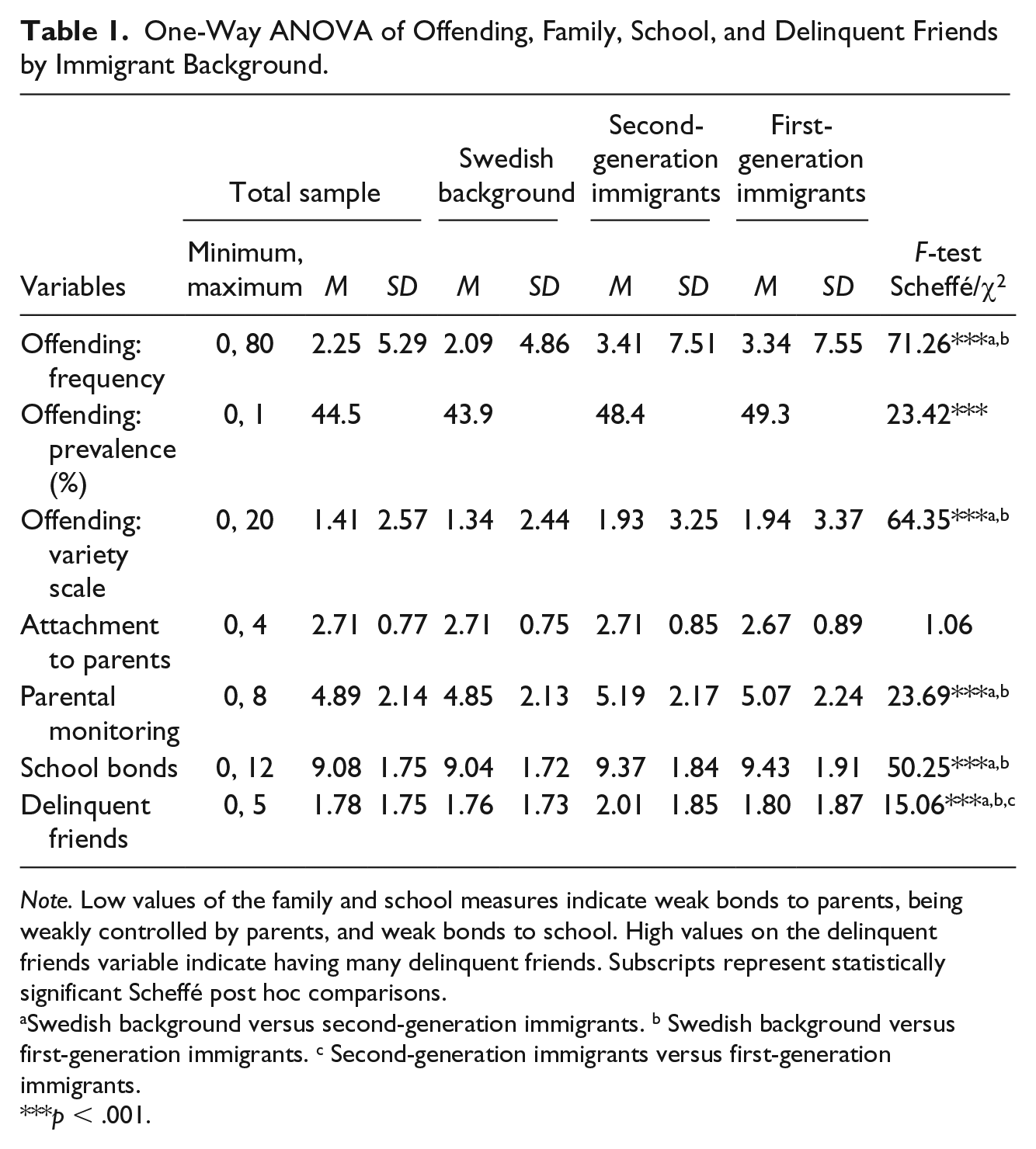
Note. Low values of the family and school measures indicate weak bonds to parents, being weakly controlled by parents, and weak bonds to school. High values on the delinquent friends variable indicate having many delinquent friends. Subscripts represent statistically significant Scheffé post hoc comparisons.
Swedish background versus second-generation immigrants. b Swedish background versus first-generation immigrants. c Second-generation immigrants versus first-generation immigrants.
***p < .001.
Multivariate Analysis
Results from the OLS regression models are presented in Table 2. The results from the first model show that both measures of immigrant background (first- and second-generation) are positively associated with offending. The strength of the association is weak (β = .06 vs. β = .05), indicating that the difference between the groups is marginal. The results also show that the two dummy variables account for less than 1% of the variance in overall offending.
OLS Regression Model Predicting Overall Offending (Variety-Scale; N = 21,504).
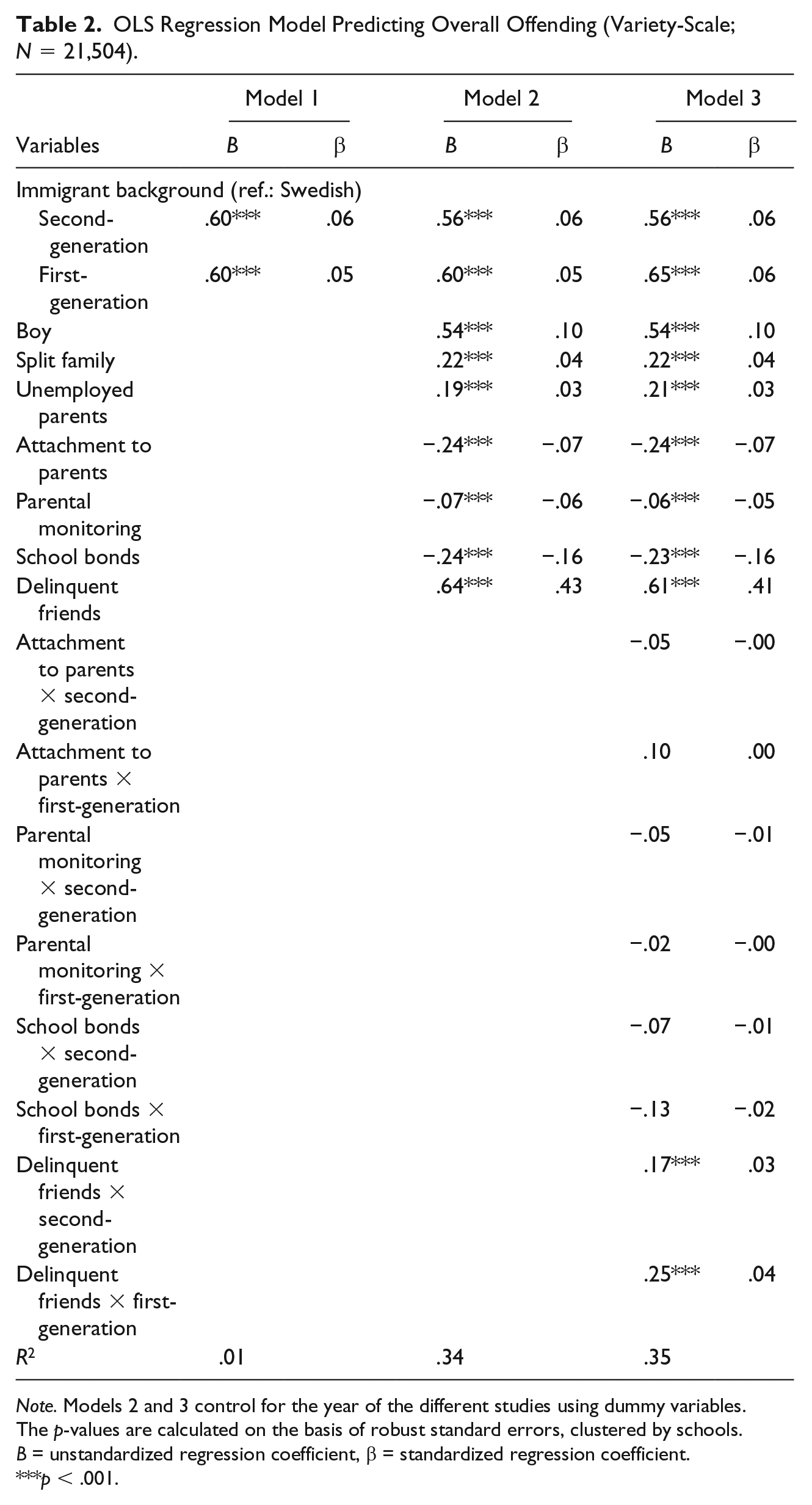
Note. Models 2 and 3 control for the year of the different studies using dummy variables. The p-values are calculated on the basis of robust standard errors, clustered by schools.B = unstandardized regression coefficient, β = standardized regression coefficient.
***p < .001.
In the second model, the strength of the association between the two measures of immigrant background and offending remains largely the same. The results also show that the other predictors are associated with offending in the expected directions, that is, attachment to parents, parental monitoring, and school bonds are all negatively associated with offending, while having delinquent friends is positively associated with offending. Together the variables included in the model explain 35% of the variance in offending.
In the third model, the interaction terms between the two immigration background measures and attachment to parents, parental monitoring, and school bonds are not significantly associated with offending. Attachment to parents, parental monitoring, and school bonds thus appear to be similarly associated with offending for native Swedish youths and for youths with an immigrant background. On the contrary, the results show that the interaction terms for second (B = .17, p < .001) and first-generation immigrants (B = .25, p < .001) and delinquent friends are both positively associated with offending. This indicates that the association between delinquent friends and offending is stronger for both first- and second-generation immigrant youth than for natives. These results confirm our hypothesis that delinquent friends may play a more important role in relation to the offending of youths of immigrant background than that of natives. Additional OLS regression analyses were also estimated separately for the three groups using the same independent variables and the same measure of offending. These results show that the association between delinquent friends and offending is significant for all three groups but that the size of the coefficient varies (B = .61 for natives, B = .75 for second-generation, and B = .83 for first-generation immigrant youth). These results thus show a stronger correlation between delinquent friends and offending for second- and first-generation immigrant youth, supporting the findings reported from the regression model described above.
To visualize the interaction, it has been plotted in Figure 1. The figure plots the predicted numbers of offense types committed (variety scale) by the number of offense types committed by delinquent friends for first-generation immigrant, second-generation immigrant and native youth. The results show that the association between delinquent friends and offending is more pronounced for the two immigrant groups than for the youths of native Swedish background.
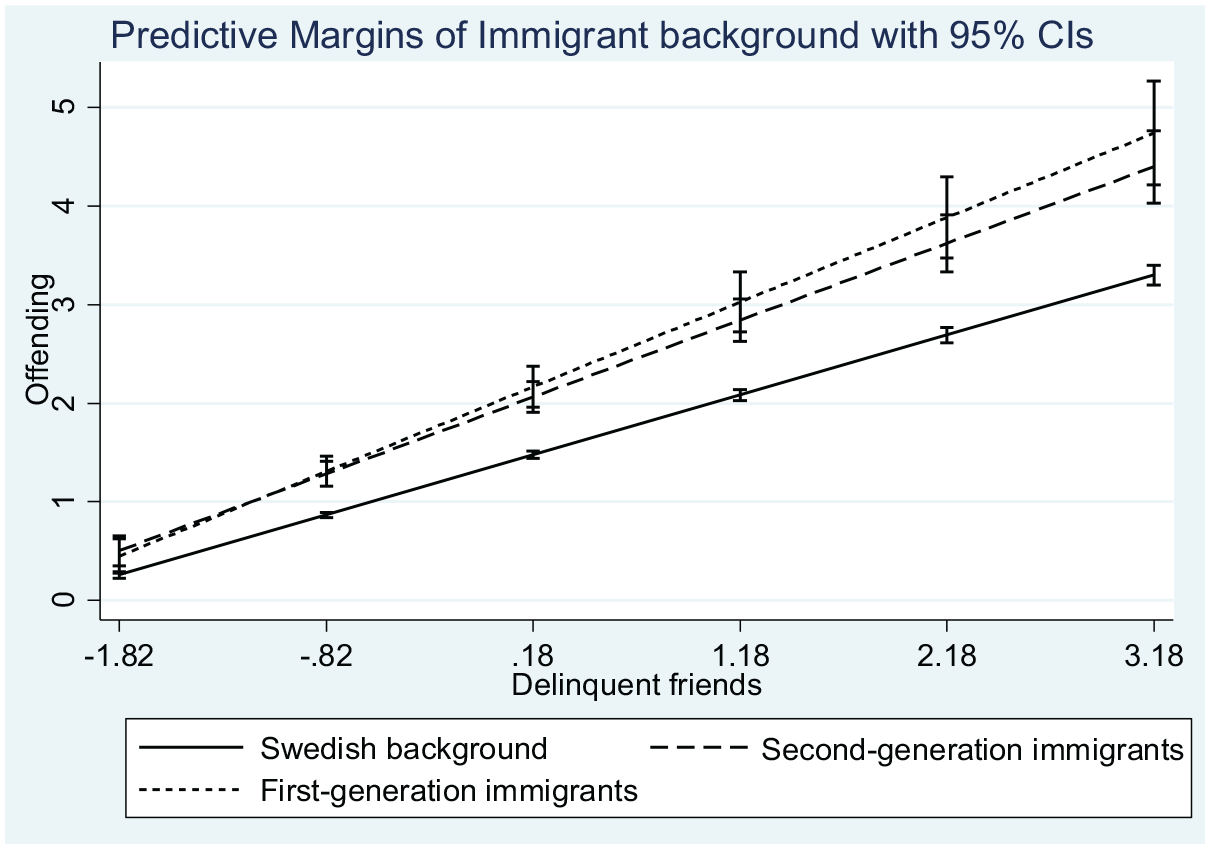
Interaction between delinquent friends and different immigrant groups in relation to offending.
Additional OLS regression analyses were also estimated for the four different survey waves, that is, for 2003, 2005, 2008, and 2011, respectively. These analyses were conducted to examine whether the results are stable over time or whether there are differences between the different years. The results are stable over time, showing that the correlation between delinquent friends and offending is stronger for both first- and second-generation immigrants than for natives. The results also show that both first- and second-generation immigrant statuses are significantly associated with offending in each of the 4 years. Finally, attachment to parents, parental monitoring, and school bonds were also negatively associated with offending, while having delinquent friends was positively associated with offending in each of the 4 years.
Conclusion
In this article we have examined whether different agents of socialization—family, school, and peers—are differentially associated with offending for different immigrant groups. We hypothesized that the association between delinquent friends and offending might be expected to be stronger for first- and second-generation immigrants than for youths with a native Swedish background. To test this hypothesis, self-report data have been used from four waves of a nationally representative self-report study of 21,504 adolescents, with an average age of 15 years, in Sweden.
First, the results show that youths of immigrant background reported more offenses than youths with a native Swedish background but that differences between first- and second-generation immigrants were marginal. It is also important to note that immigrant background only accounts for 1% of the total variance in offending. This is in line with previous studies (Kardell & Martens, 2013; Salmi et al., 2015).
Second, we examined whether attachment to parents, parental monitoring, school bonds, and delinquent friends are differentially associated with offending for youths of immigrant and native background respectively. The results are clear. We found no significant differences between the groups in relation to family and school factors. This indicates that family and school factors are similarly important for the offending of each of the three groups. On the contrary, we found support for our hypothesis that the association between delinquent friends and offending might be expected to be stronger for first- and second-generation immigrants than for youths with a native Swedish background. This is in line with the work of Waters (1999), who has argued that the peer group may have a more important effect on the behavior of immigrant youth than on that of the children of native-born parents. This may in turn be a result of the children of immigrant parents having to rely more on what might be termed “alternative learning environments,” including the peer group, as their parents have lower levels of tacit knowledge about society by comparison with native parents. These results do not, however, mean that spending time with delinquent peers is unimportant for native youth. The results show that there is an association between offending and delinquent friends for all of the groups examined, but that the association is stronger for the two immigrant groups. Together with the similarity found regarding the associations between offending and family factors and school bonds, this means that the study provides support for the significance of both social bonding and learning theories in relation to the offending of both native and immigrant youth (Akers, 1998; Hirschi, 1969; Sutherland & Cressey, 1955). At the same time, the findings indicate that the relative importance of elements linked to social bonding and learning theories respectively may differ between youths of native and immigrant background.
This study has a number of limitations that need to be addressed. One is the study’s cross-sectional design, which cannot provide evidence of any causal influence of the family, school and peer group on offending among immigrant or native youth, but which rather shows how offending is correlated with certain characteristics of social relations. It is also important to note that there are other factors that may be of theoretical relevance and that might have an impact on the identified interaction effect. As we lack information on the length of time that first-generation immigrants have been in Sweden, for example, we cannot know whether this factor may have had an impact on the results. Furthermore, while we have included controls for split family and parental unemployment, which are correlated with both immigrant background and offending, there are likely to be aspects of the immigrant experience that may affect offending, which we have not been able to include in our analyses. These include factors that influence the way the receiving country is experienced by persons of immigrant background, not least experiences of racism and social exclusion, which may also affect possibilities for social integration in the receiving society, and thus also the likelihood of offending.
Even given these limitations, we would argue that the results of the study are important as they provide us with an improved understanding of how family, school, and peer factors may influence youth from different types of immigrant background in relation to offending. They also provide a platform for future causal analyses. Such analyses would in turn be of use for the design and implementation of preventive measures. The formulation of such preventive strategies constitutes an important goal to reduce both offending and the risk for future marginalization in the relevant groups of young people. Given the goal of formulating differentiated prevention strategies, it is also important in future studies to look for potential differences in the factors associated with offending across different subgroups of immigrant youth, for example, between refugee and non-refugee youth or between youth from different ethnic and cultural backgrounds. Given the way digital communication platforms have affected and are continuing to affect socialization patterns, particularly among young people, another question for future research would be to elaborate on the role played by online peer interactions in relation to both online and offline offending, and to examine whether there may be differences based on immigrant background in these respects.
Footnotes
Declaration of Conflicting Interests
The author(s) declared no potential conflicts of interest with respect to the research, authorship, and/or publication of this article.
Funding
The author(s) received no financial support for the research, authorship, and/or publication of this article.
