




Abstract
This study examined how peer norms condition the effect of romantic involvement on adolescents’ externalizing and internalizing problem behaviors. We hypothesized that, as a result of social control and social learning, adolescents who start a romantic relationship report more problem behavior when romantic involvement was not normative behavior in the peer group. We tested this hypothesis for two different peer groups: the friendship network and the class. Using large-scale panel data of Dutch adolescents (N = 2,302; Mage = 14.5) collected in 222 school classes that included sociometric measures, we found that adolescents who started dating reported more problem behavior if dating was not in line with the class’ norm compared with when dating was in line with the class’ norm. Friends’ norms did not moderate the association between romantic involvement and problem behavior.
Romantic relationships are an exciting new part of life for adolescents (Furman & Shaffer, 2003). These relations do not develop in isolation from but rather in the context of the larger peer group (Connolly, Furman, & Konarski, 2000; Dunphy, 1963). Peer beliefs about the appropriateness and desirability of dating matter and are taken into account when starting a romantic relationship (e.g., Brown, 1999; Collins, 2003; Connolly et al., 2000; Friedlander, Connolly, Pepler, & Craig, 2007; Simon, Eder, & Evans, 1992). Favorable norms toward romantic relationships provide guidance for adolescents when exploring this new part of their lives and positively affect the likelihood of entering a romantic relationship (Friedlander et al., 2007). In this study, we contribute to the literature on the importance of peer norms by considering whether the link between romantic involvement and adolescent well-being is conditioned by peer norms.
Several longitudinal studies have found that romantic involvement in early adolescence has a negative impact on adolescent well-being (e.g., depression; Davila, Steinberg, Kachadourian, Cobb, & Fincham, 2004; Furman & Collibee, 2014; Joyner & Udry, 2000; Olson & Crosnoe, 2017; externalizing problem behavior; Furman & Collibee, 2014). Some scholars have suggested that these problems may result from entry at a too young age into a romantic relationship (Chen et al., 2009; Collins, Welsh, & Furman, 2009; Connolly, Nguyen, Pepler, Craig, & Jiang, 2013; Kim, 2013). A potential explanation for the “off-timing” effect is that the impact of romantic involvement on problem behavior is conditioned by the norms about romantic relationships within the peer group (Connolly et al., 2013; Davila, 2008). These norms are likely to be age specific (i.e., presumably more accepted as adolescents grow older) and could therefore explain why entering a romantic relationship increases problem behavior especially among young adolescents. To the best of our knowledge, only two studies have tested the proposition that the impact of romantic involvement on problem behavior is conditional upon peer norms. Hou et al. (2013) showed that the association between romantic experiences and depressive symptoms among Chinese adolescents depended on the norms of the school class, whereas Furman and Collibee (2014) showed that the impact of romantic relationships on well-being did not depend on the norms within one’s age group. Our study builds upon this line of research in two ways.
First, we directly test the suggested role of peer norms. In contrast to the study of Furman and Collibee (2014), we study the norms of peers with whom one socializes on a regular basis rather than all adolescents of the same age. We move beyond a single focus on the class network (Hou et al., 2013) and distinguish two different peer groups: those of the more distant and assigned school class, and those of the more proximal and self-selected friendship group. Both the norms of close friends (e.g., Vásquez, 2010; Voogt, Larsen, Poelen, Kleinjan, & Engels, 2012) and the larger peer group (e.g., Heilbron & Prinstein, 2008) have been found to be influential. However, whereas adolescents can select new friends when norms of the friendship network are not in concordance with one’s behavior, the same does not apply to the school class. Our study examines whether the proposed conditional effect of peer norms on the relationship between dating and problem behavior applies to both types of peer groups.
Our second contribution is that, in contrast to the earlier cross-sectional work of Hou and colleagues (2013), we utilize unique large-scale panel data which were collected among Dutch adolescents (Mage = 14.5) in 222 school classes across the country. The cross-sectional association between starting a romantic relationship and problem behavior might be driven by the fact that those who started dating had higher levels of problem behavior to begin with. Our panel design allows us to more rigorously account for this potential selection bias.
Theory and Hypotheses
Previous research has put forward different interpretations why starting a romantic relationship could increase problem behavior—or more generally, could reduce well-being—among adolescents. Romantic relationships can be stressful life events (Steinberg & Davila, 2008) and may take attention away from other areas of functioning (Joyner & Udry, 2000). The association may also be explained by heterogeneity in personality characteristics (e.g., relational style; Davila et al., 2004). In this study, we explicitly test the proposition that it is the violation of certain norms which makes the association between entering a romantic relationship and problem behaviors more likely.
To better understand the impact of norms on human behavior more generally, scholars have distinguished descriptive norms (“what others do/did”) and injunctive norms (“what others approve of/desire”; Cialdini, Reno, & Kallgren, 1990; Reno, Cialdini, & Kallgren, 1993). These types of norms are associated with each other: behavior that is considered appropriate generally becomes more common (Lindenberg & Steg, 2007). Descriptive and injunctive norms act simultaneously, with the more salient type of norm having the biggest impact (Cialdini et al., 1990). Descriptive norms appear to be the ones that adolescents are most sensitive to (Rivis & Sheeran, 2003; van de Bongardt, Reitz, Sandfort, & Deković, 2015), as they particularly dislike being dissimilar from the group (O’Brien & Bierman, 1988; Wright, Giammarino, & Parad, 1986). There are two complementary arguments leading to the expectation that not acting in line with the descriptive norm has a negative impact on adolescents’ well-being.
The first argument concerns the reactions of the peer group toward nonnormative behaviors, reflecting the mechanism of social control. Peers use a variety of strategies to communicate normative information and reinforce group norms (Simon et al., 1992). Adolescents who violate the norm receive sanctions from peer group members, such as being teased or becoming the subject of gossip (Simon et al., 1992). By contrast, behaving similarly to the groups’ central tendency is rewarded by social approval (Wright et al., 1986). Adolescents do not want to be a social misfit (Baumeister & Leary, 1995; Wright et al., 1986) and therefore have a strong incentive to act in line with the behavior of their peers. As romantic relationships in early adolescence are relatively short-lived (Seiffge-Krenke, 2003), it is important for adolescents not to alienate themselves from their peers. Furthermore, the complicated task of managing one’s changing social network after starting a romantic relationship (Zimmer-Gembeck, 2002) may become even more stressful when peers reject romantic involvement.
Our second argument refers to peers’ help in the development of relationship skills, reflecting the mechanism of social learning (Montgomery & Casterline, 1996). Romantic relationships are challenging for adolescents (Davila, 2008). The development of skills and coping abilities that are needed in a romantic relationship may reduce the related stress (Davila, 2008). Adolescents may learn such skills from peers who themselves have experience with romantic relationships. These peers are able to provide information about various aspects of romantic involvement, such as appropriate cross-gender interactions (Connolly et al., 2000), potential dating activities (Connolly, Craig, Goldberg, & Pepler, 2004), and how to handle the relations with best friends and the romantic partner (Kuttler & La Greca, 2004). In peer groups where romantic relationships are the descriptive norm and thus, more common, opportunities for social learning are larger. As a result, uncertainty and related stress about various aspects of romantic involvement are expected to be lower.
When applied to adolescents’ problem behavior—being one aspect of well-being—both of these arguments lead to the expectation that problem behavior will be observed particularly among adolescents who initiate romantic relations in a context where those relationships are less common. The mechanisms are expected to apply to both norms of the friendship group and the class.
The Current Study
The current study focuses on the romantic relationships of early adolescents from the Netherlands. Using a longitudinal design, we examine whether the impact of starting a relationship on well-being is conditional on the norms within the peer group. Our aim here is not to test which theoretical argument explains the association best but rather, to establish whether norms moderate the association between romantic involvement and problem behavior. As studies suggest that externalizing problem behavior is more common among boys, whereas internalizing problem behavior is more common among girls (Boyd et al., 2015; Chen et al., 2009; Eaton et al., 2012), we estimate our models for boys and girls separately. Furthermore, we examine whether the theoretical expectations find support for norms in the more proximal, self-selected, friendship group, as well as in the more distant, assigned class.
Method
Procedures and Participants
In the school year 2010-2011, 4,363 adolescents attending their third year of secondary school (Mage = 14.57, SDage = 0.66) in 222 classes at 100 high schools in the Netherlands participated in a panel study about various aspects of their life, including their friendships and romantic relationships. The survey was part of a large-scale cross-national panel study, the Children of Immigrants Longitudinal Survey in Four European Countries (CILS4EU; 2016a; Kalter et al., 2016a) which targeted both native and nonnative adolescents.
Sampled schools were invited to participate with at least two randomly chosen third-year classes (i.e., equivalent to ninth grade in the United States). A total of 100 Dutch schools agreed to participate (net participation rate 91.7%). Adolescents within the sampled classes were surveyed during school hours, conditional upon receiving parental consent. The first wave was conducted between October 2010 and April 2011. Pupil response rate in T1 was 91.1%, resulting in a sample of 4,363 adolescents. The second wave was conducted a year later at school in the same period. In total, 3,206 adolescents who participated in T1 (73.5%) also participated in T2 (CILS4EU, 2016b; Kalter et al., 2016b).
We restricted our sample to adolescents between 13 and 16 years old who were single at the time of T1. After dropping adolescents with missing values, we obtained an analytical sample of 2,302 adolescents.
Measures
Starting a romantic relationship
Adolescents provided information about their relationship status at the time of T1 and T2 by answering the question “Do you have a boy/girlfriend?” Adolescents who answered affirmatively were classified as “involved in a romantic relationship,” all other adolescents were classified as “single.” Starting a romantic relationship indicated the change in relationship status from being single at T1 to being romantically involved at T2.
Externalizing problem behavior
Adolescents were asked how often they engaged in the following risky and rule breaking behavior on a 5-point scale (1 = never to 5 = almost every day): arguing with the teacher, getting punished in class, skipping class, coming to school late, using alcohol, smoking cigarettes, and using drugs. Some of these behaviors were more common than other behaviors. To make sure that all items contributed evenly to the constructed scale of externalizing problem behavior, all items were standardized before taking the mean of the items (αT1 = .77; αT2 = .76).
Internalizing problem behavior
On a 4-point scale (1 = often true to 4 = never true), adolescents indicated how often the following was true: I feel very worried, I feel depressed, and I feel worthless. The items were reversed (i.e., a higher score denoted the presence of more internalizing problems), not standardized (because feelings were about equally common), and averaged to form one scale (αT1 = .78; αT2 = .75).
Norms about dating
Norms about romantic involvement were measured by calculating the proportion of group members who had experience with dating. It is essential to measure actual experience rather than perceived experience to be able to test the mechanisms of social control and social learning. As a result of the class-based sampling, each classmate self-reported about their past and current relationships. Adolescents who indicated that they had a partner before T1, at the time of T1, or at the time of T2 were classified as having dating experience at T2.
We calculated the norms of the class and the in-class friendship group. The in-class friendship group was identified by asking adolescents to nominate up to five classmates they considered to be their best friends. A few adolescents (n = 246) nominated no classmates as their friends. These adolescents were dropped from the analysis.
Controls
Cross-sectional independent-sample t tests comparing problem behavior at T1 for those who remained single and those who entered a relationship in the subsequent year demonstrated that adolescents who became romantically involved were the ones with more problem behavior to start with. Adolescents who remained single (M = −0.105, SD = 0.012) showed significantly (t(2487) = −7.45, p = .00, less externalizing problem behavior than adolescents who started dating (M = 0.118, SD = 0.031). Similar results were found for internalizing problem behavior (t(2487) = −2.624, p = .01; Msingle = 1.997, SDsingle = 0.606; Mstarts dating = 2.084, SDstarts dating = 0.629. The longitudinal design of the data allowed us to minimize this selection bias by measuring problem behavior after the start of a romantic relationship (T2), while controlling for problem behavior a year earlier (T1). We also controlled for other factors that could lead to spurious associations between dating and problem behavior. These were family structure, level of education, and the average externalizing and internalizing problem behaviors in class. Family structure distinguished between adolescents living in a two-parent household (reference category), adolescents living in a single-parent household, and adolescents living in multiple households. Level of education was a categorical variable ranging from lower vocation track (reference category) to academic track. All these controls were measured at T1.
Analytical Strategy
To test whether norms moderated the association between starting a romantic relationship and problem behavior, we estimated two-level random intercept fixed effect models with adolescents nested in classes. For each measure of problem behavior (i.e., externalizing and internalizing problem behavior), we estimated two models. Model 1 estimated the main effect of starting a romantic relationship on problem behavior to examine whether this association, which has been reported in earlier studies, was replicated. Model 2 focused on the hypothesized moderating effect of norms by including the following: (a) an interaction between starting to date and the friends’ dating norm and (b) an interaction between starting to date and the class’ dating norm. This model specifically tests whether the difference in problem behavior between adolescents who remain single and adolescents who start dating is smaller in contexts where dating is the norm compared with contexts where dating is not the norm. We conducted a likelihood-ratio test to test which model fits the data best. We estimated these models for boys and girls separately. To facilitate the interpretation of the interaction terms, we estimated adjusted predictions for representative values of the peer groups’ norms (Williams, 2012). These show the expected level of problem behavior for adolescents who lived in a two-parent household, attended lower general education, and report average problem behavior at T1.
Results
Before turning to our main analyses, we provide some descriptive information regarding dating in the Dutch population of adolescents. Most adolescents had dating experience by the time they were in their third year of secondary school (Mage = 14.5): 78% of the adolescents reported to have had at least one boy- or girlfriend in the past. Ongoing romantic involvement was lower: 18% of adolescents were involved in a romantic relationship at T1. A year later (Mage = 15.5), the percentage of Dutch adolescents who were involved in an ongoing romantic relationship increased to 21%.
Our analytical sample consisted of those adolescents who had no romantic partner at T1. Table 1 provides information about their characteristics. Only 14% of the boys and 18% of the girls started a relationship between T1 and T2. Looking at the dating norms of the friendship group and of the class, Table 1 shows that, on average, the majority of friends (67%) and classmates (78%) had experience with romantic relationships; we interpreted this as romantic involvement being the descriptive norm in these friendship group and these classes. At the same time, the large standard deviation suggested that there was considerable variance in these norms, especially between friendship groups.
Descriptive Statistics.
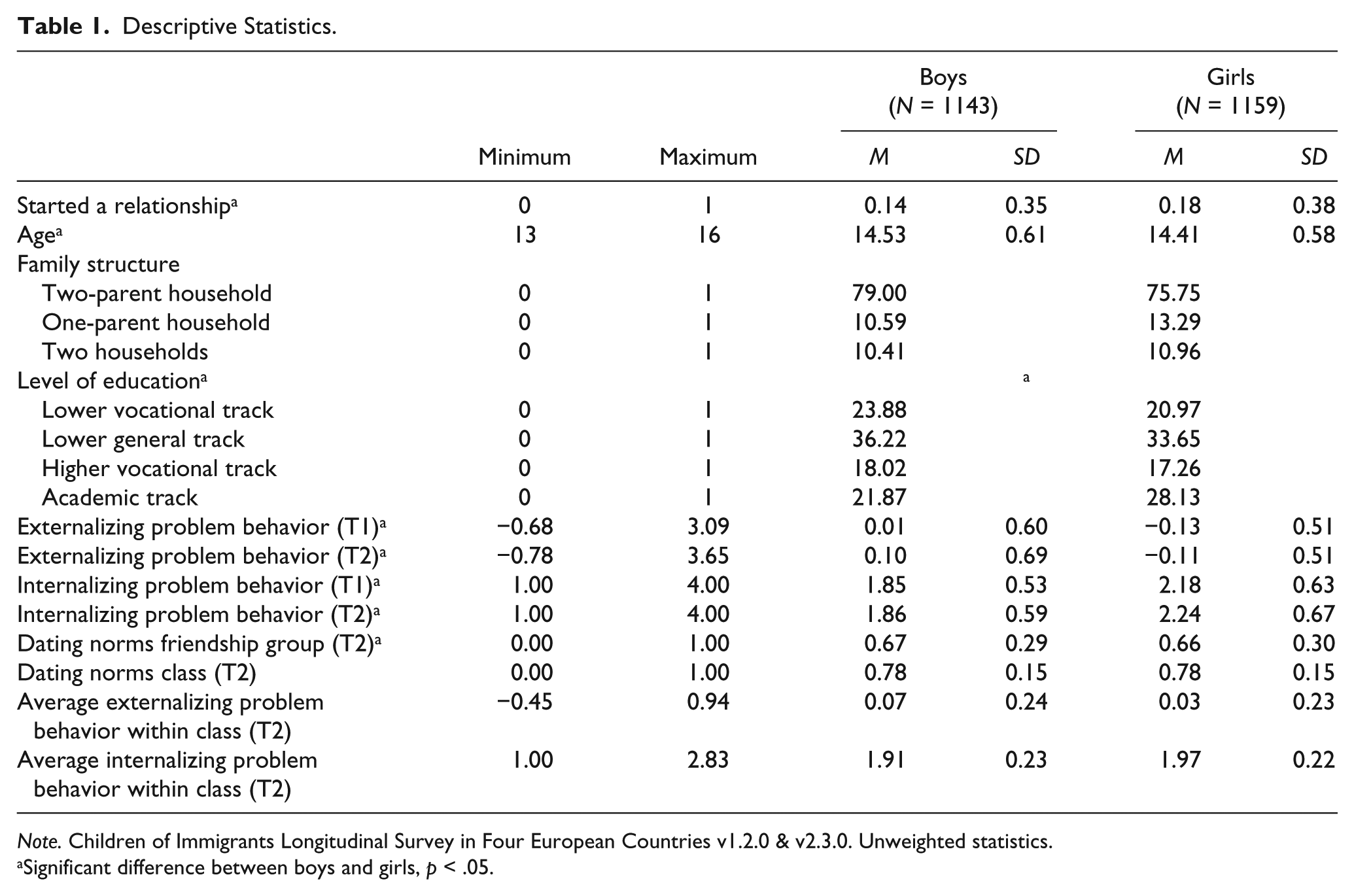
Note. Children of Immigrants Longitudinal Survey in Four European Countries v1.2.0 & v2.3.0. Unweighted statistics.
Significant difference between boys and girls, p < .05.
Table 2 provides insight into the association of problem behavior and dating, and whether this association is conditional upon norms. Model 1boys and Model 1girls in Table 2 suggest that adolescents who started dating between T1 and T2 engaged in more externalizing problem behavior at T2 (bboys = 0.177; bgirls = 0.080). Our main interest was in the interaction terms that were included in Models 2. For boys, the nonsignificant interaction term of dating and friends’ norms in Model 2 implied that the dating effect was not conditional on the norms in the friendship group. The significant main effect of friends’ norms reveals the pattern that boys who remained single while dating was the norm in their friendship group—and thus acted against the peer norm—showed more externalizing problem behavior compared with single boys whose friends did not date either. The significant interaction term of dating and class’ norms implied that the dating effect was conditional on the norms in the class. Boys who started dating reported more problem behavior than boys who remained single, and higher levels were particularly observed when none or few of their classmates had dating experience. Figure 1 shows the predicted externalizing problem behavior of adolescent boys who remained single and of adolescent boys who started dating, for several levels of class norms. In a class with an average norm (i.e., class’ norm = .78, indicating that 78% of the classmates had dating experience), boys who started dating reported 0.42 more externalizing problem behavior than boys who remained single, which is equivalent to a difference of 0.62 standard deviations. In a class where only 48% of the classmates had dating experience (i.e., a class with a Norm 2 SD below the average), this difference in externalizing problem behavior was 0.63, which is equivalent to a difference of 0.91 standard deviations. Girls’ reaction to dating in terms of externalizing problem behavior was independent of the dating norm of their friends or classmates, as can be seen in Model 2girls. Additional analyses on the pooled sample of boys and girls (full results available from author upon request) showed that the effect of the moderating role of class’ norms significantly differed between boys and girls (bStart × Class’ Norms × Girl = 0.774, p < .05). The results of the likelihood-ratio test showed that taking the moderating role of norms into account resulted in a better model, χ2(2) = 17.29, p = .002.
Random-Intercept Fixed-Effect Model of Externalizing Problem Behavior: The Effect of Starting a Relationship Conditional on Dating Norms of Friends and Class by Sex.
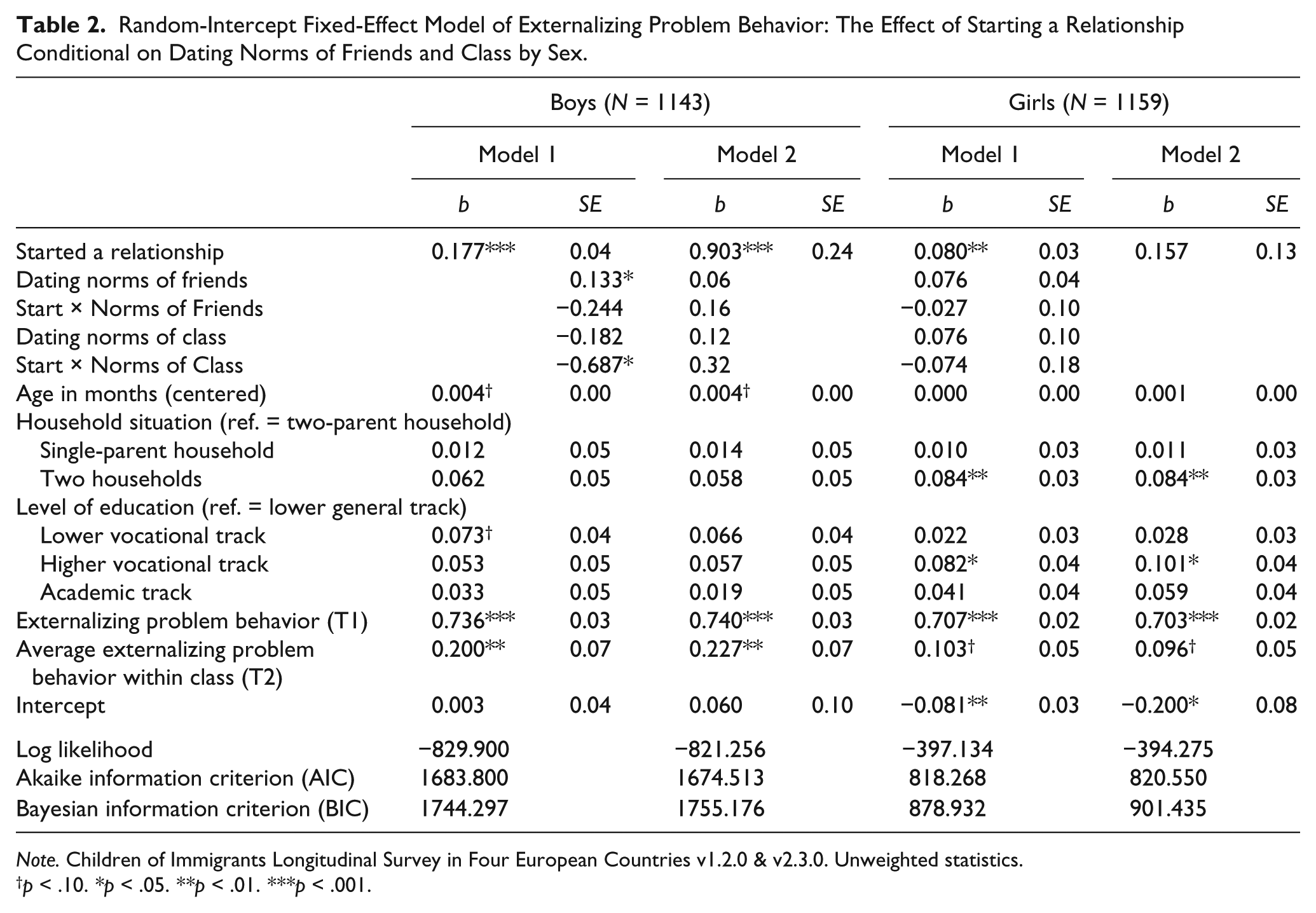
Note. Children of Immigrants Longitudinal Survey in Four European Countries v1.2.0 & v2.3.0. Unweighted statistics.
p < .10. *p < .05. **p < .01. ***p < .001.
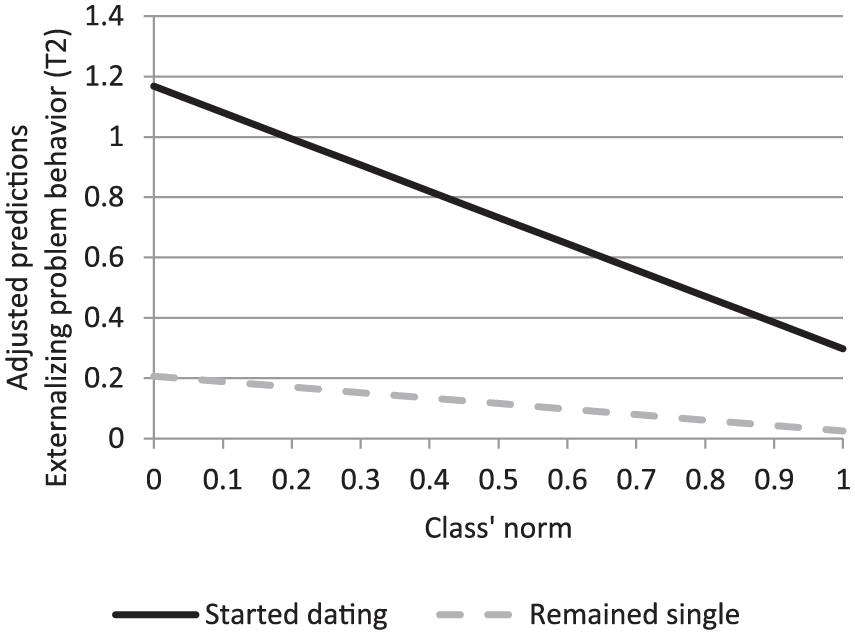
Adjusted predictions of boys’ externalizing problem behavior at representative values of class’ norms.
We now turn to our models concerning internalizing problem behaviors. Model 1 in Table 3 suggests that starting a romantic relationship had no main effect on internalizing problem behavior both for boys and girls (bboys = 0.062, p = .168; bgirls = −0.016, p = .691). Model 2 in Table 3 includes the interaction terms between dating and the norms of friends, and between dating and class’ norms. For boys, the nonsignificant interaction terms demonstrate that the association with dating was not conditional on the norms of friends, nor was it conditional on the norms of the class. For girls, however, the association with dating was conditional on class norms. Figure 2 shows that those who started dating reported more problem behavior than those who remained single, and the difference between daters and singles was smaller in a class where romantic involvement was the descriptive norm compared with classes where dating was less common (b = −0.647). In a class where 48% of the classmates had dating experience, girls who started dating reported 0.24 more internalizing problem behavior than girls who remained single, which is equivalent to a difference of 0.36 standard deviations. In a class where 78% of the classmates had dating experience, this difference in internalizing problem behavior dropped to 0.04, which is equivalent to a difference of 0.06 standard deviations. Hence, with regard to internalizing problem behavior, only girls—not boys—appeared to be sensitive to the dating norm of their classmates when starting a romantic relationship (although the difference between boys and girls was not supported in an additional model testing this three-way interaction [(Start × Class’ Norms × Girl = −0.673, p = .101; full results available upon request). The results of the likelihood-ratio test showed that taking the moderating role of class’ norms into account (while excluding the nonsignificant interaction term of dating and friends’ norms) resulted in a better model, χ2(2) = 5.72, p = .057.
Random-Intercept Fixed-Effect Model of Internalizing Problem Behavior: The Effect of Starting a Relationship Conditional on Dating Norms of Friends and Class by Sex.
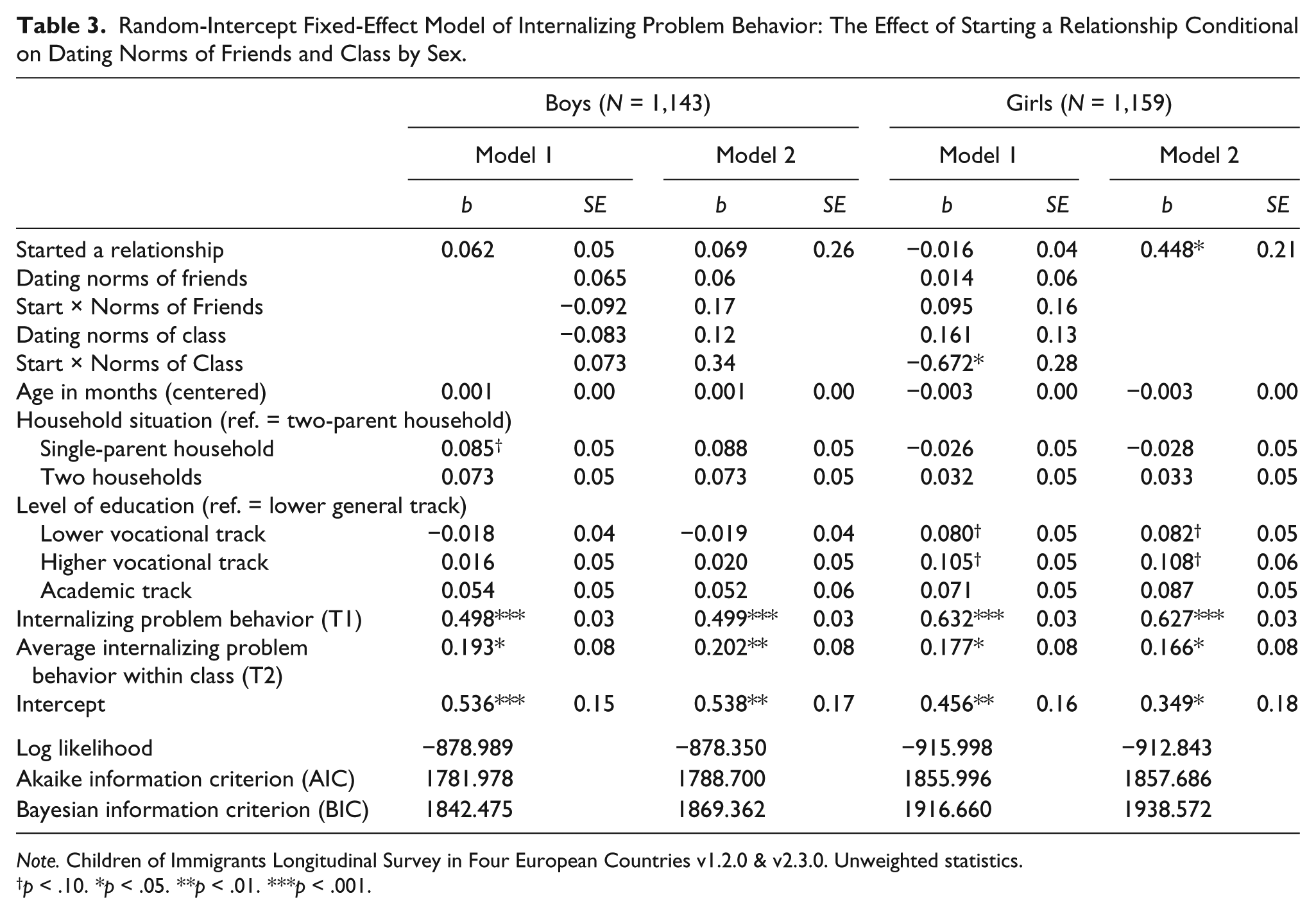
Note. Children of Immigrants Longitudinal Survey in Four European Countries v1.2.0 & v2.3.0. Unweighted statistics.
p < .10. *p < .05. **p < .01. ***p < .001.
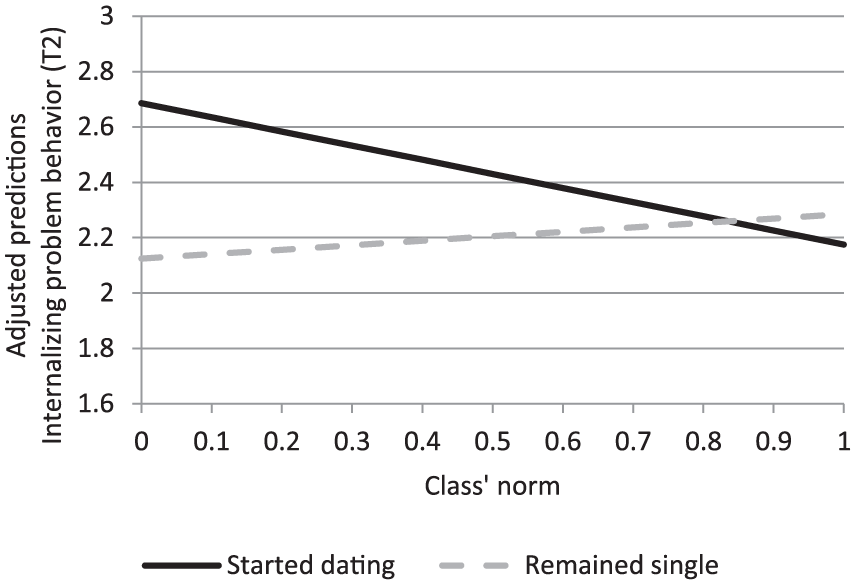
Adjusted predictions of girls’ internalizing problem behavior at representative values of class’ norms.
Discussion
The main aim of this study was to explicitly test the assumption that dating norms of peers condition the effects of dating on problem behavior. We tested this assumption for norms of friends and for norms of classmates. We utilized unique longitudinal Dutch sociometric data that allowed us to create strong measures and models.
Our findings with regard to the moderating role of the class’ norm were in line with our expectations, namely, that the association between being romantically involved and adolescents’ problem behavior depended on the dating norms of the class. More specifically, we found that adolescents who started a relationship when this was not in line with their classmates’ norms reported more externalizing problem behavior (boys) and more internalizing problem behavior (girls) than adolescents who did so in classes where dating was the descriptive norm. By contrast, the dating norms of friends’ norm did not moderate the association between starting a relationship and problem behavior.
Two possible mechanisms were discussed for why norms moderate the relationship between romantic involvement and (mal)adjustment. The first mechanism was social control. Peer groups exert pressure on adolescents to conform to the group norms, by rewarding normative behavior (Wright et al., 1986) and sanctioning nonnormative behavior (Simon et al., 1992). As a consequence, adolescents who engage in nonnormative romantic behavior may experience stress and consequently experience an increase in problem behavior. The second mechanism which we described concerned social learning. Involvement in romantic relationships is a new and potentially stressful experience in adolescence (Davila, 2008). Adolescents who are embedded in a group where romantic experience is more common may learn from their peers how to handle these possibly challenging relations, making the experience less stressful. However, this opportunity is not available to adolescents engaging in nonnormative romantic behavior. Our analyses provided some insight into the applicability of each mechanism, but our data did not allow us to empirically test the relative influence of each mechanism. This remains for future studies. One way to distinguish between the mechanism of social learning and the mechanism of social control might be to separately investigate the impact of descriptive norms (“what most people do”) and injunctive norms (“what most people approve of”), respectively.
Our findings need to be examined in light of some limitations. First, the friendship group was restricted to friends within the class and for some adolescents the most pertinent friendship group might be outside of the class. This may have underestimated the effect of the friends’ norms, but does not alter our conclusion that norms of friends within the class do no moderate the influence of dating. A second limitation of this work was that dating was already relatively common in our sample of adolescents. This limited the variation in norms across our sample. Furthermore, while dating may not be so common in the class context, the fact that it is common in one’s age group may have limited the impact of the class context, because opportunities for social learning can also be found outside the class context. It may, thus, be expected that the impact of the class’ norms is even larger at a younger age.
Despite these limitations, the present study provides further empirical support for the normative influences of peers. The longitudinal design allowed us to investigate changes in problem behavior, while controlling for the selection of adolescents with high problem behavior into dating. The sociometric design allowed us to construct a reliable measure of descriptive dating norms for both the in-class friendship network and the school class. Our findings nuance the conclusion of earlier studies that romantic relationships have a negative impact on adolescent well-being (Davila, 2008; Joyner & Udry, 2000) by showing that whether dating in adolescence is associated with maladjustment is dependent upon the norms of the context. Rather, romantic relationships had a negative impact particularly when the behavior violates the norm of a well-known, assigned peer group. In other words, an understanding of adolescents’ adjustment to events in their lives requires a more careful examination of the diverse social contexts in which they are embedded.
Footnotes
Declaration of Conflicting Interests
The author(s) declared no potential conflicts of interest with respect to the research, authorship, and/or publication of this article.
Funding
The author(s) disclosed receipt of the following financial support for the research, authorship, and/or publication of this article: CILS4EU research project funded in the NORFACE ERA NET Plus Migration in Europe-program.