



Abstract
This article explores the construction of the Syrian Kurdish Democratic Union Party (PYD) and the People's Protection Units (YPG
The narrative of terrorism and its associated terms and constructions have become omnipresent in the discourse of the Turkish authorities headed by Recep Tayyip Erdoğan and his Justice and Development Party (AKP, Adalet ve Kalkınma Partisi: in Turkish). The Turkish official narrative of terrorism has extended beyond the Turkish border to encompass various Kurdish actors outside Turkey. This article focuses on Turkish official discourse regarding the Syrian Kurdish Democratic Union Party (PYD, Partiya Yekîtiya Demokrat: in Kurdish) and the People's Protection Units (YPG, Yekîneyên Parastina Gel: in Kurdish) who partnered the U.S.-led coalition against the Islamic State of Iraq and the Levant (ISIL) (Killea 2015; Kirby 2016). In particular, the article seeks to uncover the main narratives that have been used in the construction of PYD and YPG as terrorist organizations and their action as terrorism in Turkish official discourse, which is endorsed by the Turkish authorities including the Turkish presidency and government. These narratives usually involve the Kurdistan Workers’ Party (PKK) as well, since the Turkish official discourse constructs the PYD and YPG as organic parts of the PKK. The Turkish official texts usually use the acronyms “PYD or YPG” with reference to both organizations. Therefore, the article frequently uses PYD-YPG instead of PYD and YPG. In addition, both terms “narrative” and “construction” have the same semantic implication in this article. Accordingly, the article uses both terms interchangeably in line with their grammatical indications. Usually, the term “construction” indicates “nominal sentences” while the term “narrative” indicates “verbal sentences.” The article also uses the term “statement” to denote the relevant part of statements, speeches, interviews, and other texts by the Turkish officials.
Turkish official discourse and policy regarding the PYD-YPG involve the de facto semi-autonomous administration of North and East Syria, also known as Rojava. 1 Between the years 2012–2014 Rojava was established as a semi-autonomous administration in the majority Kurdish regions (cantons) of Jazira, Kobani, and Afrin in the north of Syria (BBC 2016a; see Map 1). The Rojava administration addressed itself as the representative of various Syrian communities of Kurds, Arabs, Syriacs, and others (Peace in Kurdistan 2014). Later, the administration included majority Arab areas and it was renamed in 2018 as the autonomous administration of North and East Syria (AANES) (ANHA 2018). However, this article uses the term Rojava as a reference to the administration since Rojava was used by the institutions of the administration until 2018, and it is still used in the media and publicly.
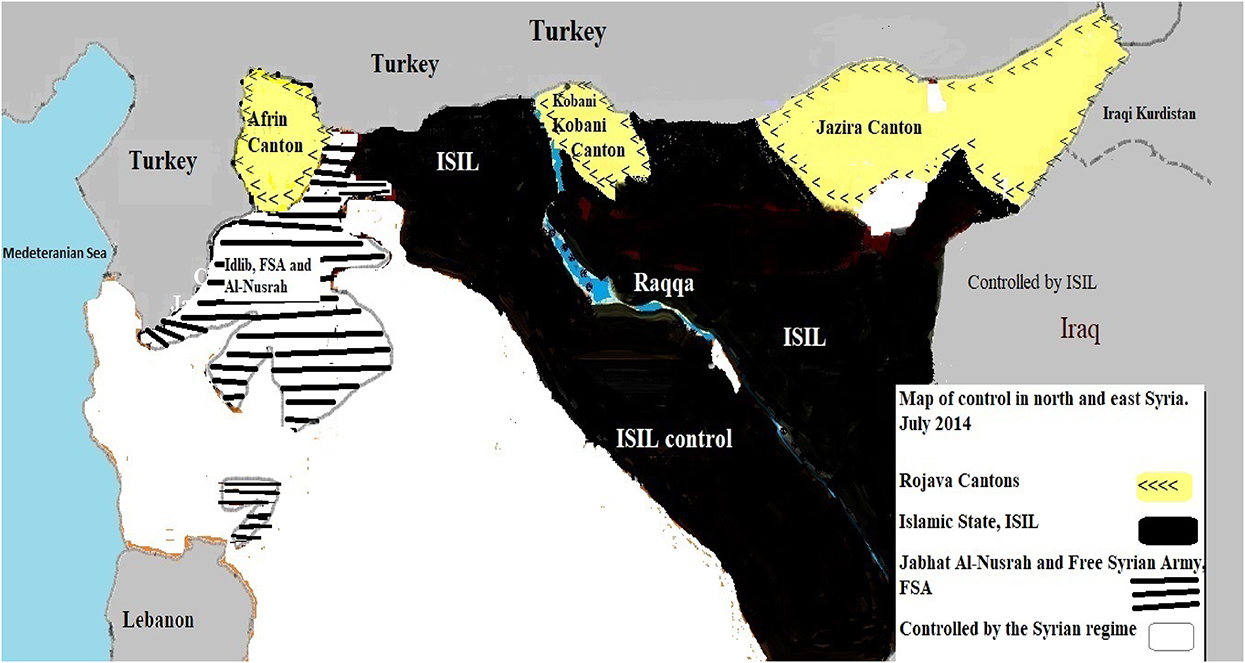
The control areas of Rojava cantons, ISIL, and Al-Nusra (HTS) and FSA Islamist factions in July 2014. Map 1 and 2 are by the author, and they show the areas of control in north and east Syria. These maps depend on information by the Live Universal Awareness Map. See https://syria.liveuamap.com/.
The remainder of the article begins with a section elaborating the theoretical framework and methodology. I then provide an analysis for the narratives of the Turkish official discourse regarding the PYD-YPG. This is followed by a discussion highlighting the main ideological factors and agendas that these narratives are driven by.
This study contributes to discursive studies on terrorism and to Kurdish and Turkish political studies. Although discursive studies of terrorism deal with various cases, they overwhelmingly concentrate on the American narrative of the “War on Terror.” Such an approach usually lacks comprehensive analysis for the characteristics of individual case studies that involve various discursive constructions and narratives. This perspective can be discerned in the work of Bartolucci (2010); Bhatia (2009), and Cetti (2010), and Hülsse and Spencer (2008). In addition, studies on the Turkish position regarding PYD and YPG are usually limited to Turkish policy and do not concentrate on the discursive constructions of the Turkish authorities. This is exemplified most in the studies of Gunter (2014); Knapp, Flach and Ayboga (2016), Leezenberg (2016), and Manzinger and Wagner (2020), and Radpey (2016) who deal with the Syrian Kurdish project of autonomy. In view of this, and with an intent to expand the scholarship in these areas, I aim to answer two main questions: how has Turkish official discourse constructed the PYD and YPG? And how did the construction of PYD and YPG in Turkish official discourse function in legitimatizing or delegitimizing particular actors and policies?
Theoretical Framework
This study employs critical discourse analysis (CDA) to analyze texts that reflect the position of the Turkish authorities regarding the PYD and YPG. This is despite the fact that the discourse of terrorism, the subject of this article, is not dealt with in the work of the main scholars of CDA, including Fairclough (2003); Van Dijk (2001, 2006a, 2006b), and Wodak (2001). CDA's analytical mechanism has two levels: macro and micro. The micro analysis of text focuses on its semantic and grammatical structures, while the macro level deals with the socio-political and historical contexts that govern the production and dissemination of text (Titscher et al. 2000). However, the macro and micro levels of analysis are not discrete entities. They work in tandem as they form the analytical outcome (Fairclough 2003, 38).
The micro-macro analytical framework of CDA facilitates deciphering the semantic and grammatical structures of text which serve ideology, dominance, and power relations (Van Dijk 2001, 2006a, 2006b; Fairclough 2003). This study deals with some of these structures including:
Creating assumptions. Assumptions are abstracted descriptions of certain phenomena that are presented as taken-for-granted realities (Locke 2004). Fairclough (2003, 41–60) argues that assumptions are built on oppressing, or keeping untold, details that reflect opposing views. Omitting certain details. The omitting technique is practiced by hiding certain details or oppressing certain views that contradict the interests of the text producer (Van Dijk 2001; Fairclough 2003). Interdiscursivity. This is practiced by including the constructions of more than one discourse in a single text or interconnected texts (Wodak 2001; Fairclough 2003). In the case of the discourse of terrorism, interdiscursivity could serve ideology when it connects the constructions of terrorism to those of other discourses, such as nationalism. The othering constructions, or the “othering discourse” (Bartolucci 2010, 123). The othering constructions serve ideology as they form a dichotomy between the in-group, or “we” and the out-group, or “they,” which serves the positive presentation of the ingroup and the negative presentation of the outgroup (Van Dijk 2006b, 126). Using metaphors and a certain lexicon. Metaphor is a term or phrase, which is located in an unusual setting, and the metaphoric structures usually target the emotional cognition of recipients to make them accept the message of text (Bhatia 2009, 280). Metaphors and other lexicons serve ideology when they aim at creating a sense of devaluation against certain groups of people.
Methodology
The data this article draws from include written texts disseminated through the broadcast media and press. The analysis deals with statements, speeches, and decisions of the officials and institutions of Turkish presidency and government, which were produced during 2014–2019. These are 46 texts mainly generated from the websites of the Turkish presidency, government, and major Turkish news agencies and newspapers—including Anadolu Agency, Hurriyet Daily News, and Daily Sabah—and international news agencies, such as BBC Monitoring and Reuters. The study mainly depends on written texts because the texts that divulge the views of Turkish officials in English are most available as written texts. In addition, the generated written texts are sufficient for representing the position of the Turkish authorities, which is the focus of this study. The study also challenges the view of the Turkish authorities using texts taken from various non-Turkish sources including international research centers and organizations (such as Amnesty International and Human Rights Watch) and newspapers and news agencies (such as the BBC, New York Times, Al-Monitor, and the Guardian) as well as the relevant statements published by the U.S. administration.
The generated texts are mainly in English. To overcome any potential inaccuracy in the English texts that include the statements of Turkish officials, the study gave priority to those texts originally produced in English by the identified institutions of the Turkish authorities and the main Turkish news agencies and newspapers named above. In addition, the study compared various texts to choose those with more content matches with other texts. This method was chosen in case more than one text was available about the same event or statement.
The strategy of data sampling in this study is purposive and selective. This sort of sampling strategy is compatible with CDA, while random sampling is less suitable for the purposes of CDA, and the goals of this study. This is mainly due to the fact that CDA is more compatible with texts that are rich in linguistic details. Usually, texts with linguistic details inform the attributes of ideology, dominance, and power relations that are the target of CDA (Fairclough 2003). Such linguistic details consist of many grammatical and semantic structures like the assumptions, interdiscursivity, and metaphors that are defined above. Accordingly, generating a sufficient number of such texts requires an appropriate selection process. By contrast, random sampling (which was not chosen for this study) might result in many short texts that lack such linguistic details. In addition, as the study needs to acquire a considerable level of credibility, the adopted sampling strategy targeted various sources and views.
Main Narratives of Turkish Official Discourse Regarding the PYD-YPG
The construction of PYD-YPG as terrorist organizations and their action as terrorism in Turkish official discourse is accompanied by certain narratives. There are five major narratives regarding the PYD-YPG in Turkish official discourse and they usually involve the PKK, as stated earlier. These narratives mainly construct the PYD-YPG as a threat against both the national security of Turkey and the international community as explained in the following sections.
‘The PYD and YPG are Organic Parts of the PKK’
Using the term ‘organic’ aims at creating the assumption that ‘the PYD-YPG are actually the PKK itself.’ The Turkish Ministry of Foreign Affairs claims that the PYD-YPG and PKK share “the same leadership cadres, organizational structure, strategies and tactics, military structure, propaganda tools, financial resources and training camps” (MFA n.d.). The majority of the texts that reflect the views of Turkish authorities about the PYD and YPG construct them as organic parts of the PKK. For example, Ibrahim Kalin, spokesman of the Turkish presidency, described the YPG as “an organic extension of the PKK” (quoted in AA 2016d). Likewise, Turkish Minister of Foreign Affairs (FM) Cavusoglu stated that the YPG is “just an extension” of the PKK (quoted in AA 2017). Whereas Turkish Prime Minster (PM) Davutoglu stated that “the PKK and PYD are the same” (quoted in Daily Sabah 2016a).
This narrative within Turkish official discourse is subject to stiff challenge. Although the PYD-YPG and PKK share similar ideological roots, they have dissimilar political goals and characteristics. However, reference to such goals and characteristics is omitted in the Turkish official texts and this type of omission serves the assumption that the PYD-YPG act as organic parts of the PKK.
The PYD and YPG geopolitical characteristics are different from those of the PKK (Khalil 2017). The PKK is an armed movement that demands autonomy for the Kurds in Turkey, and it operates against the Turkish forces inside Turkey and in the mountainous areas of Iraqi Kurdistan (BBC 2016b). The PYD, by contrast, is a Syrian Kurdish political party and its agendas and goals are limited to Syria (Knapp, Flach and Ayboga 2016; PYD Rojava n.d). The PYD has been part of the Syrian Democratic Council (SDC) since 2015 (see Figure 1). Likewise, the YPG presents itself as a Syrian military organization whose agendas are limited to Syria (Peace in Kurdistan 2014; YPG Rojava n.d.). Since 2016, the YPG has operated under the umbrella of the Syrian Democratic Forces (SDF) (see Figures 2 and 3). The latter consist of the YPG and other Syrian armed groups of Arabs and Syriacs who share the goal of defeating ISIL and protecting the administration of Rojava-North and East Syria (Knapp, Flach and Ayboga 2016; YPG Rojava n.d.). 2
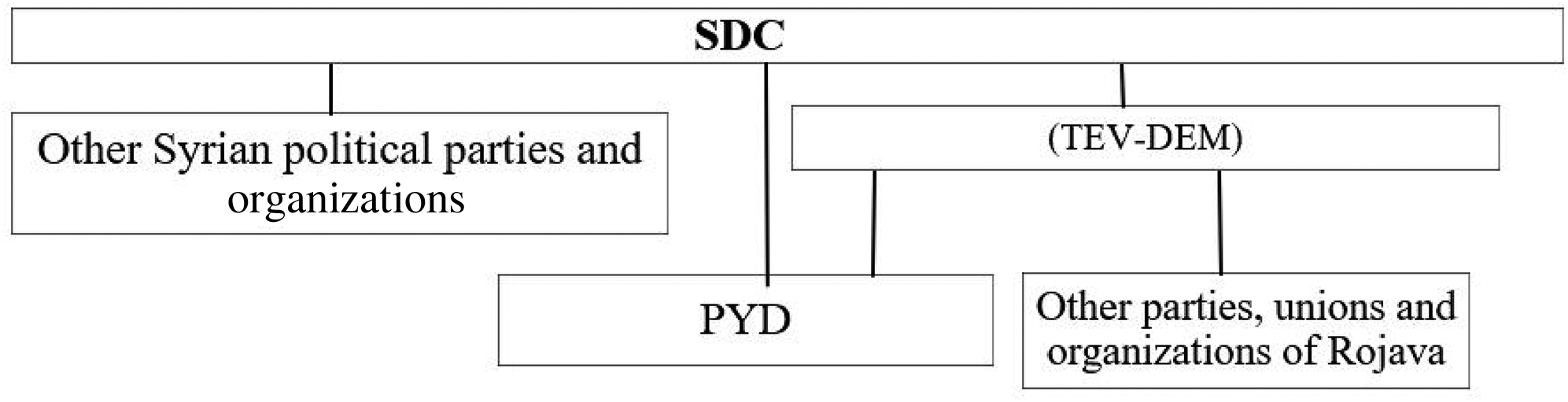
PYD as part of both the Syrian Democratic Council (SDC) and Rojava Movement of Democratic Society (TEV-DEM).
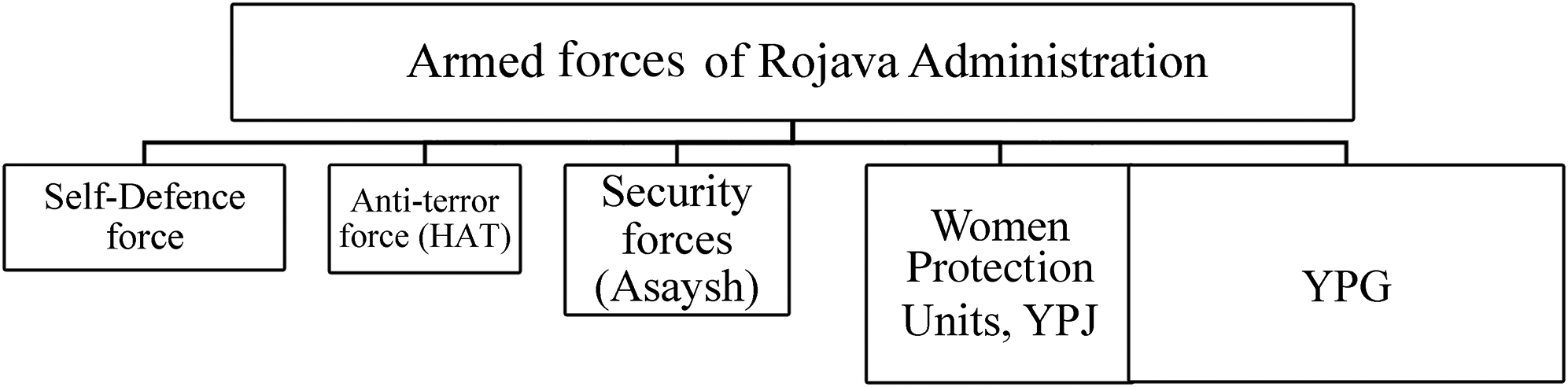
YPG as an armed force of Rojava administration.
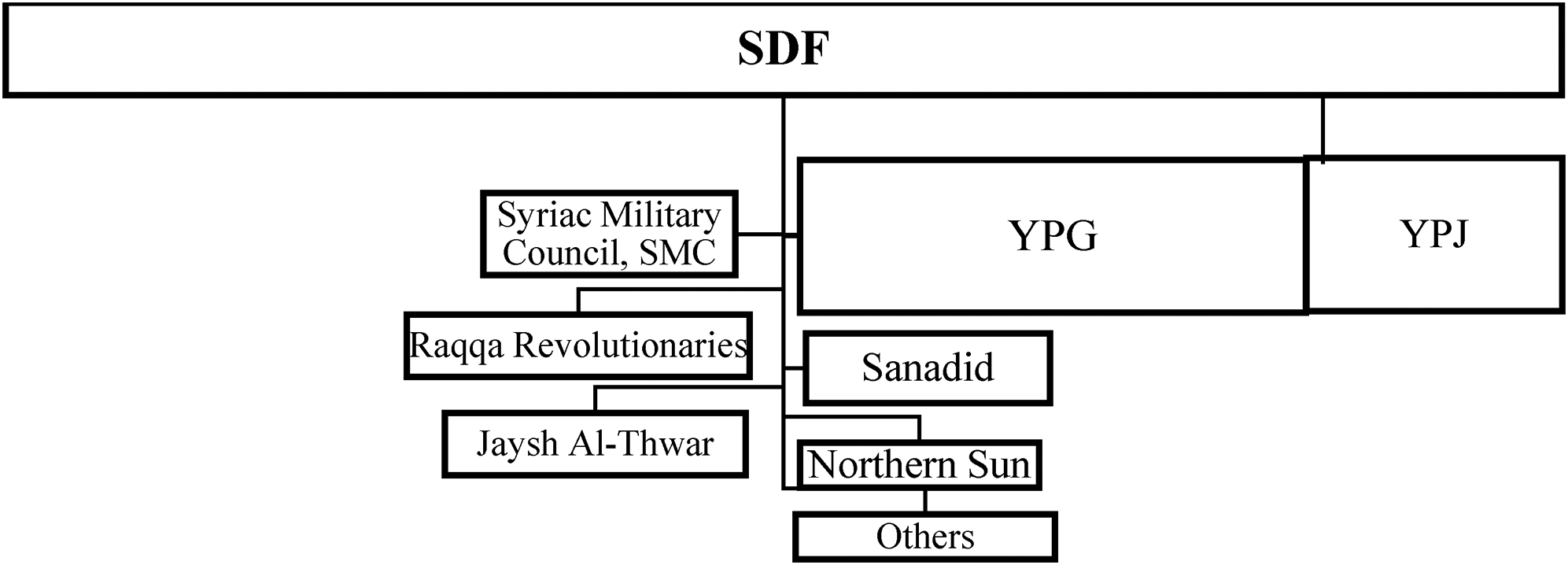
YPG as part of the Syrian Democratic Forces (SDF).
PYD-YPG have established certain types of relations with the successive U.S. administrations and other Western governments as part of the international campaign against ISIL (Tastekin 2016). The U.S. administrations have generally considered the YPG as a main partner in the campaign against ISIL (Kirby 2016; Toner 2017). In addition, the United States repeatedly denied the claim of Turkey that the YPG is part of the PKK. The spokesperson of the U.S. Department of State emphasized that “the YPG is a separate entity from the PKK” (Toner 2016b). Unlike the YPG, the PKK is designated as a terrorist organization by the United States and NATO members, although it actively contributed to the Kurdish resistance against ISIL in the Iraqi Kurdish areas (BBC 2016b).
‘The PYD-YPG are Involved in Attacks Inside Turkey’
This narrative consists of two forms, which either come in separate statements or come together interdiscursively in one statement. As noted, interdiscursivity occurs when the text includes the constructions of more than one discourse (Fairclough 2003, 3). The first form of narrative is that the PYD-YPG are involved in attacks inside Turkey. Turkish FM Cavusoglu claimed that PYD-YPG “trained terrorists in its camps” and sent them to “conduct attacks on Turkey” (quoted in Hurriyet Daily News 2016a). In another statement, Cavusoglu declared that “the PKK terrorists who are responsible for the last terrorist attacks, suicide bomb attacks in Ankara, Istanbul, all came from YPG camps in Syria” (quoted in AA 2017).
The Turkish authorities continued to accuse the PYD-YPG for such attacks, although other organizations claimed responsibility, while the PYD-YPG denied any involvement. This was the case of the attack of February 17, 2016 against the Turkish police in Ankara. The Turkish authorities were quick to accuse the PYD-YPG, and they carried on accusing the PYD-YPG for the attack, although the Kurdistan Freedom Hawks (TAK) already announced its responsibility for the attack (Daily Sabah 2016a; Letsch 2016b). Turkish PM Davutoglu considered the announcement of the TAK as a “montage” to “exonerate” the YPG (quoted in Daily Sabah 2016a). However, the YPG leaders denied any responsibility for the attack and emphasized that they had no interests to act against Turkey (Peace in Kurdistan 2016). PYD leadership also claimed that the accusations against the YPG were used as an excuse for the Turkish military intervention in Syria (Letsch 2016a).
The second form of narrative, which occupies more space in the statements of Turkish officials, connects the U.S. weapons support of the YPG to the claim that the PYD-YPG are involved in military actions inside Turkey. The U.S. weaponry support of the YPG has been a major concern of the Turkish authorities and, therefore, Turkish officials repeatedly denounced U.S. support of the YPG. Turkish officials claim that these weapons end up in the hands of PKK, and that they are used in attacks inside Turkey (BYEGM 2014; Butler 2016). The Turkish PM stated that arming the YPG by the United States “directly causes a rise in terrorist attacks against Turkey” (quoted in Daily Sabah 2017a). Likewise, Erdoğan claimed that American weapons were used by the YPG in attacks “against civilians” inside Turkey and that these weapons caused “their death” (quoted in Toksabay 2016). Using the terms and structures ‘against civilians’ and ‘their death’ in Erdoğan's statement aimed at influencing the emotional cognition of the text's recipients to make them more likely to accept the assumption that U.S. weapons to the YPG have been used in attacks inside Turkey.
The claims of Turkish officials that the YPG was involved in explosive attacks inside Turkey, and that the YPG supported the PKK with weapons, are denied by the U.S: administration. Stephen Townsend, the U.S. commander of the anti-ISIL operation, valued U.S. cooperation with the YPG, and stated that “I have seen absolutely zero evidence that they have been a threat to or supported any attacks on Turkey from northern Syria over the last two years” (Townsend 2017). Townsend (2017) added that the YPG leadership, contrary to the Turkish claims, desired “to have a good working relationship with Turkey.” In addition, the U.S. spokesperson of anti-ISIL coalition stated that they “carefully monitor” the weapons they gave the YPG and that these weapons were only used in the campaign against ISIL (quoted in Cook 2016).
‘The PYD-YPG are Proxies Used by Other Countries Against Turkey’
Turkish officials labeled the PYD and YPG as proxies used by other countries against the national security of Turkey. This construction usually includes the PKK alongside PYD-YPG. Turkish officials used the metaphorical term ‘pawns’ to describe the PYD and YPG as proxies used by other countries against Turkey (Daily Sabah 2016a, 2017b, 2017c).
This narrative usually denounces the position of Western countries regarding PYD-YPG. Erdoğan used the metaphorical structure of “hypocritical, two-faced” to describe the Western countries because they have an “insincere attitude in the face of terror organizations,” denoting the PYD, YPG, and PKK as examples of such organizations (quoted in BBC Monitoring 2016a). According to Erdoğan, the inaction of the Western countries against the pro-PYD-YPG demonstrations and other activities generating heightened awareness in Europe can be seen as an indirect support of the PKK (Tastekin 2016). Erdoğan referred to PYD-YPG and stated that, in European countries, “the separatist terror organization [PKK] is operating freely under various names” (quoted in BBC Monitoring 2016a).
Turkish officials considered the support of some EU politicians for the PYD-YPG resistance of ISIL as a conspiracy against Turkey. For example, as a photographic exhibition of the resistance of Rojava and YPG against ISIL took place on the premises of the EU Parliament in July 2016, Turkish officials denounced the EU and claimed that the exhibition aimed to support PKK “terrorism” (Daily Sabah 2016c). Turkish FM Cavusoglu stated that the EU Parliament was used as “a tool of the propaganda of a bloody terrorist organization that takes the lives of innocent people almost every day and thereby has been involved in promoting terrorism” (quoted in MFA 2016c). To influence the emotional cognition of the recipients of his statement, Cavusoglu used the terms “bloody,” which provokes condemnation, and “innocent people,” which invites sympathy, and “every day,” which implies the repetition of harmful actions against civilians.
This narrative also considers the Rojava administration as a conspiracy project backed by the Western powers against Turkey. For example, Turkey's deputy PM, Nurettin Canikli, claimed that the Western support of the YPG is part of a “global project” that aims at dividing Turkey (quoted in AA 2016e). However, this narrative constructs the United States as the main player in the conspiracy. This can be discerned in the statements of Erdoğan who denounced the U.S. support of the YPG and claimed that the campaign against ISIL is a pretext used for the creation of a separate entity in northern Syrian (TCCB 2015; Daily Sabah 2016b)—although none of the Western countries approved the Rojava administration. Moreover, the U.S. administration expressed its disapproval over Kurdish autonomy in northern Syria. The spokesperson of the U.S. Department of State voiced this by stating that: “we have been very clear that we won’t recognize any kind of self-autonomous—or self-rule, semi-autonomous zones in Syria,” “we are committed to the unity and territorial integrity of Syria” (Toner 2016a). The construction of Syrian Kurdish self-governance as a threat against Turkey is discussed further in the next section.
‘PYD-YPG are Separatist Organizations that Constitute Threats to Both the Territorial Integrity of Syria and the National Security of Turkey’
The interdiscursive relationship between separatism and terrorism is deep-seated in Turkish official discourse. For a long time, the Kurdish aspiration toward self-rule has been the main concern of Turkish authorities, and it is labeled as ‘separatism’—which is considered as a main form of terrorism in the Turkish law of anti-terror. According to this law, separatist-terrorism encompasses actions that aim to “damag[e] the indivisible unity of the State with its territory and nation” (quoted in Legislationline n.d.). However, this Turkish definition of terrorism is not limited to armed actions against Turkey and has been applied against wide-range nonviolent pro-Kurdish nationalism activities inside and outside Turkey.
The interdiscursive relationship of terrorism and separatism in Turkish official discourse is even more complex in the case of PYD-YPG and their administration of Rojava. This is as it also connects the national security of Turkey to the territorial integrity of Syria (see Figure 4). Turkish officials construct PYD-YPG as a threat against the territorial integrity of Syria because they are separatist organizations that aim to establish a Kurdish entity or state in the north of Syria. The Turkish FM stated that “PYD's agenda and motives will threaten the territorial integrity and political unity of Syria” (quoted in MFA 2015). Turkish officials have usually expressed Turkey's commitment to defend the territorial integrity of Syria against PYD-YPG separatism, and they constructed the territorial integrity of Syria as a matter of national security for Turkey. The Turkish FM denounced the Rojava administration and stated that “Syria's national unity and territorial integrity is fundamental for us” (quoted in Pamuk 2015). Likewise, Erdoğan constructed Rojava as a threat against Turkey and stated that “it is not possible for us as Turkey to say ‘yes’ to this threat” (quoted in Pamuk 2015). Erdoğan even described Turkish military intervention as a solution to protect the territorial integrity of Syria (Ant and Abdu-Nasr 2016). To emphasize that Rojava constitutes a serious threat to the national security of Turkey, Turkish officials have consequently constructed the Rojava cantons as a source of terrorism that targets Turkey. This can be discerned in the usage of terms like “terror cantons” (Hurriyet Daily News 2016c), “terror camps” (Hurriyet Daily News 2016a), and “terror corridor” (AA 2016f) to describe the Rojava cantons. However, the connection between the national security of Turkey and territorial integrity of Syria in Turkish official discourse is limited to Rojava and Kurdish self-governance.
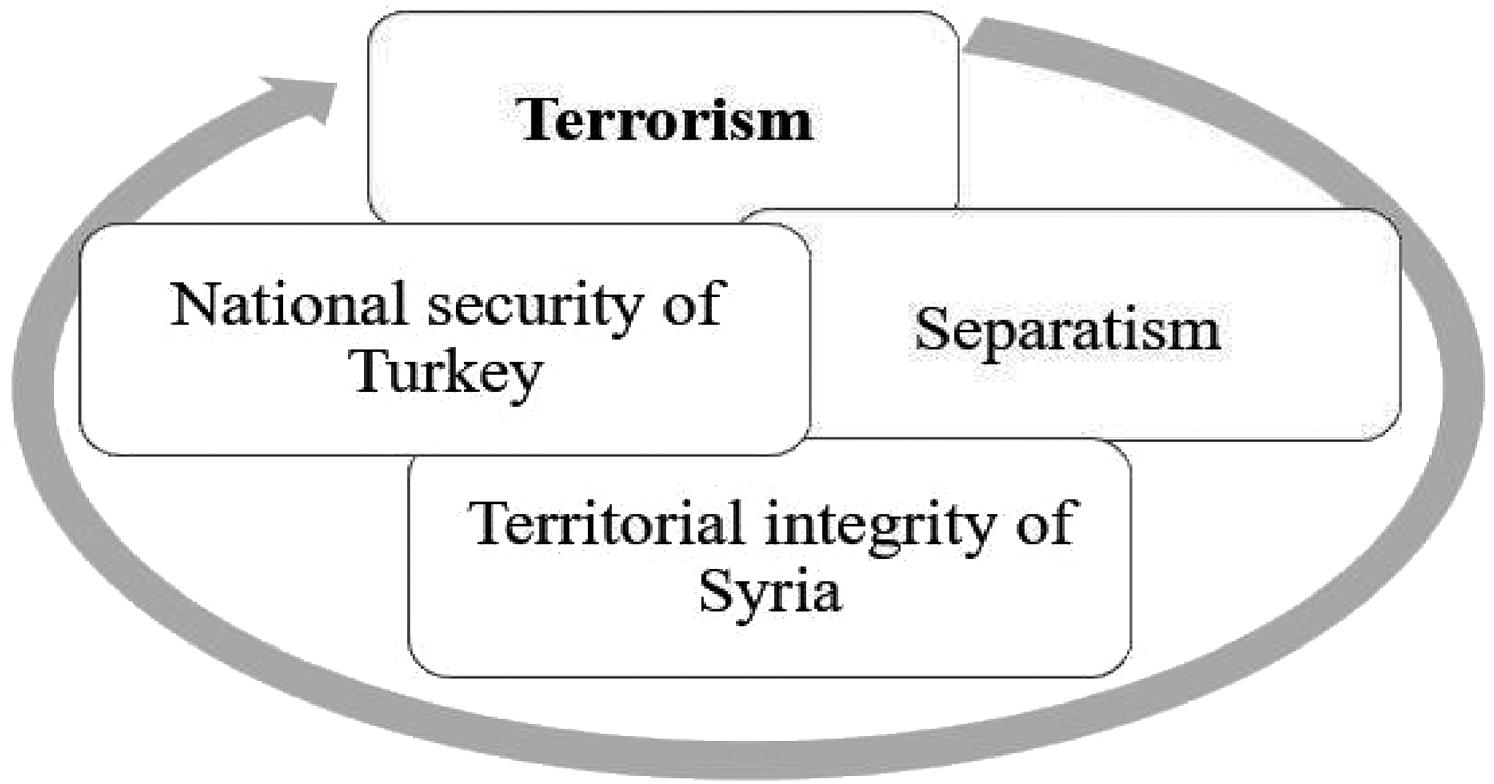
Interdiscursivity of terrorism and separatism in Turkish official discourse regarding the PYD-YPG.
In 2017 the United Nations Office for the Coordination of Humanitarian Affairs (OCHA) published a report on the status of border-crossing centers between Syria and Turkey. This document illustrates that only three border-crossings out of 19 were open—Bab Al-Hawa, Bab Al-Salameh (Azaz), and Jarabulus—and these were administered by Turkish-backed Islamist groups (UN-OCHA 2017). 3 The OCHA report also shows that all border-crossings between Turkey and the Rojava cantons were closed.
Contrary to the claims of Turkish officials, which emphasized defending the territorial integrity of Syria, the Turkish military was involved directly in infringing that territorial integrity and occupied part of the Syrian territory. During 2016–2019, the Turkish military—backed by the Islamist groups of the Free Syrian Armey (FSA)—conducted three major invasions into the north of Syria and, since then, these territories have been under the occupation of Turkish military and Islamist groups (Reuters 2019; see Map 2). Turkey has also been directly involved in the region of Idlib, which is governed by Jabhat Al-Nusra and other Islamist groups (Tastekin 2017; see Map 2). Brett McGurk, the U.S. special envoy for the anti-ISIL coalition, stated that “Idlib province is a serious problem. It is a haven now for al-Qaida” (McGurk 2017).
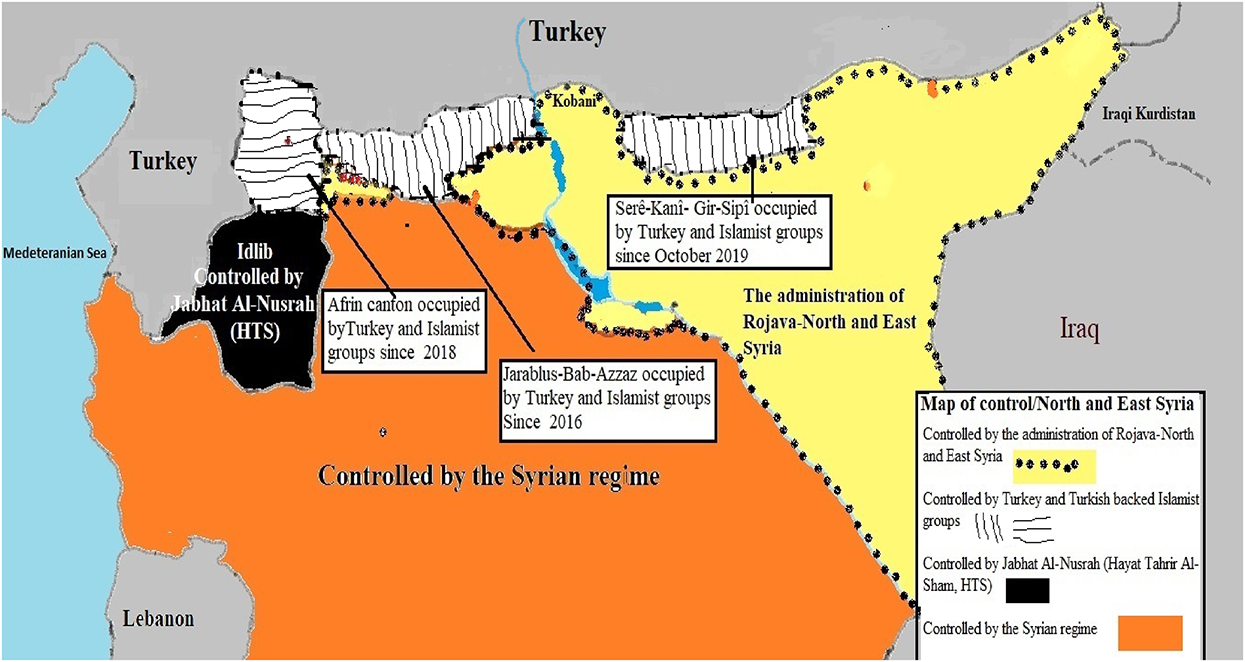
The control areas of Rojava cantons, ISIL, and Al-Nusra (HTS) and FSA Islamist factions in November 2019. Map 1 and 2 are by the author, and they show the areas of control in north and east Syria. These maps depend on information by the Live Universal Awareness Map. See https://syria.liveuamap.com/.
‘PYD and YPG Constitute a Security Threat Against the International Community’
This narrative is captured in the sentence that the PYD-YPG are a threat against the other countries or “the others.” However, this narrative contradicts the construction of the PYD-YPG as proxies used by the same others against Turkey (see Figure 5). That is, the PYD-YPG are constructed as proxies used against Tukey by the United States and other members of the anti-ISIL coalition, and in contrast, they are constructed as a threat to the United States and members of the coalition. This narrative usually includes the PKK alongside the PYD-YPG.
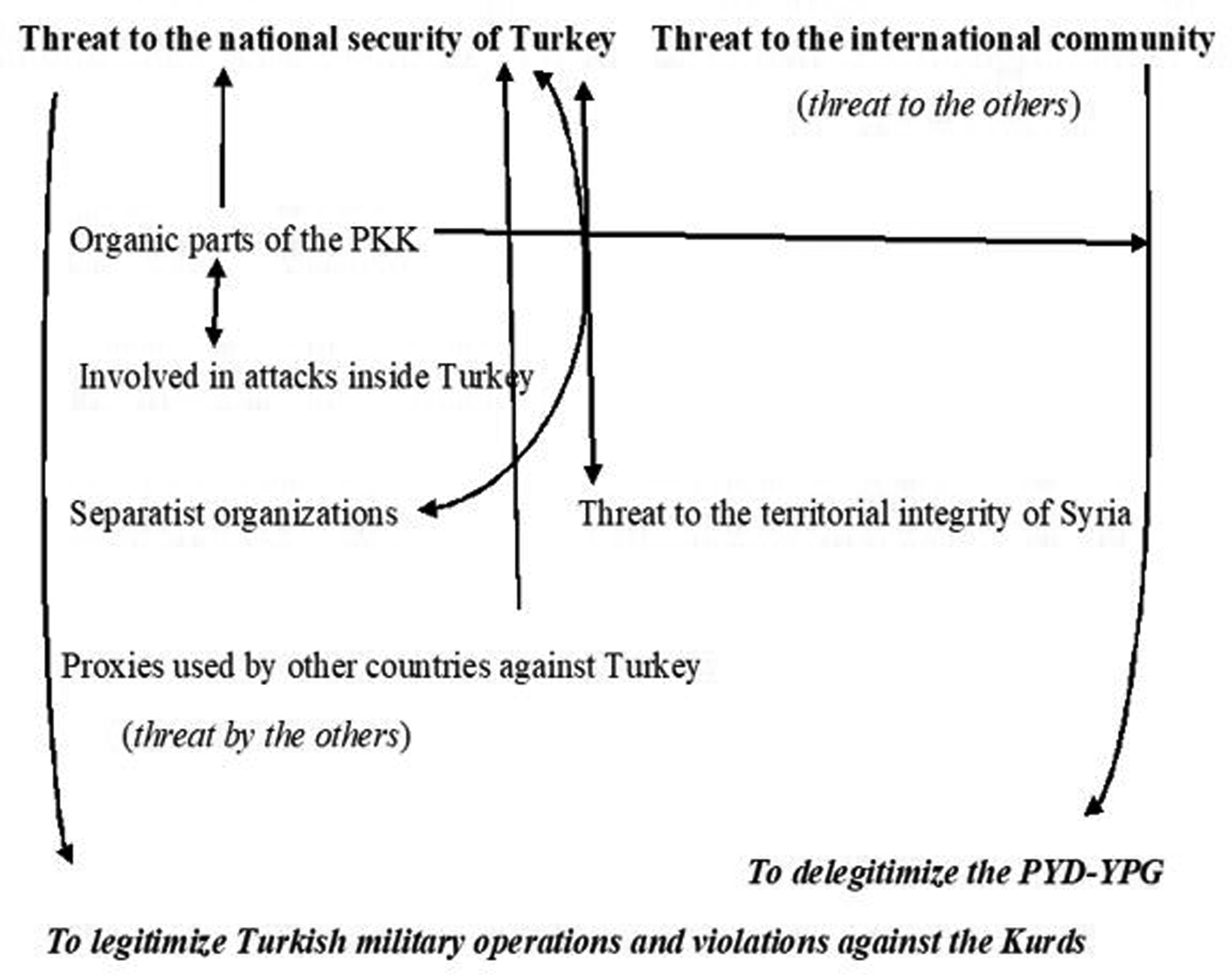
Interdiscursive relationship of the main narratives and their dual agenda.
There are two forms of the narrative that constructs the PYD-YPG as a terrorist threat to the international community. The first form aims to build the assumption that the PYD and YPG are internationally designated terrorist organizations, although they are not. CDA highlights that such an assumption can serve biased and ideological considerations (Fairclough 2003; Locke 2004). This form of narrative uses terms and structures like “good terrorists” as a reference to PYD-YPG and “bad terrorists” as a reference to ISIL and it attributes these references to the way that the United States and its Western allies view PYD-YPG and ISIL. For example, Erdoğan denounced the Western support of the YPG and stated that “the West considers the PYD-YPG as “good” terrorists, while it considers ISIL as “evil” terrorists (quoted in AA 2016c). This is although the United States and its allies do not use such references and such a dichotomy.
The United States and its Western allies do not, in fact, consider the PYD and YPG as terrorist organizations. Opposing the Turkish claim, the United States and its Western allies consider the PYD and YPG as partners in the anti-ISIL campaign. For example, the spokesperson of the U.S. Department of State, John Kirby, stated that “we do not consider the YPG a terrorist organization” (Kirby 2015). 4 The U.S. administration even praised its partnership with the YPG in the anti-ISIL military campaign. This view is supported in the relevant statements of the U.S. State Department of Defense—the latter described the YPG as an “effective” and “reliable partner” who managed to defeat ISIL in Syria (Killea 2015; Kirby 2016; Toner 2017). Likewise, French President Emmanuel Macron rejected the Turkish classification of PYD-YPG as (a) terrorist organization(s) and accused Turkey of collaboration with ISIL (France 24 2019).
The second, and more dominant, form of narrative that constructs PYD-YPG as a threat to the international community compares the PYD, YPG, and PKK to ISIL and other Jihadist organizations. For example, Cavusoglu stated that “the PYD/YPG and DAESH are the same as the PKK” (quoted in MFA 2016a). Cavusoglu used the ‘othering’ constructions of ‘us’ and ‘ours,’ (which denote Turkey and the whole international community) whose security and values are threatened by the PYD, PKK, Jihadists, and other “terrorist” groups (MFA 2016b).
This form of narrative attributes the Jihadist attacks conducted in some Western countries to the entity of terrorism, which also includes the PYD-YPG and PKK. This narrative implies overgeneralizations and mixes various types of actions including: Jihadist attacks in Western countries, attacks in Turkey, and the Turkish-PKK armed conflict. The narrative abstracts all these actions in its use of the term ‘terrorism’—which requires joint international action and, accordingly, the international action should target PYD-YPG and the PKK because they are all considered by Turkey as “terrorist organizations.” Turkish Minster of EU Affairs, Volkan Bozkir, considered the Turkish label of “terrorist” to be enough evidence for blaming the PYD and PKK for the “terrorist” attacks of Jihadist groups, and that this requires other countries to support Turkey in its counter-terrorism policy (AA 2016b).
The statements of Turkish officials, which blame PYD-YPG and the PKK for many international Jihadist actions, are also formulated as ‘warnings of imminent or foreseeable attacks’ by PYD-YPG and PKK. The statements of Turkish officials imply that PYD-YPG-PKK would attack the very countries that support the PYD and YPG. For example, Erdoğan stated that: “I am calling on countries supporting the PYD: If you have a conflict with them, these people will come and attack you with bombs like [IS]” (quoted in Tastekin 2016). 5 Erdoğan used the metaphorical structure that “the snake you feed can bite you too” (quoted in BBC Monitoring 2016b). Describing the PYD and PKK as ‘a snake’ that ‘can bite’ aims to dehumanize these organizations and invokes, if not expressly provokes, the feeling that they are unreliable and imminent threats.
Discussion
Turkish governments that preceded the AKP and Erdoğan in ruling Turkey often viewed the Kurdish movements in Syria, Iraq, and Iran and their demands for self-rule as a security threat against Turkey (Hale 2013). However, in 2013 Erdoğan declared peace negotiations with the PKK to end the Turkish-Kurdish conflict, and this also reflected positively on the PYD as its leadership was invited by the Turkish authorities for talks in Turkey (Hurriyet Daily News 2013). Nonetheless, as soon as Erdoğan ended the peace process in 2015, these talks also ended.
The main reason for ending the peace process by Erdoğan was the failure of the AKP in gaining a desired majority in Turkey's June 2015 elections. The AKP loss was relatively due to the success of Kurdish People's Democratic Party (HDP) in the Kurdish provinces (Popp and Reuter 2015). Therefore, Erdoğan planned to rely on the votes of nationalist Turks in the later snap elections. To do so, he had to satisfy the nationalists by ending the peace process and resuming the fight against the PKK. In addition, Erdoğan's new policy incited further Turkish animosity against PYD-YPG and Rojava. This is although the anti-PYD-YPG narratives of the Turkish authorities began to form in 2014 during the YPG resistance against ISIL invasion of Kobani canton (see BBC Monitoring 2014; BYEGM 2014).
It should, by now, be clear that the narratives regarding the PYD-YPG discussed in this article reflect certain ideological messages and serve certain agendas and policies of the AKP authorities. The next section discusses how these narratives serve the project(s) of delegitimizing PYD-YPG and legitimizing the Turkish military operations and violations against Syrian Kurds (see Figure 5). I then highlight the ideological factor which influenced Turkish official discourse and policy regarding PYD-YPG and Rojava. However, I now turn briefly to a discussion of the main features of analyzed texts, which serve the Turkish ideology and agendas, guided by the conceptual points mentioned in the earlier discussion of the theoretical framework.
Main Features that Serve Ideological Implications and Agendas in Turkish Official Texts
Creating assumptions. The above analysis reveals that assumptions dominated the way the Turkish official texts constructed PYD-YPG. A main assumption in the Turkish official texts is the construction of PYD-YPG as internationally designated terrorist groups, which was reinforced by comparing their action to international Jihadist attacks. This is although, as I have shown, PYD-YPG are not internationally designated as terrorist organizations. On the contrary to the Turkish claims, PYD-YPG have been situated by the United States and other key international actors as part of the international campaign against ISIL.
Omitting certain details. As explained earlier, Turkish official texts usually omit reference to those political goals of the PYD and YPG and their Syrian characteristics that are dissimilar to those of the PKK. The majority of the Turkish official texts examined for this research also omit the involvement of the Turkish military and security forces in violence and violations against human rights. This type of omitting information is a good example of the strategy described by Van Dijk (2001, 107) as hiding the negative action of the party whom the text producer favors.
Interdiscursivity. Analysis of Turkish official texts reveals several types of interdiscursivity of various constructions. However, the interdiscursive relationship of the constructions of terrorism with other constructions is dominant, and this type of interdiscursivity matches the ideological messages and agenda of the Turkish authorities. This is discerned in the texts that interdiscursively construct Rojava as both a separatist threat against the territorial integrity of Syria and a terrorist threat against the national security of Turkey (see Figure 4).
The othering constructions. The relevant Turkish official texts usually refer to PYD-YPG as the ‘outgroup’ or ‘negative other,’ and they refer to the Turkish authorities and their allies as the ‘ingroup.’ This is either explicit in the pronouns such as ‘we,’ ‘us,’ ‘our,’ ‘they, ‘them,’ ‘their’ or implicit in semantic structures that create the dichotomy of ‘us versus them.’ This can be discerned in Erdoğan's statement in which he constructed PYD-YPG as the outgroup “infidels” who aim at creating a “terror corridor” and those who support his anti-PYD-YPG policy as the ingroup Muslims (quoted in Hussein 2019).
Using metaphors and a certain lexicon. This can be seen in the metaphorical structures of “the snake” that “can bite” to describe PYD-YPG (BBC Monitoring 2016b). Furthermore, the analysis reveals that, in addition to the structures and terms of ‘terrorism,’ ‘terrorist,’ and ‘terror,’ Turkish official texts contain various terms and structures of condemnation and criminalization against PYD-YPG such as “murderers,” “lowlifes,” “bloodstained,” and “enemies of humanity, democracy and freedom” (BBC Monitoring 2014, 2016b).
Delegitimizing the PYD and YPG
The construction of PYD-YPG in the Turkish official texts may be seen as a strategy designed to incite other countries to label the PYD and YPG as terrorist organizations. The construction of PYD-YPG as a threat to the international community mostly goes with this type of agenda. However, this is also connected to the construction of PYD-YPG as organic parts of the PKK. Turkish Deputy PM, Lutfi Elvan, stated that “we called on the UN to recognize the PKK and the PYD as terrorist organizations. The PYD is linked to the PKK. There is no difference between the PKK and the PYD” (quoted in AA 2016a). 6 Nevertheless, the narratives of Turkish officials were not successful in convincing the international community of their claims. In particular, the Turkish authorities were not able to convince Western countries that the PYD-YPG constitute a threat against them. In contrast to the demands of the Turkish authorities, the United States and its Western allies continued to support the YPG in the anti-ISIL campaign, as discussed earlier.
This is although limited anti-PYD-YPG measures have been practiced by the authorities of some European countries, and by the international companies of media-broadcasting. One type of such measures is the occasional suspension of the PYD-YPG-affiliated TV station of Ronahi and the censorship and suspension of pro-PYD-YPG social-media accounts on Facebook and YouTube (Kurdish Question 2016; Briel 2017). Such measures are usually influenced by the narrative that PYD-YPG are organic parts of the PKK. This is discerned in the case of suspending Ronahi TV in April 2017 by the French satellite company Eutelsat. The suspension was applied as a response to constant requests by the Turkish authorities who claimed that Ronahi TV served the propaganda of the PKK that has been designated as a terrorist organization by the EU (Briel 2017).
Another type of these measures, which has been conducted by the authorities of certain European countries, involves interrogating some of their citizens who joined the YPG. The cases of interrogation have been conducted by the police and counterterrorism branches of Germany, the UK, and Denmark against several citizens of these countries who voluntarily joined the YPG to fight against ISIL—in a few cases, these individuals faced legal prosecution (Dearden 2016; McKay 2017). Such cases built the implication that, although the Western governments support the YPG in the campaign against ISIL, they discourage their citizens to join the YPG. However, this policy is more related to prohibiting citizens from involvement in armed conflicts if they are not members of military missions with government authorization (BBC 2014). For example, the UK Home Office considers unauthorized involvement in armed conflicts as an offence according to criminal and anti-terror laws (BBC 2014). Although such rules have been quite strict regarding those who joined ISIL and other Jihadist groups, they remained loose regarding YPG volunteers (Moor 2016).
Legitimizing Turkish Military Operations and Violations Against Syrian Kurds
The Turkish military repeatedly attacked YPG positions in Syria and conducted three military operations in Syria and against the semi-autonomous administration of Rojava. These operations ended with seizing parts of the Syrian territory by the Turkish military and the Turkish-backed Islamist groups of the FSA (Reuters 2019; see Map 2). These included the following operations, as named by the Turkish authorities: a) Operation Euphrates Shield, which was launched in August 2016 and resulted in seizing Jarablus, Al-Bab, and Azzaz; 7 b) Operation Olive Branch, which was launched in January 2018 and resulted in seizing the entire Rojava canton of Afrin in northwest Syria; c) Operation Peace Spring, which was launched in October 2019 and resulted in seizing other areas of Rojava including Ras Al-Ayn (Sere-Kani: in Kurdish) and Tall-Abyad (Gir-Sipi: in Kurdish).
Before and during these invasions, Turkish officials used several narratives against PYD-YPG and the Rojava administration. However, the dominant narratives that served the agendas of these invasions constructed PYD-YPG as organic parts of the PKK, and as threats to the national security of Turkey and the territorial integrity of Syria. Before launching the October 2019 Turkish invasion, Erdoğan stated that “the PKK, and its extension the YPG/PYD, is the biggest threat to Syria's future” (quoted in ILETISIM 2019). In addition, the construction of Rojava as a terrorist threat against Turkey was repeated by Turkish officials during the Turkish military operations and to cover-up accompanying violations of human rights. During the 2018 commemoration of the 1915 Ottoman battle of Gallipoli, and as the Turkish military was advancing in the canton of Afrin, Erdoğan dedicated his speech to applaud the 2016–2018 Turkish victories against Rojava, which he described as a “terror corridor” that threatened Turkey. He stated, “thanks be to Allah, the chain of terror corridor has been broken from four rings” (quoted in TCCB 2018).
Several international human rights organizations reported that, during and after their military operations, the Turkish military and Turkish-backed Islamist factions perpetrated flagrant violations against Syrian Kurds and religious minorities. These include, among others, acts of extrajudicial execution, torture, rape, kidnap, detention, looting and confiscating private and public properties, and forcible displacement of the Kurdish population (Amnesty International 2018, 2019; Al-Hilu 2019; Human Rights Watch 2019; UN News 2019; UN-HCHR 2020). The displacement of Kurds, accompanied by settling Arabs and Turkmans from other parts of Syria in their homes and properties, has been part of the ongoing policy of demographic change that the Turkish authorities adopted against Syrian Kurds (Chulov and Shaheen 2018; Al-Hilu 2019, 1–14).
The Ideological Factors that Influenced the Turkish Discourse and Policy
Two main ideological factors have influenced the construction of PYD-YPG in Turkish official discourse and in the concomitant Turkish policy. The first factor is related to the de facto Syrian Kurdish autonomy of Rojava as a matter that encouraged further nationalist action by Kurds in Turkey. In particular, Rojava autonomy—alongside other factors—encouraged the Kurds in Turkey to declare their autonomy in December 2015 (Reuters 2015; Beauchamp 2016). Several sources underlined that the inspiration driving the Kurds in Turkey (grounded on the Rojava experience of self-governance) has been a major concern for Turkish authorities (Idiz 2015; Jones 2015; Butler 2016; Kingsley 2017). Turkish Deputy PM, Nurettin Canikli, constructed Rojava as a conspiracy bent on dividing Turkey (AA 2016e).
As highlighted earlier, Turkish officials expressed repeatedly that they would not allow a Kurdish-governed entity in Syria. Turkish Defense Minister Fikri Isik stated that “Turkey will prevent the unity of the PYD [Syrian Kurdish] cantons at all costs” (quoted in Jones 2017). This is although Turkish officials usually omit reference to the pro-autonomy action of Kurds in Turkey. Instead, they describe it as ‘terrorism.’ Erdoğan stated that “our hope is never to see a belt of terrorism, a corridor of terrorism emerging in or around our region” (quoted in Landler 2016). In consequence, Turkish officials constructed the Rojava cantons as both a source of terrorism that targets Turkey and a threat to the territorial integrity of Syria, as explained earlier. To prevent the geographical interaction between the Kurds in Rojava and in the Kurdish region of Turkey, the Turkish authorities adopted certain measures. One was the closure of the border-crossing centers between Turkey and the Rojava cantons, while crossings controlled by Islamist groups remained open (Balanche 2017; UN-OCHA 2017).
A second ideological factor is related to the pro-political Islam ideology of the AKP, which contradicts the enthusiastically secular doctrine of PYD-YPG and the Rojava administration. The AKP has presented itself as the role-model of the Muslim Brotherhood parties of Arab countries (Gurpinar 2015, 30–32). In addition, AKP authorities have the ambition to exert a stronger regional role in the Arab countries through the Sunni Islamist movements. In the case of Syria, this ambition of the AKP matched Turkey's historical claims of ownership regarding the north of Syria (Hale 2013). To practice such a role in Syria, the AKP supported the Syrian Muslim Brotherhood, and armed Islamist factions (Gurpinar 2015, 30–32; Stanford University 2017).
The AKP policy in the north of Syria has been challenged by both the Rojava pro-secular administration, and the YPG resistance against the armed Islamist groups of the FSA. The Rojava Charter of Social Contract (constitution) asserts secularism and separates religion from governance (Peace in Kurdistan 2014). The charter made no reference to Islam, but it considered all practiced religions to be equal. Furthermore, the YPG resisted and managed to defeat the Jihadist movements of ISIL, Jabhat Al-Nusra, Ahrar Al-Sham, Ghurba’a Al-Sham, and others in several conflicts in north and east Syria (Rubin 2020). The AKP leadership indirectly expressed its anger for the action of PYD-YPG against its pro-Islamist policy in Syria. Erdoğan described PYD-YPG and the PKK as “enemies of Islam” (quoted in TCCB 2016), and as “atheists” who have waged war on Islam (quoted in Svirsky 2016). Yasin Aktay, spokesman of the ruling AKP, made a similar statement and claimed that the YPG includes in its ranks Westerners who are either “crusaders” or “Western intelligence agents” and whose aim is to create a “secular pro-Western Kurdish statelet in the heart of Islamic lands” (quoted in Sharma and MacDonald 2016).
The Islamist ideological tendencies of the Turkish officials were also noticeable during the Turkish military operations of 2018 and 2019 against Rojava. During these Turkish military operations, and upon the instructions of the Turkish Directorate of Religious Affairs (Diyanet), the mosques of Turkey held the “conquest” prayer and read out the Quran chapter of Al-Fatih (conquest) (Hurriyet Daily News 2018; AA 2019; Diyanet 2019; Hussein 2019). The Al-Fatih chapter has linguistic structures that incite Muslims to join Jihad against infidels. Erdoğan also named the invading Turkish military and Turkish-backed Islamist factions as “the Army of Muhammad” (after the name of the prophet of Islam, Muhammad) (Al-Hurra 2019; Burke 2019; Hussein 2019). However, this action of the Turkish authorities aimed at inciting Muslim Turks and Arabs against Rojava and PYD-YPG, who were described by Erdoğan as “infidels” (quoted in Hussein 2019). As stated earlier, such religious constructions usually imply “othering constructions”—in this case, they presented PYD-YPG as the negative “outgroup” and the Turkish authorities and their allies as the positive “ingroup.”
Conclusion
In this article I have shown various examples of how the construction of the PYD and YPG as terrorist organizations in Turkish official discourse has accompanied certain narratives. The latter also involve the PKK, and they mainly revolve around the construction of the PYD-YPG as a threat against both Turkey and the international community. These narratives include:
PYD-YPG are organic parts of the PKK. They are involved in attacks against Turkey. They threaten both the territorial integrity of Syria and national security of Turkey. They are proxies used by other countries against Turkey. They constitute a threat against the international community.
The article highlighted that these narratives have served the agendas of delegitimizing PYD-YPG and legitimizing Turkey's armed operations and violations against Syrian Kurds. The article also identified two main ideological factors that influenced Turkish official discourse and policy regarding PYD-YPG and the Rojava administration (also known as the Autonomous Administration of North and East Syria). The first factor is that Rojava's experience of autonomy encouraged the nationalist actions of Kurds in Turkey and their demands for autonomy. The second factor is that the pro-secularism of PYD-YPG and the Rojava administration have created a barrier against the AKP's Islamist agenda in Syria.
The Turkish invasions have resulted in dire consequences for the security of Rojava and its population. The last invasion of October 2019 made the situation even more complex and hazardous as it enabled other players, including Russia and the Syrian regime, to reinforce their positions in Rojava. The October 2019 invasion was condemned by the U.S. Congress, the EU, and other countries, and the U.S. administration compelled Turkey to accept a ceasefire (European Council 2019; NBC 2019). However, at the time of writing this article, the Turkish military and Turkish-backed Islamist factions have continued to bombard some areas of Rojava, and ISIL sleeper-cells have increased their attacks in the region. 8 Moreover, the Syrian regime has incited its loyalists against both the Rojava administration and the U.S.-led Coalition.
Footnotes
Acknowledgments
The author would like to thank the anonymous referees at World Affairs whose comments helped to improve the final quality of the text.
