




Abstract
This article examines the rise of leftist ideology in Ecuador and Bolivia in light of their deepening economic relations with China from 2005 to 2014. First, it reveals that market trends account for trade fluctuations but fail to explain Chinese investment in, and some loan deals with, Ecuador as well as loans to Bolivia. Second, it demonstrates how these forms of funding provided alternatives to U.S.-led international institutions, enabling Rafael Correa and Evo Morales to steer away from Western influence. Third, it contends that four factors led to a cyclic reinforcement of Chinese economic interests and the rise of leftist ideology in Ecuador and Bolivia, namely: mutual complementarity between China’s demand for energy/natural resource supply diversification and Pink Tide development agendas; U.S.–China geopolitical competition for influence in Latin America; China’s experience in engaging with leftist governments from developing countries; and anti-Americanism shaping national identity in Ecuador and Bolivia.
The second period of economic relations between China and Latin America (1978 to the late 1990s) was marked by stagnation. This was driven by three factors: first, China’s focus on boosting its own economic development took the state’s attention away from international politics; second, increasing U.S. influence on Latin America’s economic development surrounded the end of the Cold War; and third, the long distance between China and Latin America discouraged their engagement. Deng Xiaoping put China on a path of “hiding its capabilities and biding its time,” focusing first on the country’s domestic economic development. This reordering of political priorities, combined with long physical distance and globally rising U.S. geopolitical influence, resulted in declining engagement between China and Latin America. Many Latin American states were either attracted by the economic ideology of the United States or encouraged to adopt neoliberal economic policies through conditionalities paired with International Monetary Fund (IMF) loans. The outcome of these reforms differed starkly from Chile’s rising middle class to Argentina’s repeated crises (Undurraga 2015)—hence, evaluations of Latin America’s economic development during these decades are mixed (Huber and Solt 2004).
Combined with China’s simultaneous rise, the decline of neoliberalism created a favorable geoeconomic environment for an increase in its trade with Latin America. This context shaped the third period of relations between the two, a gradual rapprochement which started in 2001 and continues to date. In late 1999, China launched its “going out” policy, committing to trade openness, followed by its World Trade Organization (WTO) entry in 2001. Since then, China’s economic engagement with Latin America grew substantially. Between 2000 and 2014, the trade of goods increased from US$10 billion to over US$250 billion (see Figure 1). This number has slowly continued to rise, reaching US$307 billion in 2018 (Ray and Wang 2019) and then stagnating.

China–Latin America Trade (Yearly / US$ million).
Meanwhile, domestic politics in Latin America changed; growing discontent with neoliberalism led to a number of protests during the noughties (Mollona 2016). This spurred the rise to power of many leftist leaders, resulting in the Pink Tide which includes the rise of Lula de Silva (Brazil in 2003) and Michelle Bachelet (Chile in 2007), as well as revolutionary-minded leftists like Evo Morales (Bolivia in 2006), Rafael Correa (Ecuador in 2007), and Hugo Chávez/Nicolás Maduro (Venezuela in 1999 and 2013). The Pink Tide was a short-term phenomenon in some countries, but this was not the case for the latter three.
Ecuador, Bolivia, and Venezuela are often grouped in political analyses of Latin America as former strongholds of a radical left. However, the situation in Venezuela differs vastly from that in Ecuador and Bolivia. Venezuela has a longer history of leftist governance and an economy entirely dependent on oil exports. Chavez also greatly centralized power before his death, allowing leftist ideology to remain influential under Maduro (Ellis 2017) as Chavismo’s influence is perpetuated by systemic factors that override public opinion. It is clear that there is no longer continuous popular support for this regime which has moved toward exploitative totalitarianism in a resource-rich country, and the recent deepening of Venezuela’s economic crisis has drawn global attention to, and criticism of, its politics (Fuentes, Rogers, and di Natale 2018).
This is not the case for Ecuador and Bolivia which also share a number of similarities. First, only one year separated the first election victories of Morales and Correa. Second, both countries are located in the Andes and have a similar population size: 16.3 million people in Ecuador and 11.2 million in Bolivia. Third, natural resources account for a substantial amount of both countries’ GDP, but neither is solely reliant on them (Banco Central de Bolivia 2020a; Banco Central del Ecuador 2020b). After the election of Correa (subsequently Moreno) and Morales (recently succeeded by Interim President Jeanine Áñez), Ecuador and Bolivia began to develop comprehensive economic relations with China, which form the focus of this article.
I explore the period 2005–2014 for two reasons. First, 2005 marks Morales’ first election win and Correa’s first political campaign. Second, there exist much more reliable data about large-scale projects and/or deals from Correa and Morales’ first two terms compared to their final ones (2013–2017 and 2014–2019, respectively). This concern is based on observed incoherencies in data sets reported by various institutions—given the polarizing political climate which accompanied the final years of the Correa and Morales administrations, it could be the result of deliberately misrepresented data.
Economic relations have four aspects: trade, investment, loans, and aid. This article explores trade as the sum of Ecuador and Bolivia’s exported and imported goods to and from China. I then focus on Chinese private and state-led foreign direct investment into Ecuador and Bolivia. The inverse relationship is neglected due to the asymmetry between economy sizes. The next aspect is loans; I only consider Chinese loans to Ecuador and Bolivia equivalent to, or larger than, US$100 million; smaller loans are disregarded due to their relative economic and political insignificance. The final aspect of economic relations is aid which also remains outside of this article’s scope due to its relative irrelevance. China has expressed a willingness to provide aid to Latin America; for instance, in 2006 Chinese media reported plans to offer US$2 million to Ecuador after an earthquake with a magnitude of 7.8 struck Manta (CGTN 2016). However, no major follow-up reports surfaced to verify this. As neither Ecuador nor Bolivia requires consistent economic aid, China evaluates its potential needs on a case-by-case basis, and there are no meaningful trends in that regard. The focus of this article thus falls on three elements of its economic relations with Ecuador and Bolivia: trade, investment, and loans.
China’s deepening economic relationship with Ecuador and Bolivia corresponds to two trends. The first is China’s increasing overall engagement with Latin America which began after its 2001 entry into the WTO; the second is Ecuador and Bolivia’s shift toward leftist leadership—as economic cooperation with China only accelerated after Morales and Correa won their first election bids in 2005 and 2006, respectively. This leads one to wonder about the extent to which China’s increasing economic engagement with Ecuador and Bolivia was shaped by political, as opposed to market, forces.
This article addresses three research questions. What are the major trends, spikes, and falls in China–Ecuador and China–Bolivia economic relations between 2005 and 2014? To what extent can they be explained by market macro-trends and what political factors influenced them? Do political and economic realities intertwine in the process of deepening engagement between China, Ecuador, and Bolivia—all of which shared some (leftist and anti-American) ideological similarities as a common political denominator during 2005/2006–2014? The first two questions are discussed in the first two parts of the article which analyze China’s economic relations with Ecuador and Bolivia; the third is addressed in a separate, extended section. The results reveal that while China’s trade with Ecuador and Bolivia is largely market-driven, investment and loan trends are influenced by their cyclic intertwining with shifts in Ecuadorian and Bolivian politics. I thus argue that China’s economic engagement with Ecuador and Bolivia deepened disproportionately from 2005 to 2014 due to the simultaneous rise of leftist governments in these states at the time—which took place in a geopolitical environment conducive to China’s rise. I contend that four factors led to a cyclic reinforcement of Chinese economic interests and leftist ideology in Ecuador and Bolivia, namely: (1) mutual complementarity between China’s demand for energy and natural resource supply diversification alongside spending-heavy, extractive development agendas shaped by the Pink Tide; (2) U.S.–China geopolitical competition for influence in Latin America; (3) China’s past experience in engaging with leftist governments from developing countries; and (4) anti-American ideology shaping national identity in Ecuador and Bolivia.
China–Ecuador Economic Relations
Here, I explore trade, investment, and loan patterns between China and Ecuador from 2005 to 2014 and evaluate whether they are driven by political or market forces. I show that trade patterns were motivated by market forces and contend that Chinese foreign direct investment (FDI) in Ecuador intensified each time Correa consolidated his power. I also explain how China’s positioning as a non-Western lender drove Ecuador’s increasing reliance on its loans.
Trade
Ecuador’s primary exports are raw materials; they consistently take up over 70 percent of the country’s total exports, including over 50 percent crude oil, around 10 percent bananas, between 5 and 10 percent shrimp, and 3–3.5 percent natural flowers. Ecuador’s trade composition with China is similar, consisting primarily of oil and raw material exports (consistently over 80%) as well as bananas; this does not deviate substantially from broader market trends.
Ecuador’s imports from China have traditionally been more diverse and larger in volume, including between 10 and 20 percent for electronic equipment, machinery, and vehicles each, while other categories are dispersed and tend to take up less than 10 percent each. Similar to the majority of other Latin American states, Ecuador’s imports from China grew exponentially after 2001, leading to an increasingly deepening trade imbalance in favor of China. Figure 2 reveals two trends: a 2008 spike and a post-2010 steady increase. Comparing this to the broader China–Latin America trade pattern (cf. Figures 1 and 2) shows that the two are almost identical. This strongly suggests that China–Ecuador trade is market-driven, and exploring its links to Ecuadorean politics is unlikely to yield insightful conclusions; the next subsection moves to investment.
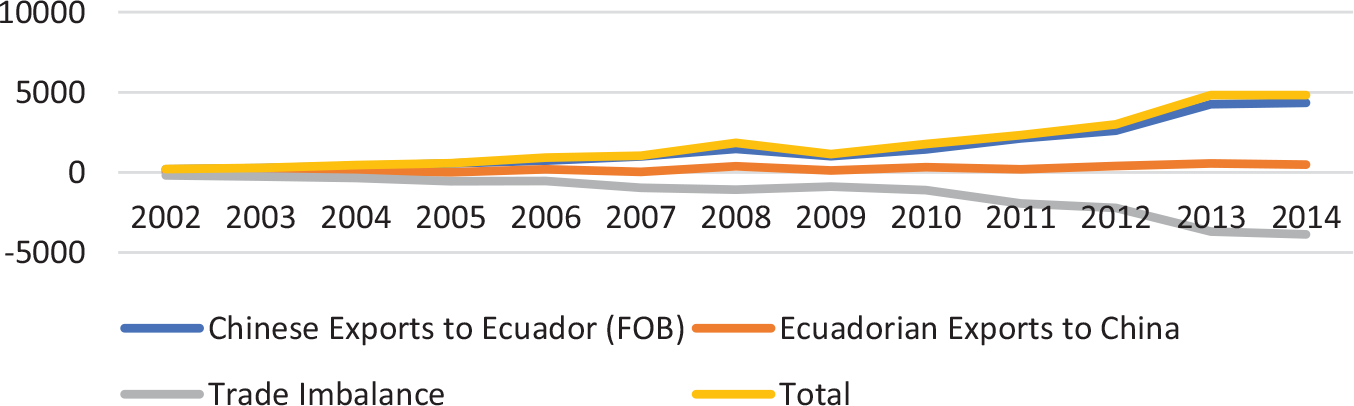
China–Ecuador Trade (Yearly / US$ Million).
Investment
The pattern of Chinese investment into Ecuador (Figure 5) differs from broader market trends, including Chinese outward foreign direct investment (OFDI) globally (Figure 3) and Chinese FDI into Latin America (Figure 4). Obtaining accurate numbers for Chinese capital outflow is challenging as much of it is processed through Hong Kong or offshore companies (Li and Zhang 2017); however, data from China’s Ministry of Commerce (Ministry of Foreign Affairs and Commerce of the People’s Republic of China [MOFCOM]) reveal a broadly valid trend which moves only upward for 2003–2014. This is unable to account for fluctuations in China–Latin America investment or in Chinese investment in Ecuador. As there is no official data on China’s FDI in Latin America, compiled estimates from various reports were used to create Figure 4, providing a starting point for understanding whether Chinese FDI in Ecuador appears to be market-driven. Figures 4 and 5 exhibit significant divergences, so the remainder of this section proceeds to seek explanations for that.
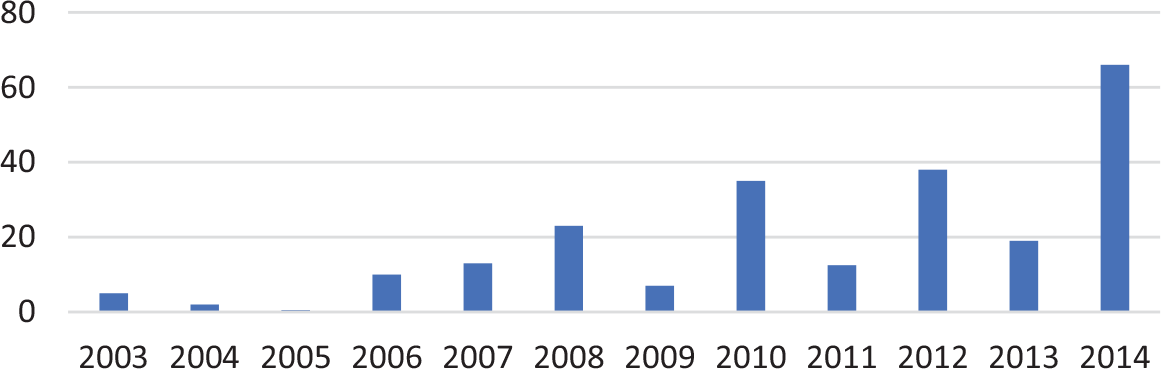
Chinese OFDI Worldwide (Yearly / US$ Billion).
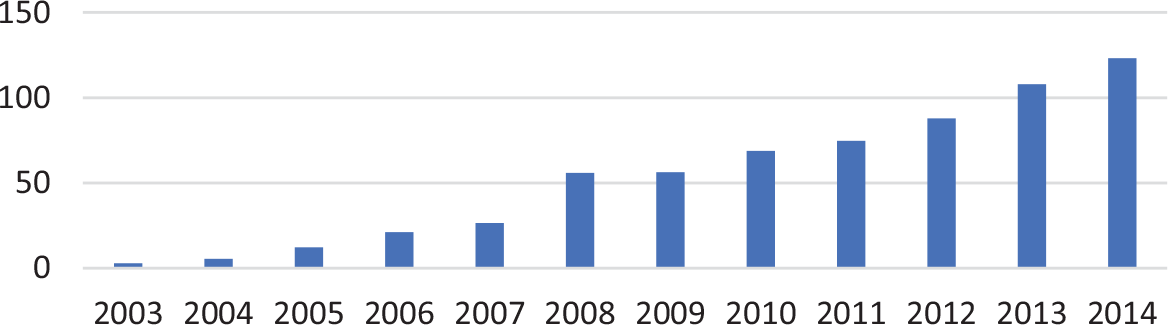
Chinese FDI in Latin America (Yearly / US$ Billion).
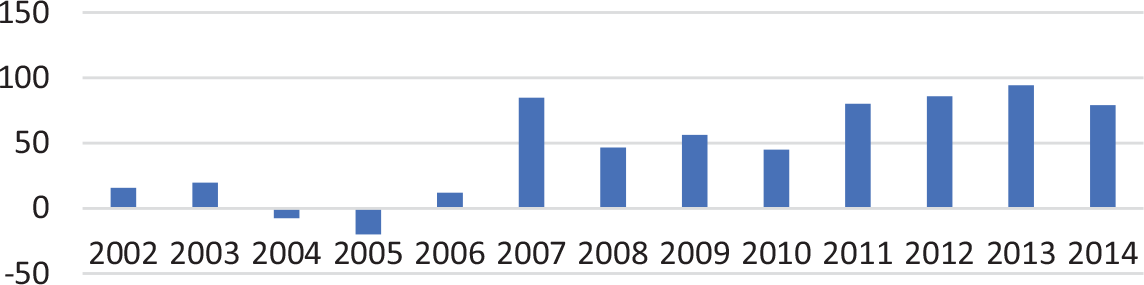
Chinese FDI in Ecuador (Yearly / US$ Million).
Although China began pursuing increasingly active engagement with Latin America and Ecuador in 2001, this had little effect until 2006–2007 when sharp investment spikes were observed in both (see Figures 4 and 5). The initial 2006 spike relates to broader trends and could be attributed to market forces, but this does not hold for its subsequent increase and sustenance.
Correa’s first election win came in 2006, and variation in his popularity mirrors subsequent China–Ecuador investment fluctuations. Figure 5 illustrates three major trends of Chinese FDI into Ecuador after 2006: a spike in 2007, a spike in 2011, and post-2011 stabilization. All three are related to Correa’s election wins and his consolidation of power which was reinforced by keeping campaign promises. Correa ran on a leftist platform, pledging increased funding for health care, education, social security, and housing while limiting external debt and decreasing taxes (El Universo 2006). His agenda was almost entirely focused on spending, except in two areas: developing new oil extraction projects and constructing new refineries, both of which matched China’s economic interests.
Much of China’s oil is imported, and its demand for energy is projected to exponentially exceed its capacity for increasing domestic supply—this estimate is based on calculations that already include a projected stark yearly increase in China’s domestic supply capacity (Wei 2016, 6). China constantly seeks to diversify its supply sources, and the 2007 spike in investment into Ecuador is a natural match between the projected increase in its energy needs and Correa’s plan to intensify oil extraction. This allowed him to temporarily boost Ecuador’s economic development while fulfilling his spending-heavy political agenda.
After 2007, Chinese investment in Ecuador became largely concentrated in energy, and engagement in all other sectors remained negligible in comparison. For instance, in 2014 alone China invested US$74.5 million in developing Ecuadorian mines and quarries, while the largest amount it ever invested in a non-energy sector was US$4 million (over 18 times less) in manufacturing during the same year (Banco Central del Ecuador 2020d). The ratio of Chinese investment in energy has been consistently larger than that in all other sectors, and they thus remain outside of this article’s scope.
In mid-2009, Rafael Correa was reelected, but this did not immediately attract an increase in Chinese FDI as Ecuadorean politics went through a period of instability. After his reelection, Correa ordered the withdrawal of U.S. troops from the U.S. Military Air Base in Manta—as he had promised in his campaign. Pro-U.S. voters and lobbyists interpreted this as an act of anti-Americanism, leading to discontent among some Ecuadorians. In the following year, Correa faced large anti-government protests against a domestic law which decreased benefits for military and law enforcement officers. The protest escalated into the later widely discussed 30-S coup attempt which ultimately failed. Ecuador’s government subsequently ran into a number of diplomatic skirmishes with the United States over having granted a travel card to Edward Snowden, while Ecuadorean officials blamed the United States for using trade negotiations to exert diplomatic pressure on them. In light of this escalating tension and political crisis for Correa, he aimed to reenergize his base by promoting a populist narrative that Ecuador will decouple its ideology and foreign policy from the United States, and his actions after 2010–2011 indeed reflected his intention. This served as a turning point, spurring a lasting opening toward Chinese foreign investment which started in 2011 and continued through 2014.
Loans
Ecuador’s 2014 debt to China is reported to have been between US$6.6 billion (Banco Central del Ecuador 2020a) and US$13.8 billion (compiled media and other reports: Araujo 2016; The Dialogue 2018). This makes up around 10 percent (low-end estimates) to 20 percent (high-end estimates) of the country’s total external debt. Discrepancies stem from a lack of clarity on the number of reported deals which in fact materialized and the criteria used by the Central Bank of Ecuador to define loans as opposed to investment or transaction deals.
From Ecuador’s perspective, Chinese loans became available in 2009 after the first one was given out following President Correa’s reelection. After 2010, the total volume of Chinese loans to Ecuador began to increase significantly. From the perspective of political economy, the initial impulse for this increase in 2009–2010 was motivated by a number of factors. First, the global financial crisis (GFC) stifled Western lenders (Liu 2012) which prompted Ecuador’s government to seek alternatives. Second, global markets saw a sharp oil price drop in 2009. Although the market partially recovered in the following year, Ecuador’s government could not have predicted that and, thus, requested Chinese funding at the time. Third, at the end of 2008 (and four months before a Presidential election), Correa defaulted on a US$31 million interest payment on global bonds, stating that this is odious debt (Mapstone 2008; Santacruz 2008). This was a de facto payment refusal to the United States and it led to Ecuador’s temporary exclusion from the global financial system which lasted until 2014. During that period, it was essential for Ecuador to seek non-U.S. funding sources.
After Correa’s 2008 debt default and his reelection, a series of hydroelectric power plant failures led to a temporary energy crisis in Ecuador. Blackouts in late 2009 and early 2010 pressured the government to purchase electricity from neighboring Colombia and Peru (Latin American Herald 2010) which motivated the Correa administration to subsequently develop more energy-related projects. Some were seen as viable, while others polarized public opinion. Perhaps the most widely discussed example is Coca Codo Sinclair, a dam project in an ecoregion of the Amazon jungle which was heavily criticized by Western media (Casey and Krauss 2018). Compiling these factors reveals that Correa’s pivot to Chinese development loans was motivated by his alienation of U.S. and international institutions and by Ecuador’s need to diversify its funding sources during a period of global market instability. In other words, a market downturn, paired with Correa’s political agenda of pursuing financial independence from the United States and China’s international financial expansion, brought Chinese loans to Ecuador.
The discussion so far demonstrates that while China–Ecuador trade fluctuations can be explained by market factors, this is not true for investment patterns and is only partially true for loan trends. Trade composition, imbalances, and patterns match broader China–Latin America trends, and the initial rise of Chinese FDI in Ecuador was motivated by Correa’s rise to power in 2006, while a sharp 2011 spike and subsequent stabilization resulted from his consolidation of power. While the post-2009 increase in Chinese loans to Ecuador is partially explained by the GFC, it was also driven by Correa’s foreign policy agenda of steering away from U.S.-led financial institutions. These developments enabled Correa’s administration to deliver on an agenda of increasing social spending while developing energy projects which matched well with China’s growing economic interest in Latin America.
China–Bolivia Economic Relations
Were China–Bolivia trade, investment, and loan patterns from 2005 to 2014 driven by market, or political, forces? As we shall see, despite China’s relative dependency on Bolivian tin exports, overall trade patterns and composition are shaped by market forces, similar to the case of Ecuador. Regarding investment, although the amount of Chinese FDI in Bolivia is negligible, its fluctuation reveals some insight into the way Morales’ anti-American ideology led to an increase in Chinese investment. Finally, I argue here that Chinese loans have risen in importance for Bolivia as an alternative to funding from U.S.-led institutions, most notably the World Bank; in this regard, their availability helped Morales to realize his political vision of decreasing Bolivia’s dependence on the West.
Trade
Similar to the case of Ecuador, China’s trade patterns with Bolivia are largely market-driven. Bolivia’s global exports are almost entirely composed of raw materials, including natural gas (consistently over 25%), various minerals, and precious metals such as zinc ore (fluctuating between 10% and 15%), tin, and lead (both fluctuating between 3% and 5%). In line with this trend, nearly 99 percent of all Bolivian exports to China are raw materials (Banco Central de Bolivia 2020b). China’s trade relations with Bolivia follow the broader China–Latin America pattern, albeit with a little more fluctuation than in the case of Ecuador (cf. Figure 6 with Figure 1). As for most Latin American countries, this led to an increasing trade imbalance; by 2014, Bolivian imports from China (US$1.8 billion) had grown over four times the amount of exports (US$434 million; Banco Central de Bolivia 2020a).
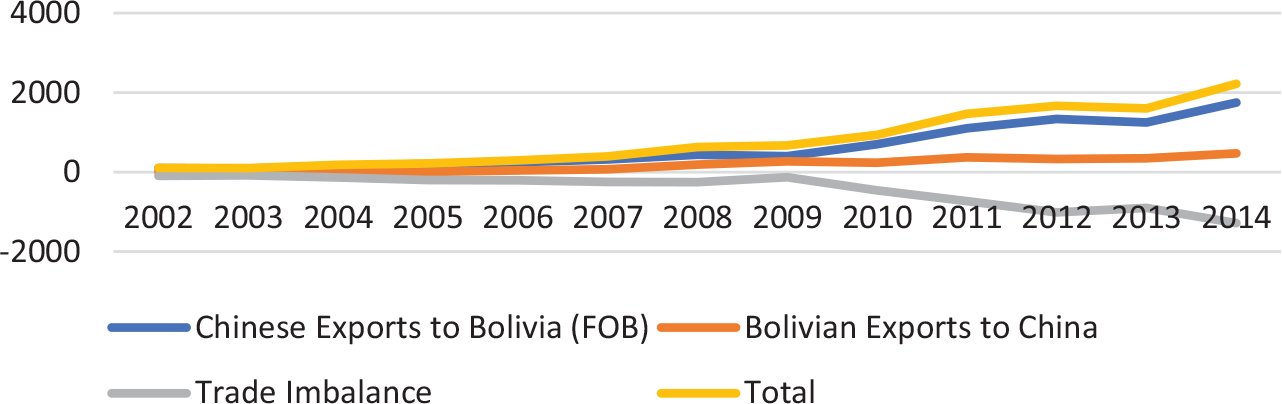
China–Bolivia Trade (Yearly / US$ Million).
Due to the small size of Bolivia’s economy, its trade volume is relatively insignificant for China. However, a more detailed analysis still provides some valuable insights. First, China turned from a relatively obscure to a significant trade partner for Bolivia. Second, a closer look at the data reveals that Bolivia’s main exports to China are topped not by natural gas but by zinc and silver (over 60% combined). They are followed by tin which plays a significant part in China–Bolivia trade relations. Although tin takes up a relatively small portion of Bolivian exports (fluctuating around 15% during the 2009–2014 period), it represents almost half of China’s total global tin purchases. This means that while trade relations are market-driven overall and too insignificant for China in terms of volume, they contain a strategic aspect of providing China with relatively rare raw materials necessary for its industrial development.
Investment
China’s investment in Bolivia is insignificant in terms of volume; yet its increase after Morales came to power reveals his administration’s deepening openness toward China. Bolivia has historically remained among the poorest countries in Latin America and consistently receives less investment than its neighboring countries. Chinese investment only takes up a small amount of this: using the World Bank’s (2020) FDI definition, it is consistently less than 1 percent of the total in Bolivia (La Marca 2017) and has no substantial impact on the country’s political or economic development.
Still, Bolivia became marginally more open to Chinese investment after Morales came into power (Figures 7 and 8). During his first three years as president (2005–2007), Morales started a nationalization campaign which targeted primarily the gas industry and other sectors managed by foreign enterprises. His goal was to renegotiate contracts which were deemed unfair, primarily with Western companies (Smith 2018), but the side effect of this approach was that Western investors interpreted it as a sign of market uncertainty, opening an opportunity for those who are less sensitive to anti-liberalization reforms, including Chinese investors. The subsequent decrease in Chinese FDI in Bolivia is not directly related to any observable market or political trend. For instance, in 2008 global market prices of raw materials fell sharply—by 52 percent for zinc, 26 percent for tin, and 32 percent for silver (Cicowiez and Machicado 2010)—and Bolivia needed additional funding. Meanwhile, the Chinese government encouraged its investors to increase OFDI, and in theory it should have inspired greater interest in Bolivia among other countries, but this did not happen—paradoxically, a small surge came later, in 2009 when market prices of raw materials had recovered. In other words, post-2007 fluctuations do not reveal any substantial political insight. The only definitive conclusion here is that the Morales government was marginally more open to cooperating with Chinese investors than previous administrations.
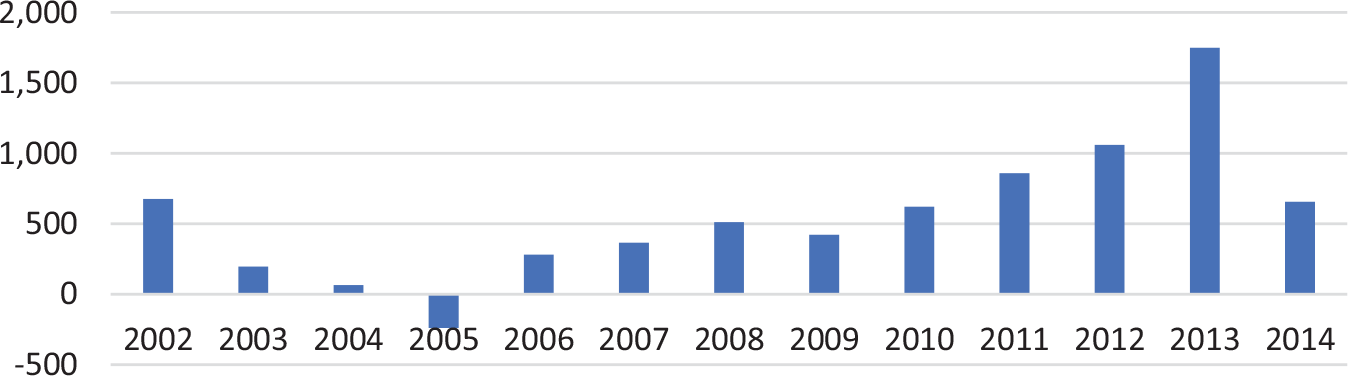
FDI Net Inflows into Bolivia (Yearly / US$ Million).

Chinese FDI in Bolivia (Yearly / US$ Million).
Loans
In 2005, over one-third of Bolivia’s external debt was to the World Bank, but this soon changed. Morales consistently pursued policies of increasing Bolivia’s economic independence from Bretton Woods institutions and managed to push down debt levels to the World Bank from over 34 percent to nearly 10 percent during his first term, and further down to 8.7 percent by 2014. Prior to 2005, Bolivia had relied on Bretton Woods institutions for decades, but recently, Morales proudly stated his country’s “total independence of them” (Telesur 2017). Under his leadership, Bolivia shifted to Latin American and Chinese loan providers. In 2005, around half of the government’s external debt was to the Inter-American Development Bank (IADB; 32.8%) and to the Andean Financing Corporation (17.6%). Bolivia subsequently maintained its relationship with the former and developed a greater dependency on the latter which held 30.9 percent of Bolivia’s debt in 2014. In the process, debt levels to the IADB surged to surpass 2005 figures (Banco Central de Bolivia 2020c). This reliance on Latin American institutions substituted engagement with the World Bank.
Meanwhile, Bolivia grew increasingly indebted to China. Before and during Morales’ first term, Chinese lending was virtually nonexistent, but it gradually rose to reach 9 percent of the country’s total external debt by 2014. In relative terms, this means that from 2005 to 2014 the importance of Chinese loans to Bolivia surpassed that of World Bank loans. Similar to Ecuador, this took place in the backdrop of an increasingly strained relationship with the United States which was embodied in three trends. First, Morales was in constant disagreement with the United States regarding coca leaf production—a key source of income for Bolivian farmers and a major source of drug supply to the United States. Second, an assassination attempt of Morales inspired him to claim that it was orchestrated by the CIA (Carroll 2009), while leaked information suggests that the United States secretly indicted some of its top officials for having connections with Morales after accusing them of involvement in a cocaine trafficking scheme (Grim and Wing 2015). Third, the strenuous U.S.–Bolivia relationship impacted Bolivia’s diplomatic relations with the West. One notable case is the refusal of France and Portugal to grant Morales a stopover permit as he was flying from Russia to Bolivia. They forced Morales to land in Austria due to suspicions that fugitive Edward Snowden might be on his plane—and the same reasoning was used by the United States in various diplomatic skirmishes with Ecuador (Roberts 2013). Overall, the decrease in Bolivia’s financial dependence on Western institutions has been paired with continuous strain on its relations with the United States. From this perspective, it becomes clear that while Bolivia’s most important financial ties are with Latin American institutions, Chinese banks successfully established themselves as key alternative lenders, counterbalancing Western institutions.
China’s loans thus had greater political impact than its trade with and investment in Bolivia. Although Bolivia’s tin supply carries a strategic element to bilateral trade, it remains market-driven—much like Ecuador’s trade with China. In terms of investment, China–Bolivia cooperation increased slightly after Morales came to power, but volume has been too small and fluctuations too sporadic to be meaningful. By contrast, China’s provision of loans to Bolivia increased notably under Morales; although his government did not take Chinese loans during its first term, it began to do so during his second term and continued thereafter—by 2014, Chinese banks combined had overtaken the World Bank in terms of loans provided to Bolivia. This trend was motivated by increasing strain on U.S.–Bolivia diplomatic relations and by the Bolivian government’s determination to decrease its dependency on Western institutions, most notably the World Bank. This reveals that the observed economic relationship has political implications as the availability of Chinese loans indirectly allowed Bolivia to steer away from Western financial influence and to pursue leftist politics.
Intertwining Economic Interests and Ideology
We have seen that China’s trade patterns with Ecuador and Bolivia for the 2005–2014 period are explained by market trends, but this does not hold true for investment patterns in Ecuador, for loan patterns to Bolivia, and to some extent for Chinese loan patterns to Ecuador. These three intensified during periods of rise and/or consolidation of Correa and Morales’ grip on power, both of which are characterized by shifts away from U.S. influence and from international financial institutions. Before engaging in the discussion, it is worth noting that some Chinese funding to Ecuador and Bolivia has impacted local communities negatively. This includes environmental damage and undermining the local labor market by employing Chinese workers to complete construction projects—for Ecuador, such reports have been surfacing at least since 2013 in academia (Gallagher et al. 2017; González-Vicente 2013) and media (Hill 2014; Nathanson 2017); more minor criticisms of environmental damage have emerged about Bolivia (Praeli 2018). In many outlets, these issues receive more attention than the political aspects of China–Latin America relations and are often framed as criticisms of China; yet their roots can also partially be traced to a lack of provision or of capability to enforce local regulations. This topic forms an important part of understanding China’s impact on Latin America but falls outside of this article’s scope.
I now turn to argue that a combination of four factors led to the development of a cyclic reinforcement of China’s interests and leftist Pink Tide agendas: (1) the mutually beneficial aspect of strategic economic deals matching Chinese funding with Latin American natural resource extraction projects; (2) the role of geopolitical competition which encourages states to hedge between the United States and China; (3) China’s diplomacy of solidarity with developing countries, which helps foster relations with Latin America; and (4) the rise of anti-Americanism seen as a pillar of national identity formation in Ecuador and Bolivia, which indirectly incites their interest in China.
Overlapping Economic Strategies
China, Ecuador, and Bolivia all share three economic goals: seeking mutual complementarity, diversifying funding sources (Ecuador and Bolivia) and raw material suppliers (China), and securing long-term deals to develop large-scale projects. China’s economic engagement with Ecuador and Bolivia largely falls within two sectors, energy and raw materials. The former is key to powering China’s rapid economic growth, while the latter supports its industry; energy plays a larger strategic role and it is thus explored first and in greater detail. In terms of oil and gas, China transitioned from a self-sufficient state to a major importer within the past 40 years. From 1978 until 1992, it maintained a policy of yin jinlai (lit. “attract to enter”) aimed at sourcing foreign investment to accumulate capital; during that period, its energy production remained self-sufficient, relying heavily on coal. After China became a net oil importer in the 1990s, it grew increasingly concerned with energy security, rather than energy policy. Political instability in major exporter-states and concerns about sea transport security (e.g., the Malacca Strait) turned into oft-discussed policy issues that permeated academic debates (see, for example, Ji 2007; Zhang 2011). After Jiang Zemin adopted the zou chuqu (lit. “going out”) policy, state-owned Chinese enterprises were encouraged to expand overseas. In the past decade, the threat of potential power outages rose in importance within China as social forces grew stronger (Luo and Yao 2012; Watts 2010).
Opposing voices stand at the two extremes of China’s energy security debate. On one end, conservatives from various coal research institutes advocate self-reliance; they pursue intensive research on clean coal energy and coal liquefaction (Nolan, Rui, and Shipman 2004; Rong and Victor 2011; Xinhua 2018). On the other end, scholars of international political economy such as Zha (2016) advocate market reliance. As of 2020, China has not succeeded in developing a low-cost technology ensuring self-reliance, and the market occasionally experiences volatilities; in response to these risks, it pursues a strategy of improving general relations (to potentially secure future contracts) and signing long-term deals with oil and gas exporters—China’s rapprochement with Ecuador and Bolivia is thus part of a broader energy security strategy. Similarly, manufacturing also requires increasingly large quantities of imported raw materials, and thus, China is interested in developing comprehensive strategic partnerships, rather than seeking short-term profit from deals with natural resource exporters.
Ecuador and Bolivia’s leftist governments also had a strategic motivation to engage with China from 2005–2006 to 2014. In Ecuador, Correa sought a number of loan-for-oil deals with China, allowing him immediate access to funding at the cost of future production while staying at odds with U.S.-led international financial institutions. Some media outlets criticized such deals for the potential budget deficit they may cause; however, the deals could be more accurately understood as a gambler’s bet on a bullish oil market. China–Ecuador loan-for-oil repayment agreements are linked to the West Texas Intermediate (WTI) index, which means the value of oil repayments is based on market prices. The primary difference with market-based trade is that Ecuador receives payments in advance and commits to one specific “buyer,” China. This approach was adopted to secure funding for new extraction projects in hopes that oil price will continue to rise. The funding was also used to develop infrastructure while steering away from U.S. economic influence; Correa defined this aim at the beginning of his first campaign and often expressed it through anti-American discourse. While Chinese funding to Ecuador is only a small part of the latter’s complex political landscape, it helped Correa to pursue his spending-heavy agenda and sustain popular support for three consecutive terms.
Bolivia’s economic reliance on the United States and the extent of its engagement with China lag behind those of Ecuador; thus, trends are not as pronounced in this case. Still, China’s role in the Morales government strategy is similar to that in Correa’s Ecuador. Chinese loans allowed Bolivia to afford steering away from World Bank loans to develop local infrastructure and smaller projects while gaining greater independence from Western actors. Overall, China’s strategic economic aims of further diversifying its energy and raw material suppliers coincided with the resource-rich states of Ecuador and Bolivia’s quests for non-Western funding sources.
U.S.–China Geopolitical Competition
After the Cold War, international politics was defined by U.S. dominance until China’s rise challenged this established order. An increasing number of critics have argued that China aims to project its power globally (Chhabra and Hass 2019) and eventually overtake the United States (Pillsbury 2016) as the leading world power. While some believe this is exaggerated, there is broad consensus that China has become increasingly assertive. This has been institutionalized in three ways; first, China regularly organizes regional summits with Latin America, Africa, and Central and Eastern Europe. Second, it has successfully backed new financial institutions such as the Asian Infrastructure Investment Bank and the New Development Bank. Third, China leads the impressively ambitious Belt and Road Initiative.
Opinions over the implications of China’s rise for the international order are divided. Optimists predict a peaceful transition toward a bipolar or multipolar world (Han 2009), and this is echoed by Chinese media (Okuda 2016). Pessimists point to rising tensions between the United States and China as evidenced in the case of Taiwan, the trade war (Paal 2018), and the recent “battle of narratives” over COVID-19. Realist scholars express deep concern as their theories predict that friction between rising and established powers produces violent conflicts (Alison 2017). Examining China’s rise through frameworks such as Gilpin’s (1981) hegemonic stability, Modelski’s (1987) long cycle theory, and Mearsheimer’s (2001) offensive realism makes for pessimistic speculations that a war between a rising challenger and an established hegemon is difficult to avoid. They predict that the eventual winner of this clash will restructure the new international order in its favor.
While signs of an upcoming violent conflict between China and the United States still remain rather scarce, the rapprochement between China and Latin America can be seen as a mode of undermining U.S. influence. As Mearsheimer points out, offensive realism posits that no single state can dominate the globe, and thus, the optimal strategy for a rising power is to dominate its own region while ensuring that no other state dominates their region. His theory elegantly illustrates U.S. foreign policy: for decades, the United States viewed Latin America as its “backyard” (Livingstone 2009) while pursuing a containment policy toward China. U.S. containment in Asia resembles its Cold War policy toward the USSR, while Chinese influence in Latin America resembles that of the USSR in the region. These parallels are partial, but they reveal a deeper insight, namely that the United States and China are competing for strategic influence within each other’s adjacent regions. From the standpoint of Latin American states, simultaneously increasing their economic engagement with the United States and China is a balancing act. For relatively small states, overreliance on one great power alone is risky, especially as the United States and China draw accusations of pursuing neocolonial policies toward Latin America. Ecuador and Bolivia have opted not to bandwagon with either one great power but seem to have been hedging between the two. This explains Correa and Morales’ foreign policy strategies: while maintaining economic partnerships with the United States, they simultaneously deepened ties with China.
In light of this, China’s rapprochement with Ecuador and Bolivia epitomizes a geopolitical clash between a rising and an established power in three ways. First, China has become increasingly assertive. Second, Chinese attempts to undermine U.S. influence in Latin America are a response to a quasi-containment U.S. policy toward China. Third, if Ecuador and Bolivia hedge successfully between China and the United States, they can benefit from geopolitical competition between the two. This analysis presents a cyclic mechanism for the mutual reinforcement of all three trends. The United States must defend its hegemonic status through pursuing a bid for dominance in Latin America, while China’s only path to global leadership is to undermine that; the more assertive each great power becomes, the stronger the response from its counterpart, triggering a vicious cycle of escalating competition for influence in Latin America. This offers an opportunity for states such as Ecuador and Bolivia to gain greater benefits such as negotiation leverage by balancing between the two great powers. Meanwhile, this further forces policy makers in the United States and China to pursue a strategy of increasingly aggressive competition for influence, akin to an arms race.
China’s Diplomacy of Solidarity
Theory shapes International Relations research, but history dominates diplomatic discussions. Historically, China has remained keen to engage with the leftist governments of developing states; in the Cold War era, it expressed “solidarity” with the “third world.” During the 1950s and 1960s, China was a vocal revisionist state that took an active part in initiatives such as the Bandung Conference; after 1978, China abandoned its revisionist views to seek greater economic gains and higher status in the international system. Since then, China has used its rhetoric of solidarity in much subtler ways during bilateral diplomatic meetings and visits. Still, it seeks to present itself as a compassionate, equal partner to developing countries based on their shared anti-colonial struggles and on a long-standing shared commitment to “non-interference” in the domestic politics of other states. This creates a historical contrast with the West’s dominance over former colonies, the promotion of Western neoliberalism and international financial institutions through political conditionalities, and U.S. policy toward Latin America. Overall, China aims to present itself as a historically credible alternative to the West.
Besides, the International Liaison Department (ILD) of the Chinese Communist Party was established in 1951 to specialize in communicating with leftist parties abroad (Gitter and Fang 2016). During the 1980s, the ILD’s focus expanded toward cultivating relations with non-communist parties, and its influence subsequently diminished. However, the ILD’s apparatus influenced decades of diplomacy, and thus it still remains mildly easier for Chinese officials to establish working relationships with leftist governments. Such a marginal and unofficial preference cannot be seen as a major driving factor for China’s rapprochement with Ecuador and Bolivia. Yet, combined with a rhetoric of solidarity, it provided a favorable precondition for establishing engagement with these countries’ leftist governments between 2005 and 2014 based on shared values and ideas.
Latin American Identities and Anti-Americanism
The failures of neoliberalism in Latin America posed many new questions about development and polarized some societies in the region. From the perspective of political economy, it would be necessary to examine states according to their levels of development; however, this would obscure the historical complexities which shape Latin America. During the colonial period, varied ethnic groups were politically dominated across the region; this was followed by decades of U.S. political influence in the postindependence era. A postcolonial reading of these trends reveals that Latin American states are struggling to form defined identities (Young 2011). The rise of leftist movements in the region was largely prompted by some countries’ quest for identification of a “self” which is only possible in opposition to an “other” (Katzenstein 1996).
Critical scholars have explored Bolivia and Ecuador’s struggles for identity formation. For instance, Rimassa (2008) analyzes symbolism in Morales’ Movimiento al Socialismo to argue that the construction of a common enemy is key to achieving unity between rural and urban workers in Bolivia. For this purpose, the enemy can only be external—thus, it is unsurprising that Morales “rejects all forms of imperialist penetration or subjugation that seek to exert domination over the will of the Bolivian people, the national State or the wealth and destiny of the Republic” (Movimiento al Socialismo 2004, 20).
From a political psychology perspective, defining a common enemy is more productive for national cohesion than defining a common goal. It invokes an urgent need for unity in the face of danger, and it implicitly downgrades ethnic/civil conflict within the state. Thus, while Morales’ anti-imperialist rhetoric causes frictions in international politics, it aims to achieve the opposite effect within Bolivia. The case of Correa’s anti-Americanism is similar as his agenda is explicitly framed around resistance to the United States (Romero 2006). Partly due to their constant calls for a rise against a common “enemy,” both Correa and Morales are seen as populist leaders who were permanently campaigning (Conaghan and de la Torre 2008). Seeking the sustained promotion of an alleged “anti-imperialist” ideology, they became prisoners of their own agendas with no other option but to pursue a populist narrative branded as “anti-imperialism” which resulted in policies undermining relations with the United States. After damaging the economic aspect of these relations, Ecuador and Bolivia sought to fill in financial gaps through alternative channels.
China’s willingness to invest in and lend to Latin America contributed to the ability of self-styled “anti-imperialist” leaders Correa and Morales to rebalance their economies while steering away from the United States, at least in the short run. From China’s perspective, the resulting cyclic relationship between its investment and loans in Ecuador and Bolivia, and the temporary consolidation of leftist governments there might not necessarily be the result of deliberate strategizing. Chinese banks are in many cases legitimately targeting profits or acting in line with Beijing’s energy security policy by seeking diversification of natural resource suppliers. Nevertheless, their commitment to engagement with Latin America has indirectly aided leftist leaders there, providing them with the financial means to maintain anti-American policy stances while fulfilling their domestic agendas and pursuing multiple bids for reelection. The sustenance of the left in Ecuador and Bolivia during 2005–2014 was supported by China’s economic interests in Latin America and vice versa: aside from market-driven increases in trade, non-leftist governments would have been unlikely to engage with China. Thus, Correa and Morales’ success seems partially based on a quest for (re)defining Ecuador and Bolivia’s national identities in opposition to the United States as an “other”—and this was supported through deepening investment and loan relations with China where ruptures with the United States had left financial gaps.
In sum, the deepening of Chinese economic relations with Ecuador and Bolivia is intertwined with the rise and success of Correa and Morales from 2005 to 2014. Areas of mutual complementarity between China and its Latin American counterparts demonstrate that its need for diversifying energy and raw material suppliers matched well with Pink Tide agendas of heavy social spending and extractive development. The geopolitical competition between the United States and China also led to a scramble for Latin America that encouraged Ecuador and Bolivia to hedge between the two to maximize their gains. And China’s rhetoric of “solidarity” with developing countries and its experience in dealing with leftist governments provided favorable preconditions for the development of strong relationships with the Morales and Correa administrations.
Pursuing closer economic relations with China to steer away from the United States has a deep psychological meaning for identity formation in Ecuador and Bolivia, allowing both to shape a stronger perception of “self” in opposition to the United States as an alleged “imperialist other.” These four factors were mutually reinforcing; they led to the formation of a cyclic relationship between the rise and success of leftist, anti-American leaders and the increased availability of Chinese funding as an alternative to U.S. and/or U.S.-led international financial institutions.
Conclusion
This article analyzed trends in China’s economic relations with Ecuador and Bolivia and explored the macro-economic and political factors that explain these trends and the mechanisms which motivated China’s economic engagement with Ecuador and Bolivia from 2005 to 2014. Economic relations were defined in terms of trade, investment, and loans; in both Ecuador and Bolivia, the former is market-driven. However, this is not the case for investment in Ecuador, for loans to Bolivia, and to some extent for Chinese loans to Ecuador. I contend that these three forms of funding are motivated by a cyclic, mutual reinforcement of China’s economic interests and by the rise of leftist leaders Correa and Morales who were integral to the Pink Tide. As Chinese economic engagement with Ecuador and Bolivia increased, it provided an economic alternative to funding from U.S.-led international institutions. More importantly, these dynamics were underpinned by four factors: (1) mutual complementarity between China’s demand for energy and natural resource supply diversification alongside spending-heavy, extractive development agendas shaped by the Pink Tide; (2) U.S.–China geopolitical competition for influence in Latin America; (3) China’s past experience in engaging with leftist governments from developing countries; and (4) anti-American ideology aiming to shape national identity through leftist narratives in Ecuador and Bolivia.
In 2014, it would have been reasonable to assume that the cyclic reinforcement between the rise of the Pink Tide and increasing Chinese economic engagement with Latin America will accelerate further over time. However, with the benefit of hindsight, it is now clear that this was not the case. In 2017, Correa was succeeded by his former Vice President Lenin Moreno who pursues more moderate policies and maintains a productive dialogue with the United States. In 2019, Morales attempted to run for a fourth term illegally, which led to social unrest and inspired his eventual fall from power. As of 2020, both Correa and Morales live in asylum (in Belgium and Argentina, respectively), which alienates them from domestic politics. The Pink Tide was followed by a conservative one, leading to the elections of Mauricio Macri (Argentina), Sebastián Piñera (Chile), and Jair Bolsonaro (Brazil). This turnaround of events is not unexpected in itself; despite the occasional rise of dictators in Latin America, politics in the region is historically dynamic, and Chinese economic engagement alone can hardly halt local trends and discontents; besides, economic engagement and geographical proximity to the United States still outweigh Chinese economic influence on domestic politics in Latin America over the long term. Nevertheless, this did not preclude China from accentuating the Pink Tide by indirectly supporting the rise and success of Correa and Moreno and prolonging the life span of their administrations.
While the Pink Tide has ended, Chinese investment and loans in Ecuador and Bolivia continue. For 2015–2018, yearly Chinese FDI in Ecuador averaged at US$81.8 million, which was comparable to the historically highest (US$85.5 million yearly average) four-year period, 2011–2014 (Banco Central del Ecuador 2020c). As of 2019, Bolivian debt to China remains at 8.7 percent and fluctuated at around 9 percent for 2014–2018 (Banco Central de Bolivia 2020c). This means that what started as a cyclic relationship ultimately resulted in the fall of the Pink Tide and the sustenance of Chinese economic engagement with Ecuador and Bolivia. Although these interactions began as mutually beneficial, from a realist perspective the real “winner” appears to be China as it obtained relative gains through achieving the strategic aim of sustaining its influence in Latin America over the long term.
The impact of China’s economic rise on Latin American politics reveals complex dynamics. It is thus necessary for further research to probe into the strategic motivations behind China–Latin America interactions. To what extent are the approaches of Latin American governments to China motivated by national interest as opposed to partisan politics? Is it possible for Latin American states to obtain relative gains through deepening engagement with China? And does China have a coordinated strategy for indirect interference in the domestic politics of Latin American states through economic means? Chinese officials maintain a foreign policy stance of “non-interference,” and on the surface, they indeed avoid directly meddling in the domestic political affairs of other sovereign states. However, as this article has demonstrated, China’s rise and increasing economic engagement with the world can still have profound systemic effects on both national and international politics. The complex mechanisms which bring about these effects and the difficulty in observing their implications for the world make them elusive. Yet they remain impactful and ought to be explored more carefully and more frequently within and beyond Latin America.
