




Abstract
This study examines urban citizenship under crisis by analyzing how wartime evacuation and violence reshaped community dynamics in Israeli cities following the October 7, 2023 attacks. It argues that emergencies catalyze a reconfiguration of civic life, expanding residents’ roles and elevating the importance of local institutions as primary agents of governance when state capacity falters. Using a mixed-methods design that combines a national survey of 88 cities and towns (N = 906) with qualitative interviews with community leaders (n = 24), the study investigates how the crisis affected two core dimensions of urban citizenship: community connectedness and collective action. The quantitative results show that exposure to risk, especially evacuation, significantly increased both. The qualitative findings provide contextual evidence for these mechanisms, demonstrating how community institutions coordinated services, rebuilt social ties, and acted as de facto civic infrastructures. The study advances urban citizenship theory by showing how crisis conditions activate community-based forms of citizenship and offers insights for policymakers seeking to strengthen civic engagement in times of disruption.
Introduction
On October 7, 2023, Hamas and other Palestinian armed groups launched a coordinated attack from the Gaza Strip on southern Israel, marking the beginning of a large-scale war. Thousands of rockets were fired toward Israeli cities and towns, and armed militants infiltrated through the border fence, targeting more than 20 localities, including a music festival. Beyond the immediate violence, the government evacuated more than 100,000 residents from border towns in both the south and the north, displacing them from their homes for extended periods. Meanwhile, cities in central Israel remained physically intact yet deeply affected by the social, economic, and psychological consequences of the conflict. During the evacuation, state authorities focused primarily on the military response and struggled to provide sustained emergency services or to manage the prolonged displacement of civilian populations (State Comptroller, 2025a, 2025b). Crucially, these disruptions reshaped urban governance and civic life across Israeli cities, placing communities and local institutions at the center of crisis response. These conditions raise a central question for urban scholarship: does crisis activate urban citizenship? More specifically, how do urban communities respond to large-scale disruption when state capacity is strained and residents must navigate prolonged insecurity and displacement?
The October 7 crisis offers a compelling case for studying urban citizenship. Large-scale evacuation, prolonged displacement, and uneven state response pushed cities and community institutions to assume expanded civic roles, organizing services, mobilizing residents, and sustaining daily life amid state dysfunction. These conditions provide a unique opportunity to observe how urban citizenship emerges and takes shape when state capacities falter.
This article examines the effects of wartime evacuation on two key community dynamics, collective action and connectedness, across a range of Israeli cities. We compare evacuated border cities, where residents experienced direct physical risk and prolonged displacement, with non-evacuated cities in central Israel that faced indirect but still significant forms of crisis. This comparison allows us to identify how varying levels of risk exposure shape communal responses and local civic life during periods of state dysfunction. While the empirical focus is on wartime evacuation, the analysis speaks to broader debates on how intense disruption and institutional breakdown reconfigure civic life in cities. To investigate these dynamics, the study employs a mixed-methods design. The quantitative component draws on a national survey of 906 respondents, including 189 evacuees, measuring collective action, connectedness, and risk exposure across cities. The qualitative component consists of 24 interviews with community leaders from evacuated, peripheral, and central urban communities, providing insight into how local institutions adapted, or struggled to adapt, to crisis conditions.
The study’s broader contribution lies in advancing the concept of urban citizenship by situating it within conditions of crisis. Urban citizenship scholarship generally develops along two broad strands: a social dimension that emphasizes everyday practices, participation, and civic action (Amin, 2006; Holston, 2008; Isin, 2002), and a legal dimension that understands urban citizenship primarily through formal status and institutional membership (Bauböck, 2003; Brøgger, 2019). We argue that crises can activate both dimensions by disrupting ordinary governance and compelling communities to assume civic responsibilities. This study focuses primarily on the social dimension, showing how crises generate conditions in which community practices acquire heightened civic and political significance. In such moments, whether shaped by displacement, conflict, disaster, or other forms of institutional strain, community responses become central to sustaining urban life. These practices are not only enacted by residents but are also mediated through urban community institutions, which frequently step in to replace or supplement weakened state functions. Urban citizenship therefore takes shape through everyday action and institutional improvisation during moments when ordinary governance breaks down.
The article proceeds as follows. The first section develops the theoretical framework by outlining contemporary debates on urban citizenship and situating crisis-driven collective action and connectedness within this literature. The second section presents the Israeli case context, detailing the October 7 war, the large-scale evacuation of towns, and the resulting disruption to urban communities. This is followed by an explanation of the mixed-methods approach, including the national survey and the 24 interviews with community leaders. The results section first reports the quantitative patterns of collective action and connectedness across evacuated, peripheral, and central cities, and then draws on qualitative findings to illuminate how community institutions operated during the crisis. Finally, the discussion integrates these empirical insights to assess how crises activate forms of urban citizenship, identifies the mechanisms linking community action to institutional transformation, and outlines implications for research on citizenship and crisis governance.
Urban citizenship and community practice
Urban citizenship refers to how individuals engage with and participate in city life, encompassing both the formal rights associated with municipal membership and the lived practices through which residents enact belonging, collective responsibility, and political agency (Bauböck, 2003). Since its emergence, the concept has been aligned with the notion of “seeing like a city,” emphasizing a form of citizenship distinct from nation-state frameworks (Lehrs et al., 2023; Magnusson, 2011). Within this field, scholarship can be broadly reviewed along two main agendas: legal and social.
The legal dimension of urban citizenship is rooted in formal recognition, legal status, and access to rights granted at the municipal level. Bauböck (2003) is central to this debate, arguing that citizenship must be understood as multilevel, whereby cities act as legitimate sites for distributing political and social rights independently of the nation-state. This perspective highlights how municipalities can operate as political communities in their own right, with authority over welfare, representation, or residency privileges. Examples include sanctuary cities (Kaufmann et al., 2022) or the unique municipal arrangements in conflict-ridden Jerusalem (Avni et al., 2022; Brenner et al., 2023). However, scholars also point to the limitations and hierarchies of legal inclusion, where immigrants, refugees, or marginalized communities may be physically present but only partially recognized (Brøgger, 2019; Gawlewicz and Yiftachel, 2022; Hays, 2009). This reflects Bauböck’s assertion that urban citizenship can both expand and constrain participation.
The social dimension of urban citizenship emphasizes citizenship as a lived and enacted practice rather than a legal condition or municipal–national authority distribution. From this perspective, citizenship is expressed through civic engagement, everyday participation, and feelings of belonging within the urban community (Amin, 2006; Blokland et al., 2015; Gillespie and Nguyen, 2018). Extending this approach, critical and insurgent perspectives view citizenship as a site of power and contestation, where marginalized groups challenge exclusion and assert rights “from below.” Rather than being granted by institutions, citizenship is enacted through acts of resistance, protest, and claim making (Holston, 2008; Isin, 2002). As a result, urban citizenship can become fragmented across spatial, social, and ethnic lines, reflecting uneven governance and differentiated access to resources (Blokland et al., 2015; Cohen and Margalit, 2015).
Alongside these critical accounts, another strand of the social agenda highlights the capacity of urban communities to generate collective responsibility. Rather than emphasizing fragmentation, this perspective views communities as central sites where citizenship is practiced and sustained (Blokland, 2017). This approach aligns closely with Etzioni’s (1993, 1996) communitarianism, which argues that citizenship rests not only on rights but also on shared moral obligations and collective responsibility. From this viewpoint, urban citizenship can be understood as the emergence and development of voluntary social connections. In this process, city residents create their own norms, rituals, and symbols. What makes these connections political, what turns residents into “city-zens,” is their collective action toward a shared cause, whether resisting home eviction, protecting local culture, or improving their neighborhood (Amin, 2006; Isin, 2002). Moreover, Blokland (2017) further shows that urban community is not a fixed structure but an ongoing practice shaped by everyday encounters. Community emerges through familiarity, the ability to build recognition and identity in shared spaces, and access, the capacity to move through and participate in urban environments.
In all these theories, the civic or political turn of community life may begin spontaneously or voluntarily and can later evolve into more organized and institutionalized forms of action. These dynamic processes continuously reshape community connectedness and collective action even in ordinary times. However, much of the scholarship examines these shifts primarily as responses to urban problems or crises, without fully theorizing how crisis conditions themselves may constitute a formative moment for urban citizenship. In this study, we build directly on this gap, arguing that crises accelerate and reconfigure these community dynamics, setting the stage for the forms of civic activation discussed next.
Citizenship during crises: A shift from state to urban
Crises, such as natural disasters, wars, and conflicts, often prompt citizens to assume new, informal roles in governance and service provision (Aldrich and Meyer, 2015; Broadhurst and Gray, 2022; Kuhlmann and Franzke, 2022). In such situations, formal governance structures may become overwhelmed or fail, prompting local communities, individuals, and non-state actors to step in. Scholars have noted that crises can serve as catalysts for emergent forms of civic engagement, with citizens assuming roles traditionally reserved for state institutions, such as disaster relief, public safety, and infrastructure management (Chamlee-Wright and Storr, 2009; Rosas et al., 2021). In the aftermath of crises, communities often exhibit self-organizing capabilities, providing critical services such as food, water, healthcare, and communication networks.
During times of crisis, urban engagement increases as more residents become actively involved in governance, assuming critical and responsible roles that are typically managed by the state. For example, in post-Katrina New Orleans, the failure of state and federal authorities to respond effectively led to a governance breakdown, with grassroots organizations, such as Common Ground Relief, stepping in to provide essential services, especially in marginalized areas (Chamlee-Wright and Storr, 2009). Similarly, after Hurricane Maria in Puerto Rico, local communities restored electricity, rebuilt infrastructure, and offered medical care, temporarily assuming state functions (Rosas et al., 2021).
In conflict-affected cities such as Beirut, where long-term instability has weakened central governance, residents and institutions have filled the void by providing security, infrastructure, and public services (Brenner et al., 2026; Fregonese, 2012; Sampaio, 2016). These cases illustrate how crises reconfigure governance, shifting from the national to the local, thereby making urban citizenship a prominent feature of the reaction and recovery processes. Moreover, a crisis sometimes serves as an opportunity for specific communities to promote their agendas. A recent study on urban citizenship making in Berlin, Copenhagen, and Tel Aviv has found that civil migrant organizations successfully secured rights and services due to the shift in governance during the COVID-19 pandemic (Krüger et al., 2024).
Overall, this scholarship shows that crises shift governance downward, prompting communities to assume roles normally carried out by the state. It also suggests that displacement can unsettle the spatial foundations of citizenship, as civic practices move beyond their original urban settings and are sustained through institutions, networks, and shared action across sites of relocation. Building on these insights, our study focuses on two dimensions widely linked to crisis-driven community engagement, collective action and connectedness (Esteban, 2025; Hawkins and Maurer, 2010; Nakagawa and Shaw, 2004), to examine how they contribute to the activation of urban citizenship under crisis.
Collective action and connectedness in times of crisis
Collective action refers to initiatives undertaken by individuals coordinating their efforts to achieve shared objectives (Olson, 1965). The role of collective action in urban citizenship represents the capacity of urban communities to self-organize, cooperate, and respond collectively to challenges. Connectedness is the state of being connected with others in a social context (Kawachi and Berkman, 2001). Connectedness complements collective action by emphasizing the significance of social networks in mediating civic engagement. Together, these dynamics represent what Isin (2002) calls “acts of citizenship,” moments when residents shift from being subjects to becoming active claim makers in the city. They also resonate with Amin’s (2006) account of urban citizenship as grounded in the “four registers of solidarity,” repair, relatedness, rights, and re-enchantment, which emphasize how everyday urban cooperation, mutual care, and shared meaning making underpin civic life.
Research on crisis response indicates that cities with strong social ties and a high degree of community organization tend to rebound more effectively from disasters and are better able to manage risks and distribute resources efficiently during crises (Esteban, 2025; Schauppenlehner-Kloyber and Penker, 2016). Moreover, Feinberg (2022) demonstrated through simulated models that social cohesion significantly contributes to the adaptability of urban systems, promoting resilience by enhancing the community’s collective capacity to face and adapt to changes. However, a less explored area is whether increased exposure to risk during crises amplifies local collective action and social connectedness and how community institutions operate within this dynamic.
In urban crises, evacuation is a significant and disruptive form of involuntary displacement. Unlike evictions, typically driven by housing markets, landlord actions, or legal processes, evacuations result from state decisions in response to immediate threats. However, both can destabilize communities. Evacuations, especially when compounded by economic fallout, can intensify existing vulnerabilities and undermine community stability (Brennan et al., 2022). They may also catalyze collective action, as residents unite around a shared risk (Desmond, 2012). However, the effects on connectedness are mixed: while initial responses can strengthen social bonds, subsequent displacement often fractures local networks (Fullilove, 2016; Desmond, 2012). Fullilove’s (2016) concept of “root shock,” the traumatic rupture of one’s social and emotional ecosystem, further illustrates how displacement can severely weaken community ties.
Accordingly, H1 proposes that evacuation, a distinct crisis-driven experience, heightens collective action and connectedness within affected communities. This expectation builds on research showing that crises often intensify shared experiences of vulnerability, prompting residents to mobilize and support one another (Kapucu, 2006; Lubell et al., 2007). In the case of evacuation, community members must confront immediate disruptions to daily life, which can encourage greater collaboration and mutual aid. Importantly, in this study evacuations are crisis induced but government decided: they are not the crisis itself but a state-led response to danger (Raymond et al., 2022; Teresa et al., 2024). This is especially clear in the context of war, where authorities evacuate border cities due to heightened risks of violence. To put it formally:
However, the risk of evacuation or other dangers is not evenly distributed. Risk exposure varies significantly between urban centers and peripheral areas, primarily due to their geographic proximity to national borders, which places peripheral regions at a greater risk during warfare. As a result, we can expect variation in the dynamics of collective action and connectedness across these communities following a crisis. Moreover, peripheral areas often suffer from weaker infrastructure and institutional capacity, which may heighten the need for and reliance on community-led initiatives (Sood et al., 2024). In contrast, despite possessing better resources and infrastructure, central urban areas face unique challenges that can impact social dynamics in various ways. The nature and scale of crises can either facilitate or impede collective social actions in these more resource-rich environments, affecting how effectively these communities mobilize and respond to crises (Avery et al., 2021). Altogether, the increased exposure to risk in peripheral areas should lead to enhanced collective dynamics and stronger connectedness within these communities. To put it formally:
H1 and H2 propose that crisis conditions, evacuation and heightened risk exposure, intensify collective action and connectedness. However, these community-level shifts do not automatically constitute urban citizenship. Urban citizenship is more pronounced when such practices are organized, and made politically meaningful through institutional arrangements and civic practices (Bauböck, 2003; Isin, 2002). In urban settings, this anchoring is performed primarily by community institutions, especially during crises. When state agencies are absent or overwhelmed, these institutions frequently expand their functions, assume quasi-governmental roles, and mediate between residents and authorities (Aldrich, 2012; Tierney, 2014). Such institutional adaptation helps stabilize collective action and rebuild disrupted forms of connectedness within affected communities.
Thus, institutions provide the mechanism linking crisis-driven connectedness and collective action to the development of urban citizenship. They accomplish this by reallocating responsibilities and resources, coordinating community participation, and reorganizing local social networks in ways that transform short-term communal responses into sustained civic practices.
This mechanism leads to the following hypothesis:
Through this institutional mechanism, crisis-driven communal practices are more likely to develop into sustained forms of urban citizenship.
Displacement during the October 7 war
The October 7 attack, and the war that followed it, marked a profound disruption to everyday life and urban conditions in Israel. The first days of the attack generated widespread violence, chaos, and loss. More than 1200 people were killed, approximately 240 were abducted, and nearly 2000 were injured. In response, the government declared war and ordered the evacuation of border towns and rural communities in both the south and the north of the country. Beyond the immediate violence, the events reshaped daily life across Israel through large-scale reserve call-ups to military service, economic disruption, psychological trauma, and widespread mourning (Perez-Benhaiem, 2025). Recent research highlights the scale of traumatic loss of loved ones and homes, as well as the profound loss of control experienced by many residents, all of which required intensive coping efforts to sustain resilience (Saar-Ashkenazy et al., 2024). Importantly, these coping processes were not only individual but also collective, relying heavily on community connections and local institutions.
In the days after the attack, the government initiated a large-scale evacuation, ultimately relocating more than 120,000 residents. Initial evacuations focused on towns adjacent to Gaza, which suffered direct assault, while pre-emptive evacuations were later carried out in northern cities in anticipation of escalation with Hezbollah (State Comptroller, 2025b). The scale and duration of the displacement reshaped Israel’s urban landscape. Nearly 65,000 residents were evacuated from 47 localities near Gaza, with 87% eventually returning, while 13 communities remained closed due to destruction (Gazit, 2024). Many evacuees integrated into nearby cities, creating new civic encounters and straining local resources (Knesset Research and Information Center, 2024). In the North, the situation has been more prolonged: approximately 68,500 residents were displaced from frontline cities such as Kiryat Shmona, Shlomi, and Metula, and tens of thousands continue to reside in hotels or temporary housing across central and southern cities.
These events unfolded within long-standing disparities between Israel’s affluent center and its disadvantaged periphery. Central cities have historically benefited from stronger public services and infrastructure than many towns in the Negev, the Galilee, and northern border areas. This uneven spatial and institutional development reflects deeper patterns of peripherality, produced through the politics of land, planning, and citizenship that have shaped Israeli space since the country’s founding (Yacobi and Tzfadia, 2019). In peripheral towns, these structural gaps have long fostered distinctive social dynamics, dense local networks, strong place-based identities, and dependence on community institutions rather than state provision (Tzfadia and Gigi, 2022). These conditions shape how urban citizenship is experienced by influencing residents’ opportunities for participation, collective responsibility, and civic action.
Moreover, research on crisis response in Israel consistently shows that community-based coping plays a central role in sustaining resilience, especially in small and peripheral localities. Studies of southern Israeli towns repeatedly exposed to armed conflict and the COVID-19 pandemic document high levels of place attachment, mutual aid, and collective action, with residents relying on dense social networks and local institutions (Kimhi et al., 2020; Shapira, 2022). In larger cities, by contrast, coping tends to rely more on formal services, with weaker everyday communal ties. This longstanding pattern of community-based crisis response helps explain why peripheral and evacuated cities mobilized so intensively following October 7.
To coordinate recovery efforts, the government established the Tkuma and Tnufa Administrations in October 2023. However, State Comptroller (2025a, 2025b) reports documented severe governmental dysfunction: major committees did not convene, implementation forums failed to meet, key positions remained unfilled, and a NIS5 billion budget approved in April 2024 went unused. These failures highlight the governance vacuum that local actors and community institutions were forced to navigate during the crisis.
Methods and sample
This study employs a mixed-methods research design that combines a nationwide survey with qualitative interviews. The quantitative component draws on an existing survey conducted by the Israel Association of Community Centers (IACC). The authors were not involved in designing the index or collecting the data; the dataset was obtained with permission from the IACC. Because the survey includes a substantial proportion of respondents from evacuated urban areas, it enables meaningful comparison between evacuated and non-evacuated communities and provides measures of collective action and connectedness.
To complement the survey data, we conducted 24 semi-structured interviews with community leaders from 18 urban localities across Israel, including 10 in border cities and eight in central regions. Community leaders were chosen because they coordinate local initiatives, interact with diverse resident groups, and hold extensive knowledge of civic engagement patterns, institutional responses, and community needs during the crisis. The sampling strategy captured variation in risk exposure, displacement experiences, and municipal capacity. All interviews were conducted with informed consent, and identifying information was anonymized in accordance with ethical research standards.
All interview transcripts were analyzed using a thematic coding strategy informed by both deductive and inductive principles (Braun and Clarke, 2006). Deductive codes were derived from the theoretical framework, focusing on collective action, connectedness, and the role of community institutions, while inductive themes emerged directly from participants’ accounts of crisis responses. This integrated approach allowed us to trace how community leaders interpreted local mobilization, changes in social ties, and the evolving responsibilities of community institutions during the war. The qualitative results enrich the survey findings by providing contextual explanations for the patterns observed in the quantitative analysis and by clarifying the mechanisms through which crisis conditions shaped urban civic life.
Nationwide survey
The survey was conducted in February 2024 by the IACC. The survey forms part of a new measurement system designed to assess and improve the functioning of community centers nationwide. Developed by ERI, 1 a research firm specializing in index construction, the survey emerged from a collaborative and iterative process. Survey questions were formulated based on a comprehensive literature review and refined through sustained engagement with both IACC headquarters and field staff. A dedicated committee reviewed the definitions and dimensions, and the draft indicators were tested with over 100 stakeholders to ensure alignment between conceptual clarity and on-the-ground realities.
The sample for this survey consisted of 906 respondents from 88 cities and towns across five districts: 34 community centers in the Southern District, 29 in Haifa and the Valley, 38 in Jerusalem, 44 in the Center, and 47 in the North. Of these, 189 residents from three towns—Kiryat Shmona and Shlomi in the North and Sdreot next to Gaza—had experienced evacuation. When asked “What is your hometown?” respondents reported their permanent place of residence and not their temporary evacuation site. To maintain an urban focus, we excluded all respondents who identified their hometown as a rural locality such as a kibbutz, moshav, or regional council (see Tables A1 and A2 for survey items and descriptive statistics).
The primary independent variable in this study, evacuation status, was assessed by directly asking: “Were you evacuated from your home?” Responses were further validated against geographic data from the participants’ city locations and national databases listing evacuated cities. In a survey of 906 participants, 189 respondents (21%) reported being evacuated from their homes.
Exposure to risk is a measure derived from the geographic region of each city within Israel. The variable was created to distinguish between the periphery (North and South regions, coded as 1) and the central areas (coded as 0), encompassing the remaining regions. Later, the periphery group was divided into non-evacuated and evacuated cities (coded 2). This measure was administered to 906 participants, where approximately 53% were identified as residing in the periphery.
Collective Action reflects residents’ beliefs about their community’s ability to mobilize, cooperate, and respond to shared challenges or emergencies. In the context of this study, it represents a perceived capacity for coordinated civic engagement, which is often interpreted as a manifestation of active urban citizenship. For this study, Collective Action was quantified using a composite score derived from three survey questions, each rated on a 1–5 scale (see Appendix). The responses to these questions were combined into a single measure and later rescaled to a 0–4 range to standardize the scores for analytical consistency. This measure was administered to N = 873, yielding a mean (M) of 2.67 and a standard deviation (SD) of 0.94.
Connectedness in urban settings refers to the strength of social ties within a community. In this study, it was measured using five items that capture residents’ everyday social relations, such as having friends in the area, ease of forming connections, and frequency of informal interactions. These scores were then aggregated and rescaled to a 0–4 range into one overall scale. This measure was administered to N = 896, yielding a mean (M) of 2.65 and a standard deviation (SD) of 0.99.
Several control variables were addressed. Years of Residency were initially reported, indicating the total years spent in the city. This variable was transformed into a dummy variable to distinguish between those residing less than or more than 10 years, a threshold validated by prior research as significant in fostering a sense of belonging to a place (Maymon et al., 2024). Seventy-four percent reported residing in the city for more than 10 years. Home Ownership was assessed by distinguishing between homes owned by the respondent or their family and all other arrangements. Among the 906 respondents, 72% reported owning a home. Past studies have reinforced the importance of ownership in fostering feelings of belonging and promoting active participation in community life (McCabe, 2013). Additional control variables included gender, income, family with children, and city size.
The sample employed in this study presents certain limitations. Primarily, it does not adequately represent individual cities or districts but serves as a baseline for supporting national-scale comparative analysis. To analyze the effects of evacuation, we conducted two-group unrelated t-tests between evacuated and non-evacuated communities. Moreover, the survey did not include educational measures. Education is often associated with higher levels of political and urban engagement. The absence of this variable means we cannot account for its potentially moderating effects on the relationships studied. However, the current set of control variables provides a robust socioeconomic framework.
Results
We begin the analysis by examining how communities responded to the crisis along two key dimensions: collective action and connectedness. The descriptive comparison reveals substantial differences between evacuated and non-evacuated cities (Figure 1). In non-evacuated cities, mean levels of connectedness and collective action are 2.55 and 2.62, respectively. Among evacuated cities, connectedness rises to 3.05 and collective action to 2.88. On a 0–4 scale, these shifts represent meaningful substantive increases, roughly 15%–20% of the full scale, indicating that evacuation is associated with markedly stronger and significant outcomes.
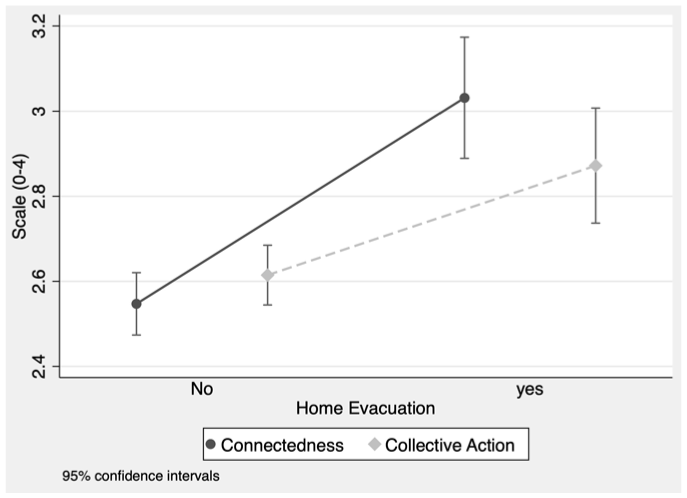
Mean levels of connectedness and collective action by home evacuation status. Points represent the mean values (0–4 scale) of connectedness and collective action for respondents whose homes were not evacuated and evacuated. Vertical lines indicate 95% confidence intervals. Lines connecting the points illustrate the difference in mean levels between evacuation groups.
Building on these descriptive patterns, the regression results presented in Figure 2 provide clear evidence supporting this claim (H1). The first panel of the figure presents the main-effects model, which examines the relationship between evacuation and the dependent variables without adding any control variables (see Table A3). In this model, evacuation emerges as a strong and positive predictor of both collective action and connectedness. Residents who were evacuated report substantially higher levels of both outcomes compared to those who remained in their homes. The effect sizes are large and the confidence intervals do not overlap with zero, indicating that the association is both meaningful and statistically robust.
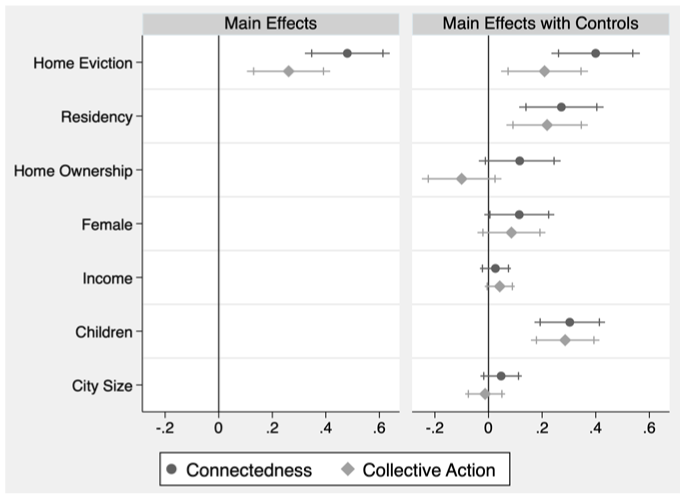
Regression estimates of the impact of evacuation and individual characteristics on connectedness and collective action. Points represent regression coefficients and horizontal lines indicate 95% confidence intervals. Circles denote estimates for connectedness, and diamonds denote estimates for collective action. The right panel presents models including controls for years of residency, home ownership, gender, income, children, and city size.
The second panel includes demographic and structural controls such as length of residency, home ownership, gender, income, presence of children, and city size. Even after adding these controls, the effect of evacuation remains strong and statistically significant for both connectedness and collective action, although some controls have their own effect. For example, years of residency is correlated connectedness, and households with children also show slightly higher levels of connection. None of these factors diminish the central finding—evacuation consistently predicts higher mobilization and stronger social ties. Taken together, both models reinforce H1. Whether examined alone or alongside demographic and structural characteristics, evacuation stands out as a key trigger for heightened collective action and connectedness. The crisis of displacement appears to activate community engagement in ways that are both immediate and substantial.
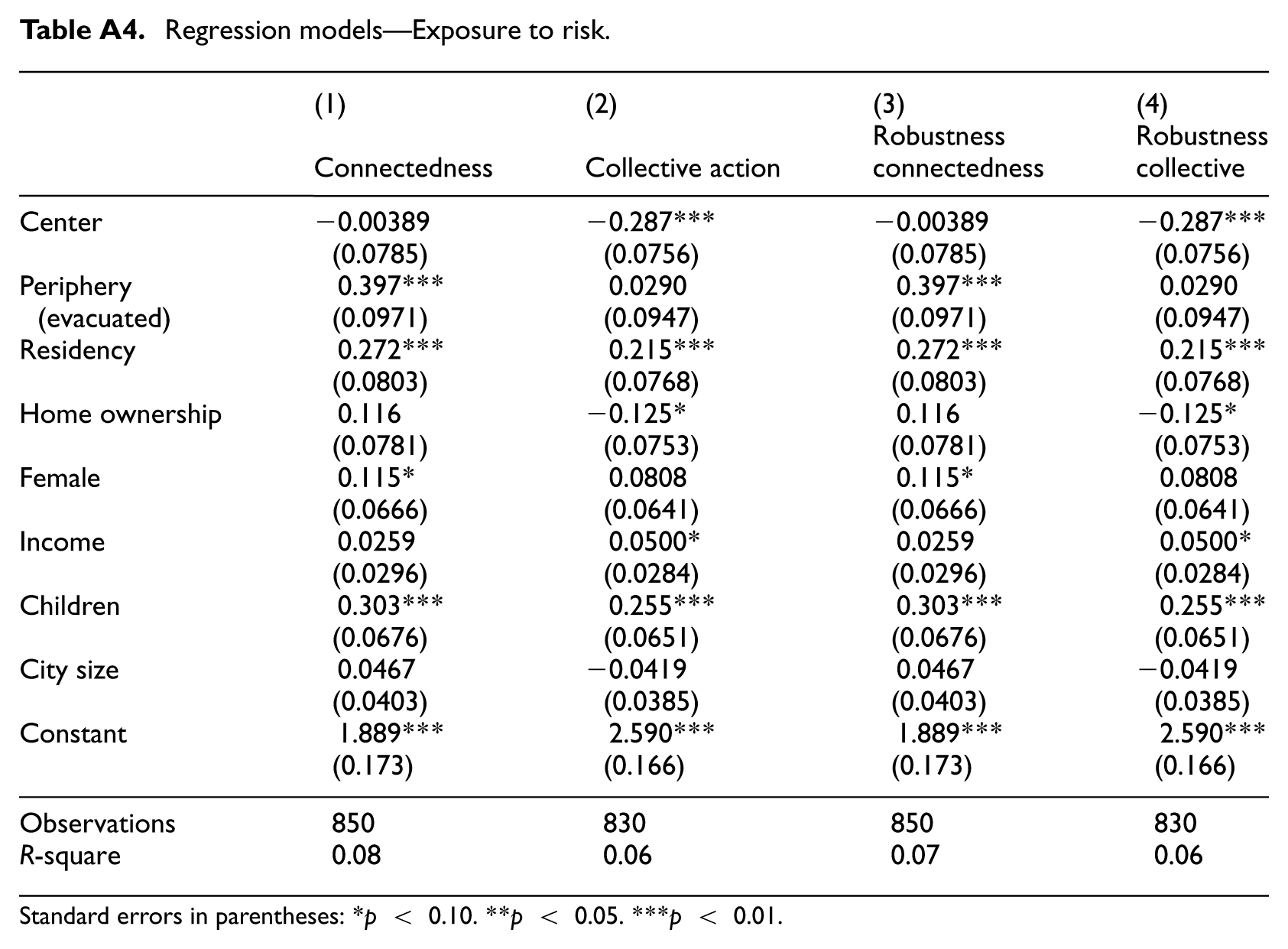
The second hypothesis (H2) suggests that exposure to risk, expressed through a community’s geographic proximity to the border and its experience of evacuation, should be associated with higher levels of collective action and connectedness. Figure 3 evaluates this hypothesis by comparing three types of communities while controlling for residency length, home ownership, gender, income, the presence of children, and city size (see Table A4).
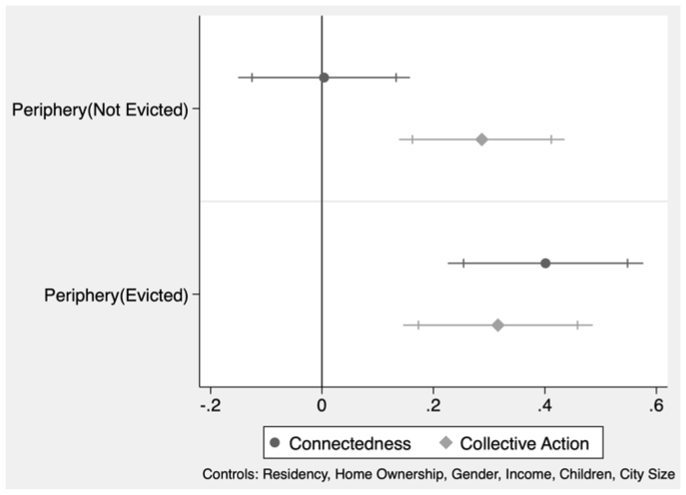
Regression estimates of the impact of exposure to risk (border proximity and evacuation) on connectedness and collective action. The figure presents regression coefficients with 95% confidence intervals for exposure to risk defined by border proximity and evacuation status. The reference category is central cities. Circles represent estimates for connectedness, and diamonds represent estimates for collective action. Models include controls for residency, home ownership, gender, income, children, and city size.
As in H1, evacuation remains a powerful trigger of civic activation. A clear pattern emerges among peripheral communities that were evacuated: compared to the central-city baseline, these communities exhibit substantially higher levels of both collective action and connectedness, even after adjusting for control variables. In contrast, peripheral communities that were not evacuated display a mixed pattern. Their levels of collective action are higher, indicating that even indirect exposure to the war mobilized residents. However, their levels of connectedness are close to zero and statistically insignificant, suggesting that although these communities acted together under stress, they did not develop stronger social ties relative to central cities. These results provide only partial support for H2 and suggest that evacuation, rather than moderate risk exposure, appears to generate increased connectedness, raising an interesting puzzle regarding the distinct role of displacement in shaping community cohesion.
This finding is counterintuitive. Geographic dispersal would normally weaken social ties, yet evacuated communities report stronger connectedness. This implies that mechanisms beyond exposure to risk are shaping these outcomes. To understand these dynamics, the qualitative analysis examines (H3) how community institutions maintained and reconstructed social bonds, mobilized residents, and transformed urban citizenship despite physical separation.
Qualitative findings: Communities filling the governance vacuum
The qualitative findings illuminate how collective action and connectedness, our two core dimensions of urban citizenship, were activated, transformed, and sustained during the crisis. Consistent with scholarship that views urban citizenship as something people do rather than something they are merely granted (Blokland, 2017; Isin, 2002), the interviews show that residents and community institutions took on civic roles as state capacities weakened. Across border cities, evacuation sites, and central cities, communities generated their own “registers of solidarity” (Amin, 2006). These practices align closely with H3, which proposes that during crises community institutions adapt to state withdrawal and act as civic infrastructures that organize, stabilize, and anchor residents’ civic engagement.
Collective action as civic agency
In high-risk border cities such as Sderot, Kiryat Shmona, and Shlomi, collective action was not simply a form of solidarity. It was a civic-survival mechanism that emerged rapidly and organically. Interviewees frequently emphasized that the immediacy of danger and the physical proximity created through evacuation intensified communal mobilization. One community center coordinator explained: “Specifically in evacuation, there was a need for togetherness. I mean, we dealt less with other things and more with basic needs. It was actually more focused on the community.”
This aligns with crisis scholarship showing that when formal institutions are overwhelmed or absent, communities generate their own governance mechanisms (Aldrich and Meyer, 2015; Chamlee-Wright and Storr, 2009). Residents built volunteer systems for childcare, logistics, and mutual support, forms of what Isin (2002) terms “acts of citizenship,” where civic identity is produced through action rather than legal designation. As one coordinator explained: “We built a whole volunteer team … the more we organized the hotel [evacuation site], the higher the rate of return to our hometown.”
Another interviewee highlighted how collective action often emerged through social diffusion: Collective action happens when people take responsibility to act together. But it can also emerge when an action becomes recognized and spreads informally until it turns into a broader community effort. That’s what happened during the war … a set of dynamics that pushed people toward self-organization.
This dynamic was clearly visible among evacuee groups, who took ownership over their situation and created new civic and community authorities. As one coordinator explained: The evacuees had full ownership of the situation. Not like, “What do I get?” and “What are you giving me?” It’s “What can I do?” and “What else can be done?” and “How can we advance?” … We currently have over 100 volunteers from the community, and the same goes for every other hotel. There are hundreds of volunteers.
These self-organized systems also extended into intimate, gendered, and care-oriented domains. One community member described: “We built entire systems, also with a huge network of ‘big sisters’ from within the community, women who support women who have given birth.” This pattern shows that collective action was embedded not only in public tasks but also in private daily life, generating infrastructures of care that substituted for absent state services. Such practices resonate with communitarian views of citizenship (Etzioni, 1993), where mutual care, moral obligation, and shared responsibility become political acts, especially in moments of institutional breakdown.
In central cities, collective action followed a different civic logic. Rather than survival-oriented mobilization, residents engaged in outward-facing volunteer efforts directed toward evacuees. These efforts were sustained but relied less on pre-existing bonds and more on a general civic impulse. A community manager recalled: “We initiated countless volunteering frameworks for evacuees, food, leisure, emotional support … it empowered the volunteers themselves.” Another manager reported that although community centers provided organizational support, residents carried much of the initiative: “Residents initiated and sustained over 100 grassroots projects. These included soldier refreshment stations, aid networks, and neighborhood patrols.”
In some cases, residents explicitly sought opportunities to participate, reflecting a desire for meaning during crisis. One interviewee explained: People want to do but don’t know how … they want to volunteer, they want to do things … People want to contribute, so during this period they want to feel that they did something. They want to hear: “Thank you, you helped me”.
Together, these accounts show that while collective action increased everywhere, its logic differed across urban contexts: it was survival driven in border cities and compassion driven in central ones.
Connectedness as social infrastructure
Connectedness—the density of social ties, mutual recognition, or everyday familiarity—is related to how scholars describe the social practice of urban citizenship (Amin, 2006; Blokland, 2017). The interview data strongly echo this perspective. In communities with long-standing ties, connectedness functioned as a crucial precondition for rapid mobilization. As one coordinator explained: “There are people here with many, many years of acquaintance … because of the long years of acquaintance, there’s a lot of mutual commitment.” Another resident similarly reflected: “In the small community, people knew each other. There was already a foundation of trust. When the crisis hit, we didn’t need to build relationships from scratch; we activated what already existed.” These accounts reflect the argument that community recognition and familiarity form the everyday infrastructure through which urban citizenship is enacted long before crises occur (Blokland, 2017).
However, the findings also reveal how connectedness can fracture under extreme conditions. Among evacuated populations, suddenly displaced and dispersed, trauma disrupted social ties. A community center director recalled: “People were frozen. The trauma was deep. They needed help to reconnect and feel like they belonged again.” Here, connectedness was not a precondition but an outcome that needed to be deliberately rebuilt. This aligns with crisis literature showing that displacement ruptures networks and erodes trust, requiring new forms of mediated community making (Aldrich and Meyer, 2015; Fullilove, 2016). Community institutions became essential intermediaries in this reconstruction process, functioning as civic infrastructures that helped residents reestablish belonging. Shared rituals and symbolic practices played a central role. As one coordinator described: “They said: ‘We want to stay together as a neighborhood’. That is what kept the group intact, shared rituals and small ceremonies. That became our substitute for home.” Such practices reflect Amin’s (2006) argument that citizenship is enacted through everyday acts of collective meaning making.
In central cities, however, connectedness followed a different trajectory. Rather than being rebuilt after rupture, it emerged spontaneously as residents sought ways to participate in the civic response. As one coordinator put it: “People were coming to us saying, ‘Give me something to do. I want to be part of this.’ The need to connect was everywhere, it was like a physical urge.” Volunteering became the main channel of new connections. Moreover, connectedness also expanded beyond in-city boundaries, generating new ties across cities and regions. One interviewee noted: “Through meetings with many communities in the north and south of the country, we learned about the similar struggles, the mutual support. Communities united around shared challenges, and new connections were formed between communities that had never interacted before.” This reflects the multi-scalar nature of urban citizenship: while rooted in local ties, it can spill outward to generate broader solidarities and shared civic narratives, blurring the line between urban and national forms of belonging.
Civic roles and civic structures
The qualitative findings show that the crisis activated forms of urban citizenship grounded in action, obligation, and mutual responsibility rather than formal rights. This aligns with work that sees citizenship as enacted from below during disruption (Amin, 2006; Isin, 2002) and reflects Etzioni’s communitarian view that citizenship rests on duties and moral commitments—what people feel they must do, and to whom they owe allegiance. As state capacities receded, residents and community institutions stepped into roles typically performed by formal authorities. One coordinator recalled even security measures that were supposed to be handled by state forces: “We started mapping who lived where … I wasn’t just waiting. I was part of a system that protected the city, protected us.” Such efforts illustrate how governance shifted downward, turning local actors into de facto civic authorities.
For evacuees, this shift was especially pronounced. Community centers and volunteer networks became the primary political institutions, organizing safety, services, and social order. Allegiance moved toward the community itself, reflecting Etzioni’s idea that duties, not legal rights, anchor citizenship when state institutions weaken. In central cities, mobilization was more individual and less necessity driven, but community institutions still stabilized residents’ civic energies and gave organizational form to widespread willingness to help. Across both contexts, the findings support (H3) that during crisis, community institutions adapted to state withdrawal and acted as civic infrastructures that organized, stabilized, and politically anchored residents.
Conclusion
This article advances a crisis-oriented understanding of urban citizenship by showing how crises generate the conditions through which urban citizenship is enacted. Building on the social dimension of urban citizenship, where citizenship is enacted through everyday action rather than granted by institutions (Amin, 2006; Blokland et al., 2015; Isin, 2002), the study shows that crises do more than disrupt civic life; they reorganize it. During the October 7 war, when formal authorities struggled to respond to the scale of displacement and disruption, evacuees and urban residents assumed responsibilities typically associated with the state. They coordinated services and rebuilt social ties. Meanwhile, community institutions adapted their practices to become relevant. In this sense, the crisis created conditions in which belonging, obligation, and political agency were renegotiated through collective action at the urban scale. By linking urban citizenship scholarship with research on crisis governance (Aldrich and Meyer, 2015; Chamlee-Wright and Storr, 2009), the study shows how cities become key arenas for civic reorganization during periods of institutional strain.
Empirically, the findings show that urban citizenship under crisis differs markedly from its everyday forms. Three shifts stand out. First, residents assumed responsibilities normally held by the state, such as coordinating security or organizing services, creating informal civic authorities grounded in practice rather than formal authority. Second, in high-risk border areas, connectedness had to be actively reconstructed through institutional mediation, whereas in central cities it emerged more spontaneously. Third, community institutions adapted in real time to fill governance gaps and facilitate both collective action and connectedness. Evacuation also altered the spatial logic of urban citizenship. As displaced residents moved across the country, community institutions followed them, transforming temporary housing sites and host cities into new civic arenas and allowing civic practices to persist beyond their original urban territories.
These qualitative patterns are consistent with the quantitative findings. Evacuated and peripheral communities consistently exhibited higher levels of collective action and connectedness than central cities. Together, these results suggest that crises and varying levels of exposure to risk activate and reorganize urban citizenship differently depending on the depth of disruption, measured in our case through evacuation and border proximity.
Moreover, these findings highlight the importance of community-based practices and institutions in mediating urban citizenship during crises. Urban citizenship scholarship often emphasizes everyday practices and participation as the basis of civic life (Amin, 2006; Isin, 2002). When combined with communitarian ideas about duties and shared responsibility (Etzioni, 1996), this perspective helps explain how residents assume collective roles when formal governance weakens. During crises, these dimensions converge. Residents became more active and coordinated, and community institutions provided the organizational arenas through which civic responsibility was translated into collective action, especially among evacuated communities. However, our findings pointing to distinct crisis mechanisms shaping urban citizenship across cities. Evacuated cities mobilized primarily around displacement and survival needs, while central cities mobilized mainly around hosting evacuees and coordinating external aid. In this sense, urban citizenship should be understood not only as a set of practices within cities but as a form of civic life that emerges from crisis conditions that disrupt ordinary governance.
At the same time, contextual factors may shape these peripheral–central city dynamics. Long-standing differences between Israel’s center and periphery offer one possible explanation. Peripheral towns often experience economic disadvantage and weaker state services (Yacobi and Tzfadia, 2019), conditions that tend to foster stronger informal support networks and greater reliance on community institutions. In Israel, these patterns are reinforced by a culture of community-based coping in peripheral localities, where dense social ties often translate cohesion into collective mobilization during crises (Shapira, 2022). In addition, Israel’s political crisis prior to the war, including the nationwide anti-government protests, likely strengthened civic networks that later facilitated rapid self-organization. These factors suggest that different forms of crisis, from democratic backsliding to armed conflict, can activate urban citizenship. Recent research likewise shows that Israeli residents increasingly turn to municipalities as key arenas of political agency during political turmoil (Alster et al., 2025).
Several empirical limitations should also be acknowledged. Although the national survey provides a broad empirical base, it is not fully representative across cities, and some selection bias may be present. Evacuees who chose to respond may differ from non-respondents in their levels of engagement or readiness to participate in civic action. In addition, the analysis captures only the immediate aftermath of the crisis, limiting our ability to assess the durability of these transformations over time. The qualitative data also focuses primarily on institutional actors; incorporating more resident narratives would offer a fuller understanding of grassroots experiences. These limitations point to promising directions for future research. Longitudinal studies could examine whether crisis-driven forms of urban citizenship persist, fade, or become institutionalized once stability returns. Comparative studies could also test the framework across different types of crises, such as pandemics, climate disasters, or civil unrest, and in other urban contexts beyond Israel. Such research would help clarify whether crisis-driven civic mobilization reflects temporary adaptation or a more enduring transformation in the relationship between communities, cities, and the state.
In conclusion, the findings demonstrate that crises can activate and transform urban citizenship. In the face of fear, displacement, and institutional strain, residents assume new civic roles, rebuild social ties, and mobilize to sustain community life. Although grounded in the Israeli case, these dynamics suggest that crises more broadly can reshape the relationship between residents, community institutions, and urban governance when formal state capacities weaken. Urban citizenship in times of crisis therefore becomes most visible when residents and community institutions respond to disruption and redefine what it means to belong, act, and care for the city. Our case highlights transformations in community practices related to the social dimension of urban citizenship, but crises may also generate institutional transformations, such as new municipal regulations or new governance structures, which future research could examine as additional forms of crisis-driven urban citizenship.
Footnotes
Appendix
Regression models—Exposure to risk.
| (1) | (2) | (3) | (4) | |
|---|---|---|---|---|
| Connectedness | Collective action | Robustness connectedness | Robustness collective | |
| Center | −0.00389 (0.0785) | −0.287*** (0.0756) | −0.00389 (0.0785) | −0.287*** (0.0756) |
| Periphery (evacuated) | 0.397*** (0.0971) | 0.0290 (0.0947) | 0.397*** (0.0971) | 0.0290 (0.0947) |
| Residency | 0.272*** (0.0803) | 0.215*** (0.0768) | 0.272*** (0.0803) | 0.215*** (0.0768) |
| Home ownership | 0.116 (0.0781) | −0.125* (0.0753) | 0.116 (0.0781) | −0.125* (0.0753) |
| Female | 0.115* (0.0666) | 0.0808 (0.0641) | 0.115* (0.0666) | 0.0808 (0.0641) |
| Income | 0.0259 (0.0296) | 0.0500* (0.0284) | 0.0259 (0.0296) | 0.0500* (0.0284) |
| Children | 0.303*** (0.0676) | 0.255*** (0.0651) | 0.303*** (0.0676) | 0.255*** (0.0651) |
| City size | 0.0467 (0.0403) | −0.0419 (0.0385) | 0.0467 (0.0403) | −0.0419 (0.0385) |
| Constant | 1.889*** (0.173) | 2.590*** (0.166) | 1.889*** (0.173) | 2.590*** (0.166) |
| Observations | 850 | 830 | 850 | 830 |
| R-square | 0.08 | 0.06 | 0.07 | 0.06 |
Standard errors in parentheses: *p < 0.10. **p < 0.05. ***p < 0.01.
Acknowledgements
This study was supported by the Israel Association of Community Centers. We thank Roni Menachem for her contribution in facilitating access to the data. We also acknowledge Avner de-Shalit and Nufar Avni for their helpful feedback on earlier versions of the manuscript, and the anonymous reviewers for their comments, which improved the clarity and quality of the article. We are indebted to the Urbanization, Deep Diversity and Shared Societies research group at the Van Leer Institute for their intellectual engagement. Finally, we extend our appreciation to the community managers who generously shared their time and experiences despite the extraordinary challenges of the ongoing war.

Funding
The authors disclosed receipt of the following financial support for the research, authorship, and/or publication of this article: This work was supported by the Israeli Community Centers Association (ICCA).
Declaration of conflicting interests
The authors declared no potential conflicts of interest with respect to the research, authorship, and/or publication of this article.