



Abstract
Over the past 15 years, Mogadishu – the capital city of Somalia – has undergone rapid transformation. As the state was rebuilt following its collapse in the 1990s, the city became a site of diaspora return and investment. In this paper we explore the role of telecommunications companies in the development of urban land in relation to these contemporary, contested processes. We focus on Hormuud Telecommunications Company and its affiliated companies involved in financing, construction, technical training, electricity provision and transnational money transfer. We show that telecommunication companies (telecoms), having expanded far beyond traditional ambits, are playing a central role in urban speculation in Mogadishu, aimed at both global and local audiences. As speculators, telecoms are not only involved in generating imaginaries for the future of the city, but take material and laborious steps to produce them. This is most apparent, we argue, in Darul Salaam, the new city being developed for the diaspora and local elites on the periphery of Mogadishu. Overall, we argue that telecoms engage in the performative work of both market-making and world-making, enrolling diaspora capital towards bold urban imaginaries in ways that are distinct from other economic sectors. While we focus on Somalia and its unique context, telecoms across Africa are growing in wealth and scope, necessitating empirical and conceptual engagement with their role in urban processes.
Introduction
In October 2022, Hormuud Telecom Inc. (HTI) celebrated their 20-year anniversary by sponsoring ‘Somalia’s Success Story’, a two-day public conference, hosted in Mogadishu, which had keynotes and panels that included scholars and business people. Under the hashtag #Hormuud20yrs, the company shared carefully curated content that celebrated the power of digital technologies in driving social change. The narrative – largely developed by the company itself and rehearsed across all its affiliate platforms – tells a story of rapid growth and innovation. In many of the online videos, the founder, CEO and chairman, Ahmed Mohamed Yusuf, speaks about the company’s successes, not only in connectivity, but also in terms of offering employment, shareholder value to Somali investors at home and in the diaspora and hope to the country in the early years of rebuilding. Similar videos celebrate the achievements of Hormuud’s affiliated companies: the many construction projects of Buruuj; the solar energy projects of BECO, the electricity provider; the advanced training facilities of Hormuud University; Salaam Somali Bank’s microlending and home construction schemes; and the scale of Taaj Money Transfer. Notwithstanding limited public data to confirm or reject the validity of these achievements, Hormuud and its affiliates are undeniably important in Somalia and have significant impacts on the city of Mogadishu, where they are headquartered. As a Somali coder working in Nairobi’s tech scene noted, ‘Hormuud is Mogadishu’. While hyperbolic, the sentiment is clear.
The context for this paper is two recent processes: the consolidation of power by telecommunications companies; and the material development of Mogadishu. Telecoms grew rapidly during the lacuna in state power of the 1980s and 1990s, supporting the ICT and remittance networks necessary to sustain the growing diaspora (Chonka et al., 2025). Telecoms also played an important role in developing and maintaining the Somali ‘greater economic space’ – an array of transnational logistical, financial and migratory networks (Hagmann et al., 2022). Since the reconstitution of the central state in the early 2010s, they have ingratiated themselves in many parts of the redevelopment processes, from drought relief to land development. Alongside this state rebuilding, Horn experts argue that the last fifteen years have seen a stabilisation of Mogadishu following decades of strife; there is a resounding perception that both people and resources are returning to the city – a renaissance fuelled by partial repatriation and remittances (Hagmann et al., 2022; Mohamed, 2021; Mohamud, 2014). The diaspora, in the form of transnational families, investment activities and business networks, is often blamed for rising land values in the city, yet also celebrated for their contribution to the revival of the urban economy in Mogadishu (Mohamed, 2021; Tahir, 2023). The scale and motivations, gambles and aspirations of the Somali diaspora are interesting and under-documented and more information on these processes would contribute greatly to studies of remittance-led development in urban Africa (Kaag and Steel, 2019; McGregor, 2014). However, we seek to build on recent debates about urban speculation by focusing not on individual diaspora and their activities but on the long-term, strategic practices of market-making and world-making by firms, specifically Hormuud Telecommunications and its aforementioned affiliates. We show how these practices not only advance imaginaries for the future of the city (such as those circulated at Somalia’s Success Story) but create material value through investments that prefigure and present these possibilities.
To do this, we draw on three bodies of work: African urbanism and new city imaginaries; speculative tools and labours (and relatedly, ideas of ‘remittance urbanism’); and world-making from the margins. Using this framing, we selectively unpack the history of Mogadishu, primarily for context. We focus on the rise of telecoms as intermediaries of local and global processes (specifically growing out of the unique context of diaspora and trade circulations for which Somalia is well known), as well as on the risks and opportunities related to urban land access in the city (also an outcome of overlapping governance systems, emerging from the country’s history of fractured statecraft). We then turn to Hormuud’s history, specifically its growth and expansion into diverse parts of the urban economy through its network of affiliates. We are particularly interested in how the companies collectively present Mogadishu’s progress to the world, while developing the underlying infrastructure to materialise these speculative claims. This is essential for understanding the final empirical section, where we explore how the speculative imaginary for the city is further materialised through the development of Darul Salaam, a new city on the outskirts of Mogadishu, by Hormuud’s affiliates. Darul Salaam explicitly targets the returning diaspora, Somali investors living abroad and local elites who maintain strong transnational connections. Finally, returning to the question of speculation, we argue that Darul Salaam and Hormuud’s role in it reflects not only a real estate project, but a project of world-making. We argue that the case challenges how we see urban speculation and African cities by showcasing diverse actors and extra-financial projects, underpinned by forms of speculative labour. Rather than seeing Darul Salaam as simply another ‘fantasy city’ on the expanding real-estate frontier, we suggest that the case presents us with a dynamic site of world-making – the character of which is shaped by the specificities of the telecoms sector. It is at once introspective and extrospective, global and local, durable and imagined.
Given the complexity of studying Mogadishu, we deployed a mix of data collection strategies. We reviewed online digital material, including company archives, news articles and statements from national agencies and government publications. We used Tik Tok and YouTube to ‘see’ the settlement through the eyes of Somali influences and visitors, while Google Earth was used to chart the temporal development of the settlement, identifying when new investments were made and how quickly. The Somali authors made site visits to Darul Salaam, where they undertook interviews; all photographs in this paper come from the authors’ visits to the settlement. Coupled with Google Earth, these images formed part of the analysis of the material fabric of the new city. The team undertook additional interviews with Somali people living abroad and representatives of the companies.
We used a combination of thematic and discourse analysis to make sense of this scattered and heterogeneous data. As we found, it is important, both methodologically and conceptually, to identify and name the spectacle of technological histories, authored and supported by those actively involved in these processes (Seaver, 2017). Of course, there are obvious constraints and contradictions in taking at face value the ways in which the Somali state, technological companies themselves and Somali social media voices narrate (their own) historical achievements, future plans and overall significance. Nevertheless, we found merit in engaging with these discourses, as they often contain useful empirical information (or provide some of the scant information available). They do more than recount or fantasise – they are also instrumental in future-making, operating as active agents of these processes (Beckert and Bronk, 2019). In this sense, we take discourse very seriously, aiming, where possible, to untangle its relationship with material processes. Where there is limited data, we have also speculated on these connections, considering probable and possible inferences and drawing on the authors’ personal experiences. To this effect, speculation has been central not only to the conceptual work of the piece, but to our method. Attentive to these data gaps and the positionality of the team members (some of whom are Somali, living between Mogadishu, South Africa and the UK) and some of whom are not, we worked together to translate, interpret, and contextualise the information throughout the process.
Speculation and African cities
Speculative imaginaries for the (new) African city
While many speculative imaginaries have shaped Africa’s urban development, the ‘new city’ has persisted for decades, taking many forms over the years. The intentional establishment of new towns has a long history in extractive and logistical sectors (Cirolia, 2014). Mining giants and railroad companies commonly planned, serviced and managed small urban centres to support their operations, creating ‘colonial company towns’ such as those in Mounana, Gabon (Hecht, 2018), Kisumu, Kenya (Anyumba, 1996) or Cullinan, South Africa. Following independence, the continent saw a rise in new capital cities, in for example Tanzania, Nigeria, and Botswana, in what might be seen as a post-colonial urban statecraft. In contrast to the company towns, which predominantly served sectoral workers, new capital cities were populated, at least in the early years, by technocrats and bureaucrats, demonstrating the tight relationship between new city formation, the imagined subjects of these towns and their eventual inhabitation (Abubakar and Doan, 2017). Of course, today, these towns no longer serve circumscribed populations or sectors, having developed along diverse economic trajectories over the decades.
However, the sorts of new cities that are capturing conversations about speculative urbanism today diverge from these older project typologies. From Nigeria’s Eko-Atlantic to Kenya’s Konza Technopolis, the project of planning cities appears to have moved from the undervalued purview of the tired bureaucrat to the glitzy websites of global design and development firms (Watson, 2014). While old-school tools and technologies of planning deployed the borrowed and archaic vocabularies of colonial urban management, the new plans refract Dubai, Shanghai or even Wakanda, animated not only with promotional videos but also discourses of sustainability, smartness and economic ‘specialness’. The late Vanessa Watson, seminal scholar of planning at the University of Cape Town, published the article ‘African urban fantasies: Dreams or nightmares?’(2014) in which she argued that these new city plans are examples of ‘speculative urbanism’, which reflects both the expansion of the global real estate project and the imposition of a modern aesthetic, which erases local culture, informality and the poor. It is a frontier, not only of the city, but of a modernist project of master spatial planning and visioning.
As many scholars concerned with real-estate frontiers (Gillespie, 2020) have shown, the urban periphery is the obvious place for this speculative urban exercise (Goodfellow, 2020; Meth et al., 2024; Ouma, 2014). The growing demand for urban land has resulted in both the intensification of land uses (Huchzermeyer, 2007) and rapid urban expansion (Meth et al., 2024). There is a perception that windfall financial gains can be had on the fringes of cities, with considerably less effort and lower upfront costs (Maina and Cirolia, 2023). These gains rest on the gamble – and hope – that this suburban land can be bought at a lower price and will be incorporated into urban fabrics (and rezoned or reclassified), serviced by large infrastructural projects (highways, transmission lines, fibre optic cables, etc.), and later incorporated into the bigger plans for the city (Berrisford et al., 2018; Kinuthia et al., 2021; Watson, 2014). These areas also tend to be managed by rural municipalities, which are keen to increase their status and tax base through these investments. This wider body of work, thinking speculative urbanism through peripheral urban development projects, presents satellite new cities as frontiers of capital accumulation and neocolonialism, an often-violent conversion of Africa’s urban value and space into the language of international investment and extraction. As Van Noorloos and Kloosterboer (2018) write: ‘Africa’s very necessary urban innovations will not come from new cities; these are too much based on assumptions about urbanisation deriving from other parts of the world’ (p. 1237).
However, from Kilamba (Cardoso, 2016; Croese, 2017) to Konza (Pollio, 2026), scholars show how new city projects, located on the edges of Africa’s largest urban centres, are more than financialised real-estate projects, mobilising both state power and economic imaginaries in diverse ways. These speculative efforts operate far beyond the financial value of land, offering opportunities for political influence, social ascent, perceptions of modernity and beauty and even secure habitation in the face of conflict and flux (Goodfellow, 2020; McGregor, 2014; Mercer, 2024; Steel et al., 2019). They are often simultaneously extrospective and introspective, their global projection integrally tied to local performances (Croese, 2018). Moreover, we also need to recognise that not all ‘new cities’ are underpinned by the same economic logics, even when they involve a substantial component of speculation. For example, Cardoso et al. (2023) argue in their article on ‘blocos urbanism’ in Luanda that there is something particular about the modality of oil production as the economic underpinning of contemporary urban development in Angola that leads to highly modular forms of urban development. Following a similar logic, we argue here that the fact Darul Salaam is rooted in capital accumulated in the telecoms sector – rather than natural resource extraction or sectors of the economy with a large industrial workforce – is relevant for understanding how and why this city emerged. As we explore in more detail below, far from a modular urban development linked to the standardised logics of the ‘oil block’ as a distinct form of accumulation, our case involves the enrolling of a global diaspora into a telecoms-led, ‘de-materialised’ project of world-making that has then subsequently been re-materialised into a diasporic ‘new city’. This produces different aesthetics and time horizons that shape the character of the city. Overall, these variegated forms of ‘new city’ development call for a more nuanced view of urban speculation that avoids easy moralisation (McGregor, 2014) and is built on a rich understanding of the complex assemblage of hopes and risks, aesthetics projects and financial compositions that shape urban imaginaries and how they are realised in different African contexts (Kaag and Steel, 2019; Mercer, 2024; Sawyer, 2014).
Speculation: The labour of future-making
While urban studies scholarship offers valuable critiques on speculation in Africa’s real-estate frontiers, scholarship from anthropology and media studies offers a more expansive (and potentially less judgemental) view of speculation. Laura Bear (2020b) argues that speculation is: ‘future-oriented social action that uses technologies of imagination to generate accumulation’ (p. 9). Similarly, Halpern and Mitchell (2023) note that speculation involves tools of measurement that dissect the world in ways that make contingent futures visible, often with the explicit attempt to inspire action (McGlotten, 2012).
As these authors show, the tools of speculation aim to discern the calculability of risk from the possibilities of uncertainty. With the right information, risk can be measured and assessed (Sjol, 2022). In fact, the assumed calculability of risk – whether related to financial dynamics, climate hazards, or political unrest – underpins many of the data programmes in Africa and other parts of the Global South, which are seen to be data-poor and therefore unable to accurately predict future scenarios. However, unlike risk, uncertainty cannot be quantified. Even with data and complex analytical tools, speculation remains reliant on the extra-rational, the intuitive and the mystical (Sjol, 2022). It is where feelings like doubt (Amoore, 2019) or hope (Miyazaki, 2006) are given currency. Therefore, speculation is never exclusively technical but is also emotional, affective and embodied (this point is made by Hoyng (2024) in the context of fintech innovations Hong Kong and Nyamnjoh et al. (2022) on the careful economic trade-offs of migrant traders in Cape Town). Moreover, in spaces that may be considered ‘data poor’ with respect to the kinds of information most prized by organisations that seek to index ‘real estate transparency’ (Anim-Odame, 2016), this uncertainty can actually be particularly appealing to some speculators (Goodfellow, 2020). Because high risk, ‘low data’ contexts can deter more conventional forms of financialised investment, this provides an additional incentive for speculation on the part of those who have emotional and instinctive motivations but also a deep knowledge of and commitment to a specific geographic context, and a material interest in its future (Menon, 2025).
This understanding of speculation, as both calculative and mystical, draws attention to actors, practices and the labour of speculation. Seeing speculation as work, and speculators as active agents, challenges some Marxian readings of speculation as lazy, labour-less ‘gambling’ (Bear, 2020b; Reith, 2013). From this position, we can recast the active (and often social) labour of speculation practices, challenging the perception of speculation as passive or purely financial (Zaloom, 2004). In Menon’s case, the labour of the middle-class diaspora in Dubai, who migrate to take up skilled jobs and earn enough to be able to save and invest in the context of significant risk, is also fundamental to the generation of capital that can then be channelled through financial institutions into Kochi’s mushrooming real estate. As Bear (2020b: 7) notes, ‘Personal debt and microfinance are good examples of the contemporary labour of speculation’. The forms of labour involved in speculation are thus multiple and range from individual practices to organisational strategies. This work is not only done by people, but it is ‘held together by mediating institutions such as financial markets, management consultancies, accountancy firms, government institutions, nodal legal contracts and media spectacles’ (Bear, 2020a: 47). Moreover, the labour is not just physical but intellectual, involving substantial re-imagining of capitalist relations (Bear, 2020b). As Menon’s (2025) work on Indian diaspora’s contribution to ‘remittance urbanism’ shows, the role of shadow financial intermediators – specifically in shaping remittance flows and managing the risk of transnational investments – is vital. These mediating institutions, whether formal or informal, play powerful governing and facilitating roles that require energy, exertion and effort: forms of speculative labour in the sense defined by Bear (2020b).
Therefore, like the performativity discussed by economic scholars (Callon, 2007; Mitchell, 2008), speculators and the wider group of people and institutions engaged in speculative activity do not just imagine value creation, but form part of its constitution and generation through their aggregated practice, social and financial work, and speculative labour (Goldman, 2010; Mackenzie, 2006). In Turkey, for example Hoyng and Es (2020) show how political imaginaries are materialised through the making of mega infrastructure projects. Through labour, spectacle and material practice, speculation actively engages in the world, shaping it and contouring the movements of those around it. In this sense it is generative, creating value through its performance. As we will show, the repeated presentation of desired futures for urban Africa not only lives in the public imagination, but shapes places materially; to this effect, speculators make the markets and, by extension, shape the future of cities. As Hoyng and Es (2020) have shown- contemporary forms of large-scale property and infrastructure speculation often involve both de-materialising and re-materialising ‘modes’; in our case, we advance this but in a different sense that is both more concrete and more temporal, arguing that a ‘de-materialised’ phase of speculation-as-world-making was subsequently followed by a re-materialisation of the speculative impulse in the form of new city development. Indeed, while city futures are indeed localised, they are also embedded in multiscalar networks, circulations and imaginaries, producing and produced by complex assemblages, territories and geographies (Ong, 2011; Pollio, 2026). It is here, at the intersection between speculating urban futures and constructing them, that we turn to the question of world-making.
World-making from peripheral geographies
In her piece, entitled ‘Interscalar vehicles for an African Anthropocene’, Hecht (2018: 112) reminds us to avoid continental essentialism, and instead hold ‘the planet and a place on the planet on the same analytic plane’. This call echoes Southern urbanists’ efforts to fight the tendency within urban studies to represent peripheral geographies, where the majority of the world’s population in fact live, as distant, illusive, disconnected, provincial, or behind. Despite the value of focusing on localised and contextual experience, scholars draw attention to the globality of African cities and citizens, as a means to understand their distributed value, interconnection, relationality and technicity (Mavhunga, 2017; McFarlane, 2021; Simone, 2001).
As Ong (2011) notes, worlding is concerned with ‘the art of being global’, capturing the dynamic assemblages of practices, technologies, and flows, that position often marginalised cities in relations to global formations – geoeconomic, cultural, religious, symbolic or otherwise (Mbembe and Nuttall, 2004; Nyamnjoh, 2019; Simone, 2016). In contrast to the idea of globalising, worlding is presented as a bottom-up process – an aggregation of agentic practices that span diverse geographies, at once material and imagined (Amin, 2004; Beeckmans, 2019; Cirolia et al., 2022). For example, the routine remittances of migrants, sending money all over the world, construct micro-worlds (Amin, 2004), and produce technical and financial assemblages with various degrees of obscurity, frequency and formality (Simone, 2021). Worlding thus breaks the unhelpful binary between the global and the local, and the social and the technical, recasting these unstable categories as equally important, co-constituted and relational (Simone, 2001).
While worlding is a useful concept, its tendency towards hyper-relationality and thick description can result in a dulling of its conceptual impact. In other words, its wonderful ability to capture messy complexity simultaneously dulls its capacity for sharp and structural critique. In part due to our interest in speculation – and its relationship with the active and political articulation of future-oriented possibilities – the concept of world-making offers a complementary entry point. African scholarship on world-making, in part informed by its more International Relations and structural roots, has tended to focus on intentional and performative ways in which Africa’s position in the world has been expressed, contested and reformatted by African actors and agencies, both within and beyond the state (Benabdallah, 2024; Ndlovu-Gatsheni, 2014). Getachew (2019) argues, for example, that in the transition from colonial subordination to independence, alternative visions of the world order that emerged out of resistance to imperialism were intrinsic to nation-building projects. World-making, used in this way, refers to the explicitly decolonial propositions which, unlike the often-quiet work of worlding, aim to act boldly on the future, in ways that challenge recursive subordination. It foregrounds the supra-national visions of post-colonial institutions and the labours involved in articulating and operationalising future possibilities which radically depart from present alliances and inertias.
Now turning to the question of Mogadishu, in part owing to Somalia’s complex history, there is already a rich body of work on the globality and translocality of the Somali experience. For example, scholars speak of the ‘Greater Somali Economic Space’ (Hagmann and Stepputat, 2023) – a relational view of the Somali economy that includes parts of the region (Nairobi, Djibouti) and locations further afield (Dubai, Johannesburg). The well-known hawala system – a trust-based network of money transfer agents, distributed globally and culturally embedded in Islamic practice and remittance economies (Elmi and Ngwenyama, 2020; Iazzolino and Musa, 2024) – is another example of worlding, sustained through transnational trust networks and diaspora connectivity, but sometimes destabilised by global regulatory regimes such as the Financial Action Task Force (FATF), whose opaque mechanisms have had far-reaching consequences for remittance flows (Muse, 2025). Additionally, scholars have explored the relationship between the Somali diaspora, digital technology and de-territorialised or multi-sited citizenship (Kok and Rogers, 2017; Liberatore, 2018; Norman, 2024). Mohamed (2021) calls us to see the ‘Somali diasporic returnees as complex political actors, with important, and controversial relationships to the “reconstruction” of Mogadishu’ (p. 167).
This worlding scholarship has been foundational for building a knowledge based on the unique ways in which Somali globality has taken form. Scholars carefully trace how these contemporary forms of social and economic practice have deep roots and contingent histories, intertwined with Somalia’s relationship with trade, logistics and finance (Hagmann and Stepputat, 2023). World-making does not aim to discount the worlding work – from the WhatsApp groups to the money traders – that shape the globality of Somali life. What the more specific and structural concept of world-making might further offer these debates, is the opportunity to look at the specific institutions, the political ambitions and the active labour which is enrolled towards a reconstruction of Mogadishu, and its repositioning both in global economies and imaginations. As Getachew (2019) has argued, anti-colonial struggles were not simply about turning the tools of the colonisers back onto themselves, but about the construction of alternative logics and worlds; as we will show, such an alternative world has effectively been created through a project of global telecoms network-building, and the associated enrolment of a transnational diaspora and projection of Mogadishu as a site for Somali globality. In this sense, world-making can be seen as conscious, speculative, and overtly political, a commitment to a future which radically departs from the present and where existing injustices and power dynamics – in particular those arising from colonial histories – are confronted.
Telecoms and world-making
Mogadishu
Mogadishu is the largest city in Somalia and an important port city on the East African coast. It has a dense history of financial and logistical circulations, both as part of the Horn region and the world (Hagmann and Stepputat, 2023). After the central government collapse in 1991, Mogadishu experienced extreme levels of governance fragmentation and informalisation. The networked infrastructures that formed part of governing also fell to disrepair. The destruction of the Public Switched Transmission Network disrupted Mogadishu’s connections, both from the surrounding areas and the wider world (Feldman, 2007). In addition, the fall of the formal banking system and closure of the central bank enhanced the importance of Somalia’s already well-established hawala system, which became increasingly essential to the survival of the country and the sustenance of the city (Lindley, 2009; Nzonde, 2018; Passas, 2006). This informal financial architecture allowed the ever-growing diaspora to remit with relative ease, despite punitive measures by Western countries (Langhan and Kilfoil, 2011).
The reconstruction of the city over the last 15 years is tied to the national (and regional) efforts to regain governmental control over urban territories, improve their safety and enable return to the city. In 2004, Somalia’s Transitional National Government (TNG) was established in neighbouring Kenya. After an eight-year term, the structure was consolidated over the following four years, including developing provisions for the Federal Member States in 2012. In this federal system, the Banaadir Regional Administration (BRA) and its 17 constituent districts are responsible for Mogadishu city, a part of the country wherein Al-Shabaab had a strong foothold until 2011. The status of the BRA was never clearly defined in the constitution, contributing to ongoing ambiguity regarding its role and authority and creating ample room for non-state actors to participate in the governance of the city. Notwithstanding the reformation of the state, the urban area remains governed by a mix of state and non-state actors. Over several decades, the city experienced ‘privatization from below’ (Hagmann et al., 2022), whereby urban services (land management, water and security) are provided through constellations of actors, including different levels of state government, clan-based social structures, donor and humanitarian agencies and armed groups.
Urban land is at the heart of political and economic contestation in Mogadishu (Hagmann et al., 2022). Wasuge et al. (2017: 24) write: ‘During 2014, an estimated 80 per cent of court cases heard in Mogadishu’s Supreme Court were related to land’. As such, one of the defining features of Mogadishu’s land market is the pervasive confusion and contestation over urban land, particularly outside of the city’s longer-established areas (Mohamed, 2021). Verifying land ownership, and related claims by extended family members, is complicated. Not only are there different processes for different types of land, but the records kept prior to 1991 are being administered from Europe by an ex-employee of the state (Bryld et al., 2013; Wasuge et al., 2017). While these pre-1991 records are considered trustworthy (even used by the state to verify transactions), they are costly to access and only exist for the central parts of the city, not the newer development areas. On the periphery of Mogadishu, where most of the new development is taking place, uncertainty regarding the exact authority of BRA, as well as its limited capacity to govern these areas, means that transactions are even less regulated, with local leaders and officials facilitating transactions (Wasuge et al., 2017).
Mogadishu has experienced both population and spatial growth – much of which has manifested as urban sprawl along key axes. Moreover, the conflict and related repair efforts have fundamentally reshaped patterns of wealth accumulation in the city (Bakonyi et al., 2019; Bryld et al., 2013; Hagmann et al., 2022). Many former elites who once controlled land, infrastructure and urban economies, have now become part of the diaspora, living abroad and/or earning in hard currencies, often moving between locales (Tahir, 2022). Their investments are credited for driving the ‘building boom’ and the city’s ‘renaissance’ (Mohamed, 2021). Data on the scale of sectoral development is limited, but there is material evidence of amplified investment in Mogadishu in real estate, logistics and finance. The role of telecoms – and particularly Hormuud – is less well reported.
Hormuud: A local/global telecom
Unlike most countries in Africa, the telecommunications sector in Somalia is dominated by ‘homegrown’ companies rather than subsidiaries of global telecom giants. Rising to prominence in the governance lacuna of the 1990s and 2000s, telecoms and related hawala firms are credited with advancing Mogadishu’s connectedness to the world, as well as contributing to the wider Somali state-rebuilding projects over the last 15 years (Iazzolino and Stremlau, 2023; Kok and Rogers, 2017; Lindley, 2009; Maimbo, 2006; Nurhussein, 2008). While there are many telecoms operating across Somalia, in Mogadishu, Hormuud Telecom Inc. (HTI) is the largest. HTI was established in 2002 in Mogadishu by a small consortium of shareholders, many of whom were located in the diaspora. The rapid growth of the company can be partly attributed to its acquisition of both the customer base and infrastructural assets of Barakaat Group of Companies (BCG). During the civil war period, BCG erected landlines and financial infrastructure through its banking and telecommunications companies. Interviewees recalled ‘feeling connected to the world’ when the telephone branches enabled people to communicate with family members who had left Somalia. However, BGC was shut down in 2001 due to an alleged link with Al-Qaeda following the 9/11 New York attack, and the founder, Ahmed Nur Ali Jim’ale, was placed on the terrorism watchlist. He became a key shareholder in the newly established HTI, enabling Hormuud to rapidly position itself in an increasingly competitive telecommunications market, growing to prominence in the city and parts of the country. Hormuud is now the single largest private employer in Somalia, with an effective monopoly in many sectors (Chonka et al., 2025).
HTI has been instrumental in the material development of Mogadishu, positioning the city at the forefront of technological advancements over a short timeframe. After nearly 10 years operating 2G and fixed line services, HTI launched its Tri-Band 3G service in 2012. In 2014, the company piloted Somalia’s first 4G services, followed by 5G in 2024, specifically in Mogadishu. In 2022, Vertiv completed the development of a cable landing station in Mogadishu in partnership with HTI to support the three cables that connect the city to the world: EASSy, DARE1 and 2Africa. These cables, an essential part of the ICT backbone of the country and city, connect to the terrestrial fibre optic network (currently only covering Mogadishu), linking to the global internet and reducing latency for users. Owing to this confluence of investments, Somalia is recognised as having the most affordable mobile internet across Africa and the Arab world, with Hormuud credited for much of this. Learning from the success of Safaricom’s M-PESA in Kenya (Iazzolino and Stremlau, 2023), HTI expanded financial services through mobile money, which allows for both local and international traders. These advancements, narrated across Hormuud’s social media platforms, present an impressive story of material and technological investments that form part of Mogadishu’s globality and worlding.
Less than 10 years after Hormuud was founded, the company moved to develop a network of ‘affiliates’ – companies that are legally separate (to reduce the sorts of risks faced by BCG) but understood to be integrally connected, if not one and the same. These include Salaam Somali Bank (SSB) and Buruuj Construction (both affiliated in 2009), followed by Hormuud University (2010), specialising in applied technology. In 2014, international money transfer operator (or hawala company) Taaj began interoperating with banks across the world and taking over significant portions of the Hormuud and SSB international money transfer offering. The Banaadir Electricity Company (BECO) was also established in 2014 as an affiliate, first to consolidate the fragmented and privately managed electricity networks across Mogadishu, and later expanding to energy projects in and beyond the city. BECO now claims to be the largest electricity provider in Somalia. Alongside this, Hormuud Salaam Foundation was established, the first corporate social responsibility programme – according to its own promotional material – ‘fully funded by Hormuud Telecom, Salaam Somali Bank, Taaj Money Transfer and Buruuj Constructions Company’. These include a grouping of companies which are involved in various parts of the value chain, and operate on different scales (from the global to the local), financial to construction. This world of companies, if we can call it that, work in concert towards shared visions for the future of Somalia and the city.
While Hormuud might have benefitted from the governance lacunas of the 1990s, the company has since formalised its recognition, seeking authorisation from the state and affirmation from global bodies. In 2019, for example, Somalia promulgated their Mobile Money Regulations (CBS/NBS/REG/06), giving authorities the capacity to licence mobile money operators. In 2021, HTI was first in line for authorisation by the revamped Somali Central Bank. Then, in 2022, HTI received a GSMA Mobile Money certification at the MWC22 fintech summit in Kigali, making it the first and only telecom in the country to receive international certification. And in 2023, HTI’s CEO won the CEO of the Year award at the World Communication Awards. It is clear that HTI has sought to formalise and valorise its operations at national and international levels, looking both to the national government and the global community to provide this recognition. As in Somalia’s Success Story vignetted in the introduction, it was indeed a collective endeavour across all the affiliate companies to showcase their work, impact and vision. Various posts on Instagram, Facebook and X – in both Somali and English – highlight how Hormuud has stabilised the economy, invested in green technology, connected everyone and works in harmony with the state. In this narrative, the future articulated (and celebrated by social media users) is already here. Similar discourses animate the sites of affiliates.
Hormuud’s affiliate network, coupled with the limited publicly available data on the companies (Nurhussein, 2008), makes it difficult to determine what is a speculative performance and what is indeed happening on the ground. However, we suggest that the advancements connected to the company, including the development of durable material networks and the institutional arrangements that expand the telecoms’ domain far beyond their traditional ambit, provide a different story about technological advancement in Africa than is commonly portrayed. Not only do these investments present durable infrastructures – long lifespans and material and institutional inertia – they also form part of Hormuud’s efforts to position and present itself as fundamental to the making of the future Mogadishu, and Somalia as a whole. This mix of discursive and material performance is not only for the Somali audience who might attend an event like the one hosted in 2022, but also for a global audience for whom the success of the Somali redevelopment project might still appear ambivalent, uncertain and risky.
Darul Salaam City history and development
Hormuud’s ‘new city’ provides the most material demonstration of its urban speculation and future-making. Darul Salaam City (also spelled Daarul Salaam and Darussalam, and not to be confused with Dar es Salaam in Tanzania), is located just over 15 km from Mogadishu, inland from the coast (Figure 1). The city’s logo, plastered on signage around the area, includes the tag line ‘gado deegaan ha gadan guri’, roughly translating to ‘buy a residence or neighbourhood, not a house’ (Figure 2). The intention is clear: the new city is more than a structure; it is a lifestyle. It is not just a place to live, but a place to make a life.
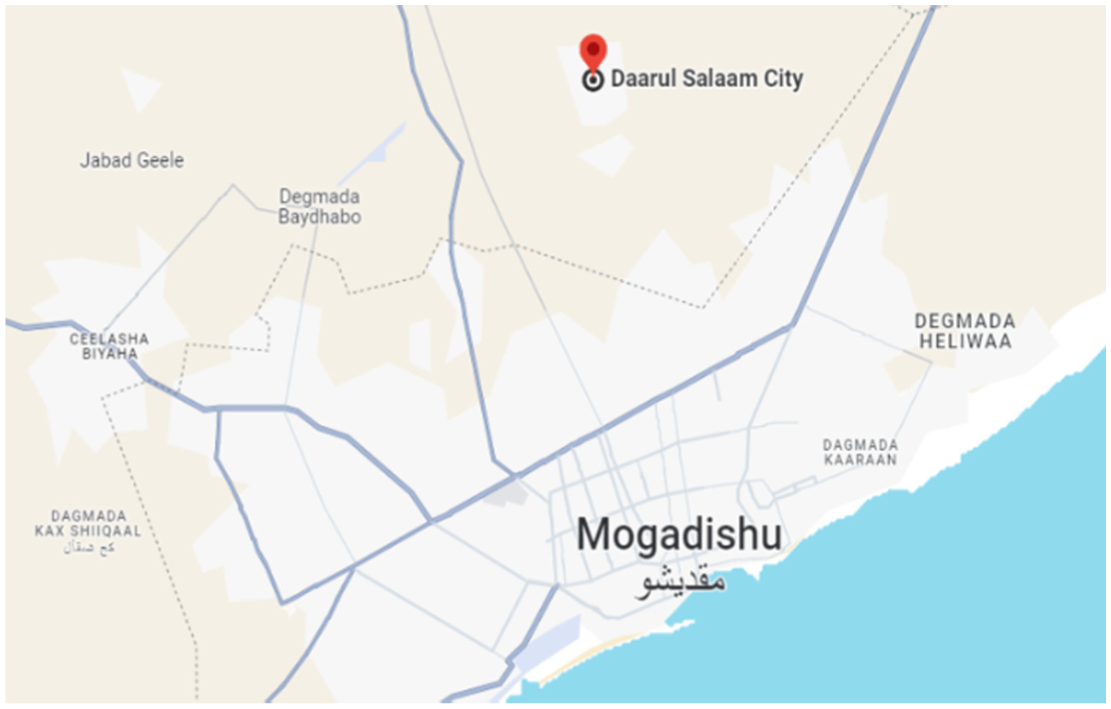
Location of Darul Salaam City.
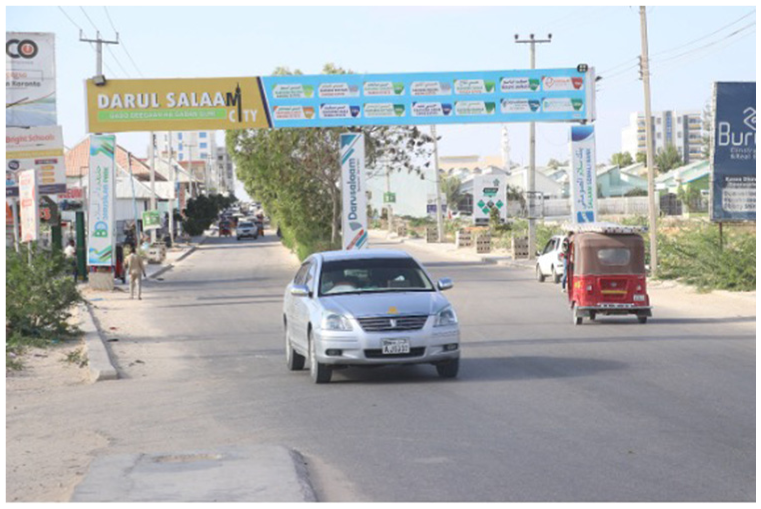
Arterial road through Darul Salaam.
Back in 2009, the area was farmland, indistinguishable from its surroundings. Between 2011 and 2012, the subdivisions that today shape the city began to take form, etched into the dusty land (Figure 3). In 2016, the first project was built by Hormuud’s construction company, Buruuj. Early in 2017, Banana Estate was developed to the north, following a similar layout and aesthetic. Towards the end of 2017, another major development was constructed to the east, along with a mosque and Darusalam Hospital. From these early anchors, we see accelerated development, mostly led by Buruuj, as well as smaller developers.
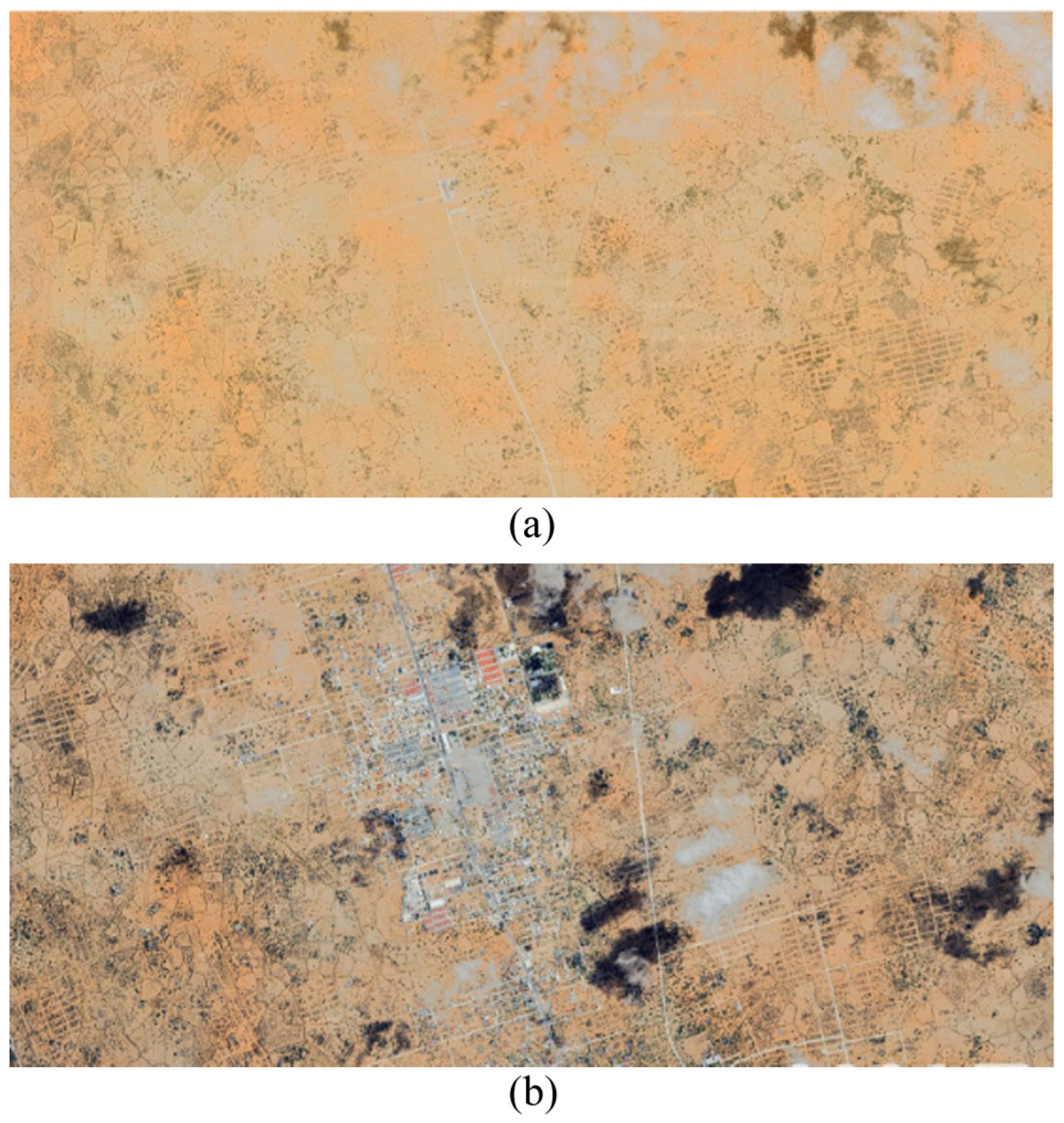
(a) Aerial image of emerging settlement over a 10-year period (2013). (b) Aerial image of emerging settlement over a 10-year period (2024).
As the area developed, it stretched towards Mogadishu proper, filling in the gaps between the city and the settlement. Today covering roughly 7 km2, this large land development project includes roads, a hospital, an international school and even a small amusement park with a zoo (Figure 4). Also linked to Hormuud, the Darusalam BECO Power Plant serves the city, with plans to interoperate with the wider urban transmission network and to transition to more sustainable energy sources in the near future. The material plans for interconnectivity are also shaped by the extended social networks that animate the space. One tenant told us that, during Eid, ‘it is so popular to come [visit the area] that I cannot even leave my front gate’, speaking to the wider use of the area by communities from across the city. There are also different types of housing in the various sub-areas – each with its own style and catering to diverse market segments. Some have large, multi-family homes, with arched pastel-pained exteriors, security guard booths on every block and reinforced – but decorated – security gates. Others have classic single-family houses, carefully laid out like matchboxes, with pitched red and blue roofs and uniform gardens. Still others contain multistorey apartment blocks, painted in earth tones and arranged in tower clusters.
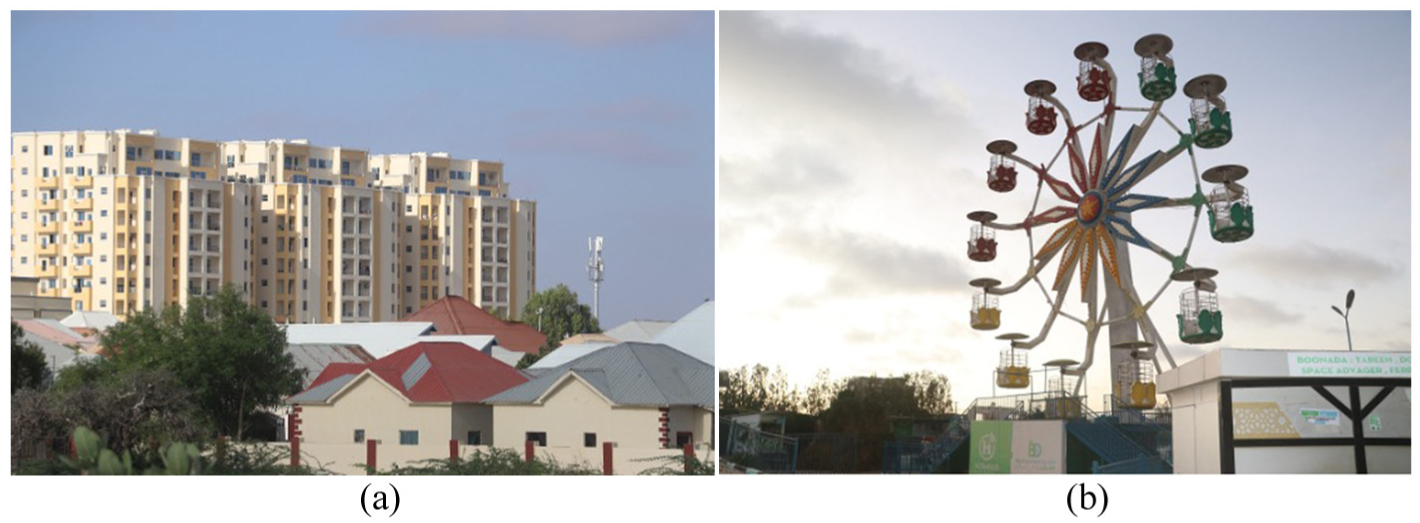
(a) Housing and amenities in the area. (b) Leisure facilities in the area.
The settlement is explicitly targeted at Mogadishu’s diaspora communities. This is not a coincidence, but a strategic choice for a company deeply invested in transnational banking and committed to Mogadishu’s on-going urban redevelopment. This porous grouping, often referenced by Hormuud as well as within various national policies, includes those living abroad who might want to return or invest locally, as well as those who live in Mogadishu but have translocal arrangements, with family members working, studying or regularly travelling abroad. As one of our interviewees said, ‘Darul Salaam is the obvious choice’ for the global family, for whom safety, security and services are vital. One father told us: I will stay in the UK, but my wife and children are protected from violence and have the services they need. They go to the school where children mostly speak English; the school is very strict, which they are not used to, but I think is good.
The importance of safety in a conflict-prone city and the necessity of reliable urban services should not be taken lightly. Another interviewer who recently bought in Darul Salaam told us: ‘I live in a block with so many diasporas, and I live between Mogadishu and Cape Town. Somali people who lived a long time in the USA and UK live all around me [in Darul Salaam]’. The material provision of security services, networked infrastructure and social infrastructure all form part of the practice of making Darul Salaam into a hub of translocal investment and position the city to represent (or perform) what the future of middle-class urban life in the city could be.
This desire for security extends beyond concerns about physical harm or financial security and is paramount to this speculative project. Because Mogadishu is rife with land disputes and conflicts, investors are drawn to lower-risk options where they know that land purchased today will not be contested tomorrow. There are several processes that work to enhance financial security in the area, making the future more predictable and less opaque. Buruujj ensures that the terms of the sale are made clear and contracts for land and housing in Darul Salaam are provided in English and Somali to all parties. This reduces the prospect of misunderstanding the terms or obligations and is particularly important for the diaspora, many of whom have become accustomed to engaging in English. A further layer of financial security is offered by Taaj’s money transfer operators, who help people to move their money and provide advice on how to avoid being flagged by regulators (Liberatore, 2018), while Salaam Bank employs a team of sharia-compliance experts, lawyers and Islamic scholars to ensure that the deals align with Islamic principles. The security of the sale is enhanced by the fact that purchases are from Buruuj and do not need to be individually negotiated according to personal networks or relations. While the terms of the deals between Hormuud, Salaam, Buruuj and the community landowners remain undisclosed, investors are given surety that the due diligence has been done on the land. In this sense, trust in Hormuud extends to the land market it has worked to create.
To attract the diaspora, representatives of the various companies, in particular Salaam and Buruuj, go on roadshows to key cities to showcase the plans for development and encourage investments. These include the production of videos and brochures that show the style of development, potential plot layouts and the amenities that will be offered. These are also advertised on Facebook and shared on WhatsApp groups. In our interviews, several people noted that they had been invited to join events and meetings abroad that encouraged the Somali diaspora to invest. A Somali businessman in Johannesburg told us: We will know before everyone else that this project is going ahead. And we will have a chance to get in on the ground floor. They will come and show us pictures of their plans, where the land is, what sort of houses will be built. It is good to invest back home.
These roadshows not only alert the diaspora to investment opportunities but also create the sense of a shared developmental project. The interest in the settlement has been so immense that there is already a second site being developed – Darul Salaam 2. ‘We trust Hormuud’, said a former resident of Darul Salaam who recently purchased vacant land in Darul Salaam 2. ‘If they are going there, it will be a good place to live and invest’.
Darul Salaam: Making new worlds from Mogadishu’s periphery
Returning to Watson’s 2014 work on African fantasy cities, we could see Darul Salaam city as simply another instance of elite land development – a peripheral project that aims to produce a ‘world-class’ settlement divorced from the conflict and problems of Mogadishu, one that intends to financialise land by enrolling it in global circulations of capital. In this story, Hormuud uses the surplus gained from its near monopoly on telecommunications services to capitalise a bank, which in turn finances the development, built by its own construction and infrastructure partners. They market their properties to the diaspora, who bring hard currency from abroad, enabling prices unimaginable without dollars and pounds. This view of speculation presents both Hormuud and the diaspora as capitalising on Mogadishu’s failures and taking advantage of their respective positions of privilege to bypass the challenges of the city.
A more nuanced view might contend that Hormuud does not simply capitalise on rising land values on Mogadishu’s periphery – it also creates value that would otherwise not exist. This perspective shifts our orientation of Hormuud from that of an opportunistic developer to that of a speculative market-maker. From Bear’s (2020a; 2020b) perspective, market-making is active work – these labours include advertising, de-risking land transactions and constructing infrastructure. These market-making processes are always contested (Searle, 2014), and in the Somali case, Hormuud has had to constantly work to navigate its position, not only in a dynamic land market, but also in the midst of conflict between Al-Shabaab and the federal government, both of which periodically target its infrastructure (Chonka et al., 2025). By focusing on the labour of market-making, we can see the ways in which financial value is produced, captured and reorganised in particular places and by particular actors. In Darul Salaam, this is led by Hormuud and its affiliates, underpinned by social labours and embedded in Somalia’s complex financial networks, land arrangement and security risks. By valorising this work, we recast speculation and the speculator.
While it is important to acknowledge the ways in which new city developments perpetuate exclusion and financialise land, we also ask: could Darul Salaam not only be a case of market-making, but also an experiment in world-making? The experiment in Darul Salaam is tied to several interlinked world-making spectacles. At the most basic level, the settlement itself is performed through its materiality and aesthetics; the identity of the settlement is forged through what it materially offers (and that which Mogadishu does not). At another level, the rich digital life of the project – presented through the online platforms of the various companies and in person at events like Somalia’s Success Story – has symbolic value, working to build trust in the company and the future of the country. This symbolic value is amplified by the many Somali influencers (most of whom identify as part of the diaspora, even if they now live in Mogadishu), who document and share their enthusiasm for the project. Despite this global orientation, these interlinked spectacles cannot be easily classified as extrospective performance, designed to attract the unwitting foreign investor, nor as introspective performance of political power on local subjects who have no choice but to accept it. The diaspora is neither unwitting nor powerless. Rather, these discursive and material projects play a remediating role – presenting the future, enrolling others in this vision, and performing that which is desired as being global while also affectively and materially local.
To see Darul Salaam as a spectacle, at once materialised in space and imagined for the future, opens new pathways for what it could represent. If we play this argument through, perhaps speculatively ourselves, Darul Salaam could represent a peripheral experimentation in what Mogadishu could be, a new imaginary for the urban life of middle-class residents and aspirant returnees. A possibility in which the middle-class is safe from multivariate violences (violences that are neither trivial nor paranoid). A possibility for secure investments; one where land purchased today cannot be contested in the future (a risk that is endemic to land purchases in older parts of the city). Beyond the commonly cited benefits of safety and security, Darul Salaam could also represent a place where the category of the resident and the diaspora become porous, where citizenship is rescripted, enabling multi-sited belonging. And in a city where international aid dominates contemporary imaginaries of Somali infrastructure development, Darul Salaam offers an alternative development genealogy. While the city itself may not represent an obvious case of world-making in the political and anti-colonial sense used by Getachew (2019), our point is that it is rooted in and financed through the alternative form of globality represented by HTI and its extraordinarily successful project of diaspora mobilisation. Rather than Somali domestic and diasporic actors simply responding passively to their marginalised position within the global economy and global state system, Darul Salaam reflects an alternative world-making in which the centrifugal processes through which Somalis were dispersed around the world through colonialism and war are rec into the centripetal artefact of the ‘new city’.
Conclusion
In this paper, we hope to advance thinking on urban speculation in and from African cities.
Firstly, to supplement the impressive and important work on African urban real estate speculation that has focused on either individual risk-takers or on large international firms, we propose that closer attention be paid to actors for whom both scale and globality are contorted. In this context, Hormuud and its affiliates – acting in both local and global capacities – are both drivers and practitioners of city-making and speculation. Through this settlement, we can also see the central role – and labours – of African telecoms in shaping urban space and their globalisation. These labours extend to every dimension of this speculative project and are built on much longer histories of peopled infrastructure and technology. Closer attention to telecoms as urban governance actors in African cities is therefore necessary, as these actors expand their role far beyond the ICT sector, building their competitive advantages into these new urban spaces and sectors. While there are few examples of telecoms involvement in developing whole new cities (as we see in our unique case), there are myriad cases where telecoms are involved in future-oriented urban economies (e.g. fintech, e-commerce, energy etc.), and where they act as both urban developer and speculator.
Second, we contend that the speculation we see telecoms undertaking requires significant labour. From mobilising across digital platforms to corralling expertise in planning, law and finance, to actual construction processes, these modes of speculation are not simply a lazy gamble, but an agentic and imaginative process of presenting possibilities and working to make possibilities visible. This visibility operates on various fronts – oriented towards the diaspora investor, the world stage and the local state. While we aim to show that speculation is laborious, we also contend with another misconception – that speculation exists divorced from material reality, in the domain of discourse-making and its mystical circulation. Here we show that these telecoms and their affiliates are affecting material worlds. From the 5G and deep-sea cables, which position the city within hyper-modern global networks, to the re-materialisation into real-estate markets that enrol global currencies, this labour produces durabilities that shape the city and its future. Although they play in the domain of the mystical, they simultaneously seek to expand the domain of the calculated, producing the sort of material inertia that circumscribes more ambivalent futures.
Third, we contend that studying Hormuud and Darul Salaam requires speculative methods that overcome and productively engage with obscurity, rumour and even the role of scholarship in advancing speculative ideas. There are several areas where this became very apparent. The first, and most important, relates to the relationship between Darul Salaam and Hormuud. While Hormuud claims no direct relationship with Darul Salaam, most of our interviewees told us that the companies involved in the city’s construction ‘obviously are all Hormuud’. Another area of speculation relevant for this paper, is that of the diaspora. The return and economic importance of diaspora capital is commonly cited as core to Darul Salaam’s prospects. In this way, the figure of the diaspora is constantly being mobilised and embedded with explanatory power. Core to this paper has been treading the fine line between the power of presentation – itself affecting and effecting the situations we seek to understand – and the material realities, which are both distinct and intertwined.
In closing, we emphasise that the case shores up the potential in African world-making, linking Getachew’s (2019) arguments about the fundamentally political work of world-making as re-inventing inherited ideas and logics of globality with Bear’s (2020b) idea of speculation as involving intellectual as well as physical labour. While Somalia is far from unique in its cultivation of home-grown technical innovation, it is at the cutting edge and underappreciated as such. Moreover, the fact that a state usually associated with implosion and state collapse has emerged as the site of extraversion and worlding turns many assumptions about the relationships between states, security and innovation upside down. Indeed, such a case challenges both the moralisation of speculation and the idea that African cities are somehow subsumed into global financial and technological processes originating elsewhere. The Mogadishu case of Hormuud and its affiliates challenges this, showing that African people, ideas and places are not just passive recipients of spatial imaginaries, technology or aesthetics, but actively involved in its making and remaking.
Footnotes
Acknowledgements
Thank you to those who read earlier drafts of this paper and contributed to the thinking in diverse ways, including Laura Wenz; Andrea Pollio; and Surer Mohamed, and Karen Press. Editing support: Lauren Smith. Thank you to the Beirut Urban Lab, and especially Mona Fawaz and Mona Harb for the opportunity to present the paper in Lebanon. Special thanks to the Smartness as Wealth team for reading earlier drafts of this work.

Funding
The authors disclosed receipt of the following financial support for the research, authorship, and/or publication of this article: African Cities Research Consortium (authors 1, 2 and 3). Smartness as Wealth (authors 1, 4); Benjamin Meeker Award (author 1).
Declaration of conflicting interests
The authors declared no potential conflicts of interest with respect to the research, authorship, and/or publication of this article.