




Abstract
This article explores how migrant gardeners from Turkey make homes and mediate experiences of displacement, settlement and belonging through multispecies collaborations with plants in urban contexts based on ethnographic research in Germany and the Netherlands. Our focus is on the temporal negotiations at play: how migrants navigate memories of past landscapes, adjust to present climatic and ecological conditions and cultivate aspirations for the future through the rhythms and materialities of plants. Here, plants serve not only as conduits of nostalgia but also as active companions in the everyday labour of homemaking. The sensory and laborious dimensions of gardening anchor migrants in embodied memories while also grounding them in new environments. Yet these processes are far from seamless. Migrants and plants face the challenges of adapting to unfamiliar seasons and changing climate conditions together, prompting inventive strategies to care for plants and sustain gardens across temporal and ecological disjunctures. In doing so, migrant gardening contributes to the transformation of urban natures – not only through the introduction of new plant species but also by reconfiguring urban spaces as sites of relational and affective life. We argue that these entangled human–plant temporalities reshape ‘home-city geographies’, revealing how migrants remake urban environments not only with and for human communities but in active and ongoing dialogue with more-than-human others in temporal registers.
Introduction
Through migrant–plant collaborations in the gardens of migrants, new species are introduced into urban flora, soil is transformed and unique landscapes with distinct sensorial qualities are created. These interactions not only reshape the physical environment but also give rise to new multispecies socialities, where relationships between people and between humans and other species are renegotiated. As recent research illustrates (e.g. Edwards et al., 2023; Gandy, 2022; Stoetzer, 2022), these transformations have far-reaching implications for the shifting socio-ecologies of contemporary cities.
In this article, we offer a close-up approach to explore human–plant collaborations and interactions in the urban contexts of Germany and the Netherlands through a spatio-temporal lens. Building on ethnographic research with migrant gardeners, we examine how migrants negotiate the temporalities of migration with the temporalities of plants and gardening to make new homes that transform the ‘home-city geographies’ of the cities they settle in and the urban natures they inhabit. We borrow the notion of ‘home-city geographies’ from Blunt and Sheringham (2019), who use it to encompass both ‘homemaking in the city’ and ‘the city as home’. Home-city geographies involve ‘both the material and the imaginative’ aspects of the relations between the domestic and the urban, and dwelling and mobility (Blunt and Sheringham, 2019: 815). In a similar line of thought, taking home as a multiscalar (Brun and Fábos, 2015; Duyvendak, 2011) as well as a multitemporal (Hage, 1997) phenomenon in the context of migration, we approach cities and homes as intimately entangled, and co-made through migratory mobilities.
However, while placed within this conceptual framework, our attention is directed towards the most minute and intimate instances of this making: in the gardens of migrants and in their literally down-to-earth relations with the plants they grow. We explore how plants and gardening anchor migrants in their pasts through reminiscences, in the present through the day-to-day care they require and in the future by projections of long-term companionship in the cities they now call their homes and where they establish their (domestic) homes. In this context, migrants and the plants they care for perform ‘the dance of relating, not from scratch, not ex nihilo, but full of the patterns of their sometimes-joined, sometimes-separate heritages both before and lateral to this encounter’ (Haraway, 2008: 25). These heritages, we argue, are not only cultural in the strict anthropocentric sense but they also point to temporal orientations that stem from the materialities of the plants, the cities and the earth.
In the following sections, we first introduce our research contexts, methods and ethnographic interlocutors. Then we clarify our main concepts: urban gardening, plant and migrant temporalities and the concept of home as we use it. The next three sections are built on ethnographic vignettes and respectively discuss how nostalgic feelings are triggered by the rhythms and sensations of the gardens, how migrants align with plant temporalities in real time, meeting the challenges of migration in multispecies collaborations and how they invest in plants and the soil to build futures. Finally, we finish with speculating about what these temporal junctures and alignments mean for the make-up of urban natures in cities moulded by migrations.
Methods and background
This article builds on two independent ethnographic research projects with migrant gardeners in Germany and the Netherlands. We both worked with people who migrated from Turkey over the span of the last 50 years for economic, familial or political reasons. Our interlocutors come from all walks of life and have had very different arrival contexts. Some came to work in factories as part of the guest worker scheme of the postwar era, others for marriage and family reunification. There are also newcomers who fled political persecution in Turkey in the 2010s. Despite this diversity, they all have first-hand migration experience; they are the so-called first generation who have faced the challenges of emplacing themselves in a new setting, while still living in transnational constellations. They are also people who have strong connections to plants and actively do gardening on their balconies or in their backyards and allotments.
Hilal conducted multi-modal ethnographic research in the homes and gardens of Turkish and Kurdish migrants in Berlin, Germany, between 2021 and 2024. Her focus was on the roles plants played in migrants’ life trajectories, including companionship in homemaking. She took part in her migrant interlocutors’ gardening, conducted life story interviews, collected biographies of plants and engaged in several auto-ethnographic tasks to get a closer, attentive connection to the plants. Simay’s research is part of a larger project on home and heritage. She conducted participant observation among Turkish–Dutch gardeners in allotment gardens in Rotterdam and Gorinchem, the Netherlands, for a year, starting in July 2023. Participant observation in this context refers to gardening alongside research participants themselves, as well as cooking (often with garden crops) and eating together. Although the larger focus of our respective research diverged, it became clear at our first meeting that there were many parallels in what we had observed regarding the role that urban gardening played in the lives of migrants.
The scholarly literature on urban gardening in these two countries diverges in focus. In the Dutch context, research primarily addresses issues of sustainability and food provisioning (Sovová and Veen, 2020; Veen and Eiter, 2018), whereas Berlin’s gardens are central to racialised debates on ‘migrant integration’, generating a significant body of work on intercultural and community gardening projects (Lachmund, 2013; Pegorer, 2023; Stoetzer, 2022). While our interlocutors’ deep connections with plants unfold within a complex and unruly tapestry of urban natures (Gandy, 2022; Gandy and Jaspers, 2020), our research highlights crucial similarities in the practices, organisation of time and engagement with urban spaces among gardeners in both countries. These similarities also provide a bridge between those who have access to leased allotments/hobby gardens in the city and those who meagerly grow beans climbing their balcony rails. These shared experiences manifest in the intimate, sensory encounters with the urban landscape, climate and nonhuman life. Through these engagements, our migrant interlocutors navigate and reshape urban natures, contributing to broader discussions on ecology, belonging and the politics of place.
Migrant gardening and the temporalities of making homes in the city
Urban gardening, especially migrant gardening, has been widely recognised for its potential and impact in shaping the socioecologies of cities. While the earlier emphasis was on the roles that urban gardening plays in attaining food sovereignty (Barthel et al., 2013), more recent policy discourses, as well as the scholarly literature consider allotment and community gardens as important elements of green urban infrastructures, and the gardeners as significant allies in meeting climate change challenges by enacting an adaptive resilience (Rosengren et al., 2022). Moreover, gardens, especially community and squatter gardens, are important areas where rights to the city are negotiated (Mudu and Marini, 2018; Rosol and Schweizer, 2012; Schmelzkopf, 2002) and some social service voids are filled by citizens themselves (Rosol, 2010). They are also seen as peaceful realms of enacting and realising an intercultural belonging, a space that provides immigrant gardeners a site to reconstruct their sense of place while retaining their cultural identity, occasions to practise conviviality and respect (Moulin-Doos, 2014) and a home in which to feel safe and build resilience in an urban environment where they can subvert the sociotemporal logics of ‘the integration grid’ (Lapina, 2017: 623). These gardens ‘offer migrants, who often dwell in small apartments, an enlarged private living space but also an opening toward a public space or even a public sphere’ (Moulin-Doos, 2014: 203).
Aside from these larger effects, gardens also have semi-domestic functions in migrants’ lives, which help with both practical and affective dimensions of homemaking (Coelho, 2016; Head et al., 2004; Hondagneu-Sotelo, 2014, 2017; Mazumdar and Mazumdar, 2012; Müller, 2007). As ‘surrogate homes’ (Hondagneu-Sotelo, 2017), these gardens provide space for re-creating familiar landscapes (Morgan et al., 2005), as well as the reproduction of social values and networks. In the gardens, migrants protect their children from the perceived hazards of their marginalised urban neighbourhoods, socialise with the people who share the same trajectory as them, engage in healing practices and finally, grow foods from the ‘homeland’ (Gerodetti and Foster, 2016; Hondagneu-Sotelo, 2014; Wen Li et al., 2010). Even people living in refugee camps, under the conditions of displacement, take up gardening in an attempt to grow food, make the place familiar and establish liveable homes (Ferreri, 2018; Thompson, 2014). In many ways, gardens occupy a significant place in the ‘home-city geographies’ (Blunt and Sheringham, 2019) of migrants, giving them a sense of being at home in the cities where they have settled (Fathi and Ní Laoire, 2023).
While we build on these insights, we employ a spatio-temporal (rather than only spatial) lens to explore an understudied aspect of migrant gardening, namely how homemaking for migrants in urban contexts is entangled with the temporalities of plants and caring for plants. By plant temporalities, we intimate the life and growth cycles of plants and the temporal urgencies they impose on humans regarding planting, pruning, nurturing, transplanting, harvesting, grafting, etc. These plant temporalities are already in a steady dance with human beings and are shaped by the ‘involutionary momentum’ (Hustak and Myers, 2012) between plants and humans, that is, by the intimate involvement with each other in chance encounters as well as in deliberate design. Hence, plant temporalities are not only determined by plant biologies but are also shaped by human cultivation of plants and how plant affordances unfold throughout these processes. Yet, paying attention to plant temporalities also requires a recognition of the radical alterity of each and every plant species for their different life spans, solar and lunar cycles, growth spurts and daily rhythms. In gardens, where plant lives are shaped by human intervention, plant temporalities unfold at the intersection of the affordances of plants, the environment and the multispecies relations that makes up that environment over time.
Admittedly, this is a rather generalisable point at the age of the Anthropocene (Moore, 2016), where it is impossible to imagine a nature that is at the same time not cultural and social, that is, devoid of human impact. However, what we investigate in this article is more specific. As we will illustrate in the following pages, in the urban contexts of migration, plant and migrant temporalities align, intersect, collide or clash in ways that significantly affect and shape migrants’ feelings of being at home in the city. Plants afford migrants intimate and sensorial connections to their pasts and past dwellings, temporal anchors in their daily struggles to be well emplaced and remain grounded and visions of the future through their growth and longevity.
Certainly, migrant temporalities are far from being uniform and linear. There is now a swathe of literature, particularly from anthropology, that looks into protracted waiting (e.g. Khosravi, 2021), acceleration (Rozakou, 2020), viscosity (Alkan, 2025a) and dilation (Jacobsen, 2020) of time, temporal dispossession (Ramsay, 2020), ‘stuckness’ (Hage, 2009) and future making (Kleist and Jansen, 2016) of people on the move and the displaced. However, there is less work on those who passed the initial ordeals and settled. Again, settling is neither a linear process nor a homogeneous one. Feelings of having arrived, being at home and belonging wax and wane repeatedly, at unexpected intervals, depending on the political climate, personal circumstances, extraordinary disruptions in life courses, economic conditions and so on. Yet still, migrant temporalities always involve time-tagging places, living with ‘a mental presence of the past’ (Bloch, 1995: 60, cited in Cappelletto, 2003: 242) that refers to not only other times but also distant places, and shifting (and often structurally limited) capacities to aspire (Appadurai, 2013), which are different than the capacities to anticipate or hope.
As we will illustrate in the following sections, for migrants who have close connections with plants through plant care and gardening, these temporal fluctuations between speed and slowness, stability and turbulence, remembering and futuring (or yearning for pasts and futures together, as in nostalgia) also involve encountering and aligning with plant temporalities. As such, entanglements with plants can tell us a lot about a migrant’s shifting feelings of being at home, which we define as an affective (Hage, 1997) and a spatial state (Beeckmans et al., 2022), and an aspirational process that is constantly in the making (Boccagni, 2022). Through affective engagements with plants, migrant gardeners cultivate place attachments and make homes in their urban gardens.
Before moving on with our ethnographic examples that will expand these points, one last conceptual clarification is needed to explicate what we mean by home. Our understanding of home, building on the expansive literature on the topic, does not refer to a fixed bricks-and-mortar place. Following Brun and Fábos (2015), we approach home as a constellation. Home as such brings together longings for a past (remembrances of past homes), day-to-day sustenance of life and living spaces (making and maintaining of homes in real time) and the social, political and spatial context that hinders or facilitates feeling at home (Brun and Fábos, 2015). So home is a multitude of places, a feeling, a structure and an aspiration, where one dwells (Biehl, 2020). Home also indicates a process – a home is a fragile, always-in-the-making entity (Boccagni, 2022) that does not stand in opposition to the publicness of urban spaces but is in a productive tension with it, transforming them into ‘mobile sites of belonging’ (Ahmet, 2013). This productive tension gives ‘home-city geographies’ (Blunt and Sheringham, 2019) not only cartographic complexity but also a temporal topography. In this process of perpetual making of both homes in the cities and cities as homes, plants become signifiers of past homes through their smells, sounds, sights and haptic qualities. They also become companions of migrants in their new homes, turning these places into nests of intimate care. And finally, they become expressions of a determination to stay and put down roots.
In the following, we provide an intimate look into the practices of homemaking of Turkish migrant gardeners in Germany and the Netherlands through several ethnographic vignettes. We describe the nostalgic sentiments expressed in the gardens as a progressive orientation towards the past, a critical look at the habits and values that used to be part of everyday life, to better understand what is worthy of carrying forward. We then demonstrate how sensory engagements with plants cultivate a present-day sense of home, while (mis)aligning with plant temporalities sometimes pose challenges to gardeners’ aspirations to feel at home. Finally, we argue that by investing in plant care and high-quality soil, our research participants demonstrate a commitment to stay in their respective countries of residence, imagining and realising a future home in these places together with plants.
Reminiscences
When I was a kid, we had a small and lovely house. Two rooms and a kitchen. We had a backyard, where my mum tried to grow aubergines, peppers and other vegetables. This is how I got to know a garden. I loved watering the plants. Early in the morning or at sunset. We usually watered them at sunset.
While Seyhan 1 told Hilal where her love for plants had originated, tears welled up in her eyes. Her simple, short sentences were imbued with longing for her childhood, her homeland and the sensations associated with that life. However, Seyhan’s childhood was far from idyllic. It was marked with abject poverty and ended abruptly when she was forced into marriage with a Turkish migrant worker in Germany and sent away to Berlin at the age of 15. Nevertheless, she sounded nostalgic with the remembrance of those days – not a golden past, maybe, but a different time and place from where she was right now.
Nostalgia is a recurring sentiment among the migrant gardeners we have worked with. Remembrances of their rural childhood or youth, and feelings of longing for some aspects of their pre-migration lives, have shaped the decisions of many of our interlocutors to acquire allotments. Different from a community garden, allotment plots are leased to individual tenants who tend to their gardens privately. Many of these gardens also feature a cabin, but there are rules and regulations as to what can be built in the allotment as well as restrictions on dimensions. Therefore, allotment gardens offer a unique opportunity to analyse homemaking in the city as they are publicly owned spaces that offer a high degree of privacy. As such, they blur the boundaries between what is ‘domestic’ and ‘urban’ (Blunt and Sheringham, 2019) as well as what is ‘public’ and ‘private’ (Milbourne, 2021). While nostalgic feelings affect our interlocutors’ practices in their gardens, memories of another life are materialised in the plants they choose to grow.
Nostalgia, in its contemporary guise, has received criticism for misrepresenting history through an overly sentimental depiction (Lowenthal, 1989) and being consistently weaponised by far-right political parties (Cashman, 2006). However, distinctions can be made between forms of nostalgia that are reactionary and progressive (Smith and Campbell, 2017) or restorative and reflective (Boym, 2008). Pickering and Keightley (2006: 922) define contemporary nostalgia as a ‘temporal dislocation’ and argue that it would be erroneous to understand nostalgia as solely orientated towards the past. While nostalgia involves such an orientation, it also serves the purpose of creating future aspirations (Hage, 1997). Therefore, it connects multiple temporalities and does not necessarily involve a desire for a ‘return to the past’. Many of our interlocutors see their future unfolding in the Netherlands and Germany, especially those whose children grew up there, and this future is decidedly an urban future, made possible by the cosmopolitanism that their cities offer, although their present lives are sometimes marked by some rural nostalgia.
One of Hilal’s interlocutors, Zeliha, came to Berlin through marriage at the age of 19. She is the daughter of a prominent local politician in a small central Anatolian town. Her barren little town, ironically named Yeşiltepe, Greenhill, was surrounded only by wheat fields and endless arid land. Yet as a child, she was determined to make the few trees she planted survive by diligently watering them until their roots found underground water. One of her sweetest childhood memories consisted of travelling on the bus, with the wheat fields expanding towards the horizon on both sides, and if it was spring, seeing thousands of red poppies growing between the fields and the asphalt. This red border and the young ears of wheat waving in the wind fascinated her. She silently wished the bus would stop so that she could go into the fields and gather poppies and wheat. Almost 30 years later, she lives in a garden house on the outskirts of Berlin. Her very large garden hosts many trees and flowers she brought over from Turkey. A narrow stretch is dedicated to poppies and wheat in her front garden. She has placed a bench just next to them (Figure 1). In early summer, when the poppies are in bloom, she and her husband sit there silently and enjoy the view and the sounds of their hometown and childhood, transplanted to Berlin.
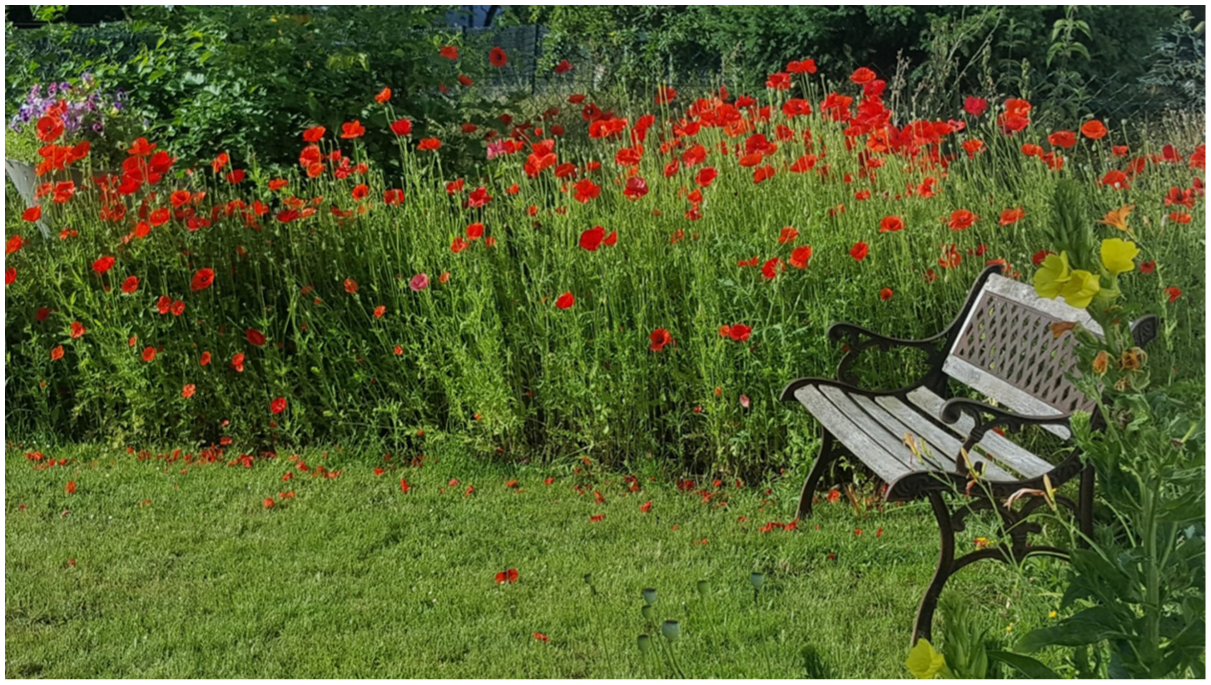
Zeliha’s garden.
Zeliha is not alone in her nostalgia-fuelled transplants. In their allotments in Bonn, migrants from Turkey grow Anatolian species of kale and climbing beans (Gladis, 2003). In the super-diverse context of Fairfield, Sydney, migrants turn their backyards into vegetal microcosms, growing homeland plants and replicating the natural and horticultural landscapes from their places of origin (Morgan et al., 2005). In the UK, first-generation migrant gardeners engage in embodied cultural landscaping practices (Gerodetti and Foster, 2016). In a similar fashion, community gardens of Los Angeles function as ‘surrogate homes’ for the doubly displaced Latinx migrants, who engage in reconstructing their homelands in an urban setting by planting Mesoamerican plant species (Hondagneu-Sotelo, 2017). In New Zealand, Chinese immigrant home gardens become sites of continuity between the past and the present through what Wen Li et al. (2010) also refer to as ‘transplantation’.
In our migrant interlocutors’ narratives, longings are not only directed to specific plant species. They also sometimes take the form of a larger rural nostalgia. One of Simay’s field sites is an allotment close to a railway station in Gorinchem, where the sounds of birds mix with the occasional shuddering of the train tracks. The women that Simay met in Gorinchem either came to the Netherlands when they were younger (because their fathers had been working in the Netherlands) or they did so through marriage. The majority of them are in their late 50s and retired due to ill health, following years of factory work and low-paid cleaning jobs. Nowadays, they have more time to spend in the allotment gardens with their families and friends. They regularly organise women-only social gatherings in the allotments, which are almost always mediated by food, even in winter. They prepare traditional dishes using the crops they harvested from their plots. However, what they share in these gatherings is not only food but also nostalgic sentiments. When Simay visited Manolya’s allotment, she described the cabin in her allotment as a ‘village home’, which was furnished with a fluffy carpet, a wood-burning stove in the corner of the room and a large table with a wax skin tablecloth (muşamba), like in a typical village house in Central Anatolia.
Manolya’s sister Yasemin offered the visitors very vivid descriptions of village life in Turkey as she remembered it: nothing would go to waste. We would harvest wheat from the fields, then we would use a sieve to make flour and bulgur with it. We also practised husbandry. We would make our own yoghurt with the milk we got from our own cows.
The other gardeners listened to her attentively, occasionally nodding at her remarks. Yasemin did not describe village life as without challenges, but what the gardeners agreed on was the importance of self-sufficiency and circularity. Cultivating the land was not a hobby; it was an essential part of sustaining themselves because their livelihood depended on their crops.
The temporalities of village life were closely linked to activities that took place there. Listening to Yasemin’s reminiscences about the village, Zerrin jumped in to say: We would refer to September as the grape molasses period. Most people didn’t know their birthdays, because they would say, ‘I was born during the period of grape molasses’. I remember being very confused as a kid because it takes three weeks to make grape molasses. So on which day exactly?
Everyone laughed at Zerrin’s remarks, after which Yasemin added: ‘We also had harman (threshing) period, which is in August. Before that, we had arpa biçme (reaping of barley) period, which would be sometime in June’.
Gardens engender nostalgic sentiments in migrants both through the sensations they evoke and the memories of how time was structured back then. This structure is in stark contrast to the urban temporalities that our interlocutors live within. What gardening makes possible for some of our interlocutors, especially for those who have rural backgrounds, is to bridge these two through the life cycles and seasonalities of plants. In the next section, we will unwrap these temporal affordances of plants to illustrate how they shape the experience of the present.
Aligning with plant temporalities
Gardening and intimate relations with plants are not only a matter of nostalgic remembrance for our interlocutors. In allotments, their present lives are deeply entangled with the plants they grow and the timely needs of the plants. While our interlocutors make the Netherlands and Germany their homes, they enlist plants as their companions and collaborators (Alkan, 2025b). For many of our interlocutors, plant care works as a mindfulness exercise. Plants dictate that their needs be met at certain times and pull migrants towards a present that cannot be put into parentheses or postponed. For some, this unfolds as an imagined communion with nature, while for others, it is the challenges of aligning with plant temporalities in a different climate that manifests the hardships of homemaking here and now, as the stories of Hüseyin and Yaşar will show respectively.
Hüseyin, with whom Simay gardened regularly, arrived in the Netherlands 30 years ago in his early 20s. When Simay initially asked him about his early years in the Netherlands, he told her that it had been a very difficult period of his life. He had not known anybody else in the Netherlands apart from his uncle. He had married a Dutch woman to obtain permanent residency, but their relationship was an additional source of stress. In the meantime, Hüseyin had been working at a factory where he had been constantly bullied by two of his Dutch colleagues. To avoid the discriminatory remarks of his co-workers, he had moved to night shifts, which had slowly taken a toll on his mental and physical health.
Thirty years later, Hüseyin leads a quiet life in Rotterdam, spending most of his days in the allotment. He likes waking up to birdsong and tying up his tomato plants to poles first thing in the morning. He occasionally rubs the leaves of his plants between his fingers to dissipate their smell and inhales them with joy. He regularly refers to gardening as a form of therapy (Figure 2). By attuning to the sensorial qualities of his plants and the soundscape of nature, Hüseyin finds a sense of harmony and stillness that stands in contrast to his earlier years in the Netherlands. He readjusts the rhythm of his body to the temporalities of nature to overcome the physical and emotional hardships he has endured for many years. While gardening alongside Hüseyin, Simay also noticed how his working rhythm was one that favoured long breaks. Hüseyin liked having a cup of coffee or tea with some snacks before gardening, then after planting a few rows he would take another break, saying ‘We worked hard, we deserve some coffee’.
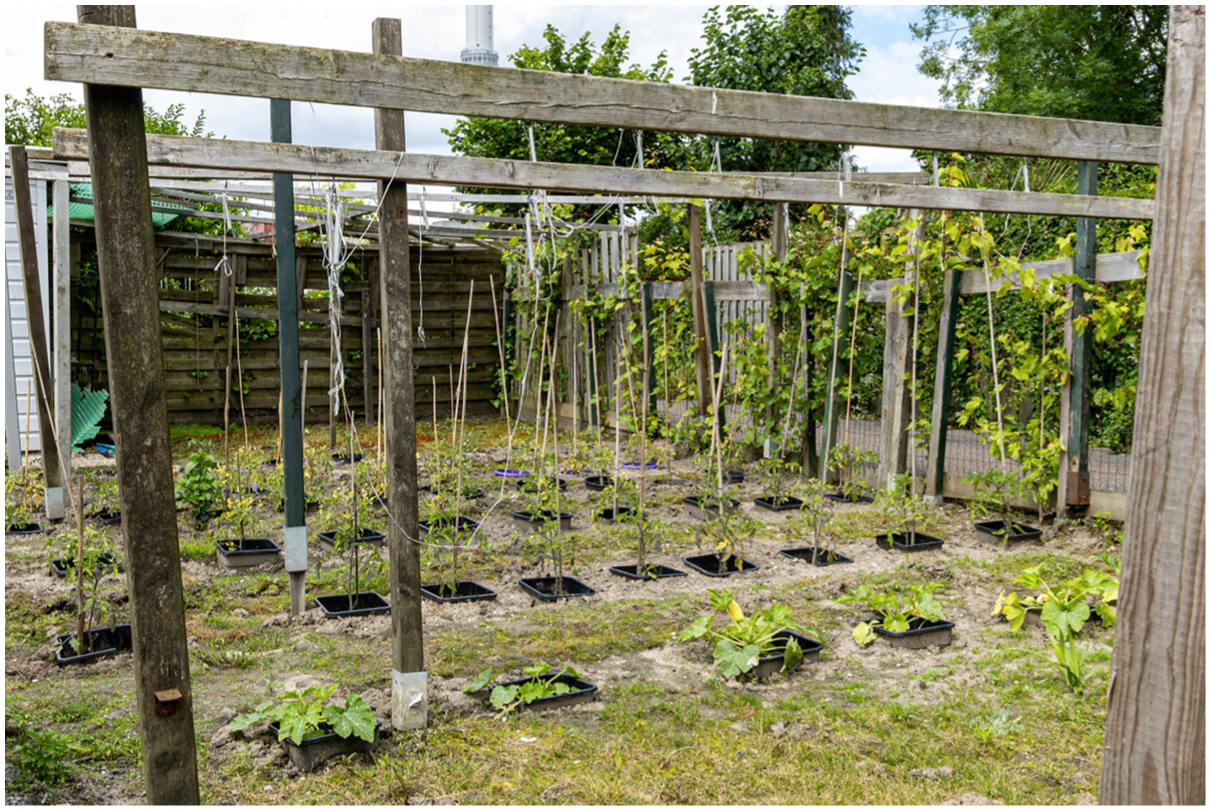
Hüseyin’s garden.
While Hüseyin’s story shows how attuning to the temporalities of nature can be restorative (cf. Pitt, 2014), there are cases where plant temporalities impose obstacles and limitations. Plant temporalities often override those of humans, and in the absence of industrial farming technologies there is very little that can be done to interfere with plant lifecycles to synchronise them with human timelines. In that sense, if one wants to engage with multiple plants simultaneously, there are quite a number of important dates when one has to closely attend to the plants, from early spring till the beginning of winter. Germination times cannot be completely altered, nor can the time for grafting. Plants come into contact with human beings with their own agendas, and if the human beings choose a convivial existence they have to collaborate. This collaboration connects people to circadian, solar and lunar cycles, which modern working lives often negate, as is illustrated by Hüseyin’s hardships.
However, the cycles do not always correspond to what was known in pre-migration lives. The seasons of the Netherlands and Germany do not exactly match what migrants experienced and got used to in their regions of origin in Turkey. Although all three countries are located in the temperate climate zone of the Northern hemisphere, the difference in latitude (and also altitude, depending on the part of Turkey they came from) has a strong effect on when and how the seasons change, as well as how they unfold. Many amateur migrant gardeners struggle particularly with the instability of weather conditions in the Netherlands and Germany in spring and early summer. Certainly, climate change also plays a role in this instability, but it often goes unrecognised except by the most seasoned and experienced.
For many migrants, it was not easy to adapt to the darkness and bitter cold of winter and the swing between quite cold and sweltering days in the summer. In 2024, late frost was the most common subject of small talk around the allotments in Berlin: the cherries and apples had lost their blossoms and therefore could not give fruit, but the pears had survived the steep temperature drop in May. Certainly, frost hitting fruit trees is not unique to Northern Europe. But the window for it to happen is very large in comparison to most parts of Turkey. It is easier to develop co-adaptation strategies with vegetables. One can germinate them indoors relatively late and transplant the seedlings in the garden only after mid-May, which is what some allotment gardeners did. However, with fruit trees, the options are limited. It is not possible to stop them from blooming when the heat triggers water to run up their veins in spring. And then, when the temperature drops below zero again, they lose not only blossoms (and in consequence the fruit) but even some branches because the water inside freezes and makes them brittle. One of Hilal’s interlocutors, Yaşar, found an ingenious solution to this problem: he grafted apple branches onto a pear tree he brought from Turkey, to align apple temporalities with the late-blooming Anatolian pear. It is a sight that makes passers-by look at least twice to understand that this one tree has both apples and pears on it. In 2024, when it was announced that there would be almost no apple or cherry harvest in Berlin and Brandenburg, Yaşar’s tree had so many apples that he was afraid the branches might break. He applied his own adaptation strategies – juggling two worlds and emplacing himself in two distant places simultaneously – to his garden successfully and managed to co-adapt with the plants with whom he migrated.
Turkish–Dutch gardeners in Rotterdam and Gorinchem expressed similar problems about the mismatch between the temporal requirements of their plants and the weather conditions that stagnated their growth. For our interlocutors, whether in Germany or in the Netherlands, aligning with plant temporalities came as a welcome requirement of gardening, and many have drawn pleasure in their attempts to do so. Yet, both for them and the plants they aspire to grow – the ones that are attuned to warmer and milder climatic regimes of different parts of Anatolia – adapting to the seasonal temporalities of their new homelands poses a real challenge.
Cultivating futures
So far, we have shown how gardening as an activity and the individual plants that are cultivated in the gardens weave migrant pasts into their present lives in Germany and the Netherlands through acts of remembrance and daily practices of care. However, the affordances of entangled plant and human temporalities do not end there. Future making is a significant element in migrant gardening. Many migrants approach their gardens as a statement of their commitment to stay and to take part in the making of the urban environments they live in.
Yaşar and Müjgan are from the earliest ‘guest worker’ generation. Yaşar arrived in Germany for the first time in 1966, as part of the agreement that Turkey and the Federal Republic of Germany signed in 1961. He and Müjgan both worked for over 30 years, raised their three children in Berlin and got the allotment only three years before Yaşar’s retirement. In the meantime, they also built a garden house in their hometown in Turkey and still spend four months there every year, but only in winter. Unlike their peers, they never imagined a retirement in Turkey. Instead, they reconstructed the little shed in their allotment and they spend all of their summers in Berlin, under the trees they had carried from their homeland and planted in their garden. When they acquired their inner-city allotment in 1999, they were the only non-Germans in the Kolonie (as the German allotment garden associations are called), which contains more than a hundred gardens. According to Yaşar and Müjgan, only in the last 10 years, and even more so in the last five, have migrant families started to get allotments. They explain this occurred with a change of mentality: Earlier, people would come here to earn enough money to buy a tractor or even a television, and then they would return. Because of that, they did not buy anything. … But in the end, they did not return, they only wanted their lives here.
Only when returning ceased to be the desired prospect did renting allotments and investing time and energy start to make sense in their future making.
If investing in a property is future making, growing plants is even more so. Growing any plant is a promise in time, in the future. One must be there to care for it regularly and attend to its needs for all the time it takes. For the parsley, it is just for a few months. For an apple tree, it is for decades. Therefore, for newcomers, plant care often involves growing annual herbs and flowers on balconies or keeping houseplants at home. Growing trees and other perennials requires both a long-term commitment and suitable conditions, like a piece of land, which is related to a more stable existence in the new homeland. When people are better ‘emplaced’ (Vigh and Bjarnesen, 2016), it is easier to imagine putting down new roots and becoming entangled with the earth and the multispecies lives it fosters (Alkan, 2025b, 2025c).
In Berlin–Brandenburg, despite the immense greenery that comprises birch and pine forests, vast meadows, green fields and lush parks, one doesn’t find soil that resembles the soil in Turkey. Instead of a rich brown, sticky earth that comes off in chunks, what lies underneath the vegetation in this part of the planet is sand that slips between the fingers. This is the first disappointment that awaits any newcomer gardener in Berlin. The earth supports giant trees but not humble peppers, tomatoes or melons. In order to grow vegetables, fruits and flowers, one has to invest in the soil.
Ertan is an IT engineer in his early 50s. He came to Berlin following his wife’s political exile as a peace activist in 2016. He is the grandchild of Balkan refugees who were resettled in Western Anatolia at the turn of the last century. He grew up in his grandparents’ fruit orchards and vegetable gardens. Before moving to Berlin, he was already looking into acquiring land for himself and engaging in horticulture. After the unexpected turn of events due to his wife’s exile, he had to delay his dream and find an allotment garden in Brandenburg, about 80 km away from Berlin. His garden is meticulously designed and very well kept. He approaches his vegetable beds almost as a scientific experiment. He tries different varieties of tomatoes, potatoes, cabbage, pumpkins, cucumbers and all sorts of herbs, keeps photographic records of their growth and watches endless hours of videos to improve his skills. But this piece of land is nothing like what he knew from his childhood. In June 2024, over a long afternoon in the garden, he told Hilal that the first assumption he had to give up was that he knew how to grow plants. He needed to adapt to a different soil and different seasonal rhythms, which required an ongoing process of trial and error. A major part of his effort is directed to turning Brandenburg sand into soil that would feed his vegetables and trees, because in his own words, ‘a novice gardener produces vegetables while an experienced one produces soil’.
He has had some problems with his neighbours in the allotments. They seemed to be disturbed by Ertan’s foreignness and became almost obsessed with enforcing every minor rule about how to manage gardens, even though Ertan’s was one of the best maintained. Ertan approached the situation empathetically, explaining their behaviour with frustration over not being able to grow as much as they would have liked on Brandenburg soil: ‘What would you expect? They deal with this soil. I understand why they are so irritable’. Fighting back frustration, he built a big compost bin where he puts all discarded vegetation. He also buries branches and autumn leaves in designated parts of the garden to support soil formation. He bought thousands of worms both for his compost bin and to release in the garden to benefit from their labour. Making soil is a long-term effort, he says. He will reap the fruits of it in several years as he is now determined to stay in Germany. Enriching the soil is an investment in a future, and a home, to come (cf. Krzywoszynska, 2020).
Yaşar and Müjgan struggle with the same problem in Berlin. Their plot is also very sandy, and they have to buy a lot of commercial soil to enrich it. However, they also need to clear the rubble of the Second World War barracks and anti-aircraft weaponry that were installed when the gardens were confiscated by the Nazi regime (Bluhm et al., n.d.). They experience the ‘ruderal ecologies’ of Berlin (Lachmund, 2013; Stoetzer, 2022) first hand and build their future homes there by rehabilitating the ruins of war, negotiating with a hostile climate and transplanting companion plants whom they know by heart. Hence, the changing urban nature of the allotments attests to migrant future making against all odds, making new homes in caring collaborations with plants, in their time.
Conclusion
In this article, we have offered insights into how migrant and plant temporalities get entangled in the multiple ways migrants struggle to make homes in their lands of immigration. We have shown, with ethnographic examples from Germany and the Netherlands, how temporalities of migration become explicit while migrants care for plants responding to their planty temporalities: trying to adapt to their rhythms, life spans, cycles and timely needs. In this context, nostalgia serves as a constructive force, helping gardeners create a present-day sense of home within their gardens, all the while longing for what they left behind. This sense of home is strongly mediated by the sensorial qualities of plants – their smells, textures and tastes – which evoke powerful associations with the past. These plants, however, do not merely function as reminders of the past; they are integral to the gardeners’ present efforts to establish themselves in their new environments – in a sense creating a viable present.
However, this process of transplantation is fraught with challenges for the migrants and the plants alike. The seasonal cycles in the Netherlands and Germany often do not align with those remembered from the gardeners’ pre-migration lives in Turkey. Additionally, these cycles are increasingly unstable due to the effects of climate change, which significantly alter temperature patterns and disrupt growing seasons. In response to these challenges, our interlocutors often deploy creative strategies to balance the temporalities of their plants with the climatic conditions of their new homes. Through these strategies, Turkish–German and Turkish–Dutch gardeners engage in a future making that deliberately enlists other-than-human beings – particularly plants but also the soil as a living entity – as their collaborators and companions. Hence, their rooting in the metaphorical sense involves real roots of real living beings with whom they live and grow.
What do these entangled temporalities mean for the making, unmaking and transformation of urban natures? First and most obvious of all, they correspond to a change in the make-up of urban gardens, both in terms of the demographics of people and cultural diversity and in terms of the demographics of plants, as migrants are often vectors of plant dispersal. Our interlocutors’ relentless plant trafficking, supported by other studies we cited above, points to another phase of world-changing human–plant co-mobilities. Second, these alignments and juxtapositions transform ‘home-city geographies’, which should be understood not only in terms of the built and social environment but as an affective ecology that is made up of an intricate web of a multitude of human and other-than-human encounters, relations and conflicts. Within this web, and actively weaving it, migrants make homes in the city and turn the cities they inhabit into their homes. They do this not alone and not only with other human beings but decisively with their green companions.
Footnotes
Acknowledgements
We are grateful to our editors Mathilda Rosengren and Lucilla Barchetta for their encouragement and insights, and the three anonymous reviewers for their engaged reading and constructive comments. Simay Çetin thanks Dilara Erzeybek for accompanying her on fieldwork with her camera.

Funding
The authors disclosed receipt of the following financial support for the research, authorship, and/or publication of this article: Deutsche Forschungsgemeinschaft, Grant No. 458661090; and Nederlandse Organisatie voor Wetenschappelijk Onderzoek, Sociale en Geesteswetenschappen, NWO, Grant No. 406.21.SW.036.
Declaration of conflicting interests
The authors declared no potential conflicts of interest with respect to the research, authorship, and/or publication of this article.