




Abstract
This article conceptualises uncertainty as a generative mode of urban spatial formation that operates through ambiguity and unpredictability for both governing authorities and urban residents. Focussing on the case of riverside flyovers in Chongqing, it examines how urban transport infrastructure is a socially constructed site shaped by conflicting governance logics and complex social patterns. Since the 1990s, massive riverside flyovers have been built to overcome the narrow mountainous terrains and to improve transportation efficiency in the urban core of Chongqing. Based on empirical observations, I argue that these flyover spaces are shaped by uncertainty that is primarily produced by precarious authoritative negotiations, as well as universal tensions between capital and territorial governance logics. This reveals the unpredictable and uncertain natures existing in the ‘top-down’ conception and construction of transport spaces. This article also argues that the uncertainty in socially constructed aspects of such transport projects squeezes local lifestyles while also providing possibilities for local innovation to reshape transport and/or reaffirm residents’ imagination of urban spaces. This article embraces the uncertainty in transport infrastructure to understand a more diverse range of urbanisation imaginations.
Introduction
August 2021 was my first time taking the No. 2 light rail line along the Jialing River in Chongqing. The elevated structures of the light rail were undulating and entangled with the structures of the riverside flyovers. When the train was about to enter the Niujiaotuo railway station, I looked through the window and saw some small Buddha statues placed in corners of the steep riverside under the elevated highways and light railway. Some were lit with candles and looked as if they had just been cleaned. Others were covered with blue cloth and some dead leaves, and the paths around them were blocked by iron fences. On the other side of the light railway, many people were swimming in the river with eye-catching orange floats on their backs. I immediately got off the railway, yet the place where the swimmers had gathered remained elusive.
This opening vignette illustrates the unpredictable and uncertain governance of the flyovers spaces, which inconsistently affects local social practices and cultural spaces in Chongqing. In this article, I use the notion of uncertainty to refer to the ambiguous and precarious mode of urban spatial formation. Such uncertainty reflects an instability of the material presentation of transport spaces caused by associated ‘relations of power’ (Prytherch, 2022). As this article argues, authoritative discourses about modernisation obscure the contradiction within the simultaneous implementation of multiple transport development goals. Hence, flyover entities are also social constructs: socially produced spaces that are not neutral but have the potential to be prisms refracting complex social dynamics and relations (Lefebvre, 1991). By tracing how the authoritative negotiation procedures in transport governance and vernacular pedestrian routes and social practices shape the flyover geographies directly or indirectly, my contributions to current debates in critical urban scholarship on transport are as follows.
Firstly, I demonstrate the uncertainty that exists discursively and materially in authoritative decision-making processes on transport, which emphasises that the unpredictable and uncontrollable are not characteristics unique to ‘bottom-up’ spontaneous urban practices and social relations. I argue that the uncertainty of transport infrastructures is caused by the inherently contradictory development logic within modernisation, namely the inevitable tension between capital and territorial logic (Harvey, 2006). Urban transport as a social construct condenses and reflects traces of the dynamic internalisation of these two opposing logics. Because their complex power relations intertwine within opaque and ambiguous negotiation processes, authoritative actors such as local governments, planners, and engineers remain unable to predict exactly how transport spaces will eventually take shape. To further support this observation, I propose the second contribution: I illustrate how such uncertainty caused by authorities dynamically squeezes local everyday life while providing opportunities for spontaneous urban practices of urban majorities to reshape transport spaces in turn (Bathla, 2024). The article observes empirically how uncertainty resonates with the notion of the ‘infrastructural heterogeneous’ (Jaglin, 2014), which assists in recognising the cracks within the uniformity and homogeneity of the modern infrastructure ideal (Graham and Marvin, 2001; Lawhon et al., 2018). Hence, I demonstrate how this research on uncertainty offers an alternative lens to analyse transport and urbanisation in other developing cities beyond the narrow focus on authoritative leading and capital accumulation.
This article commences by surveying the scholarship of uncertainty, followed by the contextualisation of this work within the urban political economic context of China, especially in Chongqing, and outlines the research methodology. Then, through rich empirical examples, I illustrate how uncertainty is produced in the transport negotiations between different authority agents, and how this both squeezes local lifestyles and provides opportunities for local innovation for reshaping transport spaces. In the process, I extend the topic of uncertainty of transport spaces to the contradictions of modern urban governance logics, in order to exceed the assumptions of modern uniform progress. In the final section, conclusions are presented and possible directions for further research on politics and practices of uncertainty are considered.
Uncertainty of transport: Beyond modern progress narratives
There remains a lack of analysis regarding uncertainty in authoritative decision-making within the transport field. Traditionally, many academic contributions have framed transport as a physical engineering means to enhance circulation efficiency, reduce transaction costs, and promote economic growth (Jain and Lyons, 2008; Kębłowski and Bassens, 2018). Under such perspectives, transport infrastructures are expected as part of the ‘modern infrastructure ideal’ (Graham and Marvin, 2001), that is, to be a widely accepted social and political goal that seeks to provide uniform infrastructure globally (Lawhon et al., 2018). Such knowledge-making, namely the assumption that needs, goals and methods of transport infrastructure are objectively certain and technically demanding (Christensen, 1985), portrays the transport field as expert-led, driven by engineers, academics, and policymakers, rather than the public and major users. This technocratic framing provides policymakers with a sense of agency to address uncertainty through the use of ‘rational’ academic knowledge (Kębłowski and Bassens, 2018), which helps to legitimise existing power relations (Flyvbjerg, 1998). Conversely, transport spaces shaped by alternative urban life and practices are labelled as ‘unpredictable’ and ‘informal’ (Harris, 2018), making them supposedly inferior and uncertain. Such a binary knowledge framework, based on the assumptions of modern development, overlooks the potential of transport infrastructure to serve as social constructs that reflect more complex social patterns and interactions (Matthews, 2015; Sheller, 2018).
Recently, the politics of uncertainty has offered an opportunity to reveal the cracks in the uniform narratives of modernity, development and progress (Bathla, 2024). In contrast to the assumption that modernity refers clearly to certain ends (what people want) and means (how to achieve it) of transport constructs, uncertainty denotes a mode of urban spatial formation that is unpredictable and ambiguous, unfolding without agreed-upon goals and/or without clearly established means of achieving them (Christensen, 1985). Scholars illustrate how uncertainty can be utilised across much of the so-called ‘Global South’ (e.g. Simone, 2013; Tucker, 2017). These discussions identify the authoritative decision-making processes that deliberately cultivate uncertainty. By tracing evictions and land disputes caused by constructing highway corridors in India, Bathla (2024) demonstrates how state and real estate developers utilise uncertain land-use definitions and legal disputes to control transport construction, thus minimising their costs and maximising future financial gains. Kamath and Tiwari (2022) argue that ambiguity around spatial and legal definitions is a necessary condition to produce uncertainty and ambivalence, which ‘is actively mobilised by state agencies in diverse ways to avoid acknowledging the consequences of their bureaucratic process or taking just and remedial actions’ (p. 677). This implies that beyond practices of knowledge-making, knowing what to ignore has also constituted the power of state and municipal institutions (McGoey, 2012; Proctor and Schiebinger, 2008).
To support this perspective, the article further identifies uncertainty caused by the contradictions of the uniform progress narrative of modernisation (Tsing, 2015). This article combines the core of ‘the evolutionary nature of the modern world system’, that is, ‘the definition of “capitalism” and “territorialism” as opposite modes of rule or logics of power’ (Arrighi, 2010: 33). Capital logic maximises revenue and economic growth. But territorial politics involves political groups or leaders wanting to stay in office (Guo, 2020; Pike, 2023), and the logic of guaranteeing collective interests bound by territories (Thompson, 2021). On the one hand, transport constructs in capital logic symbolise a very specific kind of extended urbanisation, geographic connection and resources flowing for capital growth (Brenner and Schmid, 2015; Castriota and Tonucci, 2018). On the other hand, transport systems limit the immediate territories. As infrastructure assembles, it transforms nature to materialise the modern city (Gandy, 2004). As Weber recognised, the advantages of transport costs and efficiency appear during the spatial agglomeration process. Tucker (2017: 733) terms this the ‘dialectics of uncertainty’ to highlight the generative tension between these interrelated but conflicting forces. In the pursuit of modernity, authorities need to internalise dynamically the inevitable and universal tension between capital logic and territorial logic (Harvey, 2006). This process involves ongoing authoritative negotiation and strategic creation of blind spots – situations or topics that are obscured by other themes (Kossak et al., 2014) – to hide aspects of those tensions that cannot be resolved. As a result, transport spaces rely heavily on the outcomes of precarious negotiations with multiple authoritative goals, and the unpredictable consequences are hidden in blind spots, which remain beyond full authoritative control.
Such uncertainty provides opportunities for alternative urban lifestyles and practices to reshape transport spaces beyond the modern development assumption (Bathla, 2024). The generative potentials of uncertainty of authority practices should not simply be equated to risk, but should also be viewed as a resource (Simone, 2013; Waite, 2009). Such uncertainty is a ‘possible hook’ for contestation (Thieme, 2018: 542) for the ‘urban majority’ who lie ‘between the superblock and the slum’, and ‘between the ascendant middle class and the poor’ (Simone, 2013: 246). In this sense, uncertainty resonates with the notion of infrastructural heterogeneity (Jaglin, 2014): analysing the uncertainty in transport infrastructure assists in arguing that what emerges ‘locally’ is not simply the result of pressures from globalisation or developmentalism but also local innovation (Lawhon et al., 2018). Uncertainty can then be understood in contrast with the normative aims of homogeneity and centralism of the modern infrastructure ideal (Lawhon et al., 2018). Interrogating everyday experiences through the notion of uncertainty can help to identify its generative potentials in the forms of diverse and imagined alternatives (Thieme, 2018), and thus to think beyond the narrow focus of commodification, financialisation and bureaucratisation of modernity (Scoones and Stirling, 2020).
Internalising contradictions: Capital, territory, and the politics of uncertainty in Chinese transport infrastructure
In China, uncertainty exists in transport construction, where it is strongly related to tensions between capital and territorial logic. After the 1994 tax-sharing reform in the new budgetary regime of fiscal decentralisation (Hsing, 2010: 61), municipal governments gained greater autonomy and huge decentralised financial and administrative powers (Chien, 2010; Hu, 2007). Under the framework of ‘urbanisation of the local state’ (Hsing, 2010: 6) – the entrepreneurial competition for regional investment and introducing professional incentives for cadres (Roast, 2024) – municipal governments act as profit-driven groups. They define and pursue urban modernity as a normative strategic means through which local states legitimise their spatial intervention and governance practices for local economic growth (Roast, 2019).
‘If you want to get rich, build roads first’ was the most popular policy slogan in the process of national modernisation in 1990s China. The success of transportation infrastructure construction became one of the important indicators in evaluating economic measures for municipal governments (Chien, 2010). Transport development is an important prerequisite for capital accumulation and maximising revenue of local government, because new and upgraded transport infrastructure can create locational advantage and increase property and land values in designated places (Hsing, 2010: 118). Furthermore, the greater the economic growth, the greater the chances for local leaders to achieve political promotion, administrative power and many tangible and intangible benefits (Chien, 2010; Whiting, 2001). Within this discursive context, transport construction seems to achieve a win–win situation between the capital and territorial logics.
However, the cracks between the official expectations of urban transport construction and their social practical impacts are exposed beyond the narratives of modernity. Environmental issues and unfair urban living conditions are intensified by transport construction. Authorities sweep the limitation of beneficiaries and regions under the modern capital development carpet. In addition, the erection of massive physical structures of transport infrastructure projects intensifies the territorial presence of the local state. Project-based agencies are also created to manage the construction of highways and after these projects are completed, the agencies stay on to manage these territorial additions to the local state, thus helping to consolidate its expanded territorial authority. Such territorial logic highlights the boundaries of territories and competition, instead of connection, between regions.
Hidden tensions within the logic of modernity and the complex administrative hierarchies and relations contribute to uncertainty. The following analysis will focus on how transport spaces in Chongqing are being embedded into complex social dynamics, demonstrating how they are shaped by multiple roles. This reveals the roles of uncertainty in both authoritative decision-making processes and local everyday experiences.
Research location and methods
Chongqing is a mountain city at the confluence of the Jialing and Yangtze rivers in southwest China. Due to the steep and uneven geographical terrain, it remained extremely reliant on water transportation and lacked significant roads until the 1980s. Local governments, already constrained by capital shortages, faced widening fiscal gaps during the economic reform (Wu, 2018), and lacked funds to respond to national transport construction policies. In particular, the cost of highway construction in mountainous Chongqing is double that on the plains.
To support capital accumulation and territorial stability, former Chongqing mayor Huang Qifan drew on his experience in Shanghai to restructure the Chongqing’s economy. In 2002, he established eight chengtou companies 1 to liquidate underperforming state-owned enterprises and convert others into urban financing vehicles (Roast, 2024). These companies leveraged government credibility to obtain large loans for transport infrastructure. In the last two decades, Chongqing has undergone rapid expansion, and numerous flyovers have been built in the core urban area. The riverside had less fixed real estate, which meant lower demolition costs. Thus, riverside spaces were the ‘optimal’ locations for building transport infrastructures efficiently. Yet such transformation and construction of flyovers have disrupted local lifestyles after covering, replacing, or edging out riverside spaces (docks, riverside markets, pedestrians’ routes, etc.), which once relied on water transport.
To analyse how the transport spaces in Chongqing are influenced by both authoritative uncertainty and by local spontaneous social practices, this article focuses on the riverside flyovers along the south bank of Jialing River in the core urban area (Figure 1). These highways pass through the most traditional urban core – Yuzhong Peninsula. This means that the construction of these highways has had to deal with the most entangled land rights, the highest stakes in land-rent competition (Hsing, 2010: 37), as well as the most diverse and highest-density of transport-spaces users. Hence, these riverside flyovers have become the frontier social stage showing the profound interaction and negotiation between multiple authoritative roles and urban residents.
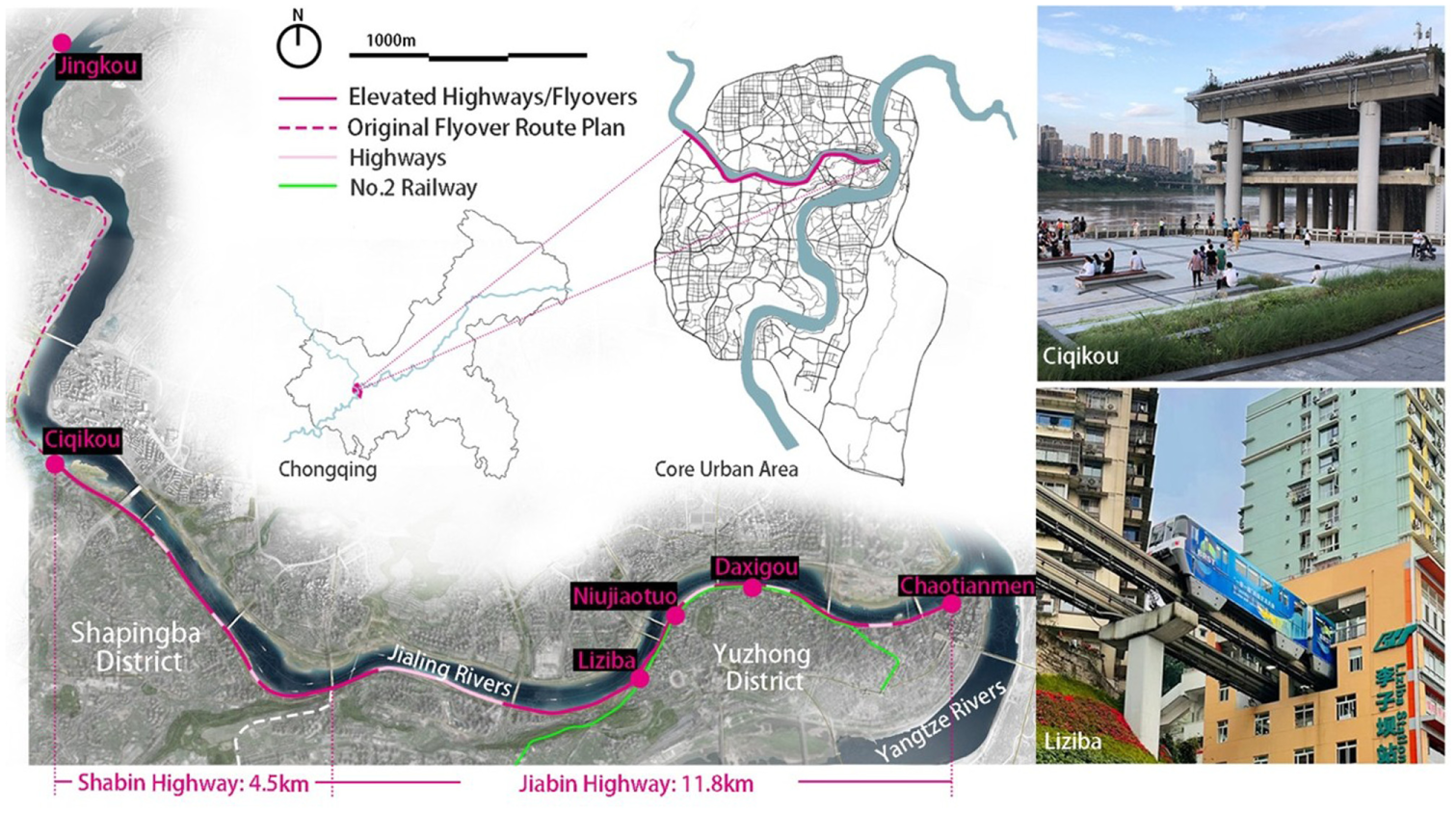
Location of research sites.
To understand this complex situation in more detail, I collected empirical data through three periods of ethnographic fieldwork in Chongqing (one month in 2021, seven months from December 2022 to June 2023, and one month in 2024). I employed participant observation to treat the participants as co-producers of knowledge, rather than passive objects of the research (Gubrium and Harper, 2016). During this process, I invited 47 pedestrians who were local residents and/or attending social gatherings under the flyovers. Through go-along interviews, I could move alongside participants while we talked (Bergeron et al., 2014), tracing local pedestrian routes and social networks that reconnect riversides and surrounding communities via GPS and photo documentation. I also marked land-use situations along the riverside flyovers. To demonstrate authorities’ perspectives on the flyover construction, five professionals, including decision-makers, transport planners, and scholars, were invited for semi-structured interviews to describe their activities, experiences and opinions in their own words (Kvale, 2007). These qualitative methods provided the rich details required for this research. However, my positionality as a non-local researcher situated me as an outsider, which created challenges in establishing trust with participants, especially local officials. Nevertheless, such distance also enabled me to question assumptions, and encouraged greater openness from residents and scholars when discussing tensions within local transport governance. Additionally, I conducted broad desk-based research to understand the historical and political context of the research site. Relevant documents, including urban plans, project documents, local chronicles and archives, were retrieved from the government website, the Chongqing Library and the Local Chronicles Office, or provided by participants.
Uncertainty in flyover geographies: (Un)covering blind spots during urbanisation
In the following sections, I divide the empirical analysis on the research sites into two main sections that correspond to aims of this article: (1) to demonstrate how authoritative uncertainty appears and materialises the flyover spaces, through tracing the negotiation processes and inconsistent interests of multiple authoritative agents; and (2) to illustrate how local everyday social spaces and spontaneous practices adapt and leverage such uncertainty to reshape flyovers in turn, through mapping the pedestrian routes and social activities. The following empirical examples assist in analysing the interplay of social powers, relations and practices shaping transport spaces beyond the uniform modern development narratives.
Authoritatively produced uncertainty shaping flyovers
To increase the transport network density in Yuzhong District and quickly connect with Shapingba District in the west, the Jiabin elevated highway was constructed along the south riverbank of Jialing River (from Chaotianmen to the junction with Shapingba District, see Figure 1). Media coverage hyped that this highway halves travel time in the main urban area (Chongqing Economic Times, 2005). A summary report from the Chongqing Municipal Construction and Development Company shows an image of a smiling child standing in front of the construction site, reinforcing the narrative of modernisation and a promise of a bright urban future. The accompanying text stated: ‘It can reduce the huge traffic pressure … Miraculously, a wide Jiabin Road was built on the riverside, creating good social, environmental and economic benefits.’
Jiabin highway quickly became a positive case of modernisation, increasing the surrounding land values, promoting economic growth and transport efficiency within Yuzhong District, and in turn supported the promotion of district leaders. Nevertheless, such a joint achievement of capital and territorial development was based on a deliberately ambiguous engagement by local authorities with the very definition of territorial logics. This means that although the authorities highlighted how the construction of the elevated road served as an example of the political achievements of district leaders, they simultaneously ignored the loss of collective interests, such as the riverside ecological degradation and the disconnection between surrounding communities and riversides (Chen, 2015; Wu, 2020). 2 By only highlighting positive impacts, however, authorities intensified competitive pressure between districts and prompted other district government leaders to put forward ill-considered plans to rapidly construct elevated highways along adjacent sections of riverside. This subsequently introduced more uncertainty in urban transport spaces across broader urban contexts.
For example, the Shapingba district leaders announced their ambitious plan for Shabin elevated highways that proposed to extend the riverside flyovers in Yuzhong District to the western part of the Shapingba district, Jingkou (Figure 1). Similar to Yuzhong District, the riverside of Shapingba District has mostly steep slopes, but there is a shallow bay, Ciqikou, that was one of the most important docks in Chongqing. Many national factories were located here during the planned economy period due to convenient water transportation. However, after economic reform in the 1980s, these factories faced challenges of industrial transformation and gradually declined due to poor management and lack of capital investment (Yang and Qin, 2009). Against this backdrop, the Shapingba district government considered that simulating Yuzhong district to construct riverside flyovers was the perfect opportunity to reinvigorate Ciqikou.
However, the Shabin highway project revealed uncertainties that were produced during ambiguous authoritative negotiations, exposing the limits of top-down decision-making rationality. When the district government drafted the construction plan for Shabin highway, the Chongqing Planning Bureau was also formulating the Chongqing Urban Master Plan (1996–2020) around 1995. In contrast to support for building the Shabin highway, the Urban Master Plan proposed protecting Ciqikou as an important historical complex in the city core. This was because the Chongqing Planning Bureau realised that this highway involved not only the district-level economic development, but also the treatment of the national heritage and ecological landscape of Ciqikou.
Therefore, although Shapingba District’s plan for the riverside elevated highway was partially supported by the municipal government, the Planning Bureau suggested replanning the highway along another route due to the risk posed by this flyover scheme to the historical and natural landscape of Ciqikou. Nevertheless, due to the low-cost and high-efficiency transport construction conditions along the riversides, the district government insisted on constructing the Shabin highway along the river through Ciqikou before the Chongqing Urban Master Plan (1996–2020) was published by the state. With the backing of the municipal government for the riverside flyover plan, the Planning Bureau approved the land use planning scheme for the whole Shabin highway after a compromise, while only providing construction permission for the eastern part of the flyover of Ciqikou (4.5 km). Despite not having the completed engineering construction approval for the entire flyover plan, the district government insisted on immediate construction. I interviewed the former deputy chief engineer of the Chongqing Bureau of Planning, who participated in the negotiation processes of this project, and recalled: Regarding legality, the construction of Shabin Highway itself is legal … But they [the district government] gambled to construct the elevated highways before the state determined the scope of protection of heritage and ecological sites of the Ciqikou. So they want to build it there quickly, because built things are not easy to dismantle due to the high cost.
3
Such disorder in construction procedures was common in China during the 1990s. At that time, the real estate market had just opened up, but the city was already entering its most intensive period of restructuring (Roast, 2024). The politics of land development in core urban areas involved not only the land battle between the socialist past and the present market economy, but also a grab in the present for a bet on the future (Hsing, 2010: 37). There were many cases of ‘getting on the bus before buying tickets’, that is, constructing before receiving completed construction permits. Another example from the period when the Shabin highway was being planned was the Chongqing Number 2 Light Rail Line, which was also on the drawing board. Part of this light rail was projected to overlap the Jiabin highway with a higher elevated structure. But when preparing to build the Liziba Light Rail Station, it was discovered that the same piece of land was also zoned for high-rise commercial housing (Roast, 2024). After multiple rounds of rectification, authorities resolved this clash by incorporating the light rail station within the residential building. The station’s platforms and accompanying mechanics occupied three central floors, with housing directly above and below. The negotiated outcome reduced the cost of rerouting the elevated light rail and transformed Liziba Railway Station into a vertical-transport landmark in Chongqing, exemplifying the modernisation of transport engineering technology.
Despite further authoritative negotiation, no consensus could be reached to balance the heritage protection and flyover construction in the Ciqikou case. After the section of the Shabin flyover approved for construction was built, there were heated public debates outside of the local government. Some scholars from local universities used their discursive powers as NPC deputies 4 to raise questions concerning the negative historical and ecological impacts of the riverside flyover on Ciqikou. They brought hidden pressures of state regulation to request that the flyover project be stopped. Meanwhile, other scholars supported the district government and even drafted a plan for high-rise commercial buildings based on the false premise that flyover construction would be completed after the destruction of Ciqikou’s historical landscape. Such contestation among authorities did not stop until 1998, when the State Council officially approved the protection plan for Ciqikou as one of the two historic districts in the main urban area of Chongqing that must be given priority protection (Liu, 2009).
This legalised the territorial boundary of Ciqikou historical landscape and negated the construction of transport infrastructure as a prioritised criterion for evaluating the performance of cadres in Shapingba district. Plans for the construction of the remaining part of the Shabin flyover were shelved. The section of the flyover left behind by the sudden halt of construction is clearly exposed on the east side of Ciqikou (see Figure 1).
After the Chongqing Municipal Government established Yufu Holding (a chengtou company) and secured loans from the China Development Bank, the Shapingba district government had a new opportunity to restart construction of the Shabin flyover. The flyover that passed through Ciqikou was re-routed through a tunnel, which was opened to traffic in June 2021. In 2020, the ‘Two Rivers Four Banks’ urban ecological renewal project proposed to remediate the ecologic environmental damage caused by riverside flyovers and to mend the urban spatial disconnections between the riverside and surrounding communities (Chongqing Municipal Housing and Urban-Rural Development Committee, 2020). The local government described how this original broken road had become a scar on Ciqikou (Chongqing Municipal Government Website, 2019). The symbolism of flyovers as positive social constructs was being changed, reflecting the precarity of authoritative policies and expectations regarding transport spaces.
Vernacular improvisations reappropriating uncertainty
As discussed in the previous section, the construction of riverside flyovers was shaped by precarious authoritative decision-making and competing development interests. Authorities also utilised uncertainty in transport infrastructure to align flyover construction with modern development narratives through highlighting the positive impacts of modernity while ignoring the contradictory interests. This created blind spots around flyovers with ambiguous governance regulations that inconsistently squeezed local everyday practices of urban majorities whose lives unfold beyond modernisation. On the one hand, the riverside flyovers encroached the riverbanks, and subsequent implementation of new regulations led to the displacement of some local everyday practices, such as small-scale agriculture, living and riverside boat restaurants (Chongqing Municipal People’s Government, 2018). On the other hand, the under-flyover spaces, as governance blind spots, enabled a form of tacit permissiveness where authorities largely overlooked the spatial encroachment by real estate developers. The real estate market has utilised the complex terrains of the riverside and unclear property lines under flyovers, to shape these under-flyover spaces. Some gated communities and commercial real estate built more ‘underground floors’ (they are actually semi-open spaces under flyovers; Figure 2B) than they declared in planning application schemes, and rented out these spaces as shops or parking lots. Many of these parking lots are not displayed on popular map apps such as Baidu and Gaode. For example, under the end of Shabin flyover on the east side of Ciqikou, the new commercial district has developed multi-storey parking lots by using the space under the flyover. A professional in charge of protecting the historical site of Ciqikou told me, [t]hese parking lots are supposed to be illegal. Especially the bottom-level garage, [which] will be flooded during flood seasons. But because there is no security accident yet, no one proposes to manage it. The interests involved are very complicated, and I am not very clear about it.
5
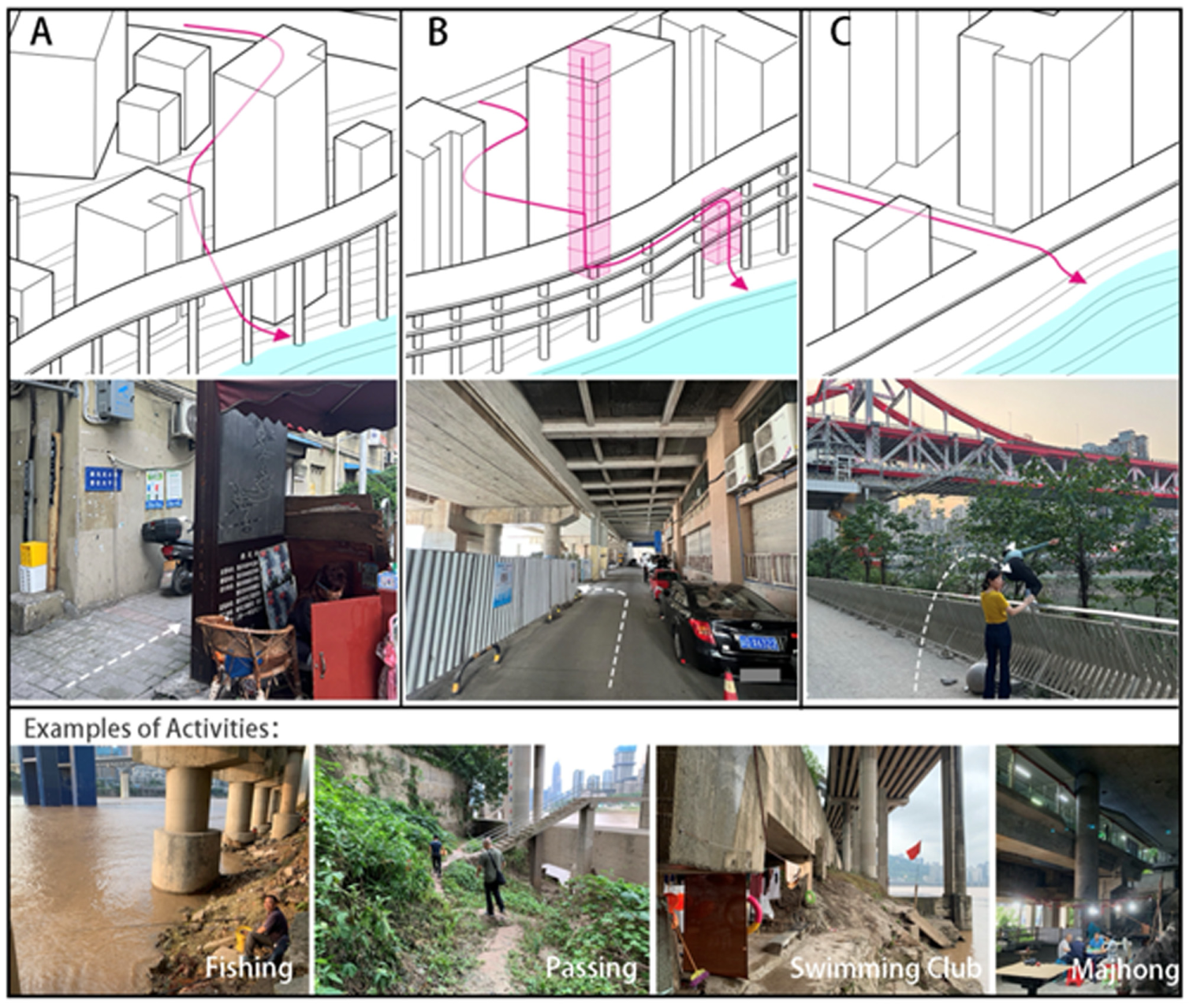
Three types of local pedestrian routes leading to the under-flyover riverside spaces (A–C) and examples of social practices.
However, as the infrastructural heterogeneity (Jaglin, 2014) demonstrates that the vernacular responses to uncertainty in transport spaces are the result of not only pressure from modern development but also ‘local innovation’ (Lawhon et al., 2018: 725). The rapidly constructed riverside flyovers covered docks, leading to significant transformations in local mobility systems. In the past, due to the convenient water transportation at the dock, various businesses, including freight, warehousing, logistics, wholesale markets, and auto-repair shops, were located close by. An owner of Daxigou Dock Flower Market told me that these flower wholesale markets were originally concentrated there because of the convenient water transportation of the dock. Following the elevated highway’s construction, this market has developed brand-new routes connected with land transportation. 6 Most notably perhaps, some auto-repair shops that serve many government and bank official cars have been retained, although these business types were considered to negatively affect the riverside landscape by some local scholars.
The uncertainty in blind spots of transport spaces also offers the urban majority opportunities to reshape flyover spaces, contesting constraints on their everyday practices and local walking networks. The purposes of these local spontaneous practices are beyond the imagination of modern development. By following these local daily routes, I gradually traced a pedestrian network that was compressed and shaped by the uncertainties of flyovers, yet simultaneously reappropriated and reshaped flyovers spaces to reconnect routes between the surrounding communities and the riversides. The locals are familiar with these routes although they are hidden and frequently disrupted by precarious authoritative governance (Cheshmehzangi, 2025). There are usually three types of pedestrian routes created by the locals spontaneously:
(1) Routes between residential buildings in open communities (Figure 2A). The regulations and negotiation processes of the construction of flyovers and surrounding land uses are marked by legal ambiguity and precariousness, resulting in overlapping or fragmented property boundaries. Locals have engaged with the consequences of such uncertainty to preserve and/or create everyday pathways to access riverside spaces.
(2) Through the stairway of the buildings along the riverside (Figure 2B). These routes lead to the riverside through the supporting staircases of ‘underground’ (under-flyover) parking lots. As mentioned above, real estate developers utilised the uncertainty in these blind spots to build parking lots that encroached the riverbanks, but which have also become part of the new routes to riversides for local communities.
(3) Directly crossing the sidewalk fence branched off by the flyover (Figure 2C). The sidewalks along the riverside highways are occasionally renovated and widened. When a new handrail obstructs existing walking routes to the riverside under or on the flyovers, locals respond by placing bricks or stone blocks both as makeshift markers indicating original access routes and as physical aids for climbing over the handrails. Furthermore, the lack of traffic lights and formal crossings makes it inconvenient for pedestrians to reach the riverside-side walkway on the flyover. Thus, in the green belts between the dual carriageway lanes on the elevated highways, people create spontaneous ‘illegal’ paths. Some have even been treated with bricks and stones, making the dirt in the green belt easier to walk on.
In addition, based on observations up to August 2024, the existing gatherings are usually based on recreational activities such as swimming, fishing, yoga, etc. at the research sites. The uncertainty of under-flyover spaces was utilised to manage social-spatial practices that in turn reshape transport spaces at a small scale. For example, there are four established, outdoor spontaneous swimming bases along the Jiabin highway. Some participants told me that they had already begun to swim there before the flyover construction. Among them, the ‘168 Swimming Base’ under the flyover near Niujiaotuo Railway Station is the best-equipped in terms of facilities. There are two changing rooms for men and women, surrounded by bamboo curtains, as well as chairs with various styles and fitness equipment, including sandbags, stationary bicycles, and horizontal bars. A retired government official who has been swimming here for more than 10 years told me: Our members brought all this furniture. Some furniture was discarded from their home or a stadium, because we have members who work in the nearby stadium.
7
A member of a swimming team told me how their day-to-day interactions with local authorities, such as police, revealed a more nuanced and permissive situation: Police often come to check on our base. But we are not building a house with a roof here, it is not against the rules to just put some equipment here … If some accidents happen, like someone falls into the water here, we can help the police to rescue them. We are definitely quicker than police to discover such accidents. So, a while ago, they [the police] sent us life jackets. We have become a spontaneous rescue team here.
8
These uses are the apparent opposite to development and productivity (Martin, 2023), and they ‘contrast with long-term purposes, productive work and serious consequences’ (Stevens, 2007: 26). Yet these spontaneous practices are maintained in a delicate balance with the official territorial discourse and show the urbanisation prospect beyond the modern development imagination.
Discussion
The flyovers in Chongqing arose from the need to overcome mountainous terrain, and their construction accelerated as the assumed prerequisites for achieving urban modernisation and economic growth since the late 1990s. Rather than being a unique phenomenon to China, the alignment of transport construction with modern development assumptions is evident in many developing cities, such as Mumbai (Harris, 2018), Manila, Bangkok, and so on (Graham, 2018). The concept of uncertainty questions such framing endorsed by the above cities’ authorities through focussing on the pervasive precariousness of authoritative decision-making and the inherent contradiction within modern development logics. Nonetheless, few studies address how uncertainty emerges through authoritative decision-making in transport planning, and especially in the context of post-socialist mainland China. Such arguments challenge the concepts of many transport consultants, politicians and business leaders who have seen flyovers as bringing predictability (Harris, 2018).
The Chongqing case locates the uncertainty of authority concealed by the narrative of modernity in two aspects. The first is the ambiguous and precarious bureaucratic negotiation procedures between different levels and locations of government produce uncertainty in flyover spaces. The flyovers actually involve diverse land uses associated with and led by authoritative agents with differing, often contradictory governance interests. The construction of flyovers significantly depends on precarious outcomes of authoritative negotiation, as evidenced by the abruptly terminated structures of Shabin flyover in Ciqikou, which continue to provide a reminder of a previous stalemate between competing authorities. Secondly, the internal tension between capital and territorial logic brings uncertainty to the shaping of transport spaces. Following capital logic, flyovers connect designated places to increase land values along their way, which maximises local government revenue and is beneficial to economic development. However, the economic benefits brought by these flyovers are also directly linked to the promotion and career development of local government leaders. Therefore, following territorial logic, different authoritative agents build limited transport networks to strengthen their power boundaries and maximise capital accumulation within their own administrative areas, which promotes regional economic competition and is contrary to the desire of free-flowing capital and service. In these ways, the contradiction between these two development logics produces uncertainty of and in transport spaces. As the construction of Jiabin highway supported economic growth within Yuzhong District and contributed to the political achievements of its district cadres, it also exerted pressure on other districts and prompted them to build riverside flyovers irrationally, thereby producing more uncertainty.
Moreover, by emphasising the discourse of modernity, authorities ignore irreconcilable contradictions between capital and territorial logics, producing blind spots that assist in concealing uncertainty. For instance, the government and the media strategically downplayed the negative impacts (environmental issues and spatial disconnection) of the construction of the Jiabin highway in order to focus on its contribution to modern development. While such uncertainty strengthens the dominance of authority over transport and pressures the spaces for local lifestyles, it also gives the urban majority a fulcrum to reaffirm their imagination and (re)shape urban spaces. Spontaneous local practices under flyovers utilise the uncertainty of land use and special property rights within planning blind spots to develop on their own terms. Under-flyover businesses take advantage of the overlap of their service catchment with the sites of authoritative power to obtain a relatively stable business environment. Meanwhile, local historical lifestyles develop alternative walking, access and gathering networks in new transport terrains, showing local innovation. These spontaneous local social practices uncover and leverage the blind spots of flyovers to flexibly and dynamically reshape the flyover spaces, creating more resilience to accommodate the uncertainty produced by top-down planning decision-making.
By juxtaposing the perspectives of authorities and urban majorities, this article has illustrated how uncertainty is embedded in the construction, governance, and appropriation of transport infrastructure. Hence, the riverside flyovers in Chongqing provide an instructive example, which shows how academic research on the social impact of urban transport responds to the call of Bathla (2024) to move beyond the narrow focus on national progress and commercialisation, and to accept uncertainty in urbanisation. Based on this, firstly, planners and policymakers need to recognise that uncertainty in transport space is not merely a problem restricted to authoritative planning, but also an instrument of governance. Uncertainty reveals that modern development goals are internally diverse and are not universally embraced by all urban actors as a uniform objective of urban governance. Therefore, authorities might utilise the flexibility of uncertainty to accommodate multiple and conflicting interests, as witnessed where the flyovers intersect with the residential land of Liziba. In addition, planners and policymakers need to recognise that their own knowledge is inadequate (Christensen, 1985). Thus, authorities need to employ incremental, adaptive processes for the construction and governance of transport spaces. This requires understanding how local social-spatial practices can reshape transport spaces beyond the uniform narrative of modern development. This promotes more active and diverse participation in attempts to remedy bargaining disadvantages caused by unequal power.
Chongqing’s elevated highways show that transport spaces are social constructs interweaving local lifestyles, capital accumulation, political orientation, and reflection of history. This challenges the perception that transport infrastructure only reflects modern development ideology, and the binary structure of the opposition between authoritative transport decision-making and the local urban lifestyle of urban majorities. The case of Chongqing suggests a new direction for research of urban transport space, that is, to explore the uncertainty of transport spaces embedded in multiple dynamic power structures and complex social relations. The Chongqing case carries theoretical weight because it not only reflects the political and economic purposes of authority regarding transport, but also presents the interaction between flyover spaces and the practices of the urban residents beyond the focus of bureaucratic development and capital accumulation.
Conclusion
My argument primarily focuses on the uncertainty of urban transport, which helps reveal the obscured sociality of transport spaces. If academic knowledge about transport tends to help legitimise and reinforce policy discourse and action, it risks covering the fact that transport spaces are embedded in diverse and even contradictory social contexts. In China, whether authorities attempt to internalise conflicting political-economic logic within a uniform modern development narrative or disparage urban life beyond the state process and capital accumulation, uncertainty is understood as an unsettling urban factor that needs to be controlled.
By adopting the concept of ‘uncertainty’ to describe sites in this article, I illustrate the uncertainty produced by authoritative decision-making through the inherent tension between the diverse governance goals and complex bureaucratic negotiation procedures. I also demonstrate that while such authority-driven uncertainty in transport infrastructure constrains vernacular social practices, it is also reinterpreted and mobilised by local residents to reconfigure transport spaces. These findings contribute to critical urban theory by emphasising the roles of uncertainty in understanding how diverse urban social norms are entangled in transport spaces. This challenges the understanding of transport constructs as the ideological desire for modern infrastructure in many developing cities and regions. Uncertainty provides a heuristic lens for investigating how we coexist with precarious urban forms and lifestyles. The sites presented in this article serve to disavow the aura of ‘rationality’ and ‘expertise’ that authoritative transport decisions have been endowed with through the application of academic knowledge in the transport field.
Closer investigation of the uncertain qualities of these sites has prompted a consideration of the social impacts of urban transport. This article is limited by the duration of site visits during Covid-19. Longer-term ethnographic research would allow a wider study of how local daily-life spaces are pressured and restructured by continuous urbanisation and transport development, as in the examples of swimming bases. Further consideration of uncertainty might lead researchers to examine the cultural political economy of heritage maintenance and city branding during transport construction, as revealed by the case of Ciqikou and Liziba Railway Station. The conclusions of this article invite a more sustained discussion of the uncertainty of urban transport to gain a deeper understanding of the social discourse, material and emotional constructs of urban transport that transcends the narrative of modernity. Most important is the recognition that uncertainty is itself heterogeneous, manifesting in multiple aspects – political, legal, spatial and everyday practices were discussed here – and thus requires nuanced attention to grasp its multiple operations and potentialities fully.
Footnotes
Acknowledgements
I wish to thank the editors of this special issue for their support and advice in preparing this manuscript. The article has benefitted from valuable and encouraging comments from Prof. Stephen Walker and Prof. Deljana Iossifova. I would like to extend my heartfelt thanks to them. The comments provided by Ziqiu Ren were particularly useful in clarifying the main topic of the article. Finally, I appreciate the anonymous reviewers for their valuable comments and critiques. All errors and omissions remain the responsibility of the author alone.

Funding
The author disclosed receipt of the following financial support for the research, authorship, and/or publication of this article: Research for the article was jointly funded by the University of Manchester and the China Scholarship Council.
Declaration of conflicting interests
The author declared no potential conflicts of interest with respect to the research, authorship, and/or publication of this article.