




Abstract
Municipalities both create and capture the economic value of density through planning and other land market interventions. In theory, this position allows them to trade-off economic advantages of densification for other gains that serve public interest, such as social housing production and resource efficiency. However, despite broad scholarship on land value capture, there is limited understanding of how municipalities strategically apply value capture instruments to pursue particular land use interests in densifying cities. We investigate, in a qualitative study of 14 large and mid-sized Finnish municipalities, what the land use interests are that municipalities motivate densification with, and how they tailor the use of one type of flexible value capture instrument – a contract negotiated between the municipality and the landowner prior to the approval of a plan that allows densification – to trade-off land value increase for certain interests. Our analysis shows that municipalities’ densification-related land use interests are heterogeneous and marked by the political realities of urban sustainability. We document that the value capture contracting practices reflect the interest plurality, as municipalities trade-off land value increase both to specific social and environmental objectives and to less clearly expressed, often financial, interests. The article deepens understanding of municipalities as strategic actors of densification and sheds light on the explicit and implicit trade-offing practices embedded in the governance processes of densification.
Introduction
Densification is firmly established on the urban agenda from local to global governance levels (e.g. Idt and Pellegrino, 2021; UN-Habitat, 2020, 2022). In recent years, however, a growing body of critical urban research has emerged to challenge the prevailing model of urban sustainability that is heavily focused on dense cities (Kjaerås, 2024; Pérez, 2020; Wachsmuth et al., 2016). Noting the tendency to put forward density as a solution to various concerns from climate to gentrification (e.g. Habermehl and McFarlane, 2023), this research emphasises the need to portray density not just as a topographical problem of number and measurement but also as a problem of topological politics and space (McFarlane, 2016). When framed as a political problem, densification – which we define here as land and property development taking place within existing built-up structures and maximising the use of existing infrastructure instead of building on previously undeveloped land – appears as an interest-laden process in which different actors (municipalities, private landowners, developers, municipal residents, etc.) have their own views on how a property should best be managed and developed. Reconciling the varying interests is not easy, particularly because densification policies often have contradictory impacts on different aspects of sustainability and redistributive effects on the actors (Anabtawi, 2023; Berghauser Pont et al., 2021; Cavicchia, 2021; Gren et al., 2019; Haarstad et al., 2023; Westerink et al., 2013).
Municipalities are key strategic actors of densification (Debrunner and Kaufmann, 2023). However, their densification-related land use interests are not self-evident; studies show that municipalities’ motives for densification vary and are often not clearly expressed in plans and other policy documents (Berghauser Pont et al., 2021; Charmes and Keil, 2015; Haupt et al., 2020). Especially in country-contexts where municipalities adopt a hybrid role in the land market as both market regulators and participants, the heterogeneity and potentially conflicting nature of municipal land use interests should be acknowledged (Buitelaar et al., 2022). In Finland, a prime example of such a country (Krigsholm, 2024), concerns have been raised that the land use and planning practice of densifying cities is dictated by a ‘green growth’ narrative in which growth and profit-making targets intertwine with environmental sustainability objectives, leaving the aspect of social sustainability aside (Leino et al., 2024; Wallin, 2025). Such observations establish a need for greater scrutiny of the interests and objectives ultimately put forward through the municipal land market intervention in densifying cities.
The municipal land market intervention consists of the strategic application of a set of policy instruments (e.g. different types of plans, information-based instruments, public land development) that support each other in the achievement of spatial development goals (e.g. Gerber, 2016). In this article, the attention is drawn to how one type of policy instrument – a contract negotiated between the municipality and the private landowner prior to the approval of plan that allows for densification – is being used by municipalities as a vehicle to advance certain land use interests in densifying cities. Such contracts that establish the rules between the contractual parties (Stapper, 2021) are conceptualised here as land value capture instruments. Public authorities across planning contexts use value capture instruments to collect (part of) an increase in land value resulting from public actions from landowners (e.g. Vejchodská et al., 2023). Despite their wide practical relevance and broad evidence on how such instruments are being used to achieve specific public objectives, including social objectives such as housing affordability or the social mix of neighbourhoods (Mouton et al., 2024), economic objectives such as land price development or the stabilisation of municipal finances (Halleux et al., 2022a), and environmental objectives such as climate targets or biodiversity prevention (Puustinen et al., 2025), we lack a detailed understanding of how public authorities strategically leverage increases in land value to advance certain interests at the cost of others in densifying cities.
In this article, therefore, we investigate municipalities as strategic actors of densification through following research questions: Why do municipalities promote densification as a policy objective, and how do they use the land value capture contracting instrument to trade-off economic value of density for particular interests? We thus assume that municipalities need to – explicitly or implicitly – prioritise certain land use interests over others in densifying cities, and that contracting practices shed light on how the prioritisation unfolds in practice. The research questions are examined in a qualitative study of 14 large and mid-sized Finnish municipalities. Drawing on interviews with municipal officials and publicly available land policy agendas, we first identify the municipal land use interests related to densification and then describe their trade-offing practices in employing contracts called land use agreements. Land use agreements are contracts between the municipality and the landowner that set out the terms and conditions of development and the landowner’s contributions to infrastructure provision. While it is the primary instrument used to redistribute the economic value of density in Finland when densification takes place on privately owned land, it is also used to advance public objectives beyond those specified in the land use plan (Krigsholm et al., 2022).
The article makes two main contributions to the literature on actor strategies and governance processes of densification. First, we found that municipalities’ densification-related land use interests are indeed heterogeneous and marked by the political realities of urban sustainability, where economic, environmental, and social objectives must be negotiated (Debrunner and Kaufmann, 2023). The interest plurality shows in the contracting practices; municipalities strategically tailor contracts to advance specific objectives like housing affordability and carbon neutrality and to promote densification as a development alternative over urban development forms associated with higher costs from municipal perspective. Municipalities thus use value capture contracting as a redistributive mechanism (Biggar and Friendly, 2023; Mouton et al., 2024), but at the same time, the instrument use is characterised by a strong pursuit to advance the financial interests of municipalities.
Secondly, our analysis clarifies how the trade-offing between various densification-related land use interests mobilises in practice. We found that in the case of value capture contracting, the trade-offing practices relate both to determination of the financial compensation paid by the landowner, and to determination of other contractual elements. While some of the trade-offing practices like discounts on the financial compensation are explicit and transparent by their nature, our analysis highlights that many trade-offing decisions are implicit and/or based on calculative techniques which are not disclosed for the public (McAllister, 2017; Shih and Chiang, 2024). This suggests that the transparency and legitimacy challenges of value capture contracting should not be downplayed and underscores the need for further discussions on how to ensure the democratic legitimacy of trade-offing decisions.
The article proceeds by discussing the means of governing the puzzling effects of densification and value capture contracting as a policy instrument. We then describe the study context, and the methods of data collection and analysis, followed by our empirical results. Finally, we discuss the results and draw conclusions about how municipalities use value capture contracting as a governance mechanism in densifying cities.
Theoretical background
The challenge of understanding the effects of densification and governing them
Higher density has been connected to many positive outcomes, such as municipal cost efficiencies, better access to services, and biodiversity gains (Talen and Wileden, 2024). However, a growing number of studies show that densification policies often have contradictory impacts on different aspects of sustainability and on various actors (e.g. Anabtawi, 2023; Berghauser Pont et al., 2021; Cavicchia, 2021; Gren et al., 2019; Haarstad et al., 2023; Talen and Wileden, 2024; Westerink et al., 2013). This creates conflicts between environmental, social, and economic policy objectives and outcomes. These conflicts are expressed in the redistributive effects of densification (Debrunner et al., 2022) and associated political problems and challenges (McFarlane, 2023).
Sometimes, densification has been associated with social trade-offs of rising housing prices, social exclusion, and the displacement of residents (Debrunner et al., 2022; Haarstad et al., 2023). The adverse effects of densification on the quantity and quality of green infrastructure within urban areas present one example of an environmental trade-off (Haaland and van Den Bosch, 2015; Lin et al., 2015). Despite the complex and sometimes contradictory effects of densification, calls for the compact urbanism persist (McFarlane, 2023). Many scholars have called for holistic and integrated densification policies in which mutually reinforcing and/or contradicting implications are recognised (e.g. Anabtawi, 2023; Artmann et al., 2019). When developing policies, the focus should be directed on how densification is planned and implemented at the city or municipal level (Debrunner et al., 2022). Westerink et al. (2013), for example, emphasise the importance of developing more detailed, tailor-made, and context-specific sustainability trade-off strategies that address quality, diversity, and multi-functionality in densification. Prior studies have particularly emphasised the importance of including policy objectives and instruments that secure housing affordability in densification so that some of the social trade-offs can be reconciled (Cavicchia, 2021; Götze et al., 2023).
The legitimisation of the government intervention to land markets generally rests on the public interest; however, the concept itself is ambiguous (Campbell and Marshall, 2002; Dadashpoor and Sheydayi, 2021). Indeed, in the case of densification it can be unclear why municipalities advocate it (Berghauser Pont et al., 2021) and what is the priority given to different sustainability objectives in promoting densification (McFarlane, 2023; Puustinen et al., 2025). Despite the blurriness of the municipal land use interests related to densification, governments regularly intervene in the land markets of densifying cities with a variety of policy instruments (e.g. Anabtawi, 2023; Dembski et al., 2020). In particular, studies have called for active approaches in land policy, that is, intentional and strategic use of land policy instruments such as municipal land purchases and land value capture, as a way to advance the different sustainability objectives of densification and to manage its redistributive effects (Debrunner and Kaufmann, 2023). Next, we direct our attention to one instrument type that can be strategically used for such purposes: a contract between the municipality and the private landowner.
Value capture contracting as a policy instrument
Densification often takes place in locations where there is considerable demand for land and property development and where the economic value of density (i.e. increase in land values) can be substantial (Shih and Shieh, 2020). Moreover, the share of private landownership in these locations tends to be high. Different kinds of mechanisms can be used to return (parts of) the value increases created by planning actions from landowners to the public. This is often referred to as land value capture or public value capture (e.g. Vejchodská et al., 2023). The rationale of value capture can be direct, indirect, or in some instances, ambiguous (Muñoz Gielen and Lenferink, 2018). That is, some instruments have more of a direct wealth redistribution function, while others seek to capture the increase in economic value in a more practical and pragmatic manner, with an underlying purpose of generating revenues for specific public purposes such as new urban transportation networks (Halleux et al., 2022b).
The literature increasingly acknowledges the capacity of value capture instruments to mediate private market forces and to advance distributive justice (Alterman, 2012; Biggar and Friendly, 2023; Wolf-Powers, 2010). Studies furthermore note that the public actors’ behaviour is not limited to the maximisation of the land value they can capture (Mouton et al., 2024). Rather, their approaches to value capture vary and are tied to various objectives, such as addressing urban austerity, or advancing social redistribution (Mouton et al., 2024).
In general, delivering public value through contracts is challenging and requires ambition as well as strong coordinating efforts (e.g. incentive structures, monitoring) by the public actor (van den Hurk and Hueskes, 2017). When the value is captured through contracts between the public actor (in this study, the municipality) and private landowner, it is important to pay attention to the combined application of different contractual elements. Indeed, the contract negotiations cover multiple issues, such as the amount of financial compensation paid by the landowner and the obligations of both contract parties. As the contract parties’ land use interests differ from each other, so too do the value implications associated with these interests (Debrunner and Kaufmann, 2023). Hence, the negotiations concern not only the relative share of value capture but also elements that shape the land value and their value implications. For example, some contractual elements such as sanctions and penalties have a clear function and value for the municipality in minimising opportunistic behaviour on the part of landowners and in supporting delivery of the land use outcomes on time and in line with predefined specifications (van den Hurk and Tasan-Kok, 2020), whereas for the developer they reduce the option value of the land (Lönnroth et al., 2024).
Negotiation-based land value capture is thus a power struggle, but the institutions in place (e.g. legislation, national planning system) greatly impact the negotiating positions of the different actors involved and, ultimately, the outcomes of the process. However, even if the local authorities had extensive formal powers in controlling spatial development through planning, implementation of the planned development is preconditioned on the landowners’ perceptions of its profitability (Debrunner and Kaufmann, 2023). Hence, in the end, the negotiations can only be successful and lead to implementation when both parties experience a common surplus. To achieve this state, the municipality often needs to decide which objectives to prioritise (Buitelaar et al., 2022) and realise through its contracting.
Study design
In order to understand municipalities’ densification-related land use interests and how they strategically apply the land value capture contracting instrument to trade-off economic value of density for particular interests, we conducted a qualitative study of 14 Finnish municipalities. The analysis draws on interviews with land policy officials and studying municipalities’ land policy agendas. This section outlines the institutional environment of the study and elaborates on the methods of data collection and analysis.
Institutional environment and land use agreement as a negotiable land value capture instrument
Finnish municipalities can exercise extensive control over the development of land use within their jurisdiction (Valtonen et al., 2018). There are three main layers of land use planning, where the more general plans steer the more detailed plans. The most detailed level, the local detailed plan, determines the organisation of land use and development opportunities (e.g. Kajosaari, 2021). In practice, any significant development requires a building permit that can only be granted if the planned development aligns with the local detailed plan. Municipalities have the autonomy to initiate, prepare, and accept local detailed plans. It is also their responsibility to provide the infrastructure associated with the plan.
Spatial planning in Finland is quite explicitly regulated. For example, municipalities can, with a land use plan, steer the physical development of the environment and the types of buildings to be built, but not regulate housing tenure structure (e.g. the share of rental housing). Municipalities enjoy much greater flexibility in the use of land policy instruments. Land policy instruments are used beyond planning purposes to encourage plan implementation, to implement value capture, and to advance various policy goals (Krigsholm et al., 2022). Municipalities can autonomously decide on their land policy aims, as long as they do not conflict with other legislation or principles of good governance. One exception to this municipal autonomy are the MAL agreements between the municipalities in the largest urban regions and central government, where M = land use, A = housing, L = transportation (Mattila and Heinilä, 2022). Participation in these agreements is voluntary for municipalities but encouraged both politically and through fiscal incentives (e.g. Bäcklund et al., 2018). In practice, municipalities commit to advancing jointly agreed goals that relate particularly to land use development and housing supply (e.g. the volume of housing production) in exchange for central government funding for transportation infrastructure.
In this article, we analyse municipalities’ contractual practices in land use agreements in the case of plan amendments that densify the existing urban structure. Land use agreements are negotiated between the municipality and the landowner in parallel with the planning process. The content of local detailed plan is set in a participatory planning process, and the land use agreements cannot steer the content of the plan. Hence, binding agreements can only be made at the final stages of the planning process (Mäntysalo and Saglie, 2010). Finnish legislation (Land Use and Building Act, LUBA 132/1999) says that land use agreements can be used to agree on landowners’ contributions to the provision of infrastructure (land use fee), but it does not restrict their use for other purposes. The municipality and the landowner are free to agree upon additional requirements and conditions.
Data collection and analysis
We conducted two rounds of semi-structured interviews with representatives of 14 Finnish municipalities. The interview rounds took place in March–August 2020 and in April–June 2023. The 14 municipalities in our sample (Appendix Table A1) are all growing in population and experience pressure for urban land development. In 2010–2020, the 14 municipalities accounted for over half of the total volume of plan amendments and most densification activities in Finland, making the sample highly representative of Finnish municipalities’ value capture contracting practices.
The first round of interviews in 2020 concentrated on observing the broader landscape of municipal land policies and the role of land use agreements in advancing densification as a policy objective. In the second round, the focus turned to contracting practices in land use agreements and how they are used as policy instruments in practice (how the land use fee is determined, what obligations do the contract parties have, etc.). All the interviewees were municipal land policy officials contributing to land policy design in their respective municipality. In most cases interviews were conducted with one person. However, in the first round there were three cases and in the second round two cases where two or three people participated in the interviews. The interviews, 28 in total, were conducted remotely via Zoom and Microsoft Teams. They lasted from 35 to 120 minutes and were recorded with the interviewees’ permission. The recordings were transcribed to allow content analysis of the interview materials.
In addition, we collected the 14 municipalities’ land policy agendas to complement the interview data. Land policy agendas are council-approved, non-binding documents that outline the municipality’s land policy principles (Krigsholm, 2024). Agendas include information about municipalities’ land use agreement principles (e.g. value capturing rates, criteria for land use fee discounts) and serve the purpose of validating and triangulating the interview data.
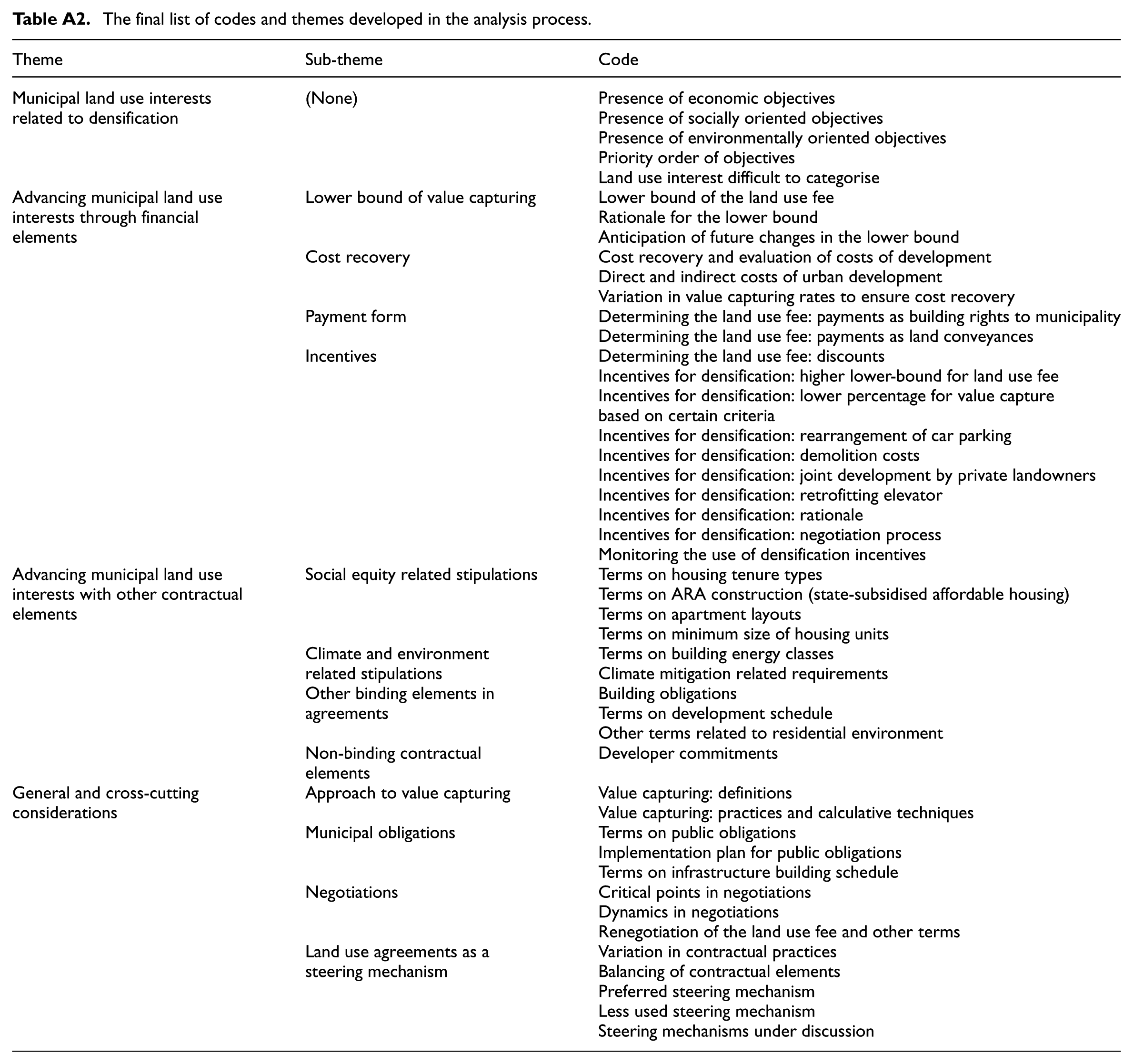
The research materials were analysed following an abductive research logic (van Hulst and Visser, 2025). First, based on theory, a tentative coding structure covering both the municipal interest perspective and common contractual elements in the case of urban development (e.g. financial compensation, sanctions, stipulations, monitoring mechanisms) was formed. We then identified the parts of research materials related to the municipal interests to densify and contracting practices relevant from a trade-offing perspective. The coding structure was further developed based on these data segments. The final codes (Appendix Table A2) were organised under four broader topics: Municipal land use interests related to densification; Advancing municipal land use interests through financial elements; Advancing municipal land use interests with other contractual elements; General and cross-cutting considerations. As we are looking for generic patterns in municipal land use interests and contracting practices, we do not refer to municipalities by their name in results.
Densification-related municipal land use interests
Densification is a clear policy objective for all municipalities in our sample. We identified a total of 11 densification-related municipal land use interests that fall under four categories: Municipal cost effectiveness, Local economy, Climate and Environment, and Social equity (Table 1).
The densification-related municipal land use interests.

Interests in boldface were mentioned by at least five municipalities.
Technical infrastructure savings were brought up in most interviews. Indeed, directing new development within the existing city structure (often) results in direct savings as there are lower infrastructure building costs. Some officials indicated the municipality has reliable estimates of the infrastructure building costs in the case of densification and greenfield development, respectively. Others, however, specified that direct savings achieved with densification are highly location and case dependent. Several officials furthermore stressed that with higher residential density, maintaining a cost-effective municipal service structure is easier as people are closer to the services and more likely to use them. Their view was that indirect savings that accumulate over time from cost-effective services substantially stabilise municipal finances.
The officials brought up another economic argument in favour of densification, namely that higher density creates benefits to local economy. First, many of them noted that by densifying the city structure, the aim is to sustain a critical mass of people for lively urban environment and local business prospects. The densification of areas close to city centre was particularly motived by this. Second, some officials stressed that densification projects have positive implications for property value development in the area. They argued that as land value increases generated by densification benefit developers, landowners, and municipal residents, it is in municipality’s interest to advance such development.
Many officials noted that compact city structure improves accessibility to public transport and decreases car dependency. They particularly argued that a compact city structure is a prerequisite for functional and effective public transport and stressed the potential for CO2 emission reduction compared to private vehicles. Some officials stressed the existence of a broader, ambitious municipal climate agenda and the importance of densifying land use decisions in reducing greenhouse gas emissions on a municipal level. In addition, a few mentioned resource efficiency and/or the pressure to preserve urban green areas as reasons to densify.
Although the officials emphasised the economic and environmental land use interests, some did highlight the role of densification in advancing social objectives. First, a few noted that densification can be a preventive measure for negative residential segregation and for within-municipality spatial inequalities. In these municipalities, the goal was to increase the supply of specific type of housing, particularly owner-occupied housing, by densifying the existing residential areas. Second, one official brought up that the municipality seeks to balance the demographics and housing structure of residential areas developed some decades ago by increasing the supply of smaller housing units via densification. Finally, one official emphasised that densifying development is needed to address the housing shortage and to curb the rise in housing costs.
Contracting practices used for advancing municipal land use interests
The sample municipalities have widely adopted value capture contracting practices meant to advance certain land use interests. We divide the practices under two categories: practices related to financial elements of contracts, and practices related to other contractual elements. The identified practices and the objective(s) advanced by them are listed in Table 2. We also assessed the prevalence of each practice based on the collected data; however, the prevalence figures should be viewed as indicative due to the data collection method, and the constantly changing policy practices at municipal level.
The value capture contracting practices used for advancing certain land use interests.
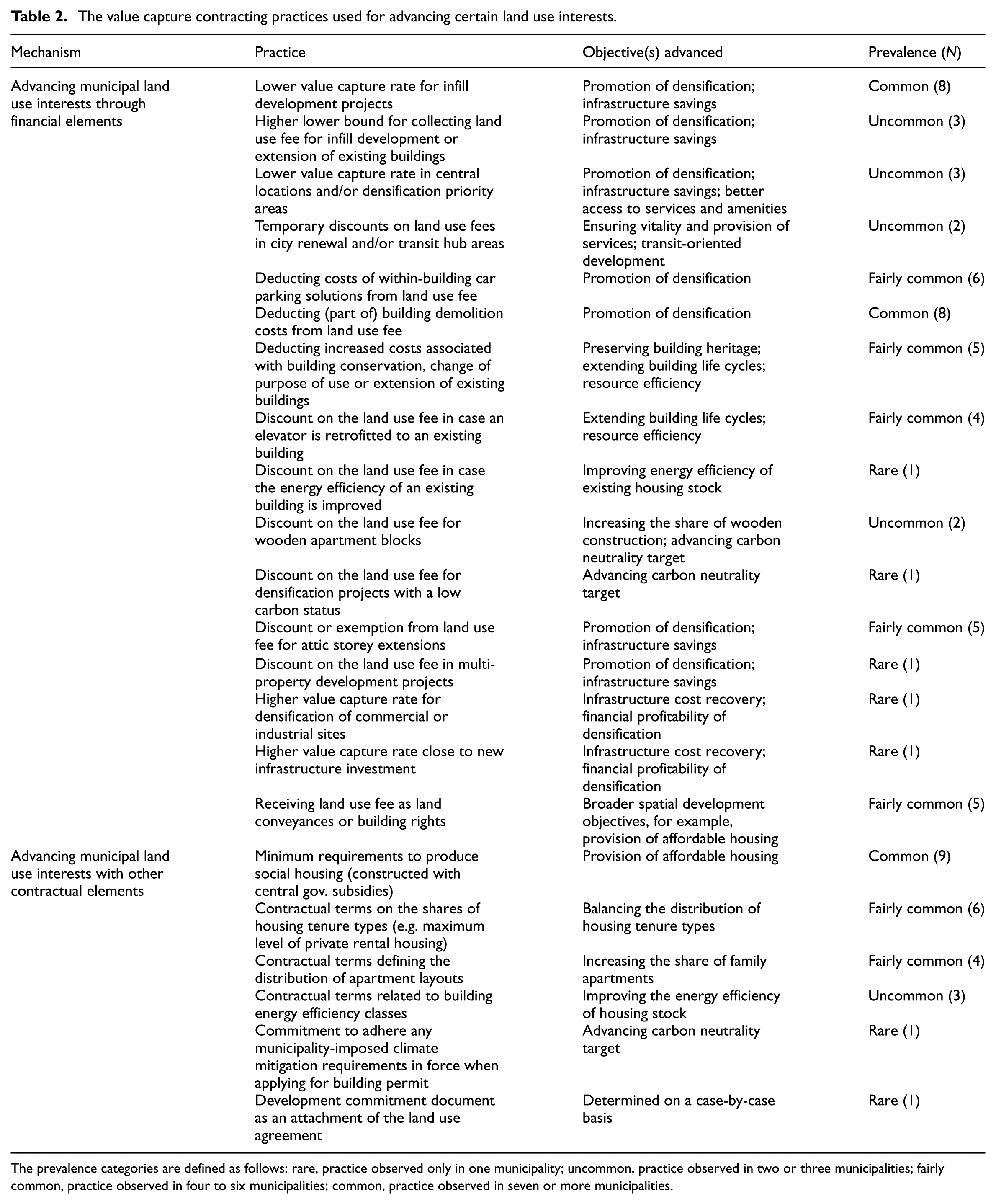
The prevalence categories are defined as follows: rare, practice observed only in one municipality; uncommon, practice observed in two or three municipalities; fairly common, practice observed in four to six municipalities; common, practice observed in seven or more municipalities.
Advancing municipal land use interests through financial elements
The financial compensation paid by a landowner to the municipality (land use fee) is a key component in land use agreements. Although legislation frames land use agreements primarily as a cost recovery mechanism, in practice the agreements are value capture instruments, and the fee is determined based on the estimated value increase generated by the land use plan. The ‘default’ value capturing rates are outlined in land policy agendas. The sample municipalities’ value capturing rates vary between 30 and 60%. The interviews confirm these rates are consistently applied in practice. The officials also stressed that the municipality avoids financially unprofitable land use agreements (agreements for which the estimated costs of development exceed the land use fee). Comparing the cost estimates with value increase estimates is common practice among the municipalities.
Many municipalities apply a lower rate of value capture in the case of infill development. Some municipalities have also set a higher lower bound for collecting land use fee for infill development projects (e.g. a fee is collected only if the value increment exceeds 100,000 euros). The officials noted that such incentives are meant to encourage densifying development and to generate infrastructure savings to municipality. Some municipalities apply a lower value capture rate for certain geographical areas, such as those close to the city centre. A few municipalities have used more spatially explicit incentives by defining temporary discounts on land use fees in city renewal and rail transport hub areas. This way, they seek to increase residential density to ensure better access to services and amenities, particularly access to public transportation.
Some municipalities want to encourage ‘soft densification’ that does not alter the prevailing urban form radically by giving a discount or a full exemption of the land use fee when new housing units locate inside an existing building (e.g. attic flats). In one municipality, multi-landowner driven densification projects are promoted through a discount for projects in which several landowners collectively initiate densifying development to their real property units.
Several municipalities deduct (part of) the costs of within-building parking costs from the land use fee. The officials noted this deduction can be substantial, up to 30% of the land use fee. Many furthermore noted that especially in areas with moderate land value increases, this incentive is a critical element of negotiations. Another broadly applied practice is to deduct (part of) the building demolition costs from the land use fee. Several officials stressed that by principle, the landowner pays the demolition costs, but that a deduction can be made to the land use fee if there is pressure to densify certain area, and the plan implementation requires demolishing existing buildings.
By contrast, many municipalities incentivise building preservation by deducting increased costs associated with building conservation, change of purpose of use or extension of existing buildings. Other practices incentivising the extension of a building’s life cycle include discounts on the land use fee if an elevator is retrofitted to an existing building, and in cases where the energy efficiency of an existing building is improved. Moreover, one municipality has outlined in its land policy agenda that they grant a discount on the land use fee if the densification project has a low carbon status. Some municipalities have decided that they will grant a discount on the fee for wooden apartment blocks. The above practices can be connected to the broader municipal climate agenda, particularly resource efficiency and carbon neutrality targets.
We identify three non-incentive-based practices. One municipality has applied a higher value capture rate for densification of commercial or industrial sites, and another one close to new infrastructure investment. The officials noted that these practices have been motivated by infrastructure cost recovery. Several municipalities prefer to receive land use fees as land conveyances or building rights instead of monetary payments. Public land banking of this kind is seen to support the municipality in advancing its broader spatial development objectives as the received land can be later assigned to developers via public land allocations or be used for delivering land use outcomes with a public service function (e.g. parks or schools). The officials particularly stressed that social equity objectives, such as the production of state-subsidised affordable housing, are easier for the municipality to advance through public land allocations than with land use agreement terms.
Advancing municipal land use interests with other contractual elements
Municipalities regularly set minimum requirements to produce social housing constructed with central government subsidies. The officials noted that since the introduction of MAL agreements and their housing targets, the use of this stipulation has become such an established practice in the largest city-regions that the contracting parties expect such terms will be included in land use agreements of larger-scale densification projects (i.e. projects exceeding a floor area of 10,000 square metres). Municipalities also include terms on the shares of other housing tenure types, particularly regarding the maximum share of private rental housing. Some officials noted the municipality includes terms and conditions related to housing tenure type to steer the ‘micro-level’ (i.e. building block level) land use outcomes and, ultimately, to produce socially mixed residential areas. Others, by contrast, connected the inclusion of such terms to the municipality’s strong commitment to the MAL agreement. Some officials stressed that the trade-off between social equity related land use interests and financial interests is explicit when the land use fee is determined based on the land value increase. In some municipalities, the order of the trade-off has been assessed by calculating the hypothetical differences in collected land use fees for agreements with and without social housing related contractual terms. However, performing such calculations is not common among the sample municipalities, nor are the calculations disclosed for the public.
Some municipalities go beyond housing tenure type steering and include contractual terms that define the distribution of apartment layouts. This practice is motivated by concern regarding the growing amount of studio apartments and ensuring a sufficient supply of family-size apartments. Although this kind of steering was generally viewed as necessary, views on the policy implementation differed. Several officials accentuated the flexibility of land use agreements and the possibility to negotiate the terms and conditions based on the current situation and to be more responsive to changes in urban residents’ housing needs. Others in contrast strongly viewed this kind of steering should only be imposed through land use plans, not via land use agreements.
Some municipalities have utilised land use agreement terms on the minimum criteria for building energy classes. Moreover, one municipality has established a practice of imposing climate change mitigation related requirements in a separate policy document. These requirements evolve over time, and the contracting parties commit to adhering to them even if the requirements were imposed after the contract was signed. In some municipalities, there has been discussions on including stricter conditions for resource efficiency and/or carbon emission levels in the new building stock. The officials were, however, wary about municipalities’ ability to advance several ambitious sustainability objectives through contracting, or more generally, through land policy interventions. Particularly in municipalities where land value increases are expected to be moderate, there are concerns about whether environmental and social objectives can be advanced simultaneously.
Finally, one municipality had attached a so-called development commitment document to its land use agreements within a specific project area that was intended as a pioneering site for sustainable development. Although this commitment is not binding in the same way as contractual stipulations, its aim is to steer development in this area in a pioneering direction in the domains of resource-wise construction, innovative and low-emission energy solutions, and new digital services and applications.
Concluding discussion
Municipalities have a central role in governing densification outcomes. However, the municipal land use interests related to densification are heterogeneous and potentially conflicting in nature. As the implementation of densification is conditional to a common surplus of the negotiating parties, municipalities must often choose their priorities when formulating and implementing land market interventions, including value capturing strategies, in densifying cities. Understanding the municipal interests in densifying and how they use value capture contracting to trade-off economic value of density for particular interests has been the focus of this article.
The article makes two distinctive contributions to debates in the densification literature. First, we extend understanding of municipalities as strategic yet somewhat complex actors of densification. Our research adds to the body of evidence of the municipal interests and motives for densification (Berghauser Pont et al., 2021; Haupt et al., 2020) and provides insights on how municipalities strategically apply policy instruments to negotiate the sustainability trade-offs of densification (Debrunner and Kaufmann, 2023). We found that municipalities motivate densification for various reasons, but particularly stress the cost efficiencies and benefits to the local economy. Indeed, these interests reflect in the contracting practices: Municipalities widely apply economic incentives meant to promote densification as a development alternative by reducing the marginal cost of development for the landowner. Such incentives form a relatively large share of the identified contracting practices (Table 2), suggesting that municipalities’ financial interests have a major role in negotiating the trade-offs of densification.
However, using incentives to promote densification is not the full story of how municipalities advance their land use interests through value capture contracting. Our analysis showed that municipalities have clear aspirations to trade-off economic value of density to advance objectives such as housing affordability, resource efficiency, and carbon neutrality. Trade-offing monetary gains for affordable housing provision appears to be the most intentional practice. This observation can be connected to Finnish municipalities high commitment to affordable housing production volumes determined in the MAL agreements signed with the central government (Krigsholm, 2024; Rosengren et al., 2024). Moreover, the findings hint that many municipalities are more concerned about the costs of including contractual terms that advance environmental objectives than of those that advance social objectives like housing affordability. On the one hand this finding contrasts with studies arguing the social equity dimension is often de-emphasised in the land use and planning practice at the local level (Loh and Kim, 2021) and in the context of densification in particular (Cavicchia, 2021). On the other hand, it reflects the Finnish context in which housing policies are highly localised and municipalities actively steer the local housing market (Sutela, 2024).
While the municipal officials clearly articulated the municipality is seeking for cost-effective land use solutions via densification, they wanted to stress that compact structure is the preferred option from the environmental perspective as well. Thus, similarly to Puustinen et al. (2025), we observe that municipalities frame densification as climate objective in itself. The results furthermore show that municipalities rely on incentivising rather than more coercive and binding contractual elements when aiming to advance environmental objectives. Similar observations about the favouring of non-binding policy means in the case of environmental objectives have been made across policy sectors (Widmer, 2018). From the prioritisation perspective, the non-use of binding elements to direct the environmental effects of densification can be interpreted as a signal of ‘lower priority’ compared to other land use interests. However, before drawing such a conclusion, it would be necessary to broaden the analysis to cover the other parallel means of governing the densification outcomes (in the Finnish context, especially the local detailed plan).
Second, our research advances conceptualisation of the trade-offing mechanisms embedded in governance processes of densification. We found that in the case of value capture contracting, the trade-offing mobilises both in determining the land use fee collected by the municipality, and in determining other contractual elements (stipulations, in particular). Many of the trade-offs are explicit: for example, by including stipulations such as minimum requirements to produce social housing in the contracts, the municipality collects a lower land use fee due to less land value appreciation. Sometimes, however, the trade-offing is more implicit and the decisions about the priority order of land use interests are made when choosing not to proceed with a certain plan. Many of the officials stressed how the municipality is highly reluctant to advance plans and sign land use agreements that would be financially unprofitable for them. To assess how well such principle advances the public interest, it would be necessary to understand what kind of – and how much – public value the ‘unprofitable’ plan would generate. Based on our analysis, however, municipalities do not perform such assessments systematically.
Our results suggest a rather high level of municipal self-regulation in trade-offing monetary gains for other gains that serve the public interest. We do note, however, that the extensive freedom of contracting enjoyed by municipalities in Finland may entail some transparency and legitimacy challenges, such as a lack of citizen participation (Mäntysalo and Saglie, 2010; Mäntysalo et al., 2011; Nappi-Choulet, 2006). Overall, our analysis suggests that information guiding the trade-offing decisions is often not disclosed for the public – not even in the case of explicit trade-offs. This finding is in line with prior research that has criticised the calculative techniques of land value capturing for a lack of transparency (e.g. McAllister, 2017; Shih and Chiang, 2024). The transparency and input legitimacy related questions should be scrutinised more closely in the future, especially if the role of contracting in determining the priority order of municipal land use interests grows.
Finally, we note that while value capture contracting allows the municipality to advance certain land use interests at the level of individual plans, the ‘optimality’ of trade-offing decisions should be considered at a broader spatial scale and in light of the local – and city-regional – policies, including anti-segregation policies and climate and biodiversity policies. Without such consideration, risk exists that the negotiated interventions create unintentional consequences, such as amplifying segregation development (Rosengren et al., 2024) or increasing the loss and fragmentation of urban green space (Haaland and van Den Bosch, 2015).
Footnotes
Appendix 1
The final list of codes and themes developed in the analysis process.
| Theme | Sub-theme | Code |
|---|---|---|
| Municipal land use interests related to densification | (None) | Presence of economic objectives |
| Presence of socially oriented objectives | ||
| Presence of environmentally oriented objectives | ||
| Priority order of objectives | ||
| Land use interest difficult to categorise | ||
| Advancing municipal land use interests through financial elements | Lower bound of value capturing | Lower bound of the land use fee |
| Rationale for the lower bound | ||
| Anticipation of future changes in the lower bound | ||
| Cost recovery | Cost recovery and evaluation of costs of development | |
| Direct and indirect costs of urban development | ||
| Variation in value capturing rates to ensure cost recovery | ||
| Payment form | Determining the land use fee: payments as building rights to municipality | |
| Determining the land use fee: payments as land conveyances | ||
| Incentives | Determining the land use fee: discounts | |
| Incentives for densification: higher lower-bound for land use fee | ||
| Incentives for densification: lower percentage for value capture based on certain criteria | ||
| Incentives for densification: rearrangement of car parking | ||
| Incentives for densification: demolition costs | ||
| Incentives for densification: joint development by private landowners | ||
| Incentives for densification: retrofitting elevator | ||
| Incentives for densification: rationale | ||
| Incentives for densification: negotiation process | ||
| Monitoring the use of densification incentives | ||
| Advancing municipal land use interests with other contractual elements | Social equity related stipulations | Terms on housing tenure types |
| Terms on ARA construction (state-subsidised affordable housing) | ||
| Terms on apartment layouts | ||
| Terms on minimum size of housing units | ||
| Climate and environment related stipulations | Terms on building energy classes | |
| Climate mitigation related requirements | ||
| Other binding elements in agreements | Building obligations | |
| Terms on development schedule | ||
| Other terms related to residential environment | ||
| Non-binding contractual elements | Developer commitments | |
| General and cross-cutting considerations | Approach to value capturing | Value capturing: definitions |
| Value capturing: practices and calculative techniques | ||
| Municipal obligations | Terms on public obligations | |
| Implementation plan for public obligations | ||
| Terms on infrastructure building schedule | ||
| Negotiations | Critical points in negotiations | |
| Dynamics in negotiations | ||
| Renegotiation of the land use fee and other terms | ||
| Land use agreements as a steering mechanism | Variation in contractual practices | |
| Balancing of contractual elements | ||
| Preferred steering mechanism | ||
| Less used steering mechanism | ||
| Steering mechanisms under discussion |
Acknowledgements
The authors wish to thank the editors of the special issue and the anonymous reviewers for their thoughtful comments and feedback that helped to improve the quality of our contribution. We furthermore thank Tea Lönnroth and Hanna Kuivalainen for their help with data collection.

Funding
The author(s) disclosed receipt of the following financial support for the research, authorship, and/or publication of this article: This work was supported by the Finnish Strategic Research Council at the Academy of Finland, under Grant nos 327800 and 352450; and Government’s analysis, assessment, and research activities, under Grant nos VN/14565/2019 and VN/340083/2022.
Declaration of conflicting interests
The author(s) declared no potential conflicts of interest with respect to the research, authorship, and/or publication of this article.