




Abstract
This article elaborates on the shared experience of displacement pressure expressed by low-income residents in the Modernist multi-storey area of Frölunda, built in the post-war decades as part of the Swedish Social Democratic ‘The People’s Home’ project. As Sweden’s second city, Gothenburg plans to grow ‘from the inside and out’ in the coming decades. Areas like Frölunda, located between the city centre and the outskirts, have been targeted for ‘densification’ that will be achieved by both renovation and infill development projects in line with the city’s ‘compact city’ planning ideals. In this context, the concepts of class architecture, territorial stigmatisation and lived space are invoked to argue that, in post-war Modernist areas, ‘social mix’/‘mixed city’ visions can be used to conceal ambitions of gentrification, and that inequality is naturalised when low-income residents are excluded from future visions. Furthermore, with reference to the reoccurring photographs of beautiful skies behind multi-storey façades in the local Facebook group in Frölunda, the article argues that more knowledge of people’s everyday life in this type of area is called for.
Introduction
In the local Facebook group ‘Västra Frölunda’, posts where members share pictures of beautiful skies reoccur; sunrises and sunsets, full moons, rainbows and thunderclouds, encompassing the façades of the neighbourhood’s multi-storey buildings in the foreground. Many local people like and comment on these photographs (Figure 1). Like similar post-war areas in Europe, Frölunda was built outside Gothenburg’s city centre to meet the housing demands of the workers of the expanding local industries (Grundström and Molina, 2016). In Sweden, public housing is universal and available for all residents (Grander, 2017), but Frölunda was primarily planned to offer working-class families decent and affordable housing. Like many other contemporaneous Modernist areas, Frölunda is characterised by sparsely distributed tower and slab blocks, grouped in enclaves with similar construction and design properties. Today, it can be challenging to discern the original planning ideal from the outside. For example, in 2022, Gothenburg’s City Architect made the following claim about Frölunda in Götepod, the municipality’s podcast that discusses urban development: ‘You can imagine that Frölunda does better as a model where architects in polo shirts stand and look at it from above than when you walk down among the houses’ (Gbg Muni, 2022a). In the dominant ‘mixed city’ (blandstad) planning discourse in Sweden, Modernist multi-storey areas are viewed as ‘anti-city’ (Tunström, 2007: 993), while, in popular discourse, such areas are represented as ‘criminal’, ‘in decay’ and ‘non-Swedish’ (Thapar-Björkert et al., 2019). However, the reason why a whole episode of the podcast was devoted to Frölunda was that the municipality has identified the area as a ‘central redevelopment area’, a ‘strategic node’ and the ‘object of major densification’ (Gbg Muni, 2014, 2022b). Compared to similar post-war areas, Frölunda is located closer to the city centre. It was previously classified as a suburb but is now being redefined as part of ‘the semi-central city’ (mellanstaden). In this article, I argue that in Gothenburg’s ongoing expansion through densification, the municipality’s focus on the (white) middle class and its lack of planning for housing diverse, low-income populations has become apparent, and, moreover, that in Frölunda, the original Modernist planning plays a part in this process.
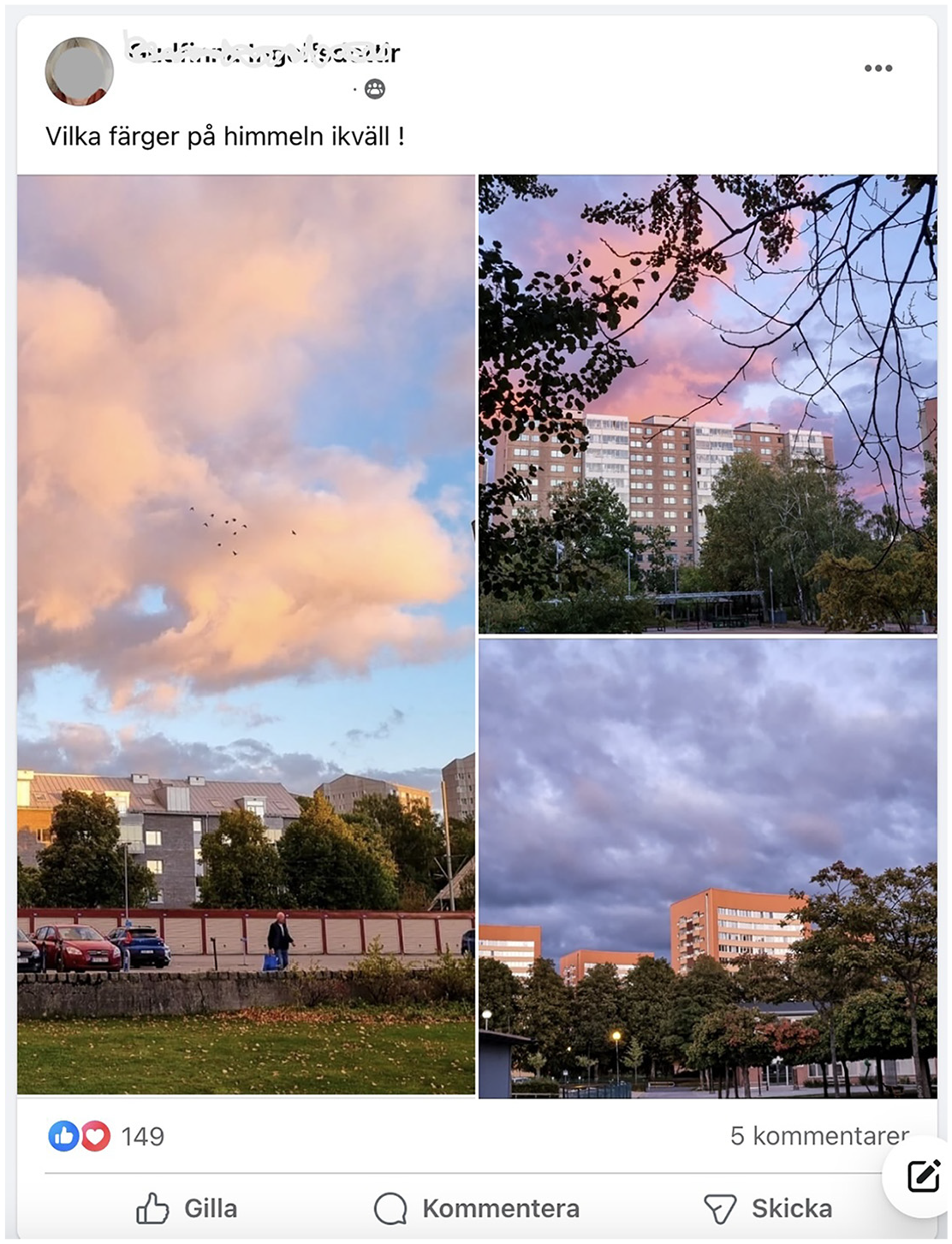
Post from the local Facebook group Västra Frölunda – ‘Such colours in the sky tonight!’ Published with consent from the author/photographer.
Most of Frölunda was built during the post-war ‘record years’, southwest of the city centre and not far from the sea. The area’s construction was part of the final phase of the Social Democratic project ‘The People’s Home’, a metaphor for an equal society with a general social welfare system. 1 However, the area is discursively identified as part of ‘The Million Programme’, a building programme the Swedish government followed to produce a million new homes between 1965 and 1975 (Grundström and Molina, 2016). The location, architectural designs, planning and socio-economic profile of Frölunda correspond with this. During the economic recession of the 1970s, several new Modernist areas suffered from out-migration, leading to a series of disinvestments and stigmatisation. In 2017, 26% of the residents of the estates around Frölunda Square were classified as ‘income poor’ (compared to 17% in Gothenburg), 46% of residents were born in another country (31% in Gothenburg), 19% had attended higher education (30% in Gothenburg) and 12% were unemployed or received social benefits (7% in Gothenburg). 2 Today, this part of Frölunda has been targeted in the municipality’s mission statement to ensure that no areas in Gothenburg remain on the Swedish Police Authority’s list of ‘especially vulnerable areas’ (särskilt utsatta områden) in 2030 or ‘vulnerable areas’ (utsatta områden) in 2035 (Framtiden, 2020). 3
Unlike 50 years ago, Gothenburg is planned to grow ‘from the inside out’ by densifying ‘the semi-central city’, areas located between the city centre and its outskirts (Gbg Muni, 2014: 8). The newly built units around Frölunda Square are either homeowner associations or expensive public housing units. In her analysis of Gothenburg municipality’s project Equal Gothenburg (Jämlikt Göteborg), produced within the same overarching research project as this article, Thörn (2023: 96) concludes that the primary aim of Gothenburg’s Expansion Strategy is to enable high-income households to move to or remain in the city. My own findings support this claim. I invoke the concept of class architecture (Thoburn, 2018) to elaborate on how the double territorial stigmatisation (Wacquant, 2007) inherent to Modernist multi-storey areas – in both planning discourse and popular discourse – affects the way in which densification is achieved and how low-income residents experience it. In Figure 2, the original planning and the proposed infills are visualised.
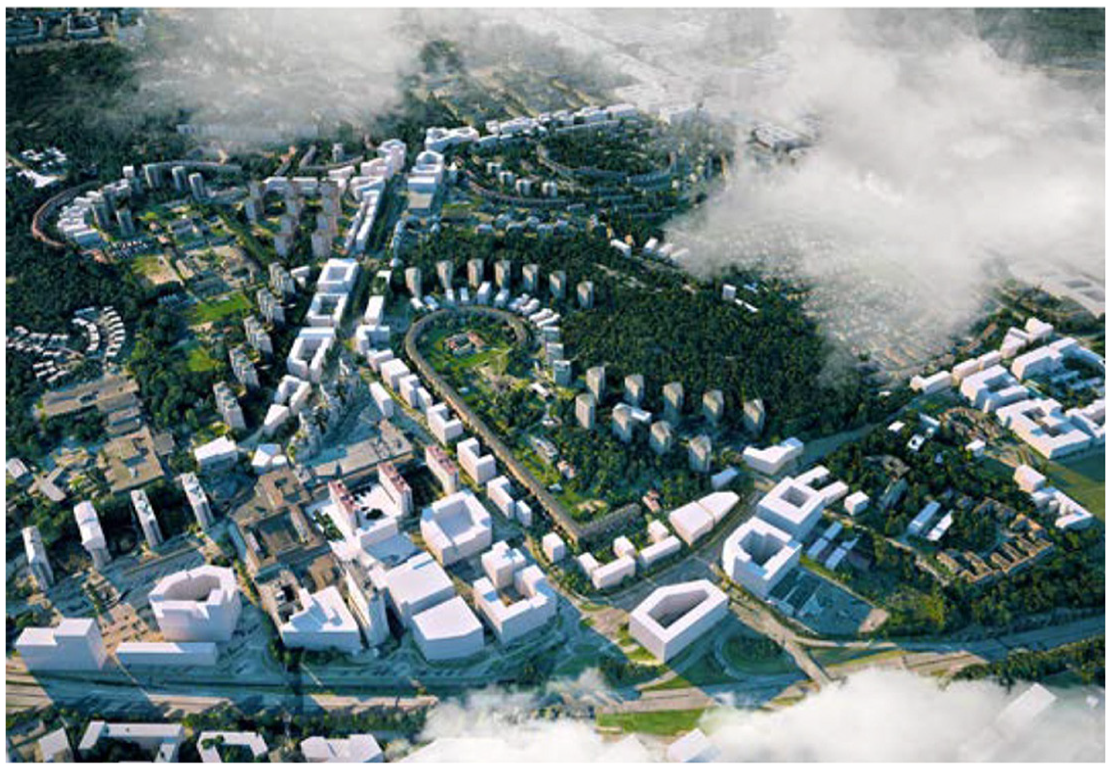
Rendering image and visualisation from the front page of ‘Program for Frölunda’ (Gbg Muni, 2014). White blocks and buildings are proposed infills.
I suggest that the numerous photographs of colourful skies that frame the multi-storey façades on the neighbourhood’s Facebook page provide us with glimpses of Frölunda as a lived space (Lefebvre, 1991 [1974]) and what the original planning means to many of the area’s residents. In an article on Christmas lights in a working-class estate in Croydon, London, Back (2015) asks the reader to pay attention to how liveable lives are made in an unequal city. He argues that we must understand society not just as ‘a set of structural arrangements but as a moving and dynamic entity that has rhythm and temporality’ (Back, 2015: 820). This observation inspired my decision to employ ethnographic methods in my research.
Previous research on the social effects of densification
Historically, dense cities have, one the one hand, been understood as a problem of overcrowding, poverty and public health – in England in the 19th century (Engels, 1971 [1844]) and in Sweden in the early 20th century (Grundström and Molina, 2016: 320). On the other hand, high density has also been presented as an ideal, for example in Le Corbusier’s multi-storey urbanism and Jane Jacob’s vision of vibrant city life (Kjærås, 2024; McFarlane, 2016). Since the 1960s, ‘the compact city’ has become the primary planning strategy worldwide and synonymous with ‘the sustainable city’. The compact city has come to represent the solution to several urban problems, including land consumption in urban outskirts, energy and resource waste, air pollution, car dependency and social segregation (Neuman, 2005: 17).
Since the 1990s, critical research has shed light on the undesired social effects of compact city planning. In her literature review, Debrunner (2024: 4) identifies social exclusion caused by increased housing prices and rents because of renovations as the main argument against the compact city (see also Burton, 2000; Daneshpour and Shakibamanesh, 2011). However, contrary to what one might assume, a new Swedish research report on moving patterns in relation to renovations, based on register data collected between 1995 and 2019, concludes that it is not primarily households with low socio-economic status who move (Borg, 2023). Dorling’s (2014) and Listerborn’s (2021) analyses offer clues into why this is the case. A shortage of affordable housing has become an urgent problem in many cities worldwide today, and poor households have very limited options.
Internationally, densification through renovation and infill programmes is often legitimised in policies that promote ‘social mixing’ (Lees, 2008). While ‘compact city’ planning has been conceptualised as ‘urban renaissance’ in the UK and as ‘new urbanism’ in the USA, in Sweden such initiatives are predominantly promoted by means of two complementary concepts, namely ‘the mixed city’ (blandstaden) and ‘the city of blocks’ (kvartersstaden). ‘The mixed city’ refers to a mix of housing (rental and self-owned), small-scale retail units, services, workplaces, cultural centres and small parks. ‘The city of blocks’ refers to the grid structure of the traditional city and invokes an ideal (often nostalgic) of a local community (Tunström, 2007). Recent critical research on the Swedish context has focused on how new dense areas are produced (e.g. Baeten, 2012; Thörn and Holgersson, 2016) and how post-war multi-storey areas are being upgraded through renovation and infill programmes (Baeten et al., 2017; Polanska and Richard, 2019; Zalar and Pries, 2022).
Methodological considerations
This article was written within the overarching research project entitled ‘For whom is the city built? A study of goal conflicts, migration patterns and living conditions in the densified city’, funded by the Swedish research council Formas. My sub-study focused on the living conditions in upgrading areas in Gothenburg. In the present article, I draw on previous ethnographic research on experiences of gentrification among low-income populations (e.g. Jackson, 2019; Lees and Hubbard, 2021; Paton, 2014; Polanska and Richard, 2019). The fieldwork was conducted from 2019 to 2021, during which time I interviewed 30 people in two ‘semi-central city’ an area. During the fieldwork, I spent a great deal of time in these areas and established contact with local actors. I recruited participants in Frölunda by putting up posters at the cultural centre, distributing flyers in a large public housing estate with help from the tenant’s organisation and making observations at a daycare centre. It transpired that the daycare centre was under threat of demolition as a result of the densification scheme.
Of the people I encountered in Frölunda, I selected 15 people concerned about rent increases due to the upgrades being made in their area. Most of the interviews were conducted in group rooms at the cultural centre; one took place in a participant’s kitchen, one during a walk (cf. Holgersson, 2017), one on a Zoom call and two in the daycare centre’s garden. The participants possessed first-hand contracts in public housing estates or in a former public housing estate. 4 They were between 25 and 80 years old. Seven participants lived alone; four identified as men an eleven as women. Six participants were born outside of Sweden or had parents who were. For the sake of anonymity, the participants have been assigned fictitious names. Berit is a retired secretary, Darya an assistant nurse, Lars a civil servant, Carina a nurse, Merel a student, Pedram a native language teacher, Shirin a retired native language teacher, Annika a communication consultant and Marita a teacher who now works as a shop assistant. Almira, Halima and Angelika were on parental leave at the time of their interviews. Bengt is a bus driver, Krister a delivery man and Helen a nurse. For the purpose of this study, I refer to several municipal planning documents regarding Frölunda, primarily Gothenburg’s Comprehensive Plan (Gbg Muni, 2022a), the Municipal Expansion Strategy (Gbg Muni, 2014), the Planning Programme for Frölunda (Gbg Muni, 2021), the Plan Description for a new area next to Frölunda Square (Gbg Muni, 2022b), the Municipal Budget for 2024 (Gbg Muni, 2023) and the local public housing companies’ Strategy for Development Areas 2020–2030 (Framtiden, 2020).
Theoretical framework
‘Mixed city’ planning, class and displacement pressure
I argue that ‘compact city’ planning is a phenomenon that is embedded in a neoliberal planning regime (cf. Kjærås, 2024; Pries, 2020). For example, Debrunner (2024) describes how contemporary densification is practised as a business dominated by powerful, resource-rich and technocratic actors. According to Theodore and Peck (2012: 20f), neoliberal urban planning is characterised by its state-mediated market rule, privatised and contract-based governance and a strong focus on competitiveness. Since the 1970s, Sweden has transformed from one of the world’s least unequal countries to one where inequality is increasing most rapidly. Note that during the critical periods of this ‘turn to inequality’, the Social Democratic party was in government (Therborn, 2020). Consequently, one should not view neoliberal urban planning as a break with the Social Democratic equivalent (Baeten, 2012). In his work on the introduction of social neoliberalism in urban planning in Malmö, Pries (2020) describes how the municipal bureaucracy, which used to work towards welfarist ends, was reconfigured into an entrepreneurial planning unit with the aim of increasing the city’s competitiveness and attracting ‘desirable citizens’ through the implementation of ‘mixed city’ visions.
Although Swedish ‘mixed city’ visions revolve around physical planning, they also entail ‘social mix’ ambitions, which Lees (2008: 2451) summarises as ‘moving middle-income people into low-income inner-city neighbourhoods’. The movement of people is never the other way around. Furthermore, in her often-cited critique, where she equates ‘social mixing’ with gentrification, Lees also highlights how such policies construct the middle class as a natural category and demonise the working-class (Lees, 2008: 2463f). In later studies she has added the racialising, but seldom articulated, aspects of social mixing policies (Lees and Hubbard, 2021), and so has Mele (2019) when he draws from her work: Social mix promises to deconcentrate poverty and create a level playing field in the market of real estate and social opportunity. Its advocates play down race and point toward social and cultural capital derived from middle-class newcomers and bestowed upon the remaining poor. The disadvantages tied to racialized identity and position are dismissed and usurped by a market-driven economic explanation. (Mele, 2019: 36)
Similarly, Kadıoğlu (2022: 1454) shows how the ‘yet-missing’ gentrification of Neuköln, Berlin, is blamed on migrant residents. In my analysis of ‘mixed city’ densification schemes in Gothenburg, I examine how the risk of increased ethnic/racial segregation in the city is dealt with.
In the past decades, displacement has come to be understood not just as the (re)movement of low-income residents (direct displacement) but also as the exclusion of this group from newly built or densified areas (exclusionary displacement), and in terms of displacement pressure (Marcuse, 1985). What was apparent in Frölunda was how displacement pressure not only involved the residents’ concern over increased rents. Given this, I follow Davidson (2009), who argues that we should take Lefebvre’s concept of lived space into account as we study ‘displacement without dislocation’: Put simply, it is impossible to draw the conclusion of displacement purely from the identification movement of people between locations […]. People can be displaced – unable to (re)construct place – without spatial dislocation, just as much as they can with spatial dislocation. (Davidson, 2009: 227f)
In Lefebvre’s (1991 [1974]: 38) framework, lived space refers to the space of habituated everyday routines and routes. Davidson (2009: 231) argues that calls for ‘the right to stay put’ should be complemented with ‘the right to (make) place; the right to dwell’. 5 The non-economic aspects of displacement pressure can be captured by emotional displacement, a concept that Valli (2020) develops from Bourdieu’s work on misrecognition and symbolic violence. Similarly, I conceptualise residents’ experiences of being excluded from future visions of an area as discursive displacement (Holgersson, 2014).
Territorial stigmatisation and class architecture
In his definition of the concept of territorial stigmatisation, Wacquant (2007: 68) emphasises that it does not matter to what extent negative accounts of an area are correct. What is more important is whether prejudicial beliefs of this sort have harmful consequences for residents. For example, Thoburn (2018: 612f) has argued that the transformation of the Docklands area in London to ‘profit, rent, and speculation’ is both social and aesthetic in nature. When working-class populations are displaced from the inner city, a critique of Modernist architecture is used as a justification for such action. Thoburn (2018) refers to the site of his inquiry as class architecture, not in an effort to romanticise the welfare era but to highlight the estate as materialised politics. He elaborates on this point in the following: Class architecture […] interrogates the capitalist relations that course through built form, and to which architecture is ever subjected. It does not declaim its utopian autonomy from these relations […]. Rather, it faces up to social relations, critically handling them in built form, and exposing, not hiding, its limitations and contradictions. (Thoburn, 2018: 617)
This perspective resembles how I view the slab and tower blocks in Frölunda. The Swedish People’s Home project coincided with the rise of the Modernist architectural movement, which shared the project’s utopian aspirations and break with the past (cf. Thoburn, 2018: 616). However, in contemporary ‘mixed city’ planning discourse that idealises the classical city, remote Modernist areas are positioned as wounds to be ‘healed’: That which has been built and does not adhere to the norm or the core is viewed as having ruptured the city’s physical and historical continuity. According to the discourse, this took place mainly during the period of Modernist rational planning in the decades following the Second World War and is the reason for the contemporary need for ‘city healing’. (Tunström, 2007: 693)
The municipal budget for Gothenburg 2024 states that ‘Modernist planning shall be avoided as far as possible’ (Gbg Muni, 2023: 38). Parallel to this position, I observe how, over the last 60 years, in popular discourse Modernist multi-storey areas have changed from an expression of post-war utopia to a representation of post-industrial dystopia (cf. Back, 2015: 824). In Sweden, such areas have been morphed into the racialised image of ‘the Suburb’ (Thapar-Björkert et al., 2019), which, to a large extent, resembles the French ‘banlieues’ that Wacquant (2007) discusses. Both territorial stigmatisation and class architecture must be understood in their local context.
Densification and displacement pressure in Frölunda, Gothenburg
The transformation of a modernist multi-storey area into a ‘mixed city’
On my way to Frölunda, I would often disembark from the tram one stop before Frölunda Square and walk through Positivparken, and during one period I passed a large advertising poster here that proclaimed ‘The future is here!’ The poster showed an image of a closed block with green roofs (see Figure 3). The municipality’s Comprehensive Plan (Gbg Muni, 2022b: 14) states that Gothenburg is to be developed into a ‘close, cohesive, and robust city’ and emphasises the need to build an attractive, less car-dependent city that is prepared for the effects of climate change. The plan aims to provide every resident access to suitable housing, a good living environment and an ‘easy everyday life’ (Gbg Muni, 2022b: 20). The municipality also acknowledges that ‘there is a large risk for gentrification in many of the areas that are suggested to be redeveloped and densified’ (Gbg Muni, 2022b: 14), but fails to clarify how that risk will be dealt with. In the municipality’s Programme for Frölunda (Gbg Muni, 2021: 36–37) and Plan Description for a new area next to Frölunda Square (Gbg Muni, 2022c: 79), the focus is on a ‘mixed city’ area. These documents contain no stigmatising descriptions of present-day Frölunda. However, the absence of references to the original Modernist planning as something worth building upon is telling. Furthermore, none of these municipal planning documents address issues of housing inequality, displacement and increased ethnic/racial segregation in the sections reserved for discussion of social consequences.
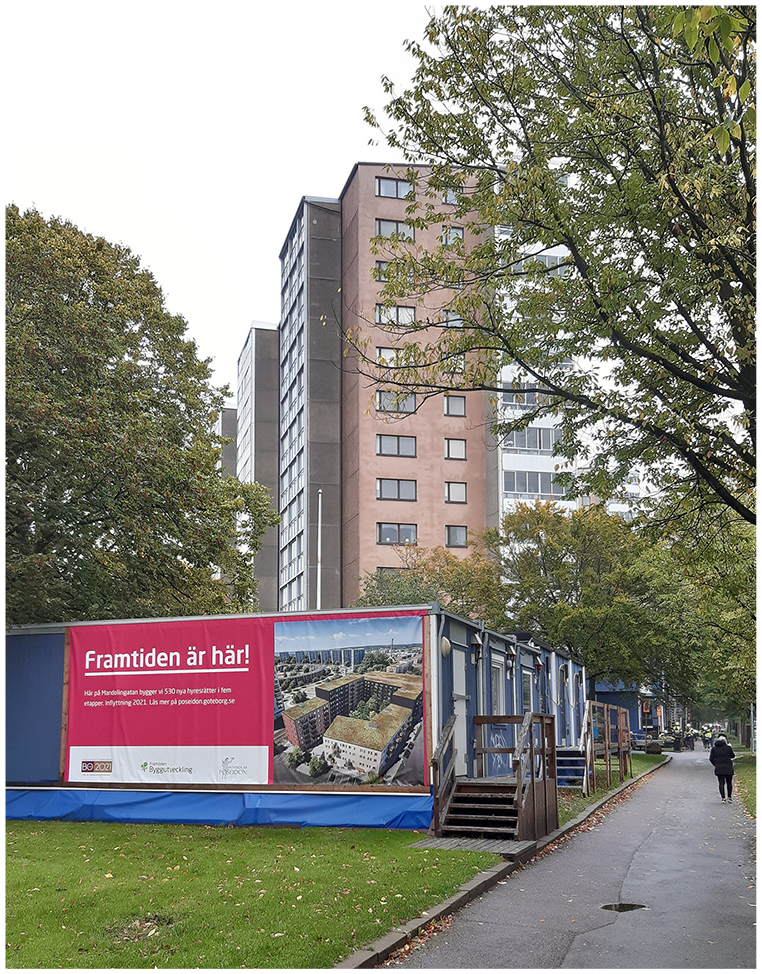
Walking through Frölunda. Photography by Johan Järlehed.
The ‘mixed city’ inspired upgrading of Frölunda comprises two general municipal aims. First, the municipality wishes to attract more affluent residents to Gothenburg, and second, it aims to counteract segregation and enable integration. I claim that the political subject in both of these aims is a (white) middle-class resident who is presumed to prefer an urbanity that correlates with the Swedish ‘mixed city’ planning discourse (Tunström, 2007). According to the municipal Expansion Plan, the city will have approximately 750,000 residents by 2035, an increase of 150,000 from 2023. The ‘semi-central city’ is described as ‘a larder’ of places and areas with the potential for densification (Gbg Muni, 2014: 12) and in the Comprehensive Plan, it is stated that in order to enable local businesses to recruit qualified labour, the city needs to offer ‘a rich range of experiences, culture and safe living environments’ (Gbg Muni, 2022b: 336).
The ‘mixed city’ is consistently represented as an equivalent to ‘the urban’ (stad) in the planning documents I analysed. For example, in the municipality’s Plan Description for a new development next to Frölunda Square, it is stated that infills and new blocks should connect to the area’s history and identity (Gbg Muni, 2022c: 11). However, later in the same document, the new area is described in the following way: ‘The additional buildings differ from the existing ones in that it consists of blocks that vary in height’ and ‘[t]he transformation is a new approach in the area, desirable to create increased urbanity’ (Gbg Muni, 2022c: 85, emphasis mine). In the municipality’s Expansion Strategy, the motivation behind the densification of ‘the semi-central city’ is stated as to create ‘more places with urban qualities’ and ‘a more local urban life’ (Gbg Muni, 2021: 11, 18, emphasis mine). I suggest that these statements express not just a physical planning ideal but also, implicitly, a desired social environment in terms of both class and race/ethnicity (cf. Lees, 2008; Mele, 2019).
Another aim of the densification of the ‘the semi-central city’ is to ‘turn segregation into integration’, as stated in the municipality’s Expansion Strategy (Gbg Muni, 2021: 8). A goal for Swedish ‘mixed city’ visions is typically expressed in terms of changing ‘the socio-economic character’ of an area, thus avoiding explicit reference to the ethnic/racial composition (e.g. Gbg Muni, 2023: 40). However, when integration is mentioned as part of the aim, I argue that it is brought to the surface. The fact that the estates around Frölunda Square have been targeted in the public housing company’s Strategy for Local Development Areas (Framtiden, 2020) reveals that the present area is still understood as part of a stigmatised ‘Suburb’. In the Strategy for Local Development Areas, one can read how specific measures, including ‘redevelopment’, ‘densification’, ‘vibrant ground floors’ and ‘improved architectural designs’, will be implemented to improve integration in the listed areas (Framtiden, 2020: 40). As Mele (2019: 36) points out, for the local state, social mixing schemes solve ‘the twin problem of poor design and concentrated poverty’.
An appreciated lived space without a positive narrative
I interpret Gothenburg’s City Architect’s claim that Frölunda makes the most sense as a model, viewed from above by architects, as an illustration of how incomprehensible everyday life in a Modernist multi-storey suburb can appear to people who do not have experience of living or spending time in such urban environments. Representations of local conviviality – defined in terms of unremarkable, everyday multicultural encounters (Gilroy, 2006) – are rare. Instead, stigmatising images of the suburb are reproduced (Grundström and Molina, 2016; Thapar-Björkert et al., 2019). In his discussion of class architecture, Thoburn (2018: 619) underlines how critique of ‘concrete monstrosity’ often disguises and disavowals class contempt. In the Swedish context, one can add an element of racism to this observation. In popular discourse in Sweden, the Modernist multi-storey suburb is inevitably associated with the presence of ‘immigrants’. I claim that this connection also appears in the municipality’s planning discourse, albeit less explicitly.
Against this background, note how the participants in Frölunda mention important qualities in their living environment in a manner that echoed other interviewees who live in similar areas (e.g. Mack, 2021; Polanska and Richard, 2019; Thoburn, 2018; Zalar and Pries, 2022). For example, Darya (45 years) describes the area where she lives in the following: When I leave the kids at school in the morning I love to walk. […] And when the spring or summer comes, oh! How nice it is, it’s just green. […] On weekdays, if you take an hour to walk around [the shopping centre], then you feel like you get your powers back, and that you’re not alone.
Such accounts make no sense in relation to the stigmatising image of the criminal ‘Suburb’ or the dominant ‘mixed city’ planning ideals of a vibrant city life. In both discourses, Modernist multi-storey areas – and hence the everyday life that takes place there – are understood as the antithesis of ‘the good city’.
In the study participants’ accounts, Frölunda appears as territorially stigmatised (Wacquant, 2007). For instance, Helen (40 years) told me that her relatives worry about her living there. Merel (20 years) reported instances of her friends joking about them having to wear a bullet-proof vest when they visit her in Frölunda. Lars (65 years) described how people around him ‘thought I moved out to the slum basically’. However, most of the interview participants pointed out that these rumours were exaggerated and none of them reported that they had been the victim of a crime. Two women who were born in Frölunda claimed to have a strong emotional connection to the area: ‘It’s my village’, Annika (55 years) said, while Halima (35 years) referred to it as ‘my home’. Many of the other participants characterised Frölunda as good enough. ‘I love Linnégatan [in the central city], but that’s impossible’, Pedram (40 years) reported and laughed. However, two women who had moved to Frölunda after getting divorced felt out of place. Berit (80 years), who used to live a privileged life abroad and at one time lived in one of the wealthiest parts of the city, felt trapped in her public housing flat and in the area in general: ‘I live in the slum’, she observed. Marita (55 years) appreciated the public housing where she lived but did not feel that she belonged ‘in the concrete’. Instead, she wished she could live in a picturesque, three-storey wooden house from the early 20th century (landshövdingehus) in the nearby area of Majorna.
Many of the study participants complained about the groups of young (non-white) men who often gathered by the tram stop in the evenings. Notwithstanding this objection, most of the participants seemed to appreciate the multicultural character of the area. For example, Helen (40 years) remarked that ‘I think it’s very interesting that all social classes meet’ (cf. Gilroy, 2006). Most of the participants had moved to Frölunda after being allocated a rental flat here and they did not seem to have been looking to live in a Modernist area prior to that. Instead, they had been interested in securing affordable housing in the city’s western area. Except for Marita (55 years), the participants did not have much to say about the planning and architecture in Frölunda. However, they did mention several specific values concerning their accommodation. Besides reports of poor maintenance, the participants were satisfied with their well-planned, spacious, bright flats that comprised several rooms, a view and balconies (cf. Mack, 2021: 563). Even Marita (55 years), who resented ‘the concrete’, felt that living in Frölunda has its advantages: ‘I’ve realised that the flats in [the picturesque wooden houses in Majorna] are tiny and very dark. I live on the seventh floor’.
Densification and displacement pressure
The displacement pressure that the participants described seems to initially have been related to a renovation scheme that took place in a large public housing estate where the rents in the first building were raised by 30–47% due to non-eligible ‘standard-enhancing measures’ (Sjöland Kozlovic, 2021: 35).
6
Bengt (60 years) reported that ‘My pain threshold [for rent] is probably 7000 or 8000 [SEK]. Something like that, because I must live, too. The salary runs out’. I met him at the Frölunda Cultural Centre where I had set up a table with a poster with the following text: ‘Do you worry about rent increases?’ Upon seeing the poster, Bengt approached me hesitantly. Low-income residents are generally more dependent on their living environment than more affluent groups. Krister (60 years) remarked that ‘Since I have a rather poor income, one doesn’t just go off somewhere without further ado, one stays in the local area’. Like him, he had also stopped by my table outside the library. Many of the participants made specific comments about the value of low-density developments. For example, Lars (65 years) informed me: ‘I like open spaces […] not dense developments, as it has been in some locations recently’. He exemplified his argument by referring to a newly built ‘city of blocks’ neighbourhood in a former industrial area close to the harbour (see Thörn and Holgersson, 2016). Halima (35 years), who grew up in Frölunda, reminisced: [Back then it] was greener, there was more outdoor life. It was more like that, it was kind of big, you could play freely. Now, it’s crowded, with more flats, expensive ownership flats. They have removed all parking spaces where children … or certain places where children could play, packing all the flats together.
In the episode about Frölunda in the municipal podcast Götepod, the City Architect acknowledged how green the area is. However, he also stated that ‘people don’t experience that there is much available greenery’ and called for more ‘functional greenery’ (Gbg Muni, 2022a). As Zalar and Pries (2022: 70) show, this view aligns with views that support ‘compact city’ planning, where undefined green spaces in Modernist areas are classified as ‘empty’, ‘unused’ and without ‘design qualities’. Furthermore, such views highlight how contemporary cartographic planning tools obscure issues relevant to everyday pedestrian mobility (Zalar and Pries, 2022: 65).
In his analysis of the partial demolition of a brutalist public estate in London, Thoburn (2018: 629) concludes that for many of the residents, the source of local community existed in areas that were classified as of ‘underdetermined use’ (cf. Mack, 2021). Given this, consider Annika (55 years), who was born in Frölunda, as she describes the local environment: I love this area because there are a lot of green spaces and a lot of animals. It’s a lively place where everyone has had a place and people have been able to walk; it hasn’t been gated or anything like that. But now this area is shrinking.
The ongoing infill densification process in Frölunda is part of what makes Annika worry about not being able to remain a resident here. Her experience corresponds to what Valli (2020: 70) describes as emotional displacement. Another participant, Marita (55 years), who had ambivalent feelings about the Modernist architecture that is prevalent in Frölunda, mourned the loss of nature caused by the construction of new buildings and blocks: Now they have built at the mountain behind here, where I had a meditation tree that I went to, that I sat in, that had like five arms so you could sit in a room there. It was right behind here […]. First, they started to build close to it, and I went: ‘Please, please can’t it stay like that?’ No. Then, they built another homeowners’ association estate.
In the remarks above, Annika and Marita touch on the theme I will discuss in the following section: for whom are the new blocks built?
A municipal betrayal
A fundamental principle that informed the People’s Home project was construction ‘Allmännyttan’ (for the benefit of everyone), in this article referred to as public housing, constituted by a universal housing regime supported by Sweden’s various municipal housing companies. Initially, the system was characterised by regulations and subsidies that were aimed at protecting the housing market from speculation (Grundström and Molina, 2016: 320), but since then the public housing system has been gradually transformed. It is still ostensibly subject to fulfilling a range of social obligations, but since 2011, due to EU legislation, a public housing company must justify all of its actions financially (Grander, 2017: 340). In his analysis of this transformation, Grander (2017: 247) highlights one group of tenants that has been caught in the middle due to the new stricter rental policies – people with too low an income and too insecure employment to qualify for new-built public housing flats, but not ‘enough problems’ to be eligible for social contracts. The participants of this study belong to this group.
As was the case in the 1950s and 1960s, the current upgrading of Frölunda has been initiated, administered and executed by the municipality. However, this time, middle-class tenants are the municipality’s target group. Given this, note how Almira (30 years) described the character of the densification that has taken place in her neighbourhood: It just feels like now it has become a bit, if you say, for slightly higher price ranges, if you say so, a bit higher … the elite if you can call it that. I don’t call it ‘the elite’, but those with more means, who can afford to pay.
Apart from the loss of light, space and greenery in Frölunda, Annika (55 years) raises yet another argument against the ongoing densification programme. Many of the new blocks are homeowner associations and are thus aligned with the municipality’s focus on the ‘mixed city’ (Gbg Muni, 2022b: 387). As we walked past some of the newly built infills close to her home, she described how these new developments have changed the social dynamic of the area: I have a relative who works at a pre-school here. She had taken the children to a playground nearby, when [a resident] came and said: ‘You can’t be here, it’s our playground’. ‘But it’s open’, she said, ‘Do we have to leave with all the children?’ ‘Yes, it’s ours, it belongs to the children in our house’. It wasn’t gated, but it’s gated anyway. She had to take the poor working-class children of mixed descent and leave.
The participants generally spoke about class and referred to themselves as ‘poor people’ or ‘ordinary people’. They referred to the new residents as ‘better off’ or, like Almira, ‘the elite’. I note, however, that Annika also included race/ethnicity in her anecdote about how the character of her residential area has changed. When Angelika (30 years) and I discussed the municipality’s plan for Frölunda, she gave a slight laugh and said: ‘For rich Swedes to come here’.
Emotional displacement is an important aspect of displacement pressure, and so is the experience of not being included in future visions for one’s area, a phenomenon that I conceptualise as discursive displacement (Holgersson, 2014). When I asked Annika (55 years) about when she first realised that there was a plan to upgrade Frölunda, she responded: ‘Three or four years ago […], it was precisely then that they started talking about it, as well as using these descriptive adjectives that are beautifying’. I interpret the ‘they’ who used ‘descriptive adjectives’ as the municipality, or more specifically, instances such as the Municipal Board and the municipal committees and departments that are responsible for urban planning. However, when the participants mentioned ‘the municipality’, they most often referred to the local public housing companies. The participants reported being very puzzled and disappointed over these companies’ recent activities (cf. Polanska and Richard, 2019: 149). Many infill projects consist of expensive rental flats built as part of the municipality’s ‘mixed city’ programme. In Sweden, public housing is universal and public housing companies are tasked with providing flats in different price ranges (Grander, 2017: 335), but the current shortage of affordable housing has caused participants to question the companies’ priorities. Regarding this, Carina (50 years) observed: And one thinks that the public housing should be for the tenants, that is, for ordinary people. But I don’t know if that’s the case today. I don’t really know if that’s the case today. It doesn’t really feel that way. It feels more like they are … that they want to get rid of a certain clientele. But then you wonder, where will they live and who will be responsible for them?
Like many other participants, Carina felt that the role of public housing companies was changing. For example, she claimed that ‘It feels a bit like that, more and more, like it’s the landlord who decides and if it doesn’t suit – “But then move!”’ I interpret these remarks as if she had previously understood the housing that was provided by the municipality in terms of a right that was due to her. In February 2023, I attended a negotiation session at the Rent Tribunal, where several tenants from Frölunda voiced their opposition to the renovation project that their public landlord had proposed. At the end of the session, the judge noted that she found it worrisome that she now frequently met public housing companies in her courtroom.
Besides Berit (80 years), who stated that she would prefer to have a private landlord, the other residents who participated in my study had a very positive view of the public housing system in general. They viewed public housing as part of the welfare system in Sweden. For instance, Marita (55 years) reported: I have a safety net in Sweden, we do, and public housing was meant to be part of that safety net, you could say. And it feels like it’s being pushed aside now, too. It’s impossible to know if their point of departure is that people should be able to afford to stay here, for example. It feels like it’s a completely different spirit now, and it’s scary, you know.
In this context, a key issue is how people deal with the experience that the municipality ‘wants to get rid of a certain clientele’, as Carina (50 years) expressed above. This concern should be appreciated in the context of the historical role of the People’s Home project in Frölunda. In their work on renovation projects and their associated emotions, Polanska and Richard (2019: 150) found that tenants in Sweden express anger and anxiety rather than shame and guilt when they experience displacement pressure, and that these emotions are attributed to the specific Swedish political context.
Concluding discussion
To conclude this article, I share three reflections concerning the broader implications of this study’s findings. Firstly, in Modernist areas – stigmatised in both popular discourse and planning discourse – visions of ‘the mixed city’/‘social mixing’ can be used to obscure ambitions of gentrification. In his discussion on class architecture, Thoburn (2018: 619) describes how the displacement of working-class residents from centrally located brutalist estates in London has been legitimised by the argument that these populations need to be saved from ‘concrete monstrosity’. This approach applies, in part, to Frölunda, but a Modernist area cannot be transformed into a ‘mixed city’ simply by the construction of infills consisting of closed blocks. What the new-built structures in Frölunda will most likely do is, however, gradually change the demographic profile of the area.
Secondly, the naturalisation of inequality in neoliberal urban planning needs to be recognised and challenged. By implementing the People’s Home project and the Million Programme, Sweden achieved one of the highest housing standards in the world, but the building of remote working-class suburbs resulted in increasingly segregated cities (Grundström and Molina, 2016). In light of this, calls for more mixed urban environments make sense. What I argue in this article is that we must not reduce the causes behind this situation to issues of planning and architecture. Since the 1970s, Sweden has adopted a neoliberal turn, governed primarily by the Social Democratic Party, resulting in a process of ‘unequalisation’ (Therborn, 2020). The effects of a deregulated housing market and a transformed public housing regime need to be noted. Generally, to avoid displacement – with or without dislocation – local authorities must find ways to include the working-class, in its contemporary racialised form, in their future visions (cf. Thörn, 2023). It is crucial that these authorities communicate directly to residents where ‘poor people’ and people of ‘mixed descent’ are supposed to live in the decades to come – not merely at the policy level but also through on-the-ground engagement.
Thirdly, more knowledge of Modernist areas like Frölunda as lived spaces for low-income populations is called for. Zalar and Pries (2022: 55) suggest that in compact-city-inspired densification projects in Million Programme areas, planners lack not only the tools to map the existing qualities of these local environments but also the will to do so. When I began this article by describing images of colourful skies, shot and posted in the local Facebook group by local residents (see Figure 1), I did so because these photographs offer a glimpse of how Frölunda appears from an insider’s perspective (cf. Mack, 2021). Back (2015: 832) has argued that the cost of putting all of one’s focus on injustice and hopelessness is that we look past ‘moments of the repair and hope in which a liveable life is made possible’. The study’s participants highlighted the same values concerning their housing environment that the Modernist planners aimed for approximately 60 years ago. And these values inform their desire to remain in Frölunda.
Footnotes
Acknowledgements
The author would like to thank the participants in Frölunda, as well as Per Nyman and Britta Andersson at Frölunda Cultural Centre, Mahasti Hashemieh from the local Tenant’s Organisation and Elin Lingman at the Family Centre Trädet. She is also grateful to Catharina Thörn, Chiara Valli, Maria Löfdahl, Johan Järlehed, Nazem Tahvilzadeh, Ulrika Lundquist, Vanja Larberg and Anders Dahlgren for their valuable comments on various versions of the article. Additionally, she is deeply indebted to the editors and the anonymous reviewers, whose feedback significantly improved the arguments.
Declaration of conflicting interests
The author declared no potential conflicts of interest with respect to the research, authorship, and/or publication of this article.
Funding
The author disclosed receipt of the following financial support for the research, authorship, and/or publication of this article: The Swedish Scientific Council Formas, Grant No. 2018-00044.
