




Abstract
Urban resilience strategies foster hybrid spaces across bottom-up and top-down urban governance processes for urban planning to include new ways of thinking. However, hybridity, on a more practical level, entails tensions between ways of doing things that do not conventionally operate together but are merged in the implementation of programmes, projects, and initiatives. We illustrate ‘governance’ and ‘implementation’ as different levels of urban organisational hybridity in our case study of Rotterdam, The Netherlands, empirically contrasting urban planning resilience representations against representations emerging during the implementation of its social resilience programme. We find that planning representations at the governance level imagined social resilience to be a result of organisational innovations that would form the basis of the so-called ‘Next Economy’, driven by decentralised renewable energy linked to entrepreneurial communitarian forms of organisation in partnership with public and private sectors. However, implementation reveals frustration due to institutional unfitness and the absence of business cases for attracting private investors to the table. Organisational fixes in response valorise networks of enthusiastic (but discrete and precarious) communitarian initiatives with little connection to large-scale (but centralised and only public–private) gas-free investments. By acknowledging that hybridity works differently at governance and implementation levels, we can avoid urban resilience imaginaries that pose, in practice, the burden of aligning with bureaucratic and profit-oriented logic as a new barrier to enacting inclusive citizenship.
Introduction
The resilience paradigm offers an approach to reshaping urban governance that embraces the uncertainty that necessarily arises from the complex interconnections between everything in a city. The recognition of radical interconnection calls for the inclusion of new ways of reasoning and for those who do not typically participate in urban governance to do so (Grove, 2018). This turn to inclusiveness in resilience discourse aims to address social asymmetries and fairness concerns in resilience decision-making (Elmqvist et al., 2019) by bringing transformative social forces into hybrid governance spaces across bottom-up and top-down processes (Beilin and Wilkinson, 2015). In this paper, however, we emphasise that while the ‘inclusiveness turn’ in resilience discourse opens space for inclusiveness, hybridity operates very differently at different levels, which are now conflated within the contemporary discourse on urban resilience. Failing to acknowledge the difference between these levels is detrimental to the need to close the gap between inclusive and resilient urban imaginations and their factual implementation.
Hybridity characterises situations that combine diverse forms, identities, rationales and logics that would not go together conventionally (Besharov and Mitzinneck, 2020). At the governance level, hybridity characterises collaborative networks and opens opportunities for imagining urban strategic orientation across different ways of doing, knowing and thinking. Conversely, at the implementation level of programmes, projects and specific organisational initiatives, hybridity leads to tensions when bringing together ways of organising that do not conventionally operate together to deliver city functions (i.e. communitarian, market and bureaucratic organising logics). These two levels are implicit but not fully acknowledged, even when achievements and failures from implementation are re-introduced in imaginaries with a performative power to define the terms of ‘inclusion’ of bottom-up initiatives within top-down urban governance processes.
What representations of hybrid solutions emerge from the governance level; What representations arise from its implementation level? And how are emerging differences re-introduced in the transformation of an inclusive resilience imaginary? To answer these questions, we look at social resilience practice as part of Rotterdam’s participation in the 100 Resilient Cities (100RC) programme. We focus on Resilient BoTu2028 (Gemeente, 2019), the flagship programme for social resilience and inclusiveness for two ‘deprived’ districts, Bospolder and Tussendijken (known together as BoTu), included in the urban resilience strategy (2016–2022) In this case, the planning discourse enabling Resilient BoTu2028 was built upon the compatibility between the ideal of social resilience and the idea that hybrid networks can ground a so-called ‘Next Economy’ driven by renewable energy and public–private and communitarian organisational collaboration. However, implementing such a hybrid organisation led to tensions between community initiatives and market and rule-oriented bureaucratic logic. The precarious solutions to these tensions (fixes) are selectively re-introduced as new resilience and inclusiveness imaginations in the second urban resilience strategy (2022–2027).
Insights provided by our case study enable us to argue for a layered view of hybridity in resilience organising, considering the differences between governance and implementation levels. We find that difficulties experienced at the implementation level by bottom-up organising resulted from imagining hybrid solutions at the governance level without considering the practical needs of non-organised cities and the tensions from bringing different organising logics (e.g. communitarian, bureaucratic and market-oriented logic) together to arrange material processes in the delivering of city functions (i.e. energy transition). Overlooking the differences between different levels led, in this case, to revisiting the urban resilience imaginary in a way that failed to provide a serious reflection on the feasibility of public-private-community partnerships. Our discussion provides an argument in favour of the strict establishment of clear distinctions of hybridity between governance and practical levels in inclusive resilience building, noting that inclusion does not necessarily entail turning citizens into commercial partners of hybrid organisations to deliver city functions. Aligning different organisational logics is a new barrier to inclusive citizenship that needs to be acknowledged in the social construction of resilience imaginaries.
Conceptual framework
The ‘inclusiveness turn’ in urban resilience discourse
Urban resilience is the capacity of an ‘urban system to absorb disturbance, reorganise, maintain essentially the same functions and feedbacks over time and continue to develop along a particular trajectory’ (Elmqvist et al., 2019: 269). This concept has landed in practice as the ‘capacity to function so that people living and working in cities survive and thrive no matter what stresses or shocks they encounter’(ARUP, 2014: 3). Resilience is an instantiation of complexity theory inspired by natural science, and, in practice, ‘resilience discourse’ encourages the integration of several concerns that have previously been seen as the domain of discrete governance sectors (Fastiggi et al., 2020). Promoting complex interconnections, buffers, and redundancies supports creative re-organisation for delivering city functions in the face of change, stressors and shocks. For practitioners, the resilience paradigm means that ‘cities should have a holistic cross-sectoral city vision’ (ARUP, 2014: 5), which at the same time enables them to respond to uncertain conditions.
While urban infrastructure delivering city functions works like complex systems (e.g. mobility, water supply, energy supply), social dynamics are irreducible to the functional terms of the resilience paradigm. Socio-cultural systems entail diverse dynamics of meaning-making, social competition, consciousness, and the dual role of culture in ideational coordination and ideological manipulation (Archer, 2013). So, the system approach enabling resilience governance to support the creative re-organisation of city functions is insufficient to deal with the asymmetric nature of social relations (cf. Olsson et al., 2015). That is, it is highly contestable to define a single cultural function that integrates society in an unquestionably normative horizon. There is neither a singular ‘cultural or political identity’ to which social re-organisation should respond in the face of disturbances and change. Rather, there is a plurality of cultures and multiple ‘worldviews’, each contesting the other’s legitimacy for shaping urban futures, in the face of uncertainty (Leixnering and Höllerer, 2022). Resilience captures well what we want from infrastructure systems delivering city functions, but it fails to resolve how to settle competitive social values, unequal distributions of power, and transformative social agency.
Consequently, the resilience discourse has turned to ‘inclusiveness’ as a way to address its theoretical and practical limitations and to account for asymmetrical social relations, values, power and agency. For example, Elmqvist et al. (2019) claim that resilience is a descriptive construct from which one could not derive any meaningful normative implication for social continuity and change. There are multiple development paths; some are more or less desirable, but all have some resilience against intended and unintended disturbances. Therefore, one should explicitly arrange inclusive decision-making processes to reduce the chances of choosing the ‘wrong path’. In more general terms, Meerow and Newell (2019) argue that urban resilience leaves open the resilience questions ‘of what, to what and from whom’. These questions are only meaningfully addressed by taking up diverse voices, recognising social diversity and negotiating a fair distribution of desired functions (Roberts et al., 2020). Therefore, turning systemic interconnection into optimistic possibilities demands the inclusion of different forms of knowledge and reasoning in policymaking and in the production of scientific knowledge (Grove, 2018).
Levels of hybridity underlying the organisation of inclusive social resilience
The ‘inclusiveness turn’ offers a space of future possibilities, articulating social, environmental and security concerns and including those who do not typically participate in urban governance processes (Botequilha-Leitão and Díaz-Varela, 2020). This strategic orientation of inclusive urban resilience presupposes what is known in organisational studies as hybridity, that is, an organisational situation that integrates diverse imaginaries and ways of acting that would not conventionally go together (Besharov and Mitzinneck, 2020).
Hybridity characterises the underlying organisational arrangement supporting designing processes that synthesise different forms of knowledge into resilience problems and solutions (Cox et al., 2022). Hybridity is indeed, for instance, a common denominator between the rather technocratic 100 Resilient Cities (100RC) framework, and the more politically resilient path taken by Durban, South Africa. Hybridity challenges ‘siloed’ approaches in resilience decision-making (ARUP, 2014) and emphasises knowledge co-production in negotiating just resilience (Roberts et al., 2020). Shared understanding and collaboration between top-down and bottom-up processes are expected to respond to the questions of resilience of what, to what, and resilience for whom (Meerow and Newell, 2019), stimulating creativity and imagination for articulating both institutional processes and bottom-up urban initiatives (Beilin and Wilkinson, 2015).
However, urban resilience literature often overlooks that organisational situations are layered arrangements. Therefore, one can make an analytical differentiation between the governance level as a design process defining resilience problems and solutions, and the implementation level of those solutions at a more practical level. At this implementation level, the question is not whose voices and ways of thinking are included in urban strategic orientation (Meerow and Newell, 2019), or whether the diversity of knowledge can be synthesised for a design (Cox et al., 2022). The key issue is what aspects of hybridisation lead to operational conflicts when executing such designs in concrete programmes, projects and initiatives. In other words, implementing solutions brings tensions in their own right stemming from integrating different operational approaches (i.e. market, bureaucratic and communitarian organisational logics). These discrete approaches rely on pre-existing sets of meanings and practices that, when combined, could bring to the table contradictory ways of valuing priorities, making sense of situations and guiding organisational performances.
Urban studies literature provides evidence that bottom-up community-driven urban initiatives interacting with top-down market and bureaucratic logics entail just these kinds of contradictions. Community-driven initiatives must be responsive to demands of acceptability posed by external stakeholders (van Holstein, 2019). Thus, community-driven initiatives must be organised in precarious and competitive environments that are shaped by the market and the state (e.g. projects). As a result, while community initiatives ground their legitimacy on their spontaneous nature, they cannot avoid professionalisation (Vakkayil, 2022). Furthermore, market and bureaucratic funding sources define the preferred model of ‘good community’, shaping a regime of precarity where bottom-up organisations are differently positioned and have unequal opportunities for persistence. Consequently, community-driven initiatives enact an entrepreneurial and opportunity-seeking rationality that lies in tension with their values of collective efficacy and social integration (Eizenberg, 2019). In the face of contradictory cognitions and actions, communitarian initiatives appear to be often reclaimed by the logic of the dominant market or of bureaucratic organising.
Tensions, fixes and representations of hybridity re-creating resilience imaginaries
Our analytical differentiation highlights a latent tension between the governance process, where hybridity opens opportunities to include diverse ways of knowing, and the implementation level, where market and bureaucratic rationales prevail in hybrid organisational designs. What remains to be better understood is how this tension manifests in representations of successes and failures influencing the re-creation of inclusive resilience imaginaries.
Resilience imaginaries are visions emerging from the collective design process structured upon a future-looking scheme (Pitidis et al., 2023); the product of ‘designedly synthesis’ of diverse knowledge and experiences formalised as problems and solutions in resilience strategies (Cox et al., 2022). This strategic orientation includes naturalised representations of places, people and processes that, otherwise, are the outcomes of political and social struggles over conceptions, perceptions and lived experiences (Davoudi et al., 2018). In particular, official resilience imaginaries often fail to fully capture contesting knowledge and experiences that cannot be translated into bounded knowledge to improve the functionality of existing urban systems (Cox et al., 2022). In other words, imaginaries are always in transformation due to experiences irreducible to designing framings and the capacity of urban actors to imagine how society might be otherwise (Davoudi et al., 2018).
Simultaneously, imaginaries are performative, making some spatial practices and material interventions possible over others through sense-making and legitimisation (Pitidis et al., 2023). Practices enabled by official imaginaries are manifested in hybrid implementation forms. These forms include programmes, projects and initiatives, whose successes and failures are necessarily reintroduced as new representations, and, therefore, subject to contestation, selection and invisibilisation (Sum and Jessop, 2013). These representations emerge as organisational and semantic fixes: precarious solutions harmonising tensions and re-constructing the meaning of inclusiveness and resilience over time. We take the case of Rotterdam, as part of 100 Resilient Cities (100RC), to explore the re-creation of social resilience imaginaries stemming from tensions, representations and fixes emerging from hybridity playing different roles at the governance and implementation levels. Accordingly, our research addresses the following questions: (Q1) what representations of hybrid solutions emerge from the governance level; (Q2) what representations arise from its implementation level; and (Q3) how are emerging differences re-introduced in the transformation of an inclusive resilience imaginary?
Research design
The participation of Rotterdam in 100RC focussed on chronic social stresses and offers a paradigmatic case of social urban resilience with low public participation. The city aimed to extend the success of climate resilience to social areas of concern and to enhance the city’s image, promoting innovative development and economic growth (Huck et al., 2020). The first resilience strategy (2016–2022) explicitly aimed for inclusivity under the motto of a ‘balanced society’ (Gemeente, 2016: 32), even when not all ‘vulnerable groups’ were ultimately reached (Huck et al., 2020: 201): only reachable networks were part of the designing process. The Rotterdam resilience journey often portrays itself as committed to overcoming social marginalisation. Paradoxically, it ranked as having the least open participatory process and the third-lowest in articulating justice among 19 resilience visions analysed by Fitzgibbons and Mitchell (2019).
In this context, what we call the governance level refers to the process leading to the design of the flagship programme for inclusiveness and social resilience, ‘Resilient BoTu2028’. Botu2028 1 was conceived as a hybrid intervention bringing the market, state and civil society sectors together to improve social and economic indicators of Bospolder and Tussendijken. These neighbourhoods are on the list ‘of the 20 poorest postal codes in the Netherlands […] where 80% of the population is made up of “new Dutch”, and nearly 70% of residents have a non-Western background’ (Gemeente, 2019: 8). What we call the implementation level consists of the contingencies and events in executing BoTu2028, led by the municipality in association with Rebel Group (Finance Consultancy), Havensterder (Real Estate Company), IARB (Architecture organisation), The Veld Academy (Knowledge organisation) and Delfshaven Coorporatie (Social entrepreneur organisation).
Methodology and data
We use an explanatory sequential design for discourse analysis, which is a sort of mixed-method research consisting of a ‘quantitative phase (collection, cleaning, and natural language processing of the data), followed by a qualitative phase (in-depth analysis of the results from the quantitative phase)’(Kokkinakis et al., 2023). The first stage includes the quantitative content analysis to answer Q1 (what representations of hybrid solutions emerge from the governance level?) and Q2 (what representations arise from its implementation level?). From the first phase, we use the statistical Wald test for no difference to inform the second phase. This second phase provides a deeper understanding of differences across Q1 and Q2 to answer Q3 (how are emerging differences re-introduced in the transformation of this inclusive resilience imaginary?). The dataset was built upon 51 documents tracing back-and-forth from Rotterdam official documents published between 2013 and 2022, accounting for the designing and implementation stages of BoTu2028. The authors screened the content of the documents and grouped them into two categories: (i) documents accounting for the designing process of Botu2028 for Q1; and (ii) documents accounting for implementing BoTu2028 to answer Q2. We named the first group of documents ‘governance level’ produced between 2013 and 2019, and the second group ‘implementation level’ comprising documents produced between 2019 and 2022 (see online Supplemental Material for the references).
Quantitative phase
We identified 688 paragraphs from a structured reading of the 51 documents. The paragraphs contained organisational representations of social resilience, including problems, goals, achievements, and practices. These paragraphs selected by our interests and questions constitute our text sample. We employed Structural Topic Modelling for quantifying representations manifested for the entire text sample across the two levels of analysis. Structural Topic Modelling identifies topics texts, assuming that texts comprise a mixture of latent topics and topics consist of mixtures of words. We used heuristics to identify the appropriate number of topics and labelled them according to their semantic coherence, frequency-exclusivity score, and structured reading (Roberts et al., 2019).
Semantic coherence is a metric related to pointwise mutual information, so words that are most probable under a topic should co-occur within the same text. The frequency-exclusivity score is the ‘weighted harmonic mean of the word’s rank in terms of exclusivity and frequency’ (Roberts et al., 2019: 11). For our quantitative analyses, we used the programming language R (R Core Team, Version 4.3.2) and for the semantic analyses we relied on the R package stm (Roberts et al., 2019). Finally, we performed the Wald test for no difference in the mean percentage of times the ‘Document Type’ appeared. The Wald test for no difference enables us to identify if there was a statistical difference in the prevalence of specific topics over time. These differences would then be used to answer our first two research questions: (Q1) what representations of hybrid solutions emerge from the governance level; and (Q2) what representations arise from its implementation level?
Qualitative phase
We interpreted the results from the quantitative phase through intertextual discourse analysis, as this allows us to get a better understanding. Intertextual discourse analysis accounts for the social production of imaginaries by identifying and tracing changes in visible representations across socially recognised documents produced as part of social practices over time (Fairclough, 2003). Therefore, intertextual discourse analysis provides the insights to answer Q3: ‘how are emerging differences re-introduced in the transformation of this inclusive resilience imaginary?’ These insights aim to characterise salient topics as changing representations linked to visible ‘social voices’ across the design (2013–2019), and implementation (2019–2022) of BoTu2028 as a hybrid solution.
First, the qualitative phase accounts for the governance processes that shaped BoTu2028 by interpreting representations and topics that show no change according to the Wald test. The second section details achievements and tensions inferred by the difference in topic prevalence between the governance and the implementation levels. The third accounts for the organisational fixes to tensions leading to changes or continuity in imaginaries and manifested in topics with higher prevalence at the implementation level (2019–2022), and topics that show no change across clusters. This session zooms into the voices made visible and invisible in the BoTu2028 appraisal included in the second Resilience Strategy for 2022–2027.
Results
Quantitative phase
Figure 1 shows the proportion of times the topics appeared in the 51 documents and 688 paragraphs we took as a sample. These proportions account for the nested structure of the database where more than one paragraph (from the 688) could belong to the same document.
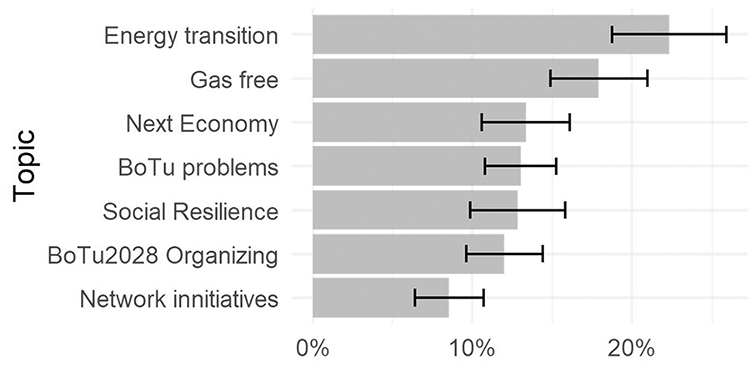
Percentage of times the topics appeared in the documents (N = 51 documents).
The labels of the topics were chosen based on an empirical inspection of the texts the Topic Modelling algorithm placed in that group. In the following sentences, we explain our reasoning for the labels. ‘Energy Transition’ contains text referring to the imaginary according to which transition to more sustainable and democratised energy production models can simultaneously address BoTu poverty. ‘Gas-free’ refers to job opportunities created by concrete public–private investments in central heating that are meant to include residents as labour suppliers. ‘Next Economy’ represents the ambition for innovation and disruptive economic change linked to entrepreneurship, knowledge-driven collaboration, decentralised energy and circular economy. The ‘BoTu Problems’ topic represents the neighbourhood as problematic, given its low scores on the liveability index. ‘Social Resilience’ refers to the resilience model emphasising the adaptive properties of community action and individual capabilities. ‘BoTu2028 organising’ refers to the organisational forms and processes involving residents with the BoTu2028 programme. It includes the Social Impact by Design, (SIbD)’ open call for developing solutions between teams across public–private communitarian groups – and Delfshaven Coorporatie, the organisation linking residents with BoTu2028 parties. ‘Network Initiatives’ refers to discrete and self-organised activities around different interests that enabled residents to react to the COVID-19 outbreak.
The comparison between topics before and after the formalisation of the resilience planning yielded four statistically different percentages (Figure 2). On the one hand, this illuminates which representations of hybrid solutions emerge from the governance level (Q1). The percentage of times that ‘Next Economy’ and ‘Social Resilience’ appear in the text is higher in documents shaping resilience and BoTu2028 planning discourse compared to documents on BoTu2028 implementation. On the other hand, it also responds to what representations arise from its implementation level (Q2). The percentage of times that Topics ‘Gas free’ and ‘Network initiatives’ appear is higher in documents on BoTu2028 implementation than those shaping resilience and BoTu2028 planning discourse. The other percentages are not statistically different based on the Wald Test. Therefore, we regard ‘BoTu problems’, ‘BoTu2028 organising’ and ‘energy transition’ as permanent aspects providing a cross-sectional answer for Q1 and Q2.
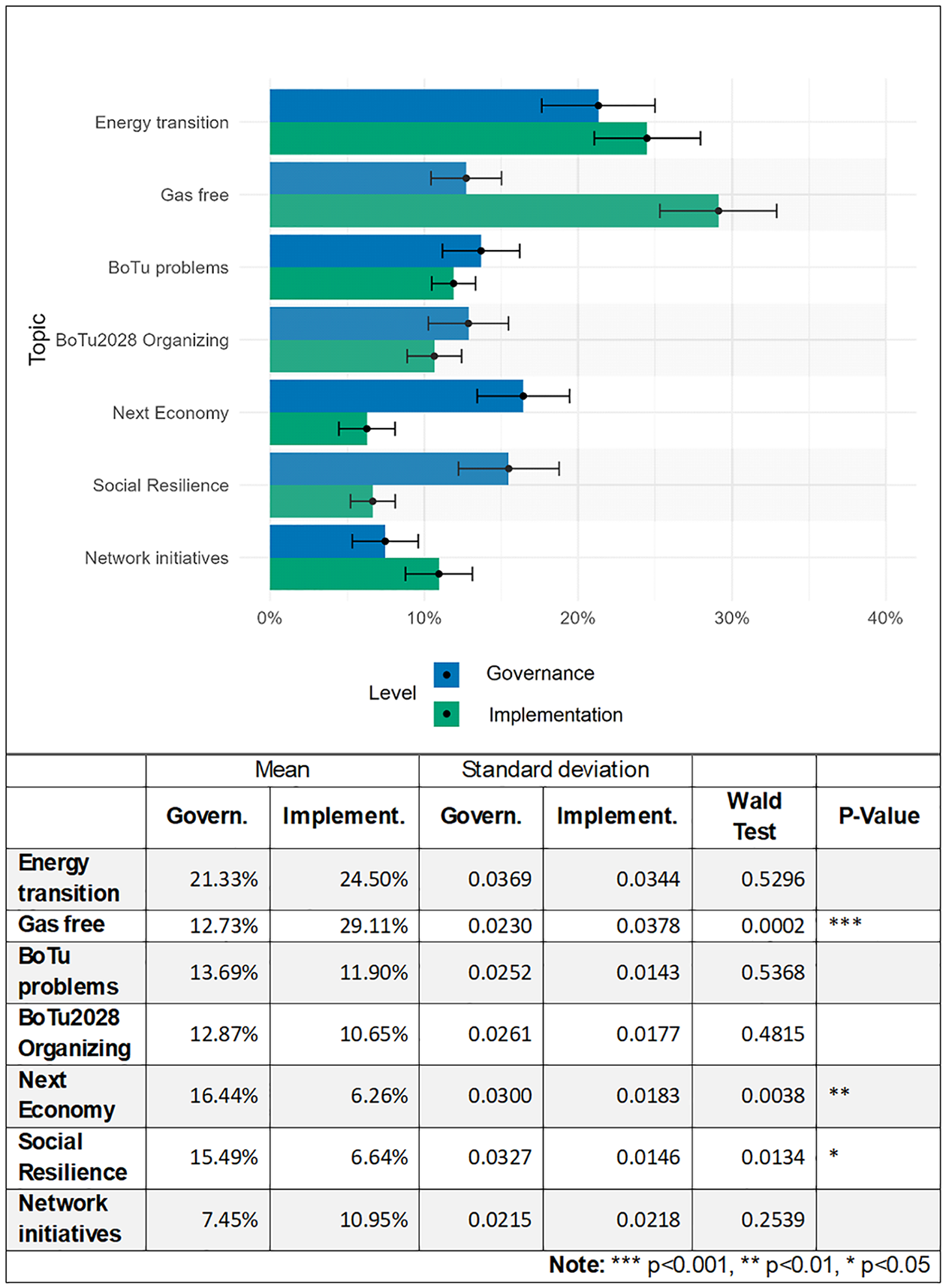
Percentage of times the topics appeared at the governance level versus implementation levels, and results of the Wald Test for no difference.
Qualitative phase
We present the results of the qualitative phase in three sections. The first section details how the imaginary of social resilience towards the next economy shaped the design of BoTu2028 hybrid solution at the governance level (2013–2019). The second section shows the achievements, tensions and contingencies that explain the frustration of the initial imaginary during the implementation(2019–2022). Finally, the third section articulates the emergence of ‘Gas-free’ and job opportunities as fixes, zooming into representations and voices that were made invisible during the 2022–2027 Resilience Strategy.
Governance orientation discourse: Social resilience in transition to the next economy
Social resilience imagination is represented as a central element of a ‘holistic’ approach that articulates bottom-up and community initiatives to ongoing transitions, including ‘climate change [and] a changing economy driven by sharing and technology innovation (“Next Economy”)’ (Gemeente, 2016: 20). The voices shaping this imagination mainly come from expert advice from knowledge organisations, often compiling results from workshops, reaching only the municipality’s close networks or performing as authoritative figures in social entrepreneur conferences. Therefore, the Rotterdam resilience strategy presents the resilient city integrated into a new economy based on renewable energy and high-tech driven collaboration and inspired by the third industrial revolution imaginary of Jeremy Rifkin (MRDH, 2016), which necessarily entails that society ‘moves away from top-down hierarchy to more bottom-up approach’ (Gemeente, 2016: 20). From this perspective, ‘the public domain is filled with many hybrid activities and partnerships, in which non-public parties are committed to creating public values and services’ (van Buuren and Meulenbeld, 2016: 3).
‘Citizen initiatives’ are situated in a hybrid ‘space between government, market and society [contributing] to the city’s organising capacity [to deal with urban challenges]’ (van Buuren and Meulenbeld, 2016: 3). The role of the government is to provide room for these initiatives so citizens can take increasing responsibility in contemporary governance. Accordingly, the authoritative voice presents citizen initiatives in BoTu2028 under the assumption that ‘the municipality, market parties or local bottom-up initiatives cannot accomplish the goals alone’ (Gemeente, 2019: 5), which justifies innovative community–public–private alliances known in BoTu2028 as ‘Social Impact by Design, SIbD’ and the grass-roots Asset Based Community Development approach. 2 Community and citizen involvement is, therefore, framed within the existing ‘participation society’ discourse, which presents the dismantling of the welfare state as inevitable (Uitermark, 2015).
The ‘designedly synthesis’ articulates this wider political process, with existing prevalent voices of social entrepreneurs and the resources provided by Rockefeller’s global leadership (ARUP, 2014). In particular, the emphasis was placed on the ‘Social Impact by Design, SIbD’. This component was inspired by the association of Rotterdam in the global network led by the Rockefeller Foundation and the participation of the Rebel Group – one of the private partners in the BoTu2028 coalition – in the Rebuild by Design competition for New York after Hurricane Sandy (RbD, 2014). SIbD replicates the blended financing model, where an initial public investment is strategically oriented as an ‘impulse to a chain reaction of positive effects that exceed the initial public investment’ (Veld, 2020: 37). Hence, SIbD became central given the innovative nature of such community–public–private alliances and its central role in the city resilience strategy, according to which ‘residents, public and private organisations, business and knowledge institutions together determine the resilience of the city’ (Gemeente, 2016: 42). In contrast, the Asset Based Community Development approach appears only in the BoTu2028 programme, with a lower emphasis on the city resilience document and Rockefeller framework.
Bottom-up citizen engagement with the state and the market aligns with Rotterdam’s esteemed social entrepreneurship model. The 2013 Architectuur Instituut Rotterdam – (AIR) forum articulates the need to link bottom-up organising and entrepreneurship for the democratisation of energy transition as the result of ‘connections informal and formal, micro and macro, institutional and community-driven oriented’ (AIR, 2013). Concurrently, the municipality supports the ‘Neighbourhood Inc.’ (Wijk BV) conference in the BoTu area (Gemeente, 2013), seeking to empower residents and attract private investment without significant government subsidies. These efforts yielded the Delfshaven Coorporatie (DHC), the social entrepreneurship organisation, backed by a large commercial bank and turning into the official BoTu2028 partner, whose vision is generating added value together with companies and all those active residents and entrepreneurs. The DHC is regarded as the ‘node’ linking a local network comprising of around 150 people (entrepreneurs, residents, local politicians, civil servants), the municipality, and the industry. The 2015 ‘Stadmakers’ conference highlights BoTu’s self-organisation success, contributing to the municipality’s vision of integrating urban development with the Next Economy.
Achievements, contingencies and tensions in the BoTu2028 implementation
The main challenge to social resilience in the frame of the Next Economy is the frustration around SIbD. This component was crucial for the ‘innovative image’ aimed at by the municipality in the context of the Next Economy. Initially, ‘SIbD seemed to be the entire programme to the outside world’ (Veld, 2020). However, frustration emerged due to the incapability to materialise large capital investment projects in the physical renovation of public infrastructure assets. There were no legal bases for using the SIbD process to structure urban renewal (Veld, 2021: 94). Other BoTu2028 partners negatively evaluated the design of the SIbD process, which paid little attention to giving space to bottom-up organisations. The underlying problem is the nonexistence of marketable business models around social objectives that would create the streams of independent revenue needed to attract private investment (Veld, 2020: 93). Notably, the 2022 monitor lacks the SIbD component, its coordinating organisational structure having been formally dissolved by then.
The frustration around social resilience contrasts with the revalorisation of social networks and collaboration in official documents – in particular, due to their capacity to react quickly during the COVID-19 outbreak. The solidarity during this acute shock provided evidence that an established district network is used during times of crisis and reinforced the value of connecting and maintaining community relations (Veld, 2021: 58). For example, the COVID-19 shock brought forward inhabitants’ solidarity channelled through ‘Delfhaven Helpt’, an initiative led by the DHC to address the crisis (Hottentot, 2020). Furthermore, the dynamics of collaboration during the emergency are portrayed as lessening existing competition between some community activities. Therefore, the increasing number of initiatives reported in the 2022 monitor are showcased as the main achievement (Veld, 2022), which is also mentioned in the second resilience strategy (Gemeente, 2022).
Simultaneously, the 2022 monitor showed a decrease in the score of subjective perception of well-being, trust and increased financial problems during the pandemic. Therefore, ‘not all local residents seem to experience the presence of [the BoTu2028 social] network or the connection to it’ (Veld, 2022). The difficulty of engaging and reaching out to a wider population beyond the ‘usual suspects’ (such as the DHC) is manifested as a continuous challenge for the public, market and community actors engaged in BoTu2028.
The role of community building also appears problematic in the monitoring documents. First, monitors consistently state that the main risk in the field of community resilience is the dependence of initiatives on municipal subsidies (Veld, 2021: 16). The very justification of SIbD and its focus on attracting private capital lies in avoiding subsidy dependency (Veld, 2020: 93). Furthermore, there was an expectation that community associations would become formal social enterprises providing a livelihood to people in the district (Veld, 2021: 66). This assumption is explicit in the monitor reporting as an achievement that social volunteers managed to have an income through their involvement (Veld, 2020: 68). Second, physical public buildings are a key resource for carrying out communitarian initiatives, which the municipality has privatised since 2015 (IARB, 2019). Consequently, ‘resident initiatives make use of vacant temporary spaces that the municipality or corporation allocates. As soon as a tenant registers, the initiative has to look for another location’ (Studiosaal, 2022).
Overall, hybrid organising unveils contradictions not sufficiently acknowledged by the BoTu2028 programme design and Resilience Strategy yet explicitly stated in their supporting discourses. On the one hand, the Next Economy openly declares that it is unlikely ‘that [the lower segment of the labour market] will be able to find work on their own’, advocating ‘participation jobs’ as a condition for welfare benefits. ‘Participation jobs’ frames civic engagement as an obligation in tension with the expected ‘active ownership and resident engagement […] for sustainable resilience’ (Gemeente, 2019: 22), and the non-fungible value of social cohesion. Hence, one should ‘recognise that the self-organisation of the city and the private initiative are not equally developed or present everywhere’ (van Buuren and Meulenbeld, 2016: 11). Therefore, communitarian self-organisation unfolds upon a skewed representation of high-skilled social entrepreneurs. This is actually the case of the DHC social entrepreneurship with a track record of difficulties in involving residents with a ‘migration background’ (Igalla et al., 2017: 4) in an area where the municipality classifies 80% of their population as ‘low-skilled’ and ‘new-Dutch’.
Fixes re-embedding new resilient imaginations: Network initiatives and gas-free job opportunities
The contingencies and implementation dynamics led to a valorisation of network initiatives as a loosely coupled set of organisations, yet requiring material support for their activity, in the context of emerging gas-free job opportunities. Several organisational fixes were proposed to address the tension between bottom-up organising realities and the top-down economic imagination. First, the insufficient consideration of locals in the initial design of the SIbD was intended to be counterbalanced by including an ad-hoc advisory board of 12 residents to ‘fill the void of diversity’ (Veld, 2021: 130). They were selected out of a list compiled by the BoTu2028 coalition from their reachable networks and aimed to reflect diversity in terms of religion, ethnicity, gender and homeownership. Their role was to provide insights into the needs of the community to ‘social entrepreneurs’, who were often professionals taking the initiative to design social business models within the SIbD call. Monitoring documents acknowledge that the ad-hoc selection does not guarantee representativeness, and the participation was conditioned to ‘think constructively’. This remains undefined, but given the usual meaning of moving forward with what is already built, it means that residents must endorse the programme principles rather than question its design or implementation.
Second, the difficulties in making SIbD operational and the dependence of bottom-up initiatives on subsidies are issues fixed by two different and opposite strategies. On the one hand, in 2022, the BoTu2028 management turned to ‘Participative budgeting’ of a 1 million euro budget where applications are assessed ‘by a group of independent residents and other stakeholders’ (Oelkers, 2022). This fix does not demand a business model from initiatives but is constrained by the availability of public funding. On the other hand, communitarian initiatives in social enterprises continue to be presented as imperative so they can manage resources under their ‘own power’ (Studiosaal, 2022). Thus, the autonomy of the initiatives is nevertheless predicated upon their capacity to come up with a business model independently from the municipality support. In an informal dialogue with the researchers carrying out BoTu2028 monitoring, we established that business models remain a daunting challenge for most initiatives in the area.
The third fix occurs in the context of re-embedding energy transitions into the top-down Rotterdam gas-free initiative, defined as a priority in the 2018–2022 coalition agreement. The municipality, the utility company and the housing corporation signed an agreement for a €4.9 million subsidy to turn BoTu into a gas-free district (Gemeente, 2020). The gas-free component went from a parallel development to becoming the technical side of BoTu2028, functioning as ‘a social component’, successfully delivering cheap and sustainable energy to the deprived neighbourhood. The fix is the promotion of ‘energy coaches’, citizens committed to their ‘community’ and connecting the social and technical components. BoTu-gas-free appears as an achievement in contrast to the SIbD and the otherwise low visibility of the network of initiatives in the media. Nevertheless, this fix also creates tension. Anthropological research presents energy coaches as already vulnerable women assuming additional burdens, reinforcing their precarity (Nolan, 2021). Furthermore, gas-free relies on a typical large-scale private concession that differs from the idea of democratising energy supply and asset ownership by the community. Consequently, social entrepreneurs advocating energy transition democratisation found no inclusion in the accord (Doff, 2021).
Tensions and fixes are not fully reflected in the 2022–2027 Resilience Plan. BoTu2028 is showcased as the reference for social neighbourhood resilience and, furthermore, the second strategy positively evaluates the SIbD objective, acknowledging that residents should have been involved first. In other words, the assessment reduces SIbD frustration to a lack of up-front community engagement without reflecting on the extent to which the initial SIbD goal of attracting large private investment would not match with the institutional and social reality. In turn, the burden of failure is shifted to the lack of participation and the lack of an integrated programmatic approach. Before, the 2021 monitoring report introduced a governance framework to assess the role of the government in dealing with those conflicts and problematising their lack of flexibility (Veld, 2021: 127). The 2022–2027 Resilience plan reproduces this problematisation and insists on the desirability of an autonomous community and the need for market-government-community cooperation (Gemeente, 2022). Overall, it concludes that ‘new forms of collaboration are needed, which will require (temporary) flexibility in dealing with the existing frameworks, procedures and programme lines [therefore] a resilient Rotterdam also requires a resilient municipal organisation’ (Gemeente, 2022: 25).
Discussion
Performative contradictions are the rule in hybrid organising, and yet this is not sufficiently spelt out in urban resilience literature that praises hybrid decision-making processes. What is up for debate is the connection of hybrid organising tensions to more fundamental inconsistencies in urban resilience imaginations and the extent to which fixes to hybrid organising tensions open new imaginaries and possibilities for reasoning about urban resilience and social inclusion.
BoTu2028 builds upon the articulation of two organising strategies, which, on the one hand, stimulate spontaneous organisation based on existing associative assets and, on the other hand, stimulate a directed engagement with the market and the state. On the basis of these two models, the social entrepreneur appears as the preferred model for self-organising citizenship, set by urban initiatives aiming to increase deprived area attractiveness to the middle class and private investments (van Holstein, 2019). Such entrepreneurship entails the ‘voluntary’ undertaking of social needs driven by the identification of opportunities aligned to a business case and self-evident social well-being improvement. Previous research noted that entrepreneurship citizenship is the type of preferred citizenship for urban regeneration in the Netherlands (Al Sader et al., 2019), and the resilient angle endorsed by BoTu2028 reinforces individual responsibilisation as the condition for a resilient Rotterdam, capable of facing future risks (Huizenga et al., 2023).
Hence, the ‘chief imagineers’ of social resilience imaginaries were social entrepreneurial organisations with a track record of collaboration with the state and the market. Their vision could articulate an imagination of social resilience within a networked society, functional to the Next Economy ambition driven by energy transition and technological-driven imagination. Our research makes explicit that social entrepreneurship necessarily takes on a partnership, a hybrid organisational form that intrinsically poses tensions to people enacting their citizenship by engaging with regulated markets.
The materialisation of resilience solutions reveals the implausibility of a harmonic articulation of such imaginations and the tacit prevalence of one organising element over others. On the one hand, value-for-money and efficiency remain the central elements of communitarian–public–private partnership models (i.e. Social Impact by Design), contradicting the incommensurable value of social cohesiveness. On the other hand, communitarian self-organising strives to make its existence marketable, disregarding the possibility of re-embedded social risk in public organisations. The entrepreneurship imaginary endorsed by BoTu2028 towards the Next Economy fails to provide a feasible alternative to the dependence of networks on public subsidies and the experience of precarity. The official evaluation of BoTu2028 in the second resilience strategy does not offer a substantive inquiry on the difficulty of attracting massive private investment by SIbD.
These failures are documented by monitoring reports but omitted in the new official urban imagination. Previous research in self-organisation noted that Rotterdam municipality adopts a ‘self-flagellating’ attitude when declaring itself not sufficiently open enough to explain communitarian initiative difficulties (Uitermark, 2015). We note some risk in reproducing such an attitude when stating that ‘new forms or collaborations are needed and […] a resilient Rotterdam also requires a resilient municipal organisation’ (Gemeente, 2022: 25) in the official evaluation of BoTu2028. In such a situation, certainly, there is a ‘chief imagineer’ dictating the way some failures are represented and selectively re-introducing others into problems and solutions for the second strategy (Pitidis et al., 2023). However, the selective mechanism is not the voluntaristic power of a ‘chief imagineer’. The mechanism is the default concern for improving functionality, making people’s experiences invisible when they cannot be translated into ‘practical learnings’ to improve system functionality (Cox et al., 2022).
Here, we acknowledge that conflicting imaginaries characterise the regime of political, economic and discursive dimensions that provide precarious stability to projected urban risk and opportunities (Wissman-Weber and Levy, 2018). Hybrid tensions are the organisational manifestation of the internal inconsistencies within the governance models and the way of projecting the desired society, risk and resilient futures. We also accept that actors simultaneously participate in diverse decision arenas, including design and implementation, and those stages often run simultaneously. However, we want to insist that failures emerge from the very nature of BoTu2028 as a hybrid solution at the implementation level, which was selectively re-introduced into the second resilience strategy pertaining to the governance level.
Therefore, we make a plea for an understanding of tensions, representations and fixes in the interplay between two analytical levels embedded in the wider context of urban risk regimes. On the one hand, there is a higher level of hybrid governance spaces that link bottom-up and top-down processes. On the other hand, there is a lower level for implementation consisting of concrete hybrid organisational forms. This analytical differentiation between the two levels can furnish substantive discussion on tensions experienced when enacting resilience in practice, making visible experiences that cannot be framed as bounded knowledge to improve functionality. For example, a layered framework would have made explicit at the governance level that the quest for ‘Social Innovation by Design’ obeys the ambitions for portraying Rotterdam as a social innovator, which differs from the quest for fitting to the practical reality for BoTu. Hence, it remains relevant to the questions of resilience for whom, what, and where. Such discussions should appreciate the conditions shaping hybrid organising experiences, including a debate on the assumptions regarding which organisational level can be operational. The direction of the conversation remains dependent on who can get recognised at the negotiation table (Roberts et al., 2020), as much as how to overcome the functional bias in resilience governance, making invisible experiences of marginality irreducible to bounded knowledge (Cox et al., 2022).
Conclusion
This research elaborates on the levels of hybrid organising to articulate the tensions and fixes experienced by those endorsing the resilience paradigm in practice re-creating resilience imaginaries. We first note that hybridity emerges as a governance manifestation of resilience indeterminacy and the quest for new possibilities, bringing together the top-down and bottom-up process of locality building. In this conceptual context, we noted that bottom-up processes face, in practice, multiple tensions that arise from the very configuration of hybrid orders where multiple organisational logics (e.g. bureaucratic, market-oriented, socially oriented) interact and pose conflicting demands on the day-to-day practices of community-led initiatives. Then, we use qualitative intertextual discourse analysis and Structural Topic Modelling to trace back and forward the representations of hybrid organising in BoTu2028, a neighbourhood programme designed under the framework of 100RC for two neighbourhoods on the list of the 20 poorest postal codes in the Netherlands. This analysis brought to light organisational imaginations, tensions and fixes emerging when the ideal of social entrepreneurship faces inherent tensions from hybrid organising (e.g. institutional misfit and lack of business cases).
These empirical insights enable us to articulate hybridity on two different levels: a higher level of hybrid governance spaces linking bottom-up and top-down processes and a second level of concrete hybrid organising experiences. The resilience paradigm opens the window to appreciating the radical interconnection of diverse processes of social organisation, but it does not provide a specific answer for steering such dynamics. A layered understanding of hybrid organising can provide a framework for reintroducing contingencies and organisational fixes during the elaboration of new resilience imaginaries. Getting such organisational lessons right is critical in the face of the second and third waves of post-100RC urban resilience strategies.
There are many limitations and additional issues that require further research. There is no such thing as an ‘objective’ discourse analysis, given the underlying interest and selective questions in the analysis (Fairclough, 2003). Therefore, we cannot make evaluative claims on the process and outcome performance of BoTu2028 beyond the identification of representations that are more or less salient over time. Therefore, the discursive analysis enabling us to substantiate the different levels of hybridity in enacting resilience should be completed in the future with additional methods, to capture social practices (e.g. ethnography). For example, ethnography can better bring forward the invisible elements in visible discourse, such as the implications of racialisation and historical differences in the urban political economy.
Accordingly, there are many topics that we identify in our research that open substantive questions not fully addressed here. First, future research can better examine the possibilities and obstacles for social mobilisation and their effective capacity for shaping the second resilience strategy. Second, our work ultimately opens the question of the extent to which governance theory developed in public administration and adopted in resilience practice should be revisited in a larger discussion on state theory for the urban domain. Third, our research only deals with the representation of BoTu as a geographical space constructed in relation to other spaces in the city and within the ambitions of the Next Economy. Finally, we invite other scholars to track the cycle of resilience planning upon implementation learnings for the post-100RC urban resilience strategies in other cases and compare the different manifestations of hybridity across state, market and civil society sectors. This research agenda can improve communitarian organisational capabilities for dealing with precarity, dependence on public subsidies and the constraints imposed by the existing entrepreneurship model.
Supplemental Material
sj-docx-1-usj-10.1177_00420980251337388 – Supplemental material for The hybridity of inclusive resilience: Organisational levels, tensions and fixes in Rotterdam
Supplemental material, sj-docx-1-usj-10.1177_00420980251337388 for The hybridity of inclusive resilience: Organisational levels, tensions and fixes in Rotterdam by Camilo Andres Benítez Ávila, Sofia Gil-Clavel and Samantha Copeland in Urban Studies
Footnotes
Declaration of conflicting interests
The author(s) declared no potential conflicts of interest with respect to the research, authorship, and/or publication of this article.
Funding
The author(s) disclosed receipt of the following financial support for the research, authorship, and/or publication of this article: This research was sponsored by the ‘Designing Systems for Informed Resilience Engineering’ (DeSIRE) programme, part of the strategic research initiative ‘High Tech for a Sustainable Future’ of the four universities of technology in the Netherlands (Eindhoven, Delft, Twente, and Wageningen), which form the backbone of 4TU.Centre for Resilience Engineering.

Supplemental material
Supplemental material for this article is available online.
Notes
References
Supplementary Material
Please find the following supplemental material available below.
For Open Access articles published under a Creative Commons License, all supplemental material carries the same license as the article it is associated with.
For non-Open Access articles published, all supplemental material carries a non-exclusive license, and permission requests for re-use of supplemental material or any part of supplemental material shall be sent directly to the copyright owner as specified in the copyright notice associated with the article.
